
- My introduction to Chrono Trigger
- How Chrono Trigger makes itself unique
- Pacing discussion
- Diving into New Game Plus
- Magic! Techniques!
- Time period analysis
- Playable character analysis
- In conclusion
Radical Dreamers
In 1995, the Super Nintendo was on the way out. With the Sony Playstation and Sega Saturn’s 1994 release in Japan, 3D graphics and CDs had changed the way people interacted with video games. No matter what, if a game came out during this period, that game was risking being swallowed up by the seas of time.
Not only were games at risk of being forgotten, there was just a good chance a Japanese game wouldn’t come out in North America around this time. Squaresoft released 15 titles on the Super Famicom and Satellaview – think a Super Famicom with a modem attached – following the release of Final Fantasy VI in 1994. Of those 15, a total of three were localized for a non-Japanese audience.
And this is from the house that made Final Fantasy VI. That’s a game that did well everywhere – including America. So if Square isn’t getting their 16-bit games carried over across the ocean, it’s pretty safe to say that all eyes were on the next generation of consoles.
Chrono Trigger was never at risk of not making the journey over – it was always going to be one of those three games that got localized. The core team behind the game are, rightfully, considered legends in the industry. First, let’s start with some familiar Square faces. You have Hironobu Sakaguchi, the ‘father’ of Final Fantasy. The music is by Nobuo Uematsu, the guy behind all the Final Fantasy music you love.
Final Fantasy wasn’t the only game in town though. In Japan, the number 1 RPG franchise was Dragon Quest. Dragon Quest didn’t quite hit America as hard – legendary games like Dragon Quest V never even made it to America until far after their initial releases – but there were no doubts that it was number 1 in Japan.
Yuji Horii, the scenario writer for that franchise, worked on this game too. And with him came Akira Toriyama. Toriyama is best known for the Dragon Ball franchise but his style is core to the Dragon Quest experience. He’s been there since the beginning too. If you saw his art in a game, there was no doubt who it belonged to.
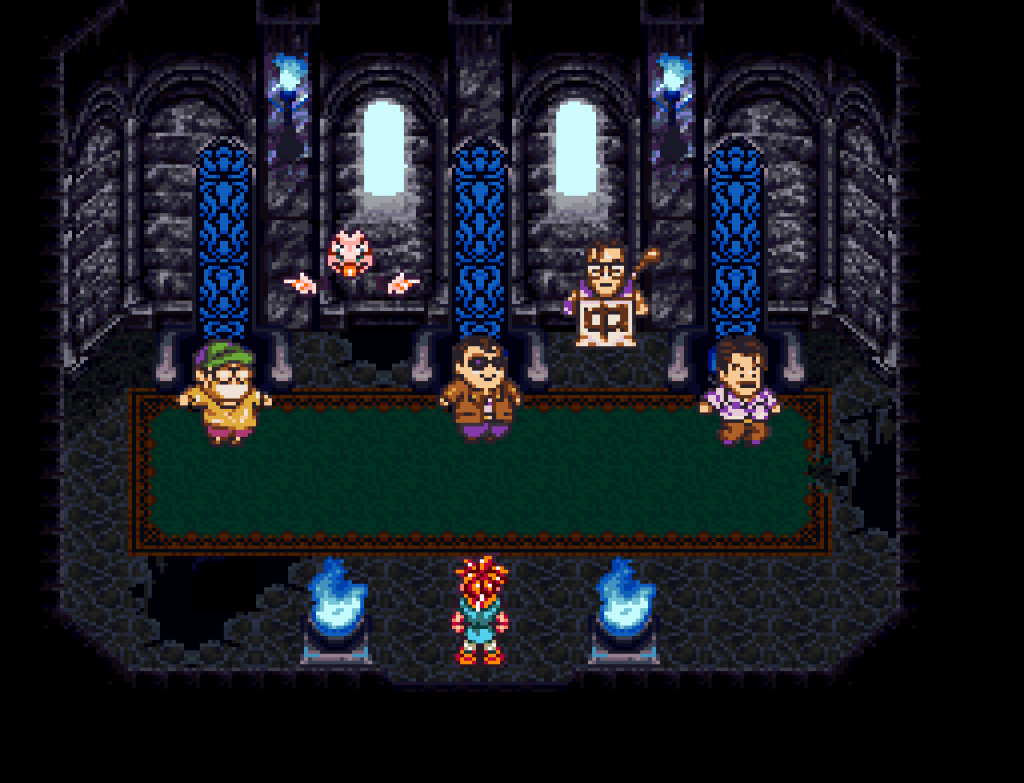
Finally, there’s Kazuhiko Aoki. He is most credited with bringing everybody together and is listed as the producer for the game. Here is what he had to say in a 1995 interview from Famicom Tsuushin magazine, as translated by shmuplations.com
“It was about 4 years ago that Sakaguchi, Horii, and Toriyama started talking about making an RPG together. At that time, it was more of an offhand, casual thing, like “hey, wouldn’t it be great if we could all work together on something?”
And from that casual conversation, Chrono Trigger was born. This assembled group of talent would go on to be called the Dream Team – no Michael Jordan to be found. Would the product they delivered be worthy of such a title? Was it worthy of being one of the three Squaresoft titles made post-FFVI but pre-PS1 worthy of localization?
My introduction
The first time I encountered Chrono Trigger was in a little rental store in Arkansas. These were the days where the only constant source of information on video games was found in magazines. And if you weren’t reading magazines at the time of a game’s release? Well, your rental was a mystery. You had no Internet to fall back on.
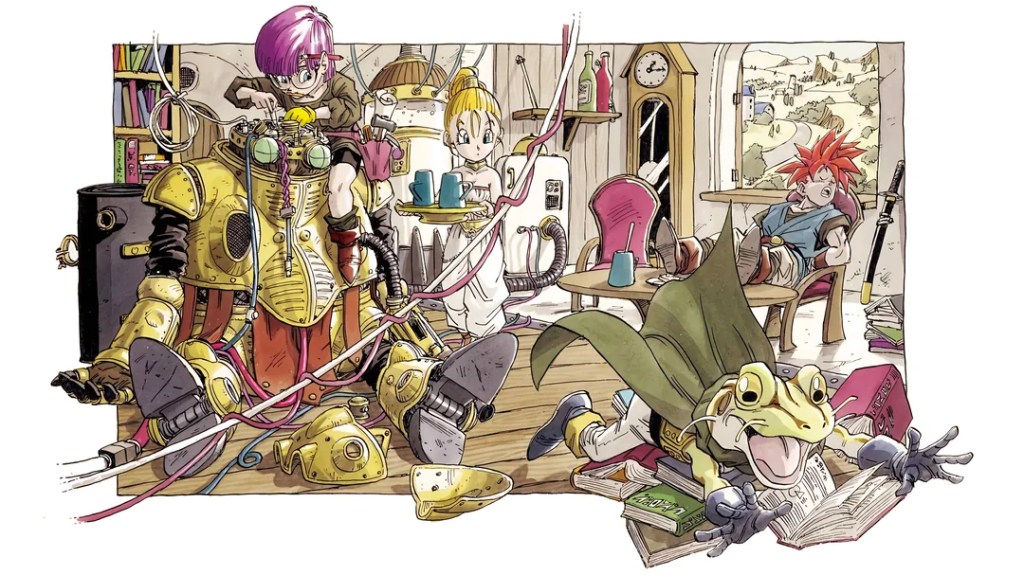
So what does a young man do when tasked to choose something blindly? Why, he does what every teacher tells him not to do: judge a book by its cover. Toriyama’s style was unlike anything I had seen before and drew me right in. I credit this cover-art with getting me into anime in general – thinking ‘hey, these guys look like Chrono Trigger characters!’ when randomly coming across Dragon Ball Z on television got me to stop and pay attention.
That’s just what got me in the door. There are games with fantastic art styles that end up doing nothing for me. Look at Ni No Kuni, it manages to look straight up like a Studio Ghibli movie, but I have never connected with any other aspect of those games. My thoughts begin and end with ‘they look nice.’ Chrono Trigger was not like that.
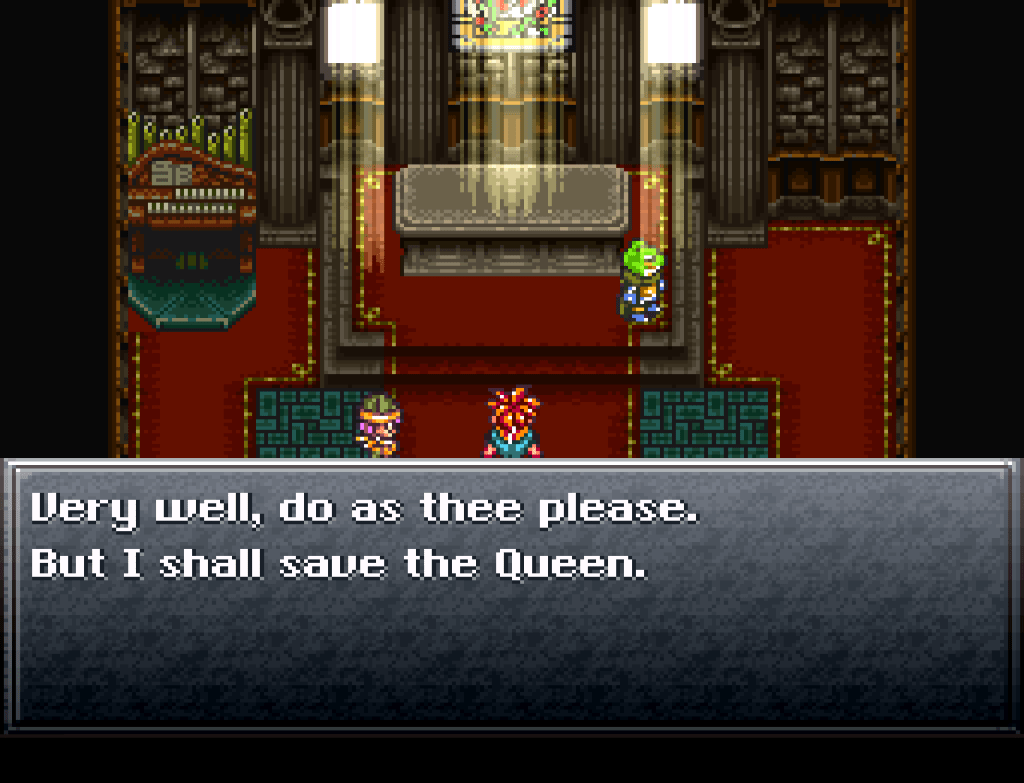
I became engrossed in the world and its characters. What got the most attention from me was an old-English knight named Frog. He was, uh, a Frog who was a knight. Who woulda thought! He is the only character in the game who speaks in thees and thous and it always stuck with me. I would just speak to myself in old English while walking around the neighborhood, I would dream of adventures he would go on after the events of Chrono Trigger. He just captured my imagination.
This game and Earthbound, which I somehow played in the same year, forever cemented turn-based Japanese RPGs as my favorite genre. I would read through magazines and scoff at reviewers who did not list RPG as their favorite genre. ‘They must not have played any’ is what I’d tell myself.
Alternate approach
From a gameplay perspective, Chrono Trigger’s most notable difference from Final Fantasy and Dragon Quest is in its encounter system. Random encounters were present in both Final Fantasy and Dragon Quest up into the Playstation 2 era. But in Chrono Trigger, random encounters are nowhere to be seen. Almost every enemy can be seen on the map and a lot of encounters can be straight up avoided.
This approach makes exploration less tedious. When traversing the world of Final Fantasy IV, let’s say you remember a branching path towards the beginning of a dungeon that you didn’t go down for whatever reason. If you want to go back and see what’s there, you have to deal with baddies. You go from overworld to battle screen and then back to the overworld. It breaks up the flow a little bit.
In Chrono Trigger, if you want to go back, you just can. If you know where enemies are – and if you’ve been down that route before you just might – you can skip past them. Even if you do fight, there is no transition from field map to battle screen, you just start fighting right there. It’s a more ‘immersive’ feeling, the player’s view is consistent no matter what they are doing.
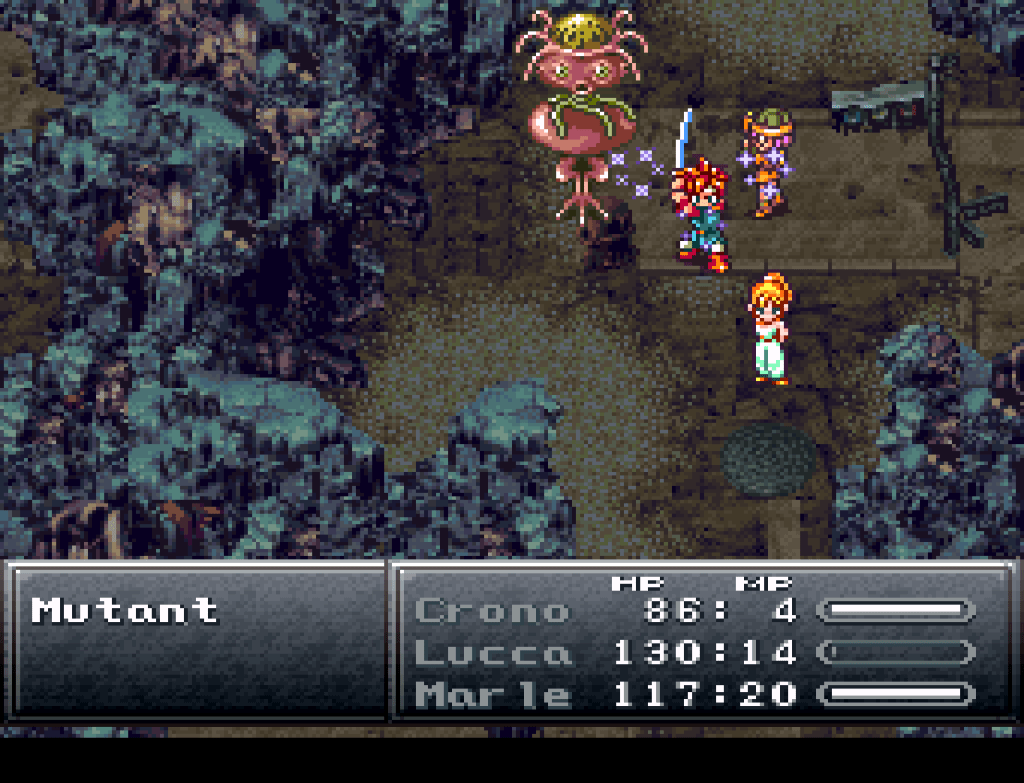
Oh and if you’re on the world map, there are straight up no encounters. Go ahead and explore! It’s a big ‘ol world.
I’m down for random encounters, I would never want them removed from the genre completely, but their absence here gives Chrono Trigger a very different feel from most other SNES JRPGs. Earthbound and Super Mario RPG also handle it this way – though they do have a separation between battle and overworld screens – and I think it goes a long way in helping those games feel more ‘modern’ than their retro brethren.
One might think that skipping battles is a bad idea. If you’re playing Final Fantasy V and running from every encounter, you’ll be missing key abilities that make certain fights a real nightmare. Chrono Trigger approaches this in two ways. First, it’s a fair deal easier than its contemporaries. Most random battles can be won by jamming on the attack button and a lot of boss battles have very basic ‘just keep healed’ strategies.
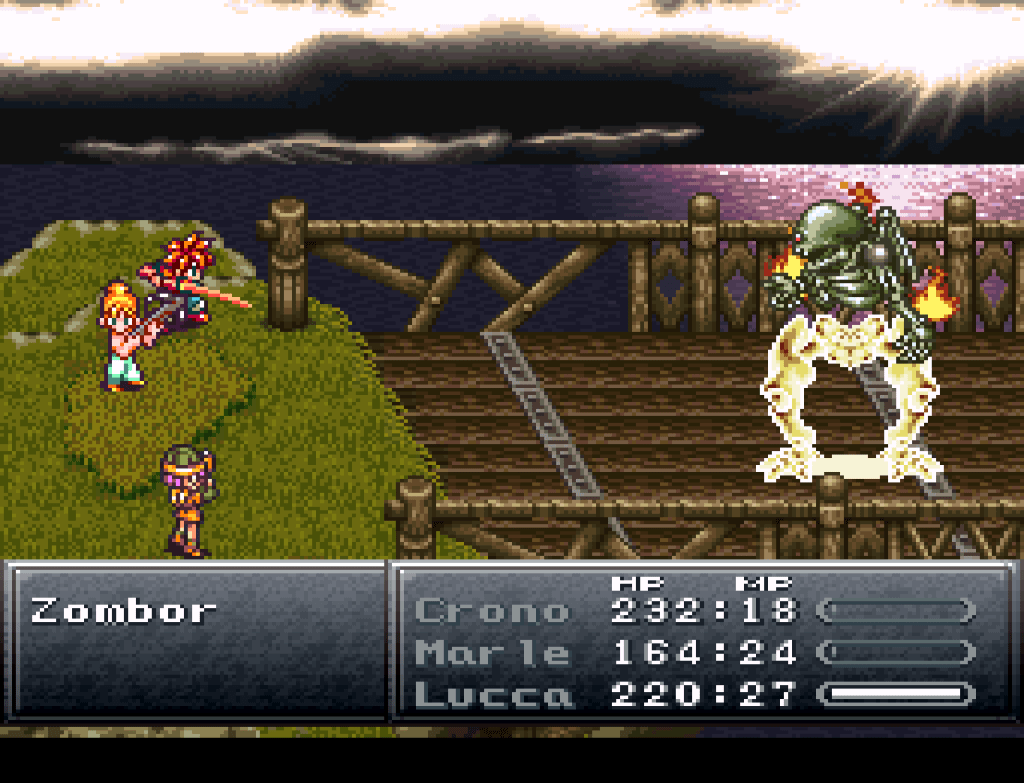
The second is, I find Chrono Trigger has a way of piling on EXP and AP (ability points, how you learn new skills) in a hurry when it determines that the player really needs it.
While a lot of encounters can be avoided if the player knows what they are doing, the game can still surprise you, and I find densely packed areas come at the player most when they need some new skills. The hardest boss in the game for most people comes directly after an area that just throws EXP at the player like it’s going out of style.
Rapid Fire
Turn-based RPGs have something of a reputation for being slow-paced – they require a lot of time to get the ball rolling. Ya ever play Persona 4? It feels like ages before the player gets to fight for real. People used to joke(?) that it took 15 hours for Final Fantasy XIII to get good.
Heck, let’s look at Final Fantasy VII. In the first two hours of that game, the player probably hasn’t left the first town yet. They probably haven’t been to the world map. It’s a more slow roll as the game gets the player immersed in the world its trying to create – that game is trying to amaze you with the scope of its world when you first exit out into it.
How about the first two hours of Chrono Trigger? The player wakes up in a new world, discovers a princess, travels through time, loses and saves the princess, goes back to the present, gets held on trial for kidnapping, gets held in prison, escapes prison and then goes through time to the distant future. That was in this playthrough with me going out of my way to talk to several NPCs that a lot of people would skip! It’s a nonstop whirlwind of events being thrown at you and it doesn’t really slow down for a good while.
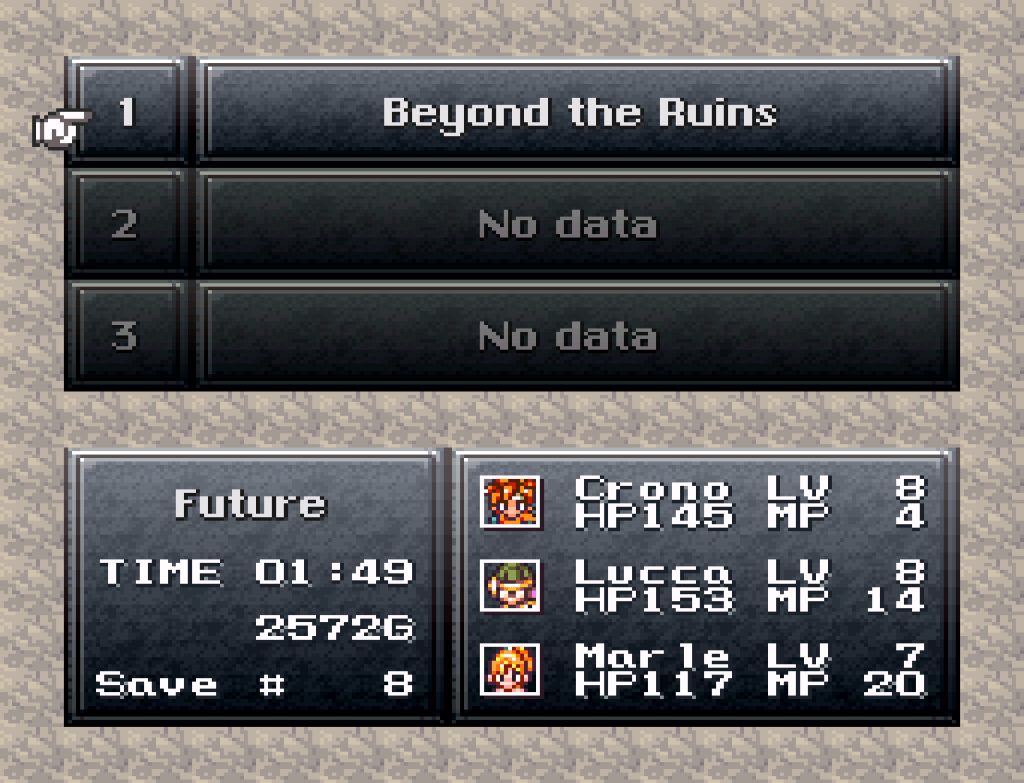
This save right here is after arriving at the future. I had already been through so much!
It almost feels like the pacing of an arcade beat-em-up. You’re in one level, a lot of stuff gets thrown at you, and then the next level just looks entirely different while the gameplay feels the same. You move from one backdrop to the next rapidly and Chrono Trigger feels like that early. Think of the Turtles in Time. One minute you’re in the old west beating up wild west foot soldiers and in the next you’re palling around with pirates.
It constantly feels like there’s something happening. When one time period feels played out, lo and behold, another one opens up. The player is on one long set of rails for about 12 hours and there isn’t really a chance to breathe. When the game finally goes ‘hey man, maybe go do some sidequests,’ you’re at the very end of the adventure and can elect to just keep steamrolling forward if you want to.
This leads to the writing in Chrono Trigger feeling a bit like an action movie. A lot of characters don’t have very much time on screen, so it’s crucial to get their primary personality traits and motivations right out in front of the player. There are characters who are on screen for mere seconds that have an enduring legacy.
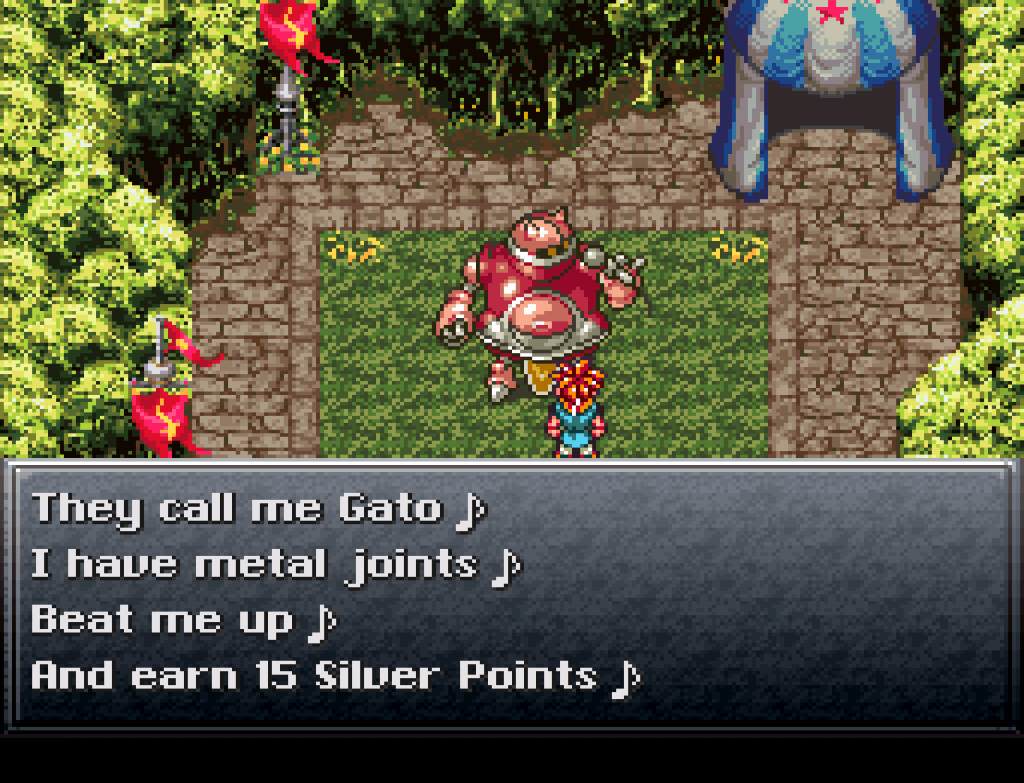
Look at Gato from the millennial fair. This guy isn’t a mandatory encounter but his unique appearance combined with his dialogue makes an impression.
Don’t think, feel
This also means, just like an action movie, it’s important to not overthink things while you play. The time travel aspect of Trigger’s plot really suffers if the player is left to linger on it. Think of it like this: Let’s pretend it is January 2, 2026 right now. If you were to travel back to the year 2020, you can only travel to January 2, 2020. Anything before January 2 has already happened.
This makes sense at first when the game suggests time portals popping up around the world are due to a cosmic world-ending alien threat called Lavos. Since the player has no control over what exact period of time they go to, it being January 2 simultaneously across all timelines makes some sense. You’re just traveling at the exact point in time you’re living in now to that exact same time x-number of years ago.
However, later on in the game, the party gains access to a time machine. After the player clears the game, the time machine is still there and it still functions. But this device operates under the exact same logic as the portals. So you’re telling me we can travel back thousands of years in time but separating things into hours and days is a step too far? Man created time travel but with the same caveats as the time portals?
The reason for this is to create a sense of urgency around character fates. The answer to the ‘this person is going to die’ problem in time traveling stories is to go back to right before that person is going to die and stopping it.
This game absolutely does not want the player to think about that possibility, so time is constantly moving forward. When a character death happens – and believe you me I will get into that later – my mind doesn’t immediately go to the obvious solution.
But that’s because of the game’s pace. The game moves so quickly that it doesn’t give the player time to think. It very much presents the world ‘as is’ to the player and does not feel the need to expand on lore or explain stuff too much.
The characters just found a way to travel through time and that’s just how it is, okay? Getting into too much detail slows things down and it would change the feel of the game completely.
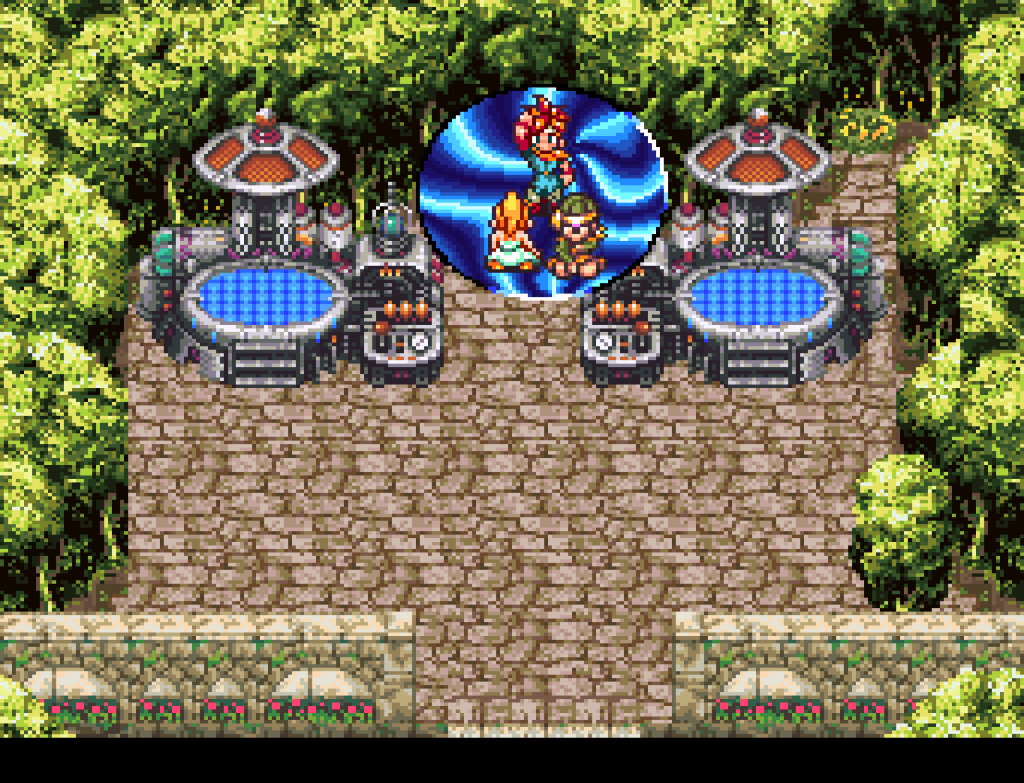
It’s a big reason why the prospect of a Chrono Trigger remake turns me right off. Players very frequently conflate the length of a game with how much they should pay for it. Chrono Trigger is not a long game – doing absolutely everything in this playthrough took me about 16 hours. I feel like Square would feel the need to fatten it up in order to validate a more expensive price tag.
Look at the Final Fantasy remake trilogy. Yes, to capture a lot of the feeling of what VII was going for, they needed to expand the scope of the game. It’s not possible to translate the few screens of Midgar into a 3D world and keep the feeling of ‘this is a massive city.’ You actually need to make it a massive city. In order to make it feel like it could be its own game that doesn’t have an overworld, you need to literally make it that.
The Midgar section of Final Fantasy VII takes about four hours to go through on your first time through the game. Maybe longer if you’re a dope who gets lost like I do. That four hours was turned into damn near 40 in part 1 of the remake and yes, some of that was necessary in order to replicate the massive feeling the original Midgar had, but that also means there’s lots of bloat. You cannot turn 4 hours into 40 without running into some of that.
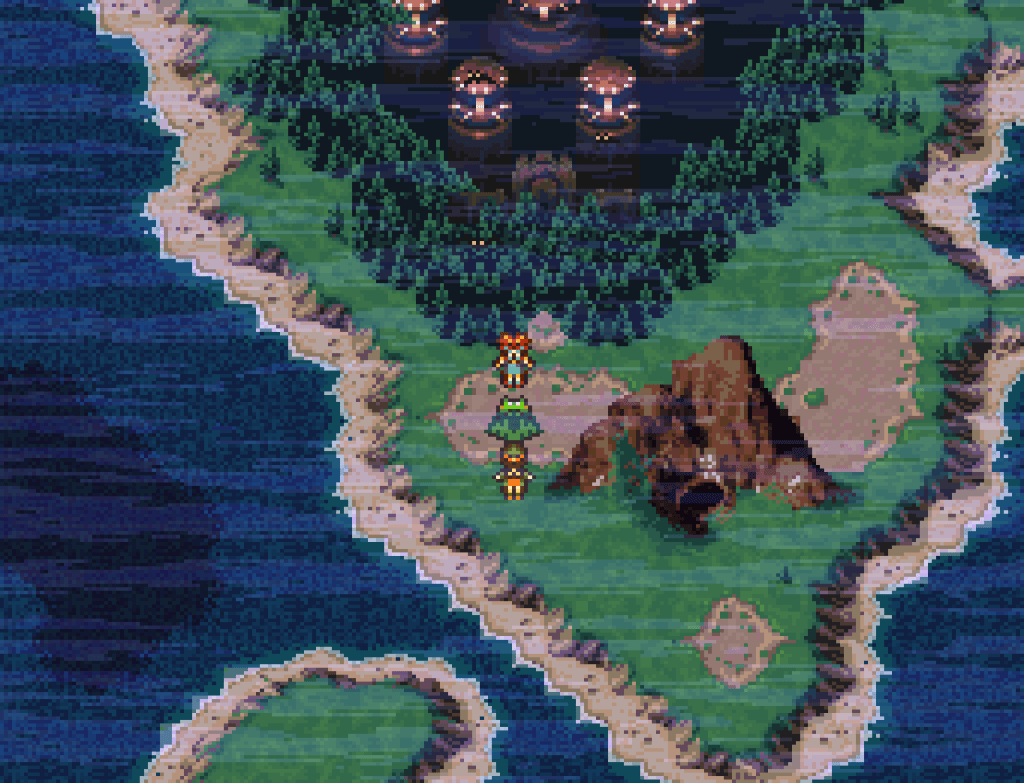
The ‘Midgar’s scale’ challenge of recreating Chrono Trigger for a new audience would be in replicating this rapid fire nature. How can you make each time period feel like a unique whole world while still keeping things moving? I don’t think you can do that in an HD environment. I would love to be proven wrong, but I see each era being padded out to compensate for that.
Chrono Trigger was released on the Nintendo DS with some bonus content. This content is proof that ‘more’ does not equal better. Unlike the core experience, the extra stuff feels padded out and unnecessary – it is immediately obvious that it was not in the original game.
The SNES/Super Famicom release of Chrono Trigger has no fat at all. Any new version of Chrono Trigger would just add fat.
From the top
Plus, Chrono Trigger already has a lot of content off the beaten path! I mentioned some side quests earlier, but one of the things this game is most well-known for popularizing is New Game Plus.
Note I said popularizing. It’s the first game to use the term New Game Plus, but Zelda 2 let the player restart the adventure using all of their stats from their original journey. Of course, since maybe five total people finished Zelda 2 in the last 30 years, nobody really talks about that.
But everyone knows Chrono Trigger has it and almost every RPG these days has some sort of version of the system.
If you’re some sort of video game newcomer – how did you find my site??? – a new game plus lets the player start over a game with most of their end game equipment, levels and money. This trivializes replays but gives the player a sense of power and allows them to explore areas that may have scared them off on initial playthroughs. Much easier tackling optional enemies when you’re rocking with luminaire instead of cyclone.
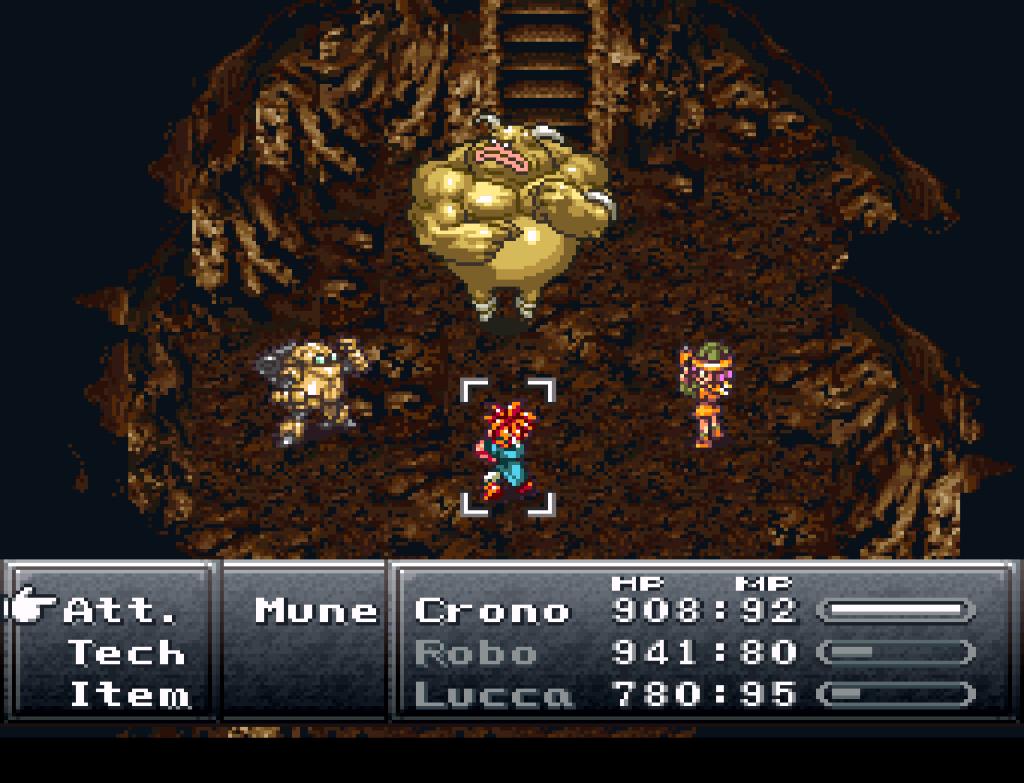
But what else do you do with a New Game Plus? Well, kid me was happy to play through the game on repeat with little-to-no challenge. If you’re trying to introduce your child to one of the greatest games ever made, I suppose removing all challenge from it is one way to do that!
But the true purpose of New Game Plus is experiencing the OTHER thing this game is well known for: multiple endings. The player is free to challenge the final boss at just about any time and the ending received depends on when the final boss is overtaken.
The game doesn’t explicitly tell you this except for a single time in the hardest ending to achieve. And when you get that, you probably already know!
Instead, it’s up to the player to start a new-game plus and then decide to fight the boss on their own terms. My gut says most people may try to do this the second they get access to ‘the end of time’ – a sort of hub that lets the player access various time periods – because that is the first point the game points out a method to fight the final boss.
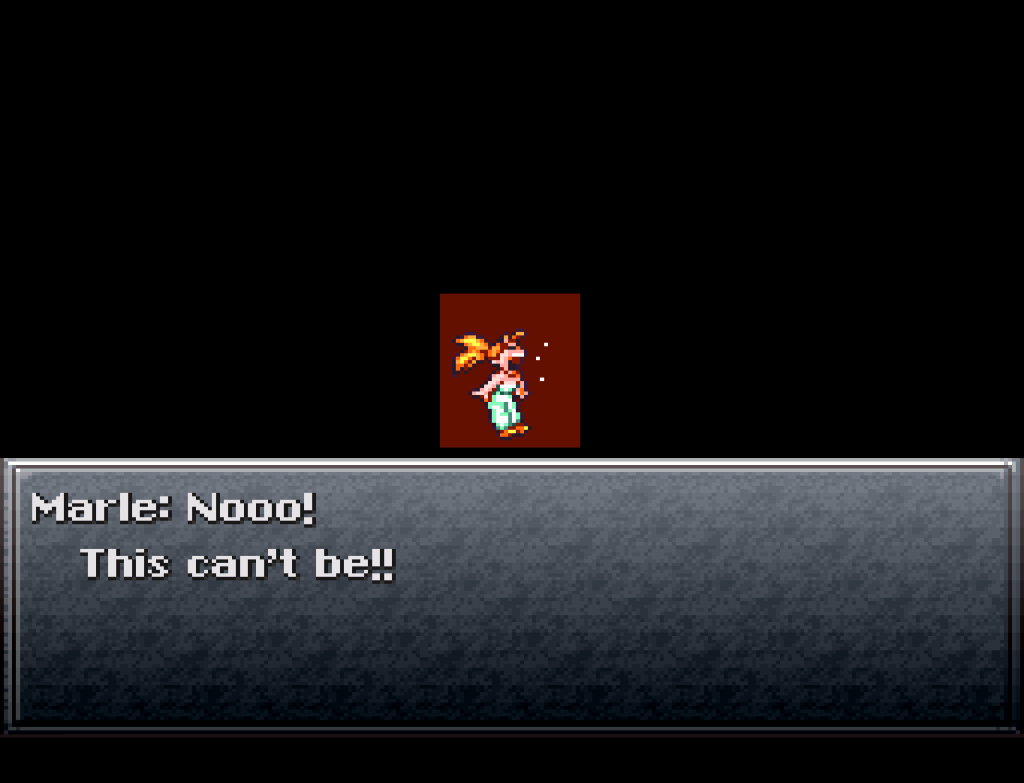
Of course, eagle eyed players may spot something at the very beginning of the game. Right before the adventure gets started – with the princess of Guardia, Marle, being sucked into a time portal – a little shining spot can be spotted. If it’s interacted with, the final boss can be fought immediately.
It’s either a solo fight or a two-man experience depending on when you do it. It’s meant to be the toughest challenge the game offers, but if the player did everything in their previous playthrough, their stats should be good enough to do this immediately upon starting up New Game Plus.
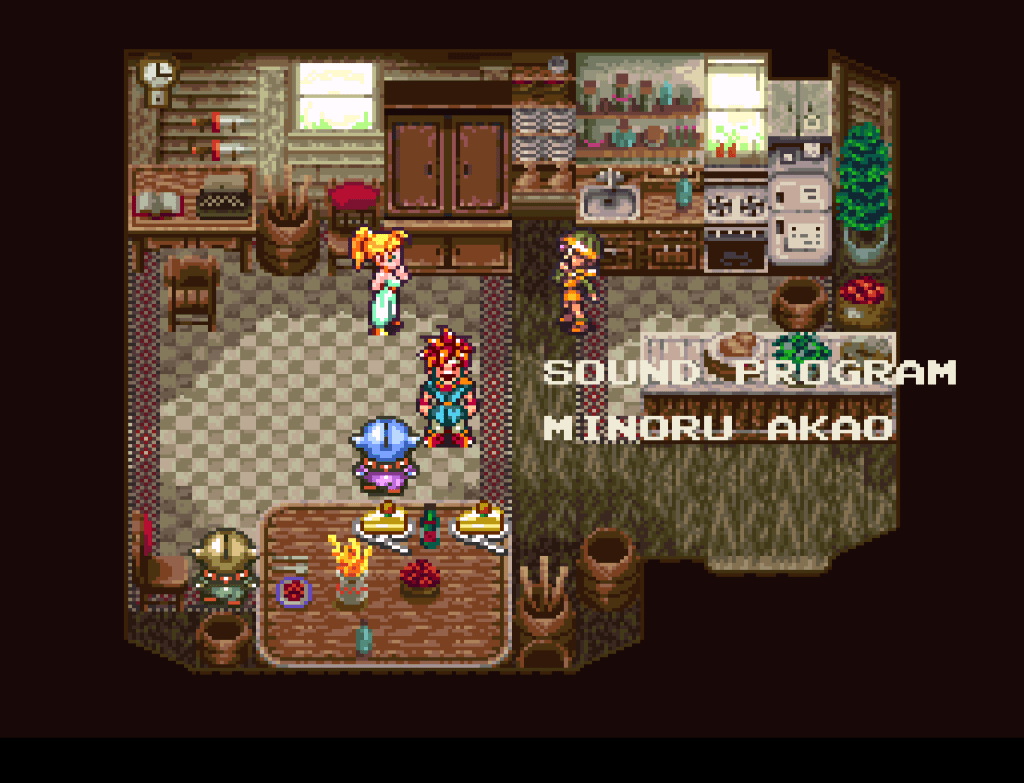
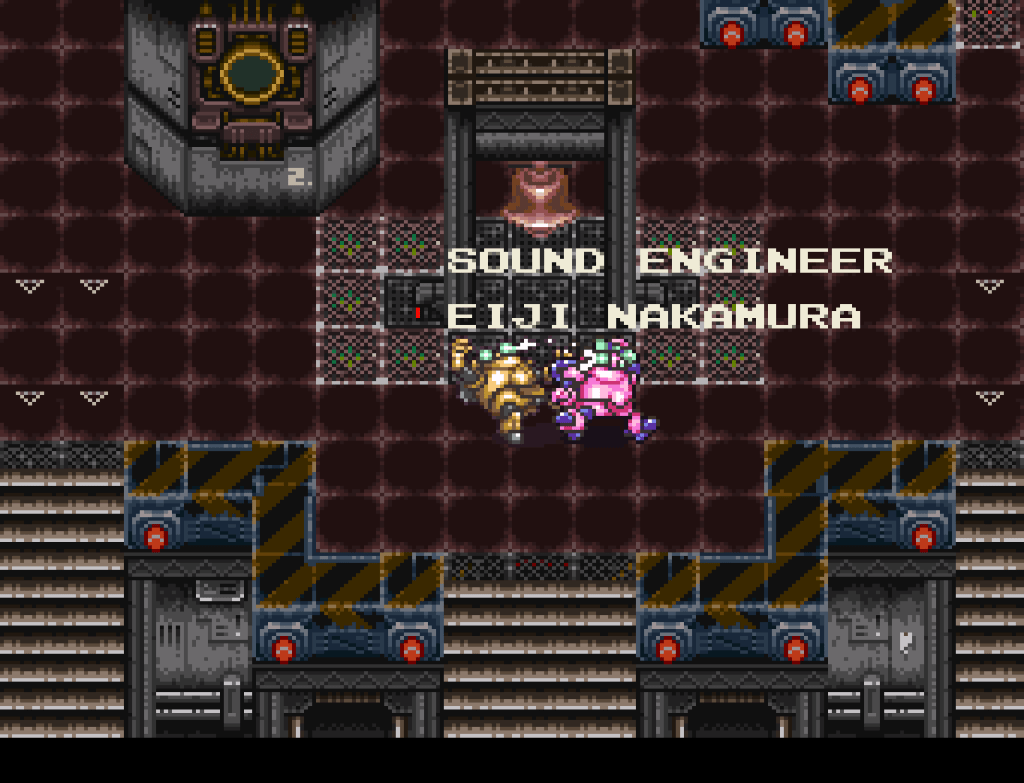
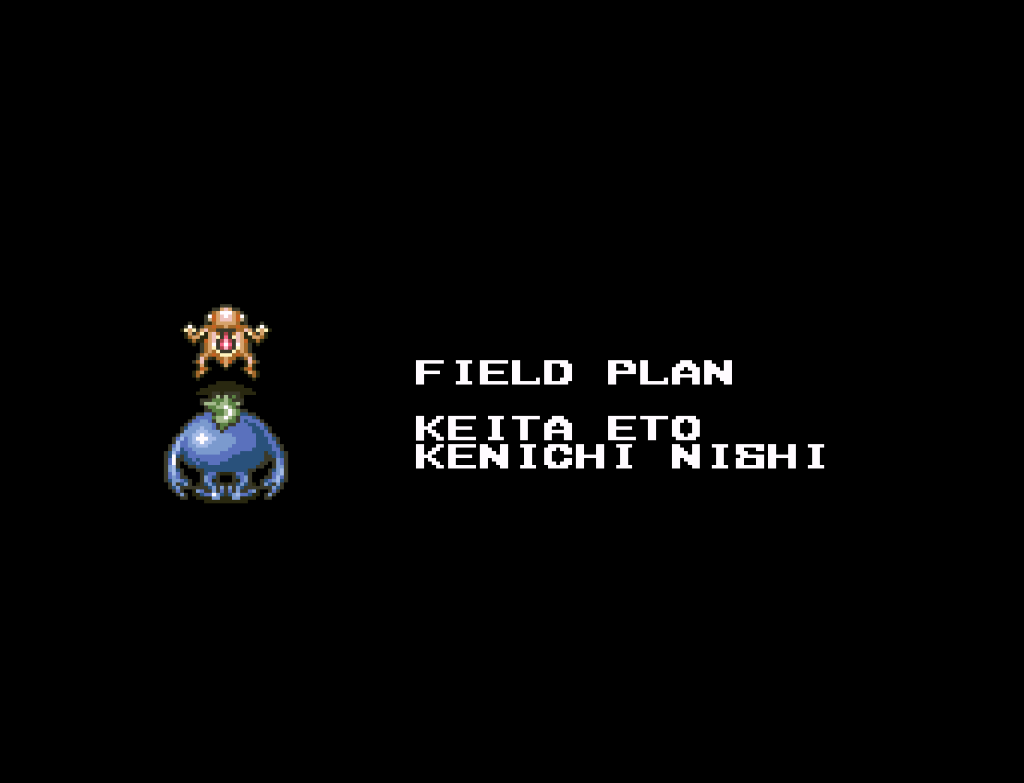
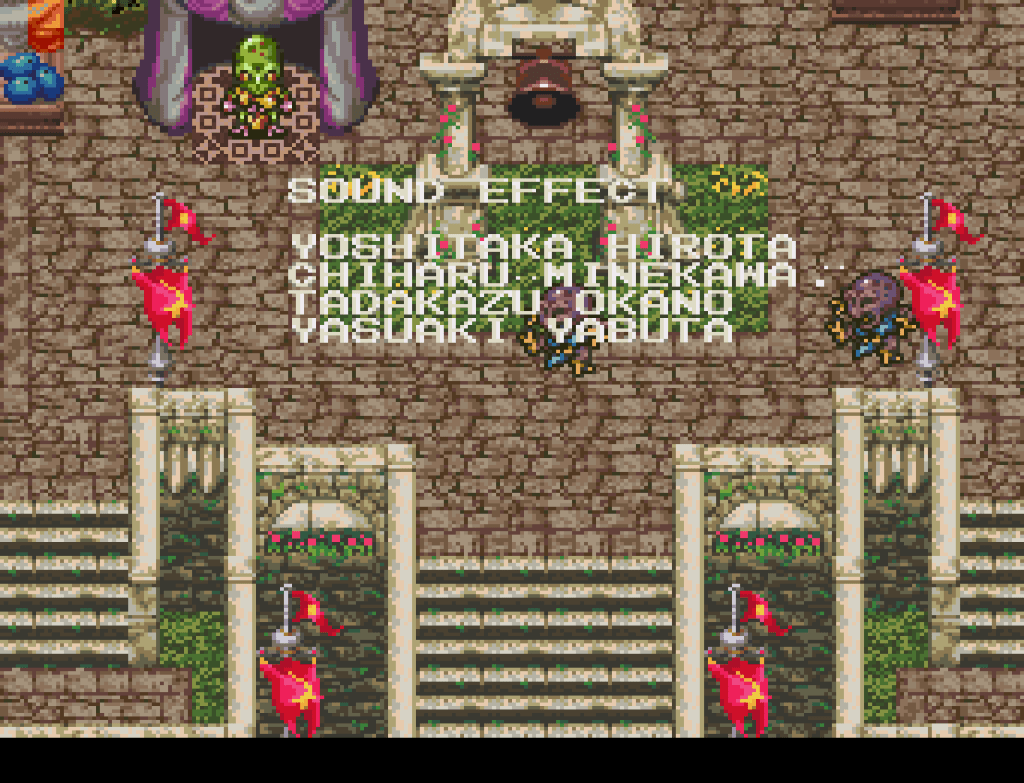
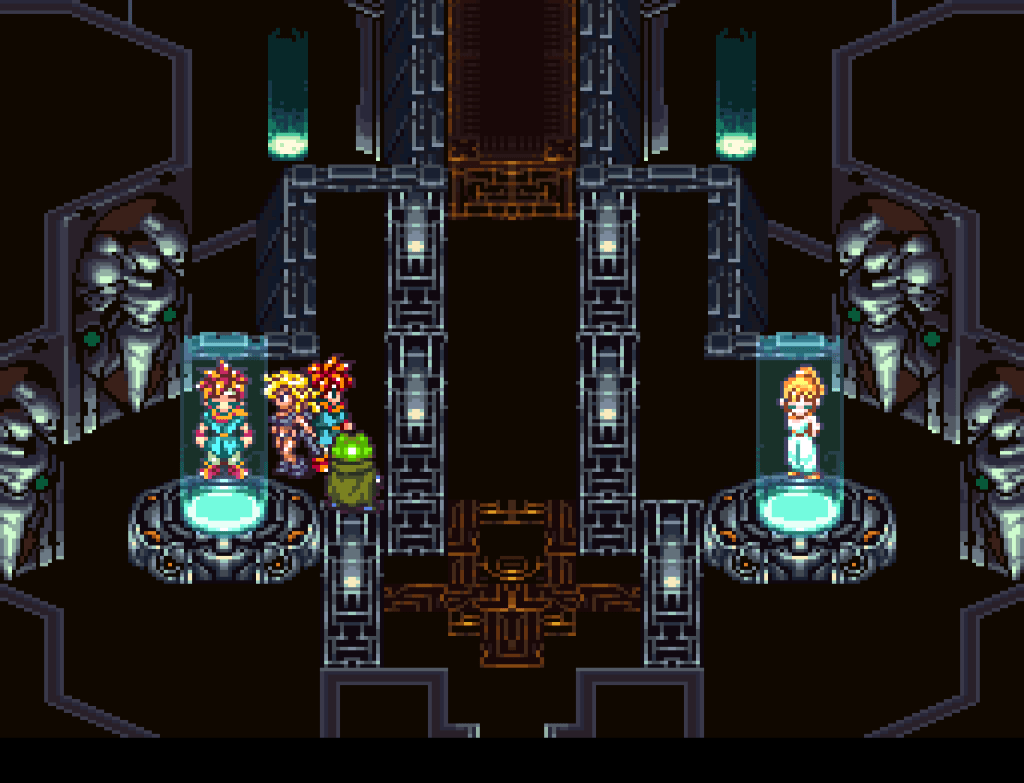
What do you get for this? Easily the best ending in the game. The player gets teleported to the end of time, which gets turned into a dev room where various people who contributed to the project say little bits and pieces to the player.
The messages vary from humorous things like ‘if you’re a cute girl playing this, please look me up!’ to devs saying stuff like ‘I haven’t seen my family in months, send help!’
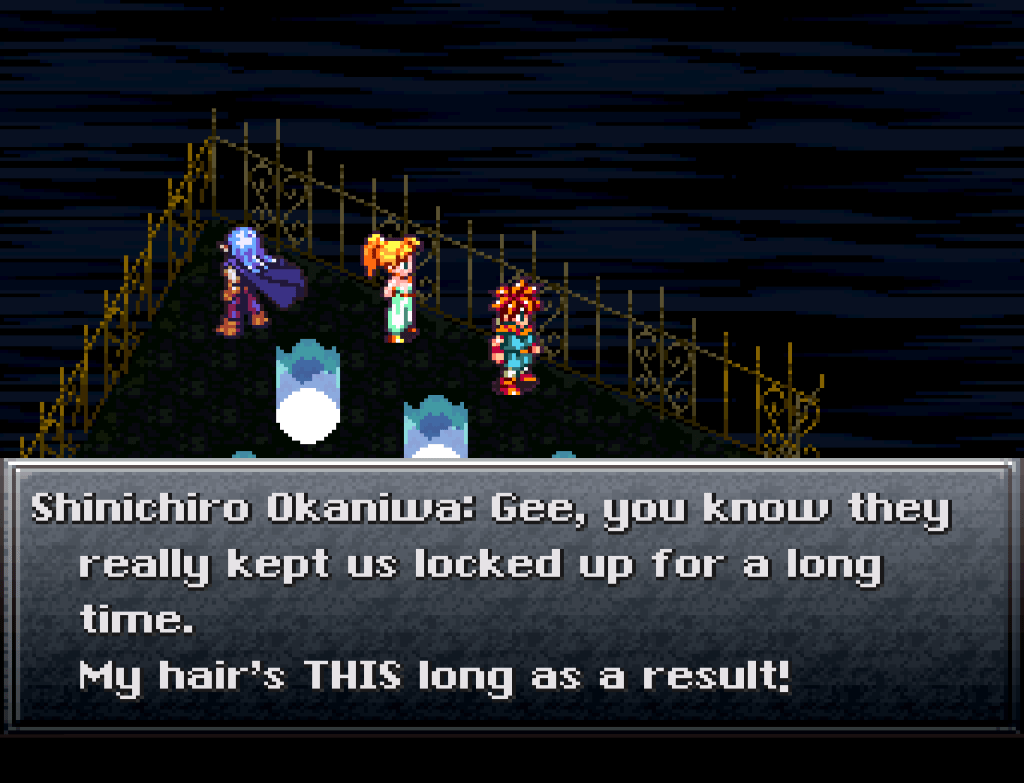
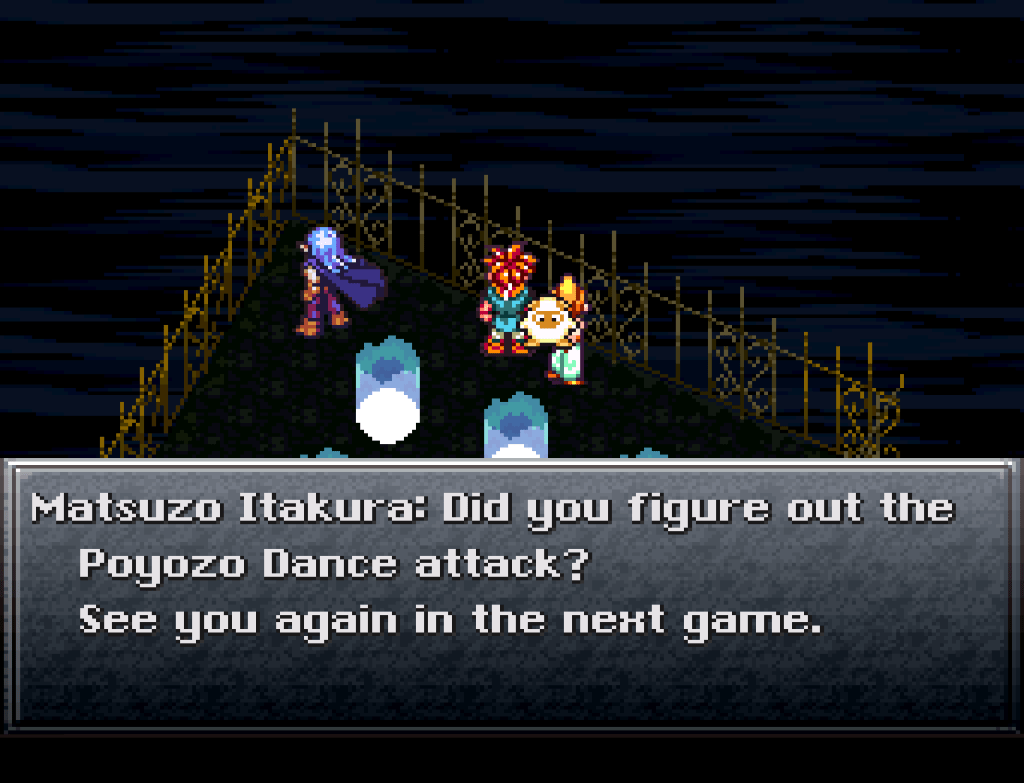
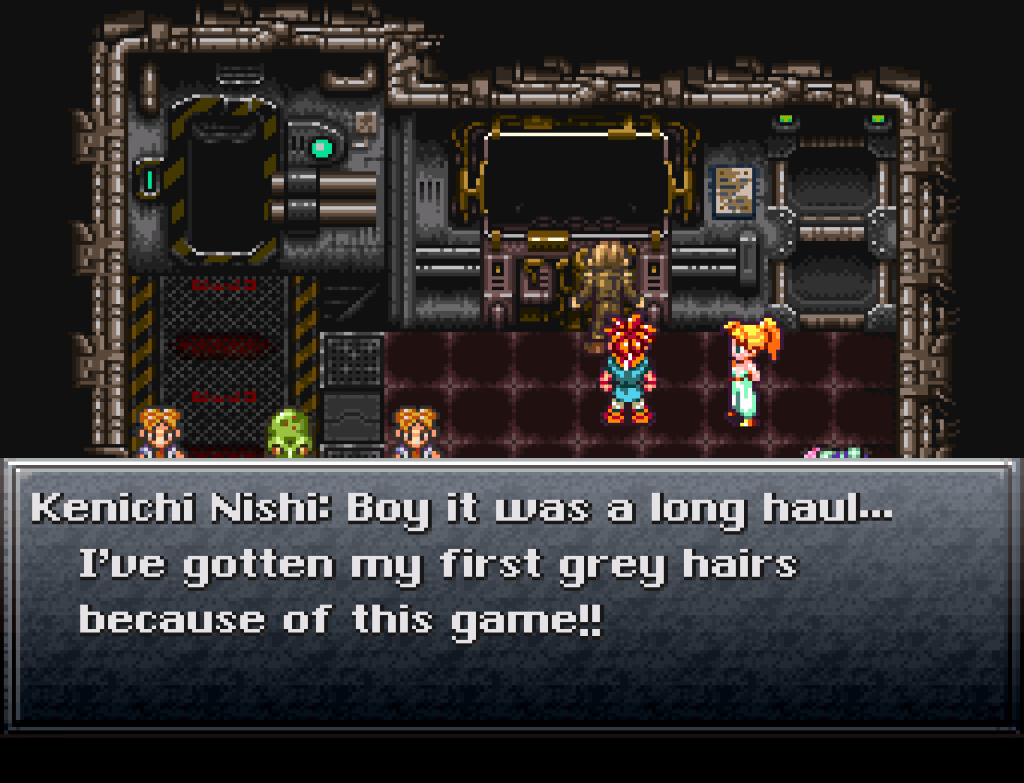
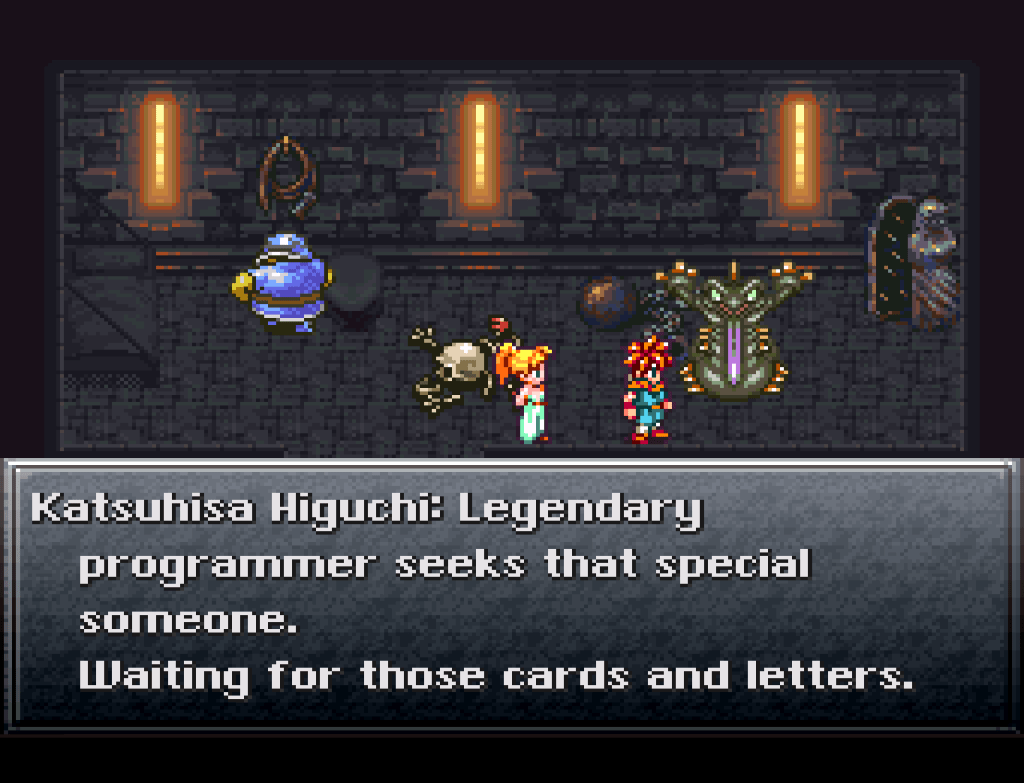
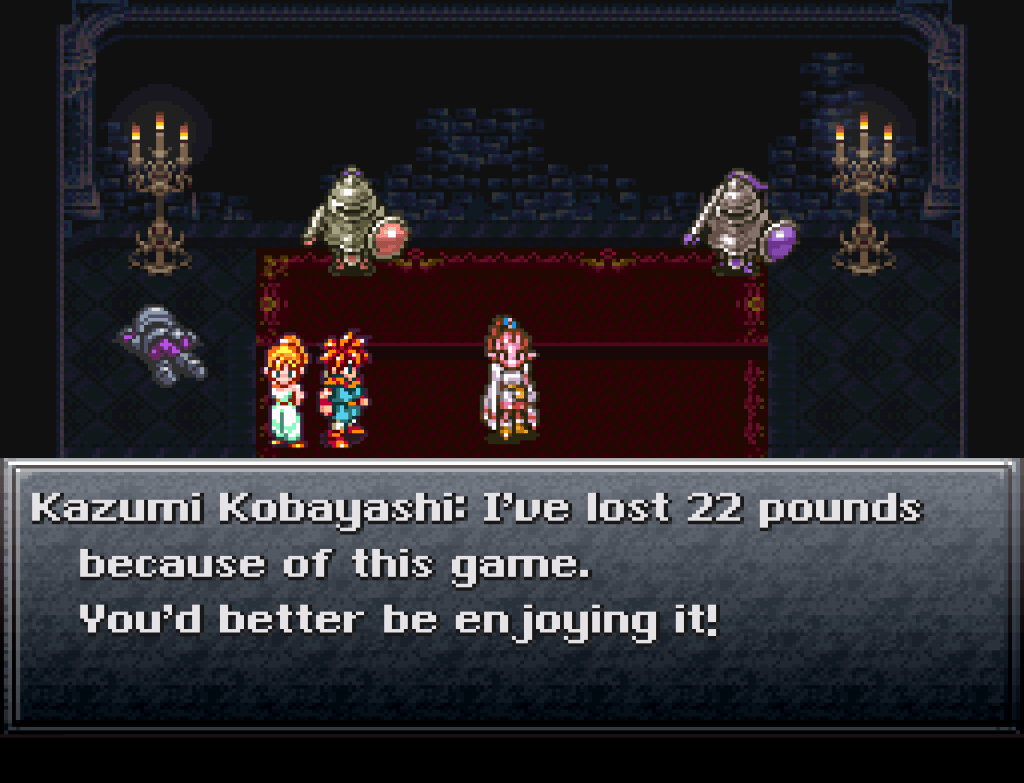
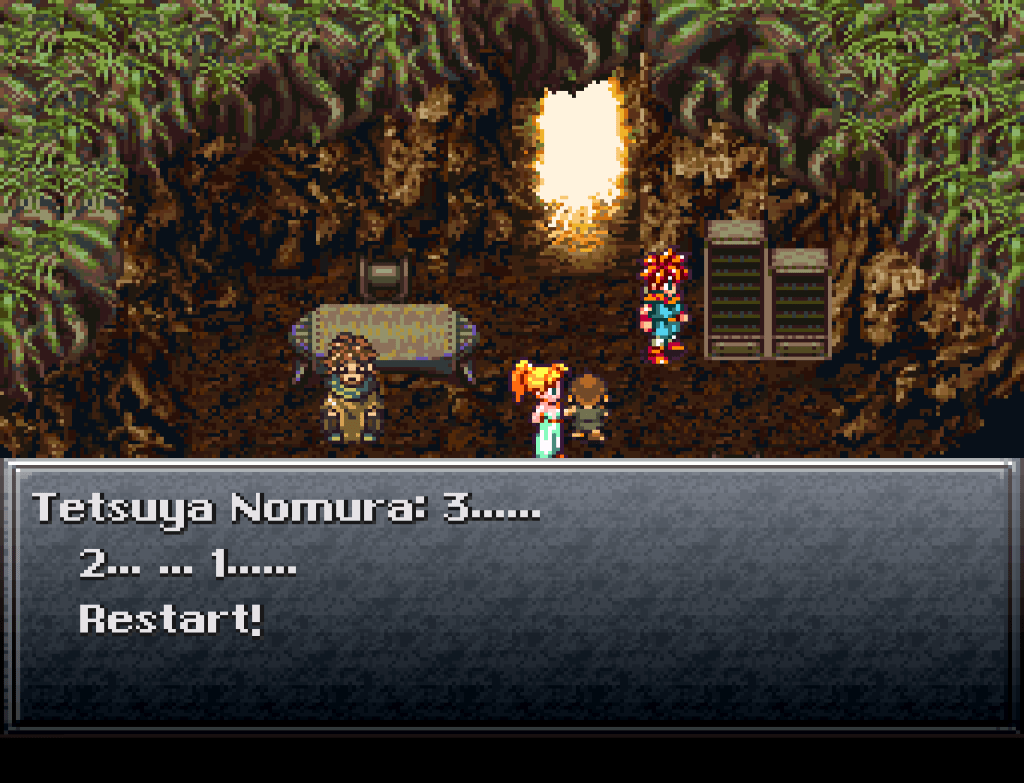
I hadn’t talked about the translation much, but for this playthrough I used the original SNES version of the game because that’s still my favorite one. It’s a little quirky because the translation lead is Ted Woolsey, who…made dialogue a little more colorful than originally intended (Frog did NOT speak old english in the original or any subsequent translations.)
But here, it seems he was pretty literal with translations and whatever the various developers had to say, he just kept it to the point. I liked that!
It was cool receiving a jumpscare from Tetsuya Nomura just randomly hanging out in a room. And then you get to meet the dream team and they all have unique sprites that aren’t seen anywhere else in the game. This is, hands down, the most rewarding thing in the game. Any ‘dev room’ ending you’ve seen was likely inspired by this one.
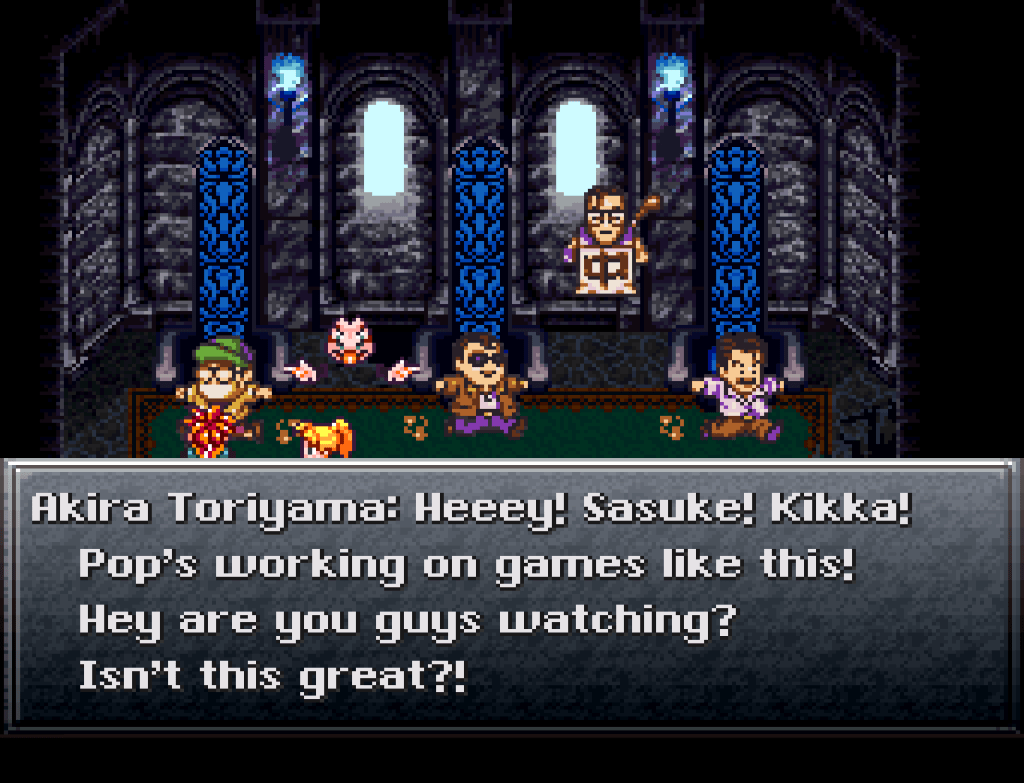
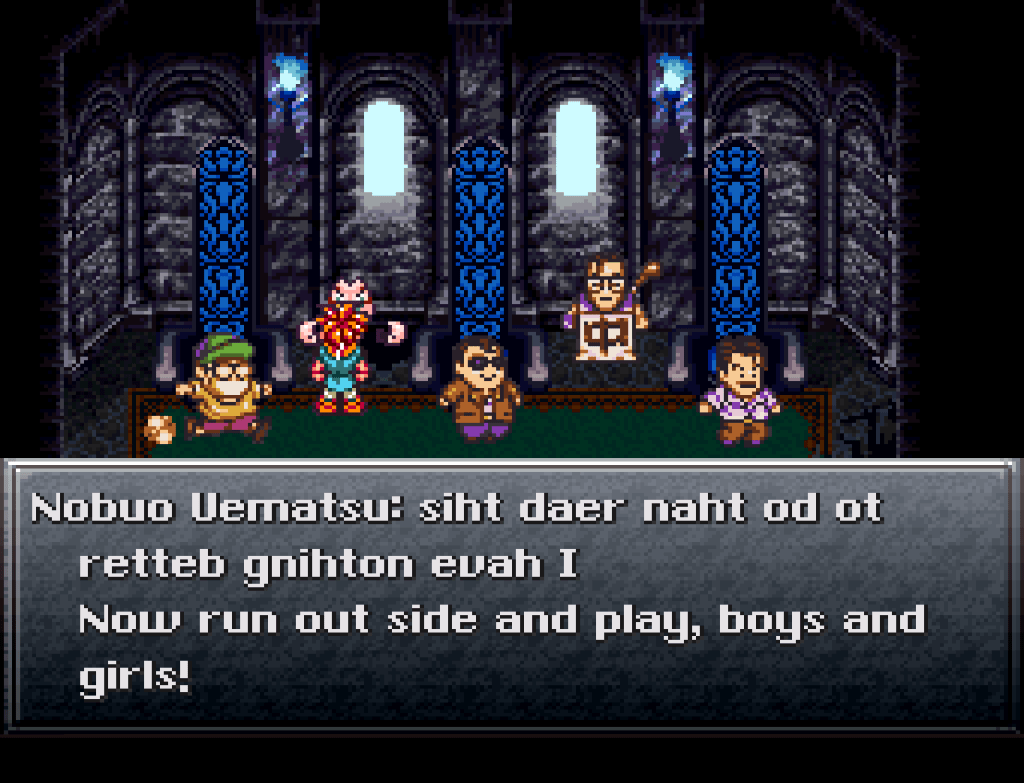
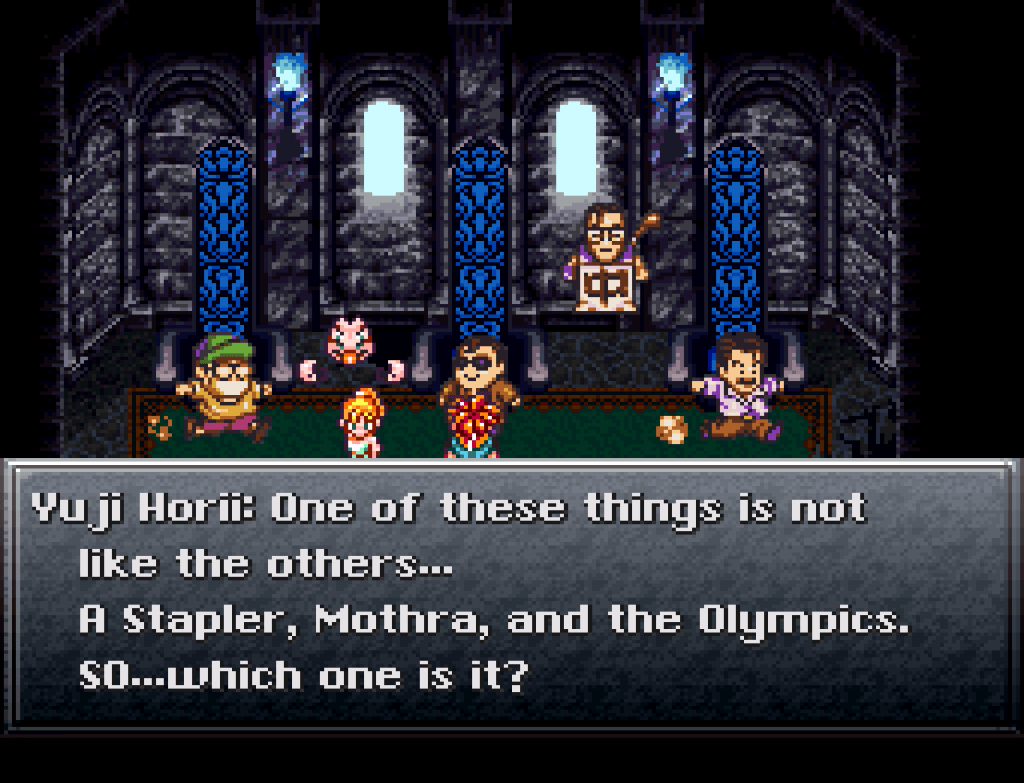
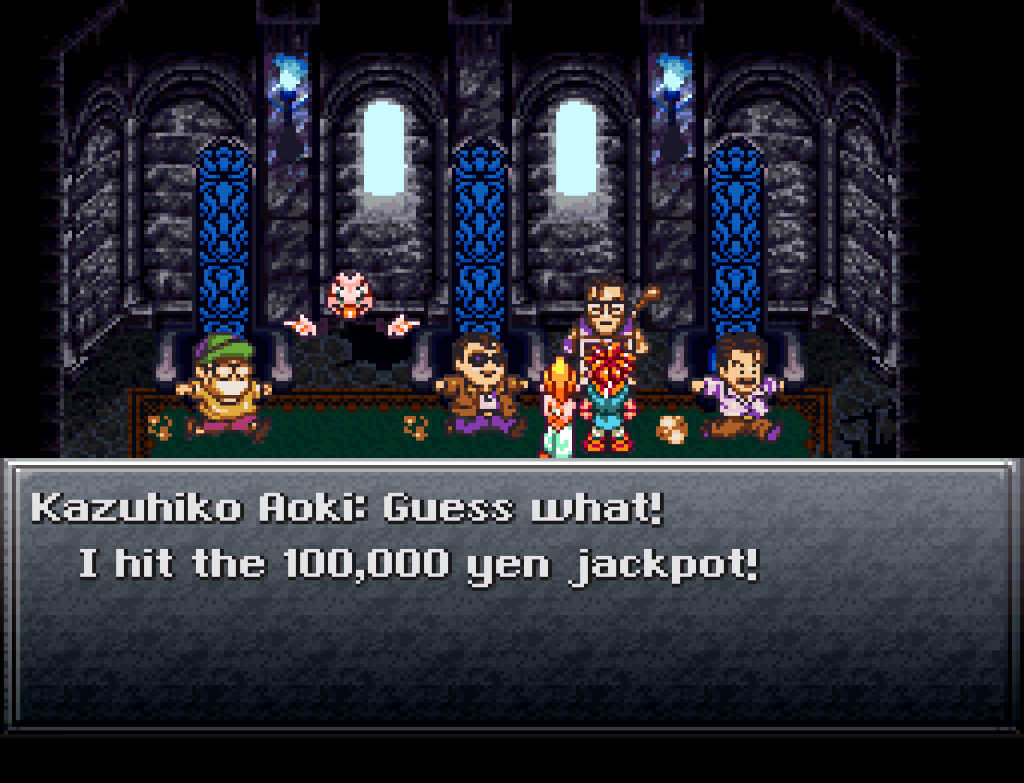
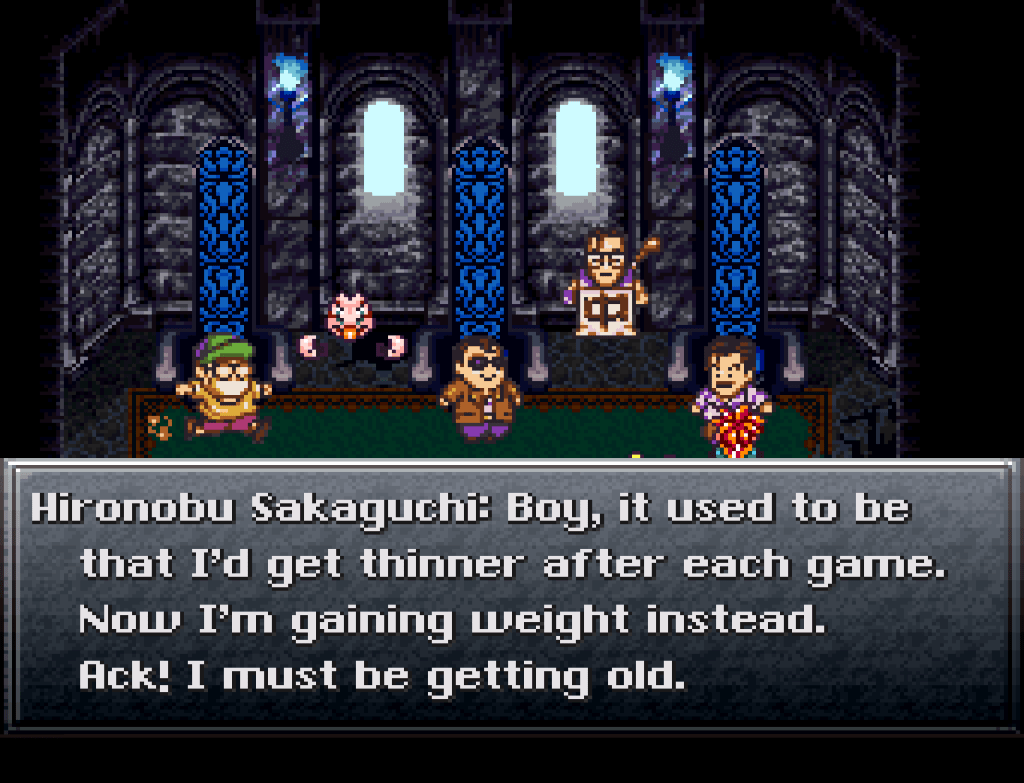
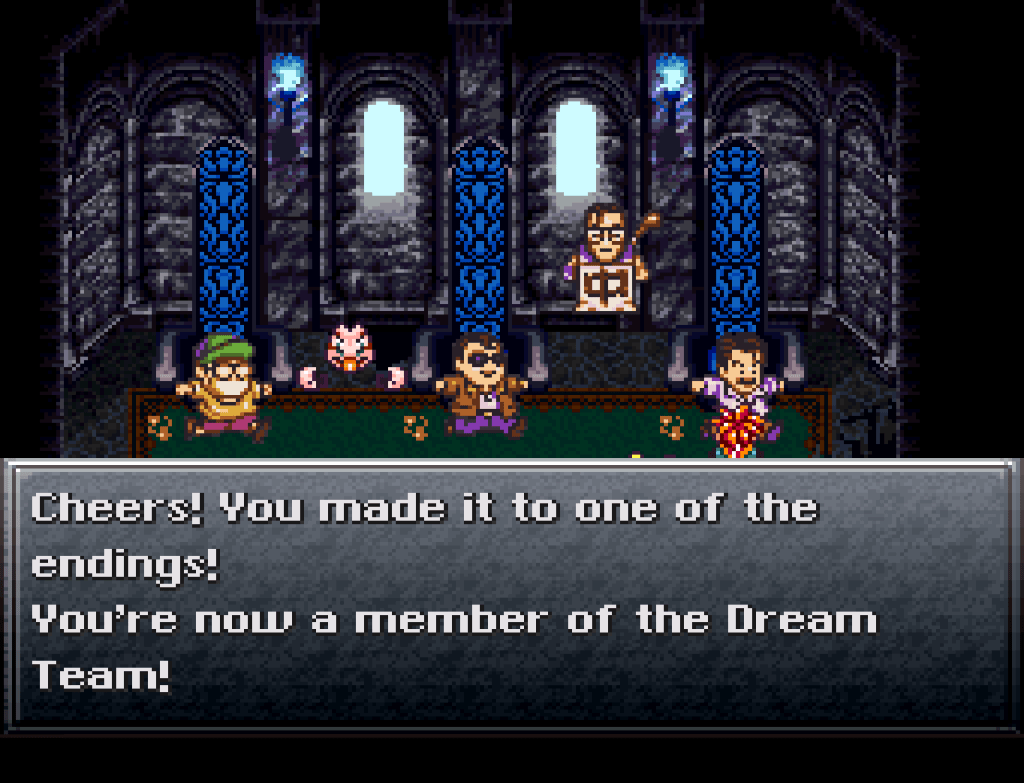
Now as for the other endings…with how I’ve handled similar gimmicks in past writeups, you may expect a breakdown of each ending. BZZT. Unfortunately, most endings after this one are pretty unremarkable. Typically they involve the credits rolling while various little scenes play in the background.
For instance, one of the endings is just a creature called ‘mu’ goofing around with a cat and a frog. There’s no story, it’s just a minute long comedy routine.
There are officially 12 endings to the game – 13 if you’re playing on the DS or Steam – and I would say only four of them are true ‘endings.’ The first two depend on whether the cast takes on a journey to resurrect the main character before finishing the final battle. The third is the dev room ending I mentioned.
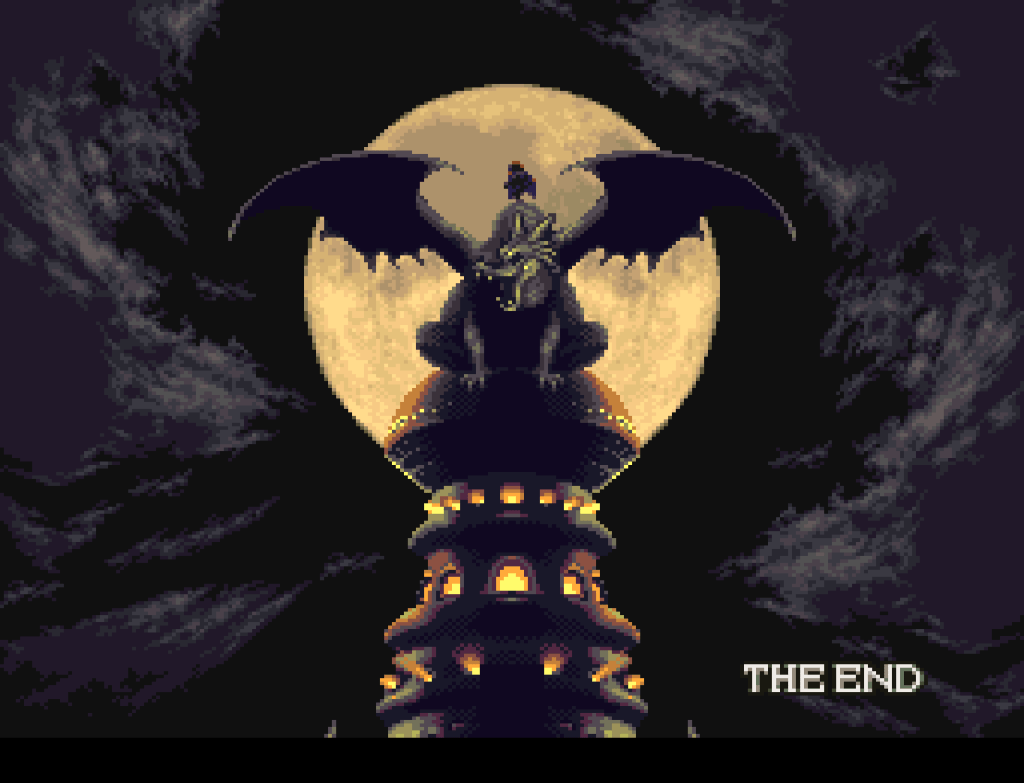
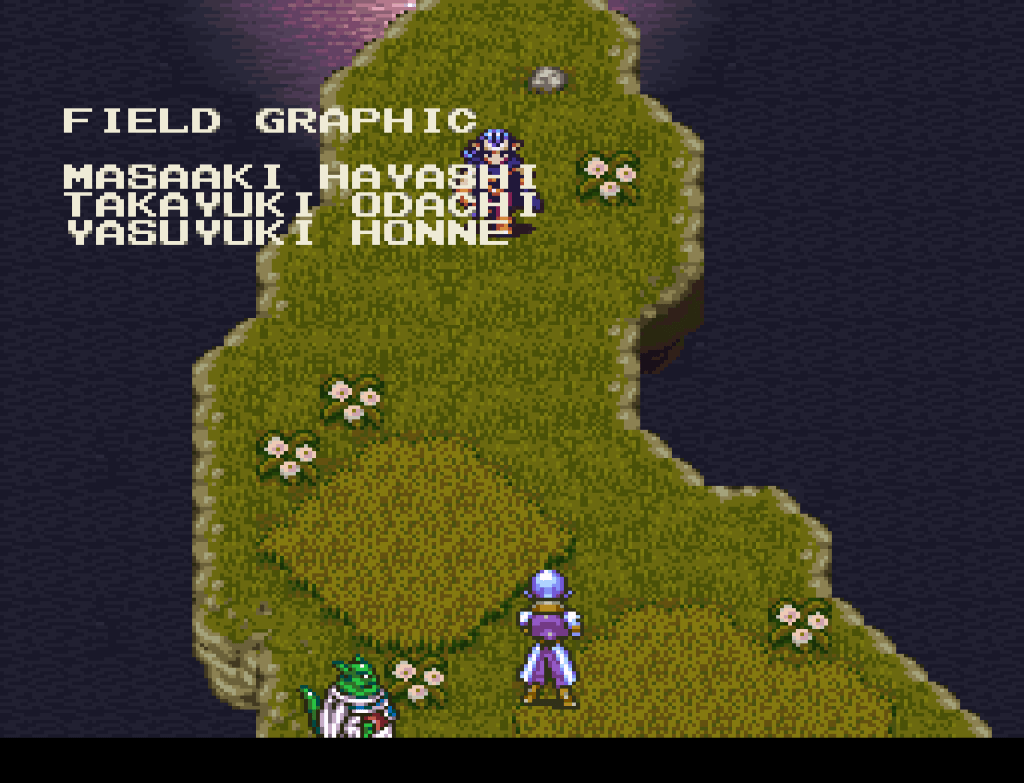
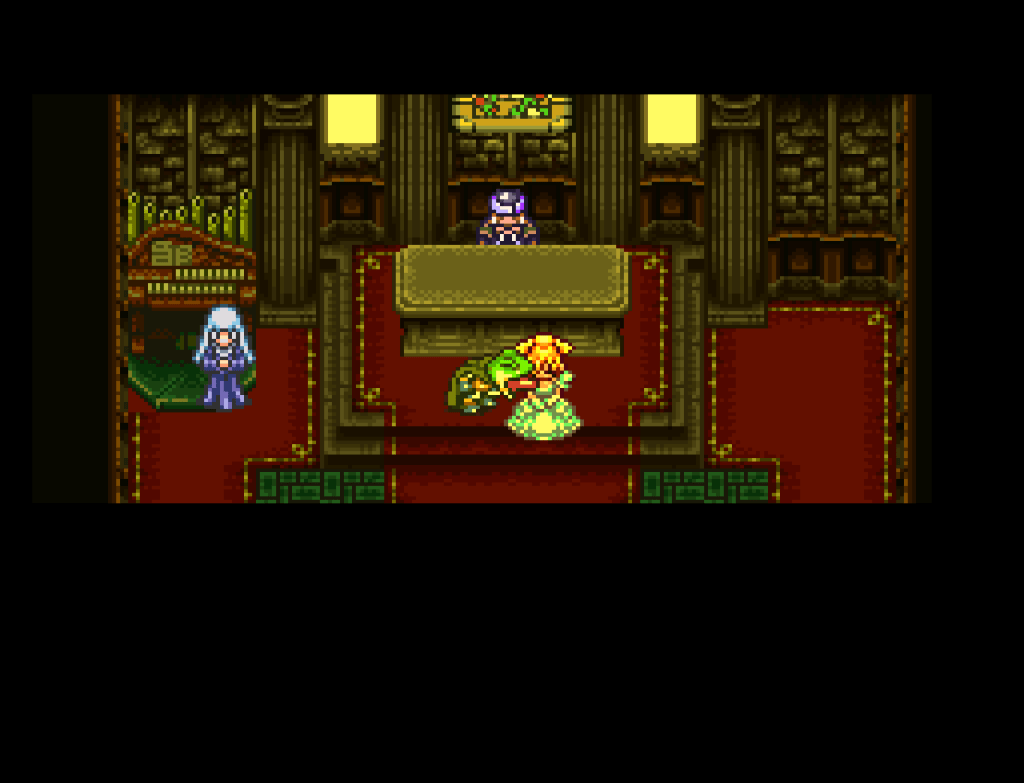
That leaves one more – towards the end of the main adventure, there is like a 2-minute gameplay window where this ending is locked. If you accidentally progress the story too much – essentially you go down a set of stairs and progress the plot – you miss out on it entirely. It’s so hard to see that I can’t imagine any player finding it organically.
And what’s waiting for you if you find it? The two lead heroines in the game, Lucca and Marle, give their opinions on a bunch of male characters. It’s essentially rating them hot or not. It’s very campy and is just a delight. It also features the only dialogue from the main character who is otherwise a silent protagonist.
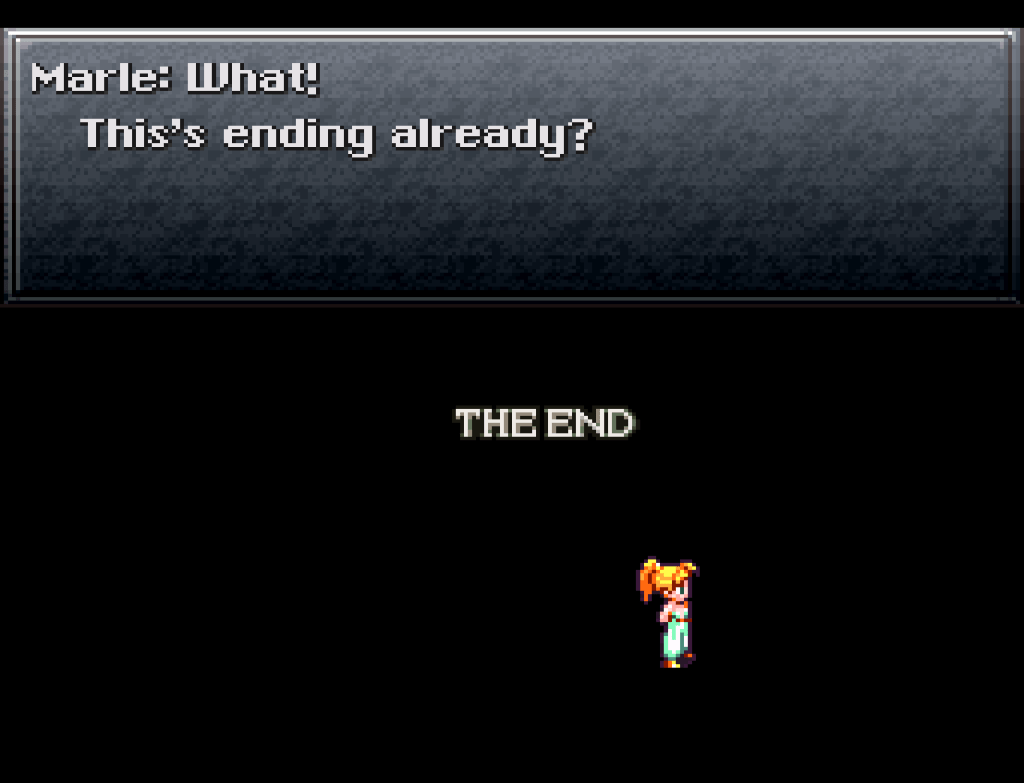
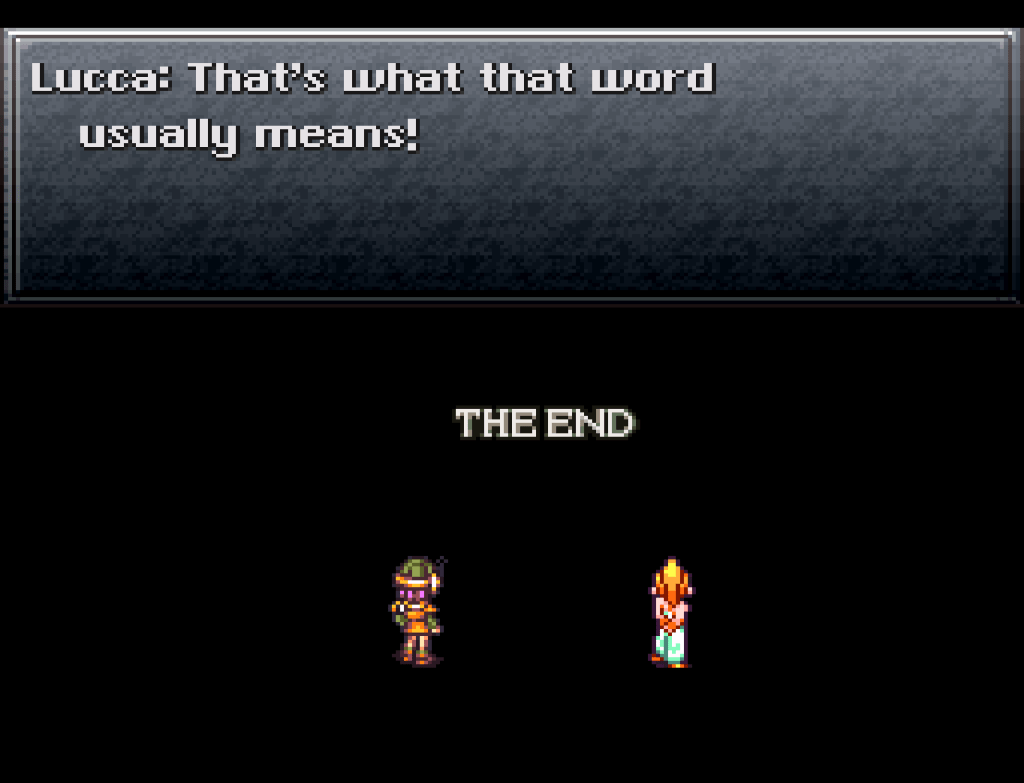
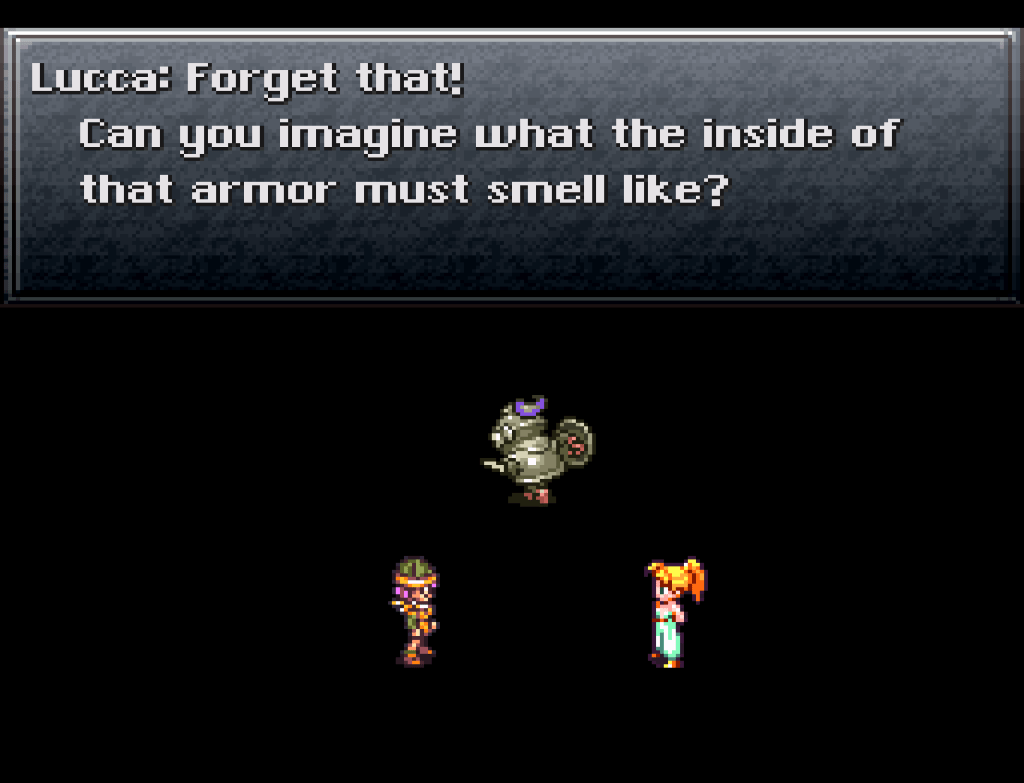
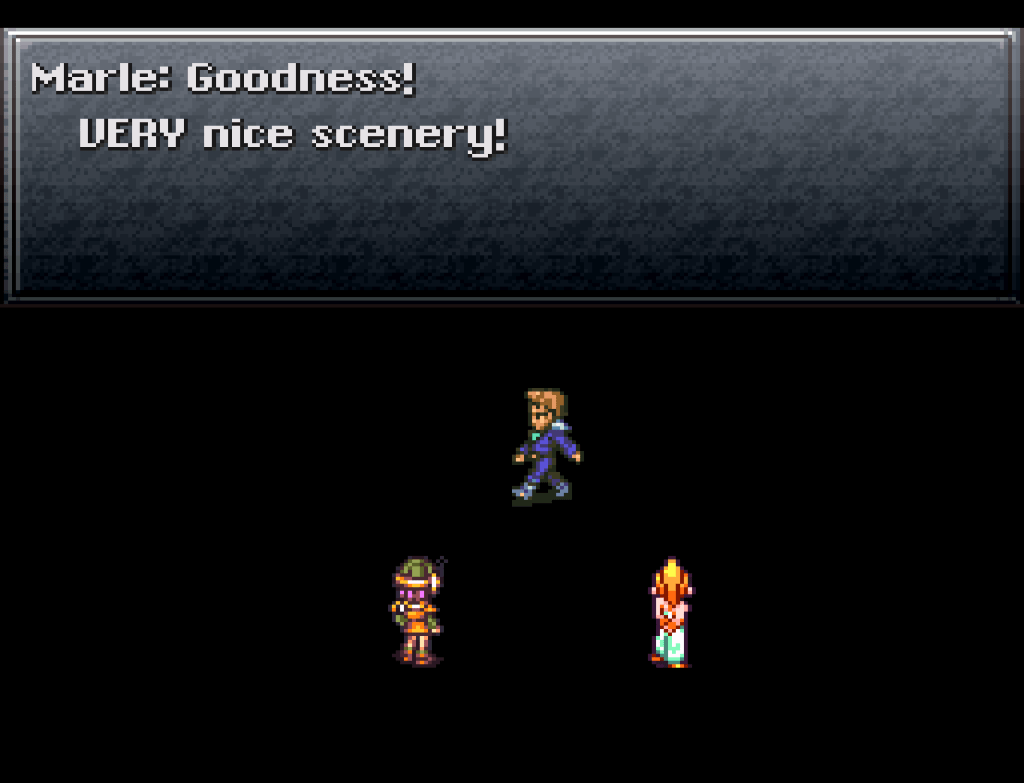
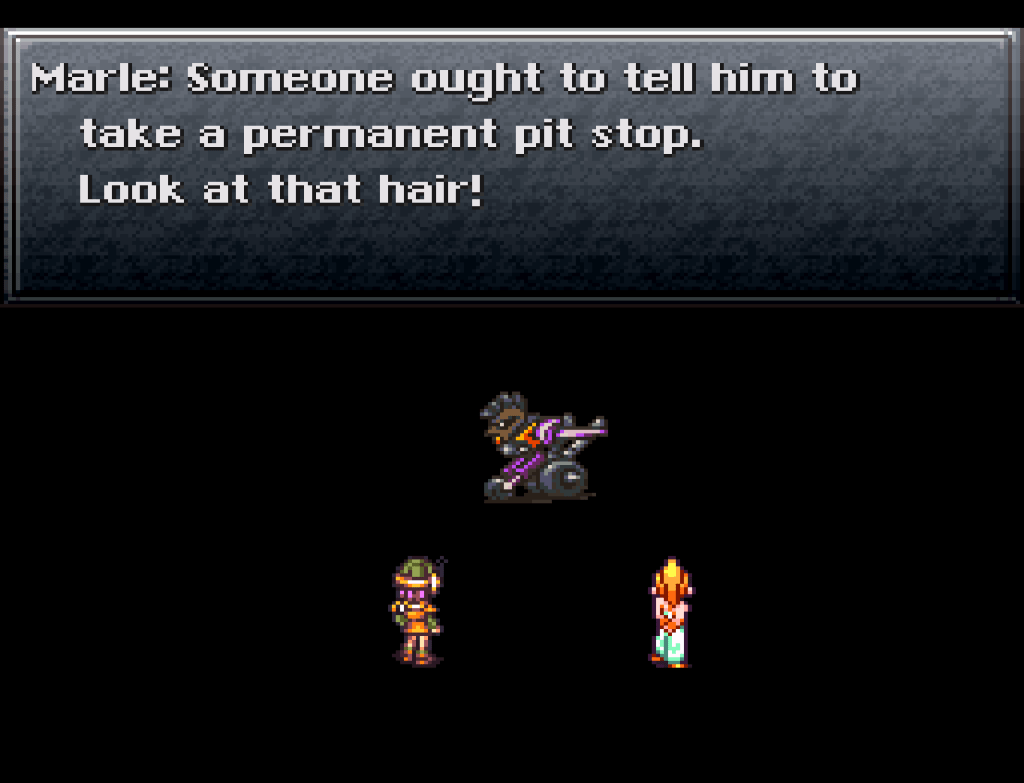
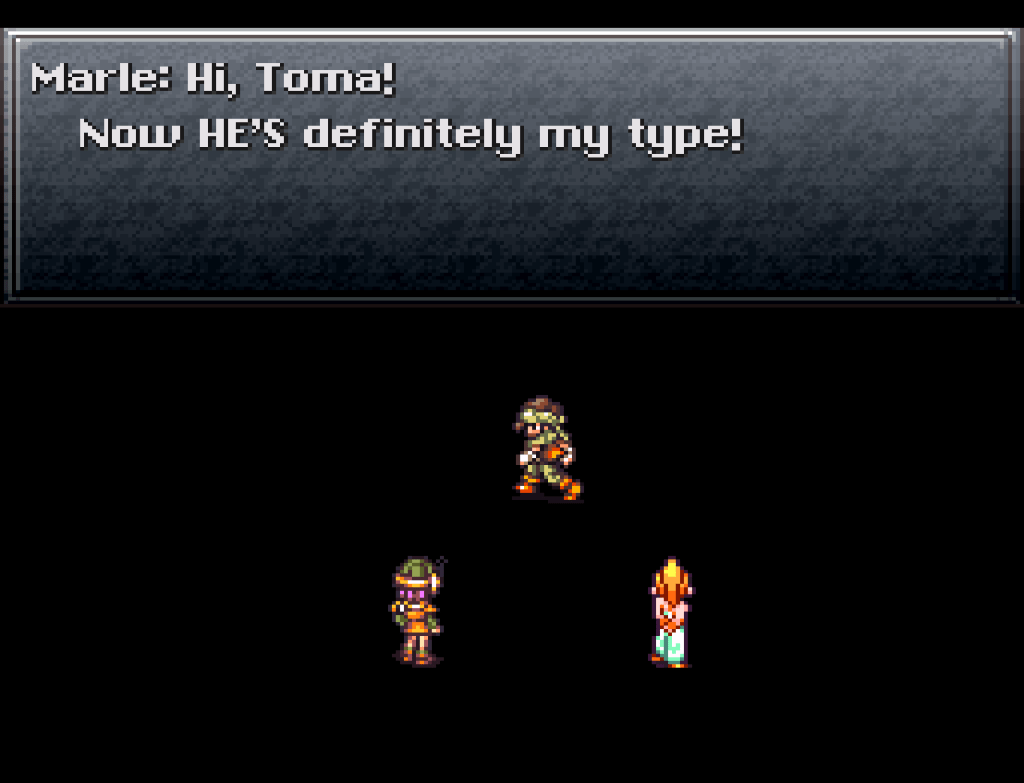
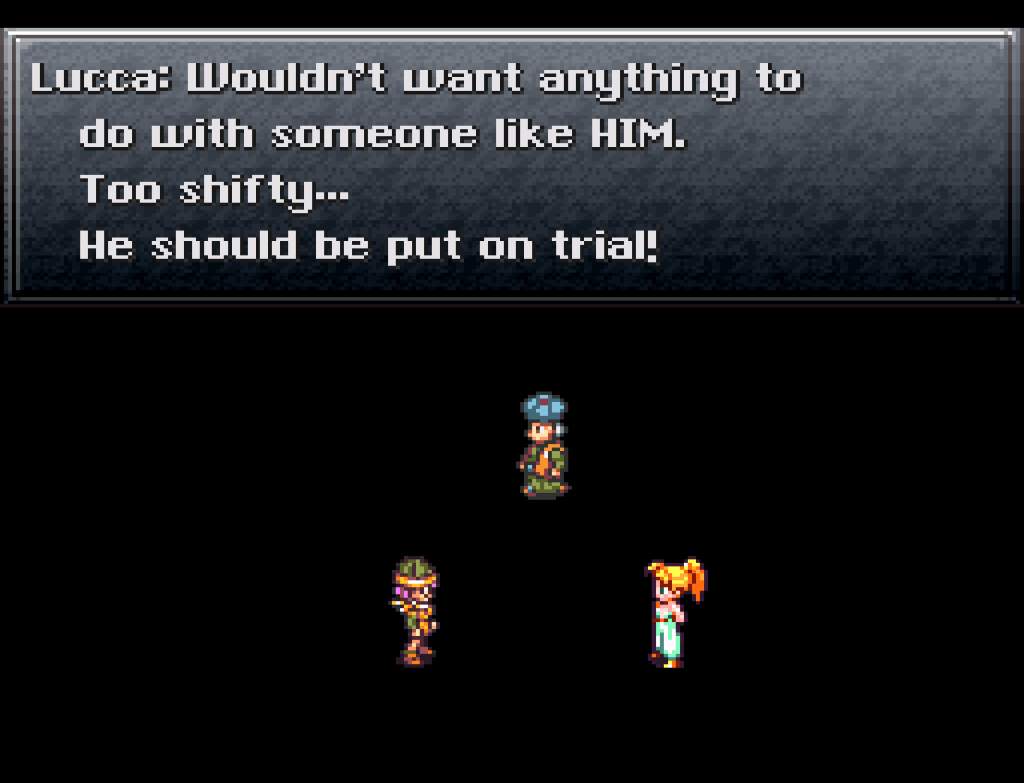
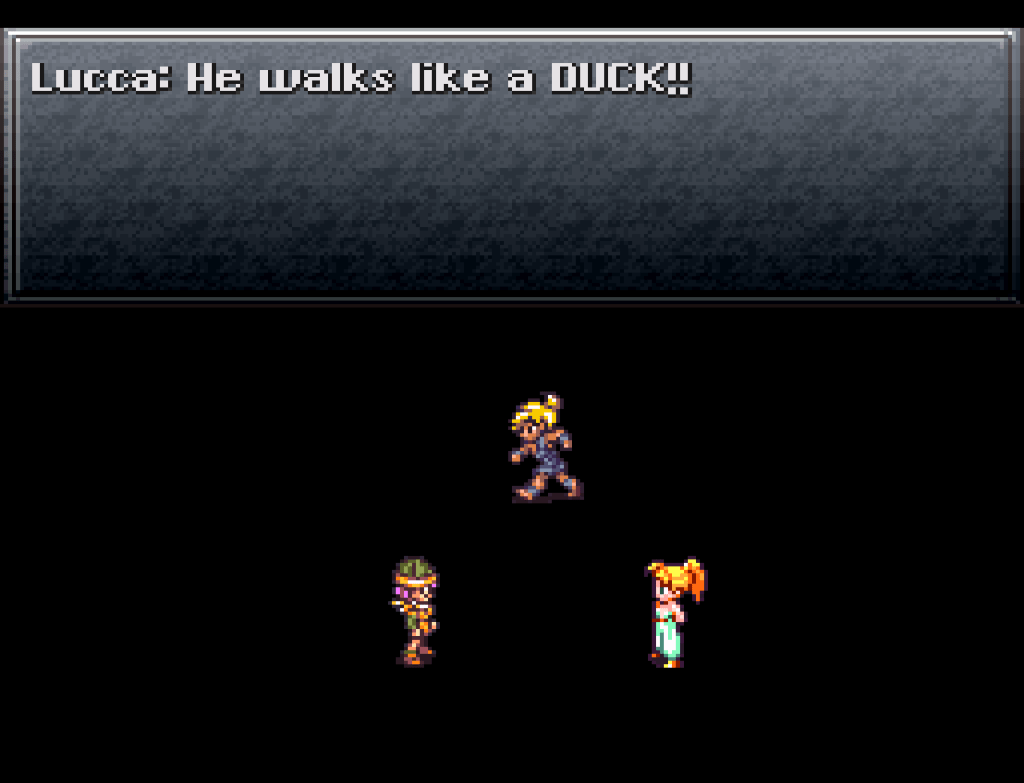
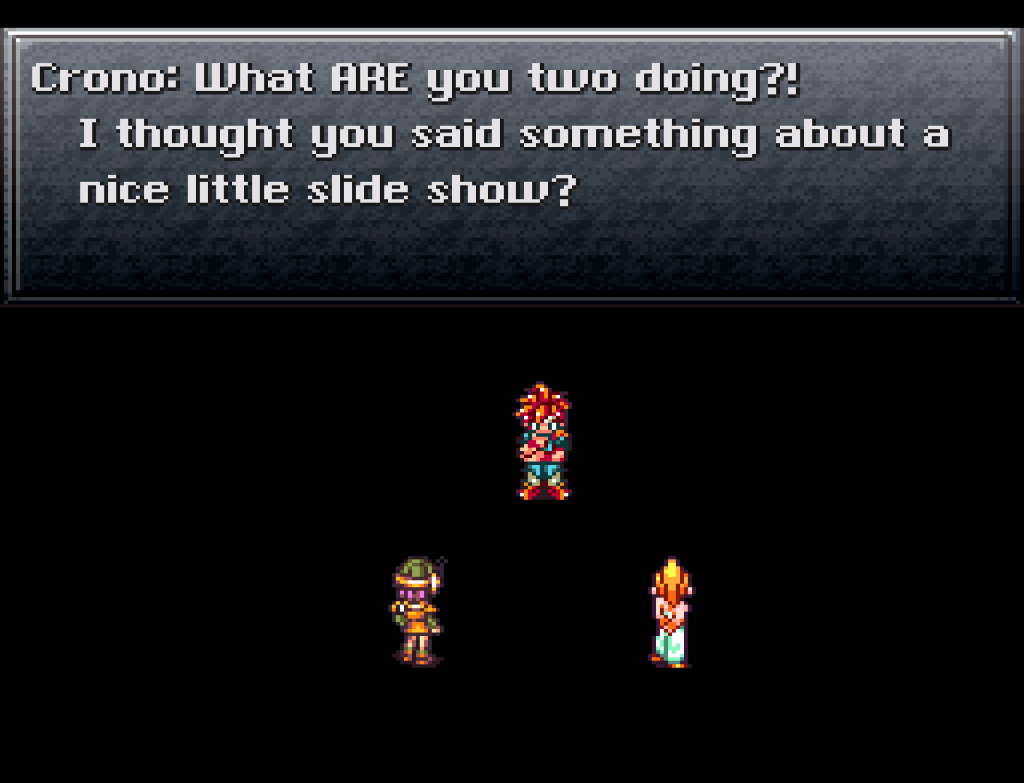
It’s a fitting conclusion to your journey. If you see this ending, there’s a pretty good chance you’ve experienced everything this game has to offer already, so it’s a nice bit of levity before Square sends you on your way to play…I dunno, a fan translated copy of Bahamut Lagoon or something.
The 13th ending creeps more into the ‘this is why I am wary of a Chrono Trigger remake’ territory. This one tasks the player with beating the extra content the DS/Steam version introduces and then beating a new final boss. This ending specifically tries to tie the events of Chrono Trigger to its official sequel, Chrono Cross.
I’ll talk a little bit about what Trigger characters get up to in Cross below, but for now, just know that there was no sequel planned for Chrono Trigger when the game came out. So all of these links are being established over a decade after the sequel came out and they’re all kind of sloppy.
I consider myself a Chrono Cross apologist and what I respect most about that game is how different it is from Trigger. This ending robs it a little bit of that uniqueness and I think both Trigger and Cross are worse off for it.
Technical
For all the ways this game feels different from a 16-bit Final fantasy, from a combat perspective, Chrono Trigger plays much like the most recent game to use the ATB at that point, Final Fantasy VI.
If you need a refresher on what the ATB system is, when characters act is determined by a timer. Early Final Fantasy games are purely turn-based – at the beginning of each turn the party selects moves for each member and the speed stat determines who acts when. With the ATB system, attacks constantly flow, even while you’re browsing spells. It helps make the more strategic nature of turn-based combat feel a little more action-oriented.
If the player wants to slow it down a little, there is a ‘wait’ mode option. This just pauses enemy attacks while browsing spells and items.
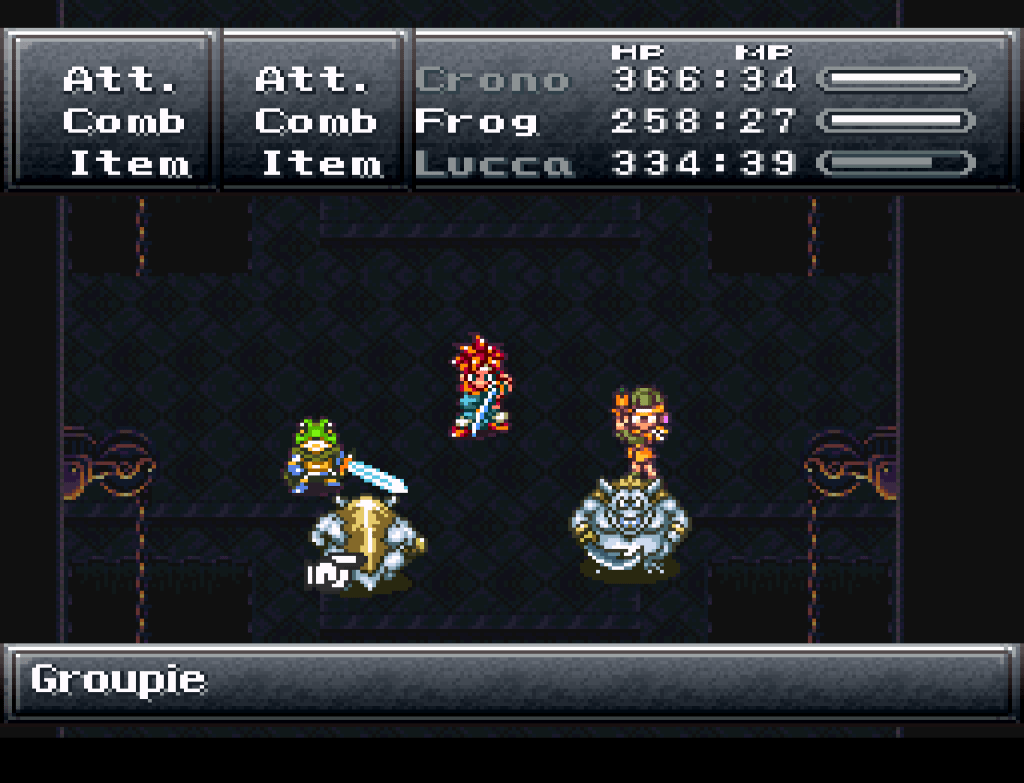
With FFVI, the whole gimmick was taking a large cast of characters and letting you customize them to your liking via the magicite system. Chrono Trigger steps back from that a little bit and takes more of a Final Fantasy IV approach to character growth.
As you develop, your characters gain new abilities that are unique to them. They each have their own specific roles on your team – so if you don’t like how one of the characters plays, there is no messing with their moveset to get them to play like you want ’em too. Frog can never use lightning on his own, no matter how much you may wish it to be so.
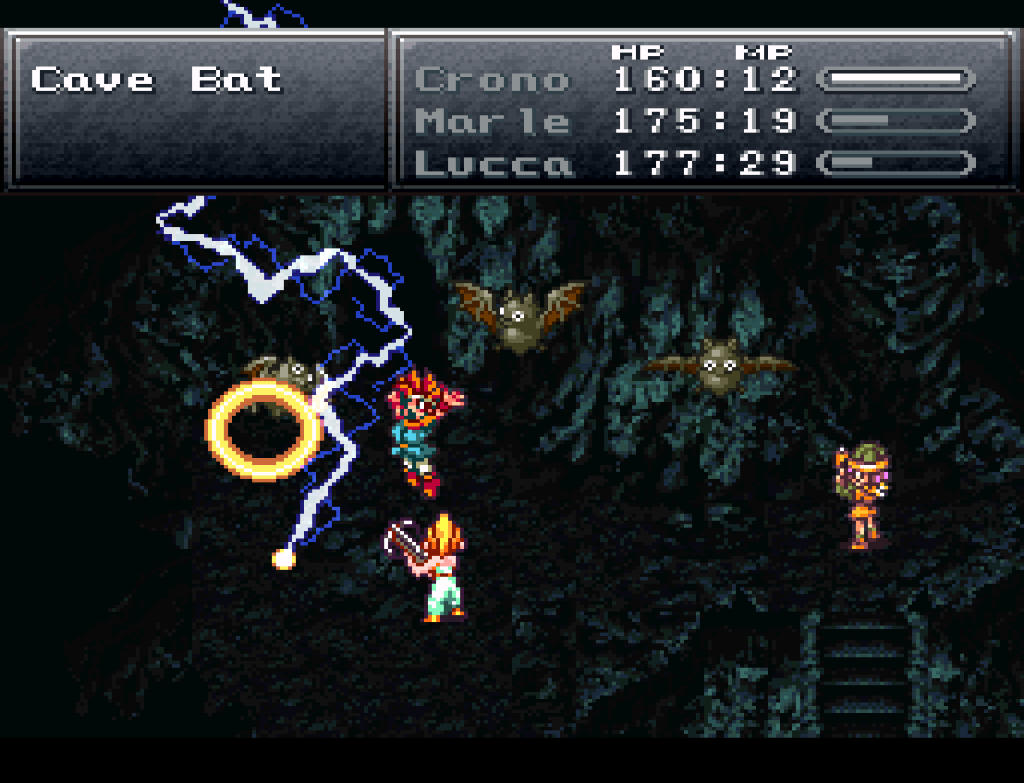
While this is a more simplified approach to character progression, Chrono Trigger did have a trick up its sleeve to give the player a reason to tinker with their party. There are a variety of ‘team’ moves in this game, which require certain party members in order to pull off. Frog on his own has his movepool, but he has a whole different set of moves he can pull off based on who else is on the team.
These moves are a lot more effective than just using solo moves. This encourages the player to experiment with different party formations to discover new and interesting combos. You may not like how someone plays as a solo act, but maybe there’s a team maneuver that is so good that it encourages the player to bring them along anyway. These moves are called Dual-Techs.
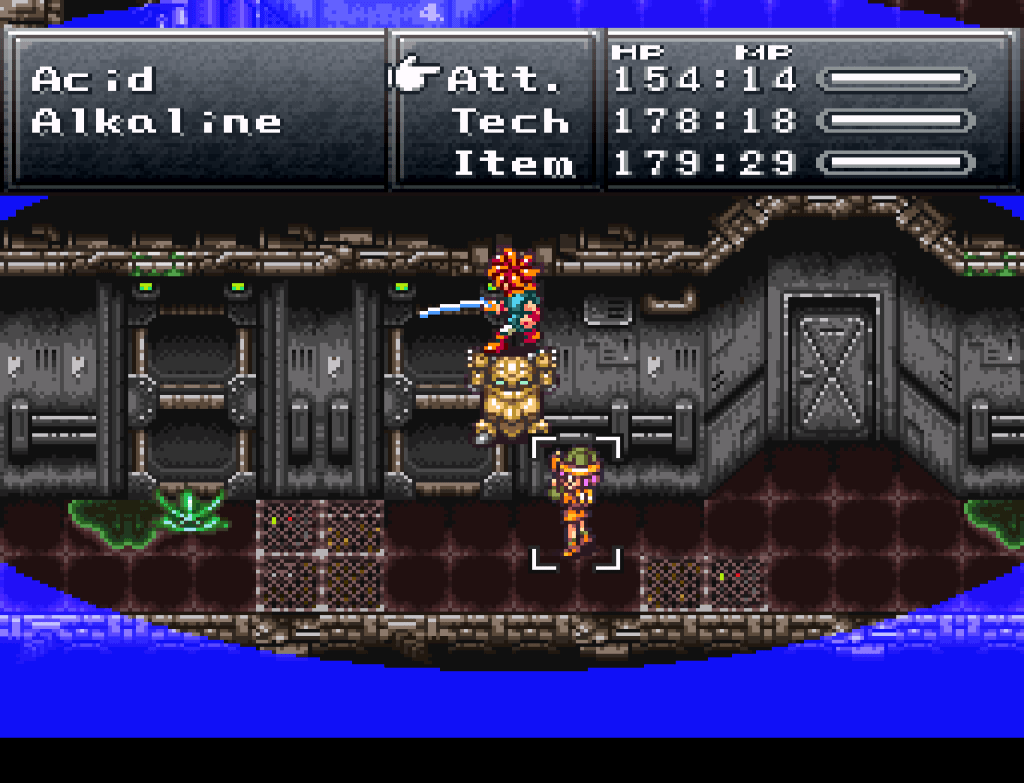
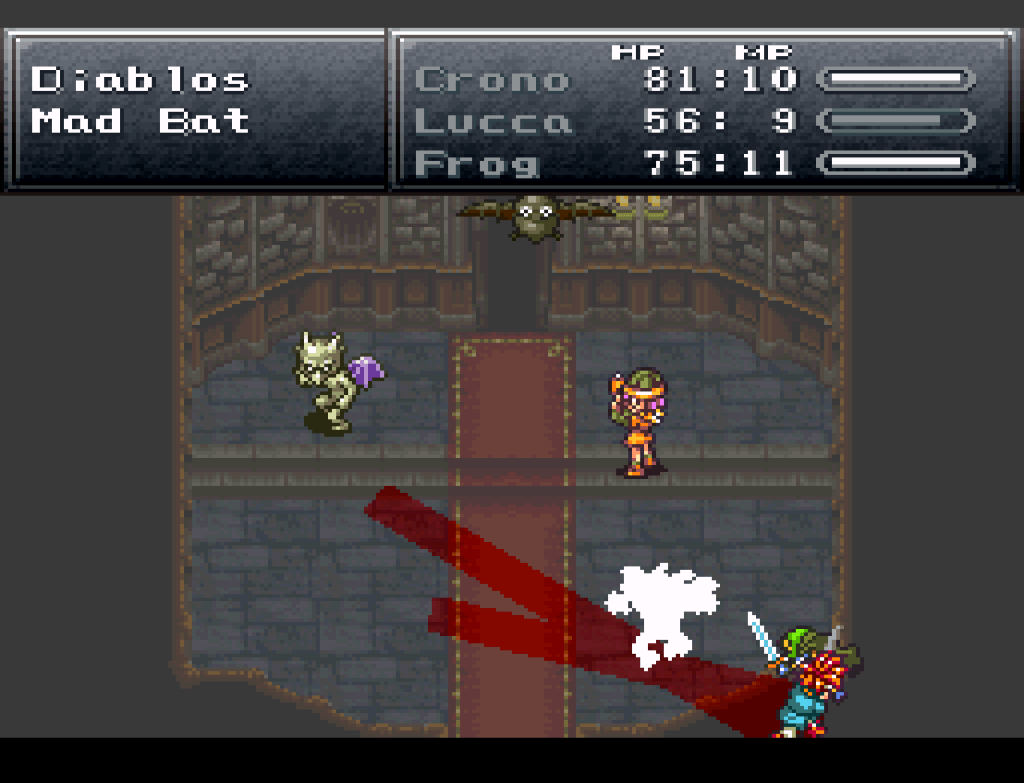
There are even Triple-Techs! You have moves that are locked behind specific teams! As a kid playing this game, I thought the animations behind the dual and triple techs were amazing, they just provided even more reason to seek them out. I noticed that one particular character, Magus, didn’t have any and I went out of my way searching for hours in order to see how I could get them to play along with everyone else.
This approach helps engage the player in ways that aren’t just tied to difficulty. Realistically speaking, most encounters in Chrono Trigger can be beaten by mashing on the A-button. Some require using magic, but outside of that, not much thought is required. Even in boss battles, most strategies are extremely basic. The ones that AREN’T are considered extra hard by the players because it requires thinking more in depth about techniques and party composition.
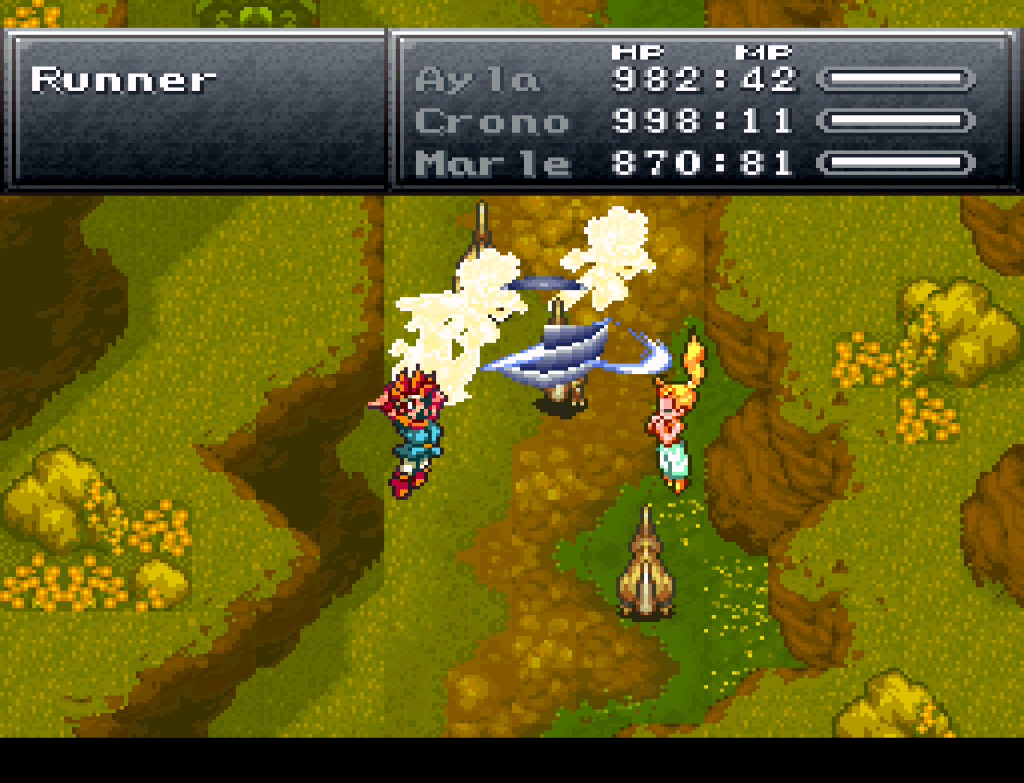
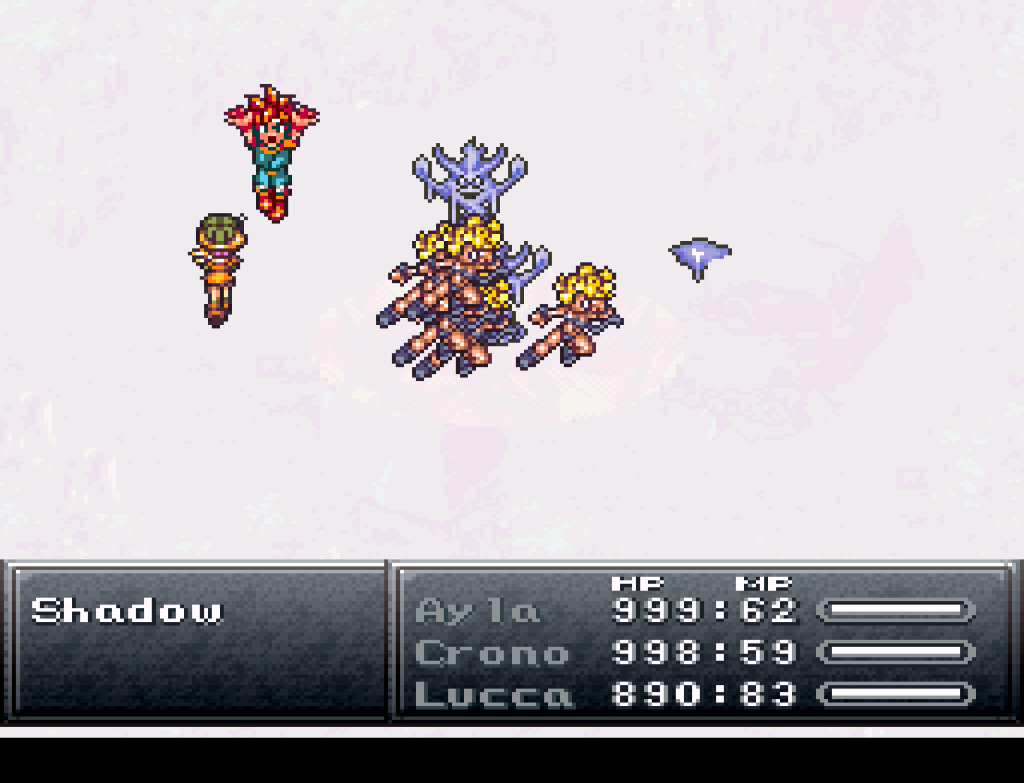
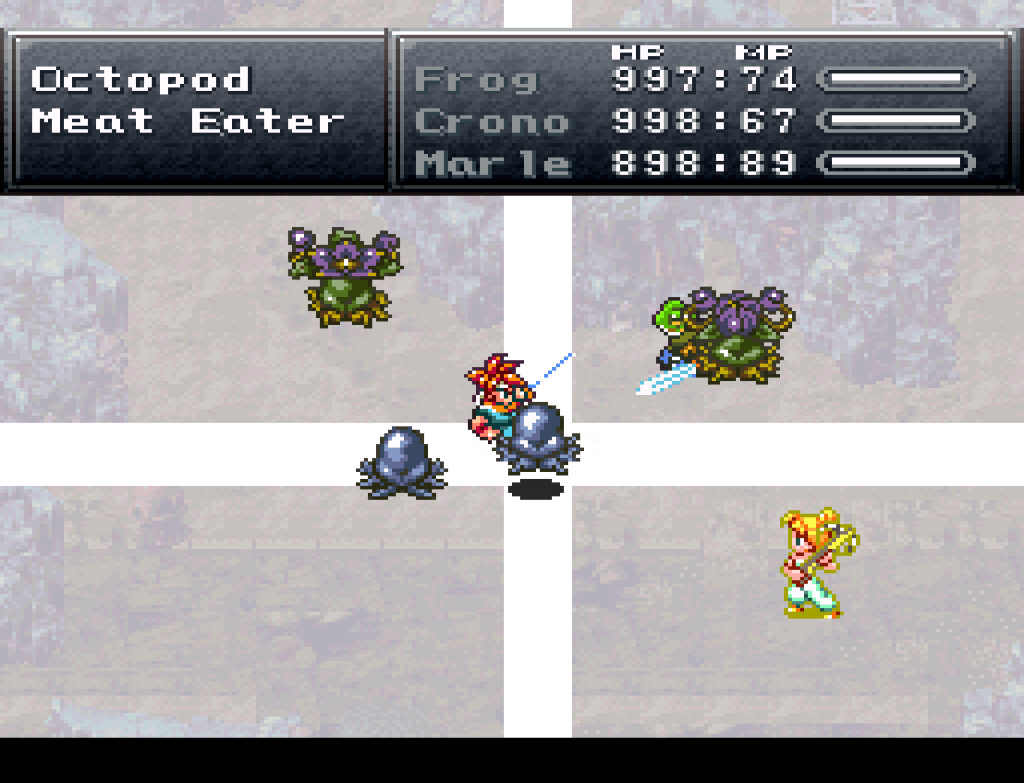
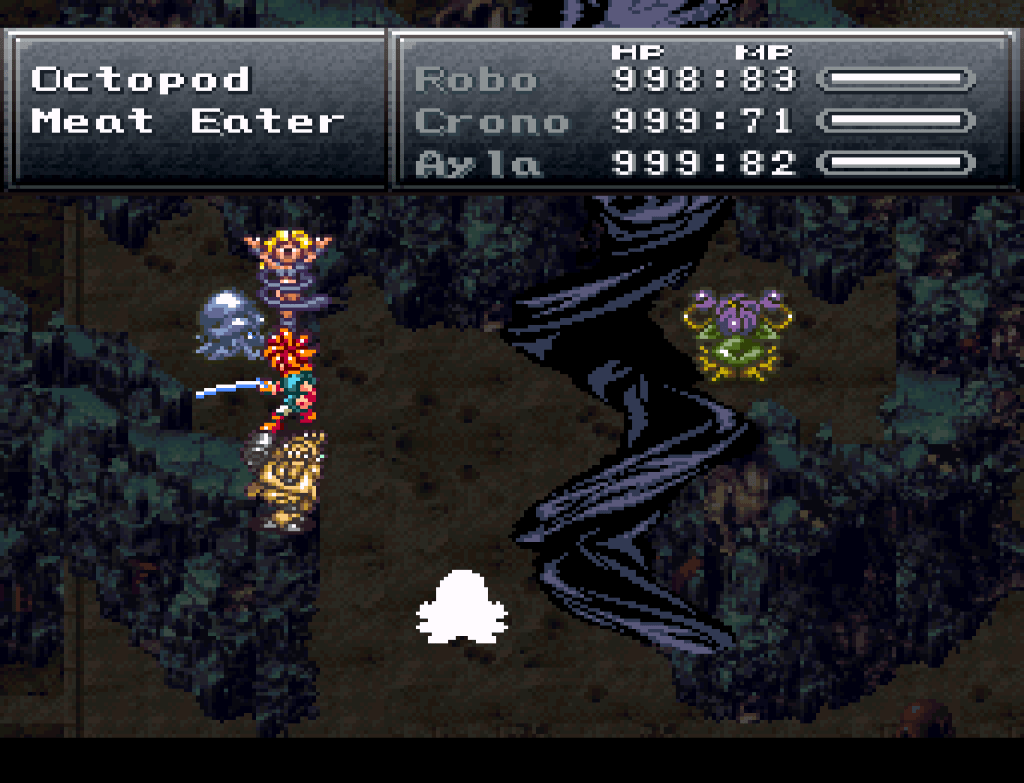
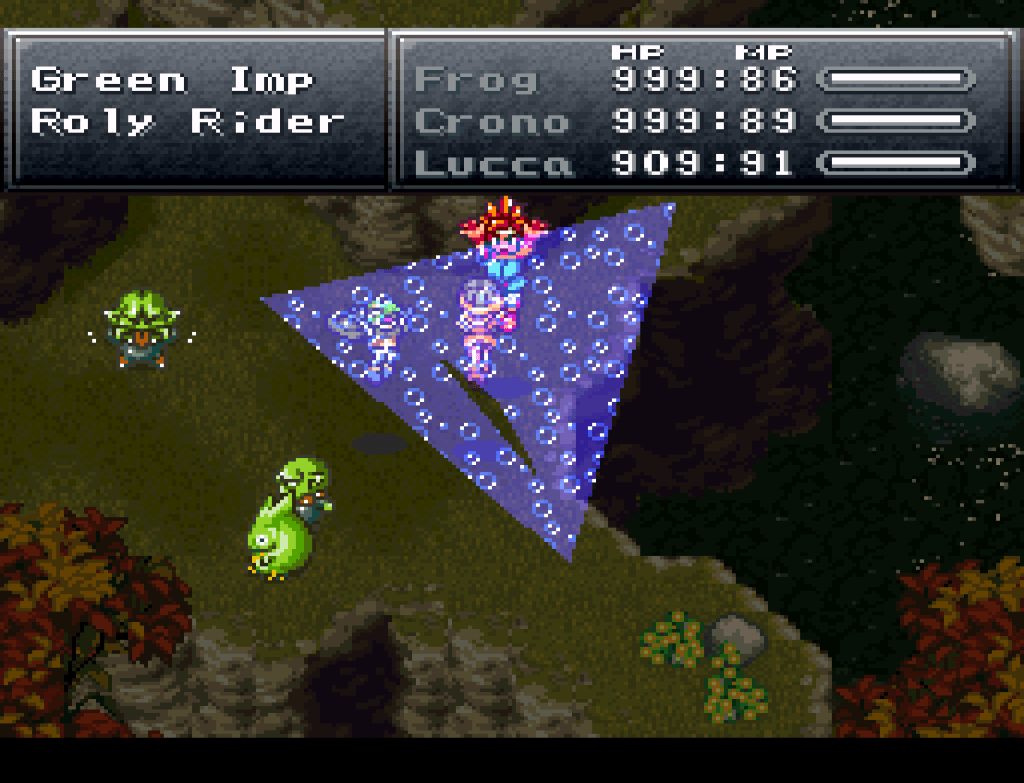
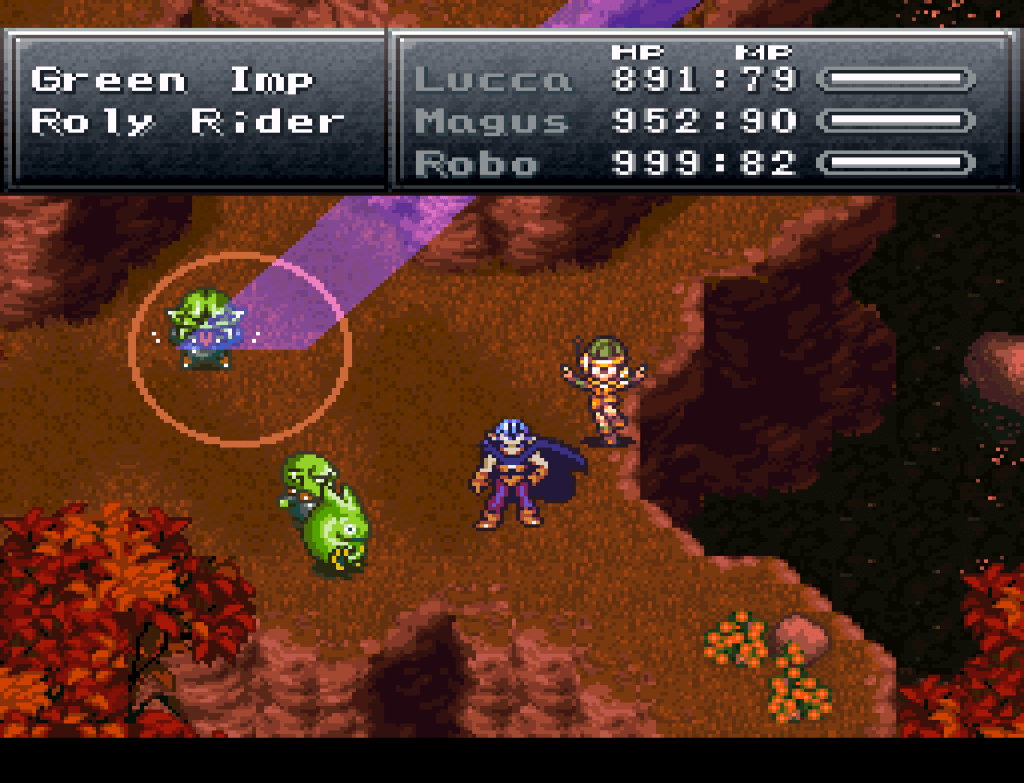
By giving the player flashy techniques, some of which can only be obtained via equipping items obtained in sidequests, it gives some incentive to go out there and explore the world. You don’t actually NEED any of these abilities, but it feels nice obliterating enemies with these overpowered and cool looking moves.
My first time playing Chrono Trigger was loading a new game plus file. I distinctly remember busting out a Frog and Crono dual tech move called ‘spire’ which involves Frog jumping up and stabbing an opponent in the head and Crono summoning a bolt of lightning to kill said foe.
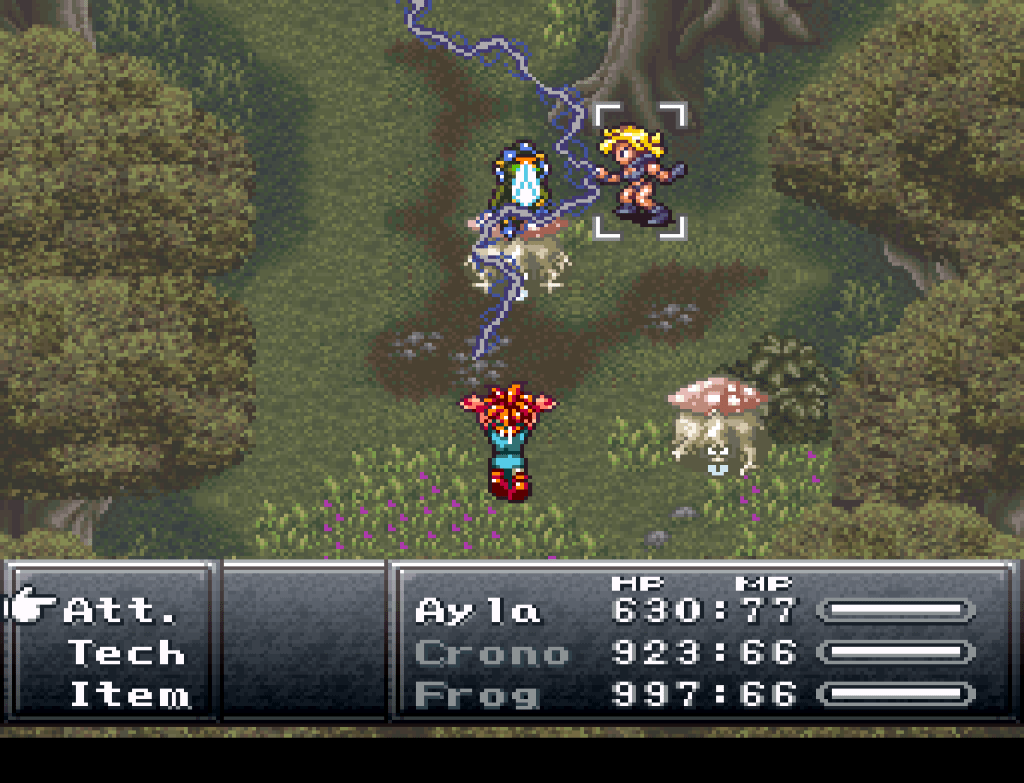
COMPLETE overkill against most opponents but it looked so cool that I had to see what other abilities were even out there. It’s like an early version of the complex summons from Final Fantasy VII. The reward is just seeing them in action sometimes.
Despite being fairly simple in terms of character growth, there are still experimentations to be had. Yes, there are definitely team combinations that are more useful than others, but no trio is useless. This game is easy! The player can clear the game with any group of characters they want – so you’re never really punished for trying something new. In fact, you might discover something cool!
Time period discussion
- Present – 1000 AD
- Middle Ages – 600 AD
- The future – 2300 AD
- The End of Time – ∞
- Prehistory – 65,000,000 BC
- The Dark Ages (Antiquity in later versions) – 12,000 BC
- Apocalypse – 1999 AD
- Playable characters
Throughout Chrono Trigger, the player has access to seven different time periods. So why not break them down a little bit and talk about some interesting elements in each one?
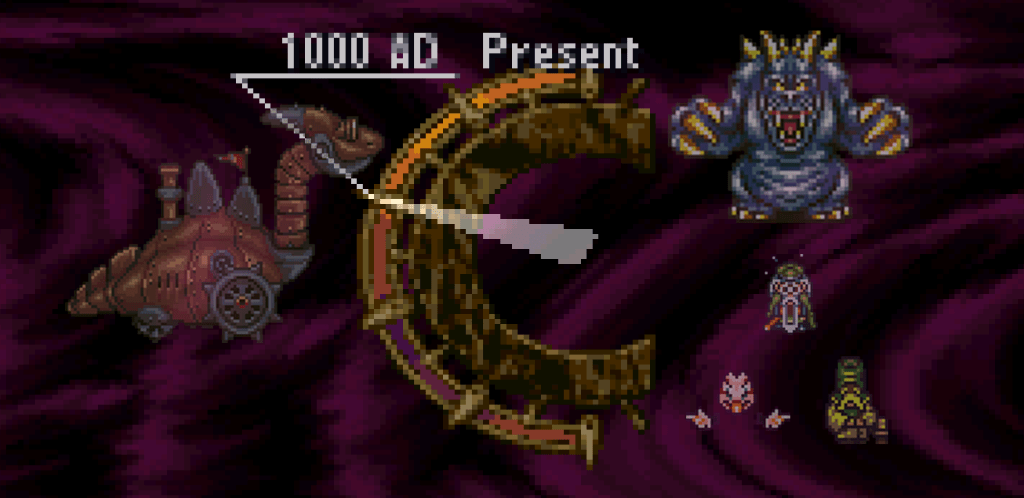
Present – 1000 AD
As you can guess by the name, this is the baseline time period of the game. Three of the party members, and arguably the most important ones, are from this time period. It’s a pretty modern take on a primitive society – with the reason being that they need to show meaningful progression from the most recent period of time players get access to, 600 AD.
This period of time may not seem important since on the surface this game is about going to the past and changing the events of the future. But a lot of the more memorable moments of the game take place here. Let’s break one of those down, shall we?
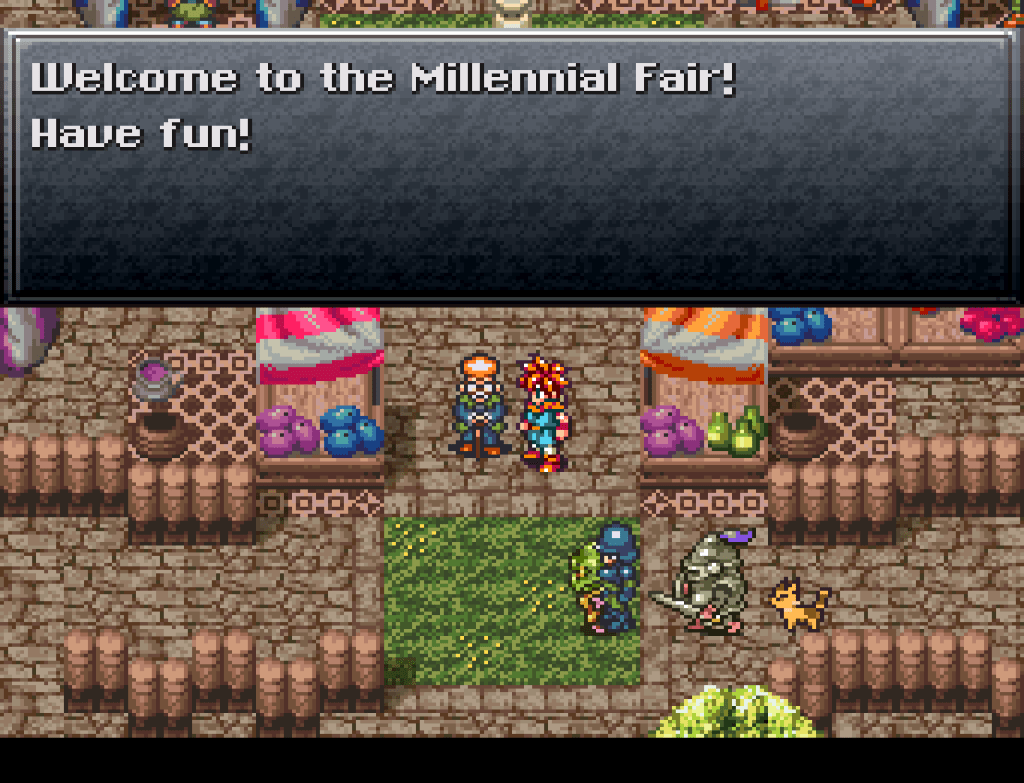
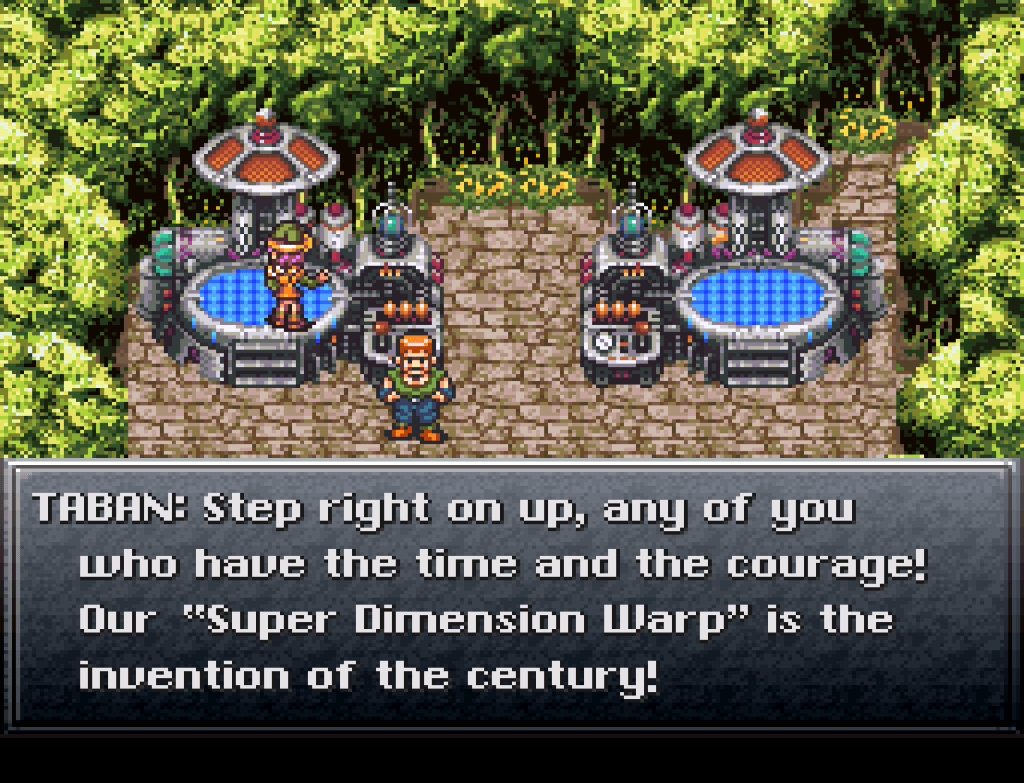
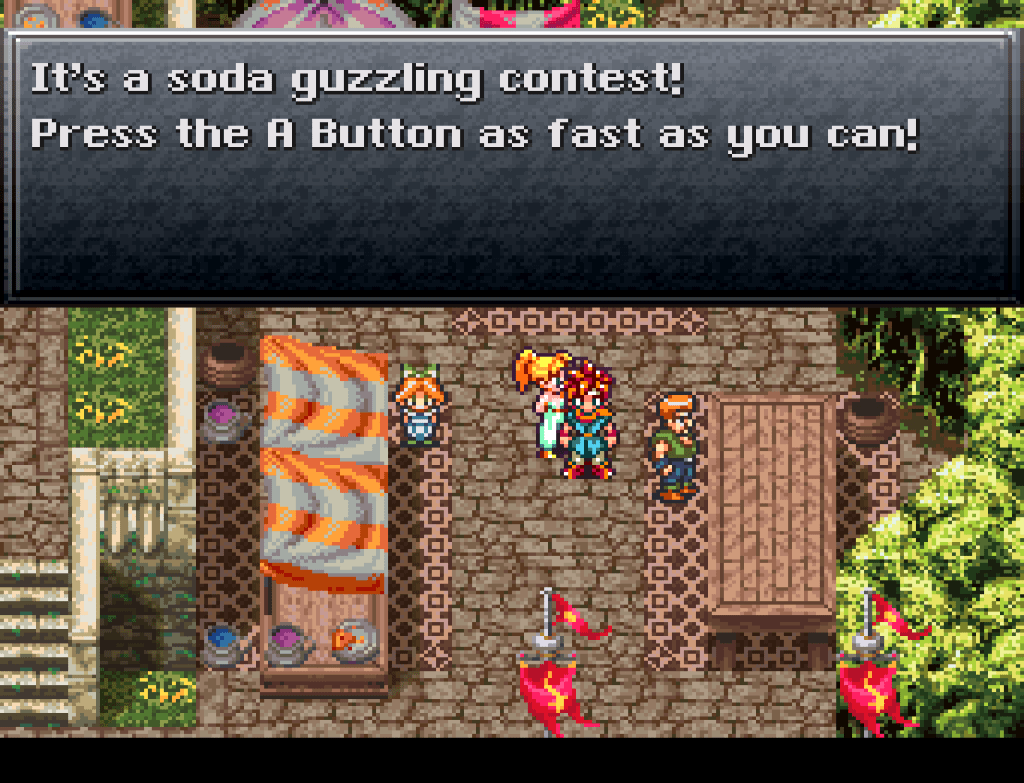
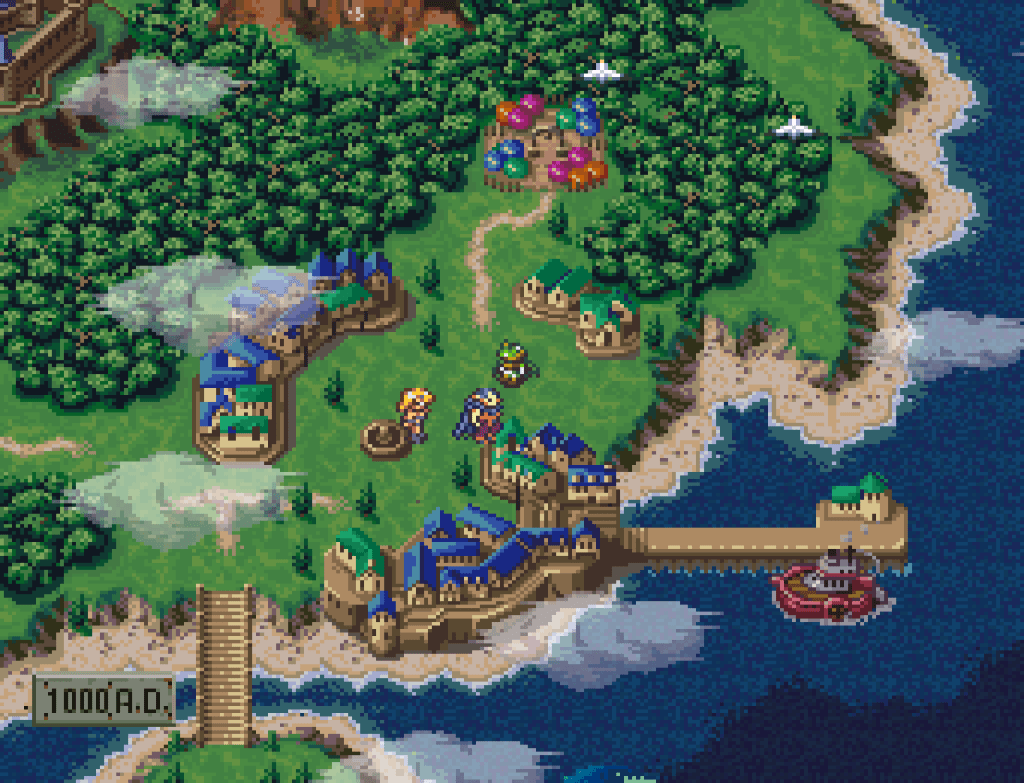
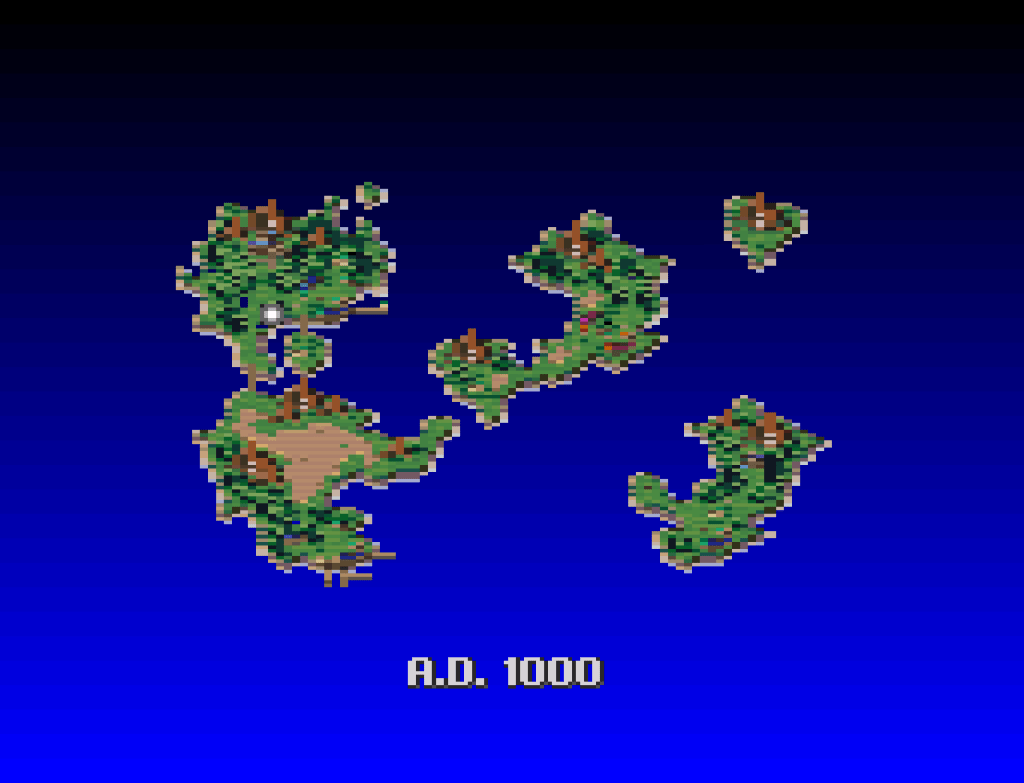
The game starts off with the main character, Crono, encountering the princess of Guardia (he doesn’t know she’s royalty yet) – Marle – at a fair to celebrate the turn of the millennium. The adventure gets started when Marle gets sucked into a time portal during an experiment put on by Crono’s childhood friend Lucca. Crono goes back to the past, saves the princess and returns her to the castle.
You’d expect a hero’s welcome…right?
Wrong! It’s a video game and they gotta give the party a reason to get back in the time portal. Back in the past, Crono rescues the kingdom’s chancellor from an evil monster who was impersonating him. A bit of dialogue that appears to be throwaway happens if you speak to him on your way back to the present – he mentions that he wants to reform the criminal justice system. So for changing history, our brave hero now gets to feel the brunt of this new criminal justice system!
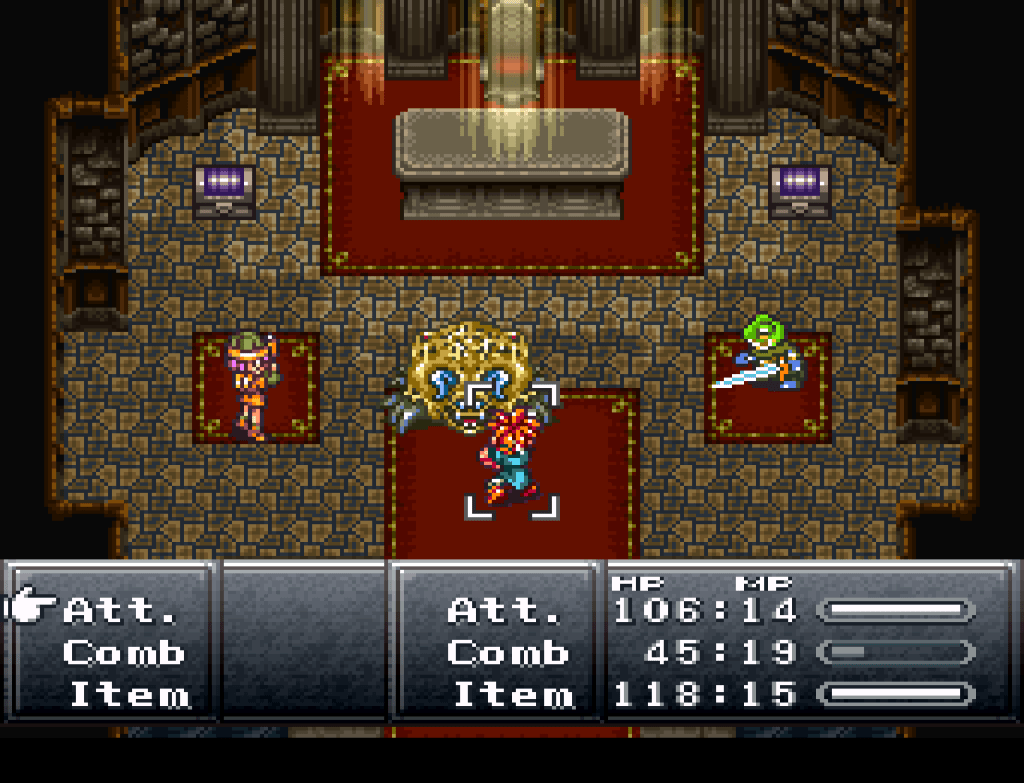
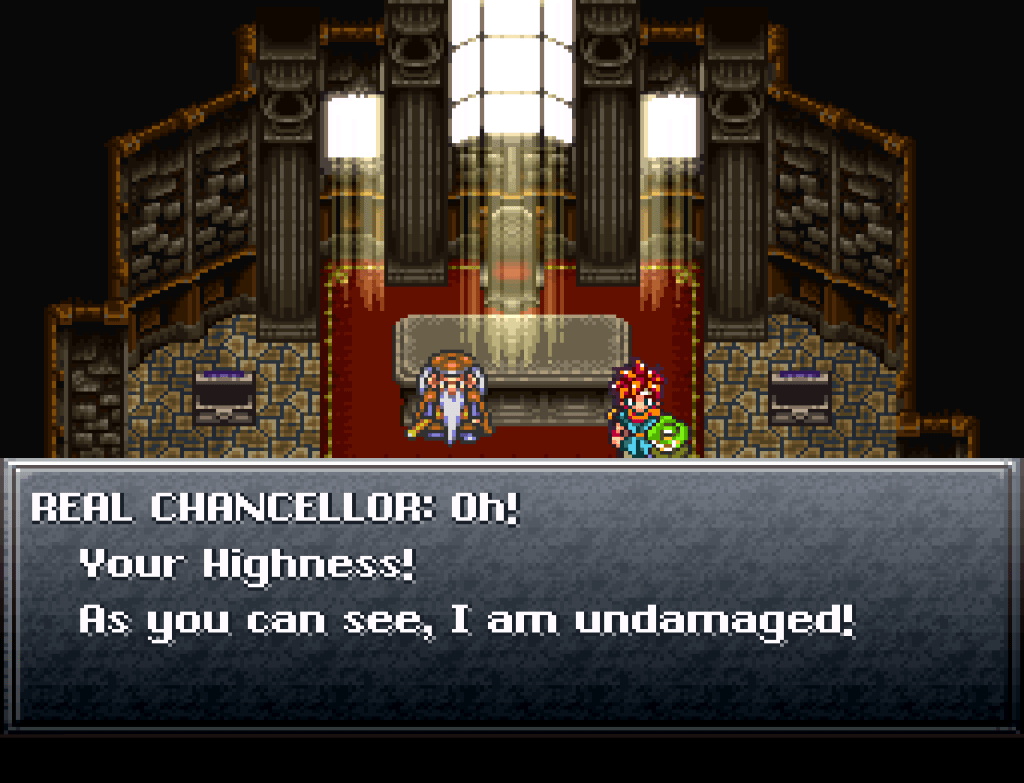
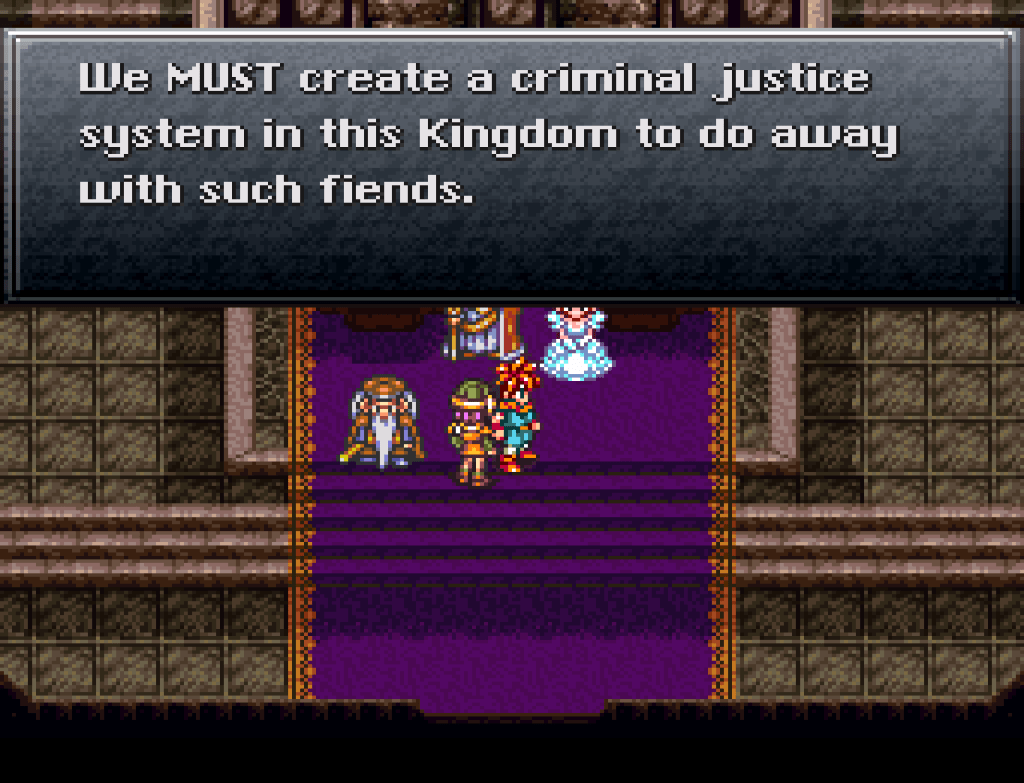
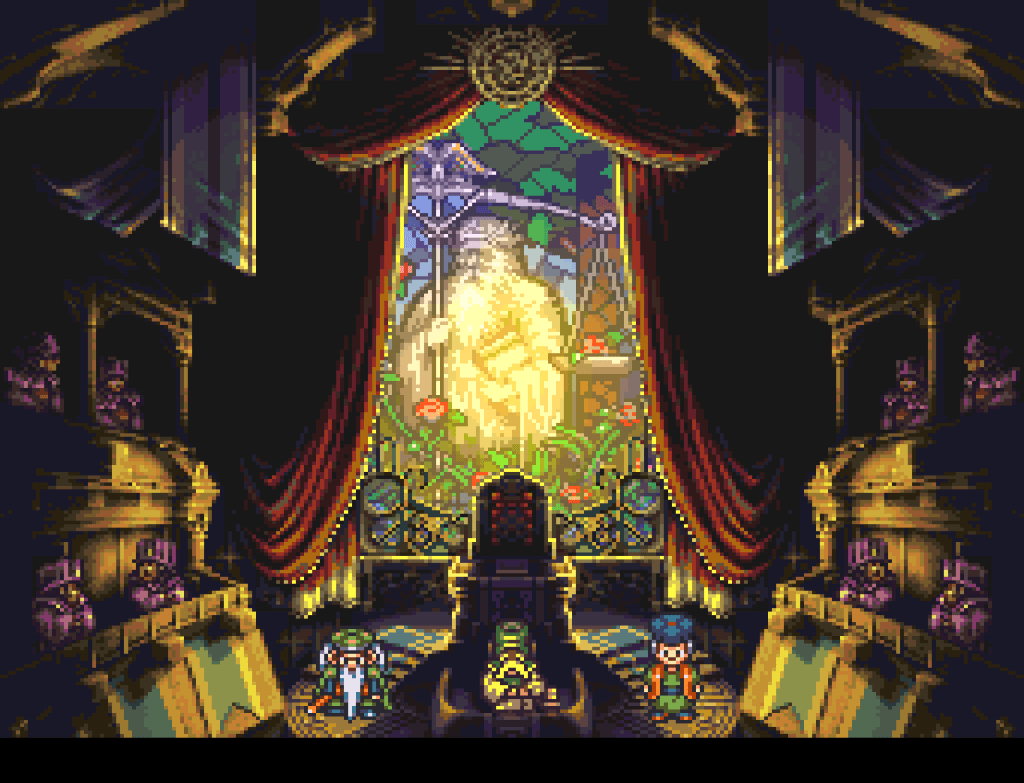
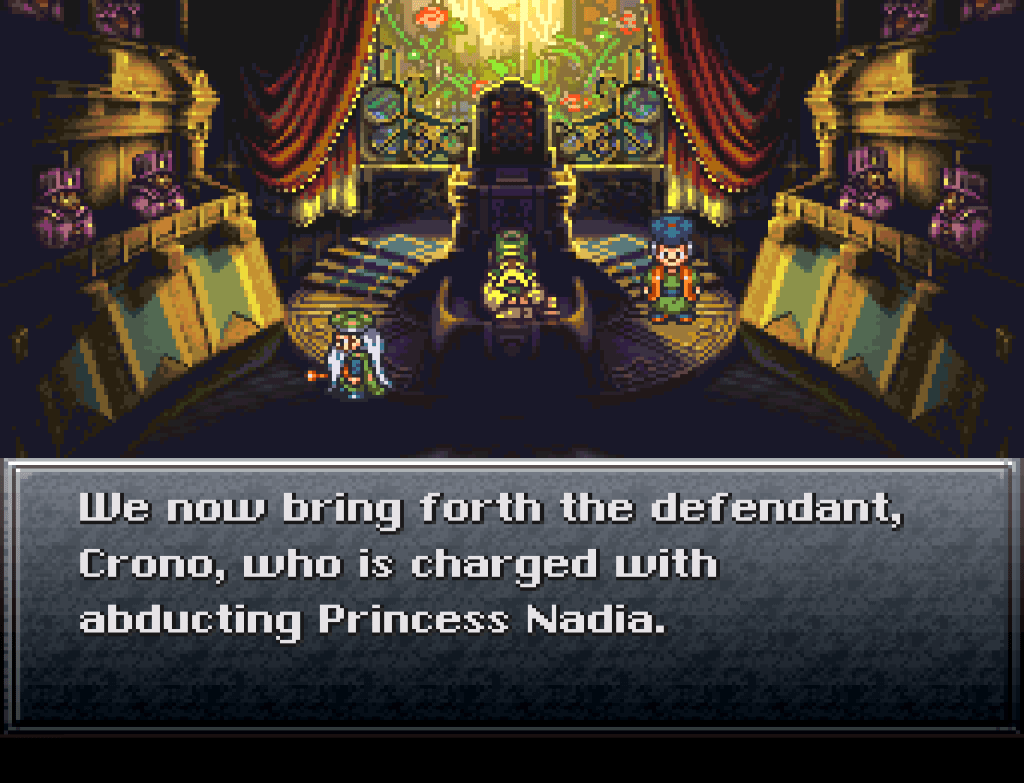
The chancellor puts the player through a trial now and the way this works is a bit of genius, an example of gameplay impacting the story being told. They essentially guess how the player is going to approach the beginning of the game and then throws it back in your face.
You meet Marle by running directly into her. So what did you do IMMEDIATELY after slamming into her? Well, an item pops out. Most players will go ‘oh shit, what’s that?’ and grab that first before talking to her.
And the game expects this and chastises you for it, using that as evidence that the player cared more about this trinket than the well-being of the princess. Similar events occur too. There’s a pink satchel that is just begging to be interacted with right by where you fight the above-mentioned Gato. It’s a lunch and it restores your HP and MP completely.
The problem? That item belonged to someone else and the player took it without asking! So the chancellor will use this as a way to further smear your character. Later, Marle wants candy and asks Crono to wait patiently. This takes a few seconds and I reckon they expect most players to fidget with the controls while this is going on to see if they can still move. But if you do this, it’s further evidence that you’re a jerk! You’re hurrying this poor lady along!
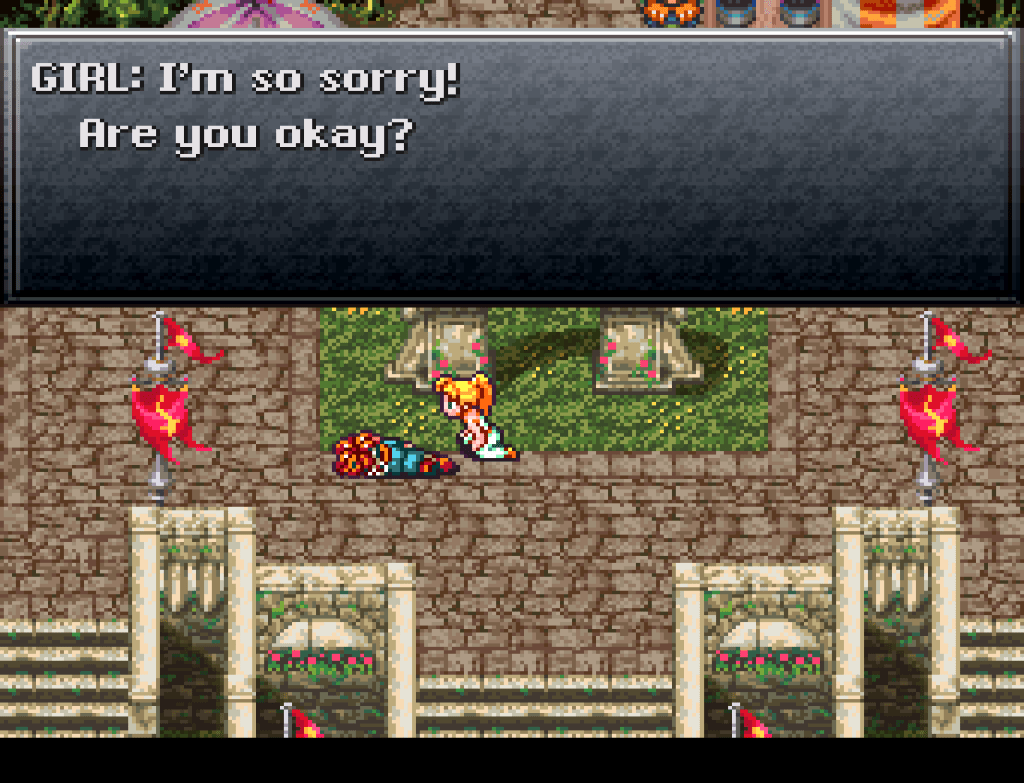
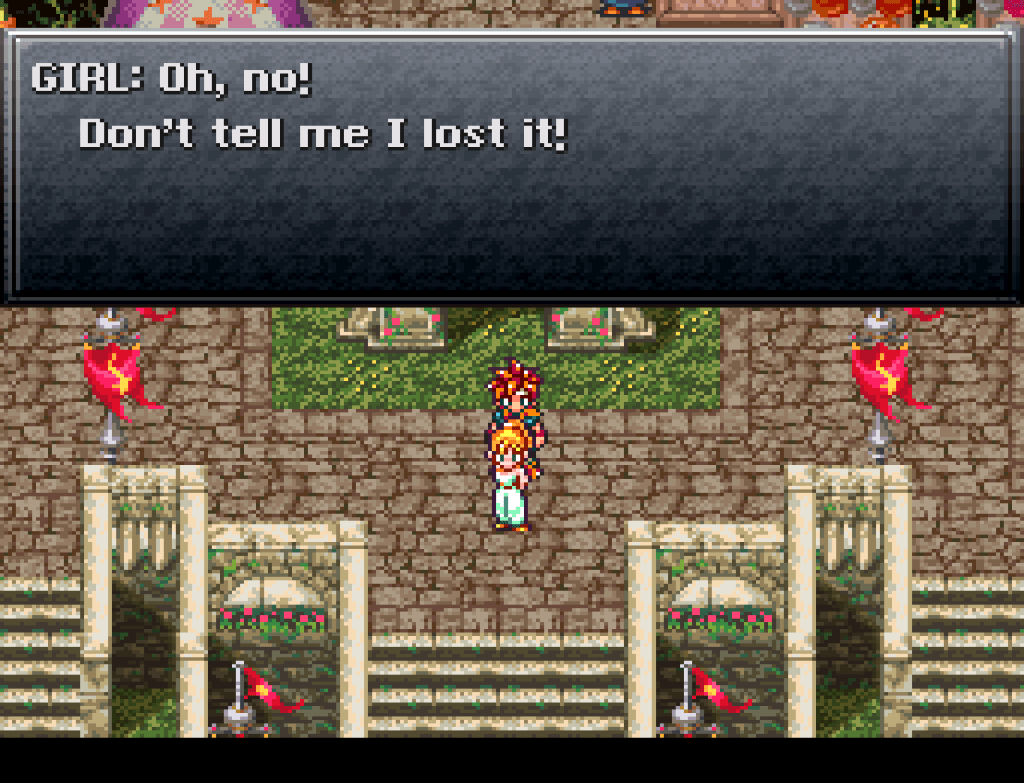
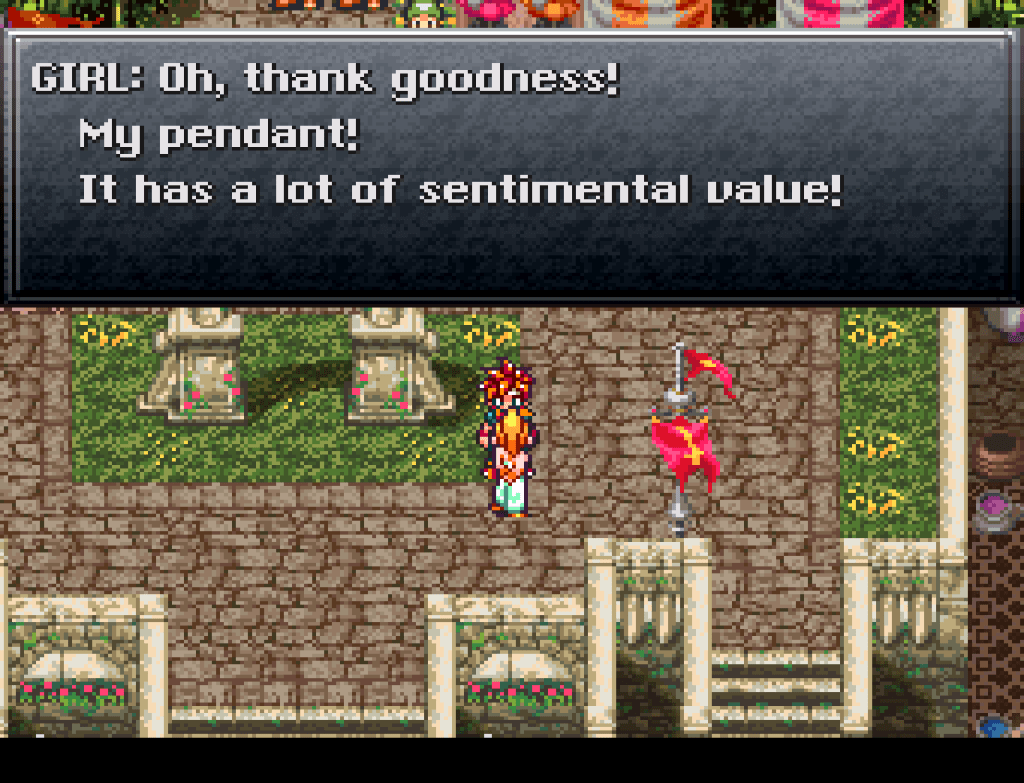
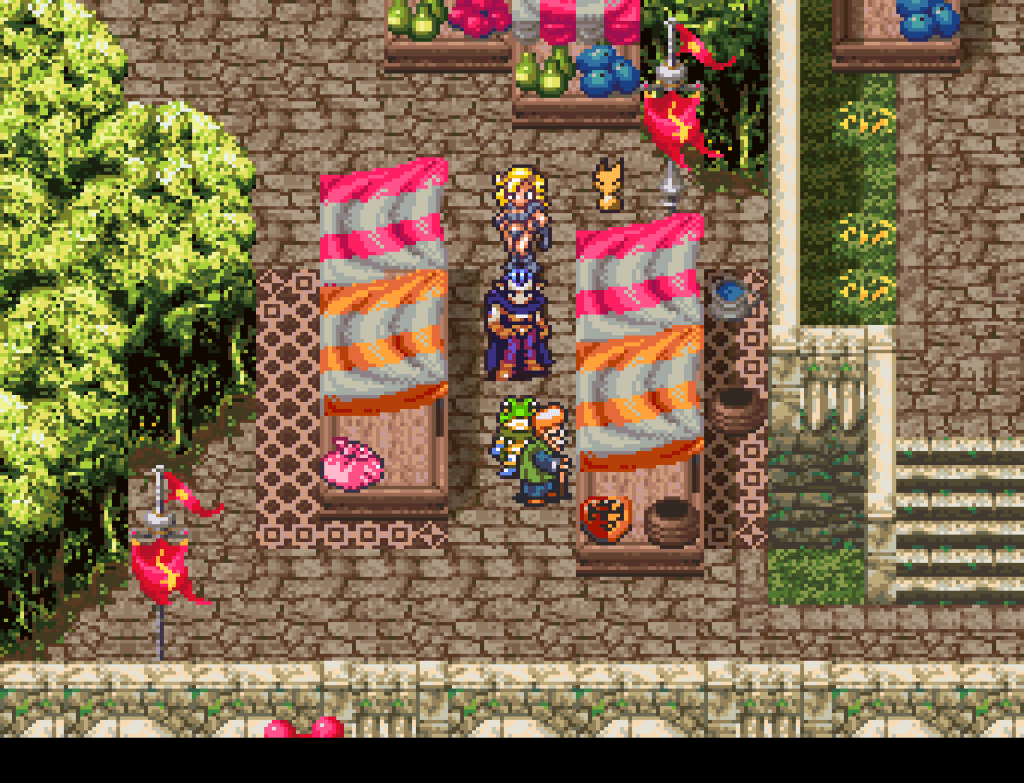
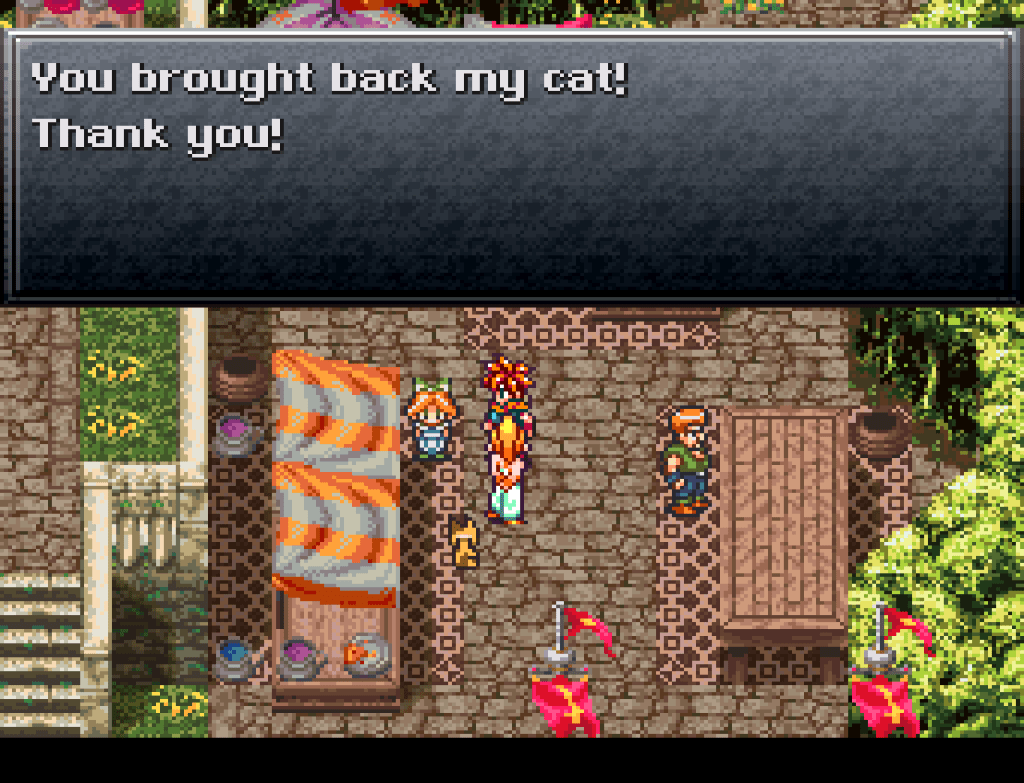
Really the only ‘positive’ I think they expect the player to do is returning a lost cat to a kid. When you’re on trial, all of these things get thrown at you and as the player, it really feels like you’re being thrown under the bus. But the thing is, you did do this. You can’t explain it away, Crono did do those actions, even if the reasons for doing them are far less sinister than what the chancellor is suggesting.
So of course the player gets found guilty, which leads to a fun escape sequence from a prison dungeon. If playing on a New Game Plus, you’re going to be aware of these things and may approach the beginning segment differently.
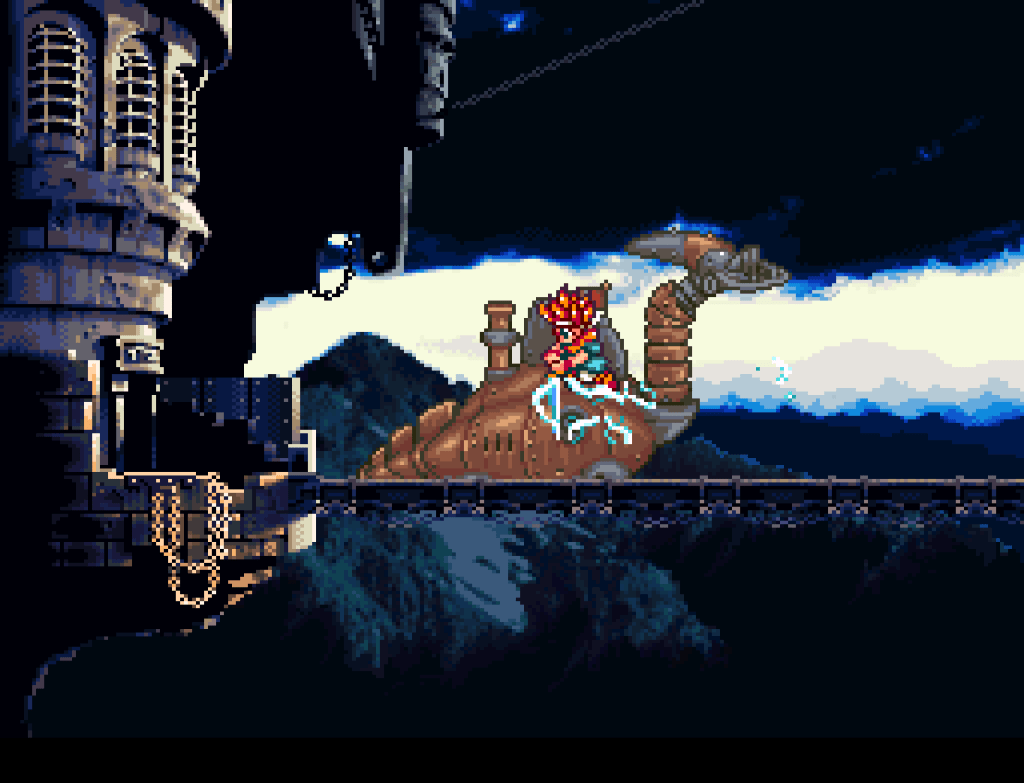
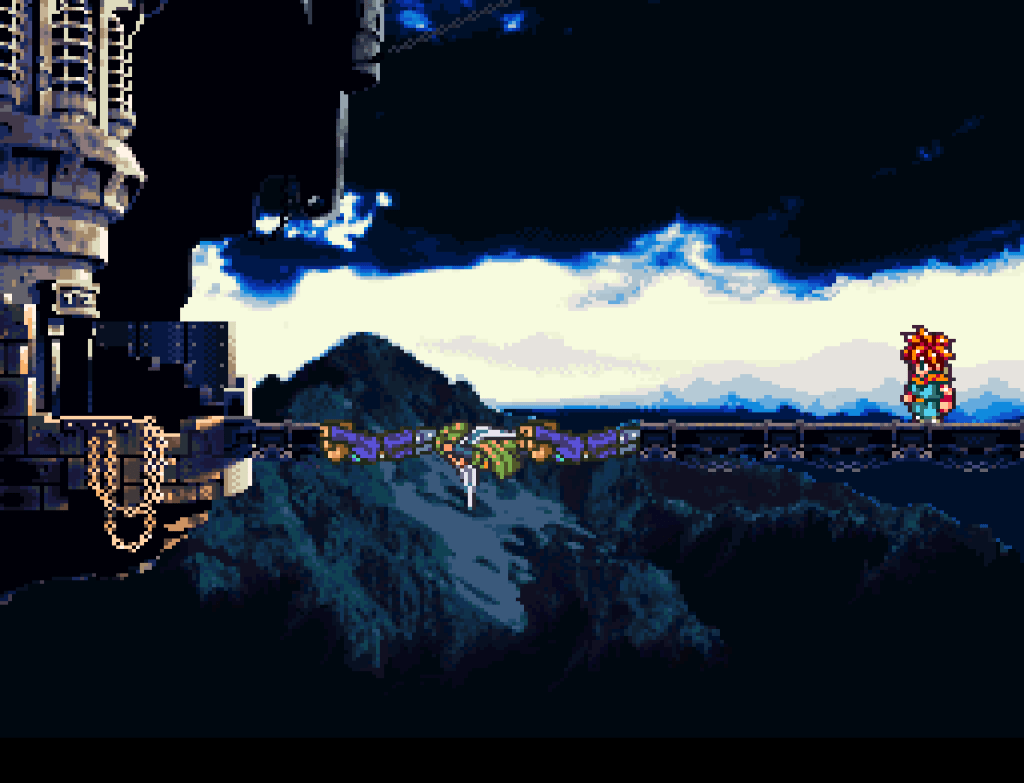
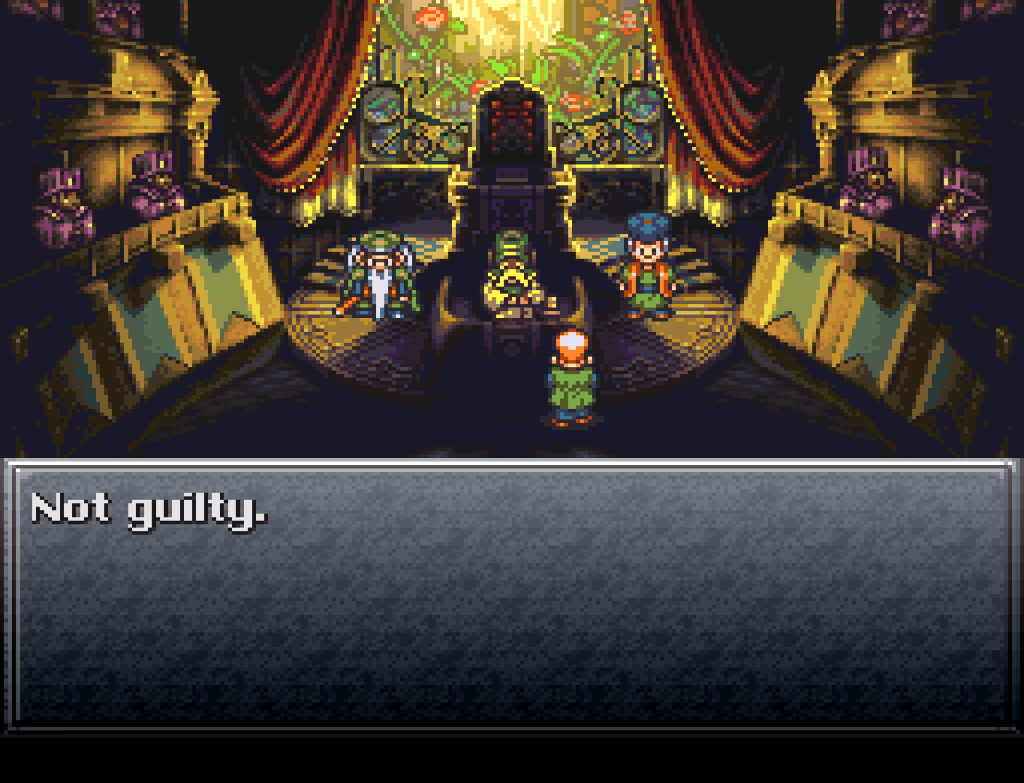
I have done this basically every single time I have replayed Chrono Trigger. And indeed, you will be found not guilty! However, a person returning will know that the chancellor is just corrupt in general, so it’s of no surprise that it was all a sham and knowing how to be found innocent doesn’t really change anything.
But hey, being found not guilty is still cool.
After this, most of the time the player spends in the present before the end game is spent in a magical village called Medina. The whole purpose of this place is to help establish how monsters in this universe are sentient beings with thoughts and feelings. It also helps push the player forward to what first-timers may think is the true final boss, Magus.
The interesting thing about Medina is how the villagers treat your main party. All of the citizens here despise humans and it’s reflected in everything. They talk poorly to Crono and when the player tries to shop – a natural thing to do in an RPG when you get to a town for the first time – they will up charge the crew an insane amount for even basic items. So if the player isn’t thinking, they may purchase a tonic (potion) for about a 700% markup. Ouch!
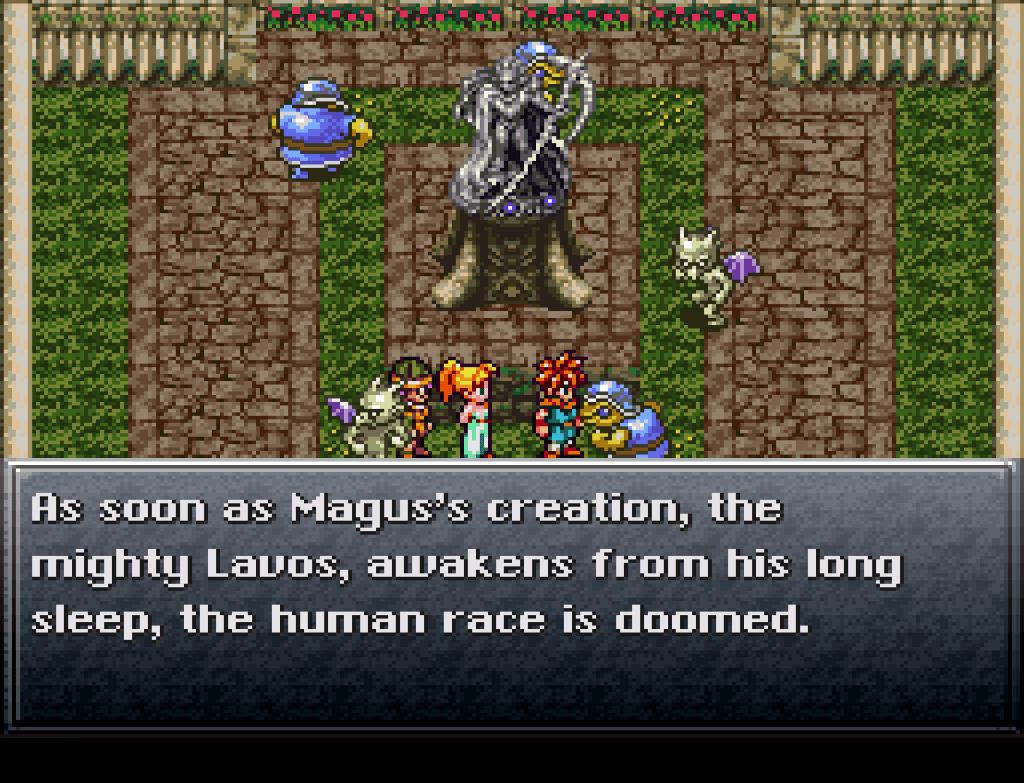
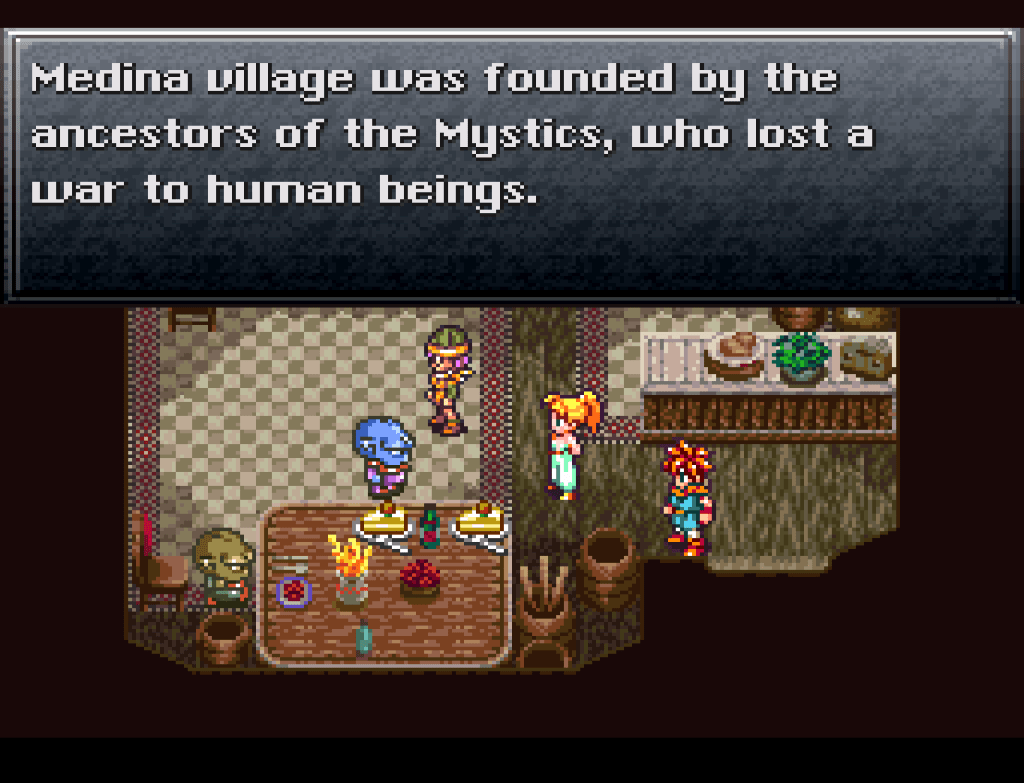
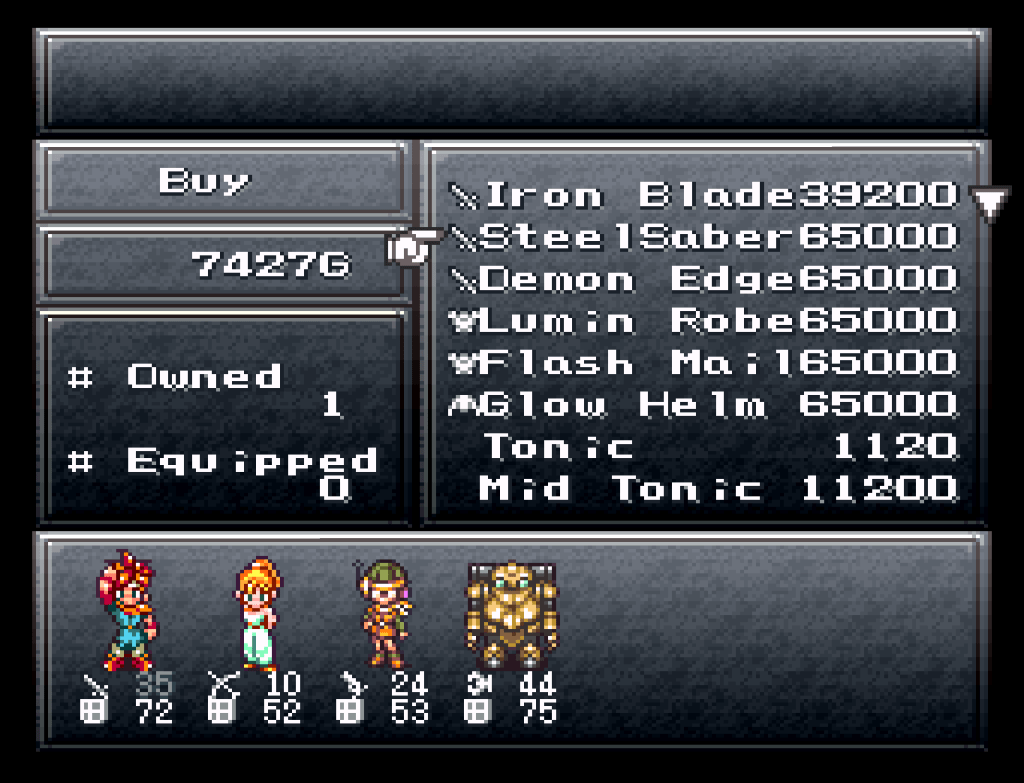
At the end of the game, when things open up a little bit, the player can undertake a sidequest that involves taking out the remainder of Magus’s forces from 600 AD. After completing this, if the player goes back to the present, the attitudes in Medina have completely shifted. Now they LOVE humans and think peace is just nifty. It’s interesting talking to NPCs after this – it really feels like your actions did change the world!
The present gets a lot of this during the end of the game. The middle portion of the main continent has a vast desert on it – but if the player goes back to 600 AD, they can start building a forest there. When you return to the area after doing this, the entire area is transformed. There’s even a chapel that sells useful MP restoring items that can’t be bought elsewhere!
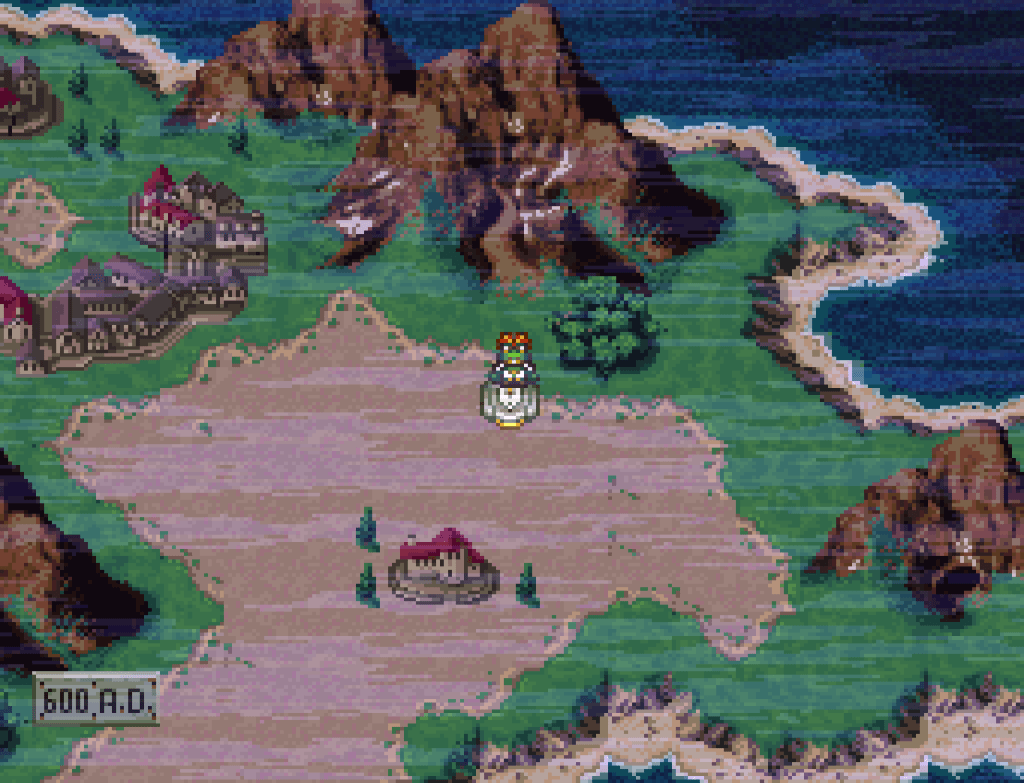
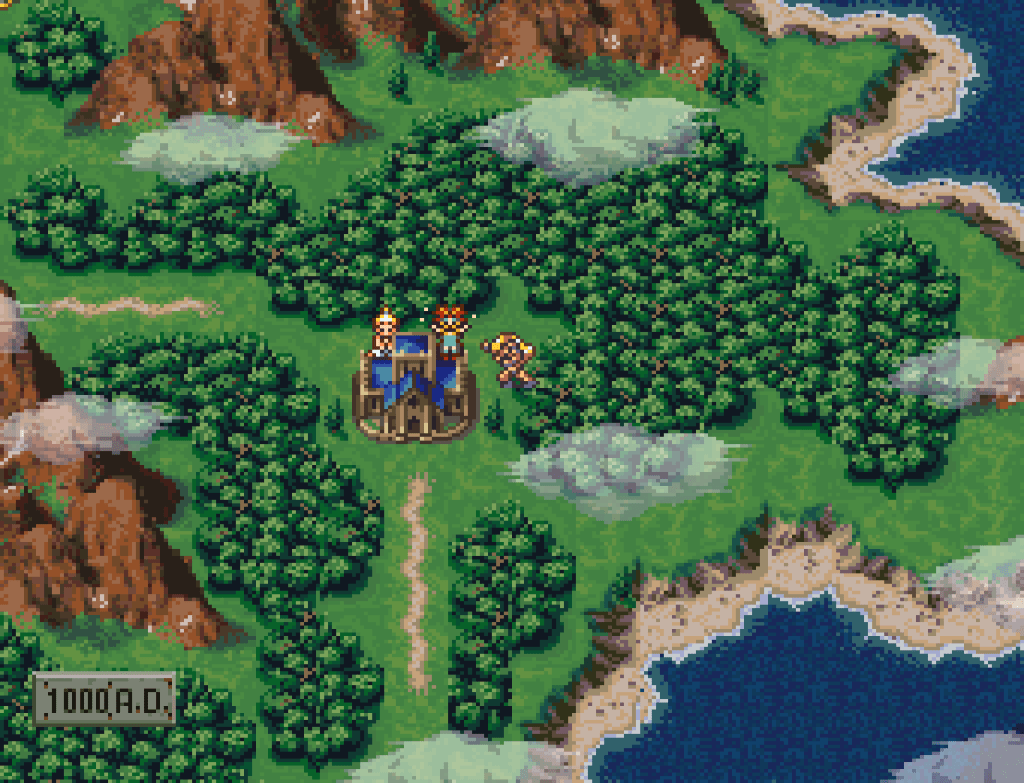
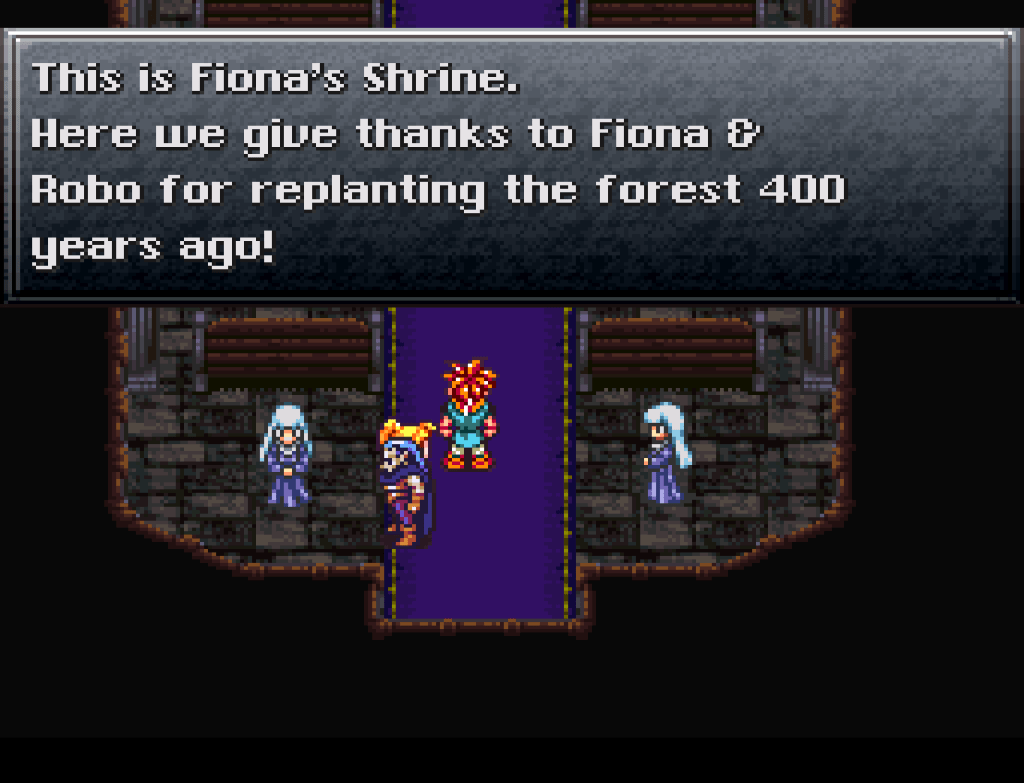
It may not seem like much, but little changes like this help immerse the player in the world. These sidequests are hinted at to the player by way of an NPC rattling off dialogue. Each line they say is accompanied by a quest. By the time the player realizes this, each new line becomes a hint at what’s going on in the greater world. One particular line generated much panic.
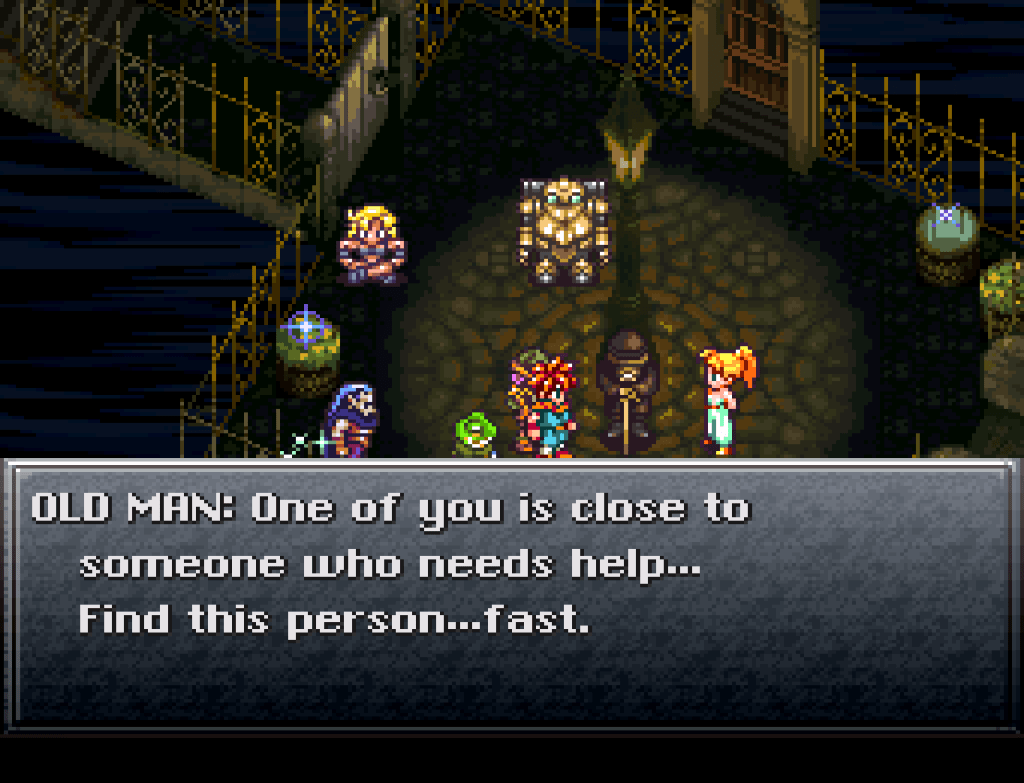
Like holy shit, what did he mean by that? If I don’t do something someone will die!? This game just got done killing the main character when the player sees this dialogue for the first time, so it’s entirely reasonable to assume they could pull this trick again! But really, this is just a mistranslation that’s meant to say something like ‘your friends have quests for you, talk to them for hints!’
But the urgency of this dialogue fueled my imagination and had me hunting up and down the world for how to fix it. Simply beating all the sidequests will get him to shut up. It’s something people would bitch about today, but I really adore this mistranslation.
1000 AD is sort of the default world and is probably the most ‘boring’. It’s also the one that most easily shows changes the player made through their actions, so even if it is a little plain, it’s all good.
Middle Ages – 600 AD
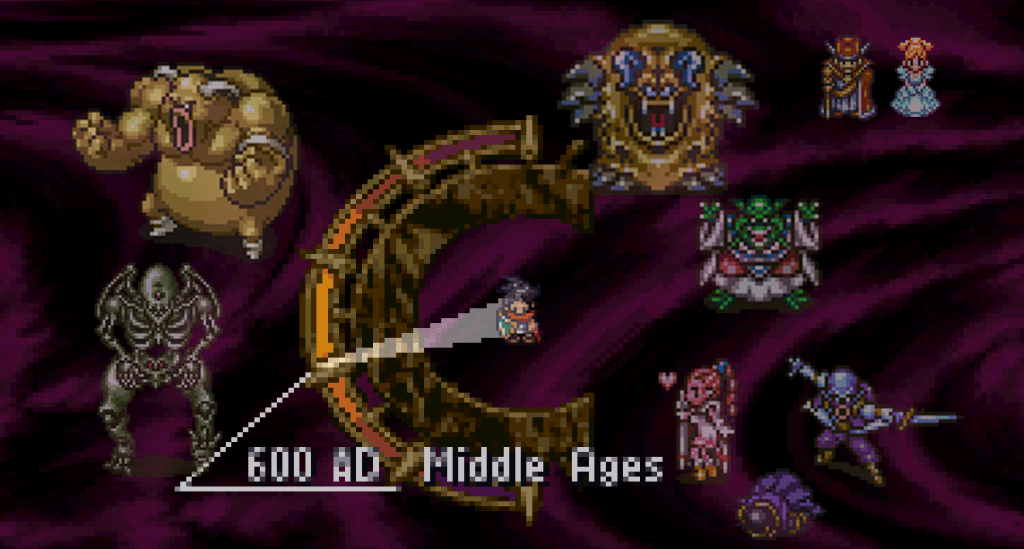
When Marle steps into the time portal that appears at the Millennial Fair, she gets swept back into the middle ages. A time when kings and knights could be seen in…wait, they still exist in the present? Well, I guess the overworld tint is slightly blueish!
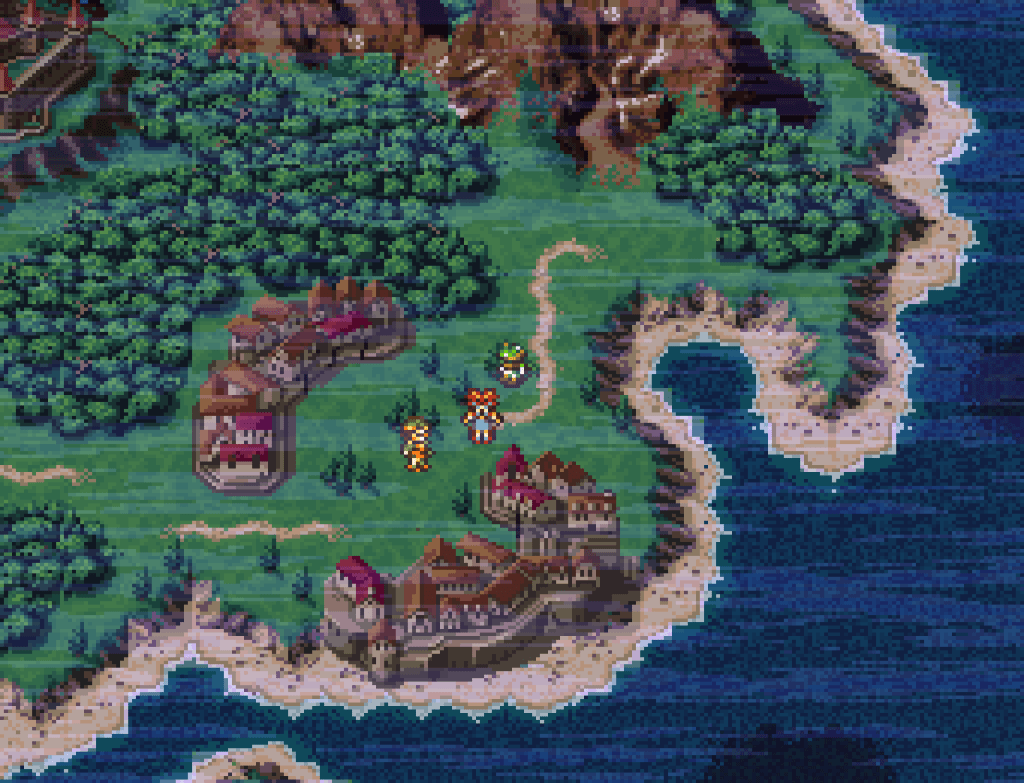
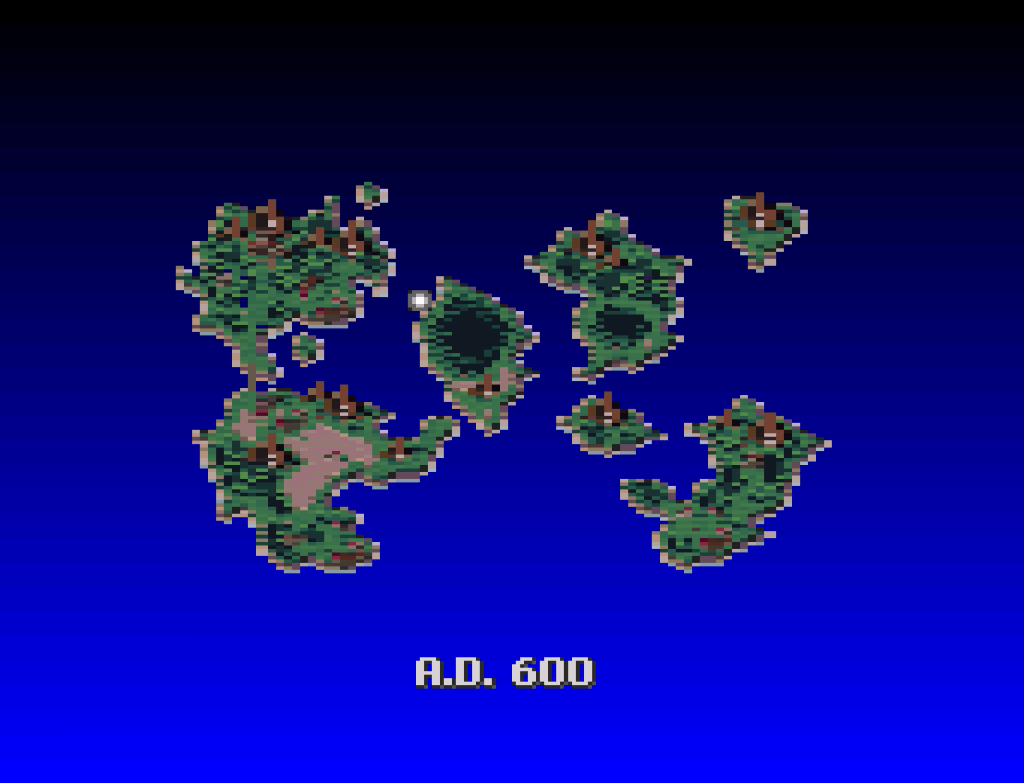
This is the player’s first step into a different time period and comes off a bit like ‘dipping your toe in’ when it comes to time travel. A lot of what the player sees looks very similar to what’s in the present, but there are clear differences. There are more monsters roaming around and there is a war going on against a group of human hating monsters.
It also gets the player more used to the idea that not being traditionally human does not mean someone is a bad guy. The first character from the present to join your party, Frog, is in 600 AD. And as his name suggests, he is a Frog man! It’s not a dramatic shift, but it immediately tells you that you’re going to encounter some weird looking guys on your journey and that dismissing them because they look different might be a mistake.
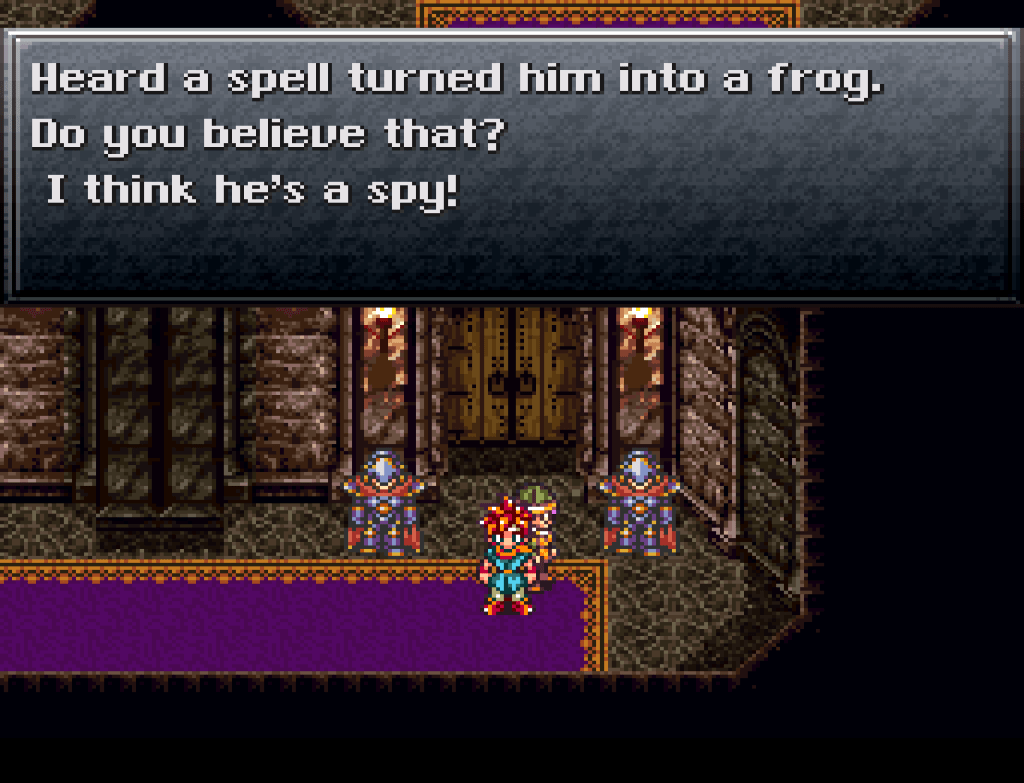
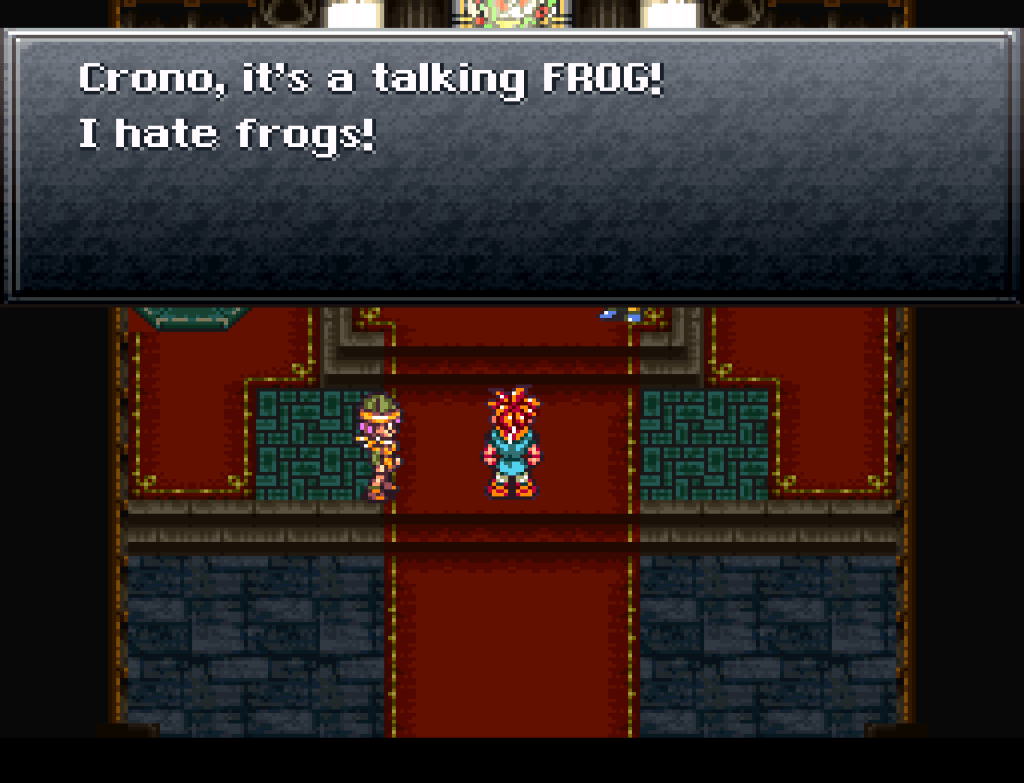
Each main era of Chrono Trigger has a playable character with that age acting as a bit of characterization for them. A lot of the time spent in the middle ages is dedicated to learning about Frog. His origins (i.e. why he’s a frog man) are delved into in great detail and one of the most important figures of the era, his mentor Cyrus, is dead from the moment you turn the power on. As the plot develops in 600 AD, so does Frog.
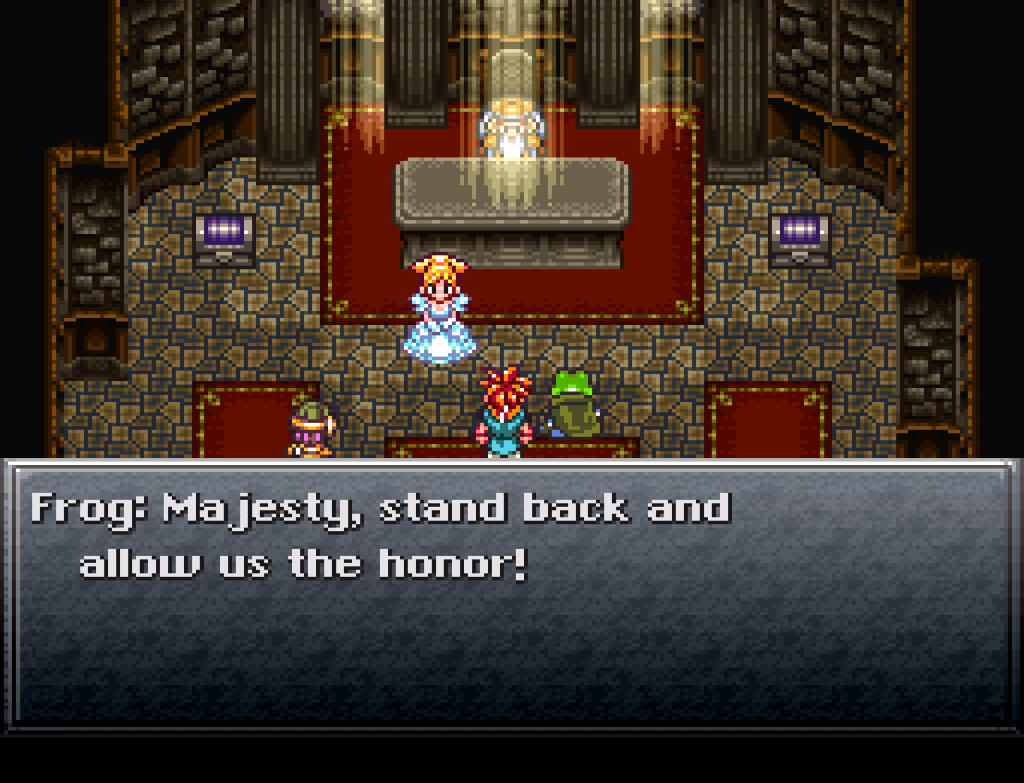
It’s important to note, as mentioned above, that Frog’s style of speech in the SNES localization is of olde English. Notably, nobody else in the game speaks like that – not even people of the same era. Heck, before Frog turns into a Frog, he doesn’t speak like that either! His human form just talks like anybody else.
The reasoning for this has to be tied to 600 AD being classified as the middle ages. They wanted something in his dialogue to symbolize his era. Why wouldn’t someone talk differently? The party member from the ancient past talks like a caveman, the robot party member is verbose…so why should Frog be different?
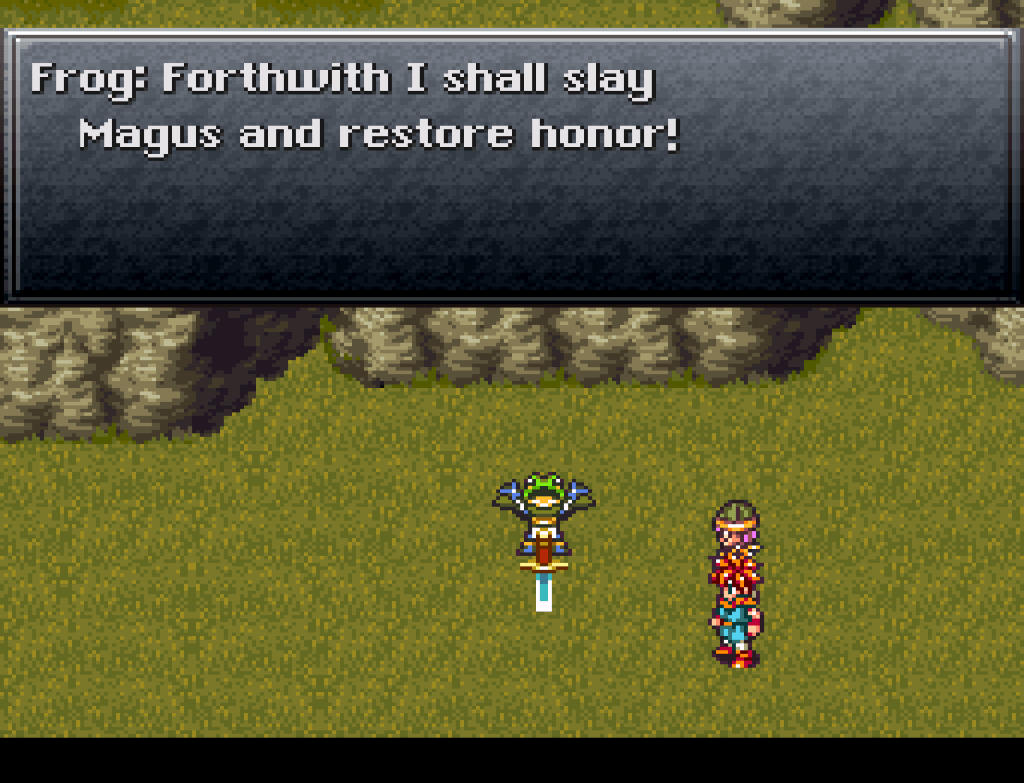
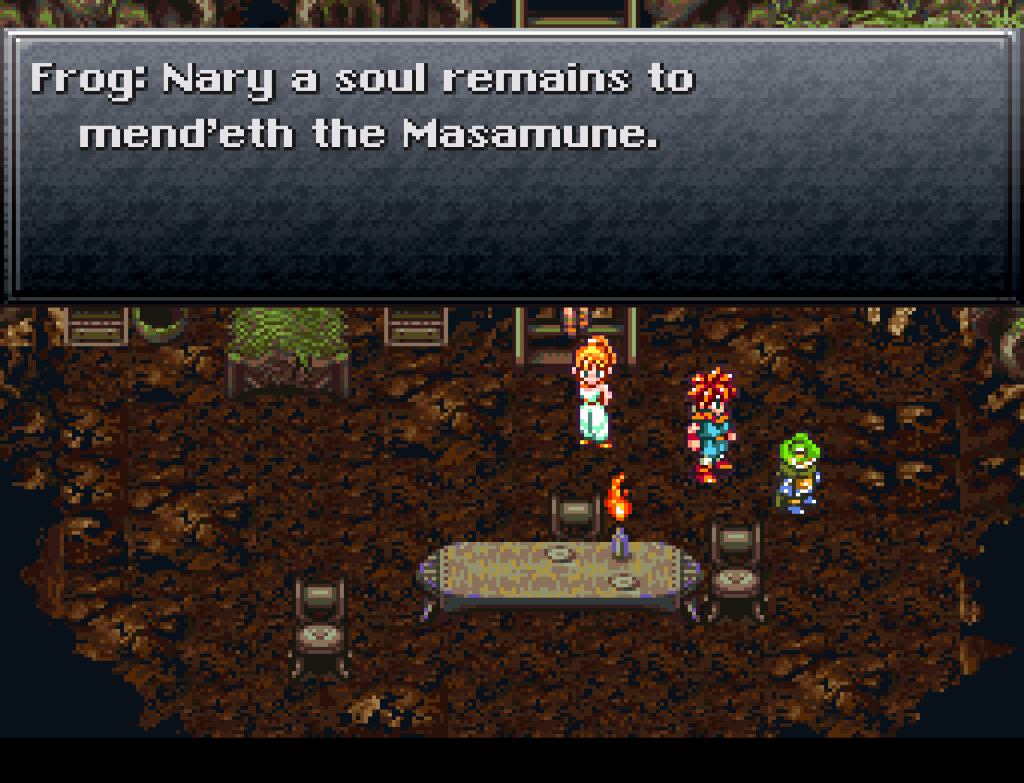
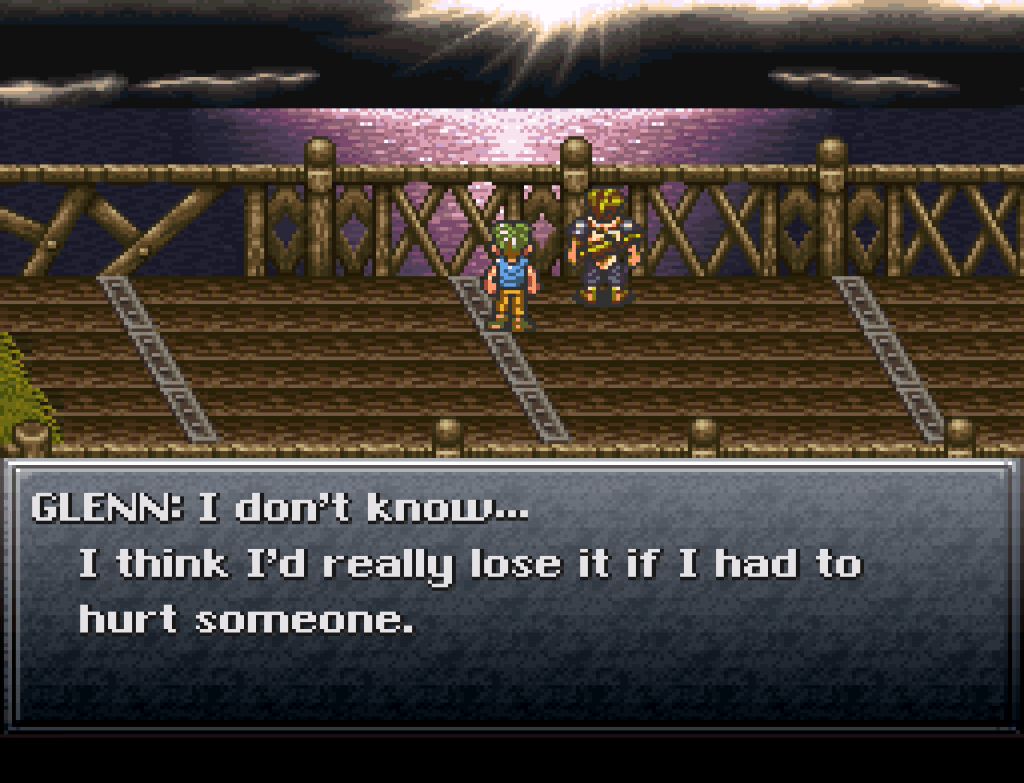
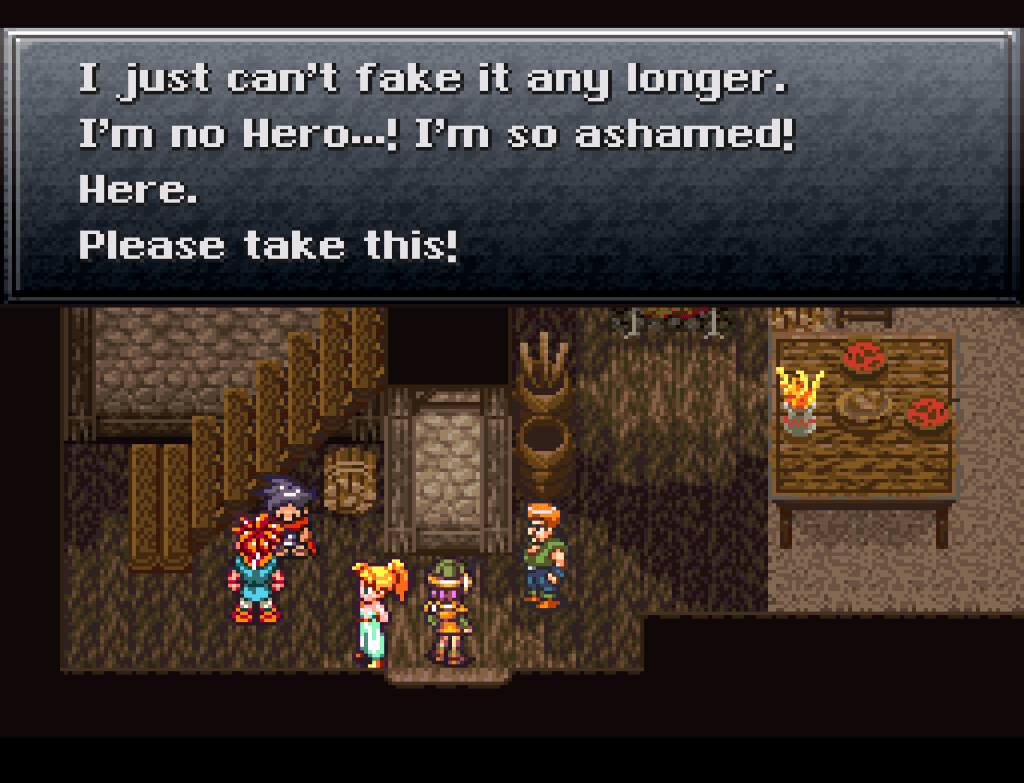
And as much as I love it, as much as I think this version of Frog is the definitive version of the character, it’s undeniable that everyone else in 600 AD talking like a normal person makes it a weird choice. It makes it feel like Frog got hit on the head or something. There’s a reason all future localizations removed this dialect – it’s either EVERYONE talks in thees and thous or nobody does. And they went with the more faithful route.
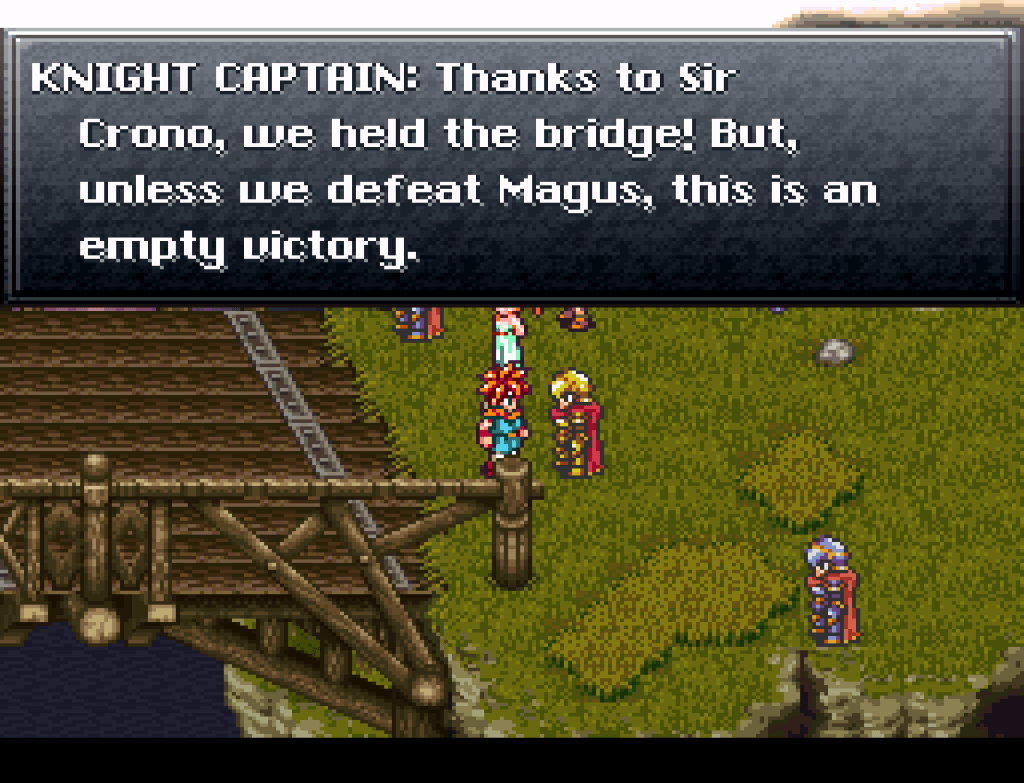
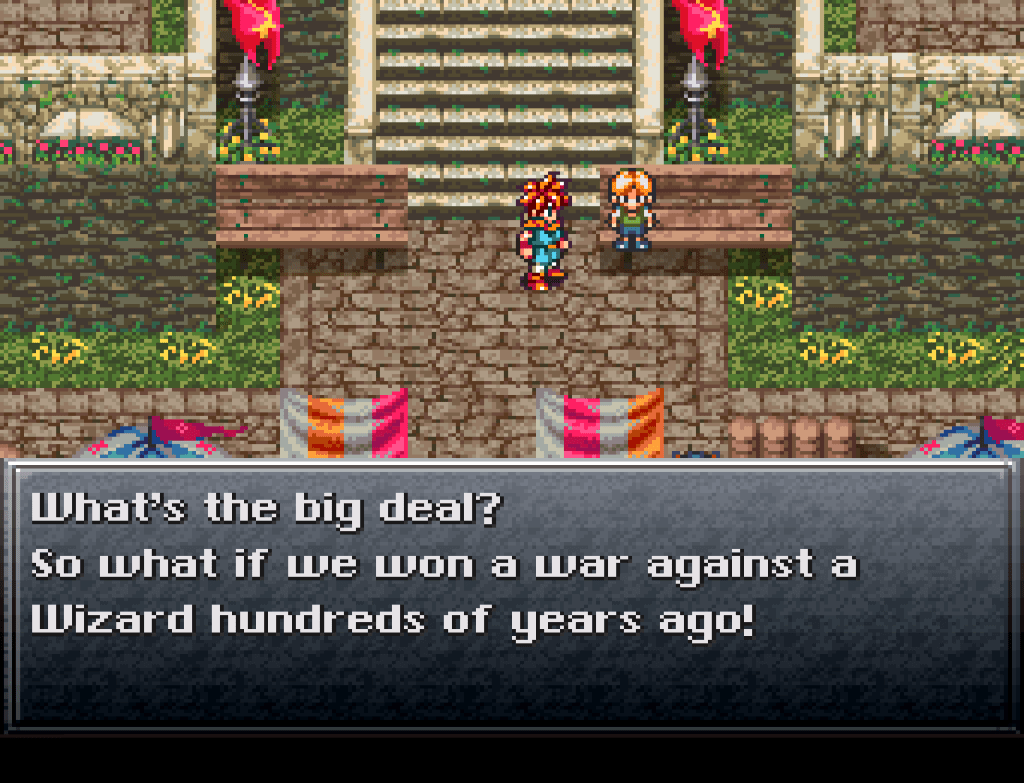
If the player spends a lot of time talking to NPCs before traveling back in time, you’ll see references to people or events from this era. One of the most prominent ‘past’ things that gets talked about is the war against Magus. You are fed little pieces about it in the present in order to build to the confrontation in the past.
600 AD functions as something of the centerpiece for the first half of the game. As mentioned above, when the player learns about Lavos, it’s discovered shortly thereafter that it is believed that Magus created the creature. So in order to stop the beast that will inevitably destroy society, the player joins up in the war.
This is not a unique observation, but it’s important to note that the first half of Chrono Trigger is spent reliving history. The player doesn’t actually change anything until near the end of the game with the sidequests – until that point is reached, most of the game’s attempts at changing history through time travel just ends in the player living through historical events of that world.
So since the war on Magus is an important historical event that shapes the world, you play through it and ultimately defeat the fiend. But getting to that point involves jumping to all sorts of different eras, it gets the player used to having to interact with the same part of the same world but in different eras.
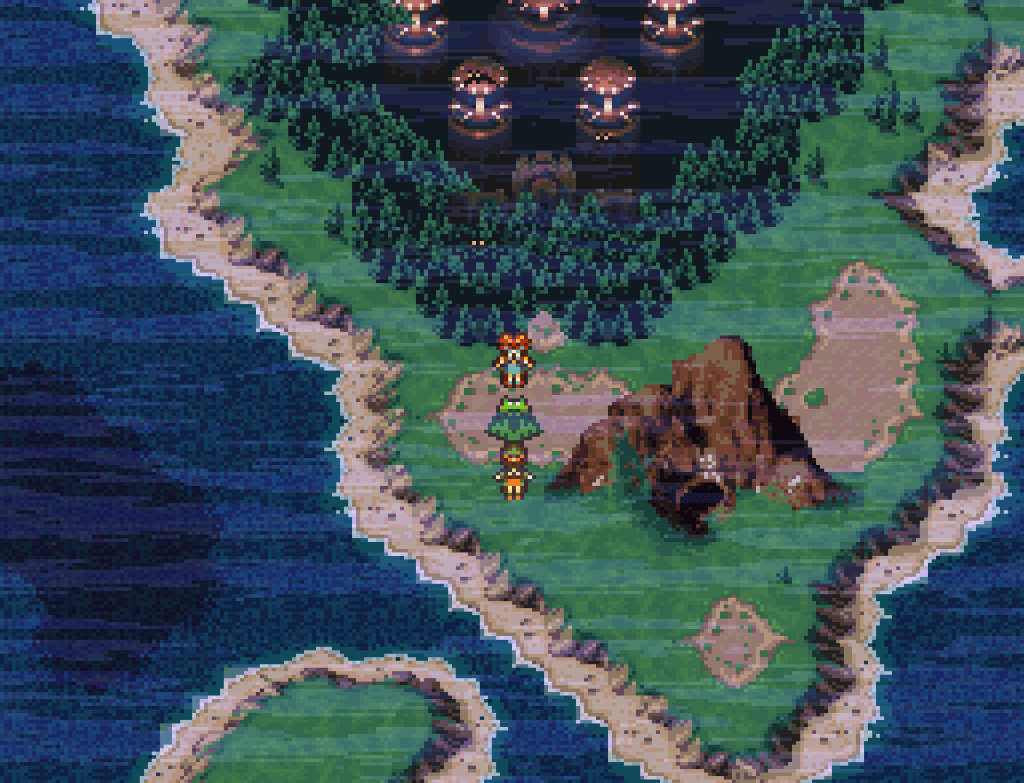
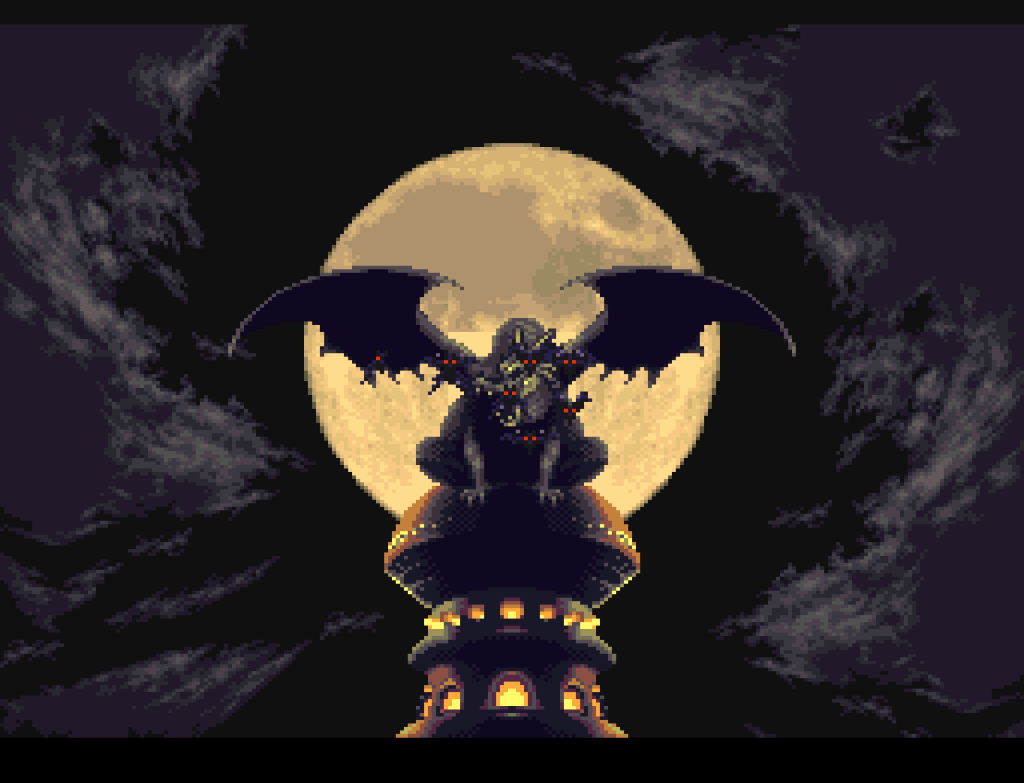
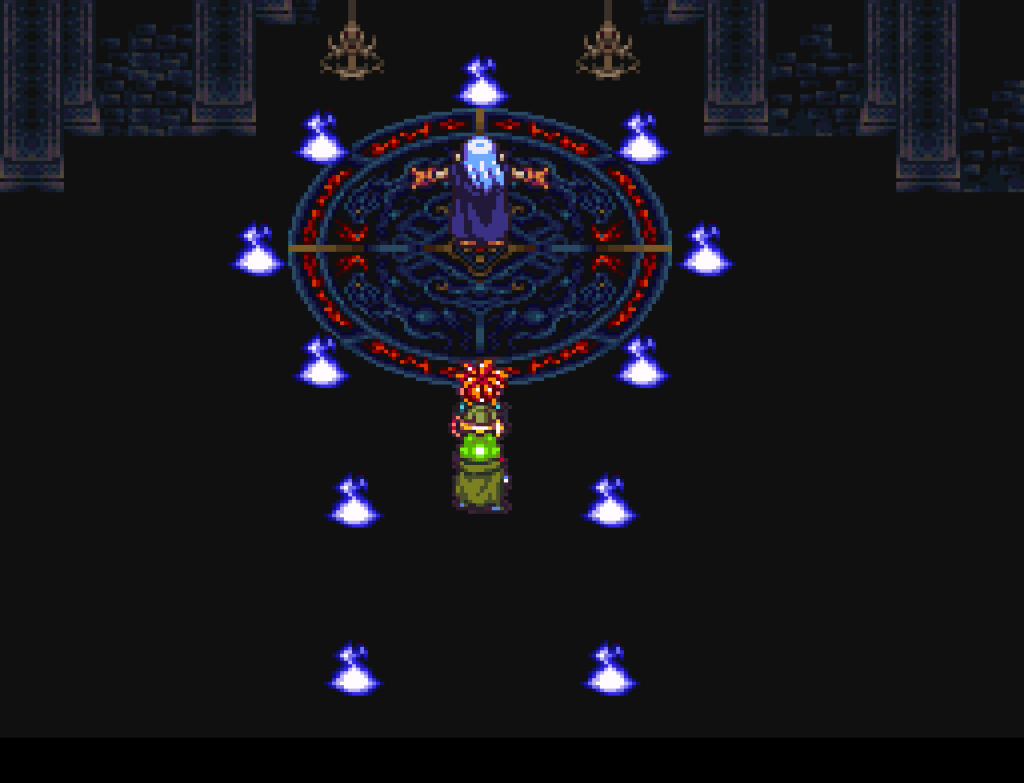
Instead of it being a straight forward rush to fight Magus and end the threat humanity faces, the player needs to reunite with Frog. Frog is really depressed, so you need to find and fix this ancient sword called the Masamune.
But get this, the stuff you need to fix it requires something that only exists in the ancient past – the Dreamstone. And then you need to use a weaponsmith who lives in Medina in 1000 AD in order to fix the blade. But the blade came from 600 AD so why is his name on it? How interesting. The player visits 3 different time periods to move things along.
While the most notable figure here is Magus, his minions end up being pretty noteworthy too. Until the confrontation with the head honcho, Magus’s right-hand man Ozzie serves as the main antagonist for the player. Ozzie is a grade-A flunky. He seems incompetent and is exceptionally wimpy in a fight – his boss battle is basically a joke battle involving flipping switches.
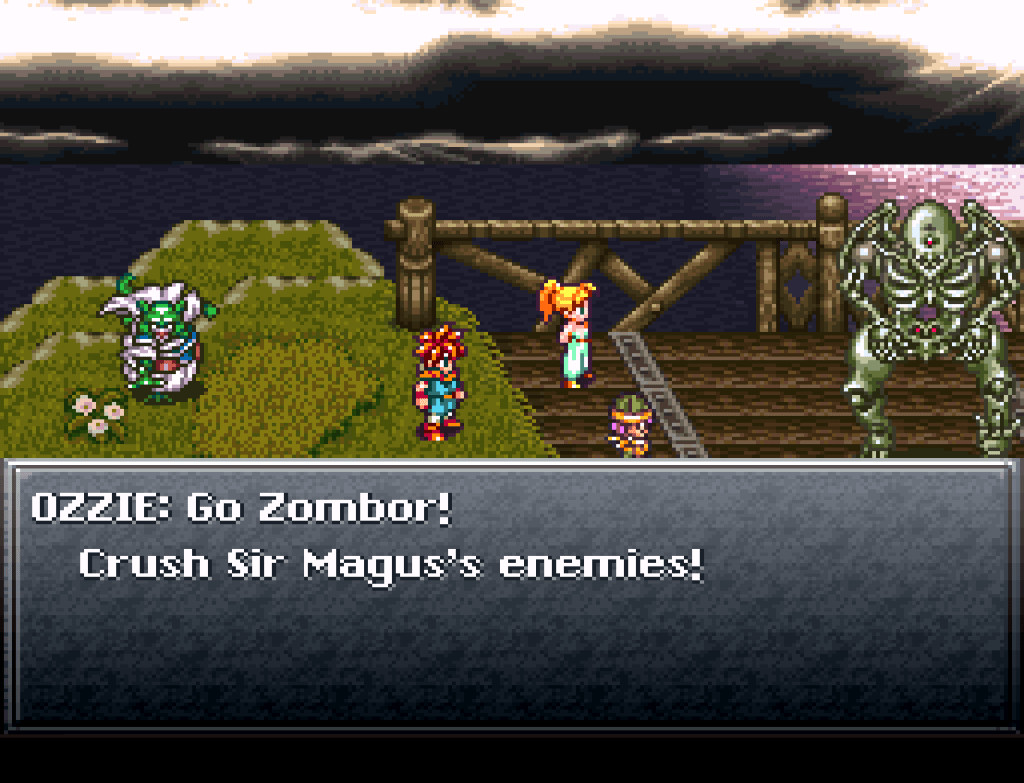
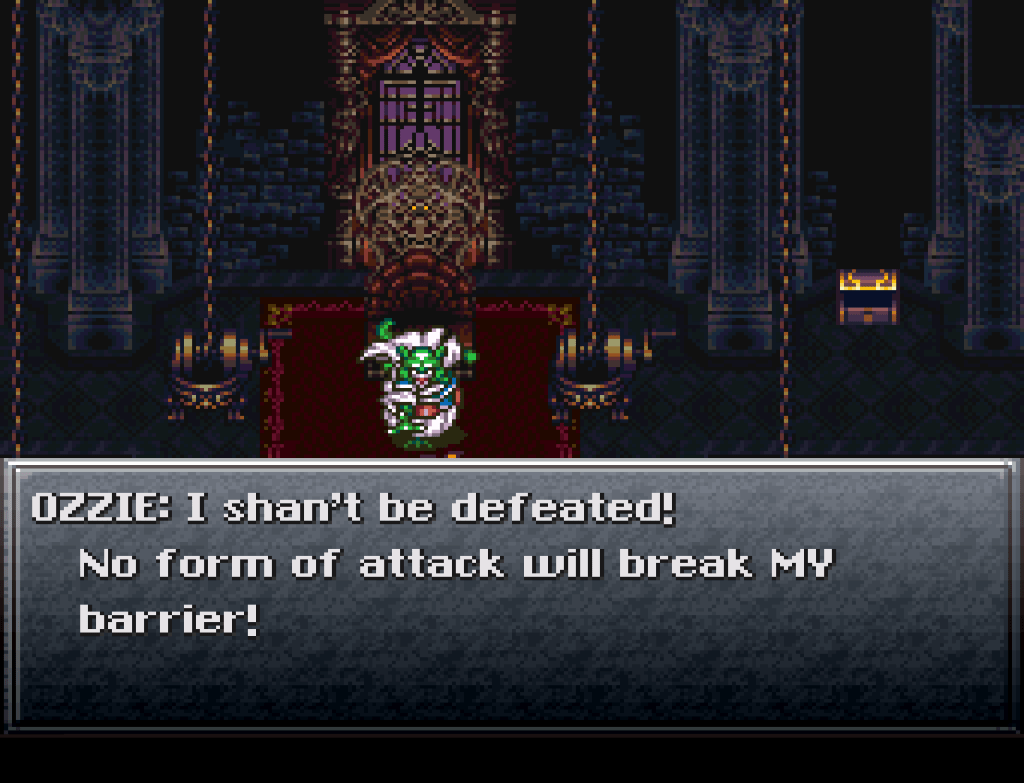
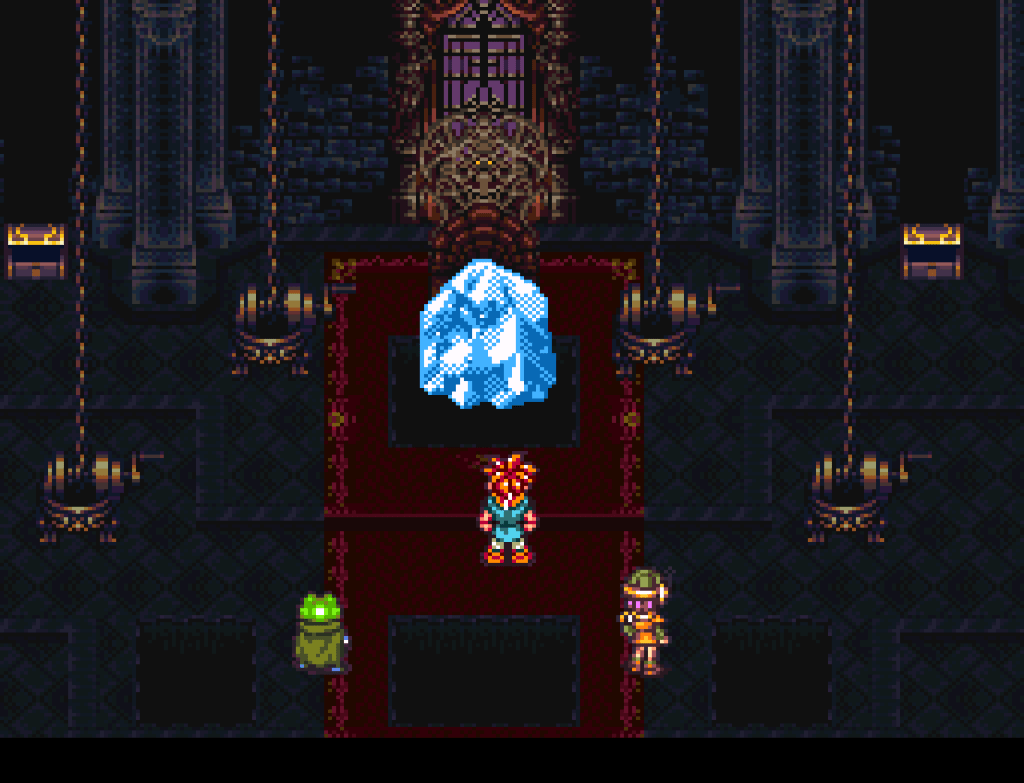
But he’s a flunky with influence. Most of the anti-human sentiment found in Magus’s army is based off of Ozzie. When the player learns more about who Magus is and what his motivations are, it becomes clear that Ozzie is using this really strong figure in order to further his own personal goals.
At the end of the game during the sidequest section mentioned above, there’s one that involves going back to 600 AD and finishing off Ozzie and once that’s done…suddenly humans aren’t so bad in Medina! How about that.
Ozzie is flanked by two other villains, Flea and Slash. Ozzie, Flea and Slash. Yep. This is an interesting localization choice. The original names of these three are Vinegar (Ozzie), Mayonne (Flea), and Soyso (Slash). The condiment trio!
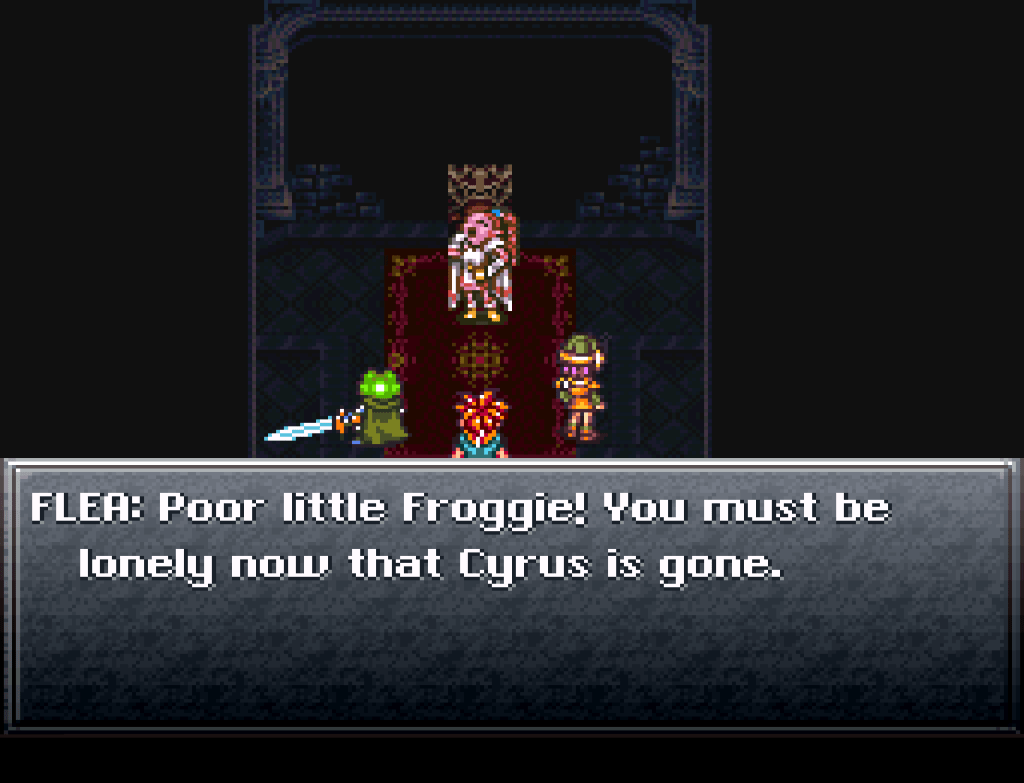
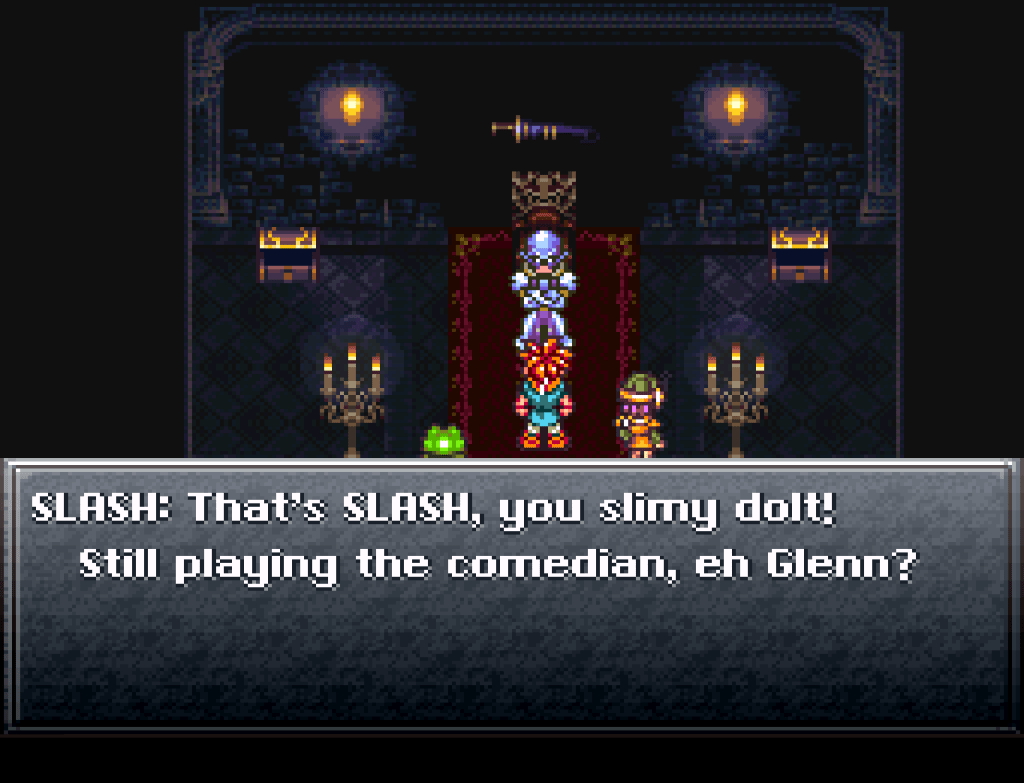
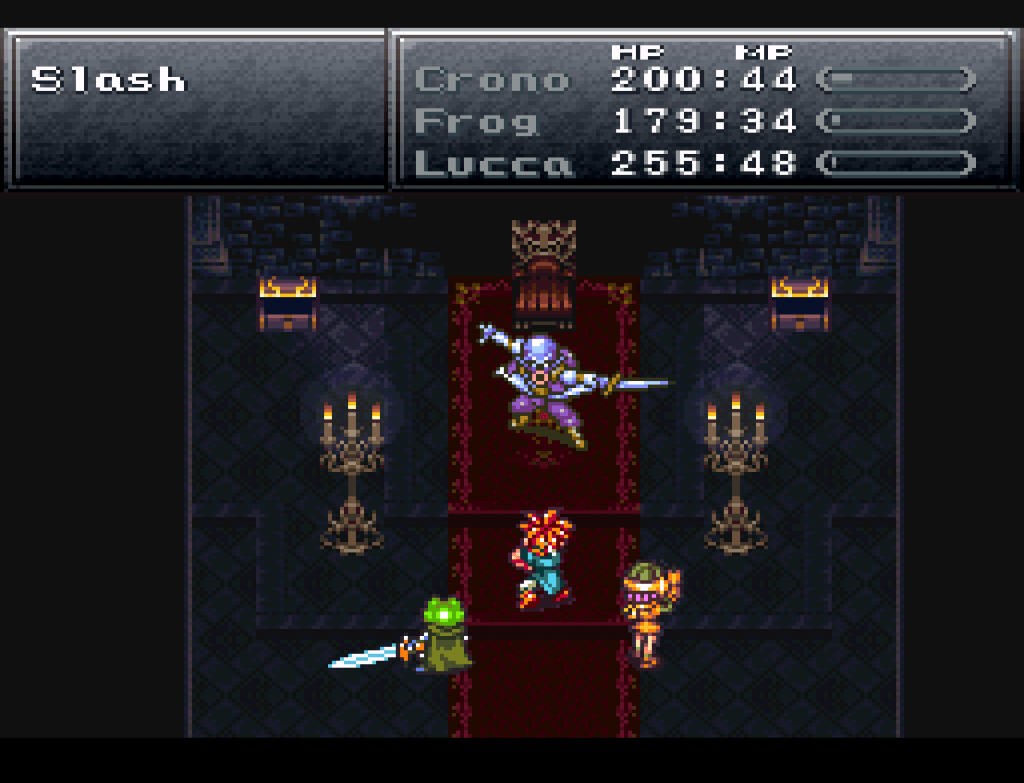
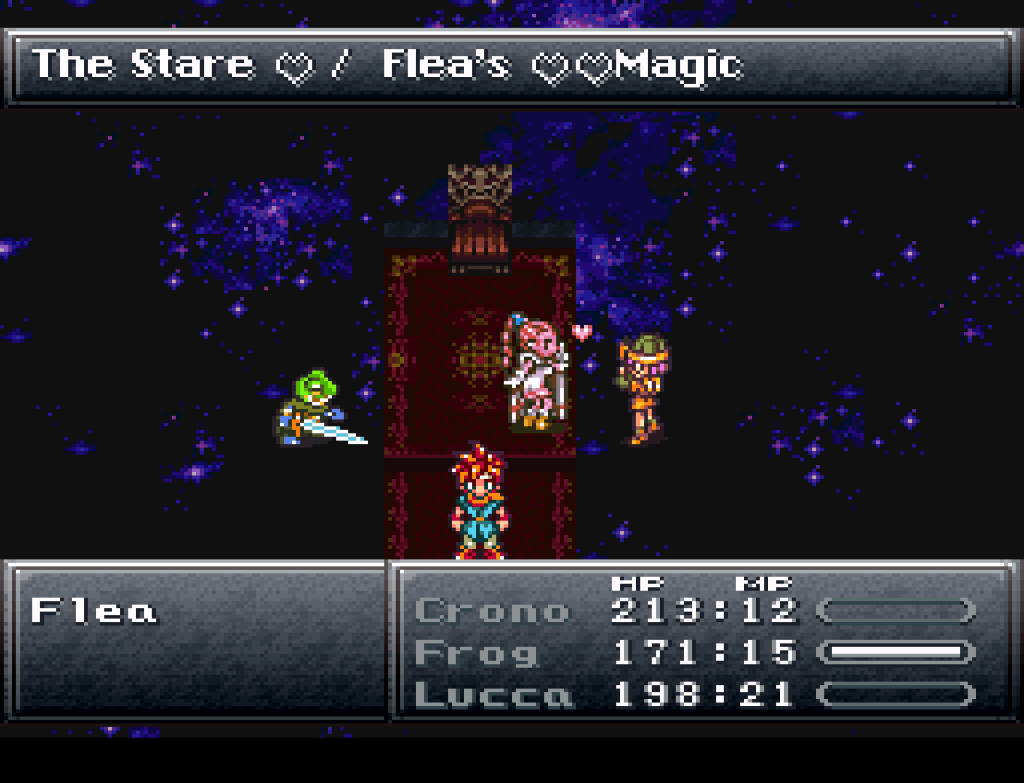
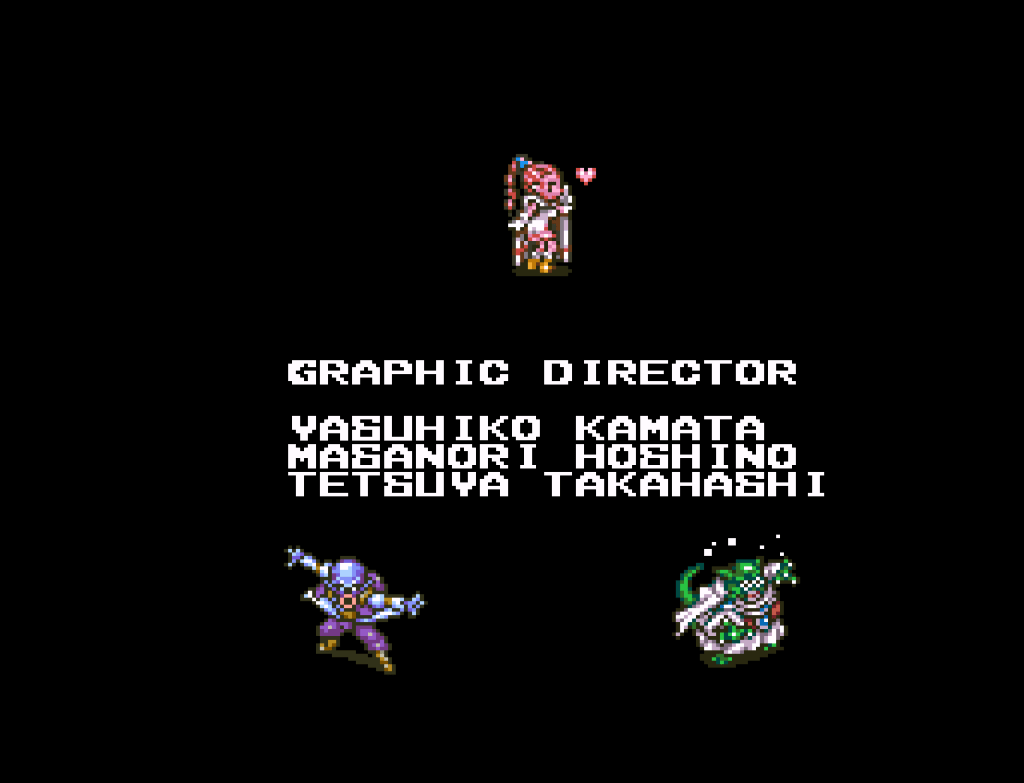
I think Woolsey probably felt that it would be hard to take a group of condiments seriously as villains – despite being silly, you are supposed to take Ozzie at face value sometimes – so he decided to keep the ‘these guys have the same naming theme’ gimmick but switch it up to rockers.
Dragon Ball wasn’t really popular in the West, so having villains named after instruments and spices weren’t super common practices.
The rocker trio are the primary villains of this era and despite Flea and Slash being relatively shallow characters, they’re still pretty memorable. I think there’s three reasons for this. The first is obviously the bizarre naming choice. The second is that they are cool and their fights feel like major deals and the third is because of the unique nature of Flea’s character.
The trio is very clearly stated to be an all male troupe but Flea presents himself as a female (while identifying as a male), claiming beauty does not know gender. The 90s were a different time when it came to LGBTQ+ representation, so the way the game deals with Flea’s identity is Frog suggesting the villain is playing mind games. The way the character is presented is meant to bewilder the audience.
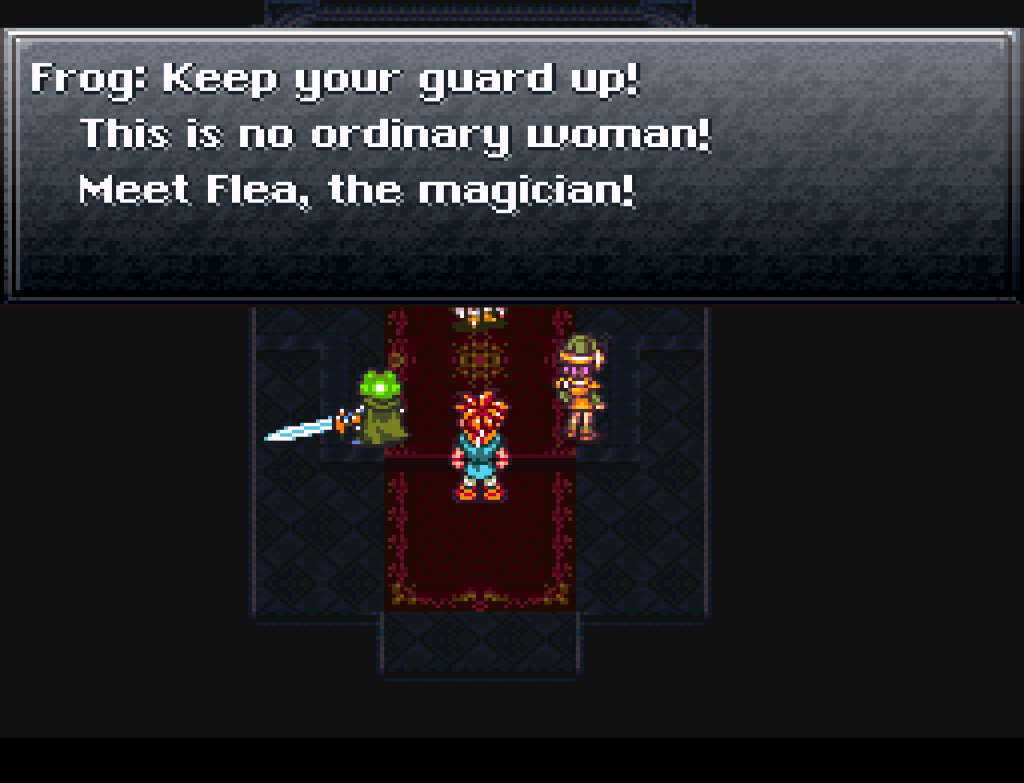
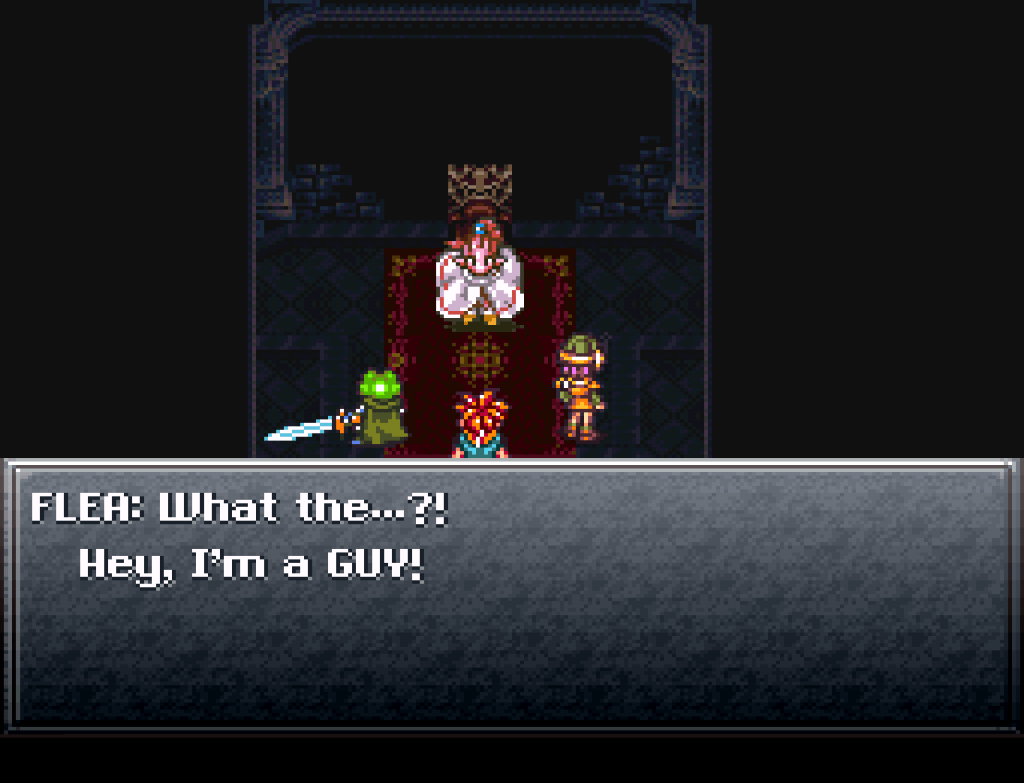
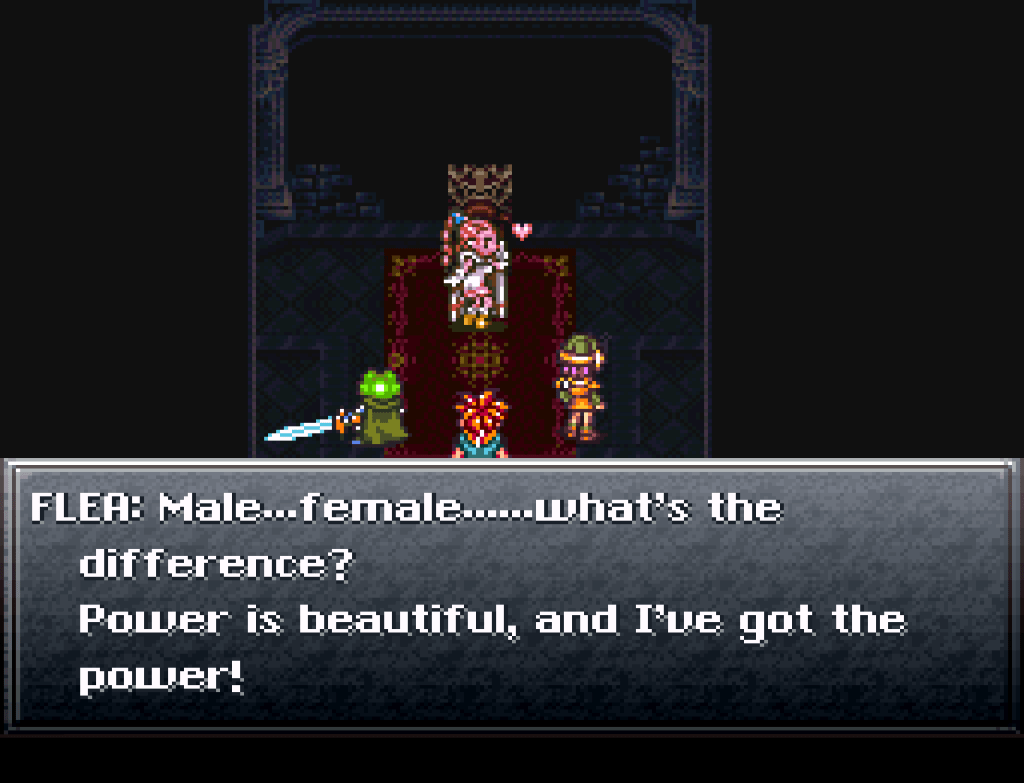
It’s probably an insensitive portrayal of a complicated issue, but I believe the goal here was to make Flea stand out as a character. In America at least, especially in video games, there wasn’t a whole lot of stuff like that in 1995.
It’s an unusual choice but I admire Woolsey and Square for not softening him down for the localization. It would have been far easier to just turn him into a ‘her’ and do a whole ‘Zoecite is actually a girl!’ thing that Sailor Moon did.
Instead, they let the unusual character squeak on by and presented him as is. And hey, the trio comes back as a secret boss in Chrono Cross, so clearly people liked what they were going for.
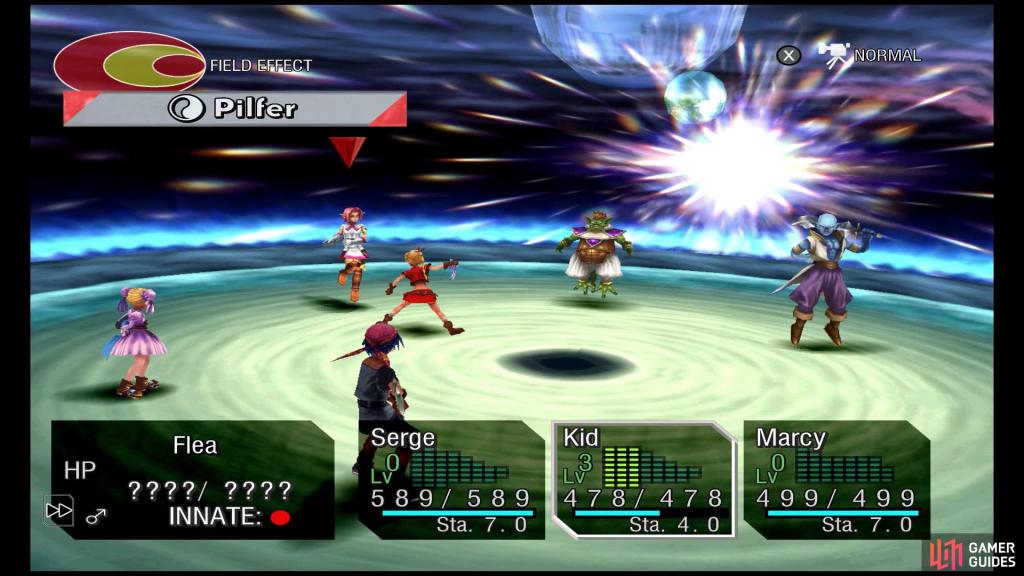
While not the most exciting looking change of scenery, the middle ages is distinct in enough ways to feel entirely different from the present. It helps establish that this is the same world as the one your characters presently live in. I mentioned above that the player experiences a lot of change in the first two hours of the game, so I think focusing a big chunk of that in an aesthetically similar location helps with the whiplash.
The next era isn’t so worried about that.
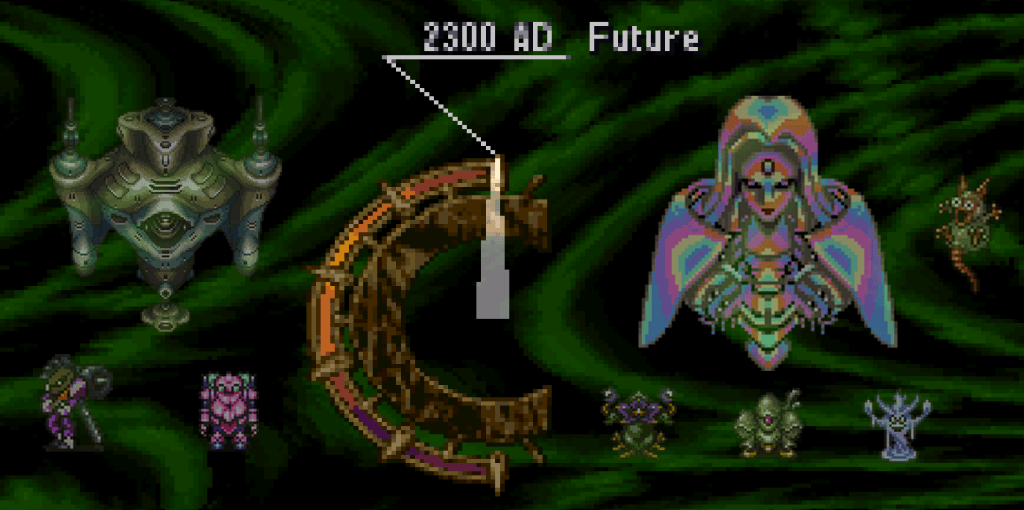
The future – 2300 AD
After Crono escapes from prison, the party discovers another time portal that they need to access immediately. You did escape from prison, ya know. It’s reasonable to assume that this one will take the party straight to 600 AD since the other portal from this era did that.
Nope! Chrono Trigger now introduces other periods of time. And this one isn’t remotely similar to the first two. While 600 AD was equivalent to dipping your toe in the water, 2300 AD is like jumping head first into the deep end.
The future is completely bleak and desolate. In the background of more open areas, you see the remains of human civilization – lots of street lights and miscellaneous electronics. Of course, we know this because we live in modern times, but such things are wonders to our party so they have no idea what the hell is going on.
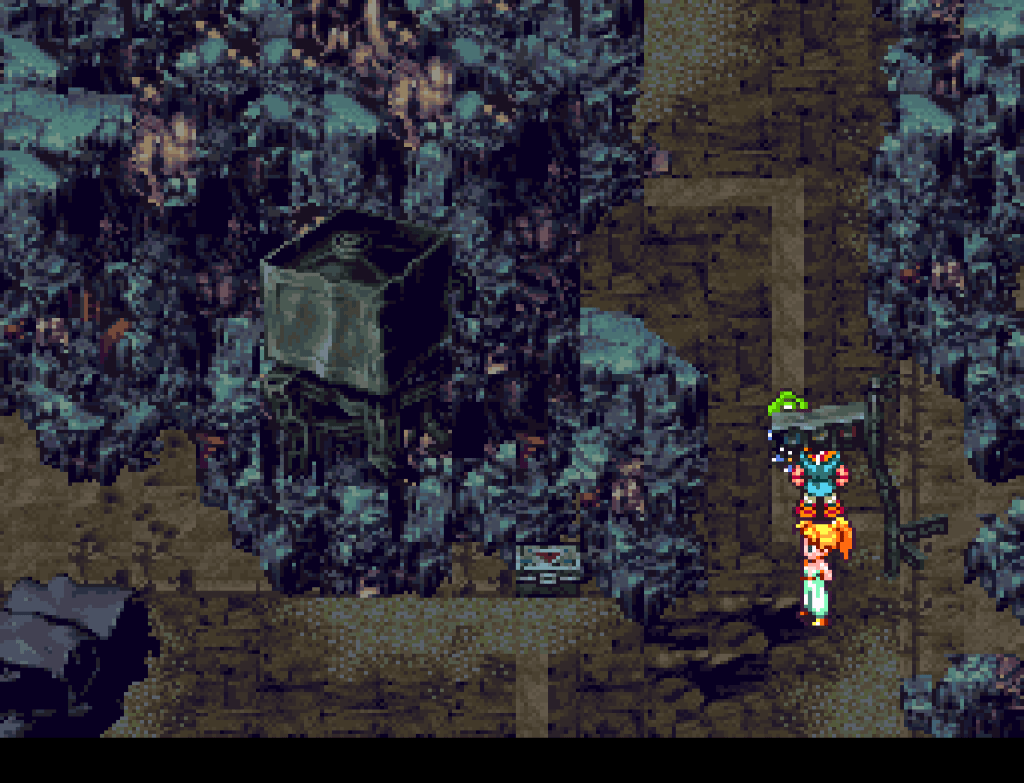
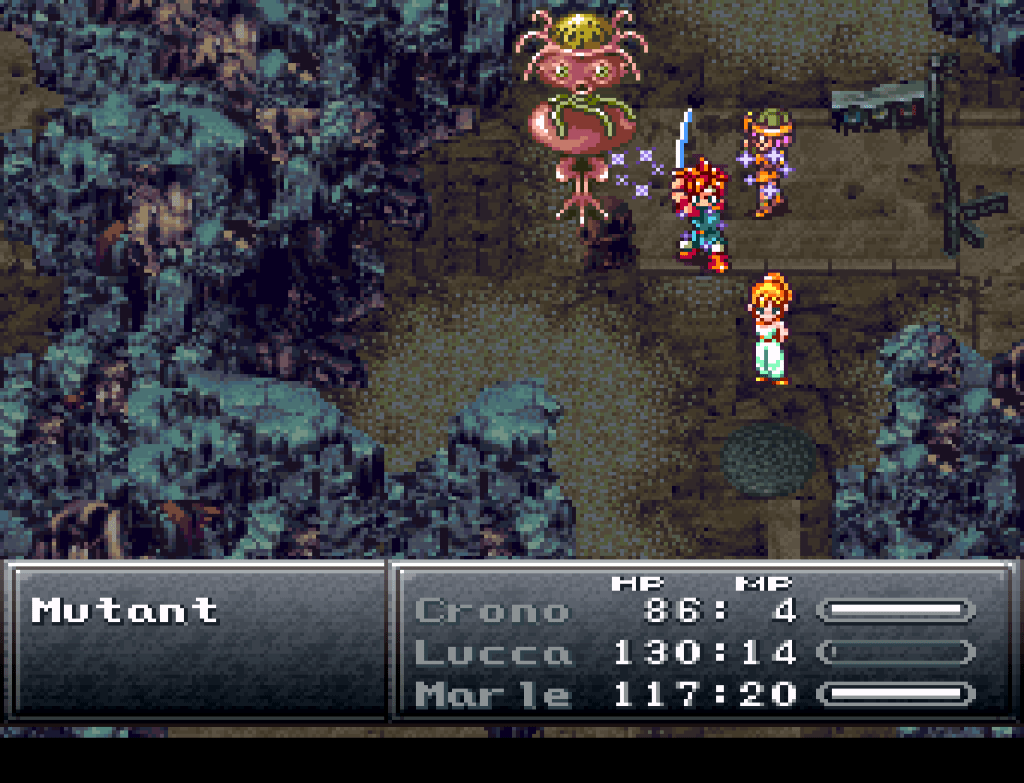
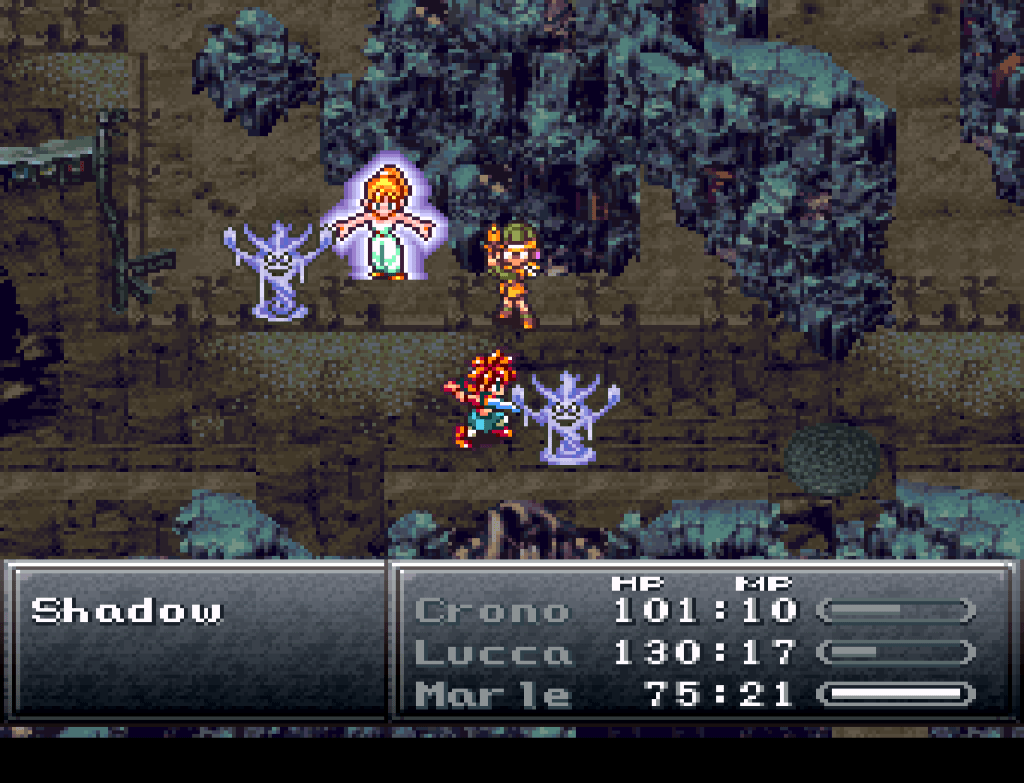
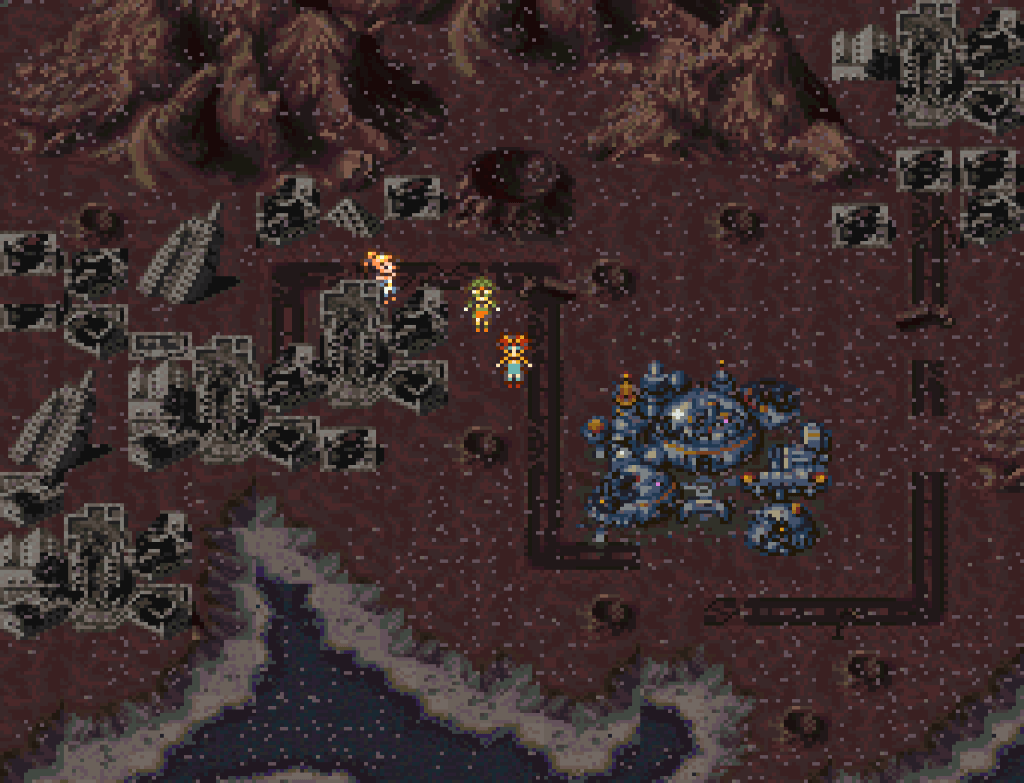
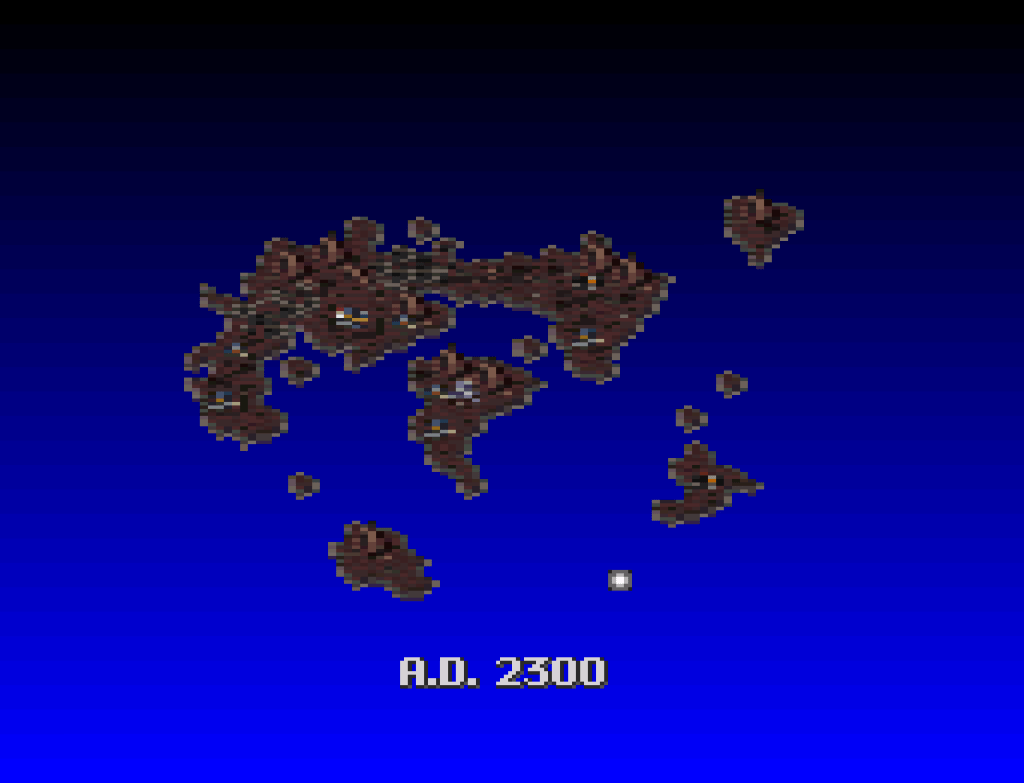
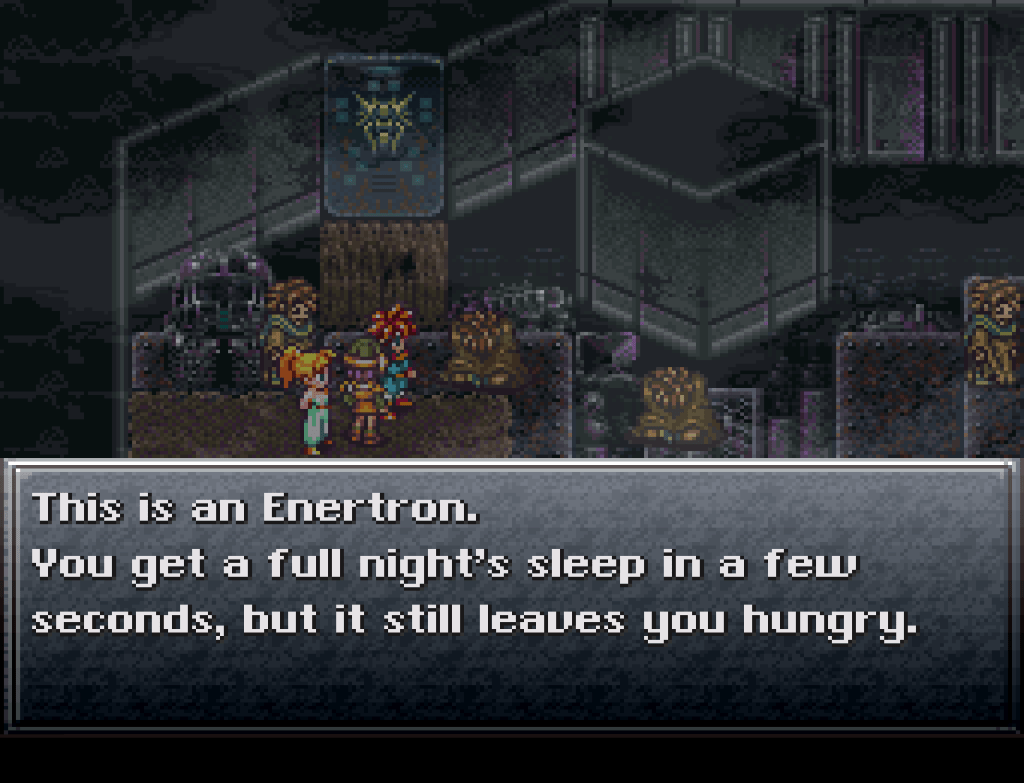
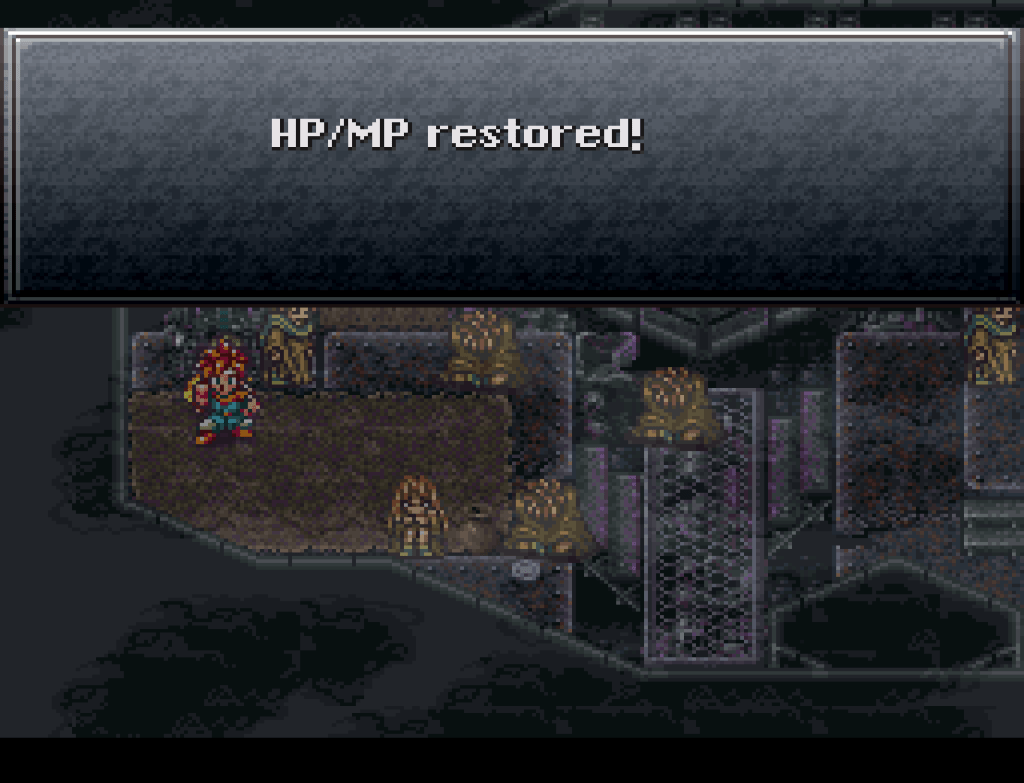
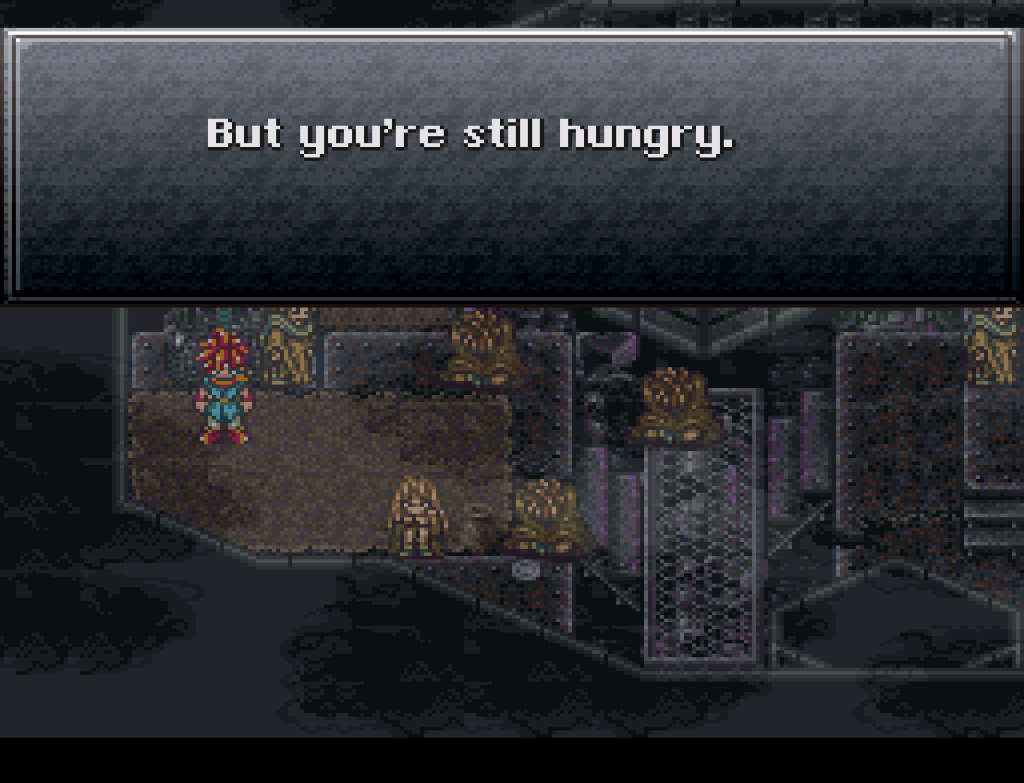
Everything about this is a barren wasteland. My favorite touch of this has to be the Enertron pods. Throughout the game, there are various areas that restore the party’s HP and MP completely. Usually the screen will just flash and tell you your party has been restored. Or you can just use shelter (tent equivalent) and do the same thing.
But with the Enertron pods, after you get your HP and MP restored an additional message plays that says ‘but you’re still hungry.’ It helps paint a picture of a civilization that has found a way to persevere through everything but just barely. They exist, but it’s an empty existence. Every human you meet in this era is starving and hopeless. So your party is determined to figure out what the heck happened.
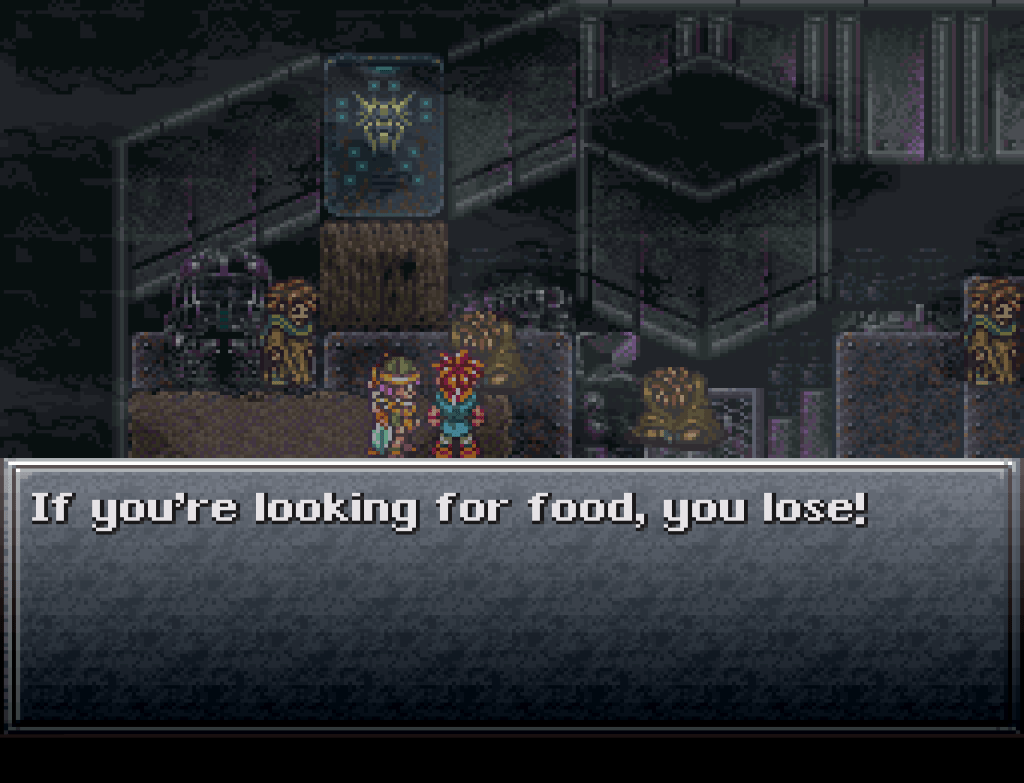
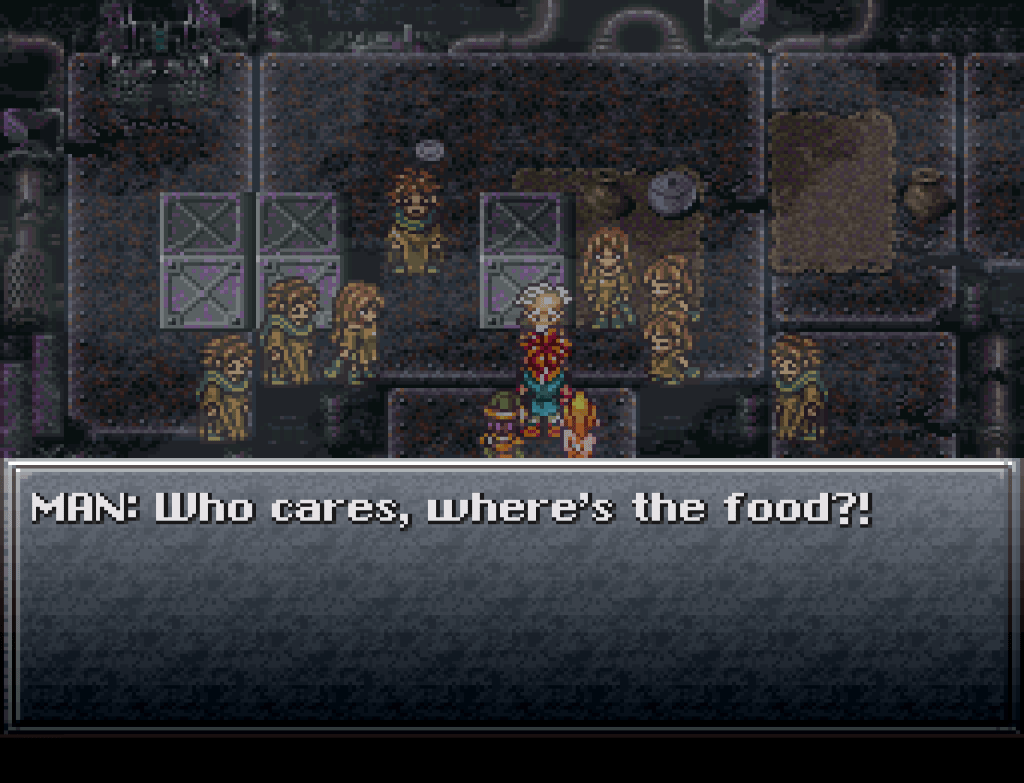
During a quest to find food for a band of survivors, the group stumbles upon the truth and this is where the main objective is discovered.
In 1999 AD a being called Lavos attacks the world and destroys everything. As mentioned above, a bit later the party deduces that a guy named Magus is the one responsible for him showing up at all, but this what we have to go on first. The whole point of the trip to the future is to give the players a reason to go scavenging the past.
Perhaps I am reading too much into things, but I think doing it this way is a very good call. In an alternate universe, where they discover the universe ends in the year 1010 or something, it’s very clear that Lavos killing everything will have an adverse effect on their lives and their family’s lives.
But by discovering the apocalypse takes place in 1000 years, it alters the character motivations.
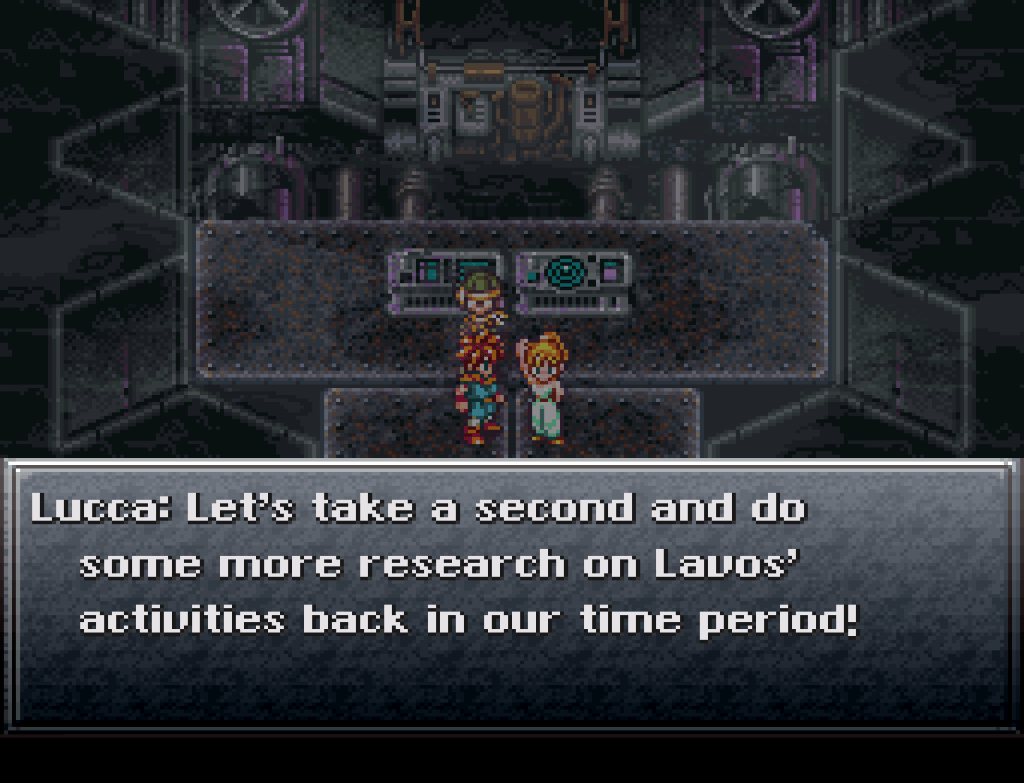
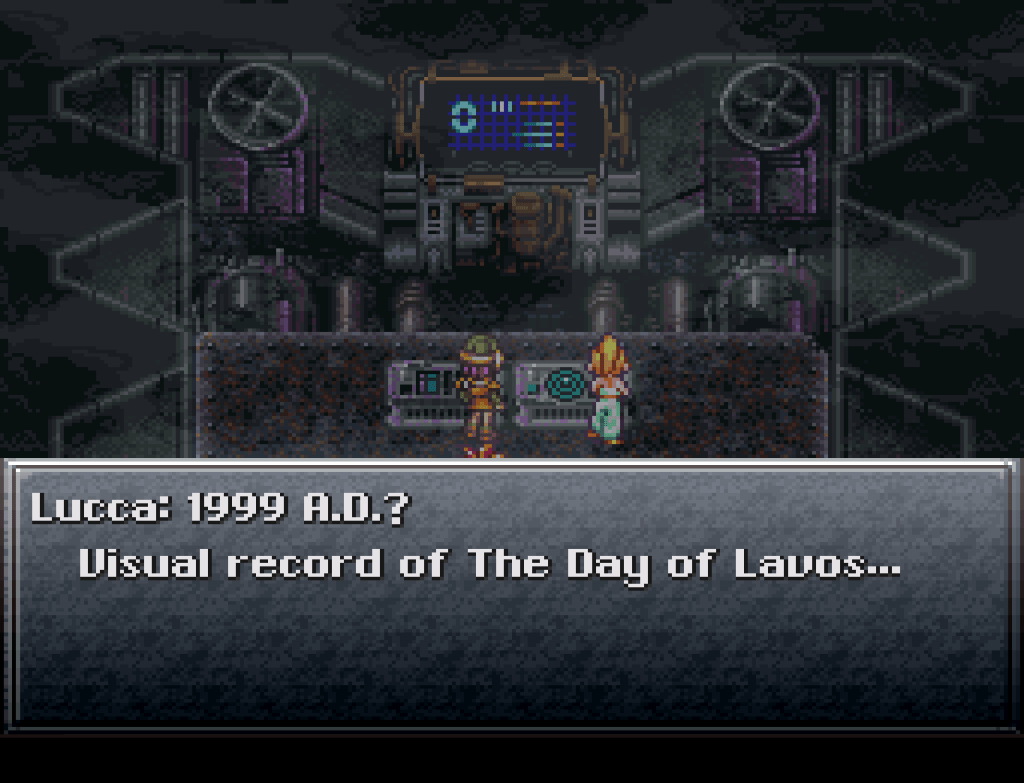
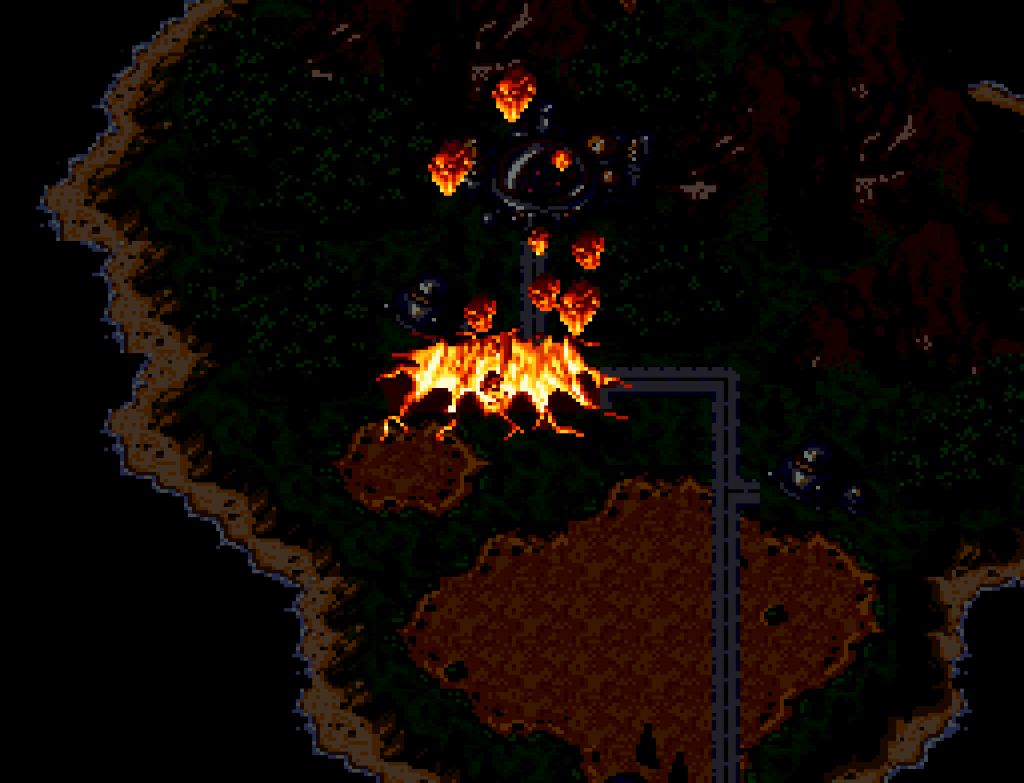
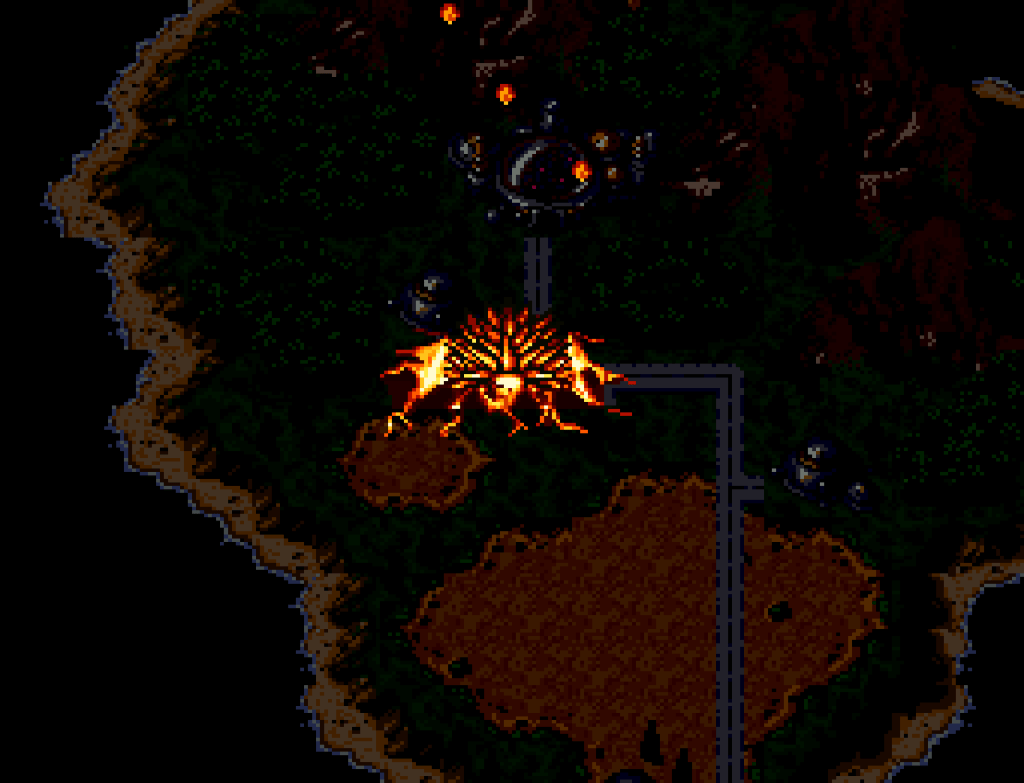
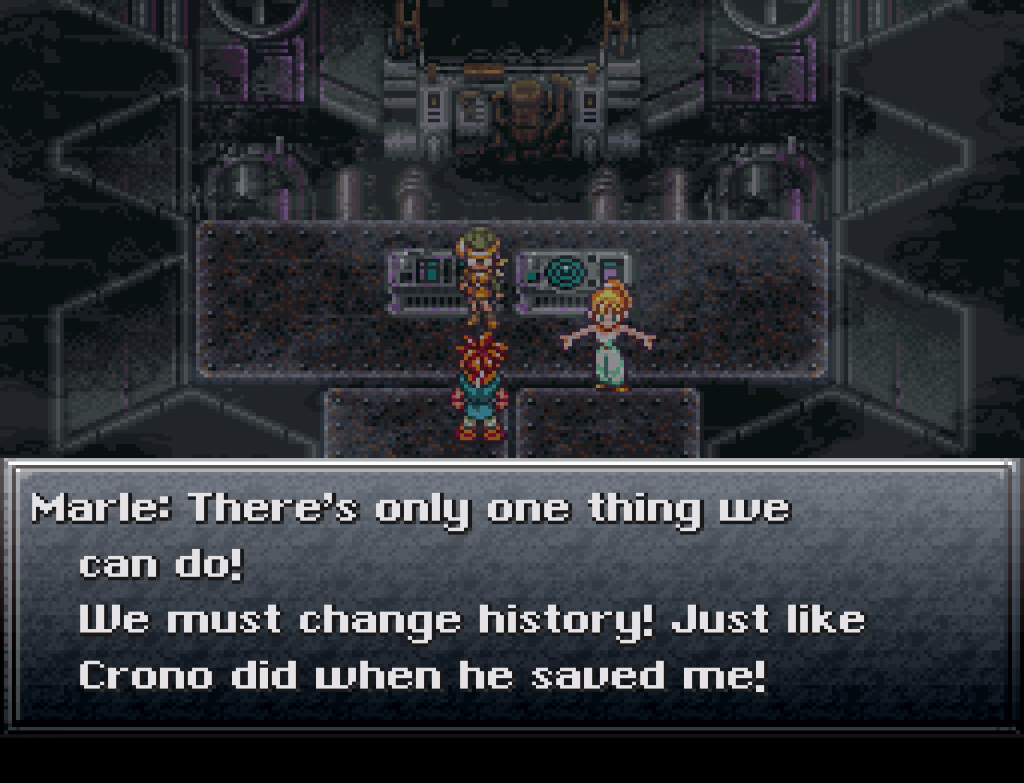
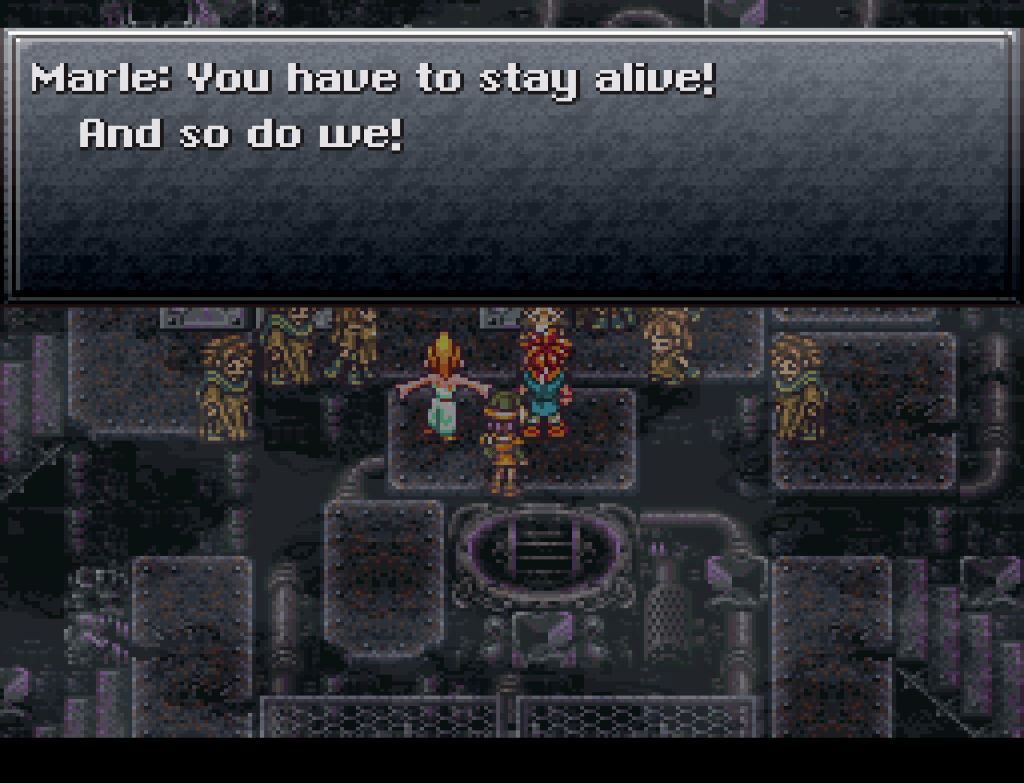
In the theoretical 1010 scenario, you could say the entire party is motivated by the desire to keep their friends and family safe. But in the ‘world ends in 1999’ scenario, everything takes place in 1000 years. Anybody impacted will be a distant, distant relative and there’s really no guarantee that any of the three heroes from the present will still have a bloodline roaring in 1999.
By doing it this way, their mission becomes more for the good of humanity than for the good of just their friends and family.
This period of time is when your focus becomes much more clear. From a narrative standpoint it’s one of the more interesting places in the game and also introduces your party to its second non human member. A robot! But from a gameplay perspective, I think the future has the most boring dungeons in the whole game.
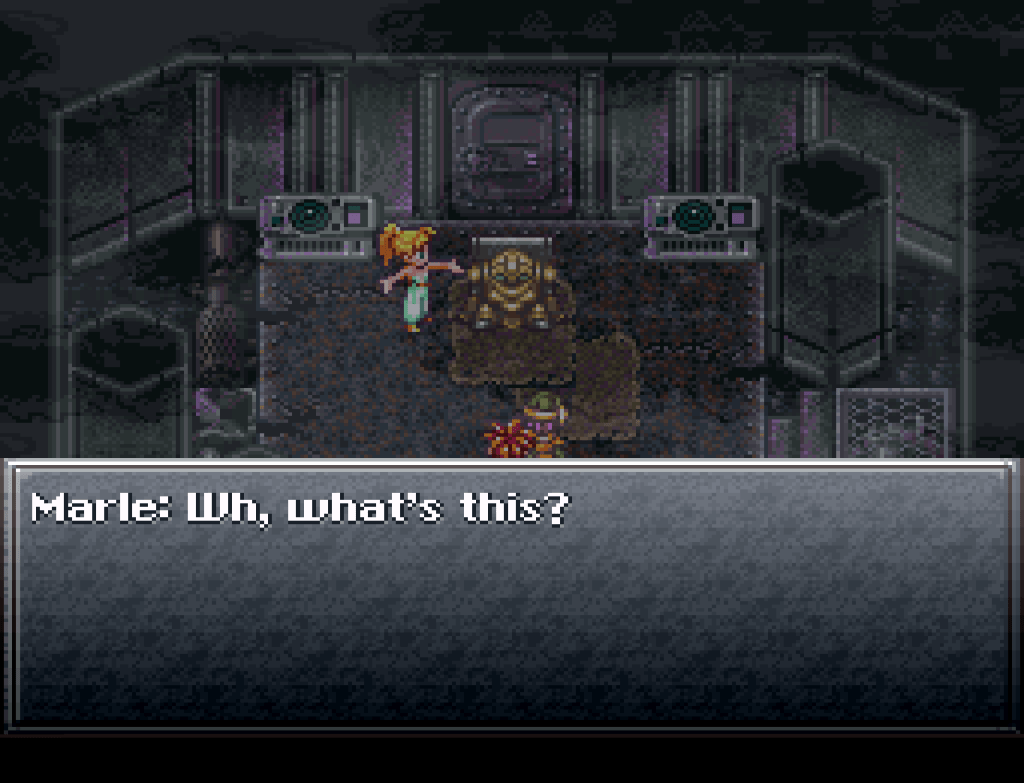
My least favorite is the sewer, surprise a video game that has a sewer level that isn’t great. This is an optional dungeon the first time you visit and its whole purpose is to wink at the player that they need to come back here much later.
The problem is…if the player holds off on visiting this dungeon until its mandatory for them to do so – towards the end of the game in order to get a time machine – it’s leveled like a beginning of the game scenario because that’s when the player is most likely to see it for the first time!
The big gimmick here is that the player has to avoid making noise as they progress. This is highlighted by various obstacles that get in the way of Crono as he progresses. They even throw a save point – they make a loud DING sound when you move a person over there – which hilariously also brings monsters to you.
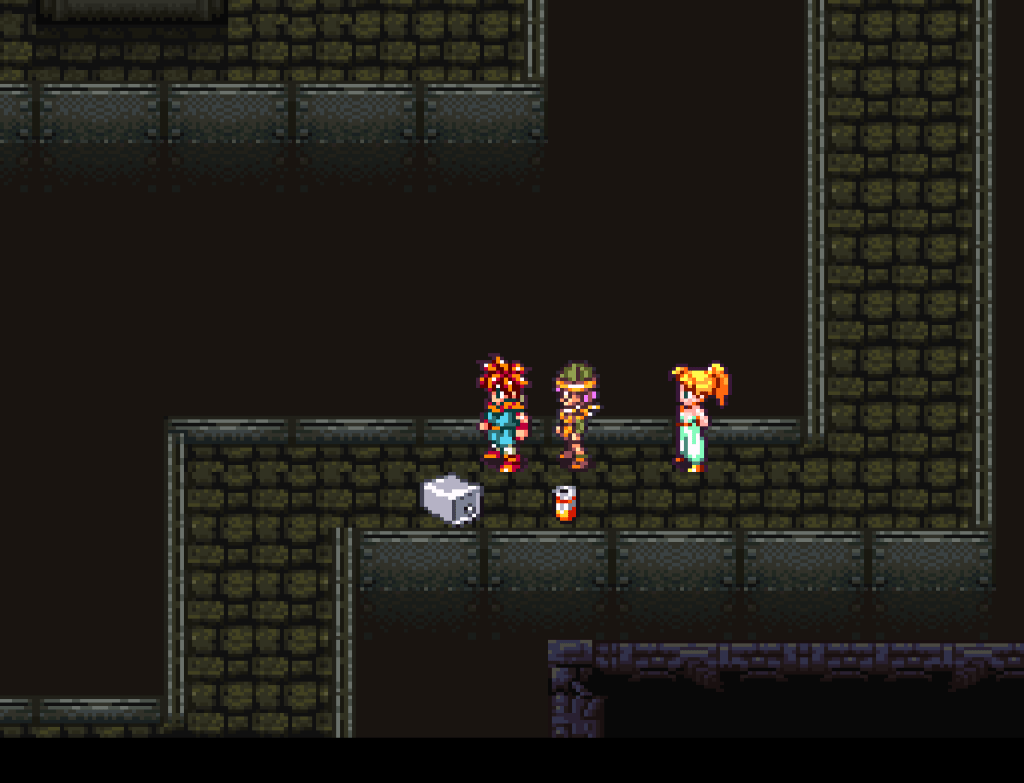
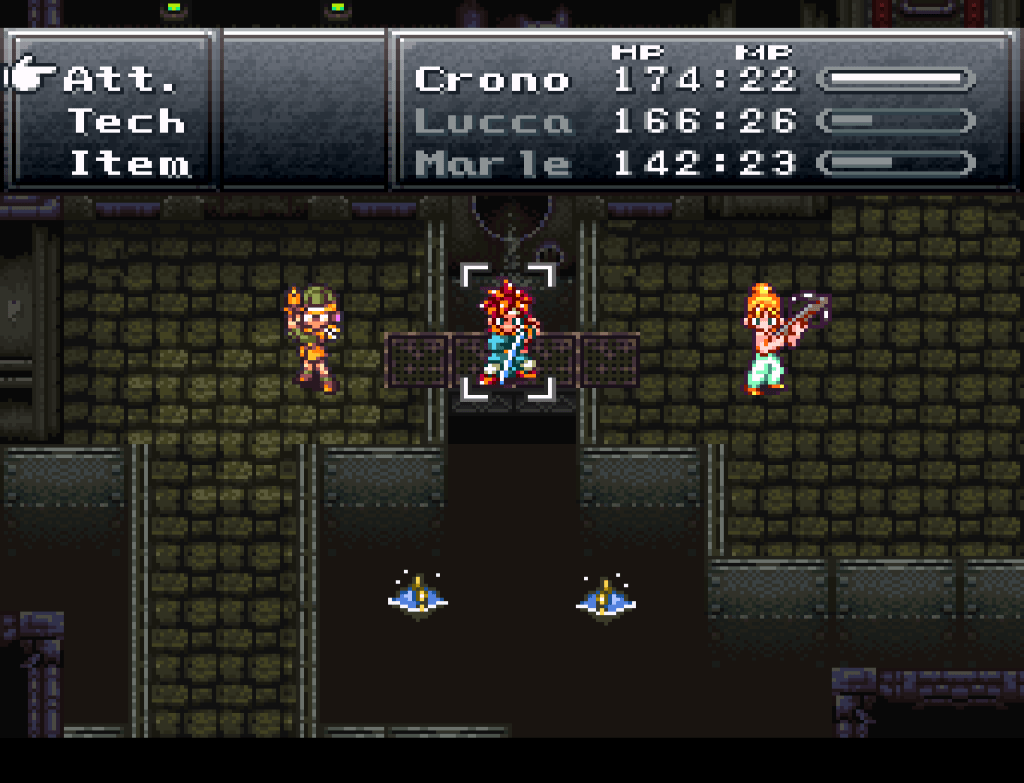
It sounds cool in practice but these fights are annoying. So you’re either going slowly on your first visit to avoid some annoyance or you’re going slowly on your visit much later to avoid a completely useless battle that gets you basically no experience for your level. Even though I’m whining, it’s not really THAT big of a deal. It only takes like 10 minutes. But it does stand out in an otherwise well paced game.
Speaking of odd moments that break things up, what’s the deal with the biking segment? Your party encounters THE MAN, who is awesome, I would never complain about him, and then get challenged to a racing minigame. And it is the single worst racing minigame of all time. Why did they even try?
You just mindlessly exchange the lead for about 30 seconds. And then you hit turbo at the end to guarantee victory. Ta-dah, you did it, you beat the man.
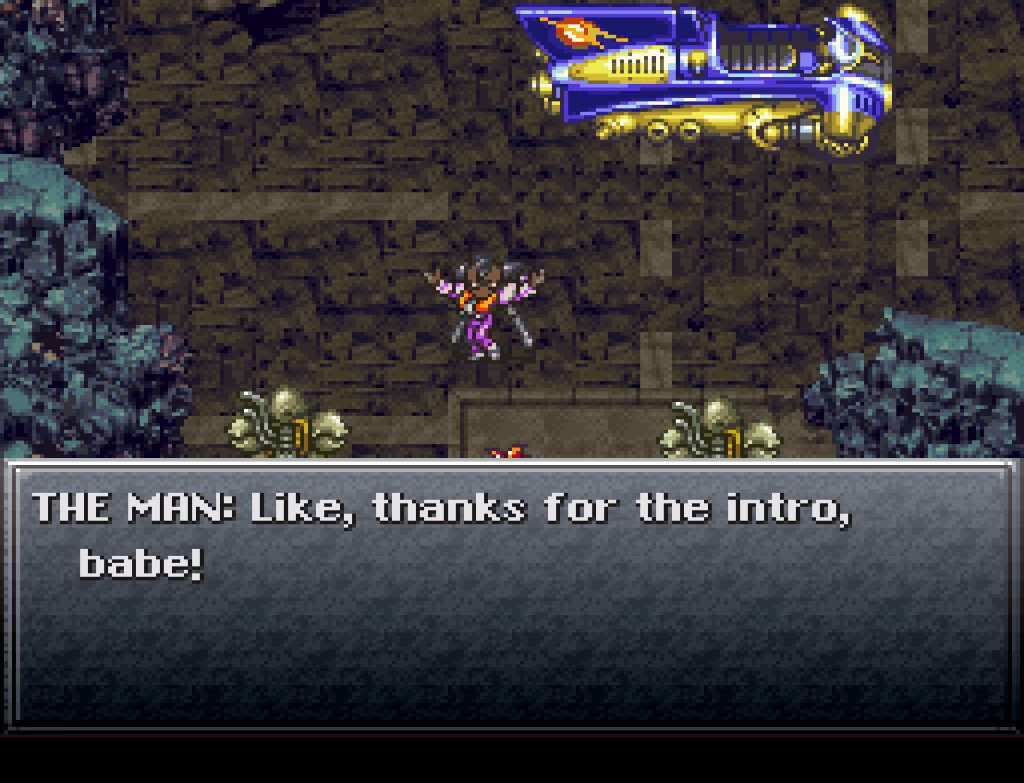
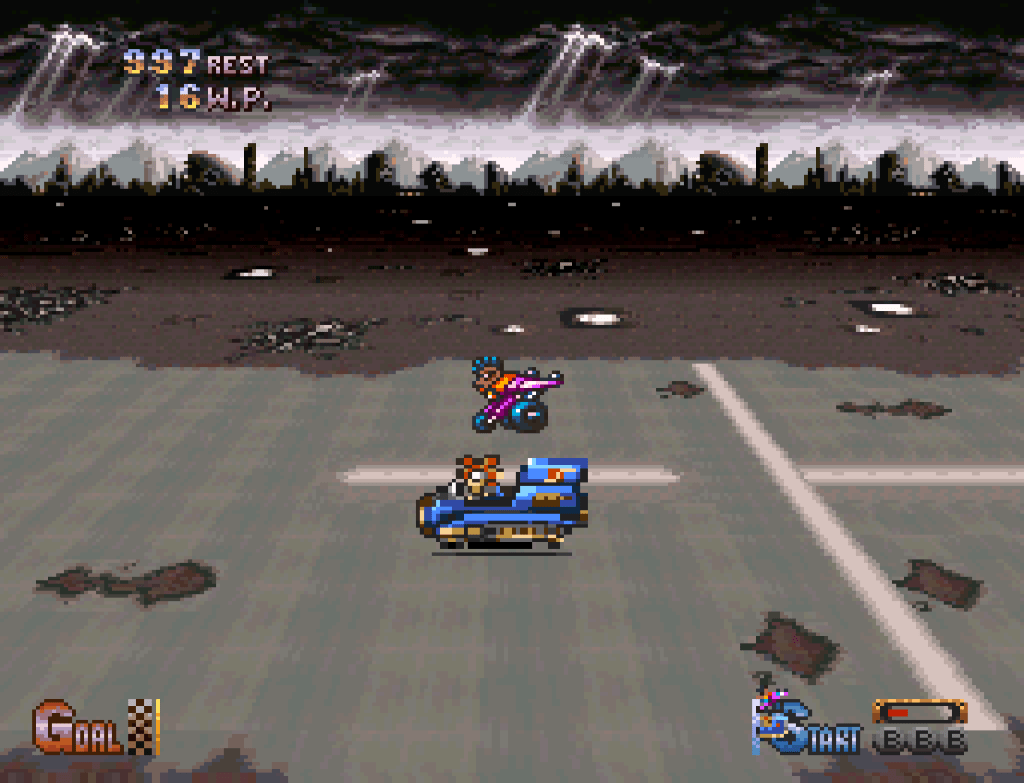
You CAN just skip this by walking off screen but the game does not hint at this at all. It takes longer to do it this way, so you’re probably better off just dealing with a minor annoyance.
I don’t mean to sound negative, most of what I’m pointing out are just small gripes. There’s a bunch of things I like here. For instance, I adore the two dungeons centered around having your buddy Robo in the party.
I’ll get into it in his character section a little bit, but his personality is all about being helpful and beneficial to humanity. However, every other robot has been programmed (or re-programmed) to despise humanity. In the main story, this leads to a battle where Robo refuses to raise arms against his robotic brothers but will also not turn his back on his human allies.
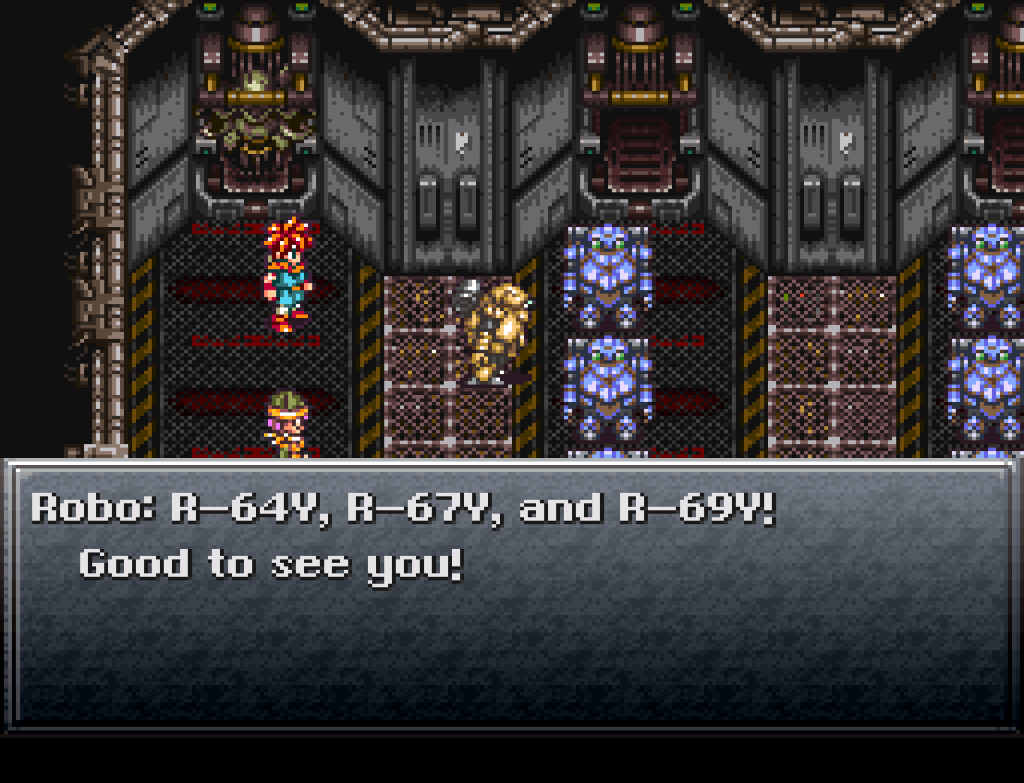
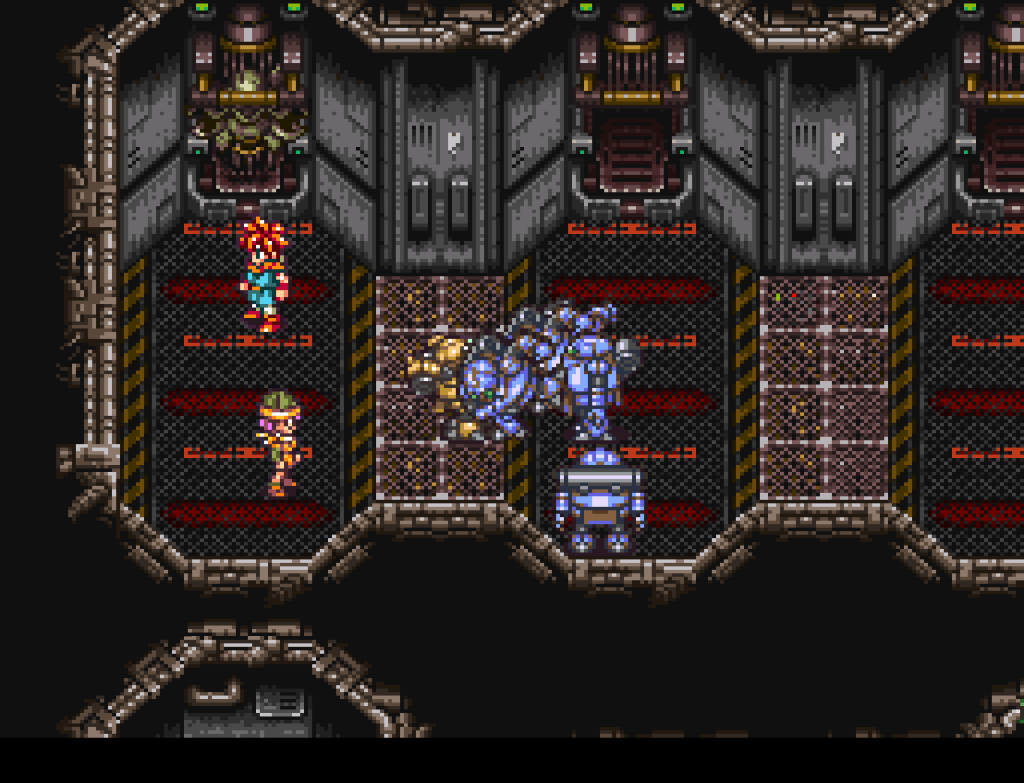
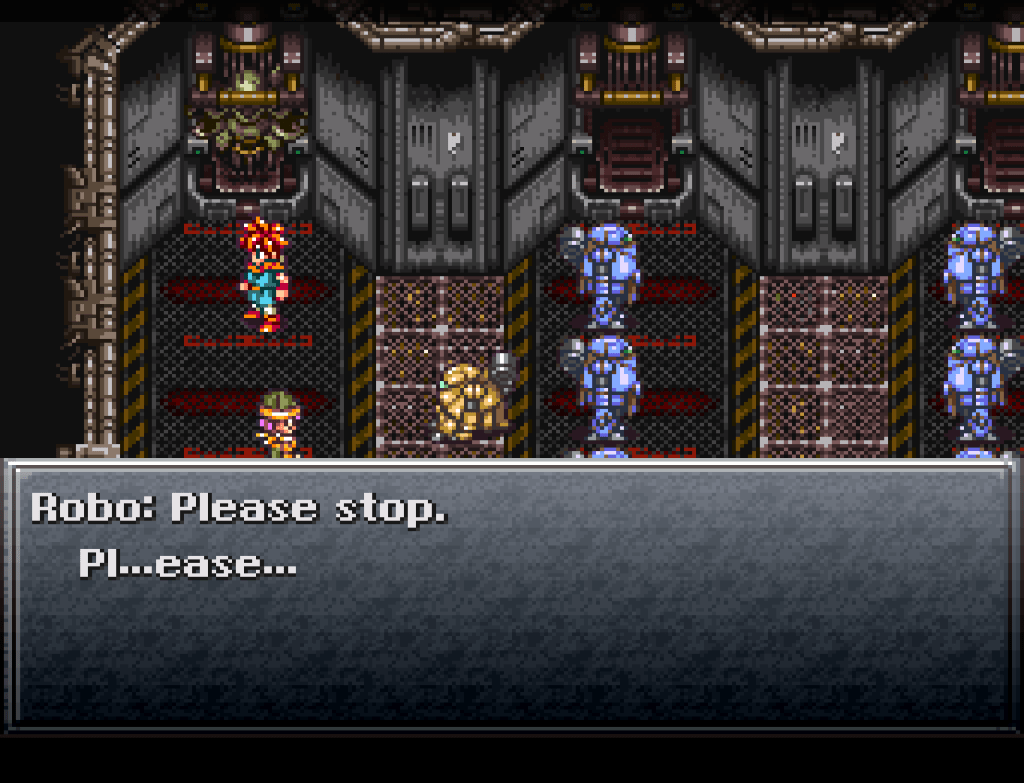
So his brothers beat the shit out of him and basically leave him for dead. The moment where he’s just standing there as these blue robots fling themselves at him has always hit home. The side dungeon explores these themes too – a girl-coded Robo has been reprogrammed to be evil – and while it doesn’t hit quite as hard, I do think it’s worth doing.
It’s also worth mentioning the quest to bring Crono back to life. It takes place almost entirely in the future and it involves climbing a mountain called Death’s Peak.
The atmosphere of this place is desolate and depressing and involves fighting miniature versions of Lavos. Reaching the peak and resurrecting the protagonist is one of the best moments of the entire game, especially if you have Marle in your party.
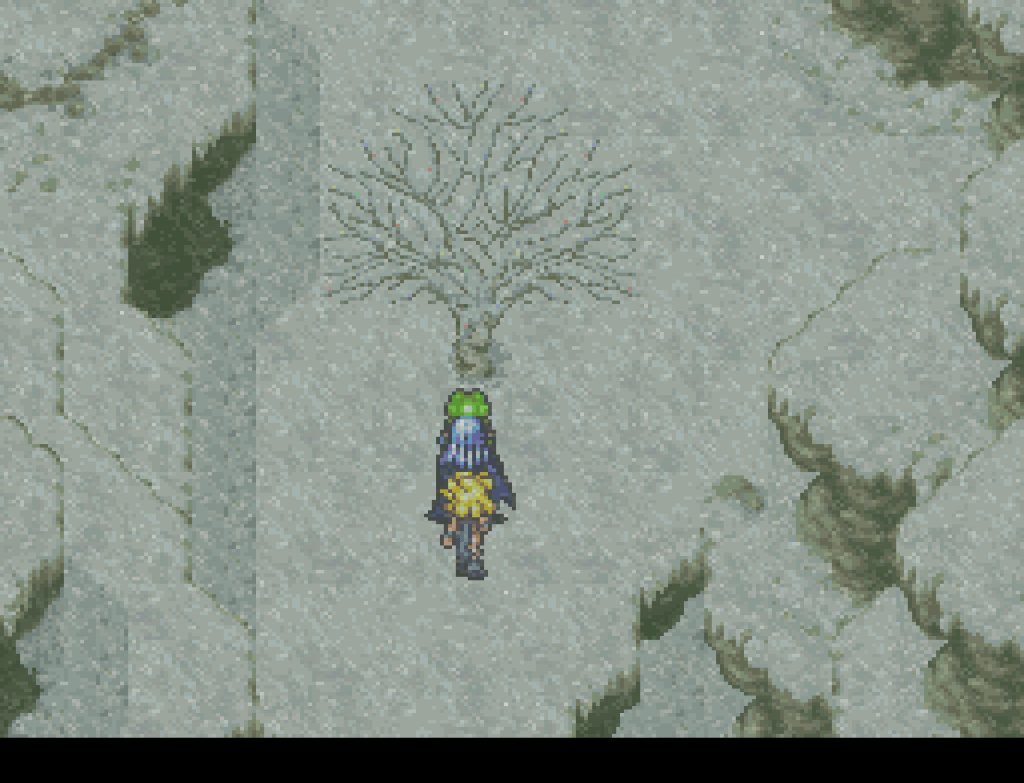
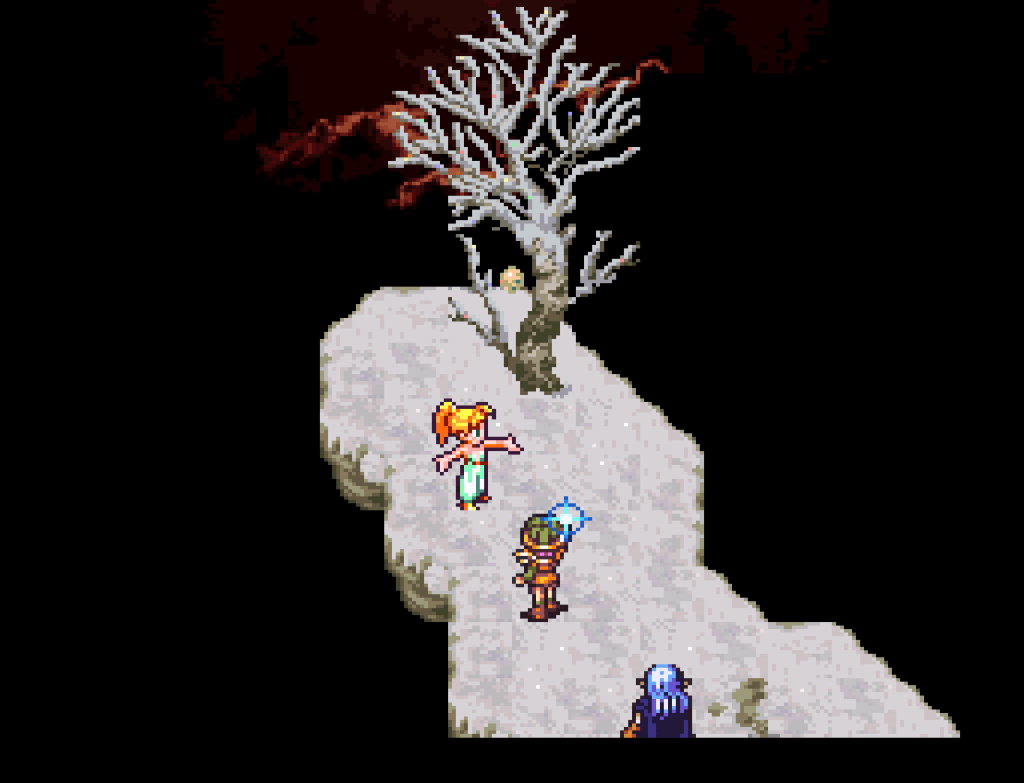
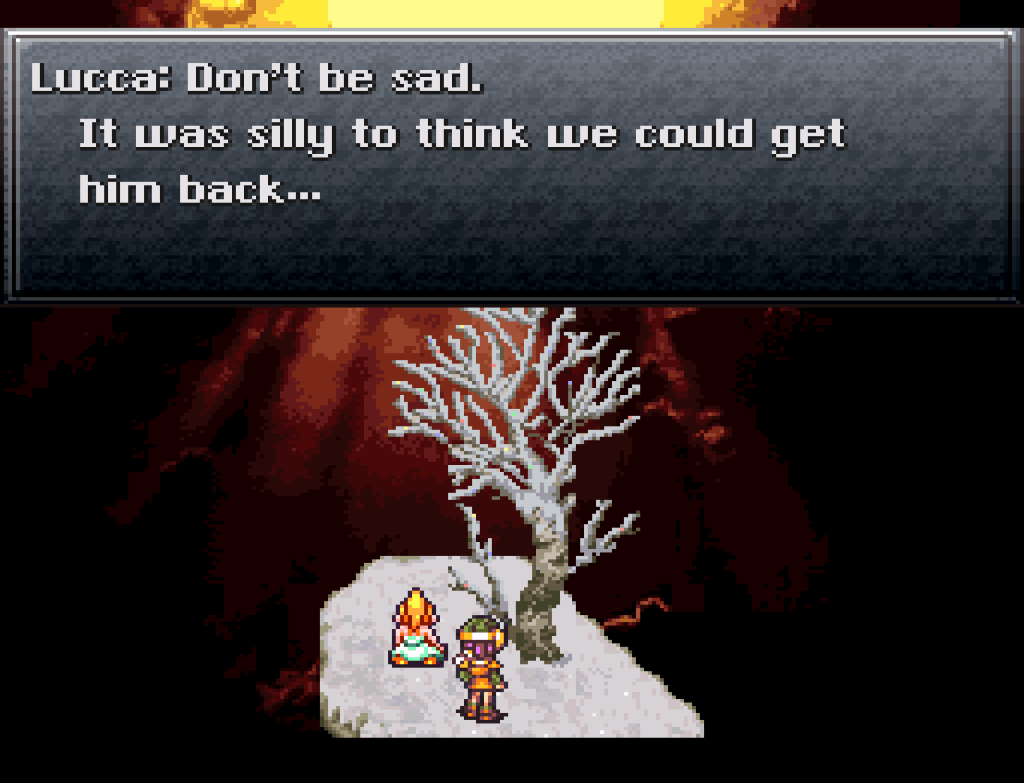
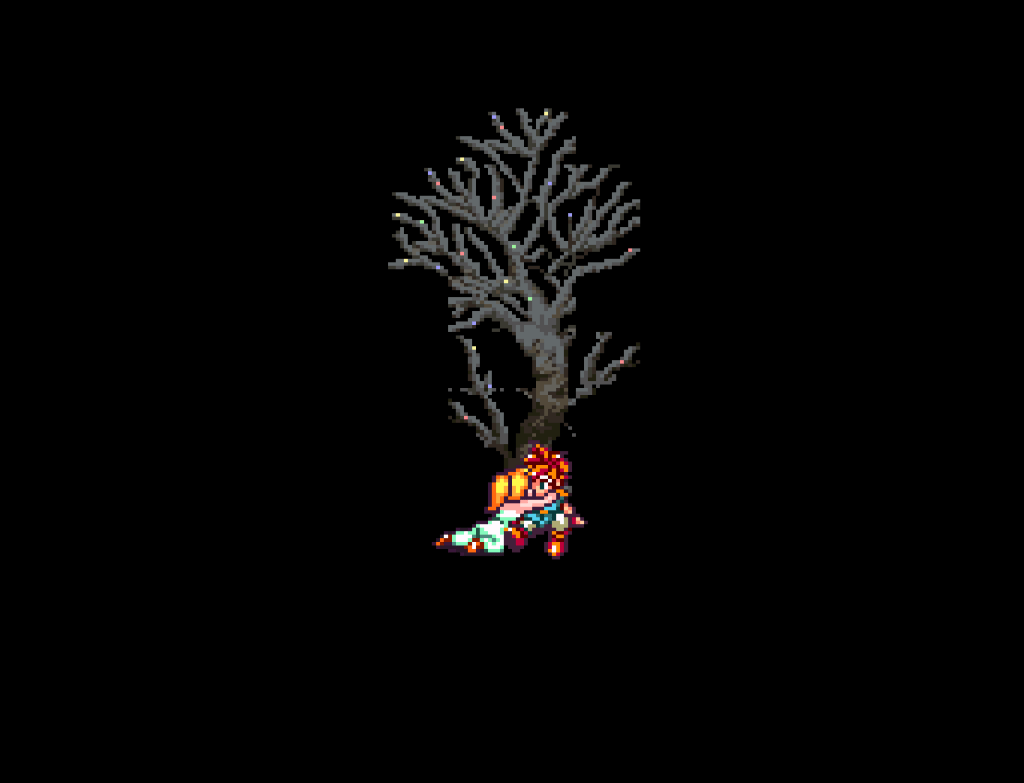
While I am a bit critical of certain elements of the future, it’s an important place because it sets the stage for the rest of your adventure. You don’t want your future looking like this. There’s no treks through Magus’s castle without this segment, there’s no kingdom of Zeal without it either. It’s the load bearing era of Chrono Trigger.
Just uh…don’t play Chrono Cross if you want to pretend the future got completely saved by your actions.
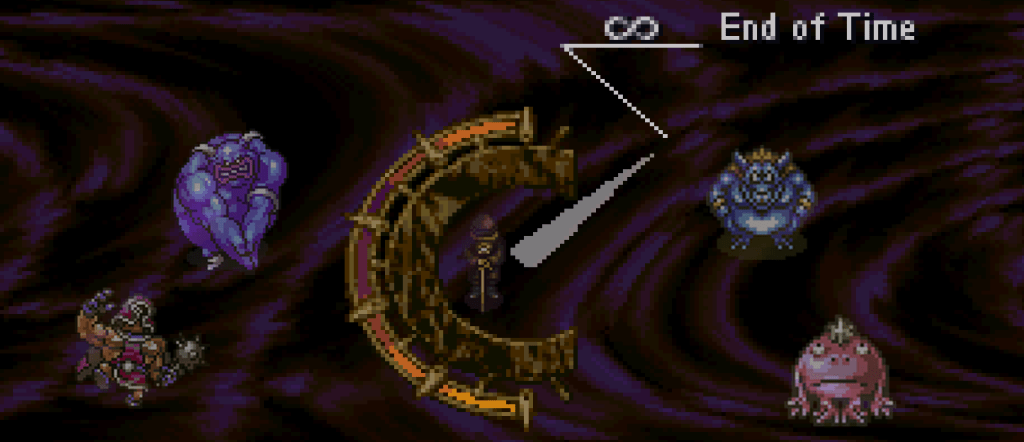
The End of Time – ∞
When the party leaves the Future with Robo, this is the first time four party members have journeyed through one of the time gates. This time, it’s well established that this gate could take the party anywhere! Instead, it takes you to the idea of somewhere.
The End of Time is deemed to be a stable anchorpoint that exists outside the typical flow of time. Beings who get lost in time and have nowhere to go end up here. The mysterious figure at the center of it all – later revealed to be Gaspar the Guru of time – makes note that a lot of people have been showing up here lately.
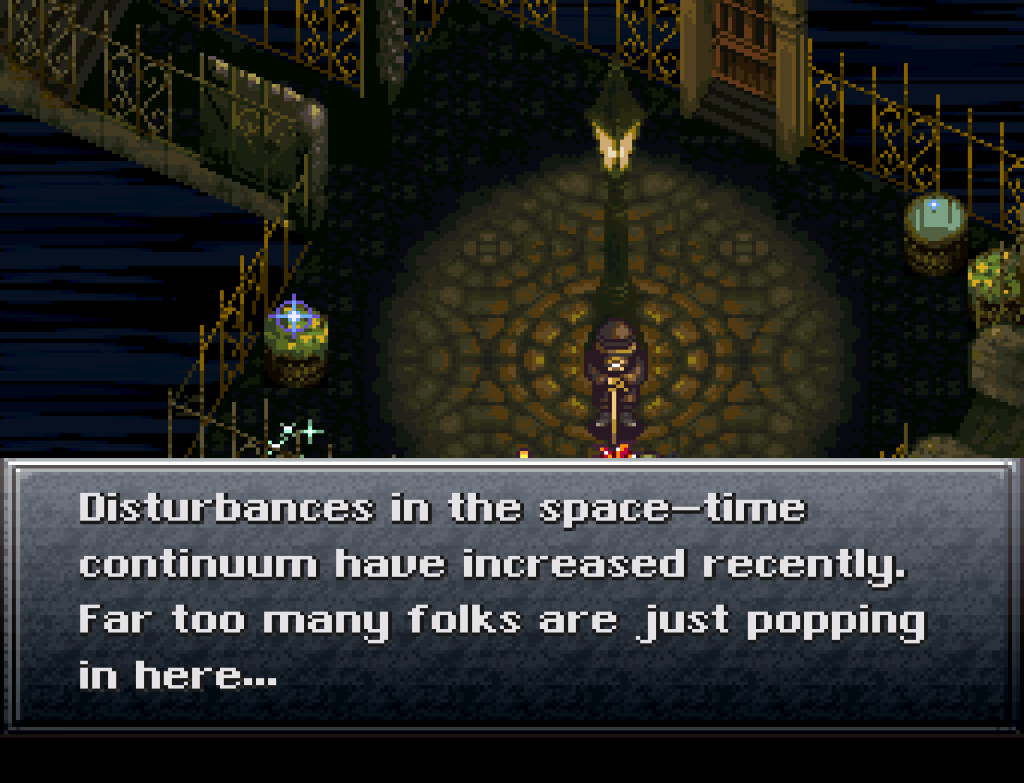
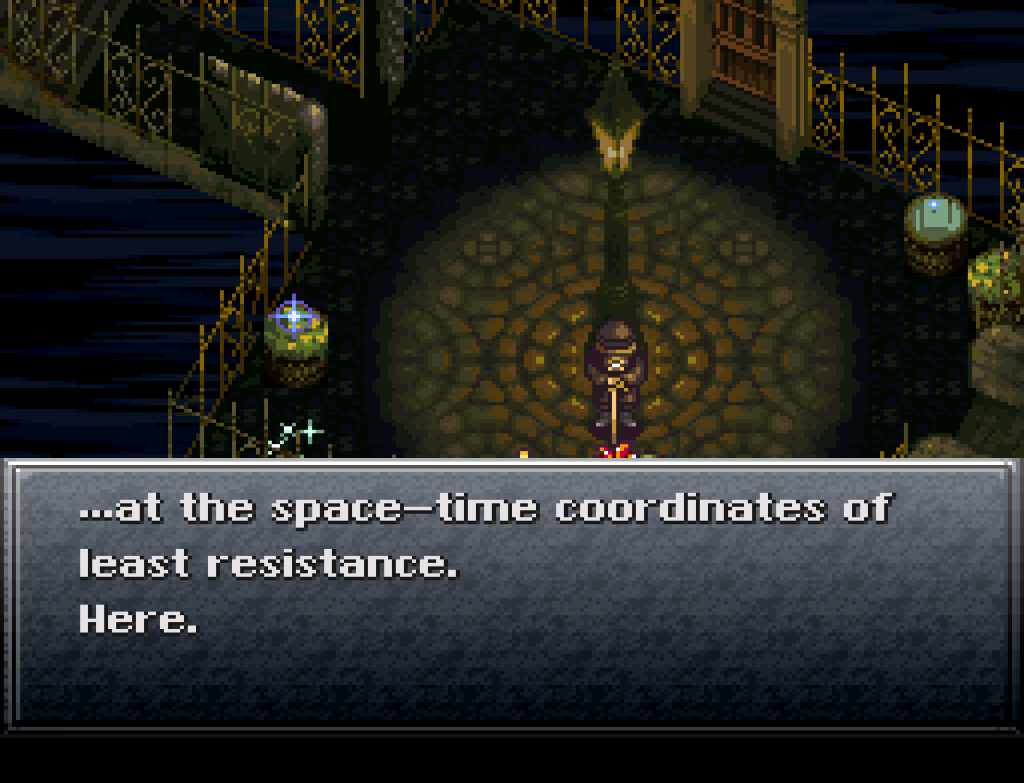
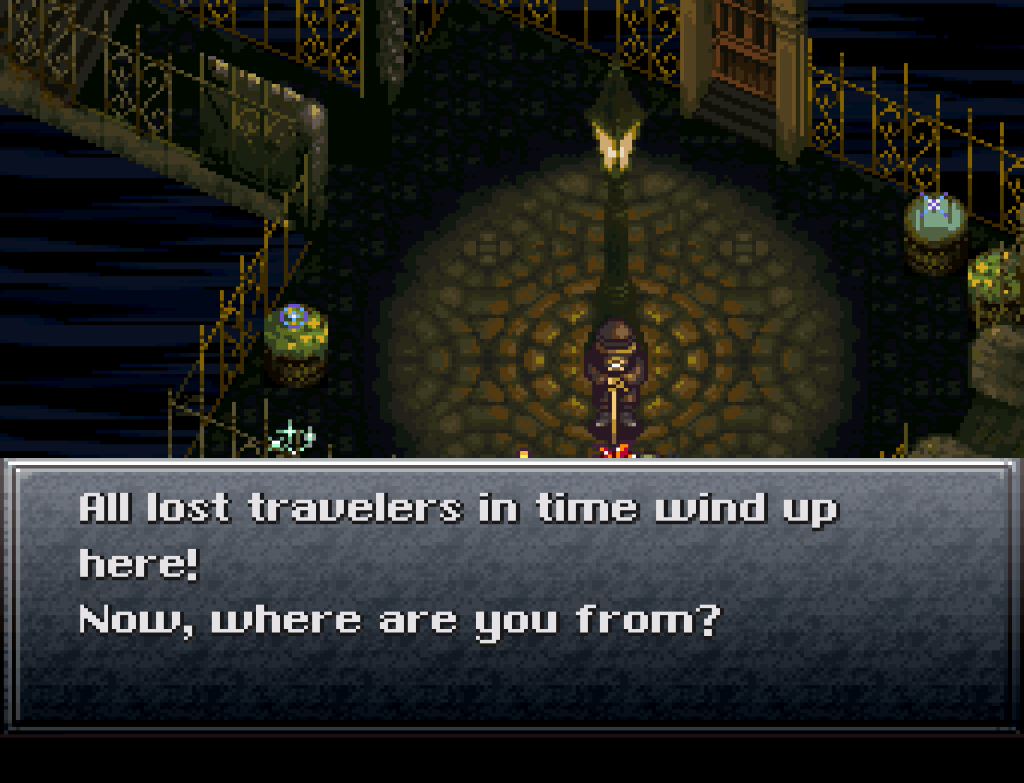
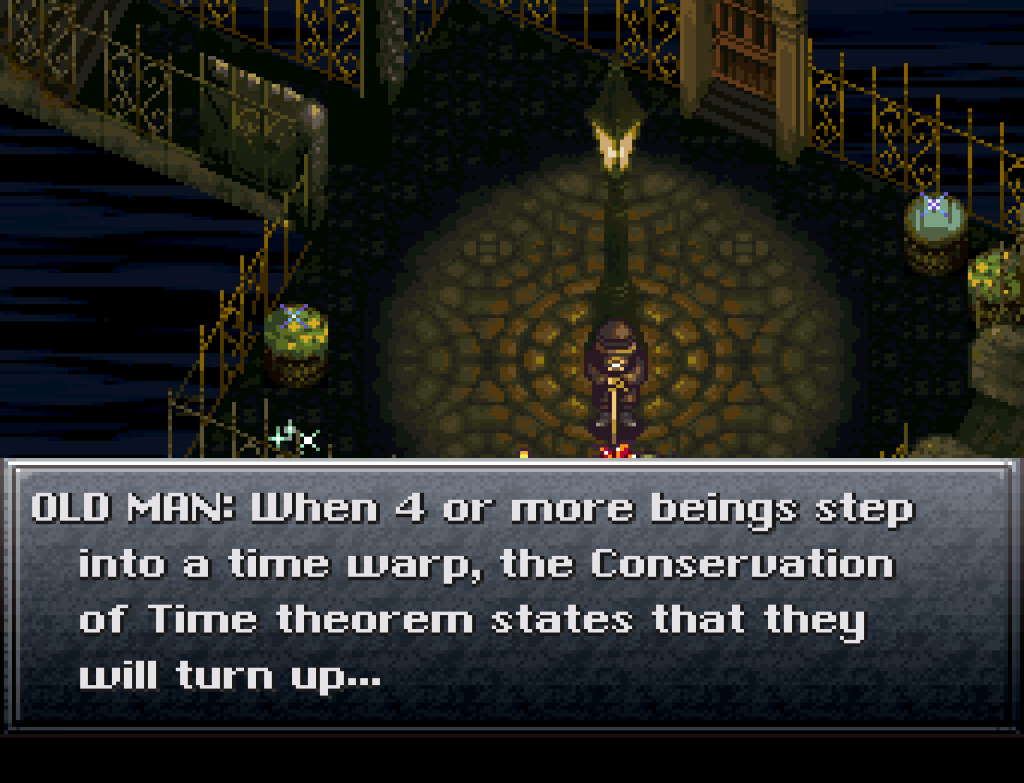
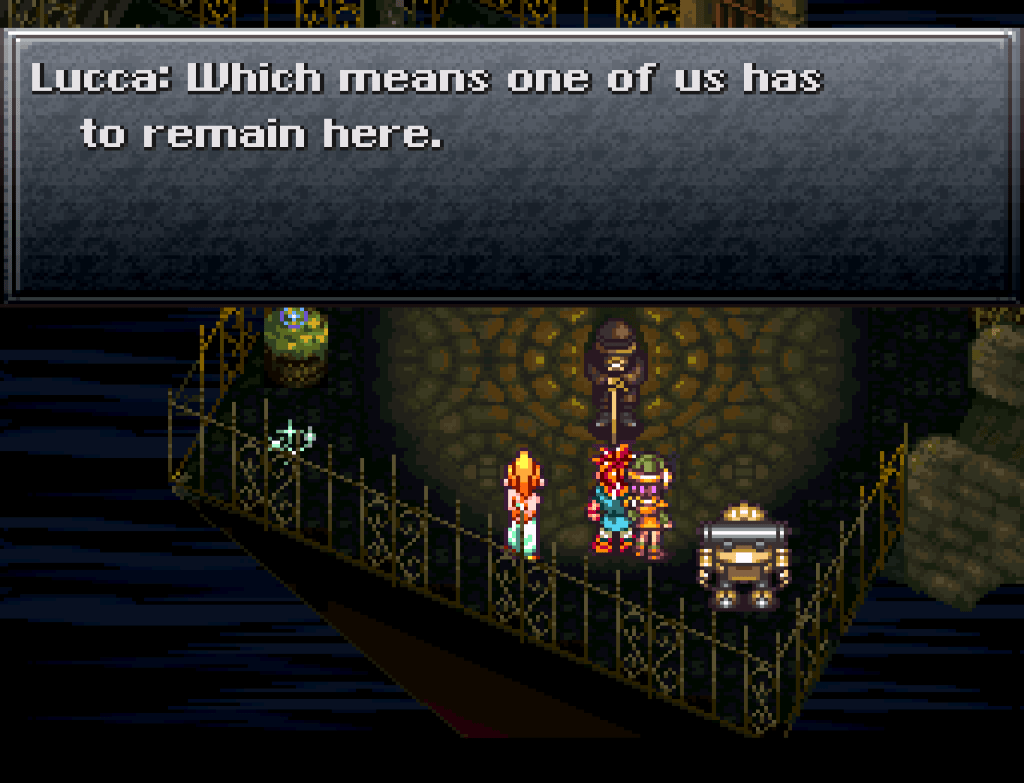
Apparently the rule of time travel prohibits groups of more than three people from going wherever they please. Add a fourth man, end up in the void. It’s a completely silly rule that just exists so the player isn’t like ‘why the hell can’t I use all of my party members in battle at once?’ but hey, at least they have a reason for it. Why couldn’t my entire party fight Emerald Weapon in Final Fantasy VII, eh?
This area has three primary functions. First and foremost, it’s your hub world. This is how you can easily move between eras without having to find specific gates. It’s convenient, that’s for sure.
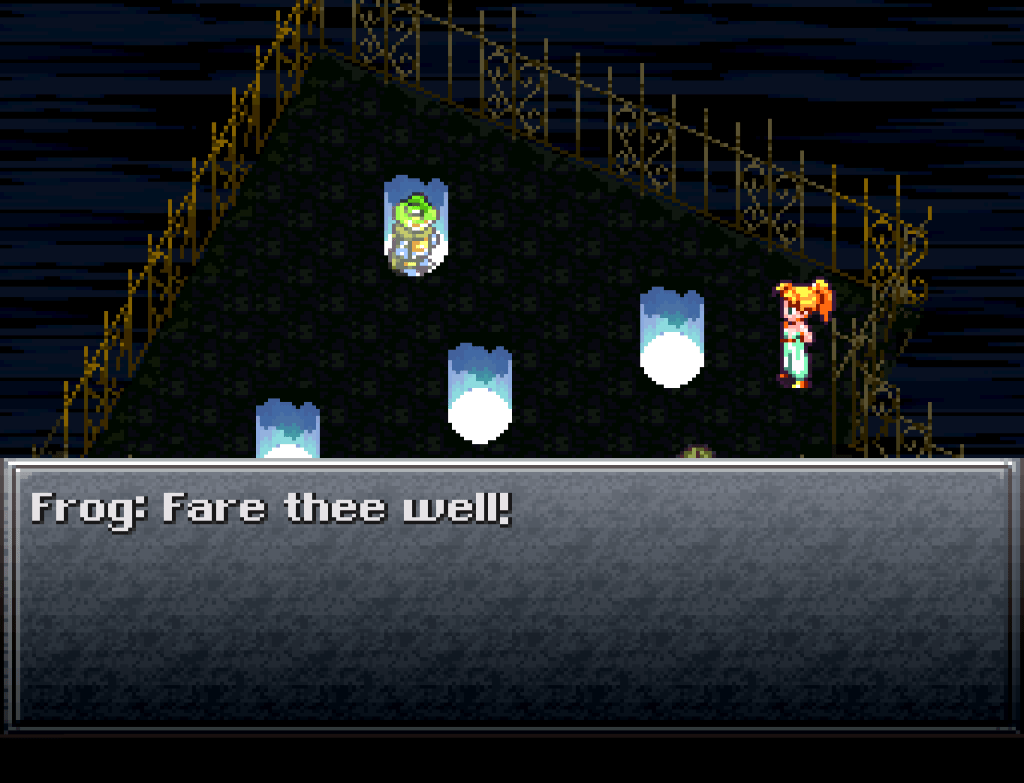
As your adventure progresses, more gates open up and they do it in a way that it’s never really a mystery on where to travel next. Older games can often be a little more vague about where to go, so I always appreciate a little guidance.
The second function is to teach the party magic. As mentioned above in the present section, humans with magic are unheard of. There’s a being here that understands magic and will happily teach it to you. It’s not that humans can’t use magic they just kinda…forgot how. Why? Well, we’ll get into that later. But ol Spekkio will help your party turn some heads in Medina.
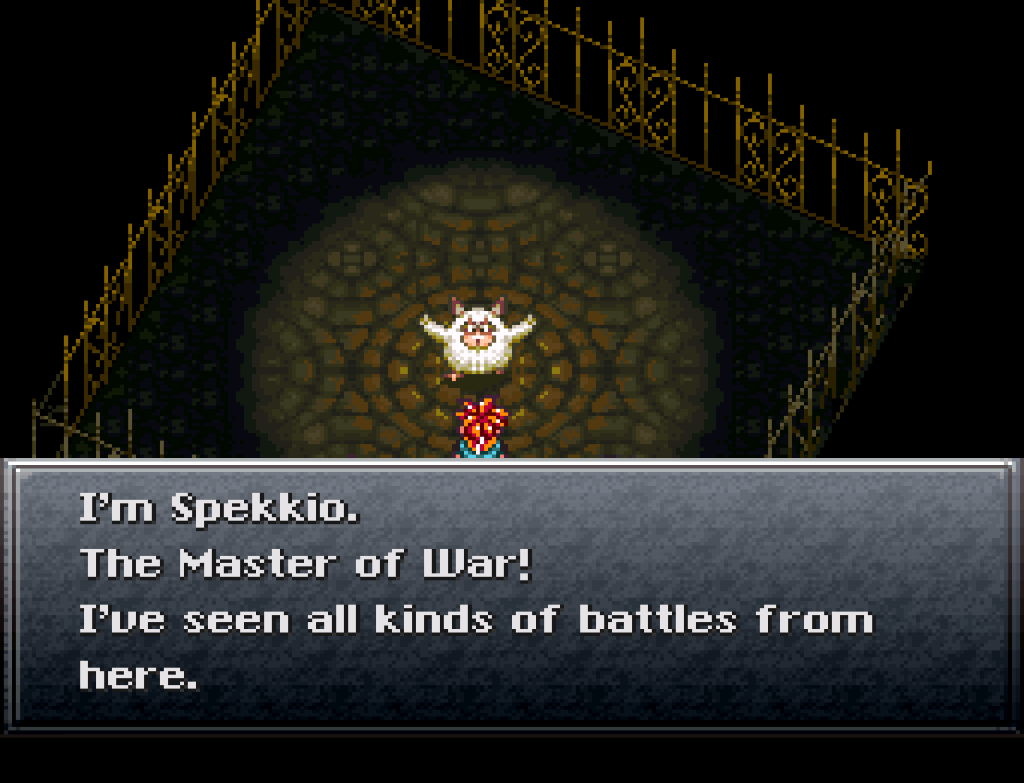
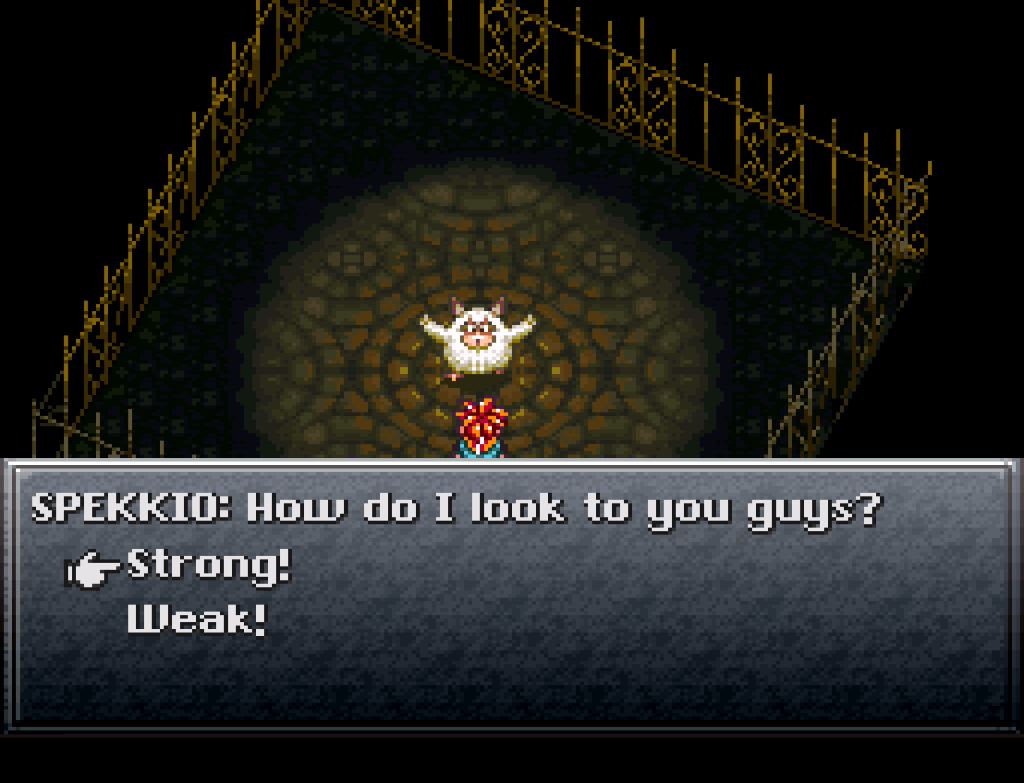
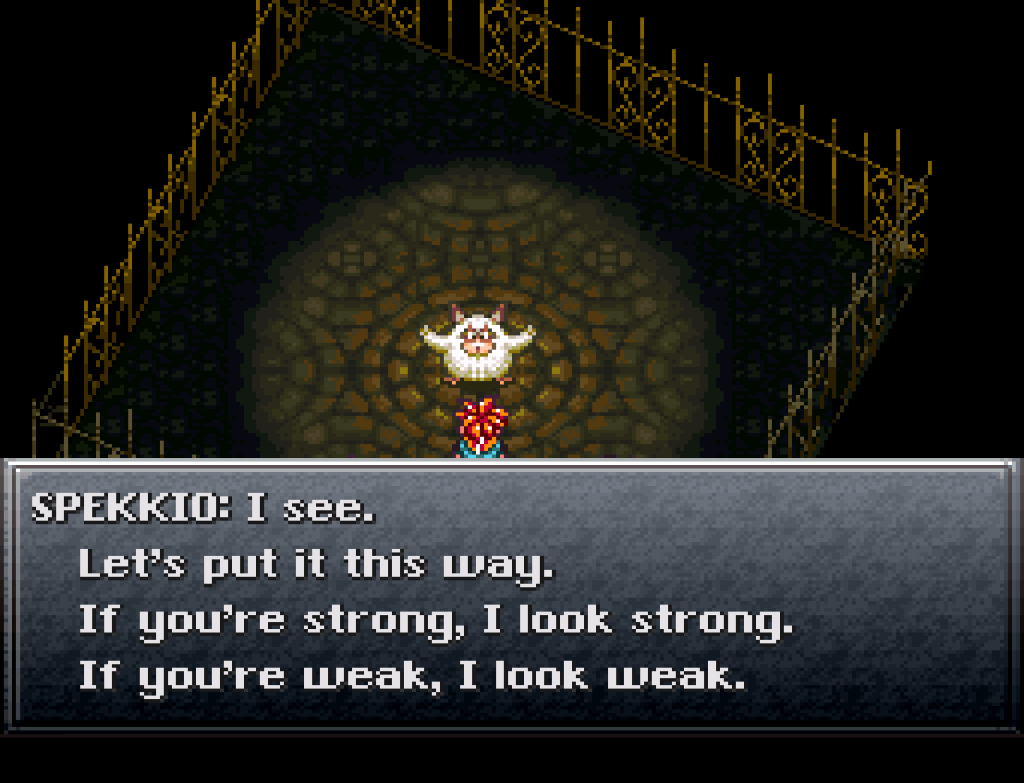
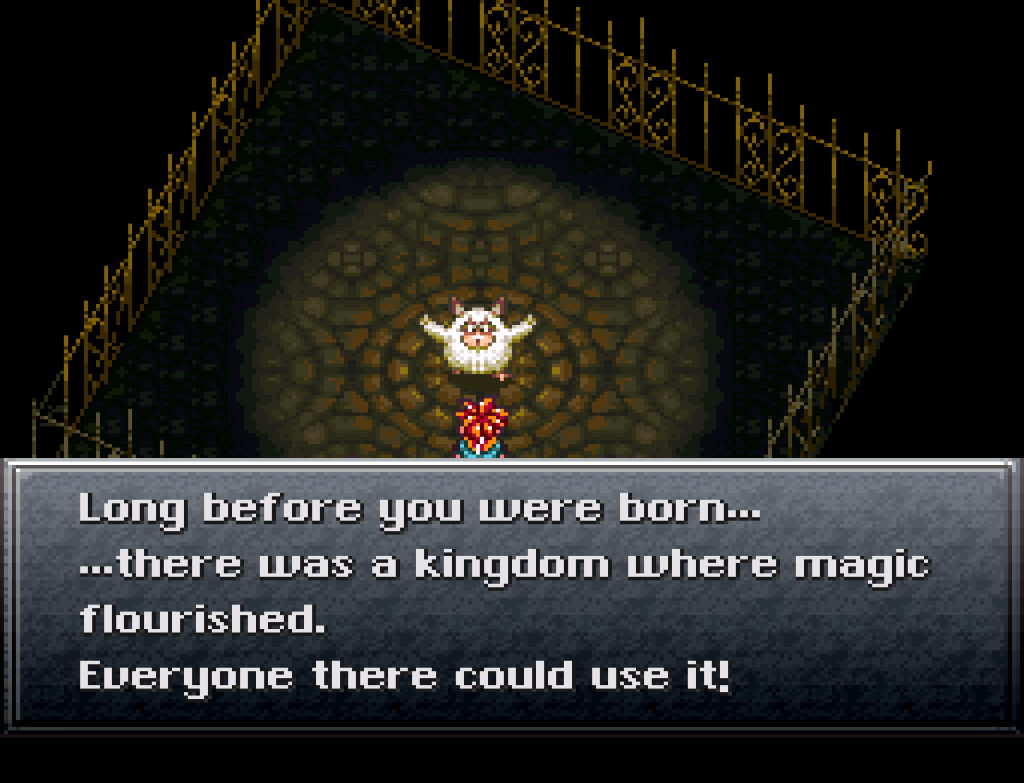
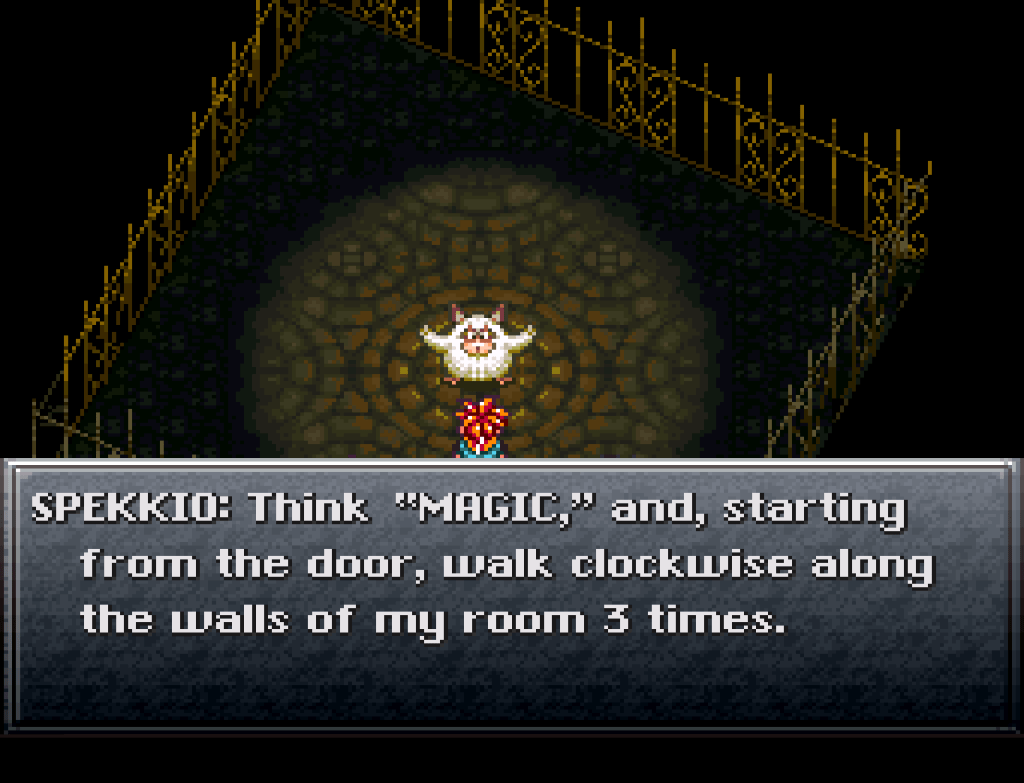
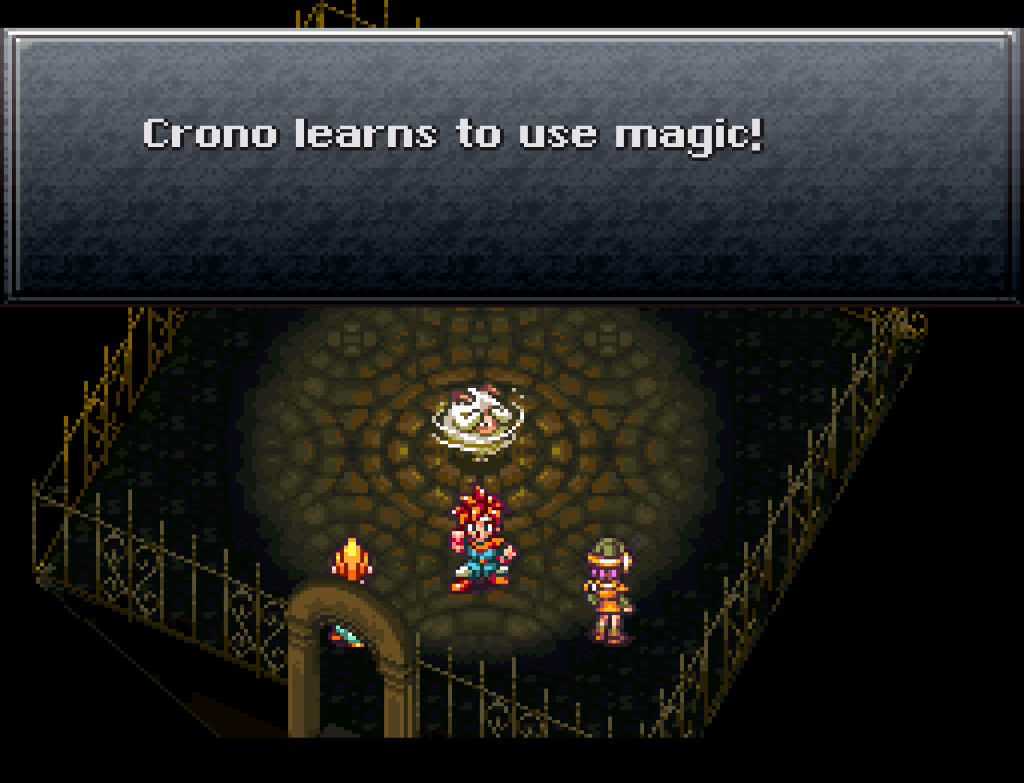
My favorite thing about teaching magic to the party, outside of it just being cool, is how they make a point to tell you to bring new people along so they can learn magic. Of the seven playable party members, four of them can learn the dark arts from Spekkio. Three of them are with you the very first time you meet him.
Frog is the only other one who gets a magic facelift. So they have this line of dialogue in the game telling you to come back and then every time you do, he basically says ‘you can’t learn it’ or ‘you already know it, idiot.’
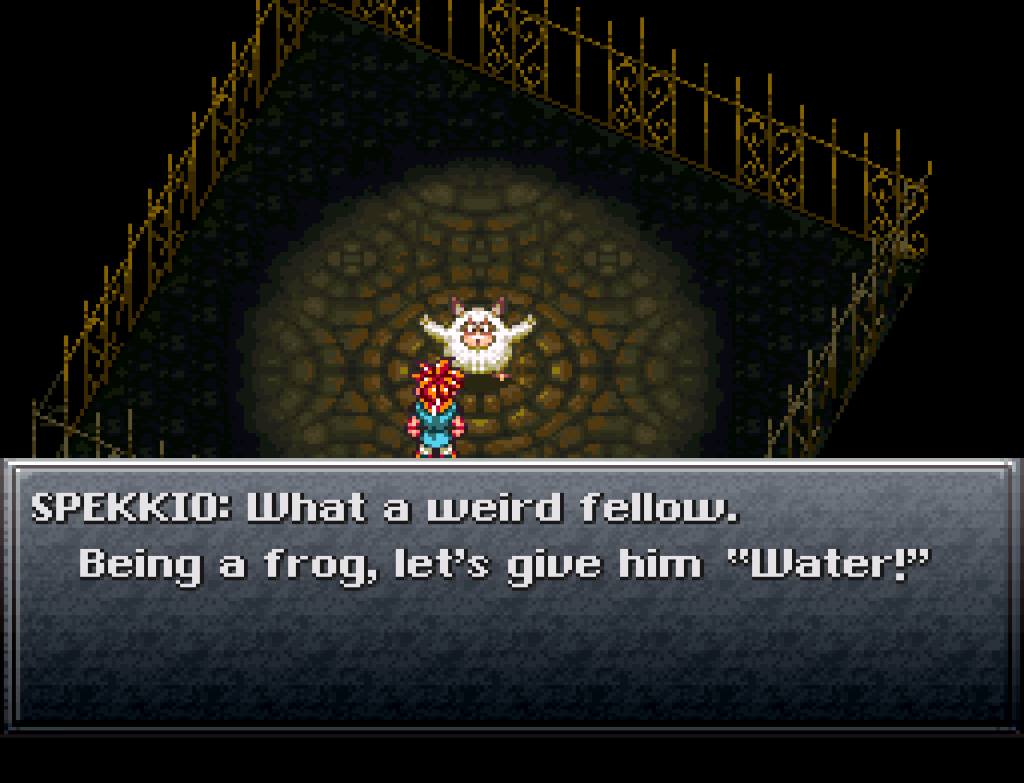
The third function doesn’t get much use until New Game Plus. They have a device here that lets the player go fight Lavos whenever they want. While it’s available in a standard playing, most players would not use this because the party just isn’t ready for it until the end of the game. You can still try though! This is the main method for experiencing the different endings the game has to offer.
There is also a secret teleporter at the Millennial Fair you can use if you want the developer ending. Or the player can also use the time machine (the epoch) to get there. But the main path is through the bucket. I think the ability to fight the final boss at any point is awesome and makes total sense for a game about time travel.
If they want to save the world, they SHOULD be able to do it at their leisure.
I just would like to apologize to this section for talking at length about sidequests earlier. I kinda took away this zone’s big gimmick. Sorry Gaspar.
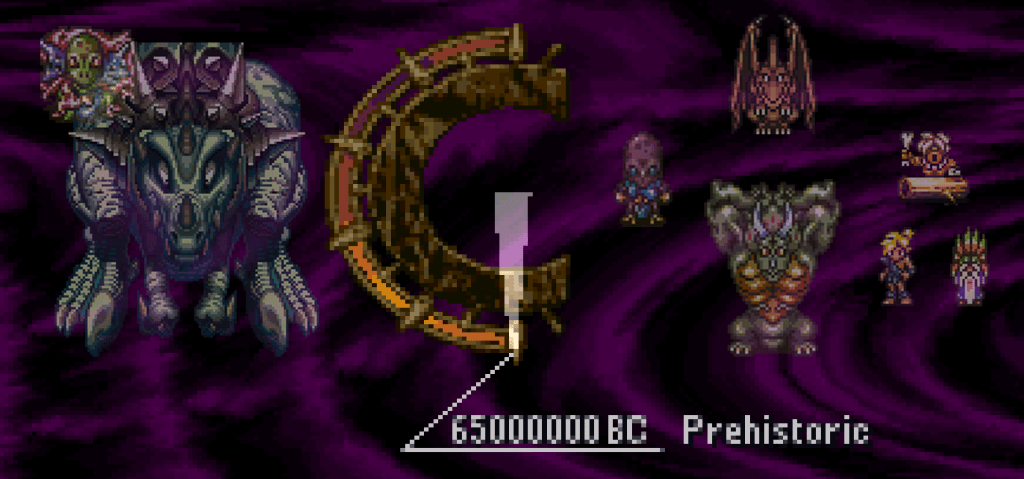
Prehistory – 65,000,000 BC
In the middle of the quest to bring back the Masamune and cheer up ol Frog, the player learns that they need an ancient stone that hasn’t existed in millions of years. I mentioned it earlier, but for reference, that’s the Dreamstone.
You’re told its hopeless, but if you’ve poked around The End of Time, you’ll spot a new era! We’re probably an hour and a half from exiting the future at this point. It’s time take us back to the past (to play the shitty games that suck ass.)
65,000,000 BC, like the far future, is much different than the times we are used to. The party is immediately put into what looks like the wilderness and there are enemies everywhere. Now granted, when you touch down in 600 AD, there are some baddies waiting for you. But nothing quite like this. Until the party hits the world map, they see nothing but wild beasts waiting for em. It was a different time!
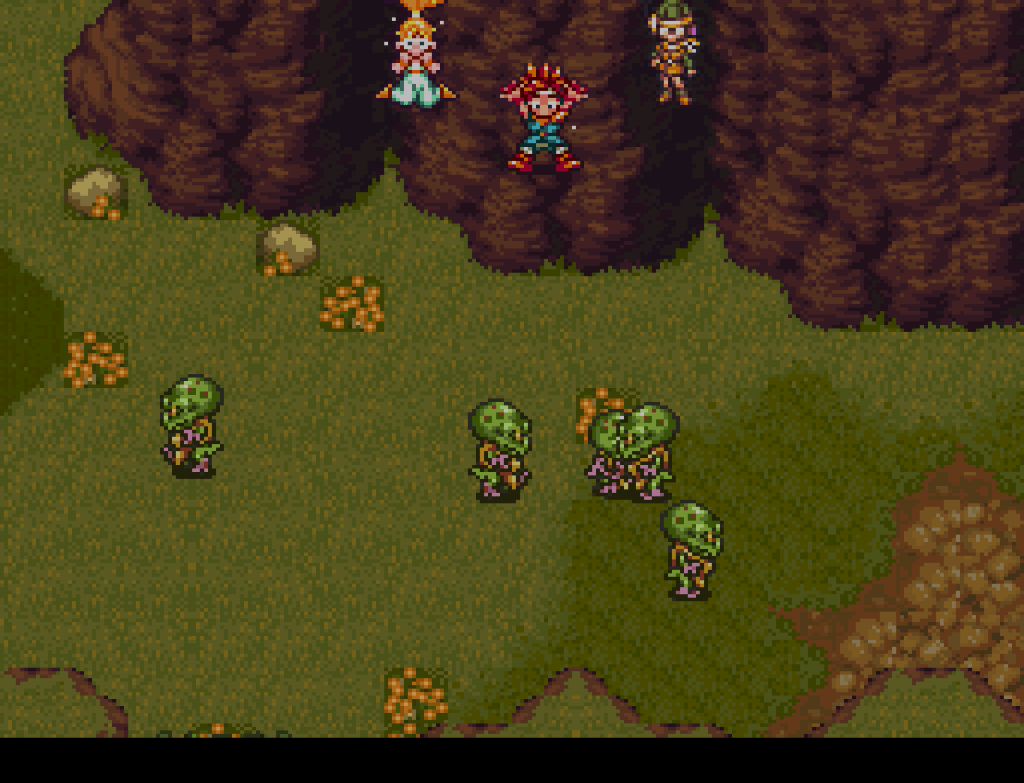
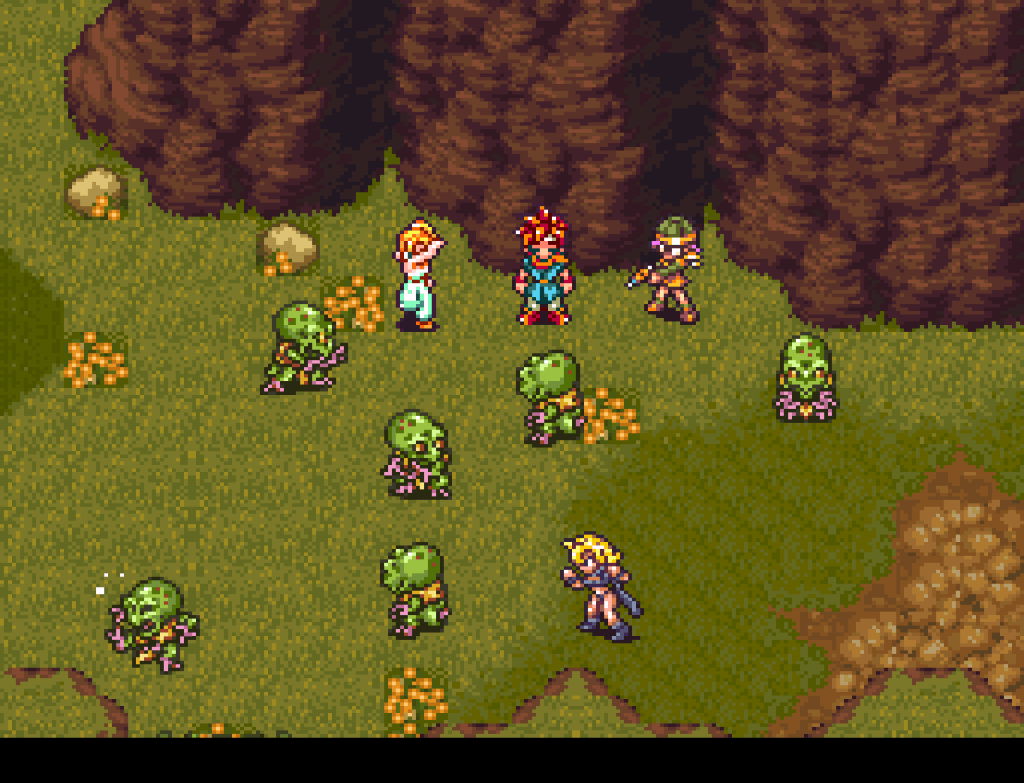
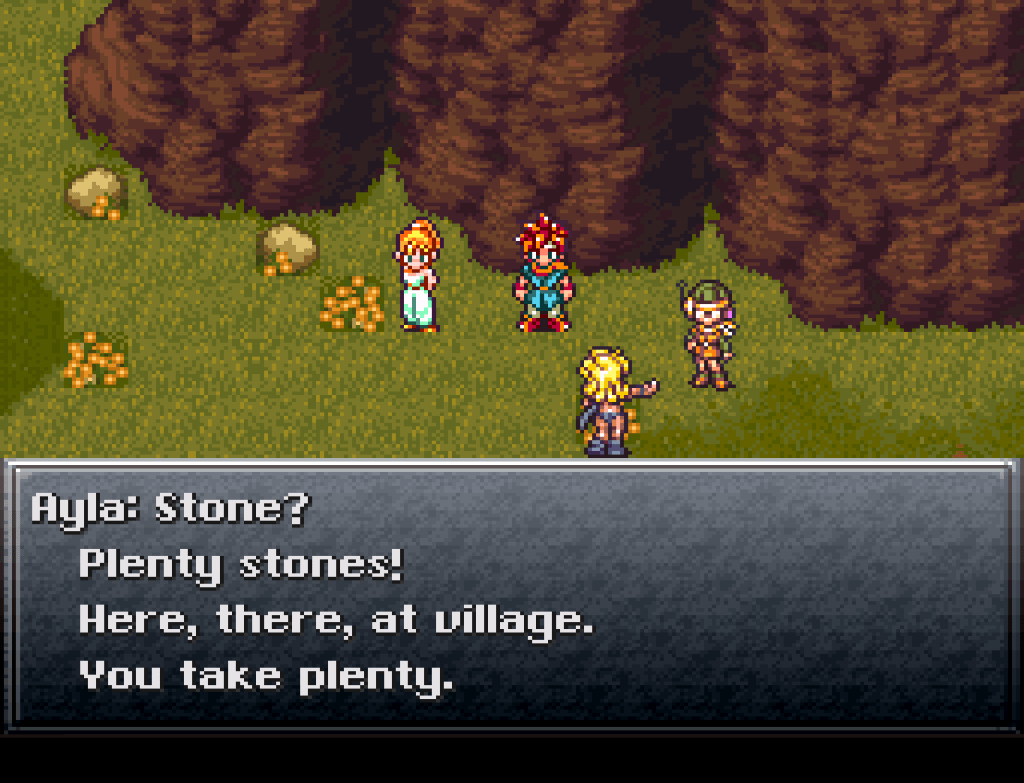
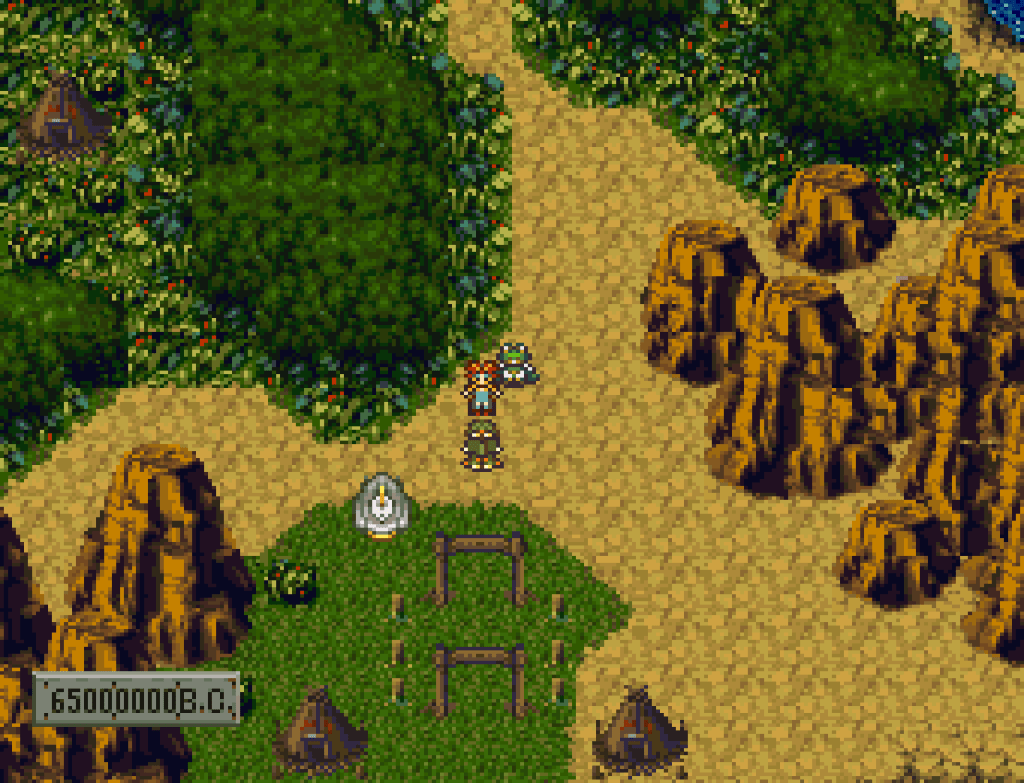
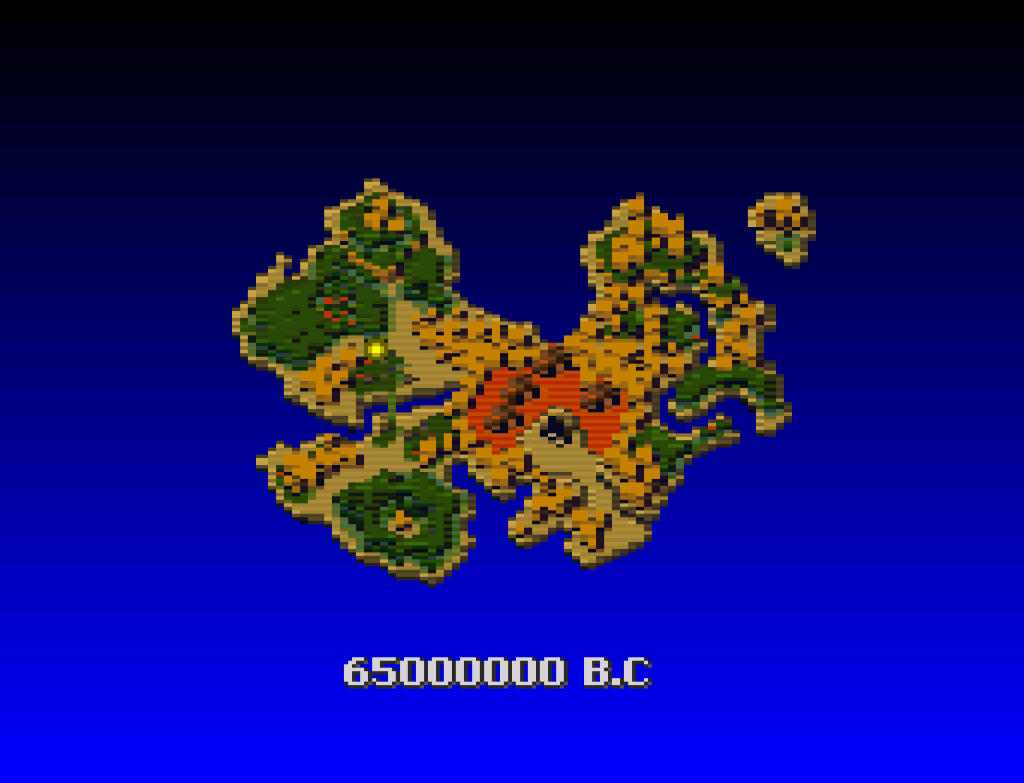
Conflict colors most of your time in the past. What you learn shortly after landing is that there is currently a battle raging between humans and dinosaurs – called reptites.
In our world, dinosaurs are thought to have been wiped out by a meteor. They aren’t thought to be anything but large brutish reptilians. Some weirdos even think they have feathers! But in Chrono Trigger, they are a far more advanced race than humans. They have better technology and without significant intervention, they probably rule over society.
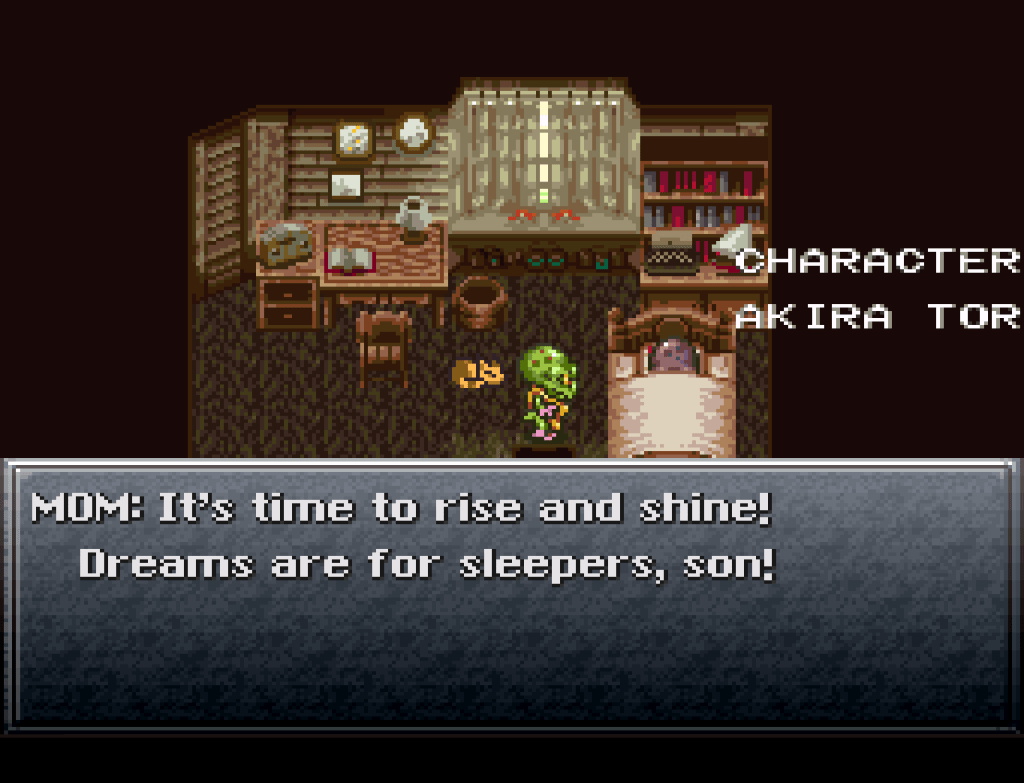
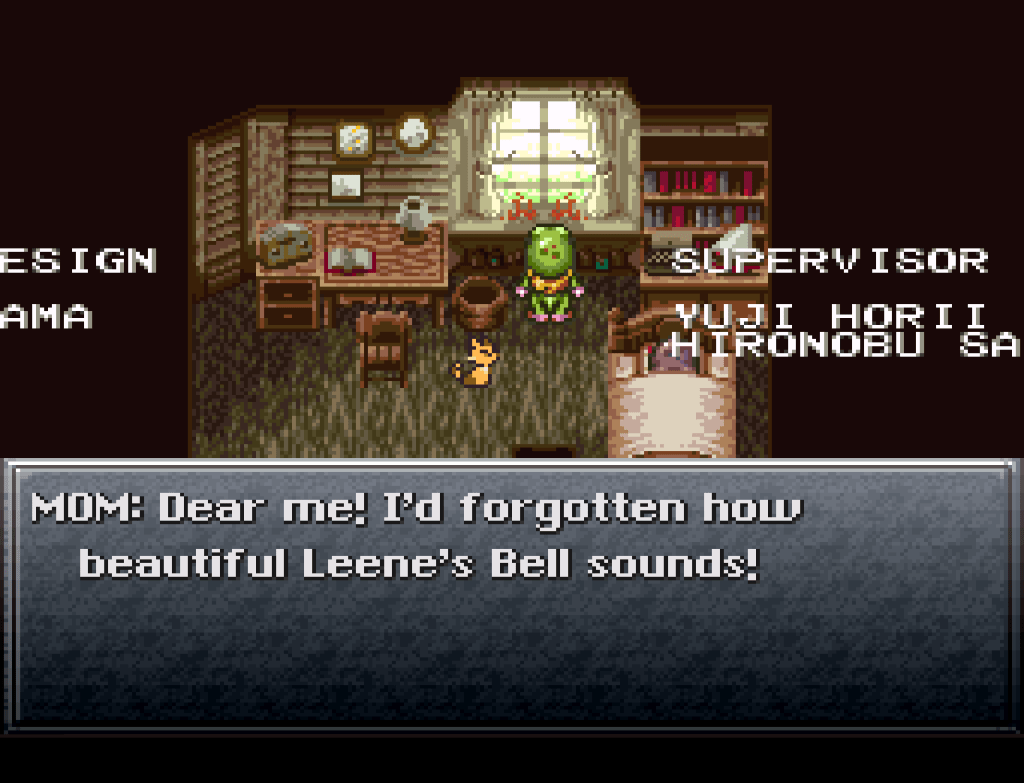
Hell, a couple of endings suggest that very thing happening, with the events of the very beginning of the game being reenacted by reptites.
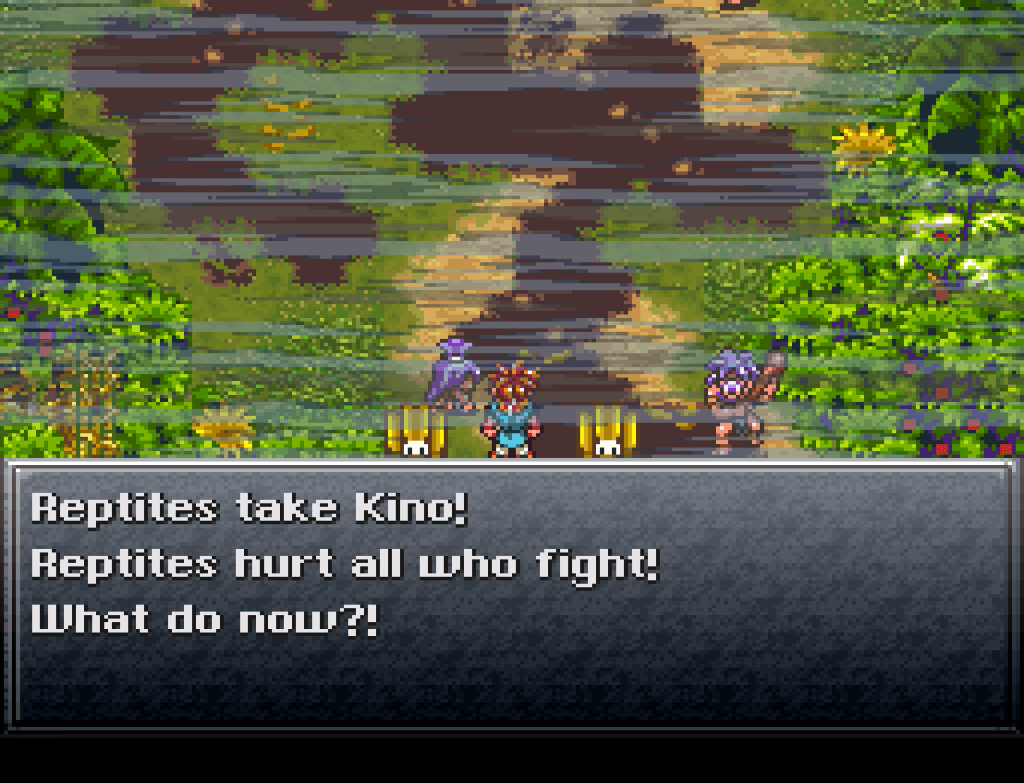
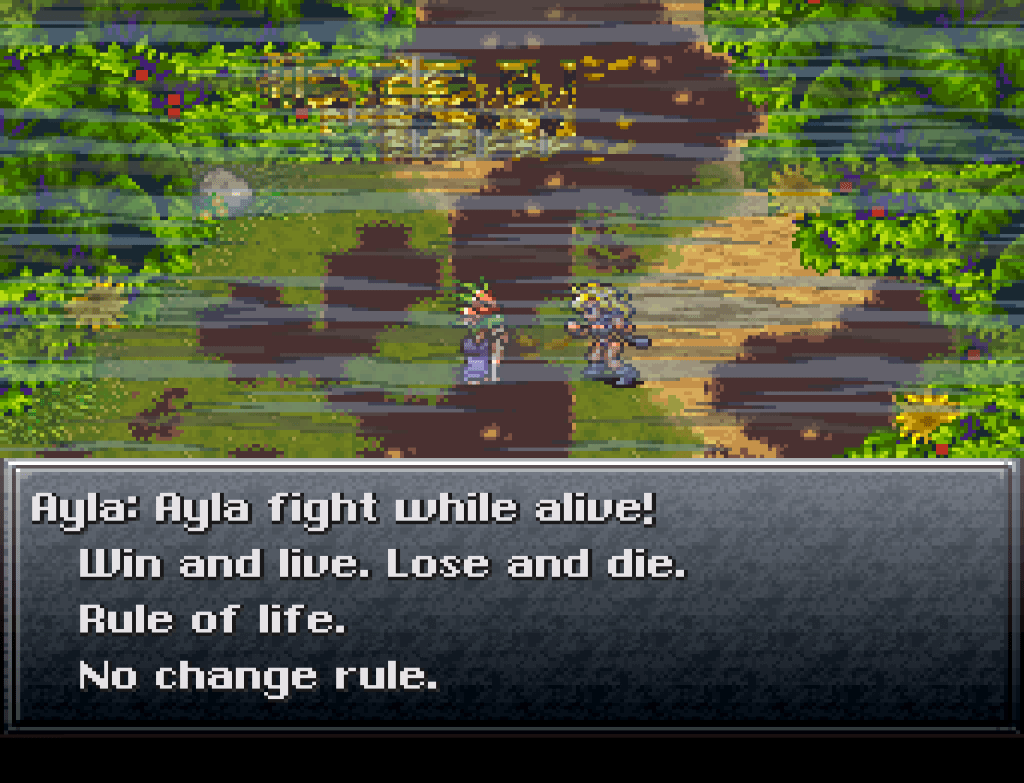
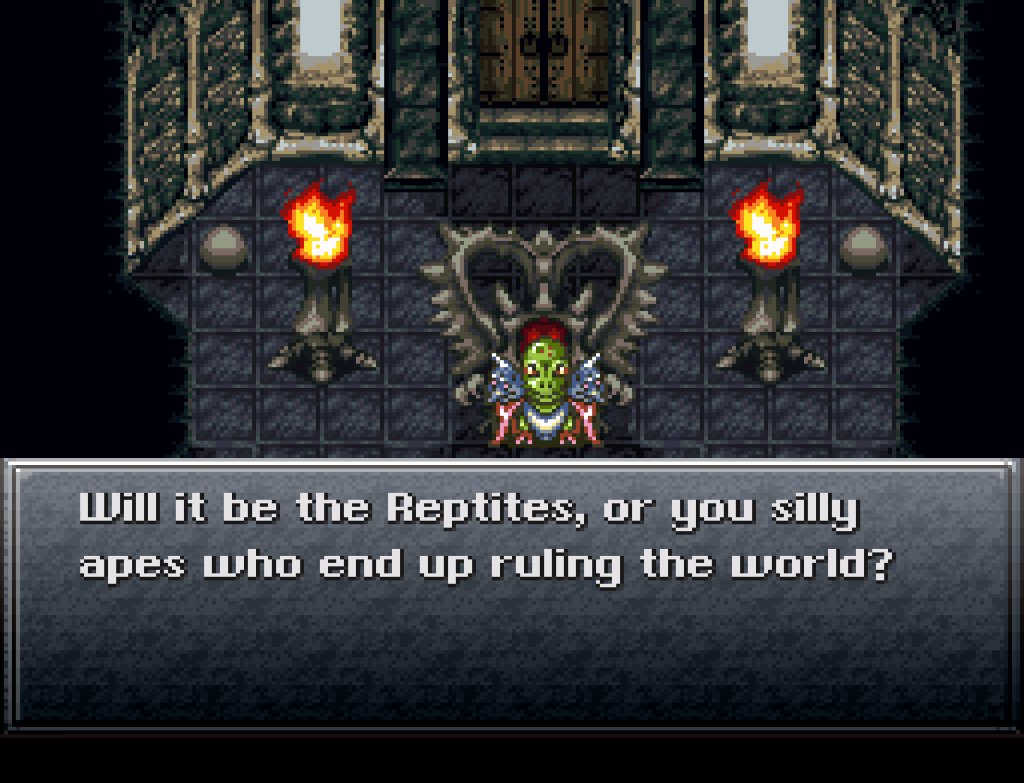
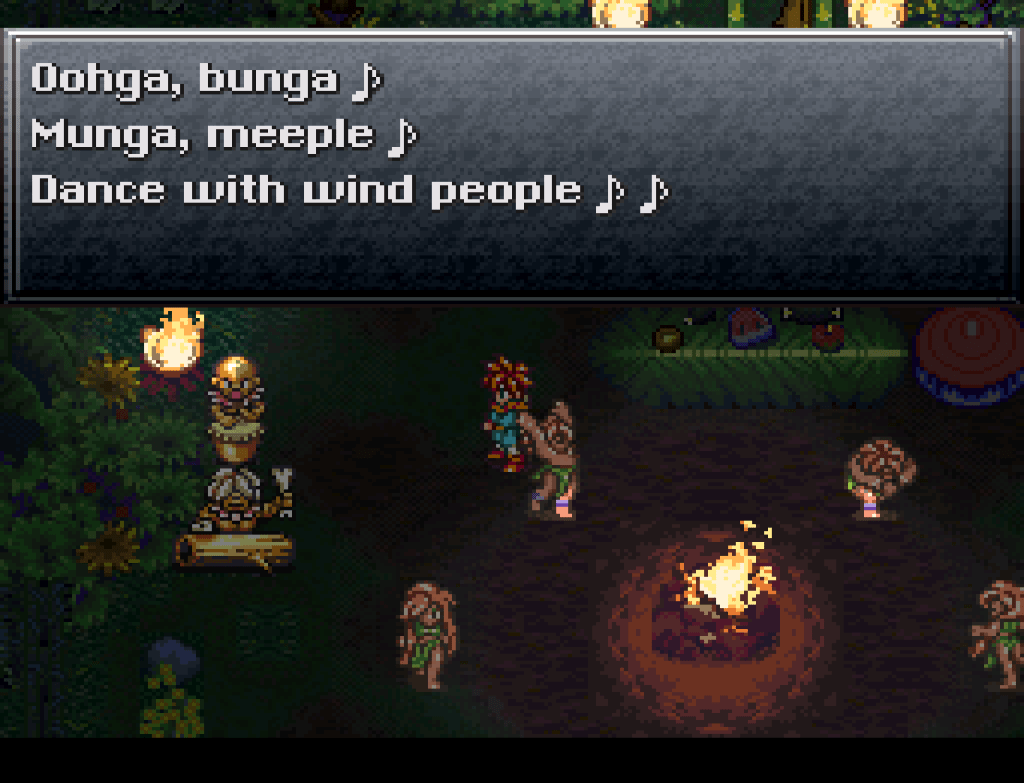
Because humans aren’t very developed as a society yet, characterization from this period is very abrupt. Everybody kind of talks in ‘fictional caveman’ prose, which is to say the fewer adjectives and words used, the better. As a result, the main character from this era and its playable party member, Ayla, doesn’t have much of a character beyond being strong.
The first visit to the ancient past comes off as a bit of a filler arc. You go here, beat up some dinosaurs to get the object needed to fix the Masamune and then you scoot back to 600 AD to finish business there. For future reference, the Dreamstone is given to the leader of civilization – royalty.
If you stopped playing right here because you returned the game to Blockbuster or whatever, you’d be forgiven for thinking stuff ends there. To this point, objectives in eras are spelled out for the player and even if they have to time travel to solve the problem, you generally know why you’re there. Not so with the ancient past.
But after you’re done fighting Magus, the party gets sucked into a giant portal and wind up back in the past. This time, they have to play a more serious role in ending the Reptite menace. Up until this point of the game, the player is led to believe that Magus is behind Lavos. 600 AD seemed to be where everything was going down. But during your confrontation with the dinosaurs, a giant red meteor comes hurling down to the surface.
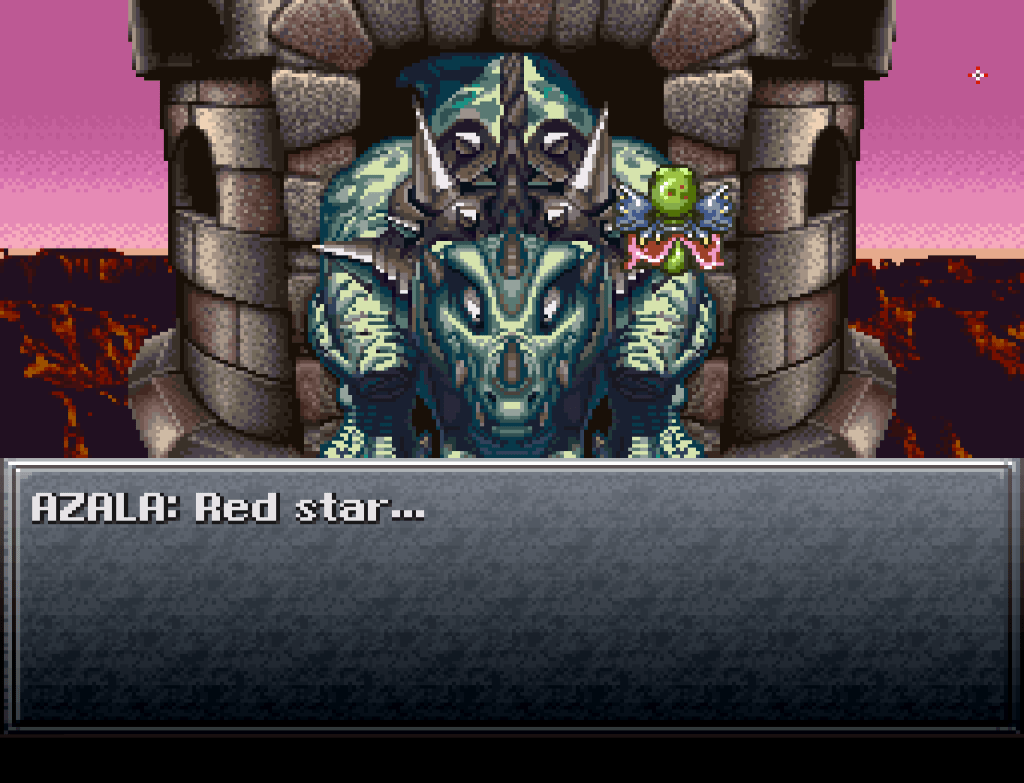
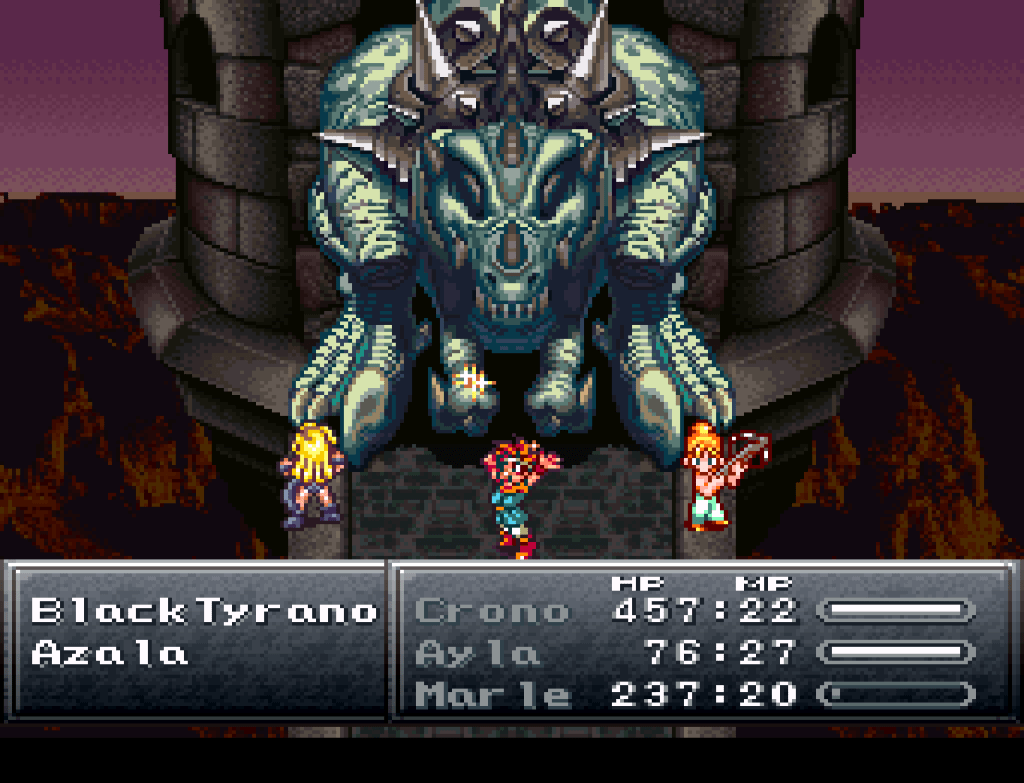
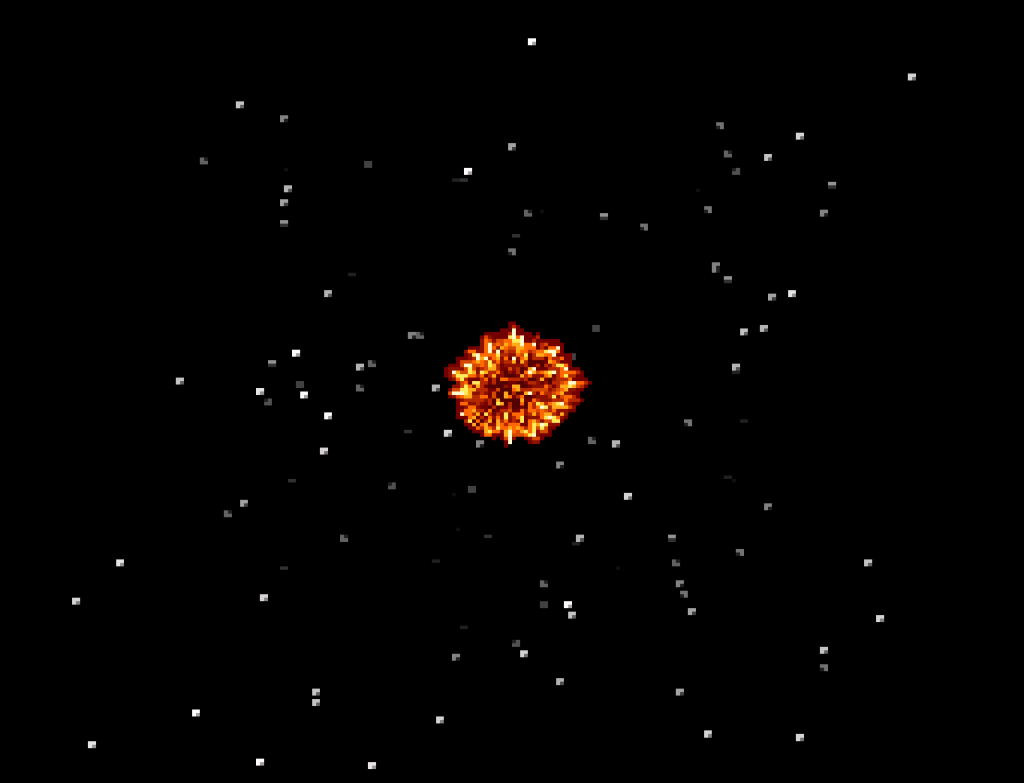
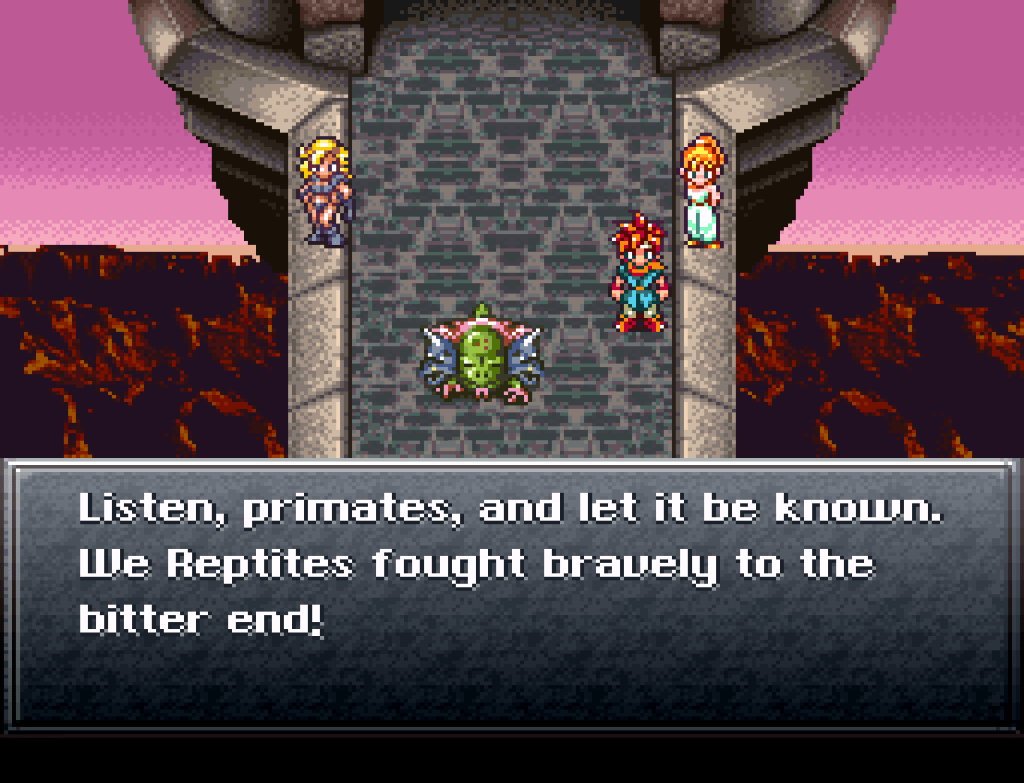
That’s right. Our history has informed us that the dinosaurs were killed off by a meteor. Chrono Trigger plays into that a little bit by making the true identity of this meteorite ‘Lavos.’
Upon touchdown, it burrows deep into the earth and leeches off the land for…well…ever. This event is suggested to be the reason for humanity being able to use magic – its influence dug its way into humanity’s mind and unlocked this ability.
So, while your crew certainly helped put an end to the leader of the evil dinosaurs, it would seem humans made it out of the caveman days by casting lightning on beasts. You simply took care of the person who organized the scalie menace, Lavos and the invention of magic is what propelled humanity to victory in this ancient culture war.
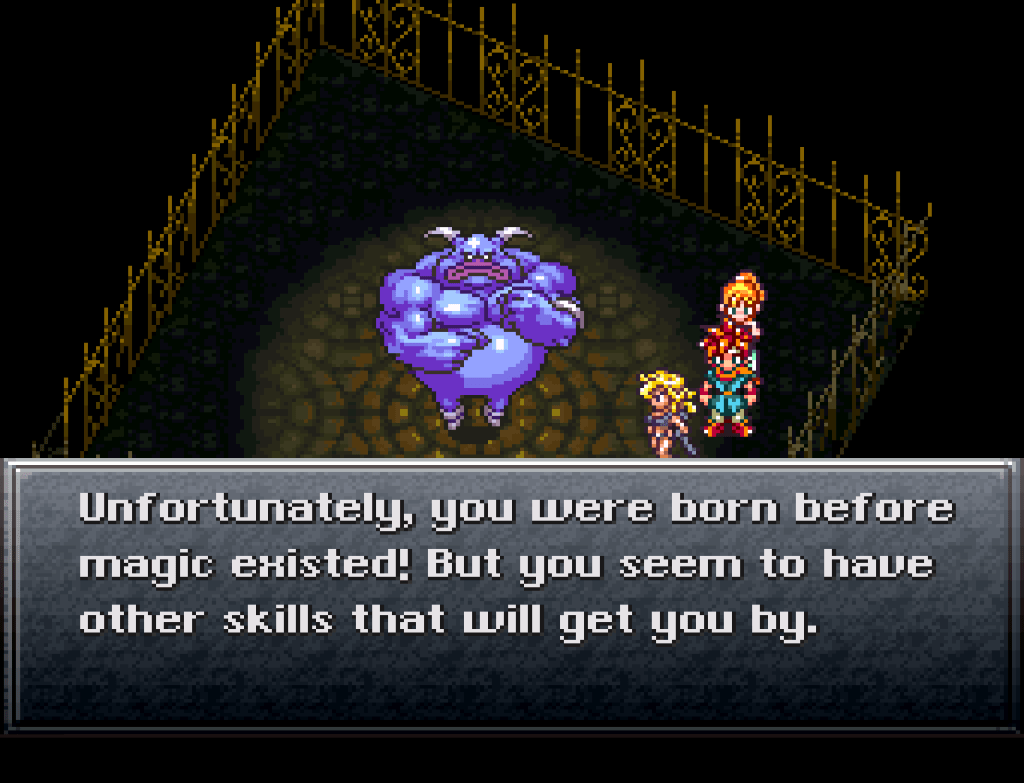
The game sorta spells this out for you through interactions with Spekkio. Remember, he tells you to bring each party member to him if they want to learn magic. If you bring Ayla to him, he says that she was born before magic was even invented.
In the immediate next era after this, Dark Ages/Antiquity, magic is at the forefront of elite human society. Since Ayla was born before the existence of magic and Lavos officially crashed down in her era, it’s logical to conclude the birth of magic in humanity is a result of Lavos.
The portrayal of the Reptites has always been fascinating. Despite being the villains of the scenario, they are ultimately just looking for the survival of their species. They see humans as a rapidly evolving and developing threat to their existence and they wish to snuff it out.
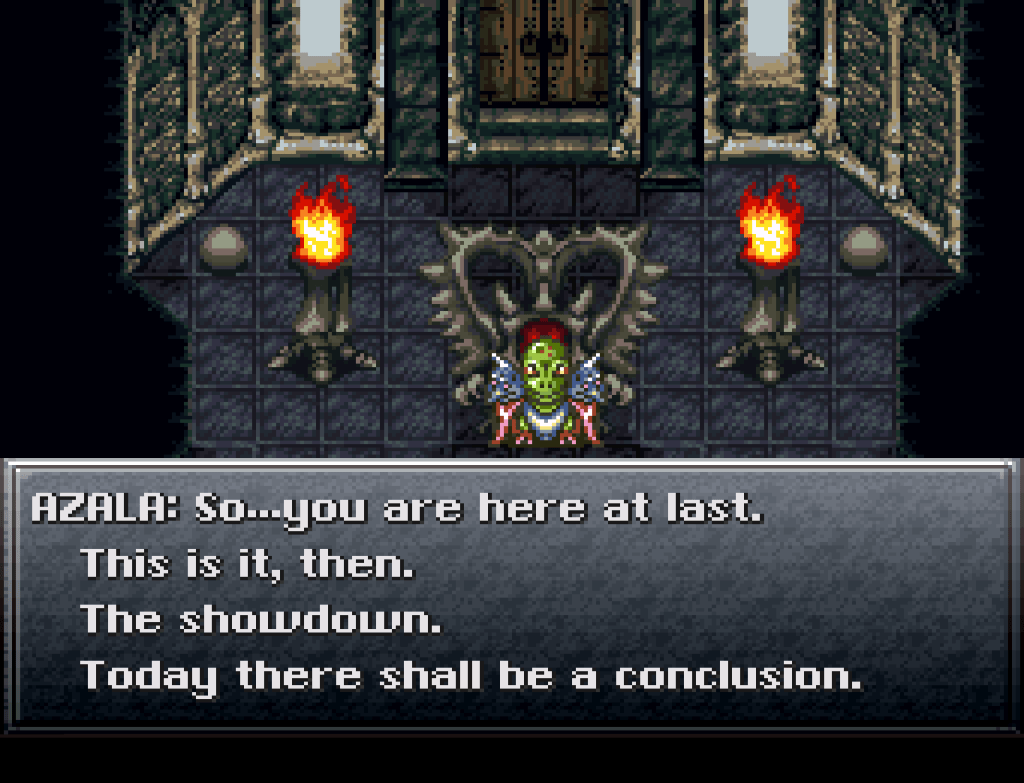
The leader, Azala, is given an opportunity to escape with the main party instead of being killed when Lavos makes impact. But he refuses, simply because he sees the way the winds are blowing, and he doesn’t want to witness the end of his civilization.
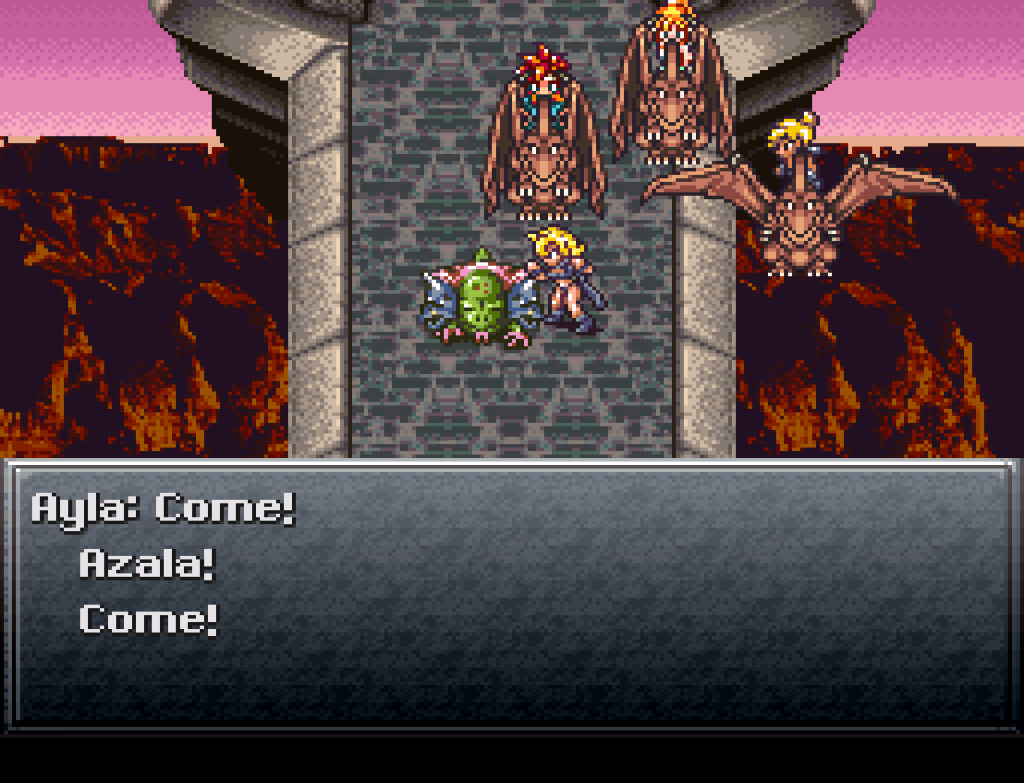
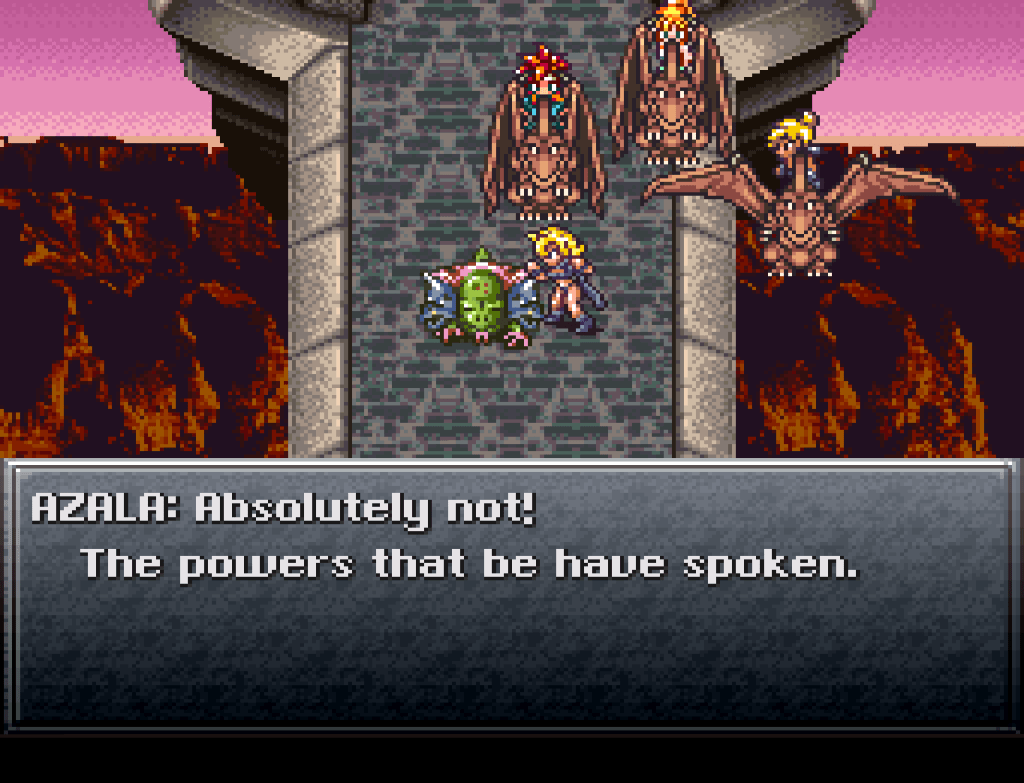
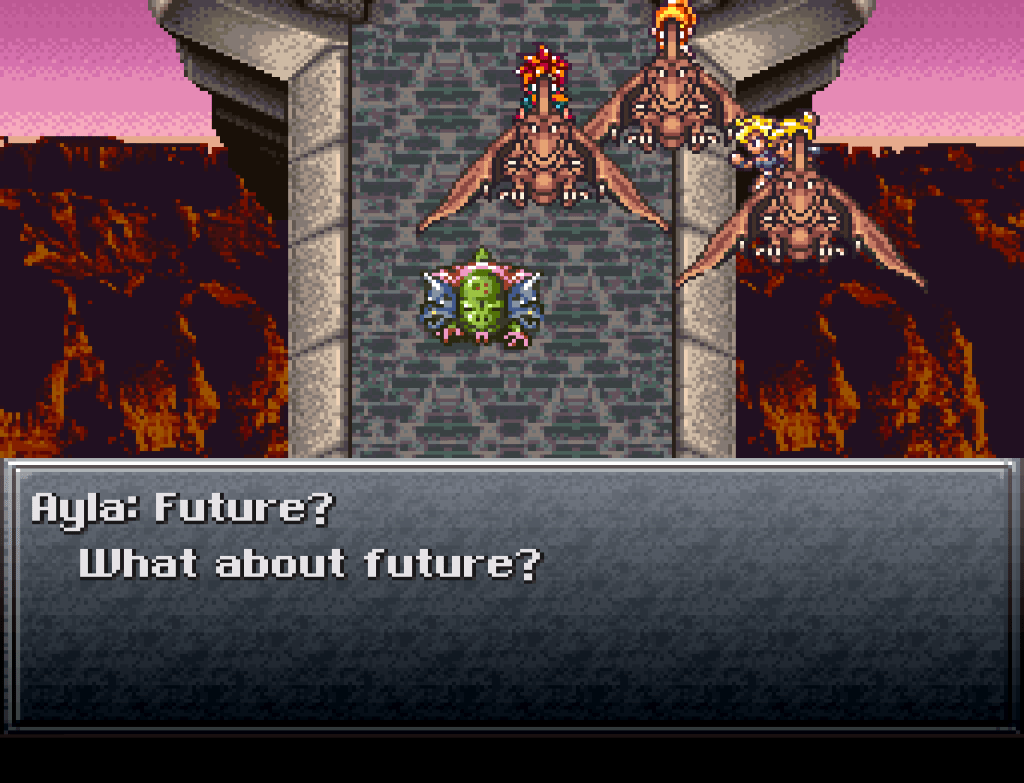
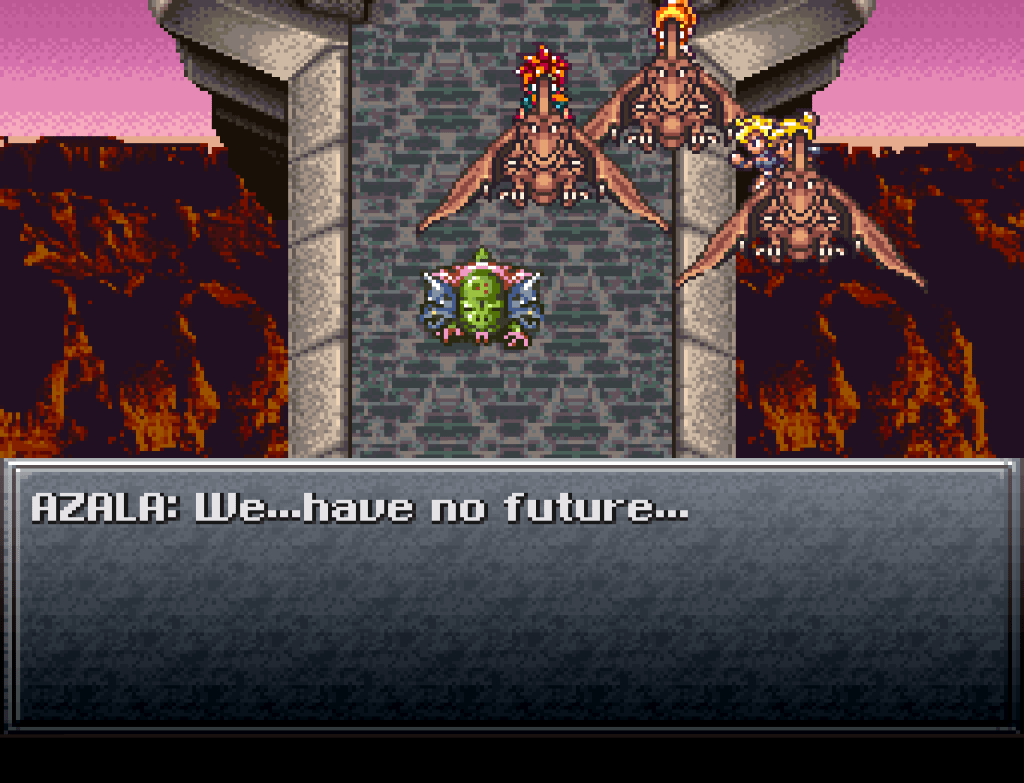
I’m not trying to tell you “Azala and the reptites good, actually.” But this does continue the Chrono Trigger trend of giving otherwise simplistic and mindless villains narratives.
In other RPGs, monsters are just monsters. Why are they evil? Because they’re monsters. Chrono Trigger makes all of the main villains sentient in some ways. A lot of Ozzie’s motivations still boil down to “I want to kill humans because I am a monster” but we can see he thinks and feels and isn’t just a mindless killing machine. Reptites are much the same way. As are the robots in the future.
Ya still kill em, but they have far more personality than the rank-and-file of games from this era typically would.
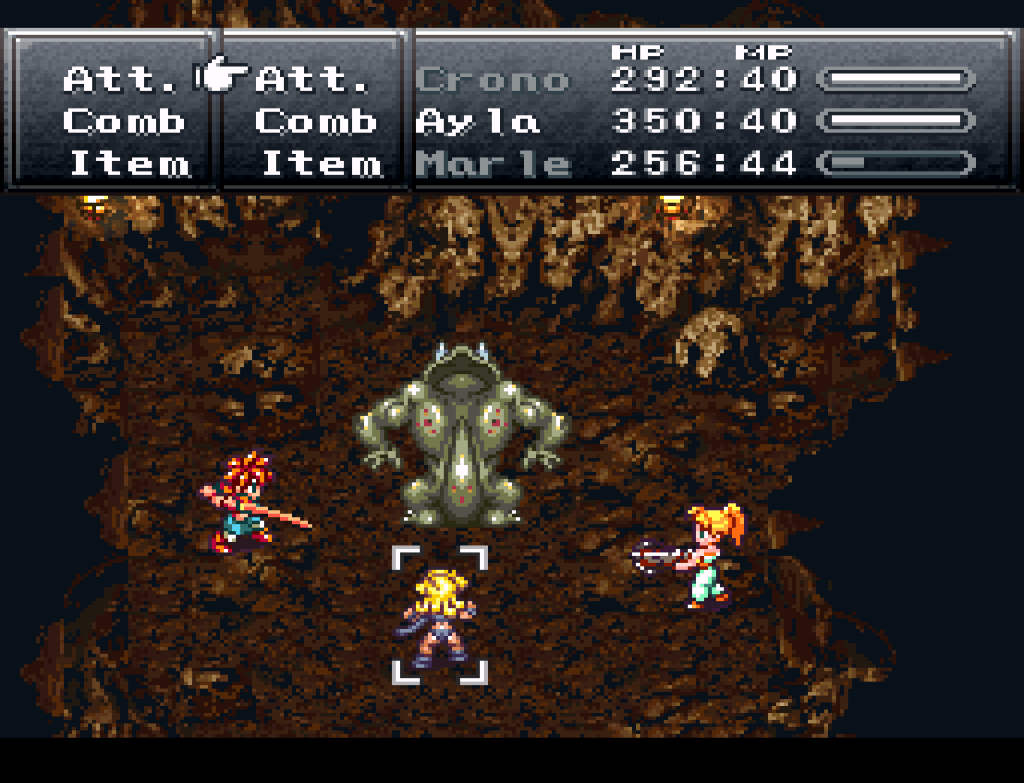
I will say it’s kind of bizarre to have the zone split in two halves like this. It would feel more natural to simply take care of the dinosaur war while you’re there the first time. But it’s crucial for the game’s story to handle it like this.
The fight against Magus in 600 AD needs to credibly feel like a final boss battle. You need to THINK that beating him could save the future and prevent a showdown with the being who destroys everything. Sure…the run-time at this point is only like six hours, but you might be so immersed that you don’t even realize that!
This era is probably the most action-packed one, which is fitting. While there are big plot points to discover, your time spent here is mainly spent navigating two large dungeons. Sure, 600 AD has mountainous areas that could be seen as the equivalent of dungeons and 2300 AD has the ruins of civilization, but what you have here is more akin to your traditional Final Fantasy ‘go to the villain’s lair and win’ design.
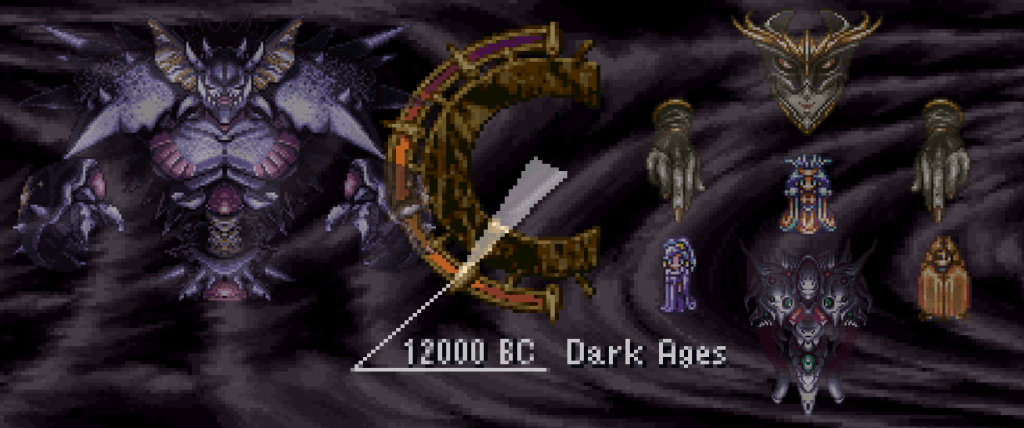
The Dark Ages (Antiquity in later versions) – 12,000 BC
This is the lore dump segment of the game, so in order to really talk about this era, well…gotta talk about some lore. Sorry to turn into a youtube essay on you!
After Lavos crash lands in the ancient past, the party finds another time portal at this crash site. The most recent portal taken to this point was the one that sucked the entire party up during the fight with Magus, but otherwise, every time portal you’ve discovered since landing at the End of Time takes the party directly to that period.
So when you find this one, it can be assumed that you go right back there. Instead, it takes you to something entirely new.
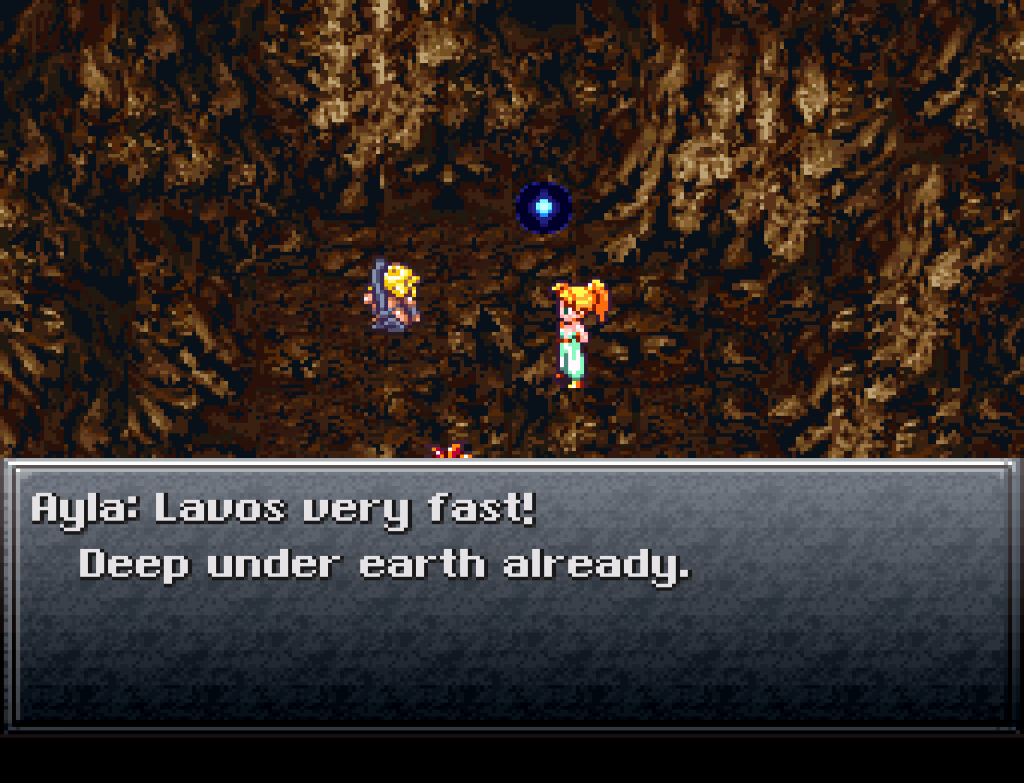
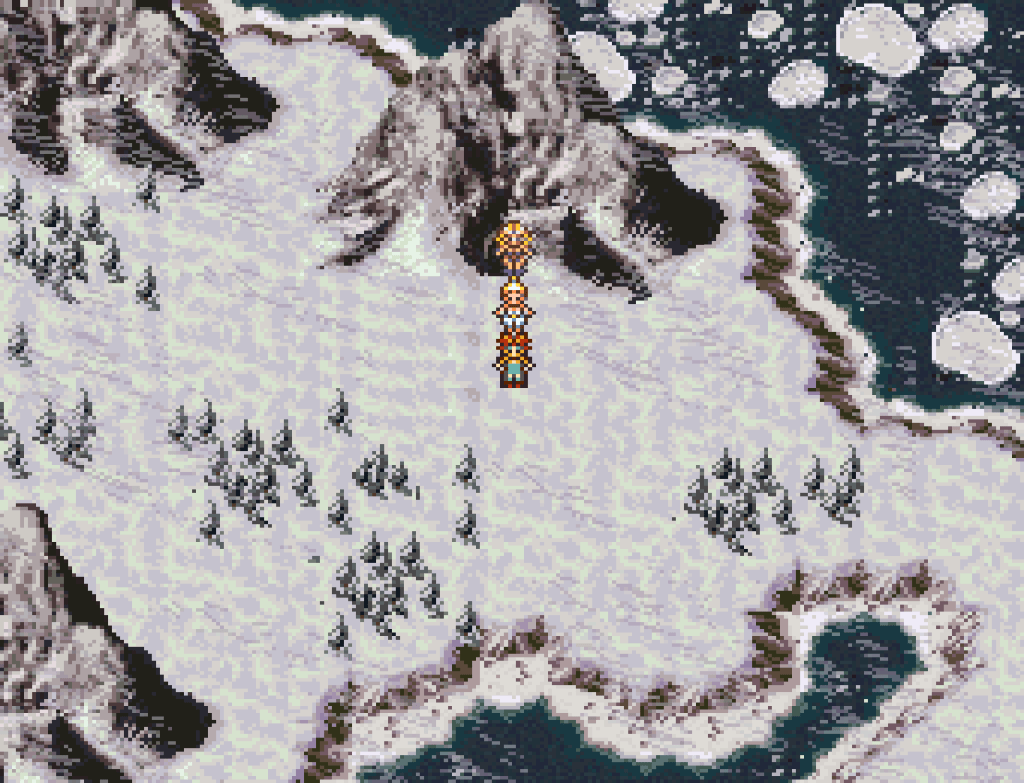
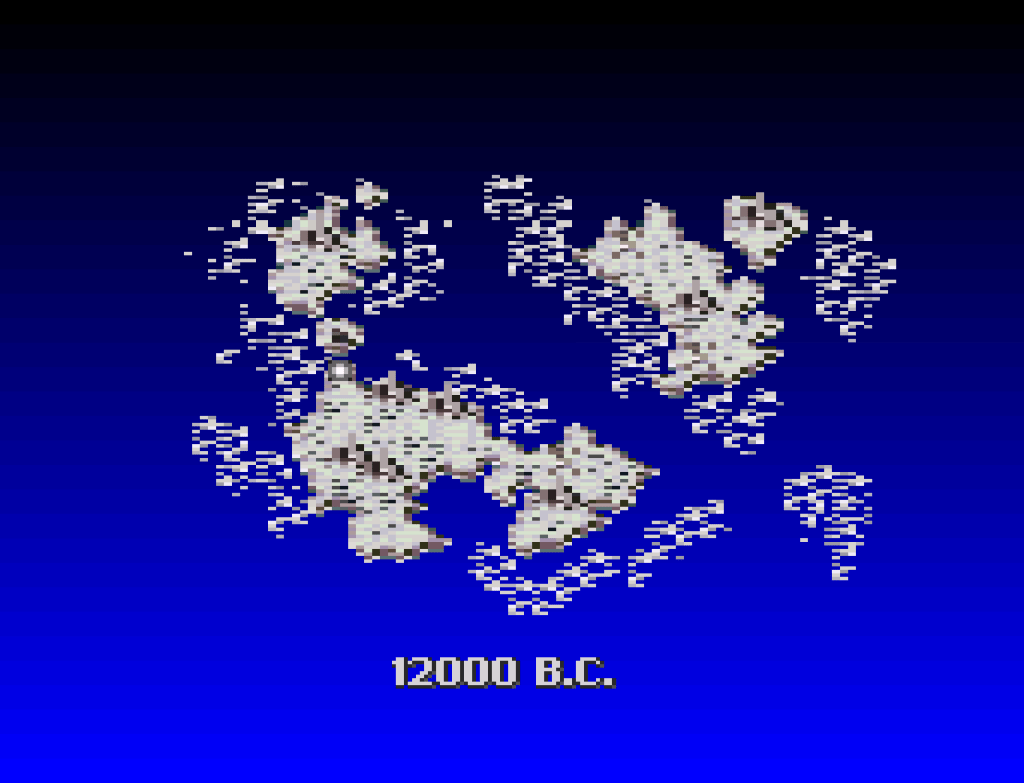
A desolate, snowy zone. One that feels similar to the distant future in terms of isolation. This feeling doesn’t last long because the party is right by a teleporter that reveals the true nature of this time period. Society is so advanced from prehistory that they have constructed a city in the sky. They use magic to power everything and meet their basic needs. It appears the party has stepped foot into a utopia.
This is the Kingdom of Zeal.
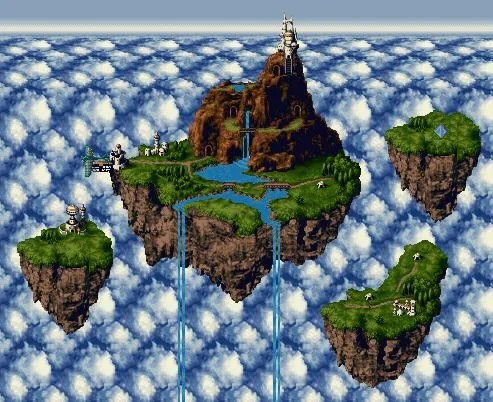
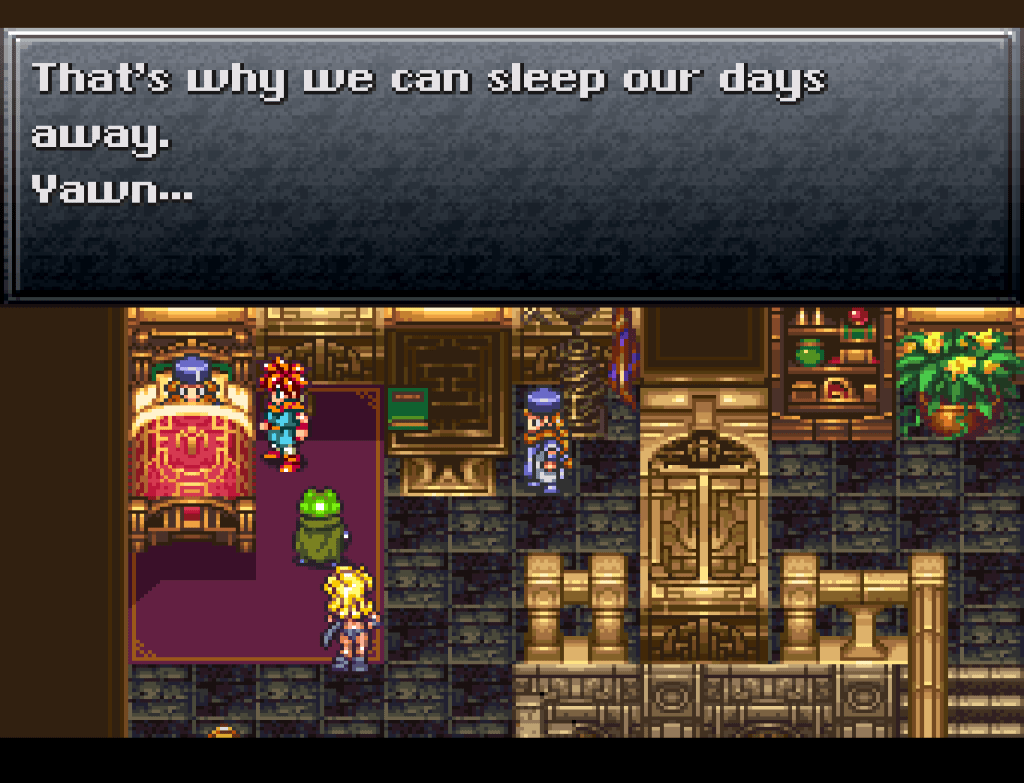
Things aren’t quite as they seem. On the first visit to 12,000 BC, the player is only exposed to the sky dwellers. These people are generally well off and rich, essentially nobles. Things are so good up here that you have a city dedicated to sleeping all day. The pretense for it is that they are studying something, but it’s pretty obvious that not a lot is moving forward in this regard.
The reason for this is because humanity has tapped into Lavos and have turned his magic into something of an energy source. Everybody up here is able to use magic in some way. But, notably, not all of humanity can use magic. This creates a serious case of the haves and have-nots. Can you use magic? Congratulations, you get to live in the magic city with everyone and sleep all day if you want.
If you can’t? Well…the party gets into a clash with royalty at the end of their first visit here and get banished from the era. When they find a way back – by finding a time machine in 2300 AD thanks to that lovely sewer dungeon I mentioned earlier – they land in an area that’s the complete opposite of the luxury they witnessed in the sky kingdom. Here on land you see the Earthbound ones, beings who can’t use magic.
The game places it in NPC dialogue, but the Earthbound ones are used as slaves. Zeal and the final dungeon of the game, the ocean palace (later renamed the black omen), were constructed by these people. The people in the Zeal clearly don’t view these people to be on the same level as them – instead of saying stuff like ‘the slaves were forced to build the ocean palace’ they say ‘the earthbound ones GET to work on the ocean palace and it gives them purpose.’
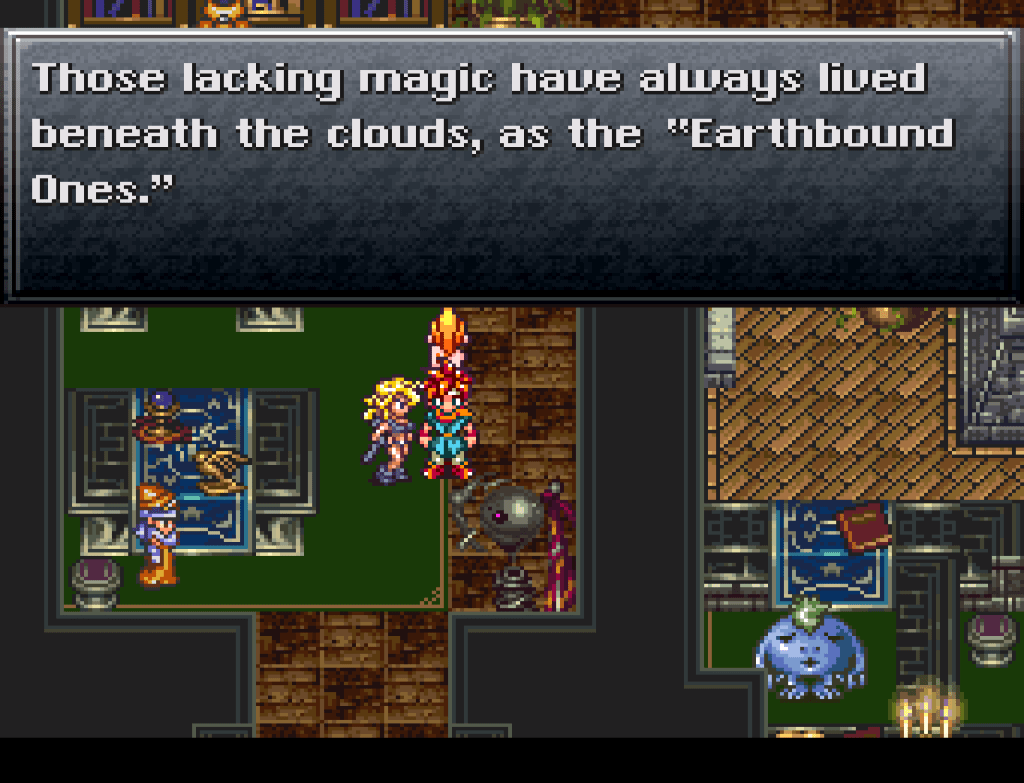
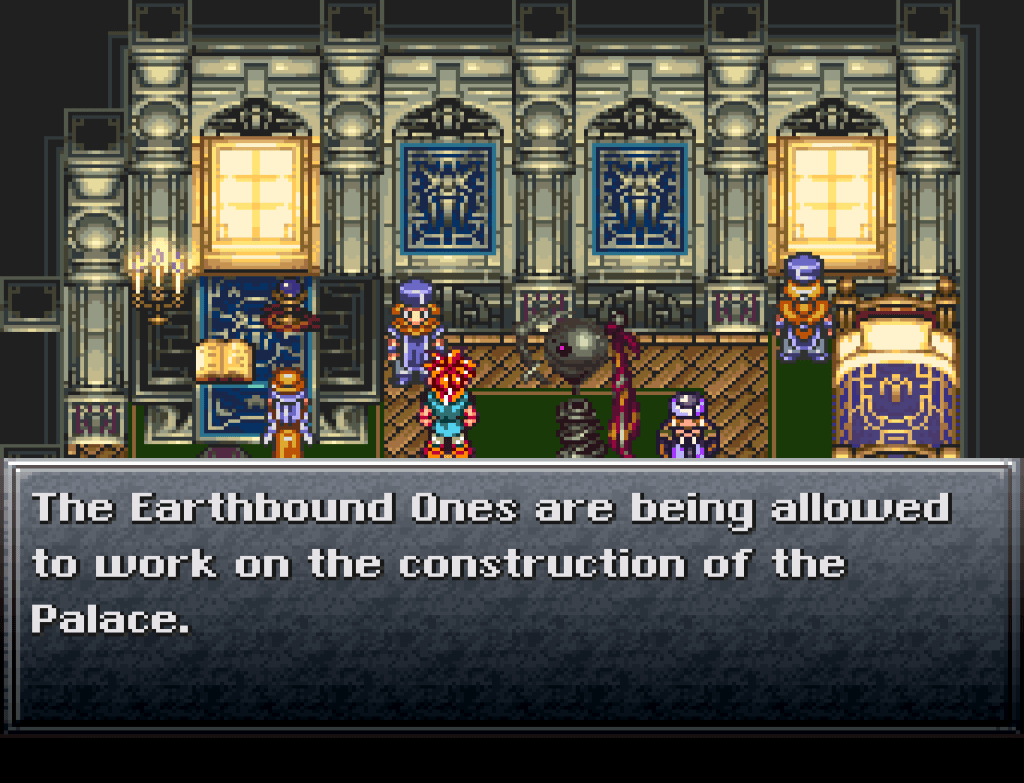
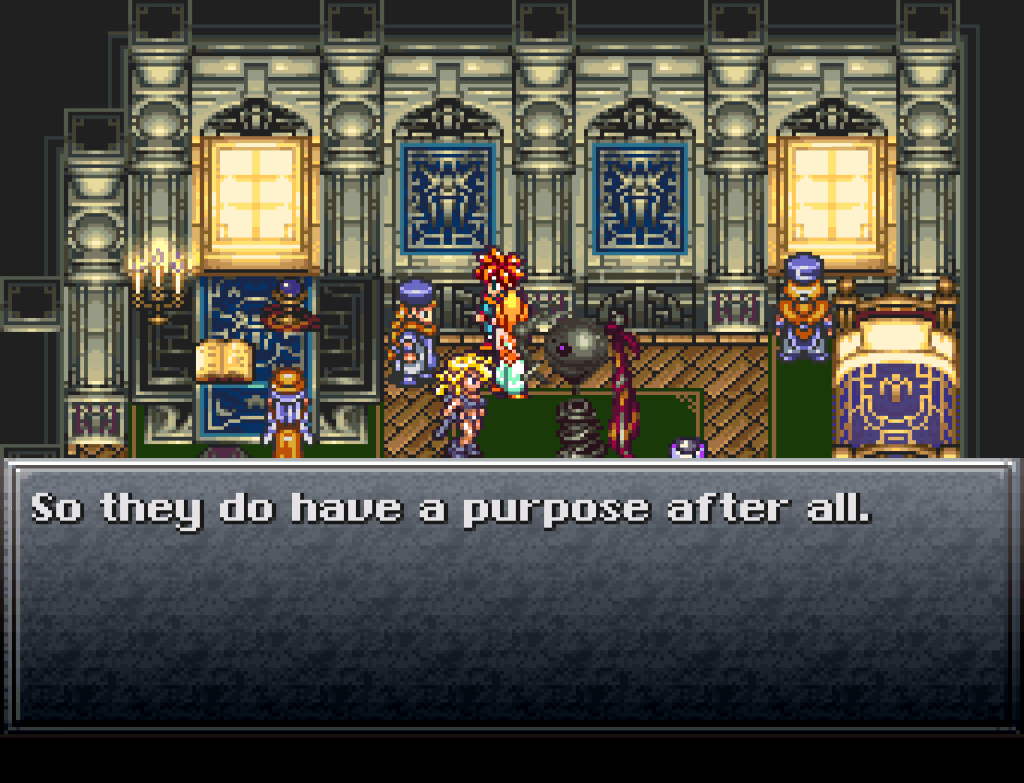
To help drive this point home, the people with magic are called the enlightened ones. In the mind of those people, life without magic has no purpose. Through servitude, the earthbound ones have found meaning. They are not humans in the same way the being of Zeal are, but now at least they can live a life with purpose.
It’s not exactly an original approach. Rich = bad, poor = good? Stop me if you’ve heard that one before. But what I like about how this is handled, at least by the general populace, is that the hatred of their fellow man is done very casually.
Whereas the monsters of 1000 AD have a very clear bias against humans and will just flat out say stuff like “those human scum” – these people will look down on them in the same way but couch it in language that makes them look less bad.
Or they simply just don’t have any curiosity about class differences at all. It’s a bit more realistic and not necessarily something you’d expect to see out of a mid-90s SNES game’s localization.
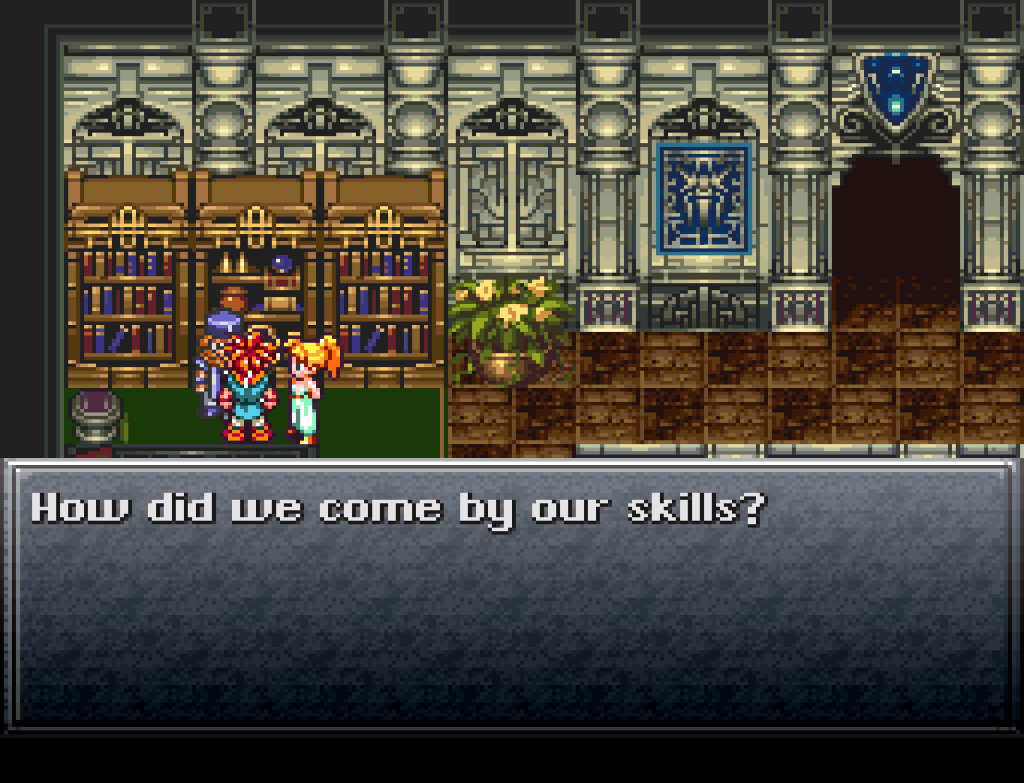
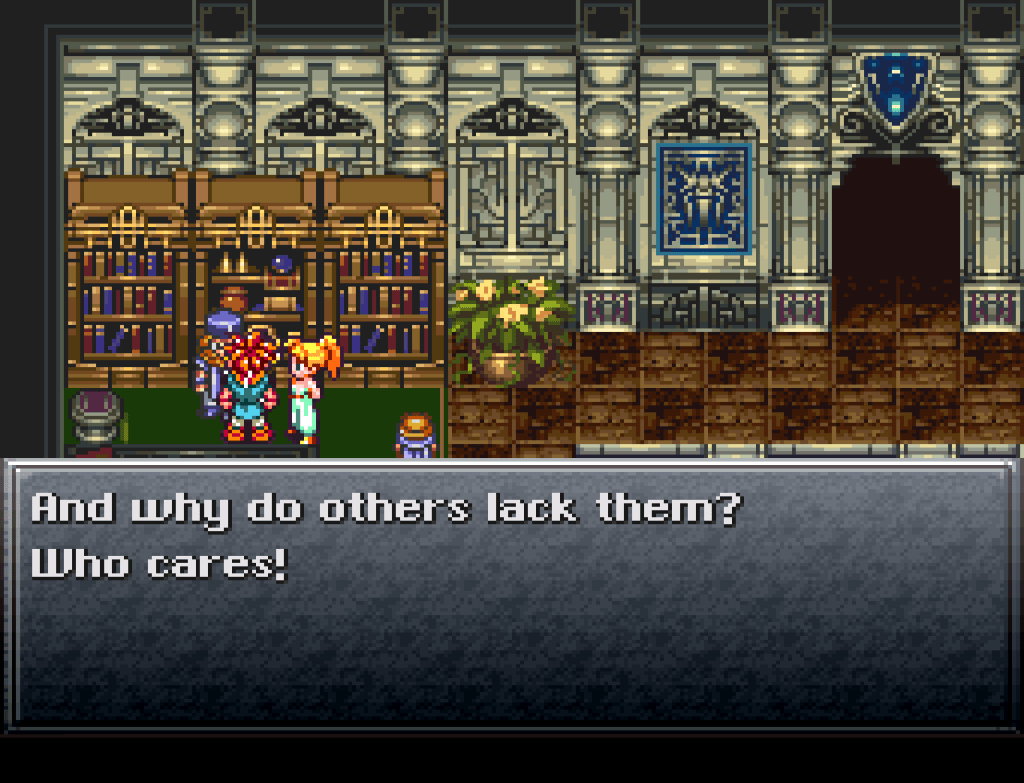
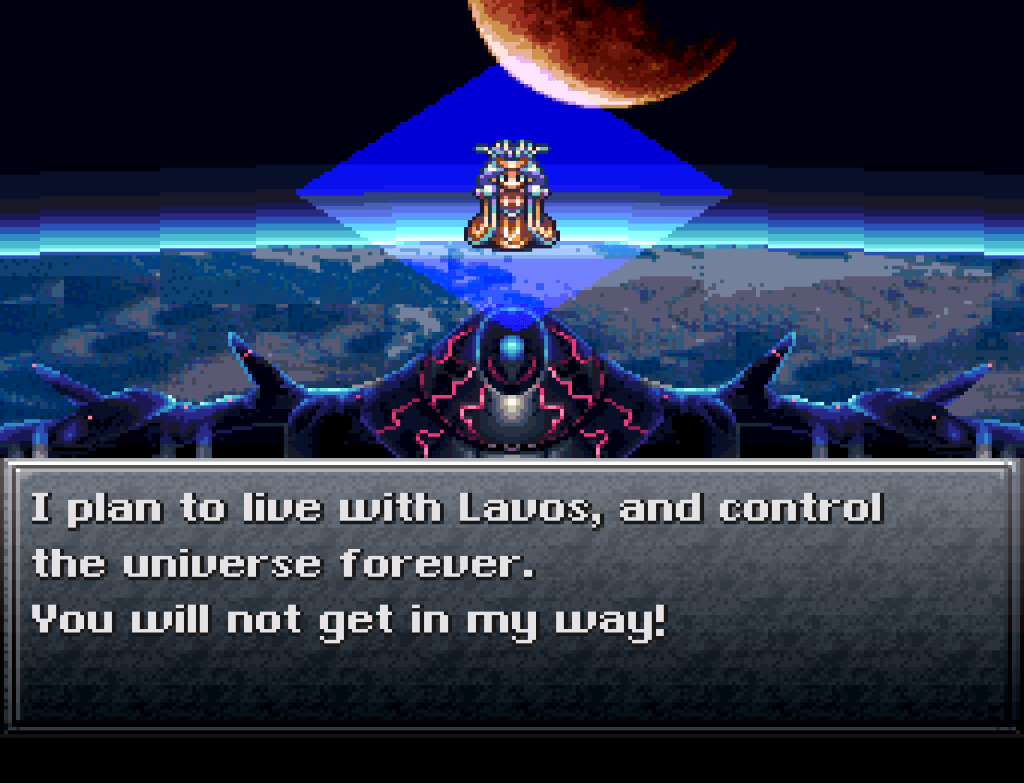
A lot of the attitude towards the Earthbound ones can be pinned on Queen Zeal, who has turned into something of a worshipper of Lavos. She has an absolute amount of power in this era and she abuses it, absolutely. Instead of being content with this airborne society of magicians, she wants to raise Lavos and rule over all of humanity and shape the future to her visions.
Ruling over her time isn’t enough, she wants to rule over every time period.
To do this, she commissions the construction of the ocean palace, which uses Lavos’s power as something of a conduit that gives everyone inside it eternal life. A calamity happens that alters this era completely and the palace gets raised into the air and it just hangs over all of humanity from that point forward.
It is then rechristened as the Black Omen. From here, the Queen rules, using the power of Lavos. After the raising of this institution, various NPCs from across time will have comments on it.
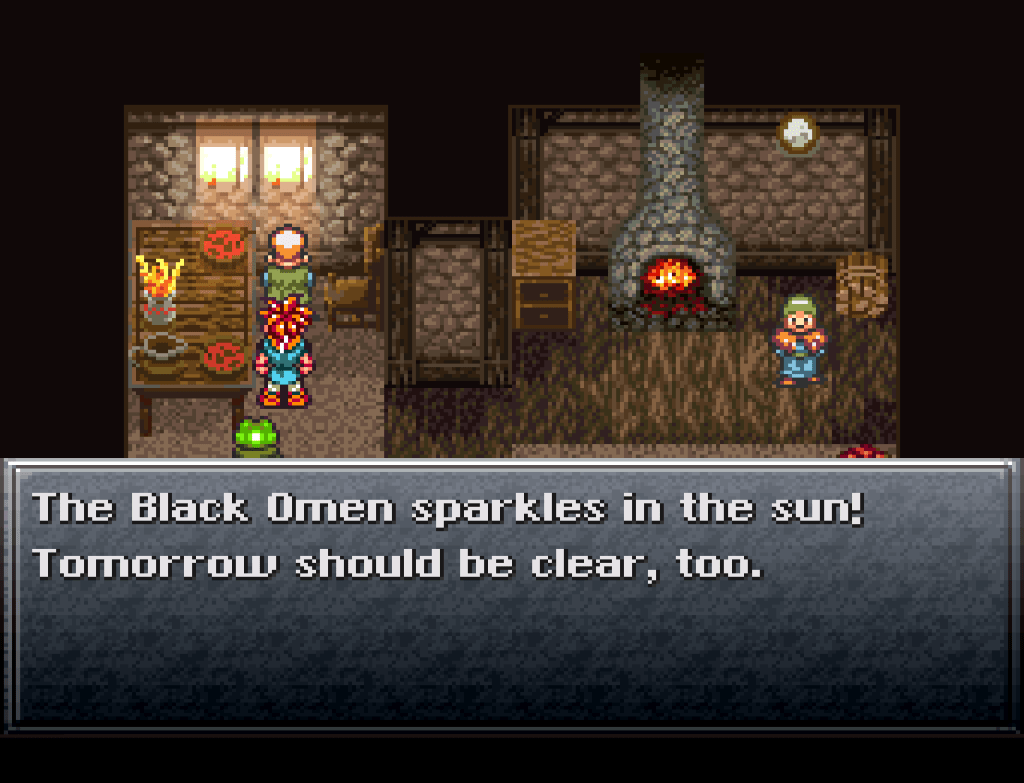
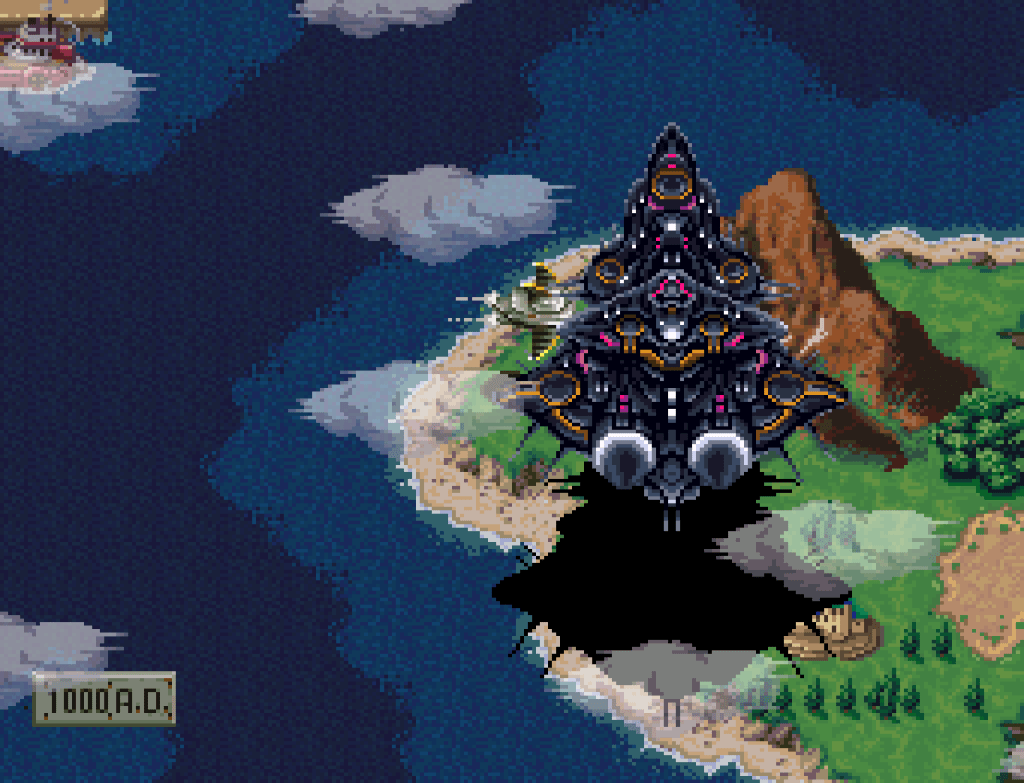
This is why Chrono Trigger has a linear flow of time through all eras. It’s important that this institution – I’m just calling it the Black Omen from here on – is not shown to the player early on.
It brings up too many questions and gives a more clear end goal to the player. Chrono Trigger’s plot needs to unfurl as a mystery. Having a giant ominous structure there right from the start suddenly makes humanity’s destruction in 1999 AD less of an oddity.
The queen’s offspring end up being some of the most important characters in the game. The party runs into her son Janus almost immediately upon reaching the sky kingdom and the first thing he says is that one among the crew is going to die soon. Well that’s cheery. He is portrayed to be a shy and reserved child who doesn’t like what his mother has become. He can use magic but chooses not to – the populace assumes he just lacks the gift.
This child is key to the story and if you want to learn more about him, scroll on down to the character section for Magus.
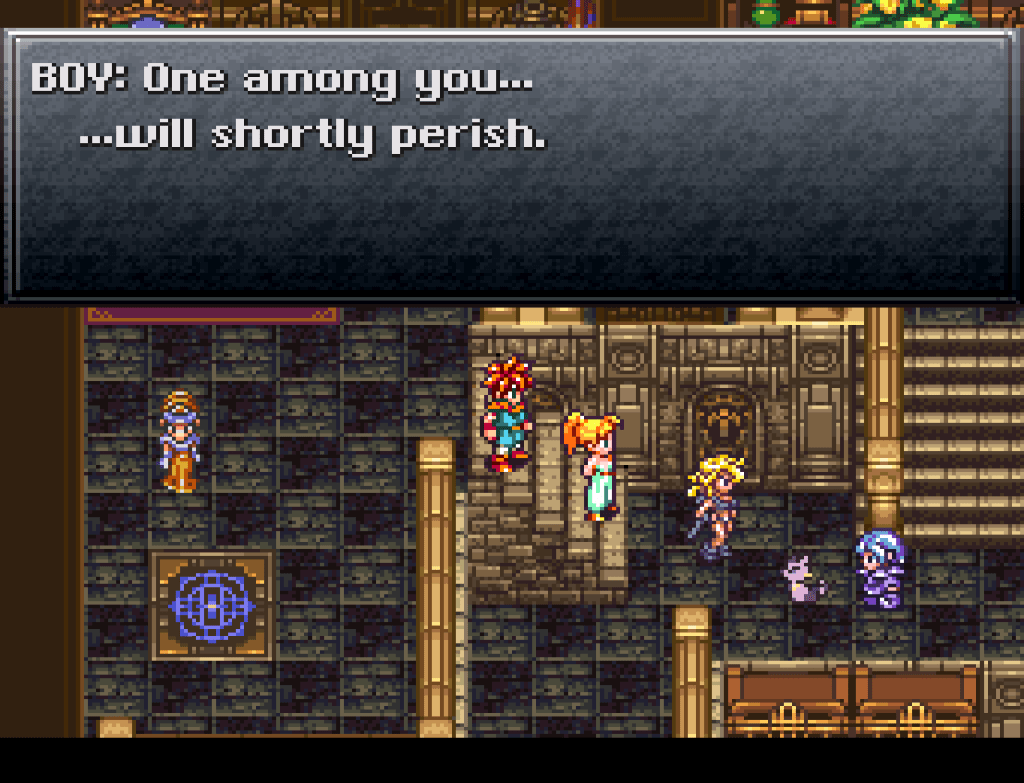
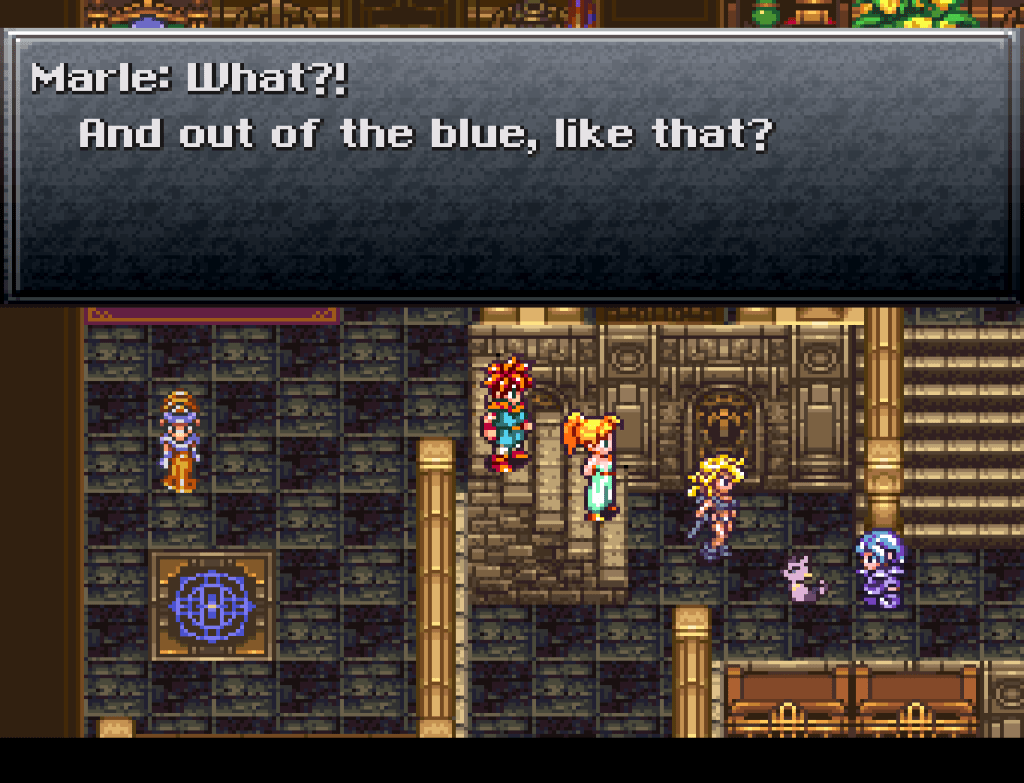
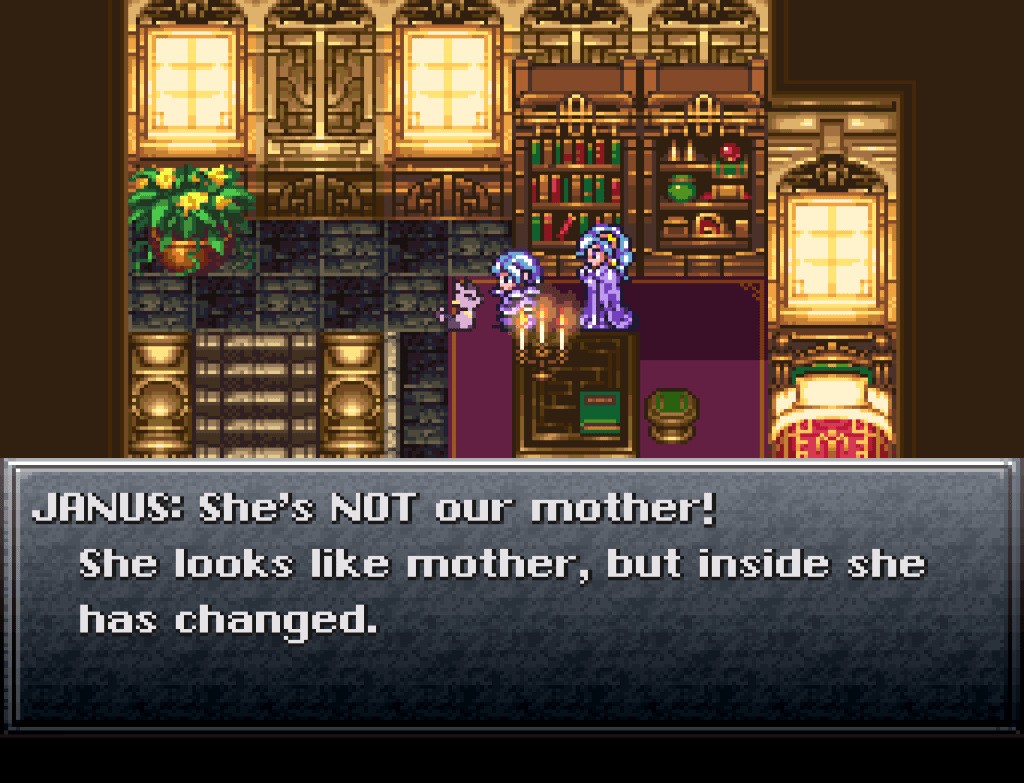
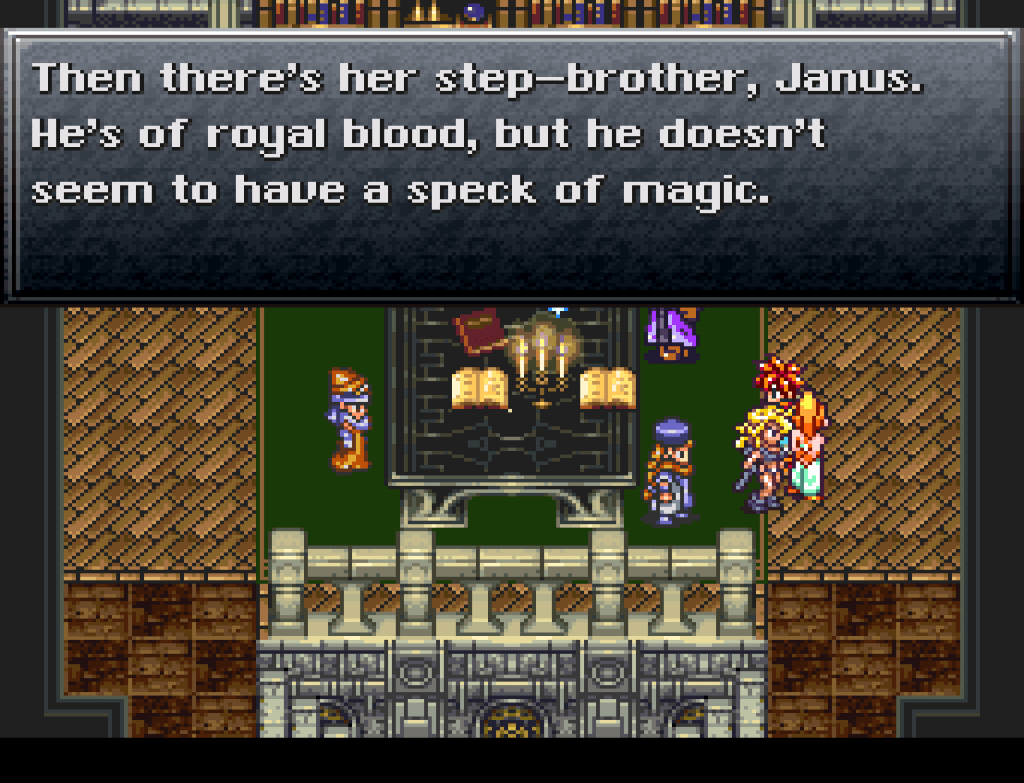
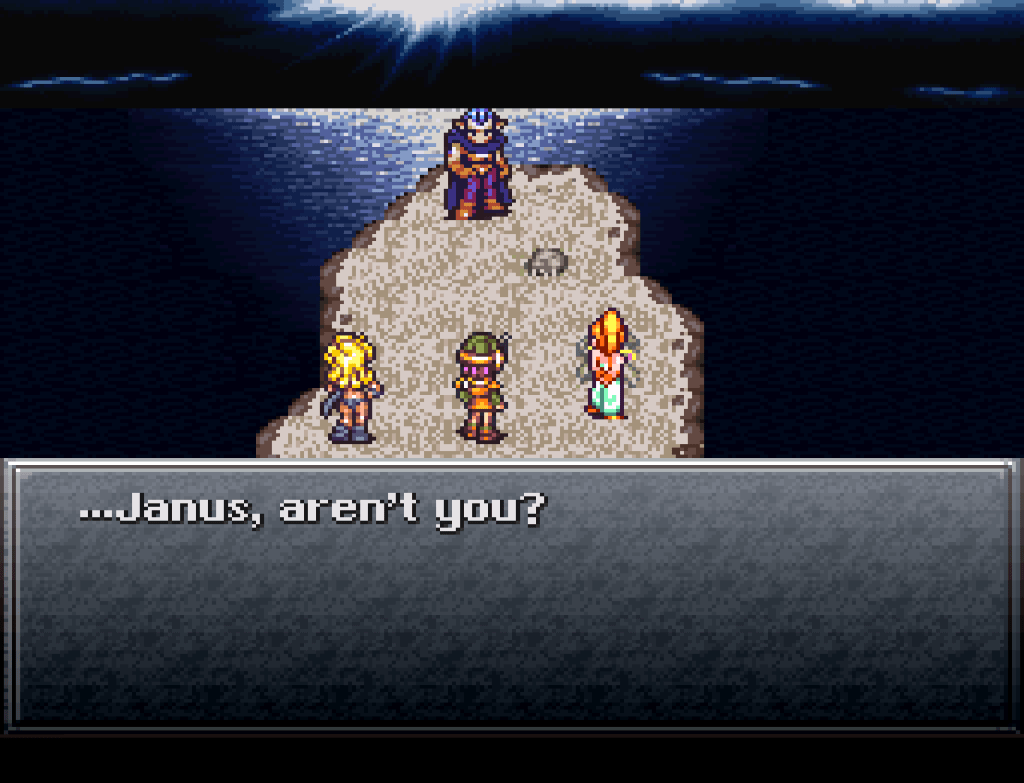
Yep. That Magus. This is where he got his start.
His sister, Schala, is also important. The princess of this era is noted by the Earthbound ones as the only person who treats them as equals. She acts as something of a mother character for society. While Zeal is filled with power hungry villains, she appears to be completely immune to this. Her motivations are pure.
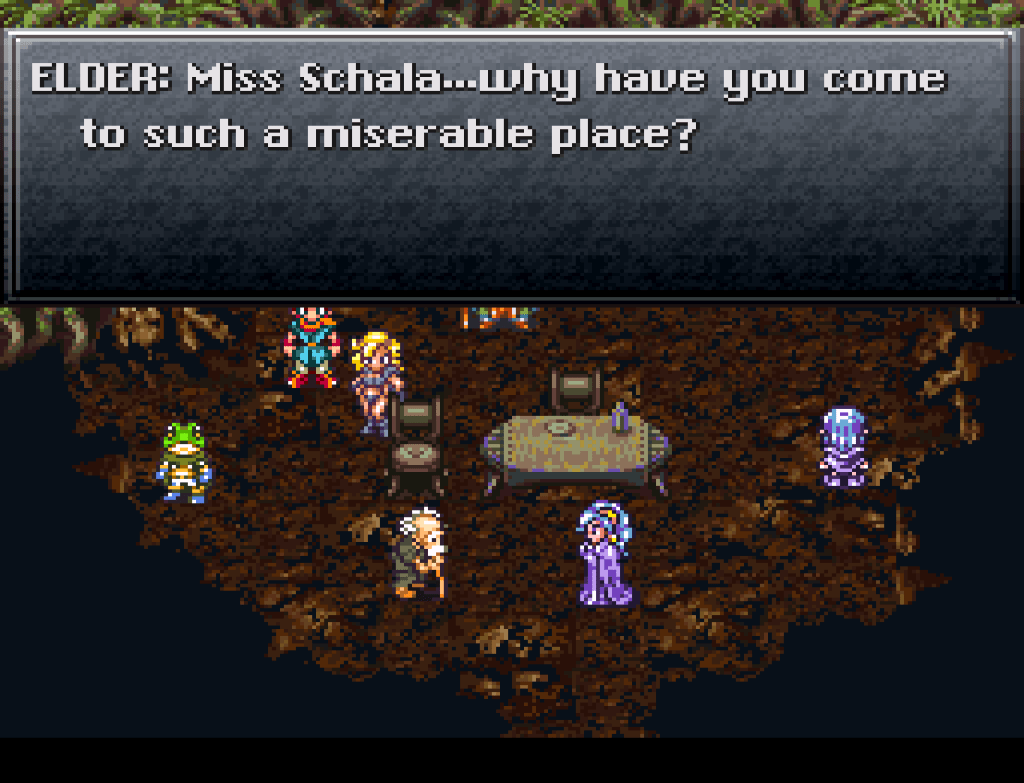
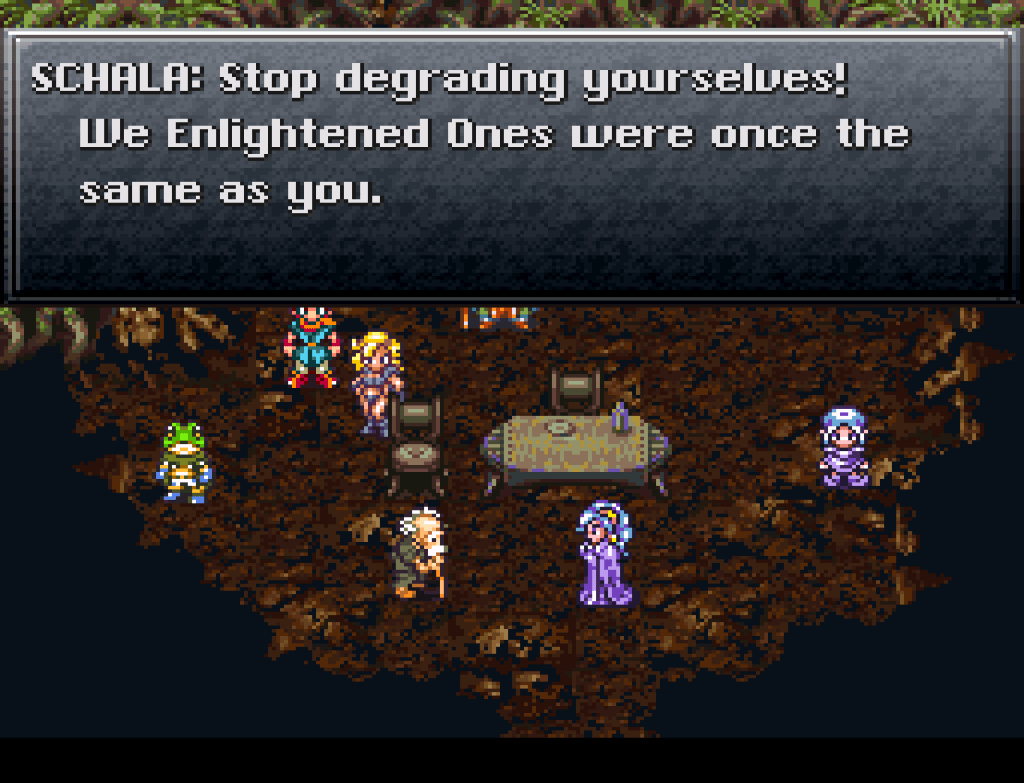
Schala is in possession of an amulet passed down through the royal family – the Dreamstone. Remember that thing? When powered up through the mammon machine – a device that siphons Lavos’s energy, this amulet can do a lot of things. Remember, this adventure started because Marle’s amulet had a weird interaction with a gate that people assume was created by Lavos.
So the Queen orders that the Mammon machine gets moved to the ocean palace so it can get even more powerful. You see being on the ocean puts you closer to the center of the earth!
But this causes a catastrophe and unleashes the full power of Lavos, basically destroying the advanced aspects of society. The ocean palace raises into the air and every bit of magic humanity enjoyed to that point raises up with it.
This completely reshapes the world from this era and is what kills Crono.
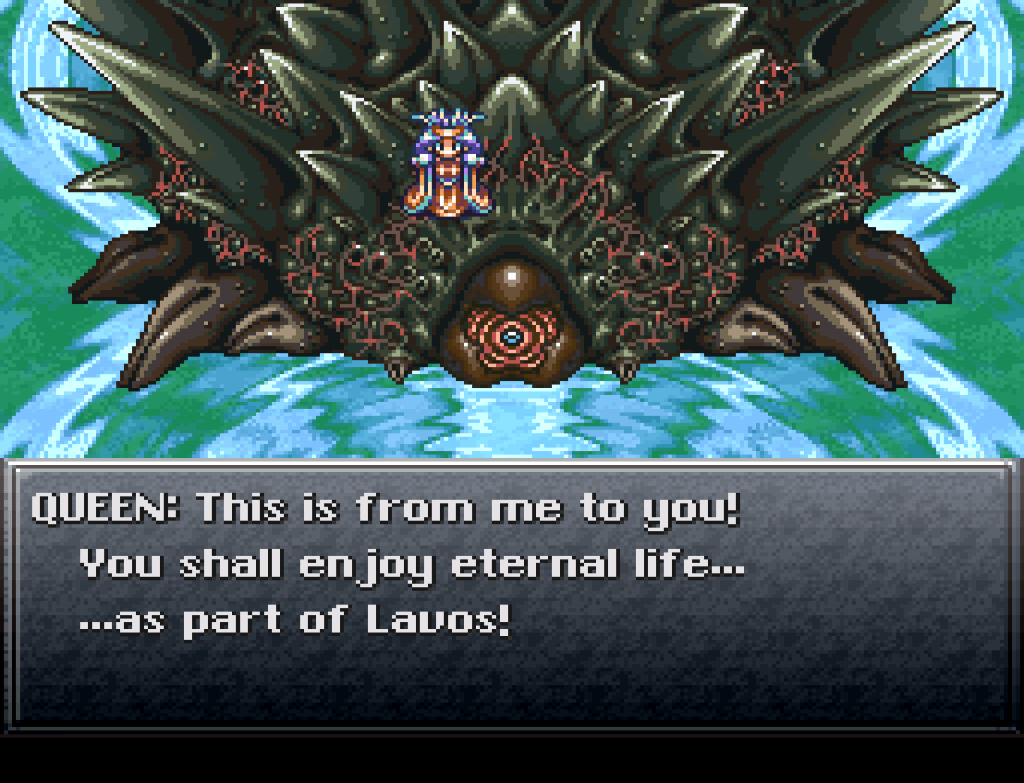
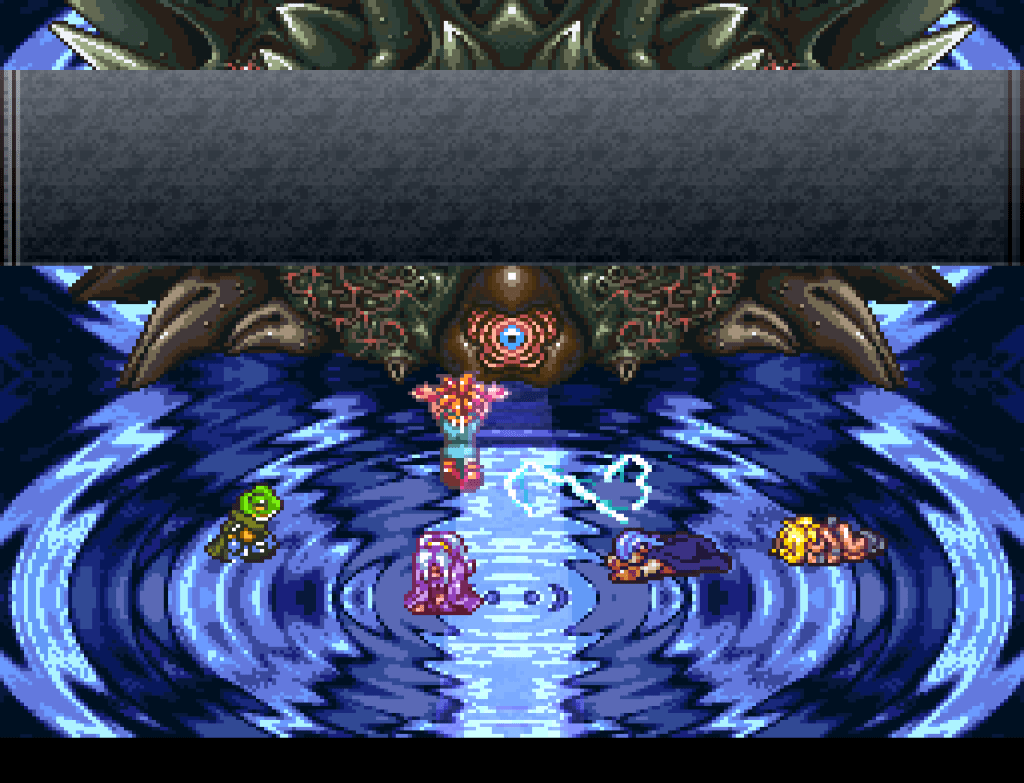
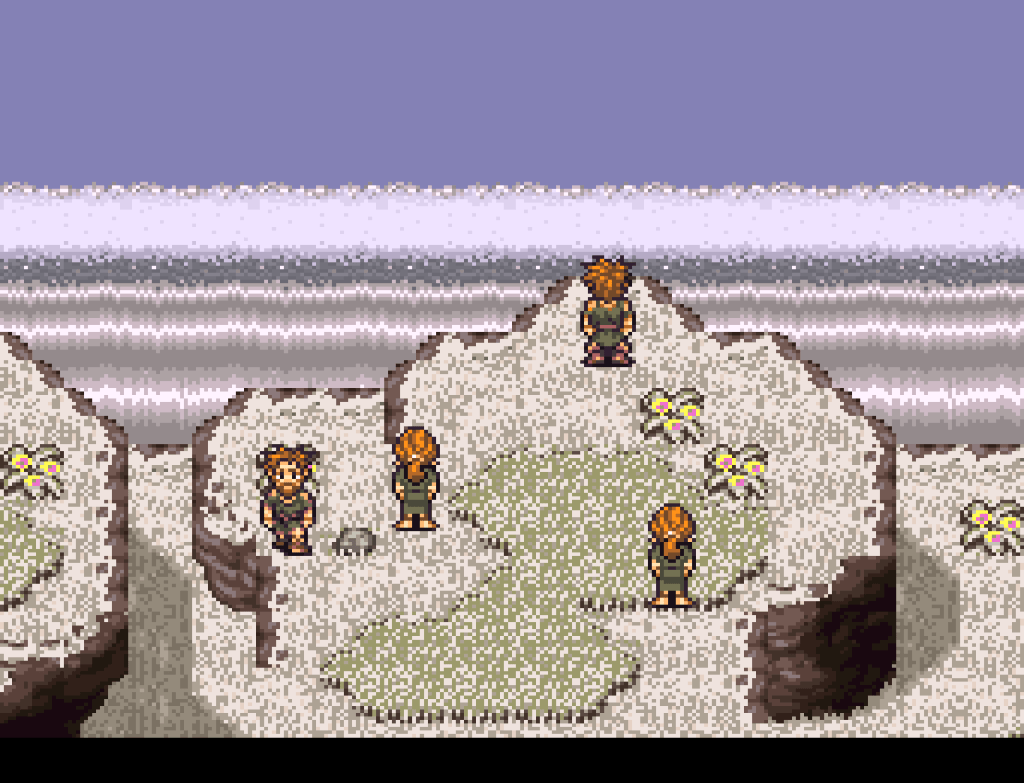
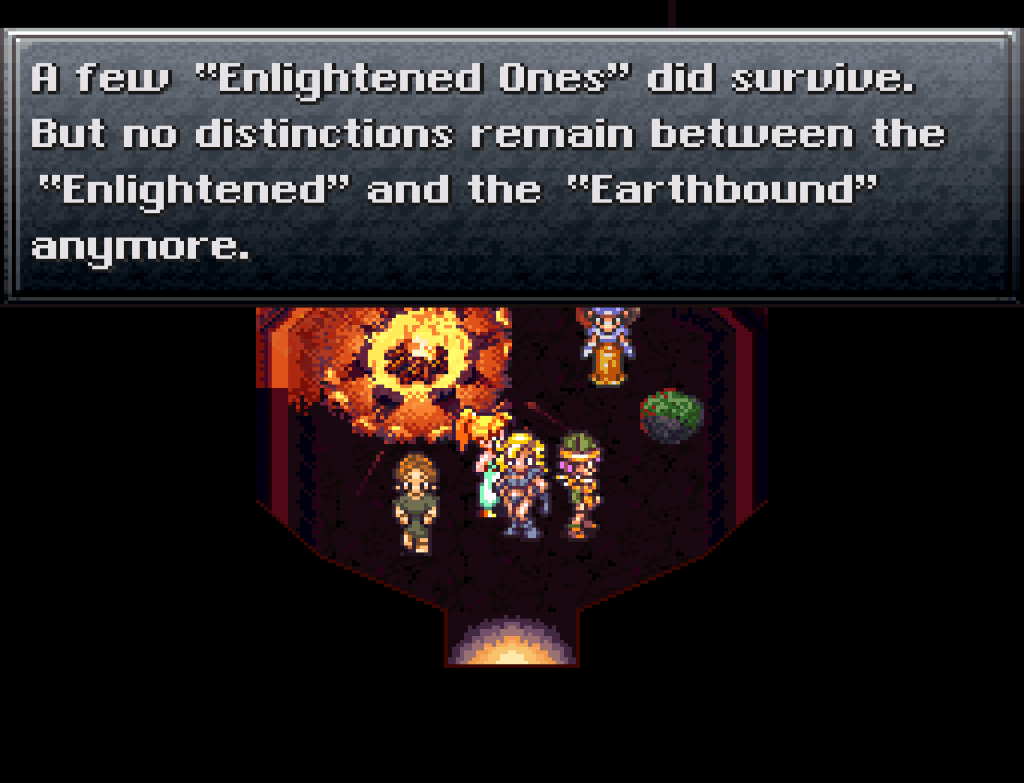
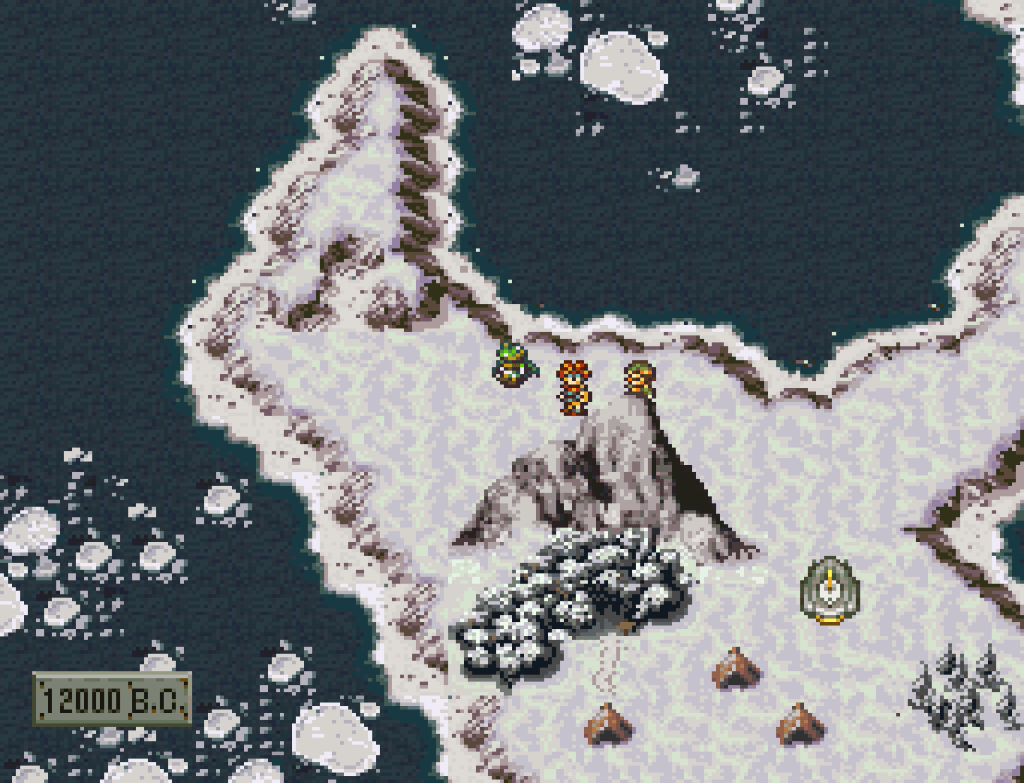
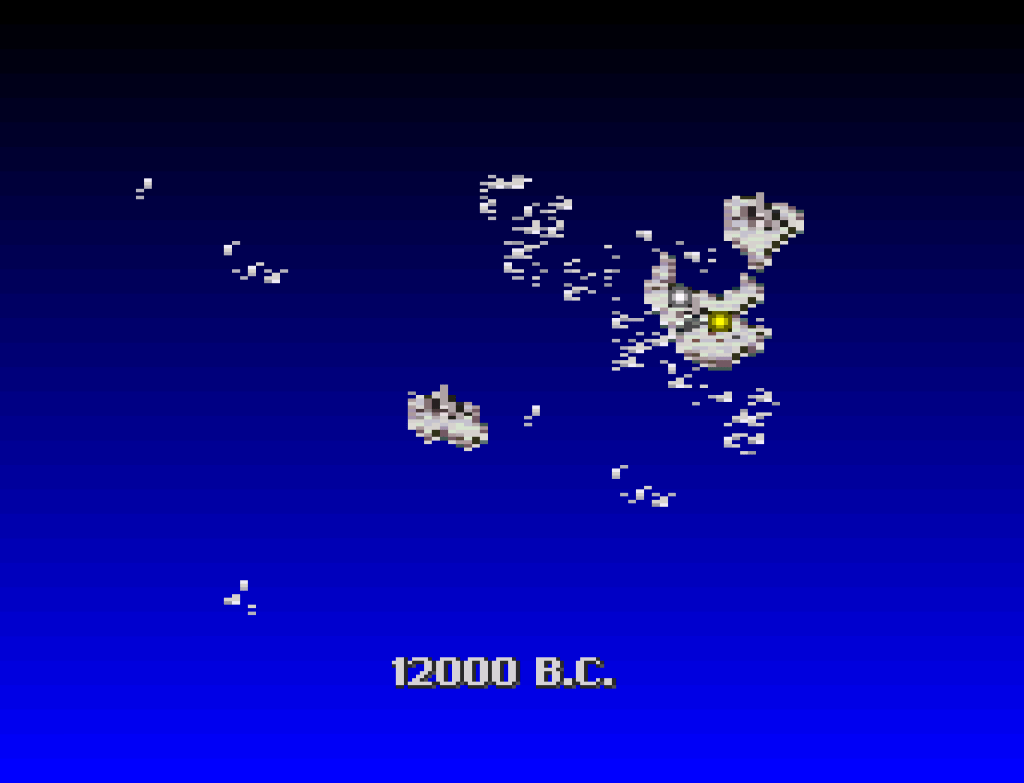
This is where Schala is important. She understands what is going on as it happens and uses her gifts to send important characters off to other areas of times.
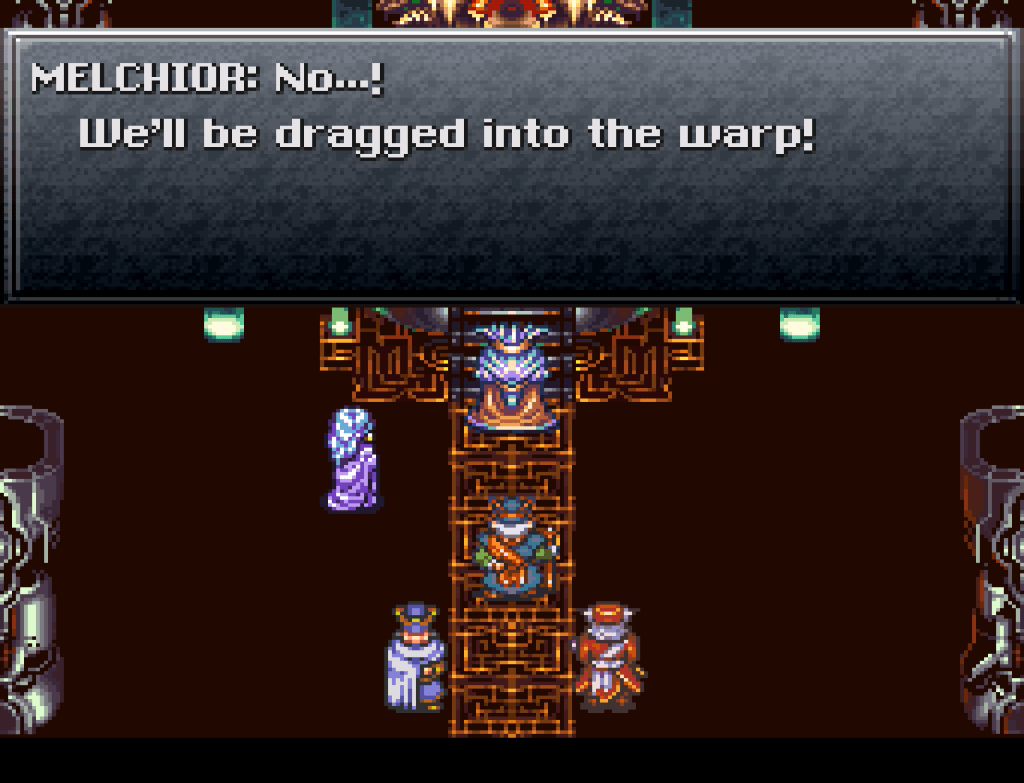
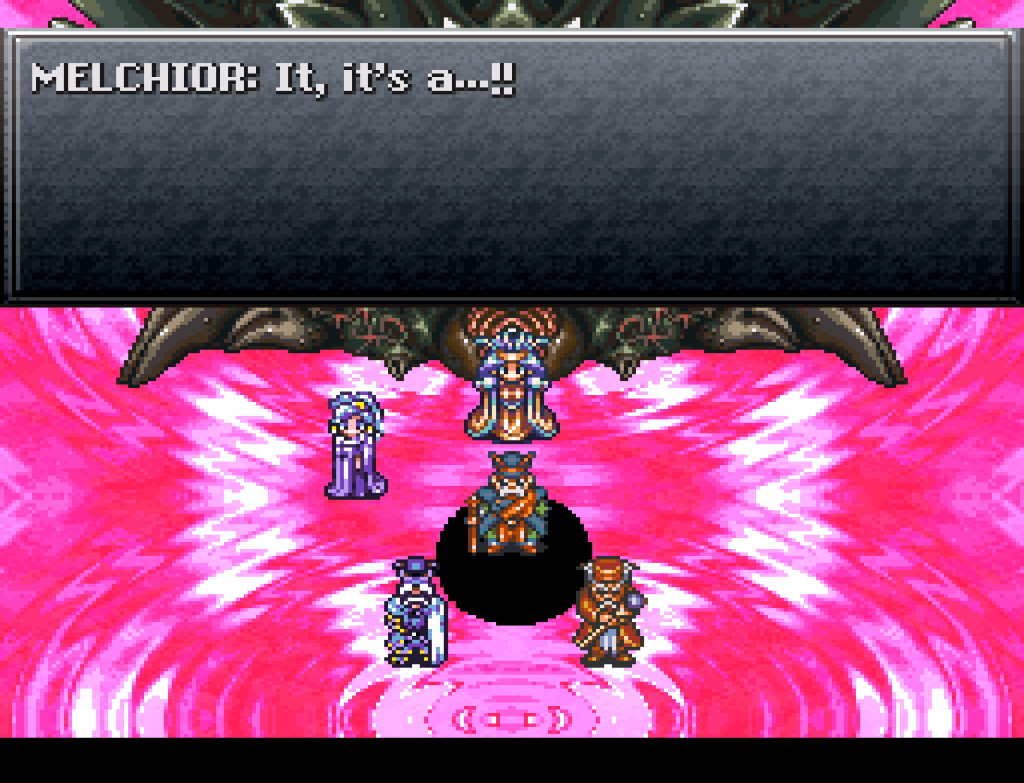
The guy who repaired the Masamune? That’s Melchior and he’s from this time period, but got sent to 1000 AD. You can encounter him at the very beginning of the game where he will attempt to buy the pendant off Marle (this will help you get found guilty). He knows the significance of that thing, so it makes sense!
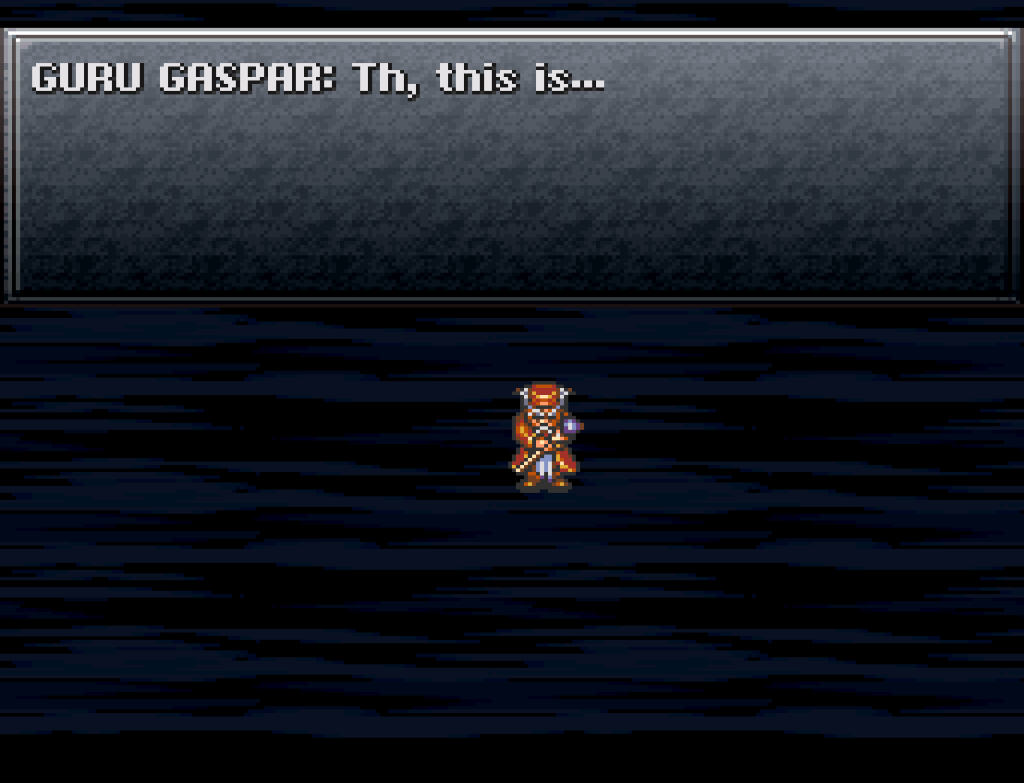
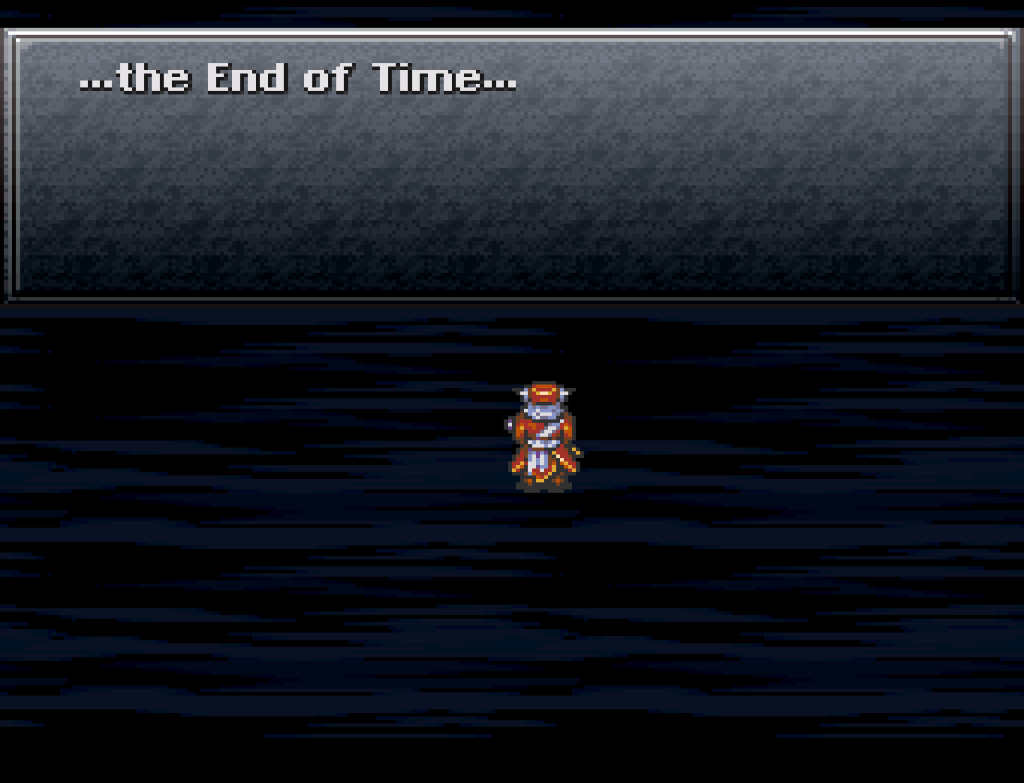
Gaspar, at the End of Time? He was sent there by Schala too. The time machine you find in 2300 AD? That’s given to you by Belthasar, another figure sent there by Schala. And finally, you have Magus, sent to 600 AD. All of the characters with an air of mystery to them all originate from the same place. Through an act of desperation, Schala put pieces in place to help change the future her mother was weaving.
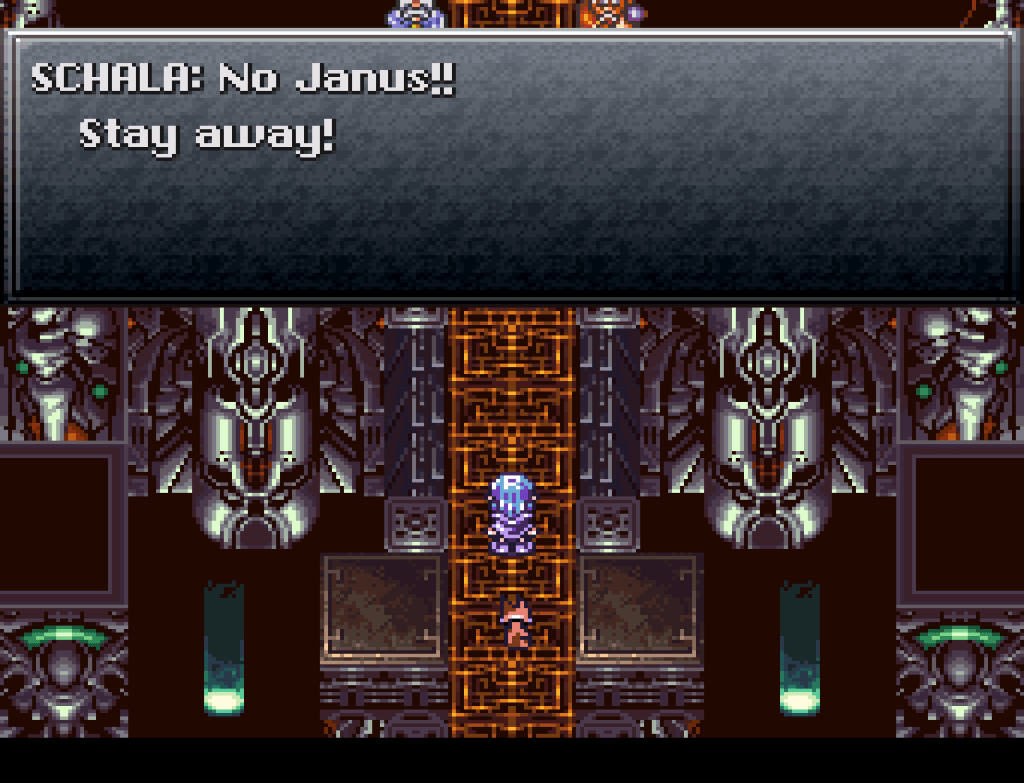
All aspects of the plot kind of come together here. It’s like poetry, it rhymes.
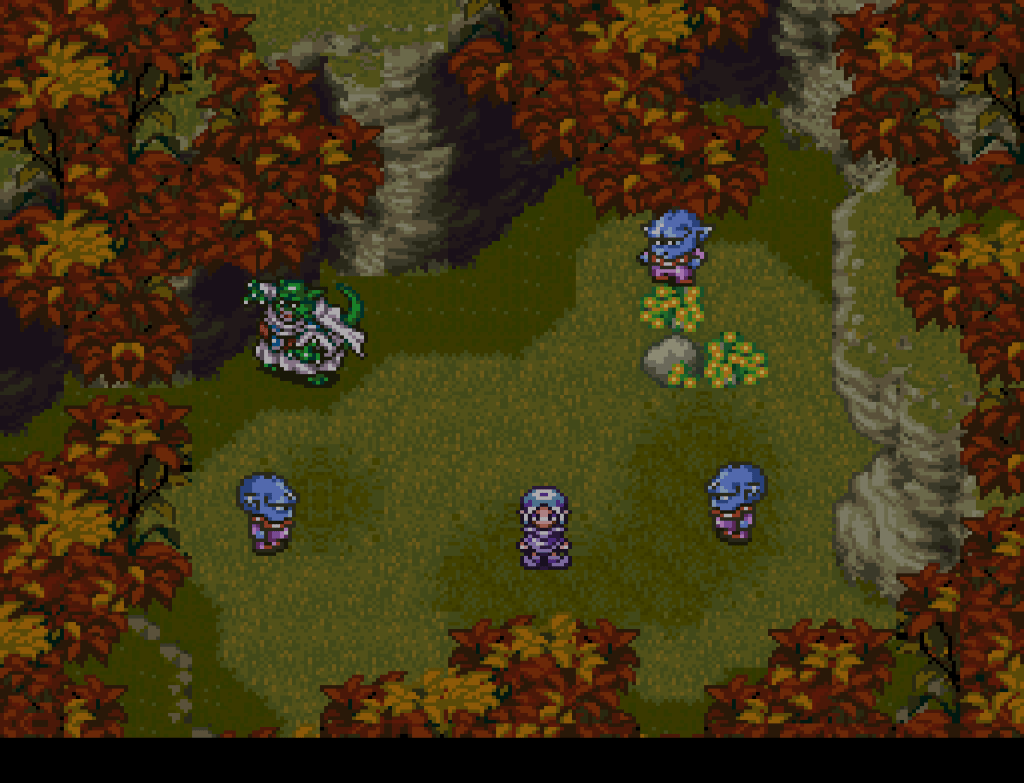
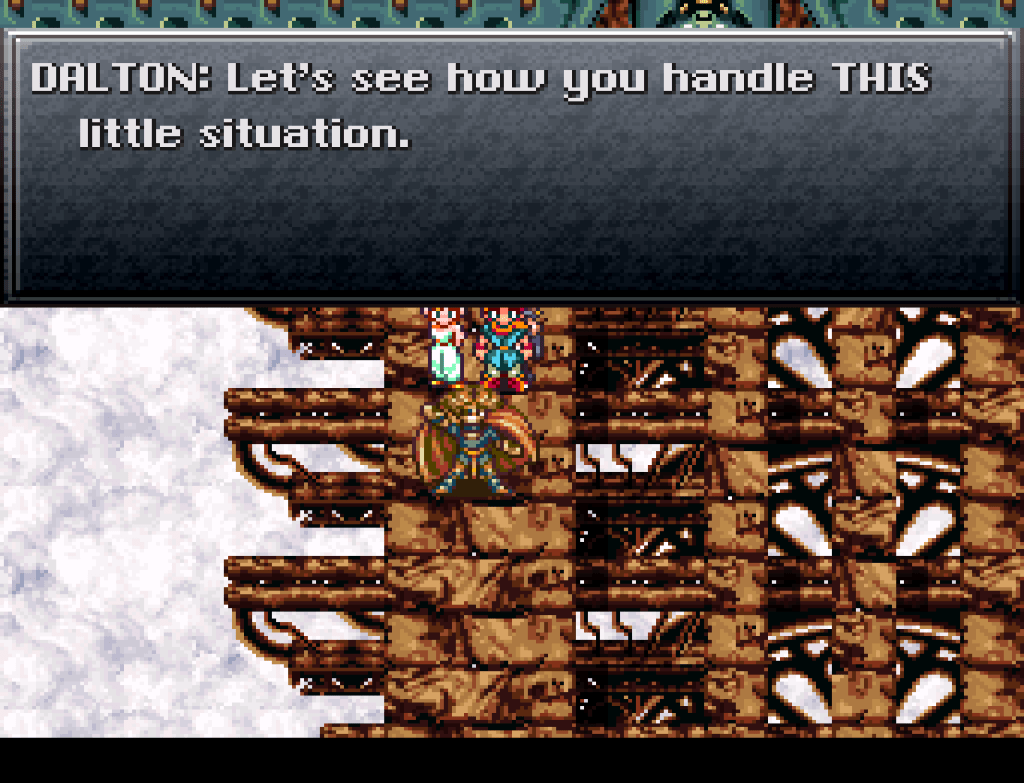
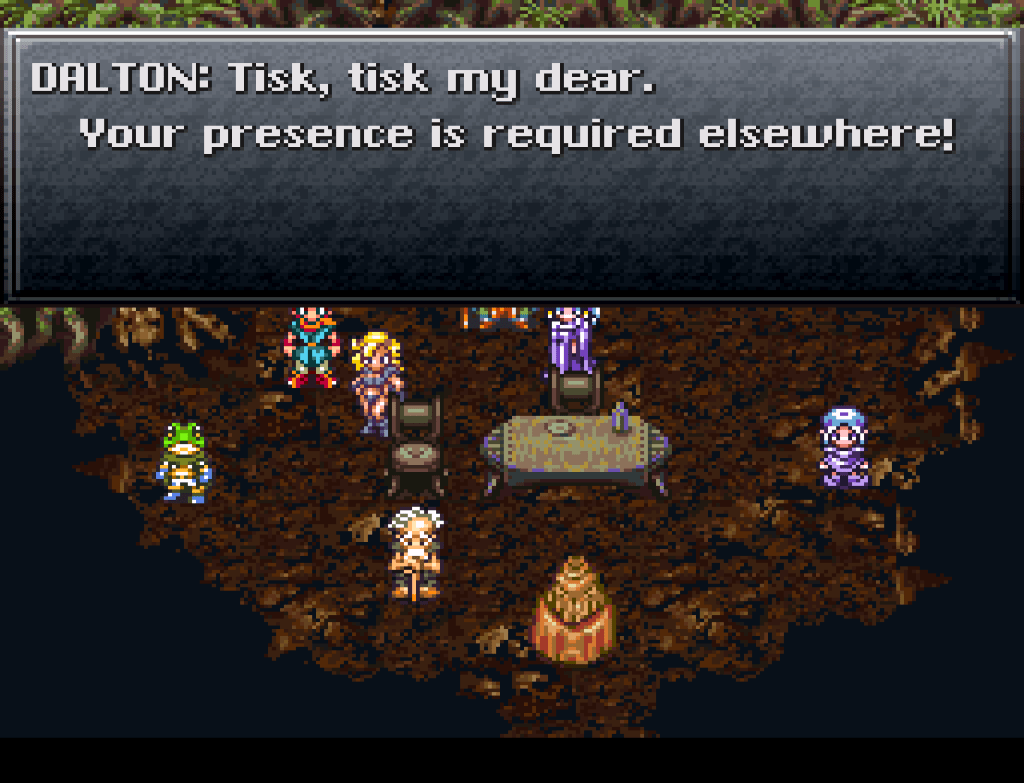
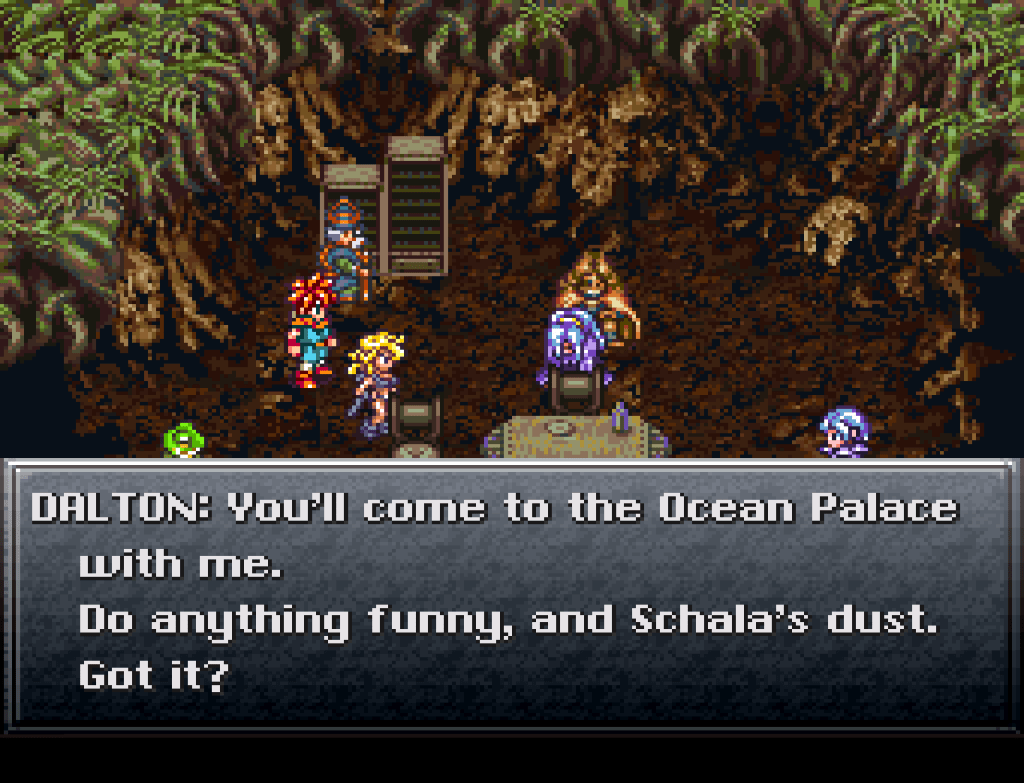
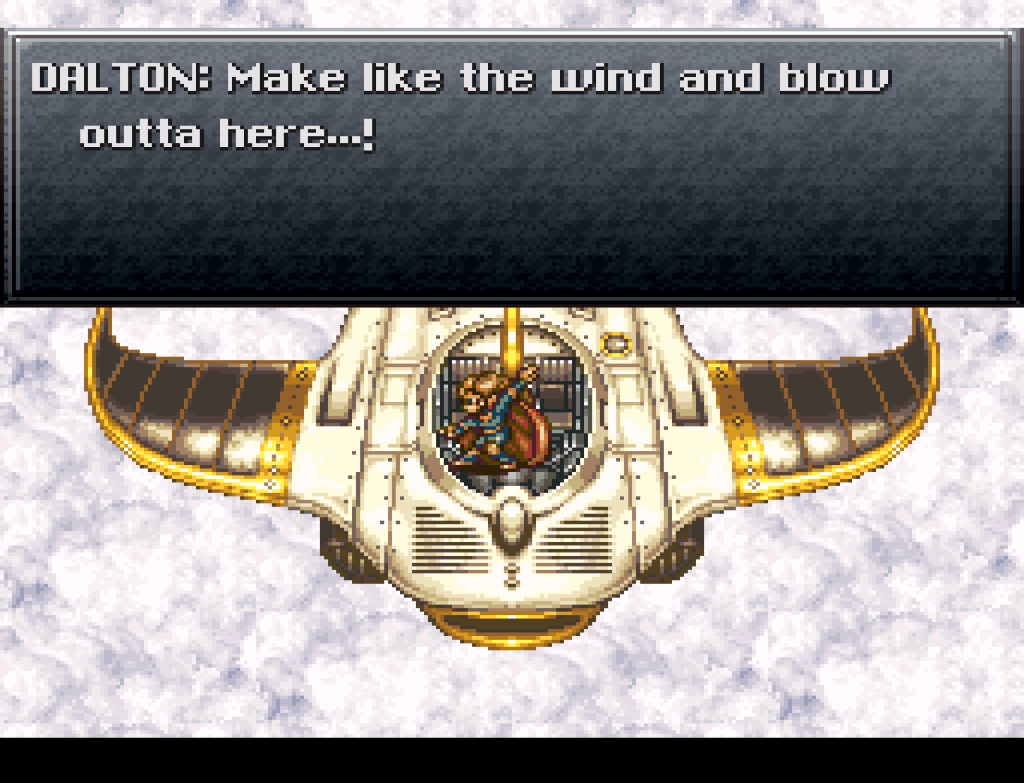
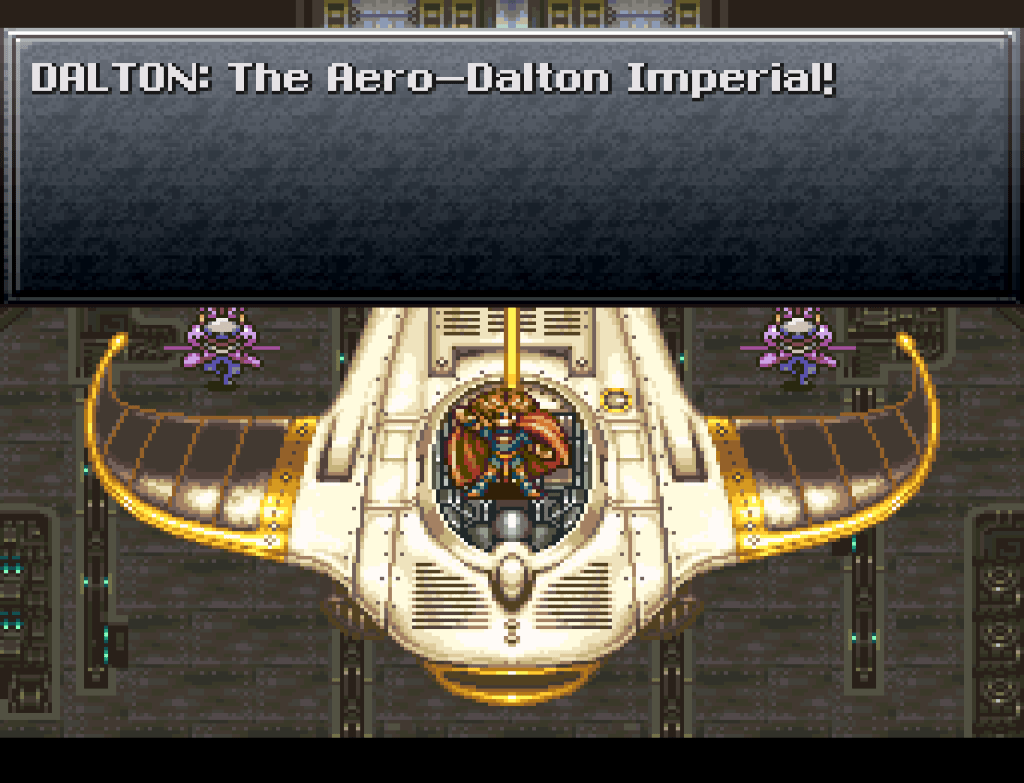
She also moves her mother’s top general Dalton to 1000 AD and the surviving members of your party to uh…still antiquity but SAFELY away from all that stuff. The only reason I’m bringing up Dalton is because if you’ve played Chrono Cross, you might know that he becomes something of an important figure in 1000 AD. He takes command of Porre’s army – a country on the same continent as Guardia – and takes over the kingdom.
In Chrono TRIGGER he’s kind of a bumbling buffoon sidekick who has some comedic dialogue.
The princess is one of the most mysterious elements of Chrono Trigger. With how the Ocean Palace incident plays out, it seems that she dies. But it’s clear that her amulet has been passed down through the generations and it’s very much there with her when that event goes down.
Magus’s whole character arc is centered around getting revenge for Schala, so he thinks she’s dead too…and yet, after Lavos is felled at the end of Chrono Trigger, it’s suggested that he’s going through time to find her.
As a kid, I know I searched up and down the eras trying to find where the hell Schala was. She has relatively few lines over the course of the game, but her presence is felt. Where the heck is she? No matter how much you look, she isn’t there.
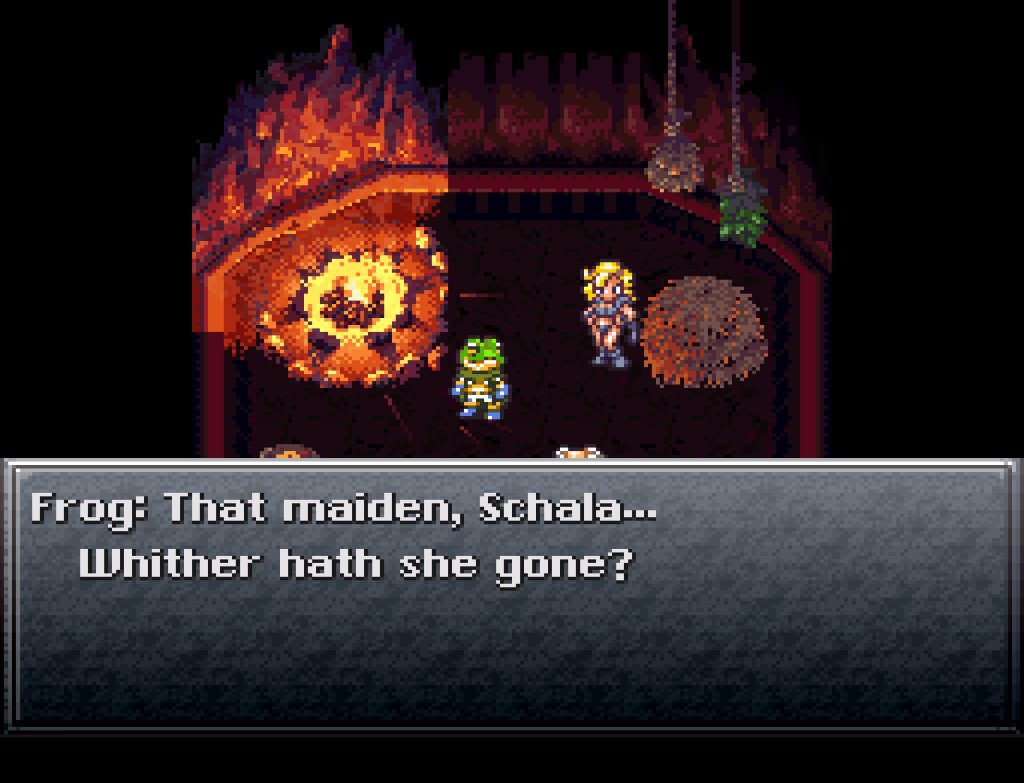
So what was her ultimate fate? Uhhhhh, well, you could play the sequel to find out. But to cut a very very long story short she essentially merges with Lavos because of some time travel fuckery. Have I mentioned yet that Chrono Cross is a controversial sequel?
This era is easily the most narratively interesting part of Chrono Trigger. This is where all of the game’s plot points come together and finally pieces together all the mysteries the player has been unraveling. Now they should have a pretty clear understanding of what the main villain is and why the apocalypse happened. There is now a direct path to confronting the bad guy behind it all and putting a stop to the events of 1999.
This era is no slouch in the gameplay department either. Chrono Trigger is an easy, easy video game. But that isn’t to say there is no challenge. They just decided to put all of it in the Dark Ages. The first ‘dungeon’ the player experiences here is directly after encountering the Earthbound ones for the first time. It’s a mountainous region that concludes with the single hardest fight in the game.
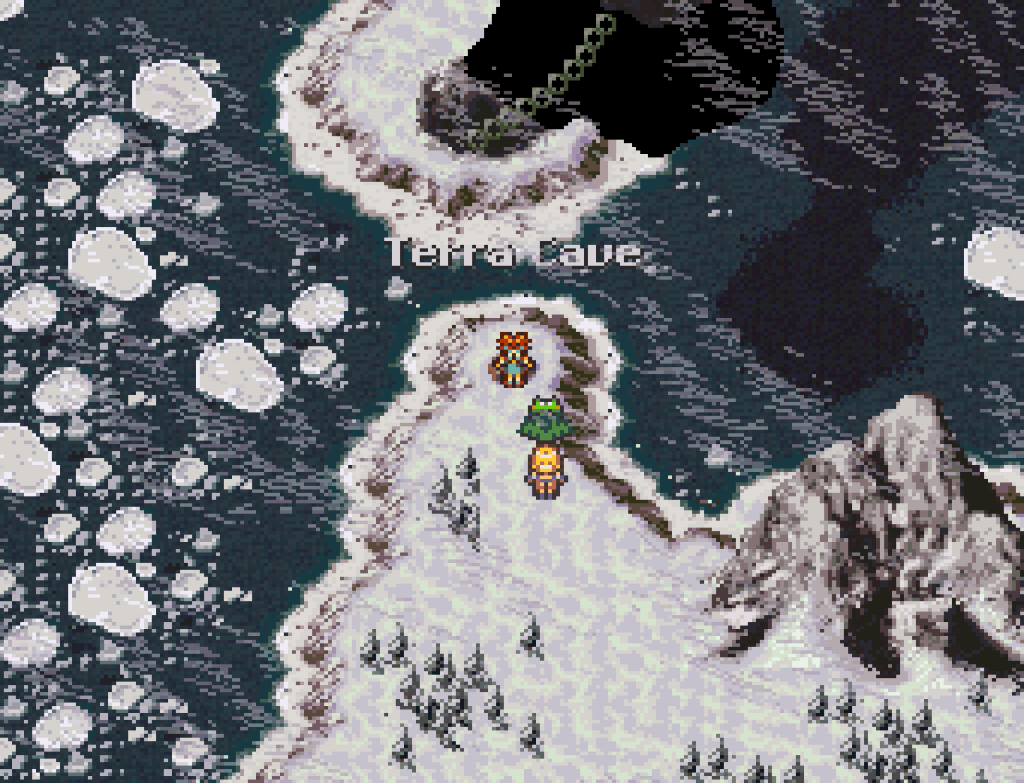
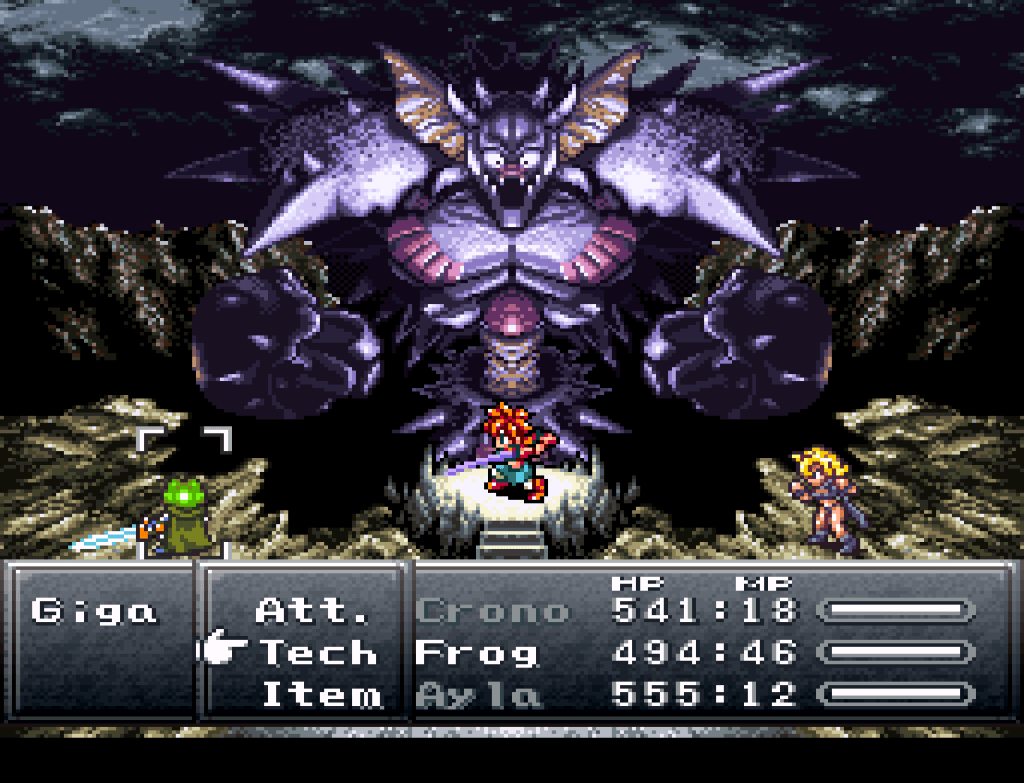
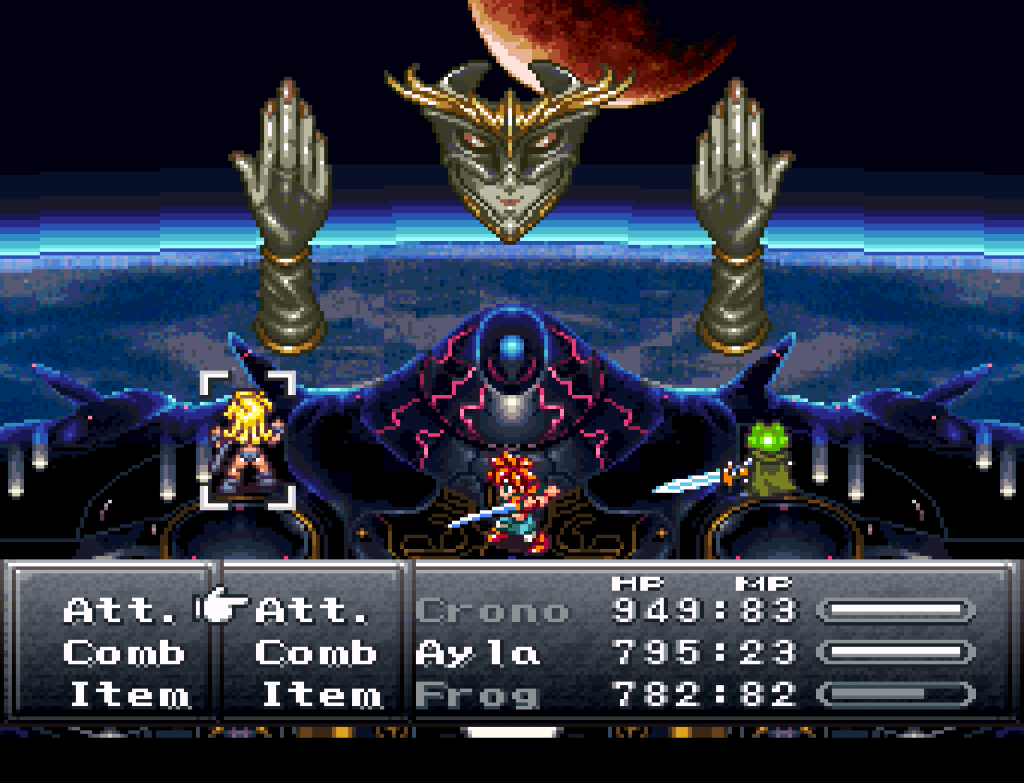
This guy will hammer the party with magic and will completely destroy any player who doesn’t have a gameplan. For returning players, it’s very easy. Simply target the hands and kill them as soon as possible. Use Ayla and Crono’s Falcon Hit dual tech to do it in like three turns.
But for first timers, no challenge like this has been present in the game to date. So it comes as a bit of a shock, especially when those hands revive and start causing havoc again. It’s very memorable and forces strategic gameplay. Bosses after this point require a bit more thinking and planning than before and I view this beast as the introduction to that.
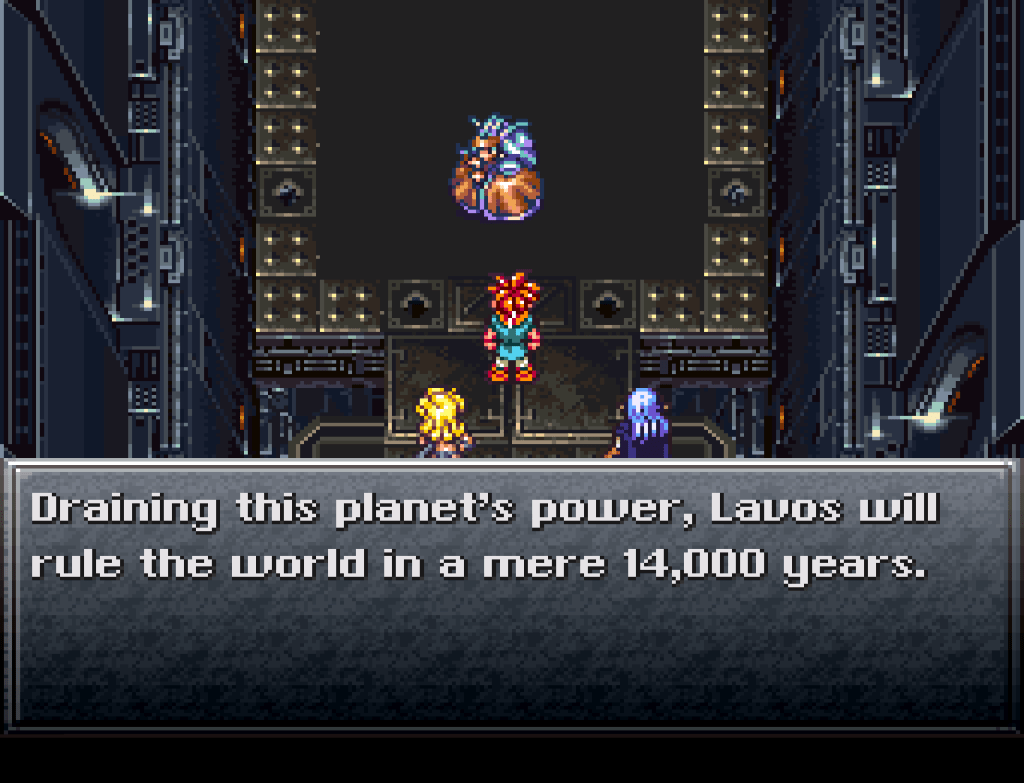
And then there’s the Black Omen. It’s essentially just a straight line to the final bosses of the game, but it feels extra grand in scale. Around every corner is a new boss and a whole lot of enemies that slam the party extra hard. For one of the few times in your playthrough, encounters are not easily skipped. It truly feels like a battle to see the end of the game.
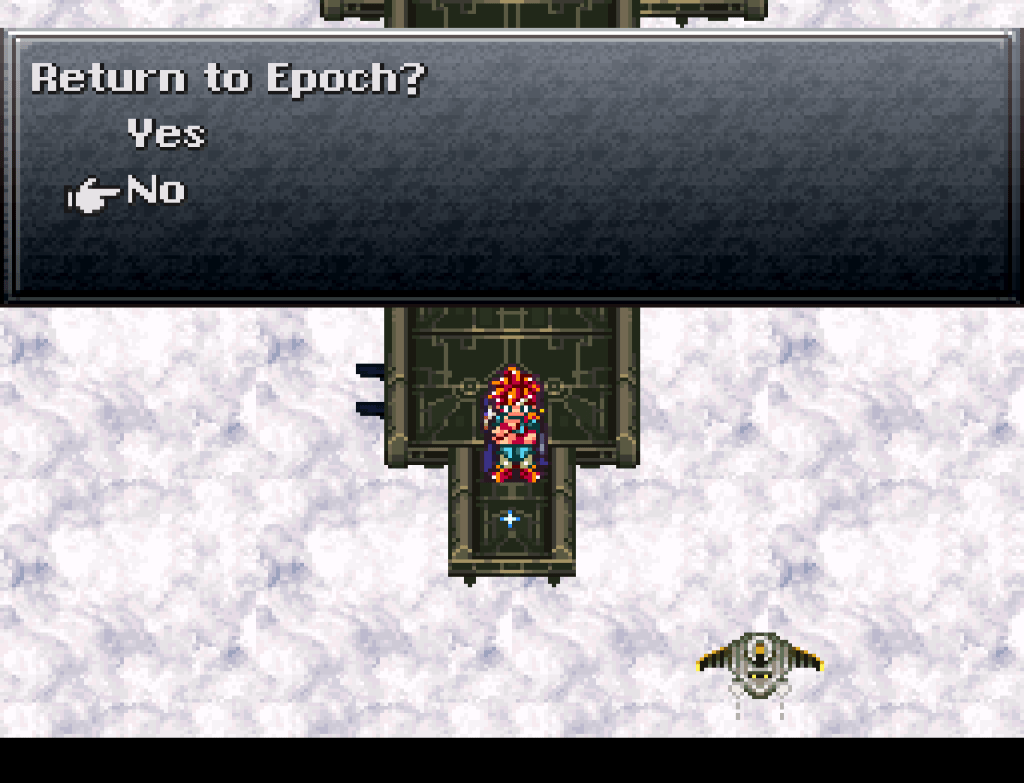
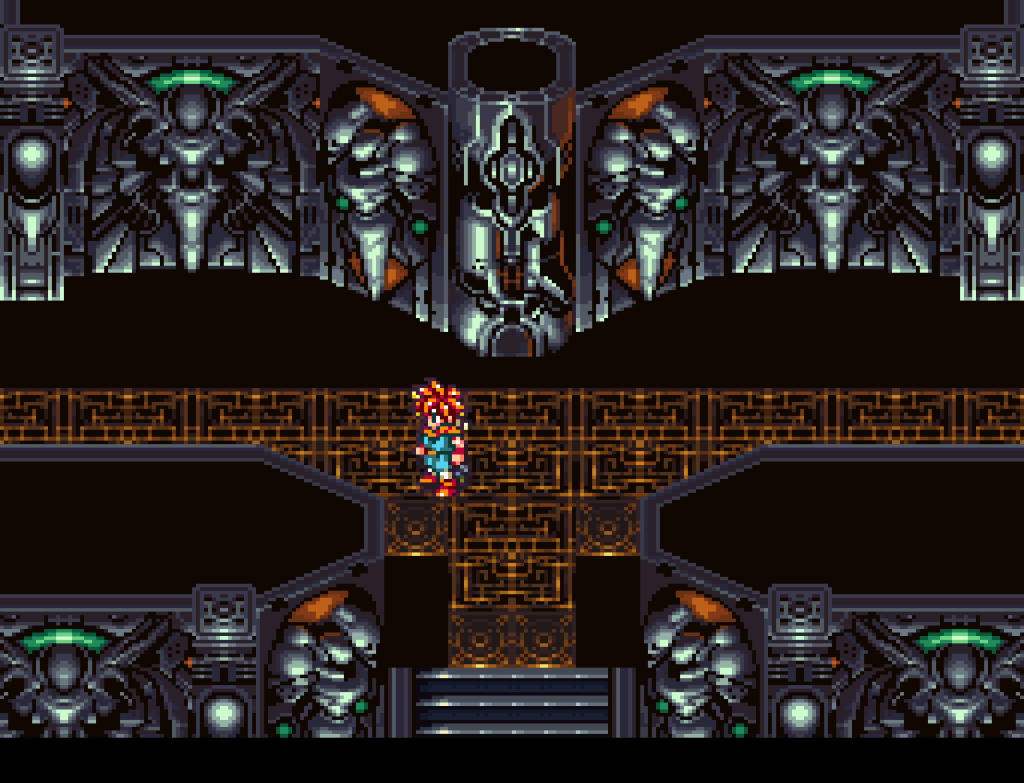
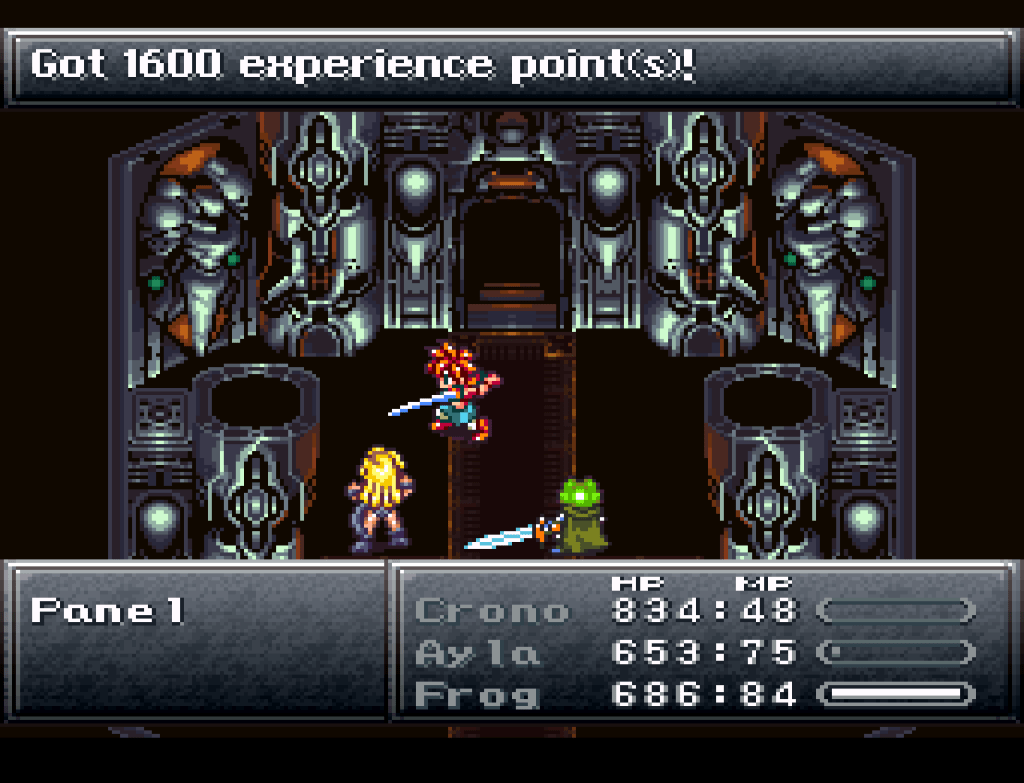
I have kind of a complicated relationship with final dungeons. My favorite RPG franchise right now is the Trails series – otherwise known as Kiseki. In those titles, final dungeons are always extremely massive and feature a million sidepaths to explore. It feels like a fitting conclusion to your adventure. But at the same time, it doesn’t feel entirely focused.
If I’m at the end of my journey and I’m trying to finish off the final boss, do I really want to go down 20 different side paths? The option is there, so I’m gonna take it because I do want that extra loot. From a narrative standpoint, it takes some of the urgency out of the equation. By the time I fight the final boss, I’m not as amped up as when I got into the dungeon, if that makes sense.
In Chrono Trigger, it feels like a straight line. But around every corner is another strong enemy in the way. By not giving you as much agency to explore a ton of nooks and crannies, it makes every encounter feel tense. Fighting bosses feels more impactful because they are in the way of your straight line reaching the end. It creates some tension through player impatience.
Both ideas have their place, but I think this approach works best for Trigger. You are trying to stop the end of humanity. You don’t want a future where humans are barely surviving, living hollow and empty existences. And these bosses are in your way of fixing things. I think it works very well.
I also like that this is completely optional. I think most players will elect to go through the Black Omen on their first time through the game. Chrono Trigger is not exactly subtle about the significance of this dungeon – it’s understood that going through this thing will end your adventure.
But if you feel prepared enough, you can just go and fight Lavos.
The purpose of a final dungeon, in theory, is to get your party to a point where they are strong enough to beat the game. But if you think you’re already at that point, why mess around with the fluff?
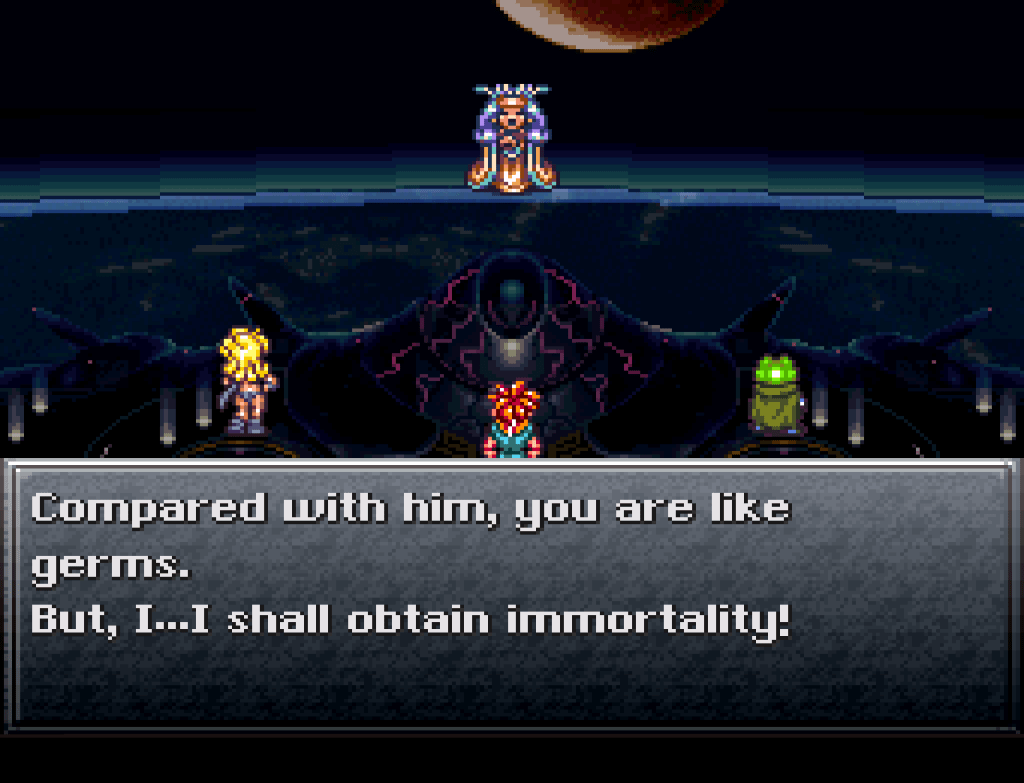
The final boss is going to be the same regardless, this dungeon just has a couple of extra steps to get to the same result. The source of the Queen’s power is Lavos, so just killing Lavos ends things entirely. And since the Black Omen is a weird entity that exists in time in perpetuity, taking care of Lavos at any time will also take care of that!
Just uh…like I mentioned above, don’t think about it too much. Hey, it makes getting all of those endings a little more convenient if you can just skip the giant ass dungeon whenever you want.
12,000 BC is easily the most interesting era of Trigger. The events here – both from a storytelling and gameplay perspective – help turn Chrono Trigger from an excellent RPG into a timeless classic. A game that people 30-some years after release will still look at you right in the face and say ‘this is one of the best games ever made and you need to play it.’ And it’s true. You do.
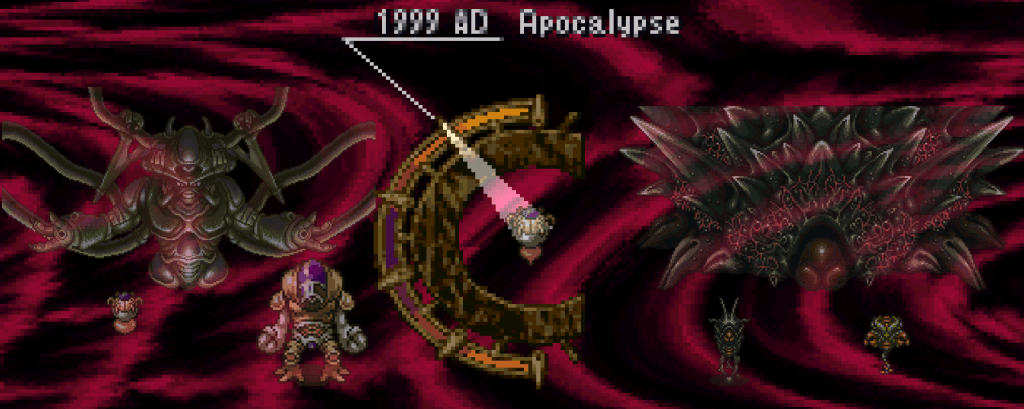
Apocalypse – 1999 AD
The end of the world. To understand why 1999 was chosen as the date the world ends, you might need to take a step back to the 90s. The change of the millennium was seen as a significant event in human history that was shrouded in mystery.
All sorts of world ending predictions were made around the turn of the millennium, ranging from the warnings of Nostradamus to the ending of the Mayan calendar in 2012. It wasn’t so much seen as a flipping of the calendar from December to January, but instead seen as a massive shift in society.
You might have also heard of Y2K, a disaster that was set to render all technology useless due to computers breaking down because they think they went back in time or something like that (think of it like this, we always abbreviate years by the last two numbers, so we’re going from ’99 to ’00).
Y2K was not something that was discussed in broader circles in 1995 – well at least not in Elementary School I guess, I was talking about Power Rangers or something then – but it represents that fear of the unknown all the same.
People don’t want to believe they live in an inconsequential period of time. In our heads, we know that the flipping of the calendar from 1999 to 2000 represents a shift of 1000 years of human history. So, 1000 years, something significant has to happen. Right? It can’t just be like the transition from 1998 to 1999.
One year is routine, 1000 years is a…well, it’s a once-in-a-several-generation sort of thing. It can’t be the same thing.
But it was. That still didn’t make the prospect of 1999 less scary though! And trust me, when I was living through 1999 there wasn’t a day that I wasn’t thinking about Lavos coming up and destroying everything. Obviously it’s just a piece of fiction, but that doesn’t mean something like that couldn’t happen right? No way the year 2000 would be so boring.
Well obviously it wasn’t, Pokemon Silver came out in America in 2000. POKEMON SILVER.
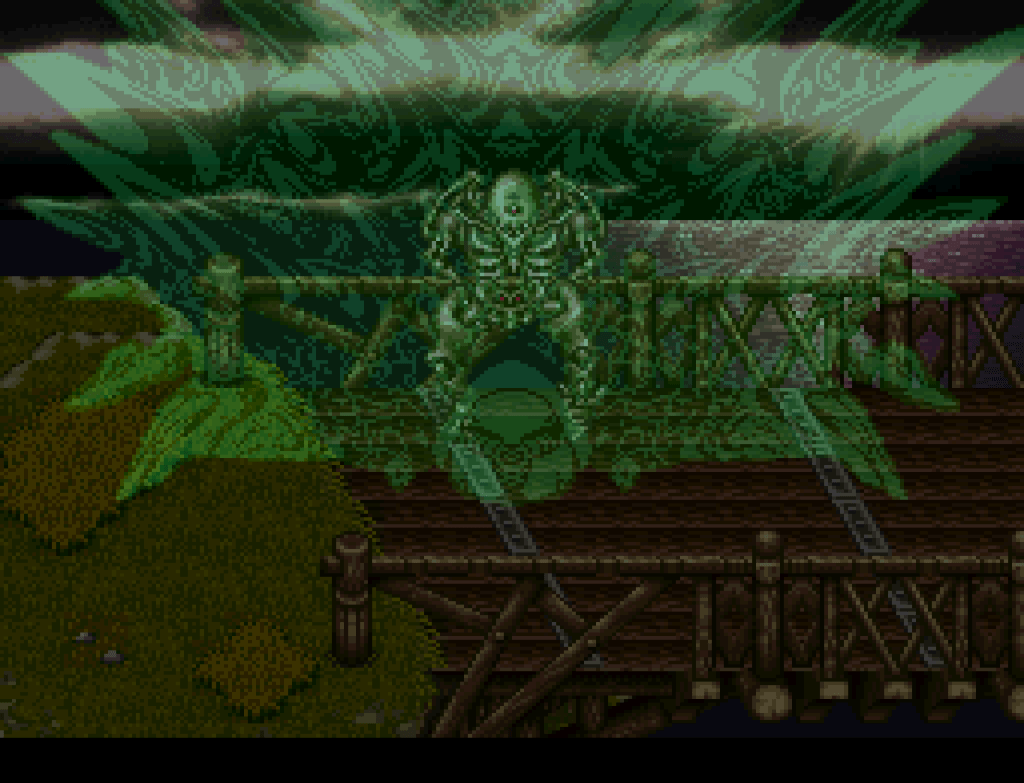
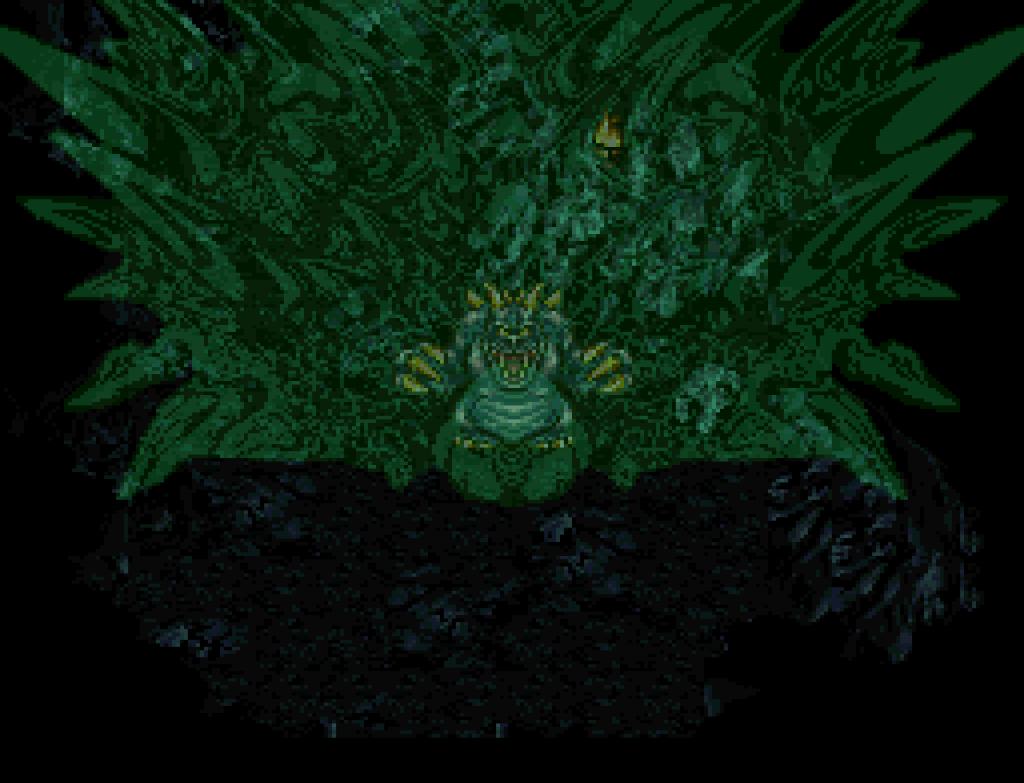
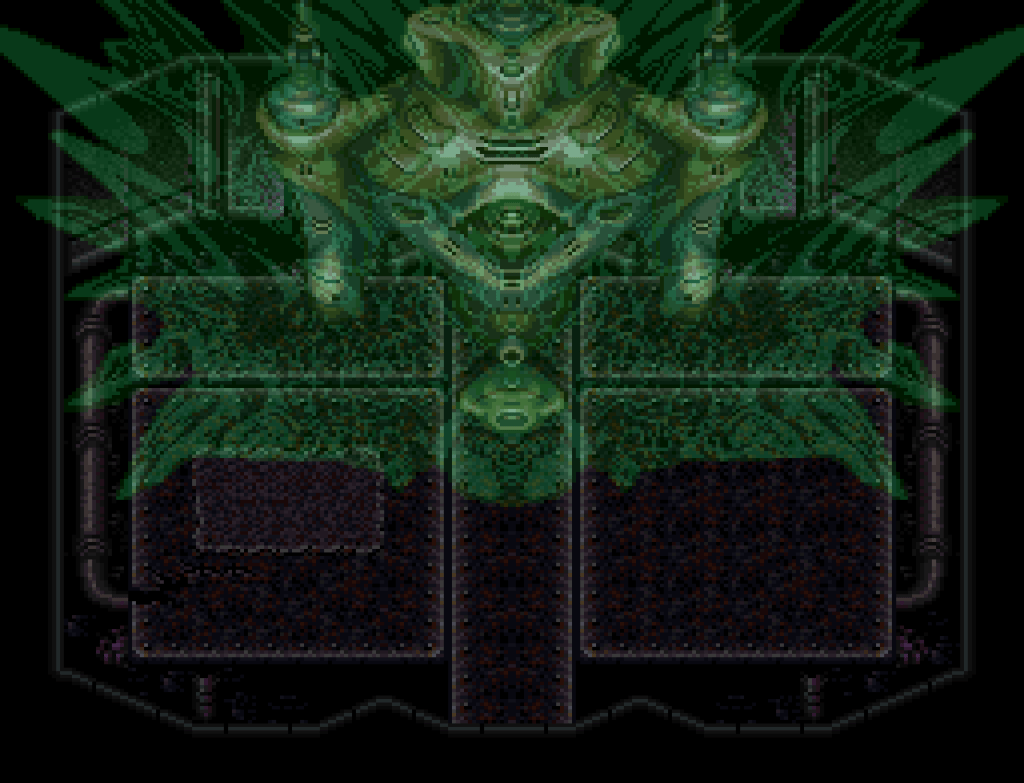
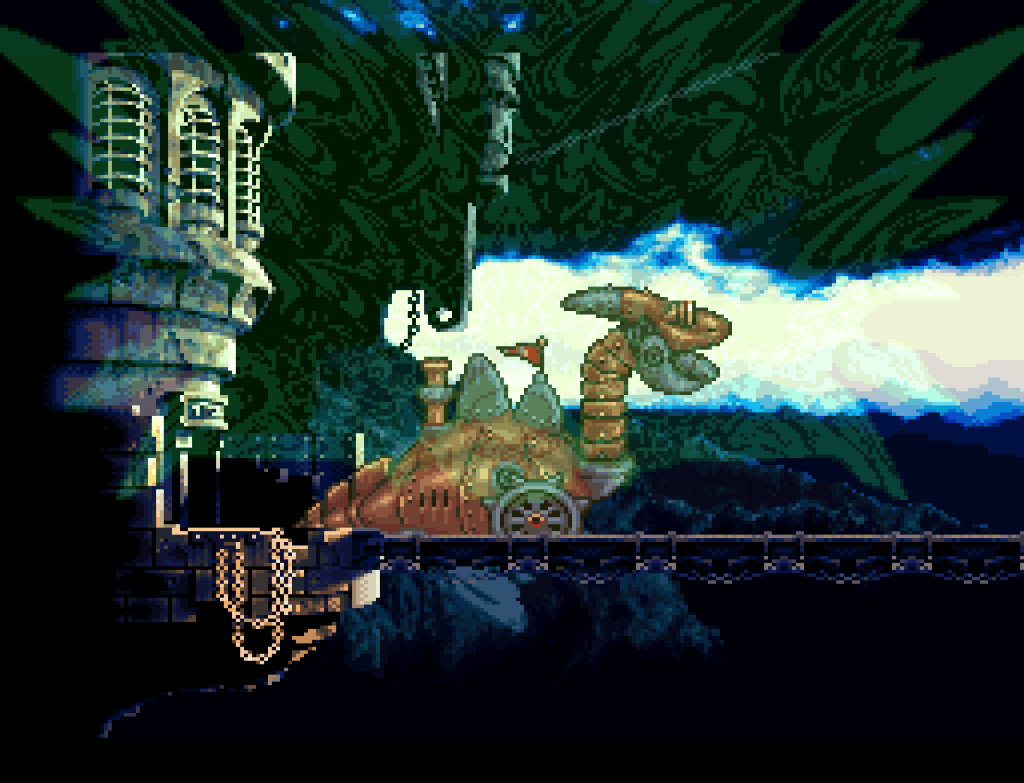
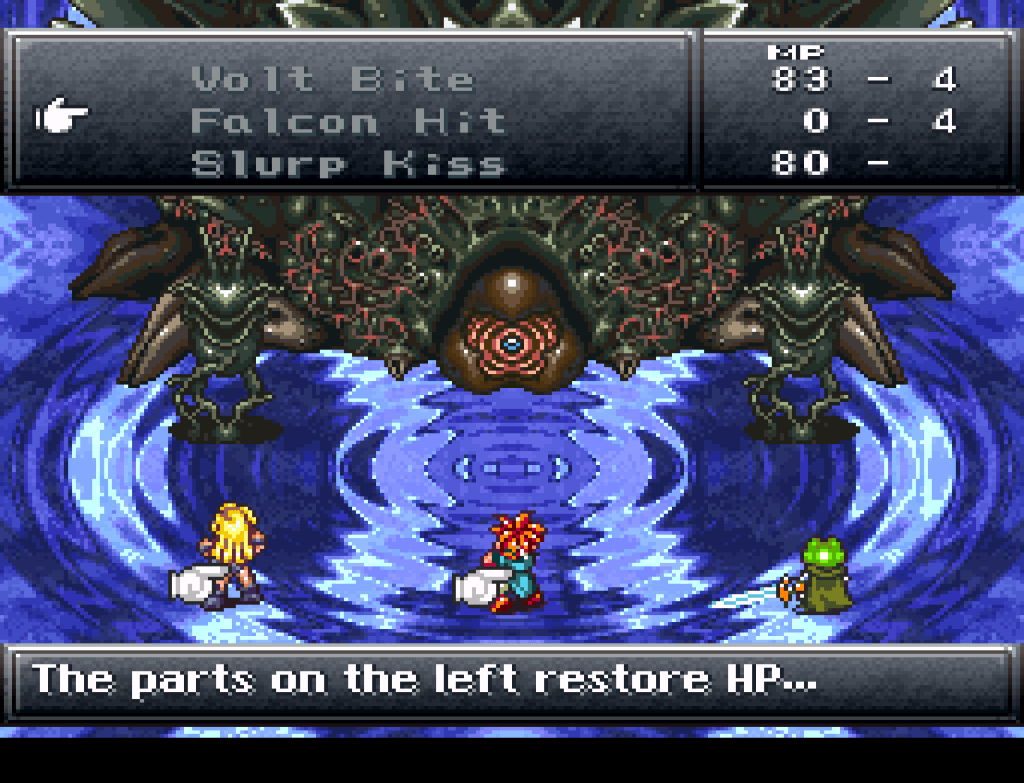
There really is one sole objective for this time period. It’s the time to fight Lavos. So let’s talk about the fight!
There are two different versions of phase 1 – so let’s start with the most common one. You face the version of Lavos that you’ve seen many times throughout your journeys – a giant almost turtle-like creature in a spikey shell. The fight isn’t straightforward though, instead he will mimic various bosses you have encountered on your journey so far.
And for some reason, the bosses don’t seem to be leveled up based on your end-game party. So the first half of the fight is spent enduring a very arcade-beat-em-up boss-rush that isn’t particularly challenging. I basically just jammed on attack until I got to a boss that could only be hurt by magic. Then I’d just cast luminaire or something. Rinse and repeat.
The second version of this fight cuts this out entirely and can be accessed by entering the fight with Lavos through the portal at the very beginning of the game.
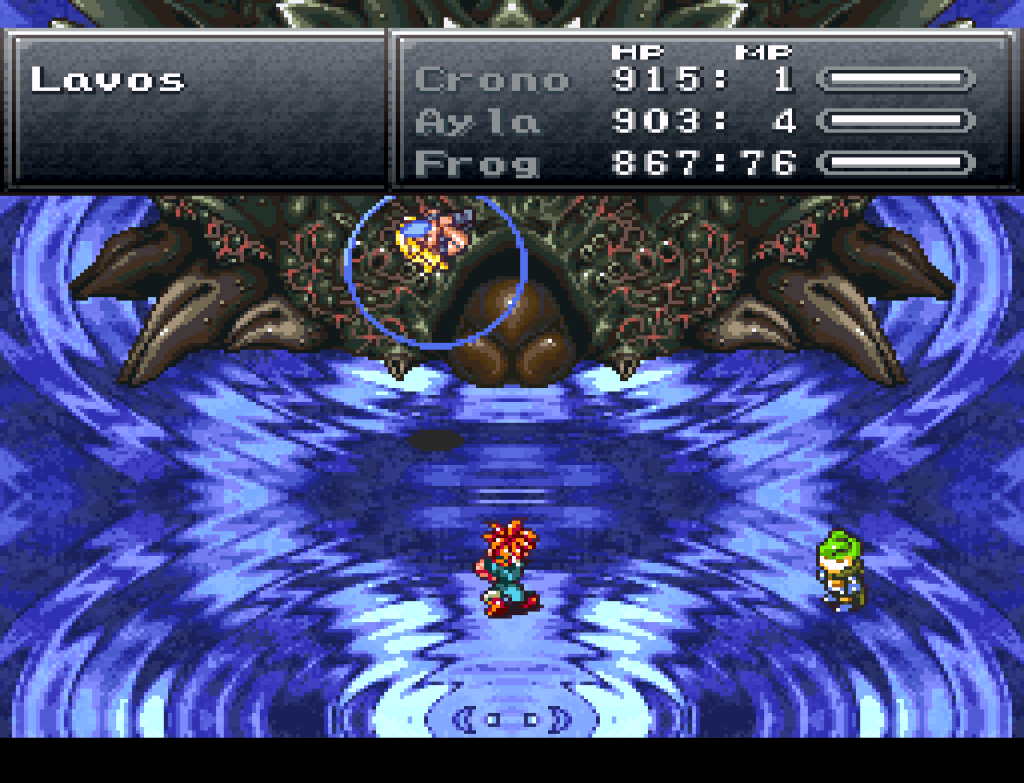
Once you’re done with the boss rush, it’s a more traditional fight with the giant space alien. If you’ve done every single sidequest that pops up at the end of the game, this section feels like a victory lap. You basically can jam on the attack button and win it. But if you’ve ever played a JRPG before, you know final bosses often bring multiple forms and this is another one of those.
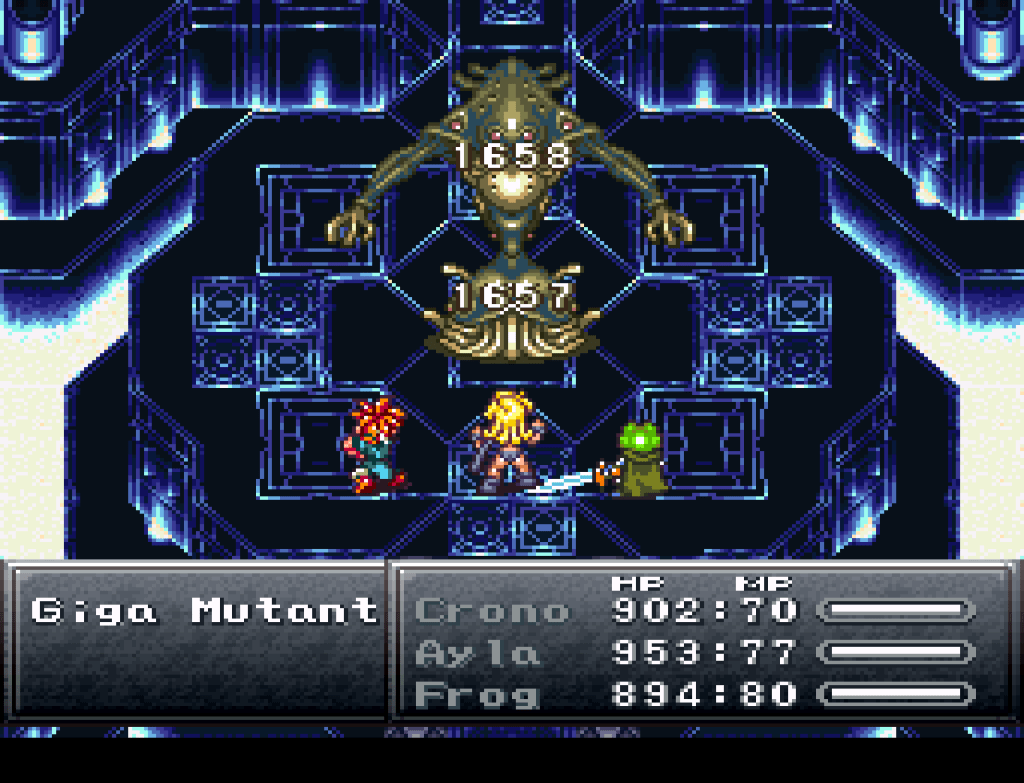
After killing Lavos’s head, you can enter the shell. This is a desolate location that puts the party on edge. Venturing further in we find the second form of Lavos waiting, a giant mechanical looking guy that feels like he’d be right at home in 2300 AD. The key to this fight is taking out his two arms and then focus on the guy in the middle – this should be a common strategy by now, starting with the hard boss from the dark ages.
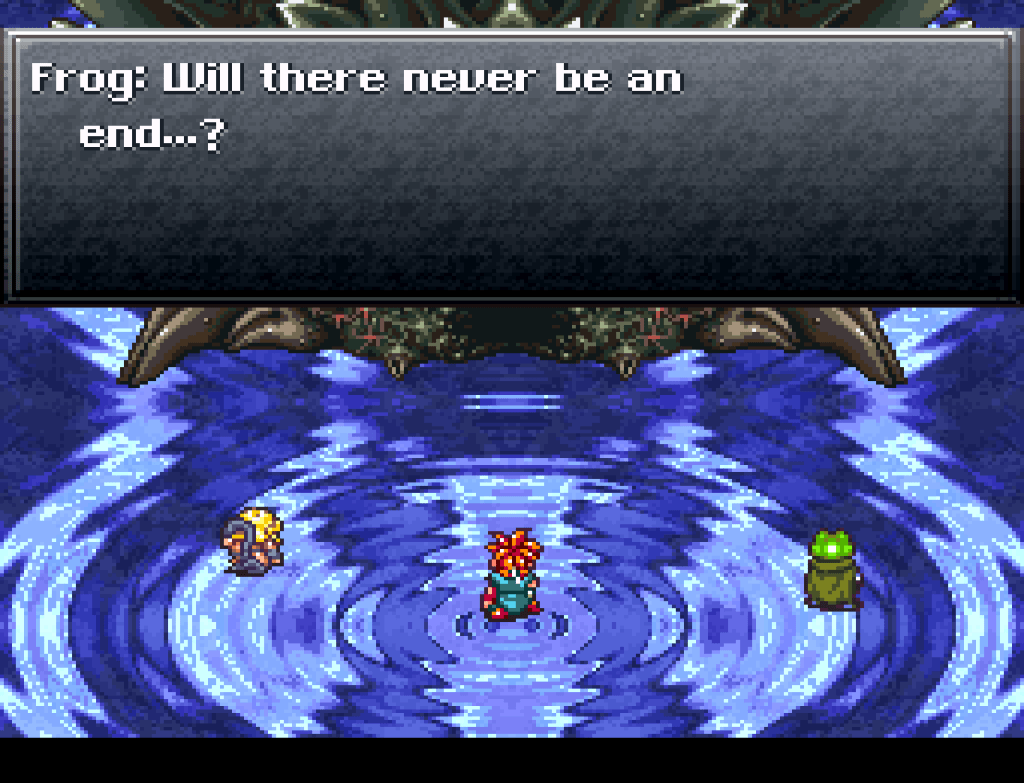
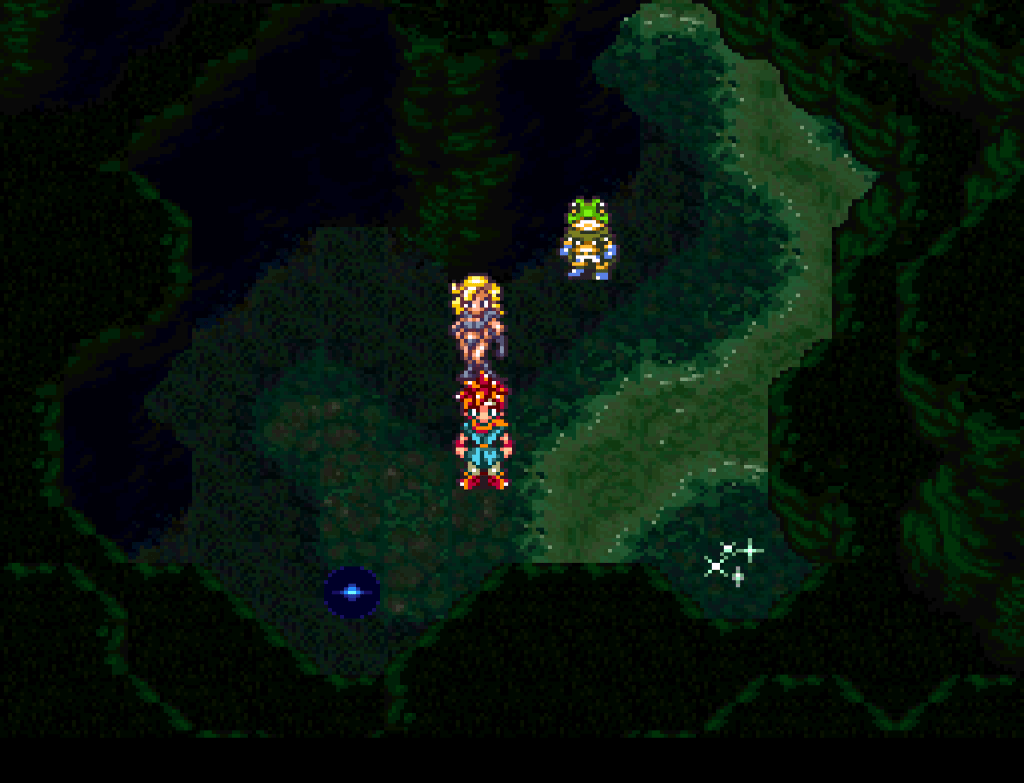
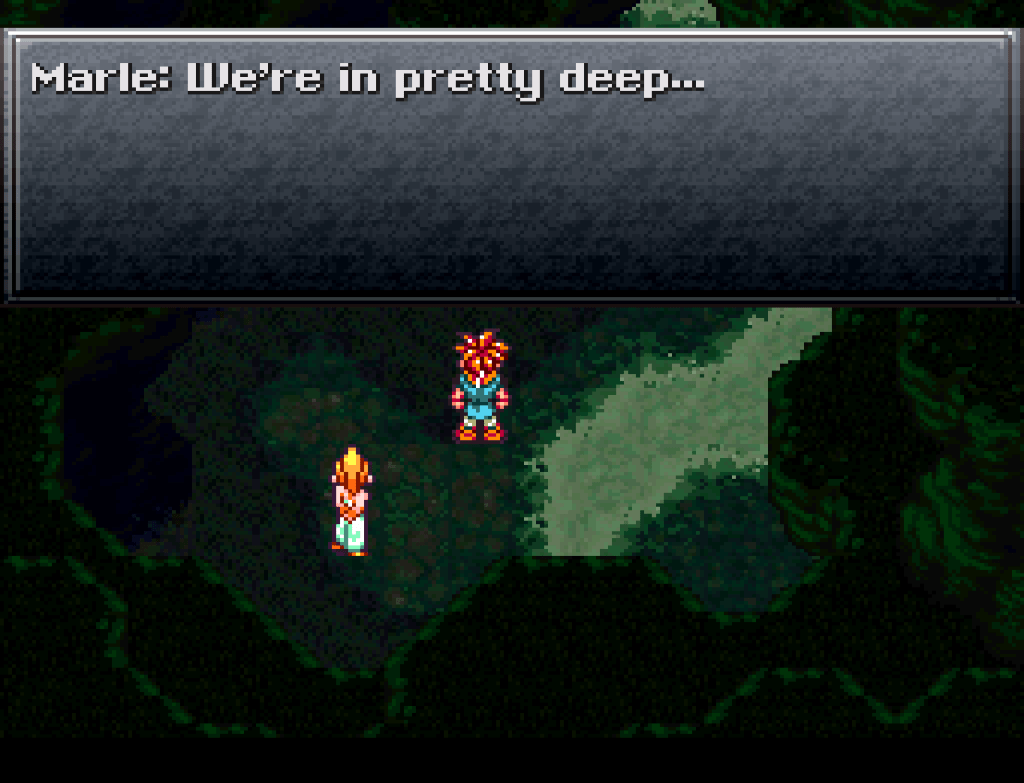
One of the more interesting bits in this battle is that Lavos’s arms have an ability that neutralizes any equipment that has status ailment prevention effects. This is the main reason why killing the arms quickly is important – you can just focus on the guy in the middle if you want.
So naturally, since I did every side quest at the end, everybody on my team had a prism helmet equipped. These are supposed to stop all status effects, so it took me a little by surprise that Frog kept getting confused!
Those sorts of attacks are unsporting and I generally don’t like them. It renders preparation for harder battles pointless because, no matter how hard you prepare, the bad guy can just ignore the rules of the game and soldier on.
However, this is Chrono Trigger. It’s an easy game and status effects aren’t so crippling that they’ll end your game. There’s no marin karin which leads to the final boss recovering all of its health. So it’s merely an annoyance here – it only becomes a problem when trying to get the dev room ending. And even then, I still did it immediately upon loading a new game plus.
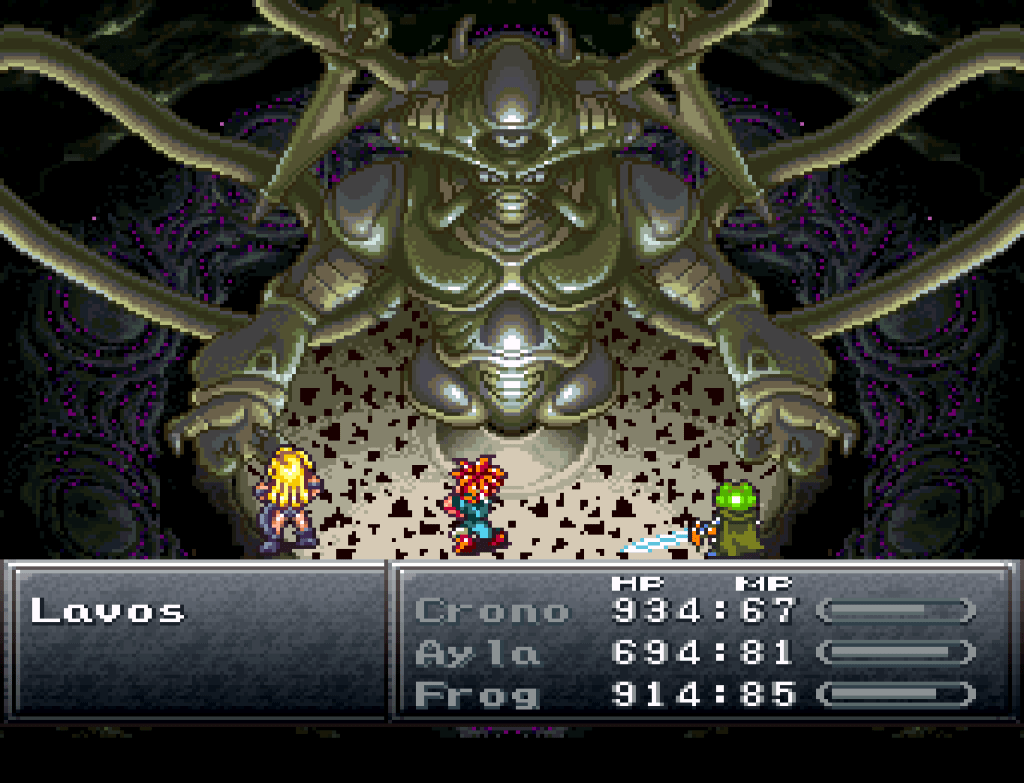
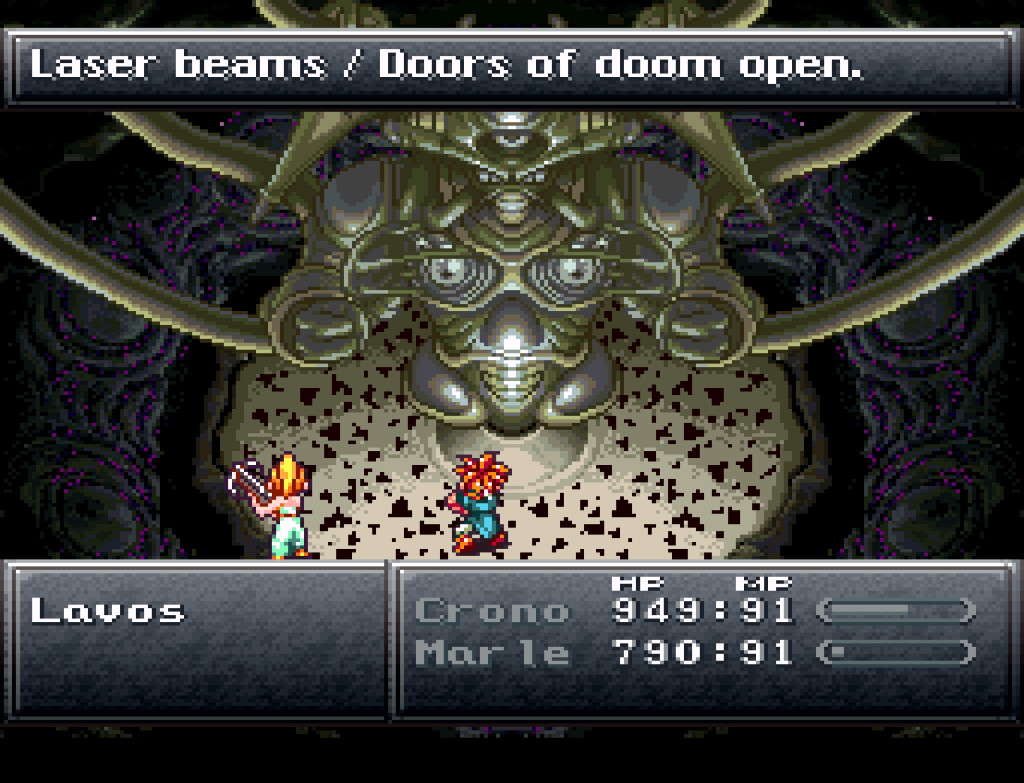
Outside of this, Phase 2 isn’t so bad. He has the occasional heavy hitting attack that targets the whole party, but once you manage to take out the arms you can just have someone heal every turn if you’re feeling nervous. I don’t think I’ve ever died here, even when I was a kid, so you’ll be fine. Probably.
Once this is over, you might think you’re out of the woods. But no, there’s a phase 3! And you can tell it’s for real this time because your entire party has unique lines for this that kinda reflect their journey to this point. It makes it feel suitably, for lack of a better word, epic.
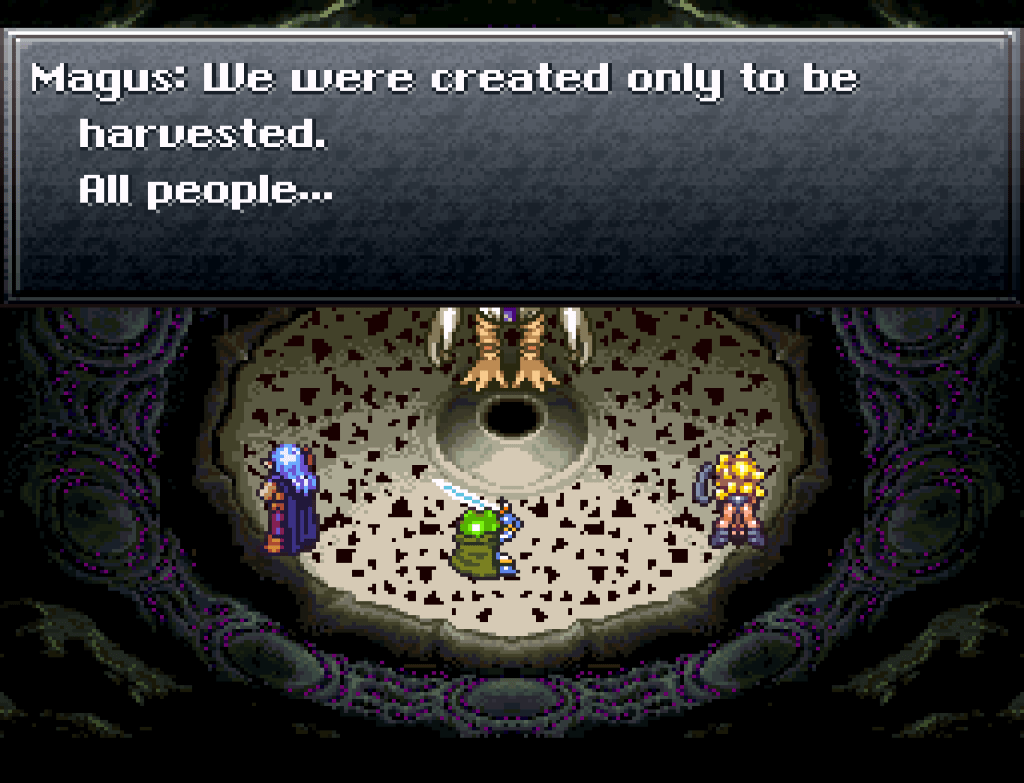
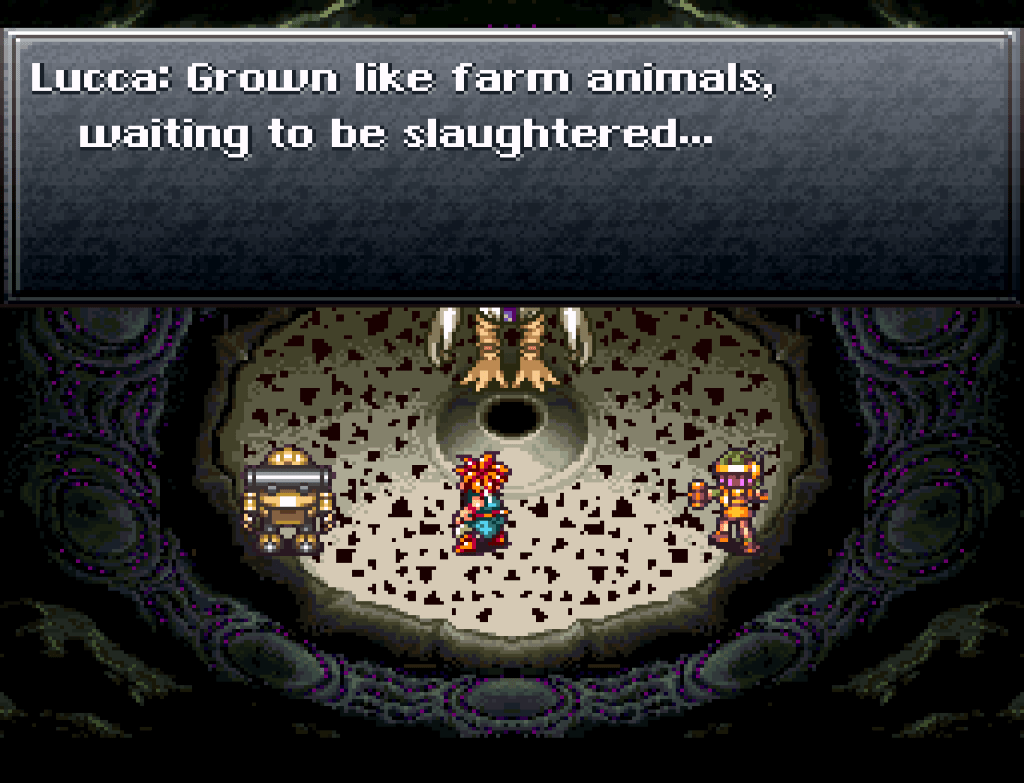
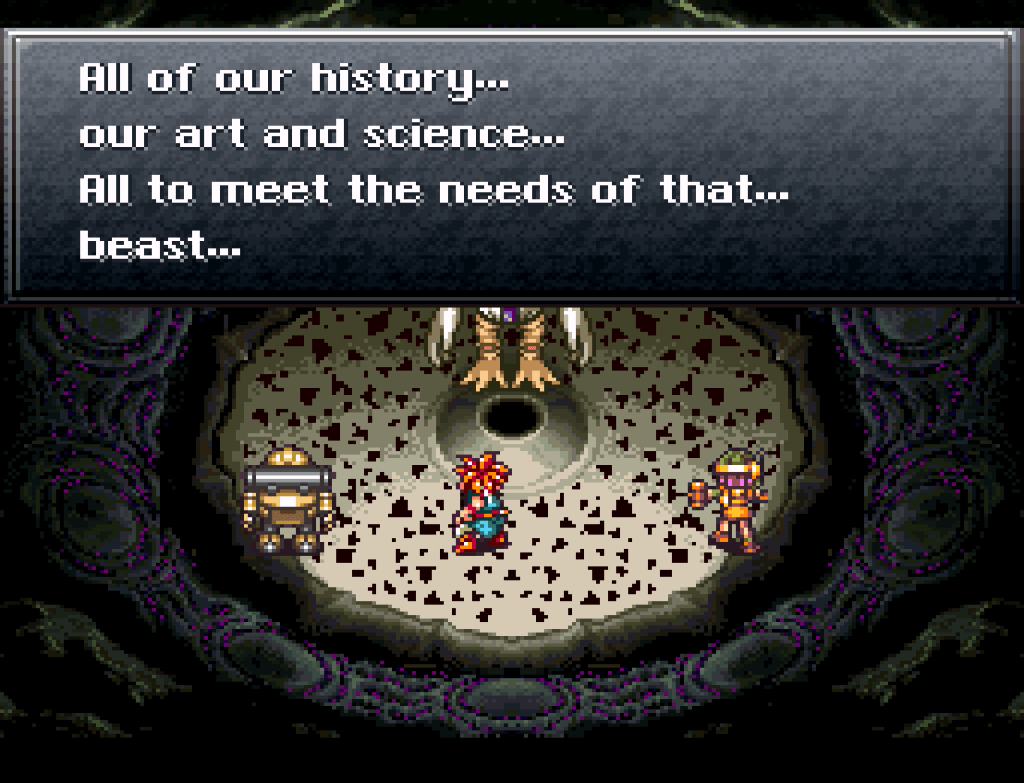
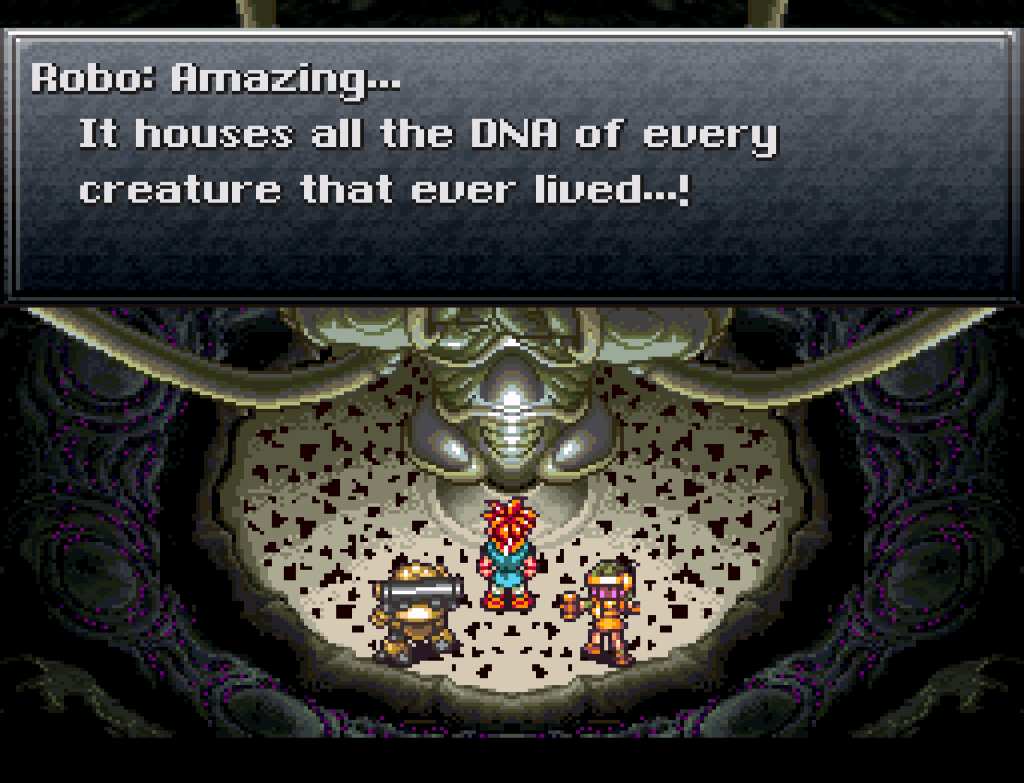
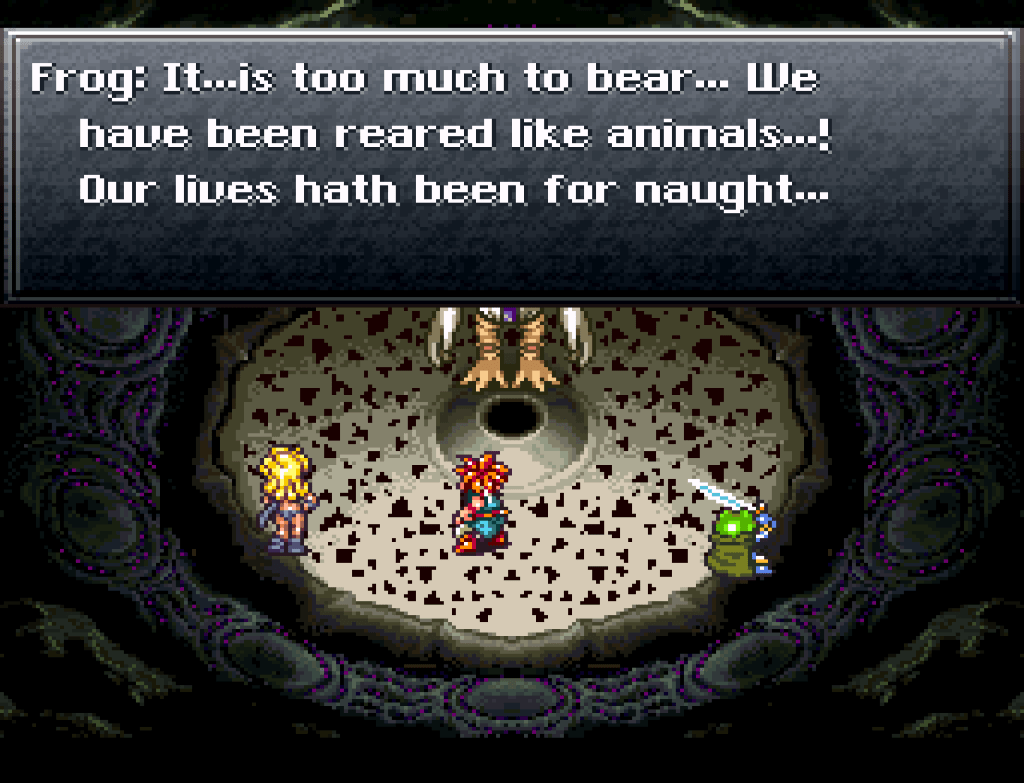
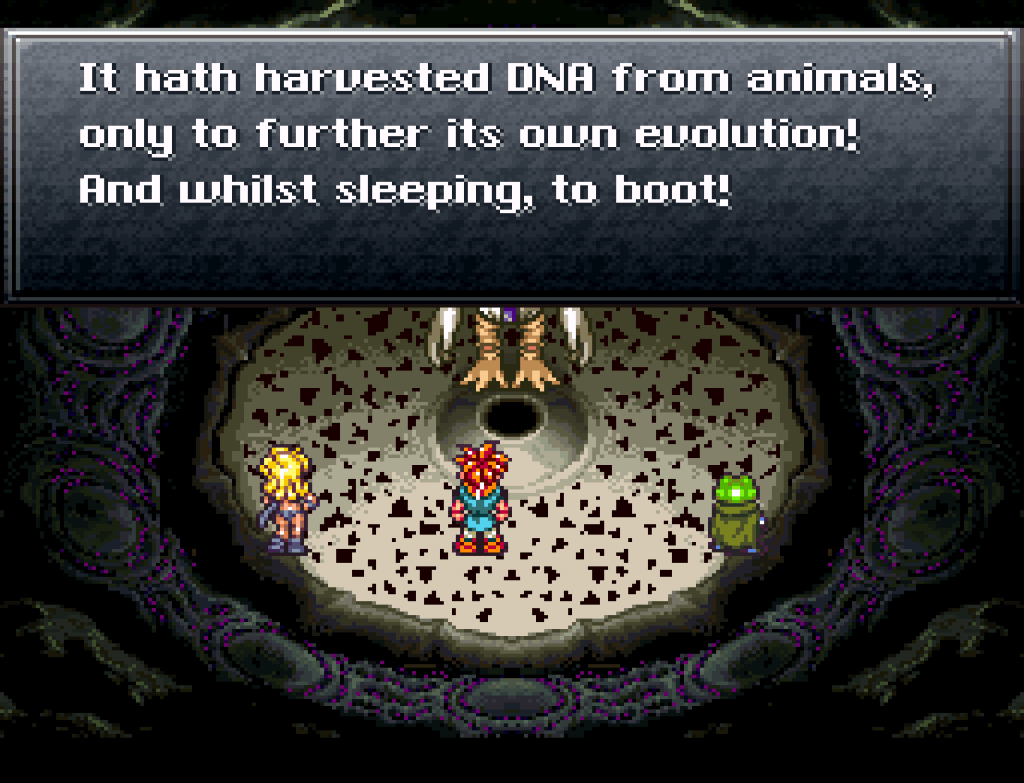
In this dialogue, it’s suggested that Lavos has been injecting itself into humanity and forcing creativity out of humans in order to leech of of it, and ultimately, consume it. Lavos’s true nature is a parasite, he wasn’t just burrowing down to the center of earth for nothing.
I think the extent of his influence on the evolution of humanity is up for debate on how you interpret the various final battle quotes. For me…I think he just provided a spark of creativity, I don’t think he’s single-handedly responsible for every invention throughout history.
Phase 3 is another one of those with multiple targets. It’s formatted much like phase 2 in that there’s three parts with one big target in the center. This is to trick the player into focusing on the center target, wasting a lot of time and resources to bring it down. It’s the last defense of a desperate creature, essentially hoping to win a battle of endurance by having you waste your time.
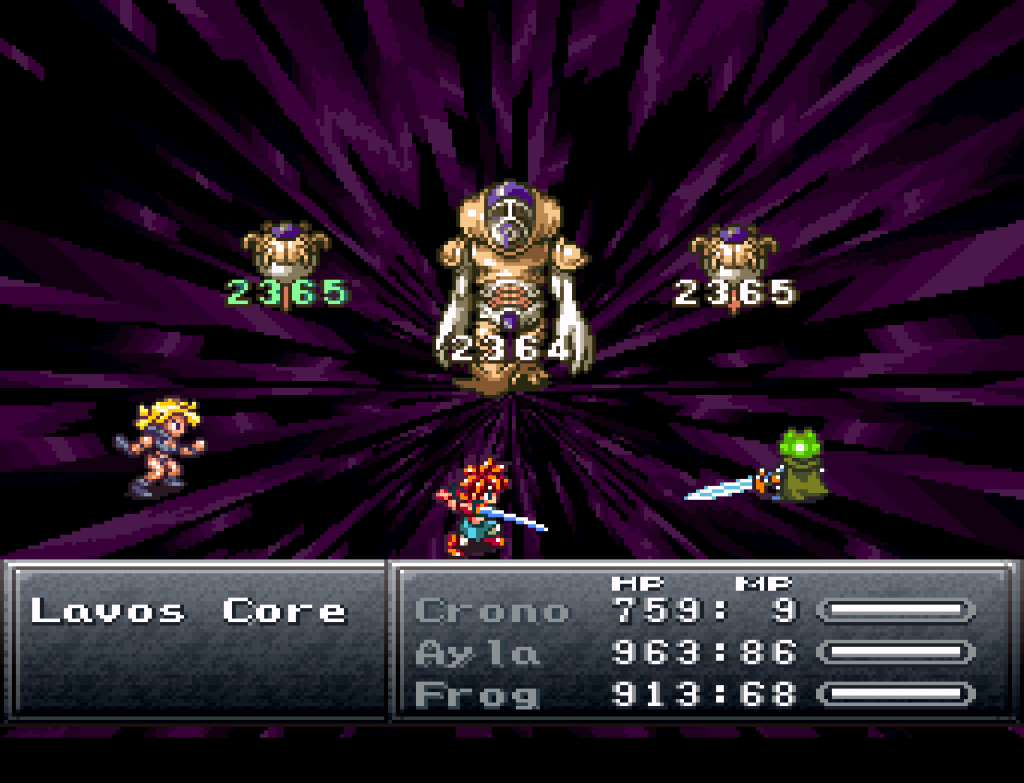
The secret to this battle is in paying attention. The left target here does a lot of healing and can do the same status effect attack phase 2 used. And as is the case with hero shooters, MMOs and every damn video game of all time – you focus on the healer. When the heals stop, progress can be made. When the left target goes down, a message pops up saying the right target has lowered its defense.
This is your sign that the true Lavos is not the center decoy, but instead the target on the right. It’s made to look exactly like the target on the left in order to increase its ‘henchman aura’ for lack of a better term. The right target, Lavos’s core, will revive the left one after a few turns. So it’s a constant battle of killing off the left target, enduring offense from the center and whittling away at the core.
The center can be killed too, though crucially the battle does not end when it’s offed and it can also be revived. I imagine most first-time players get a game over here because they spend so much time throwing themselves at the center target that they kinda freeze up when it dies and the battle continues. I think it’s a pretty genius bit of boss design, fitting for the final encounter of one of the best games ever.
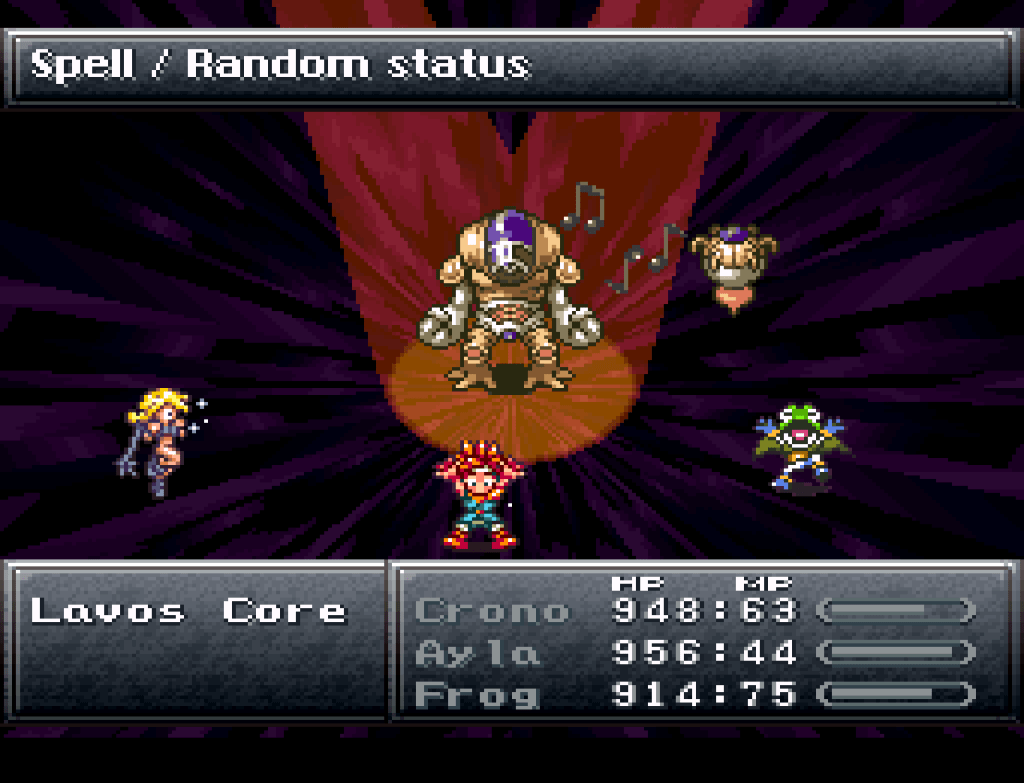
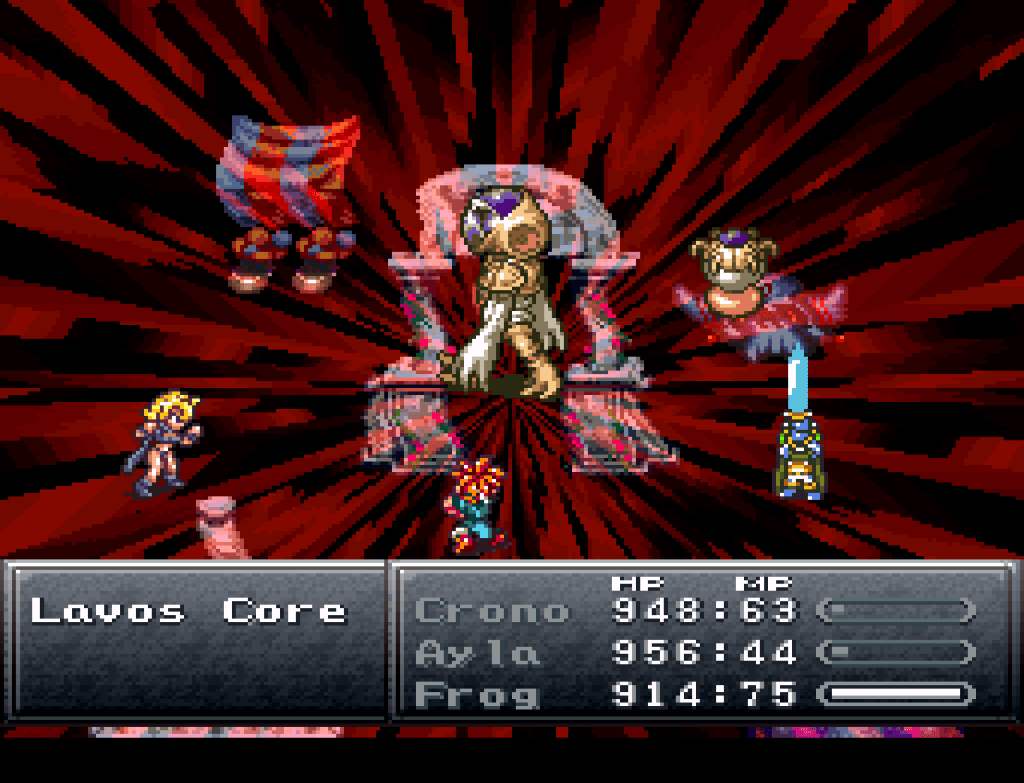
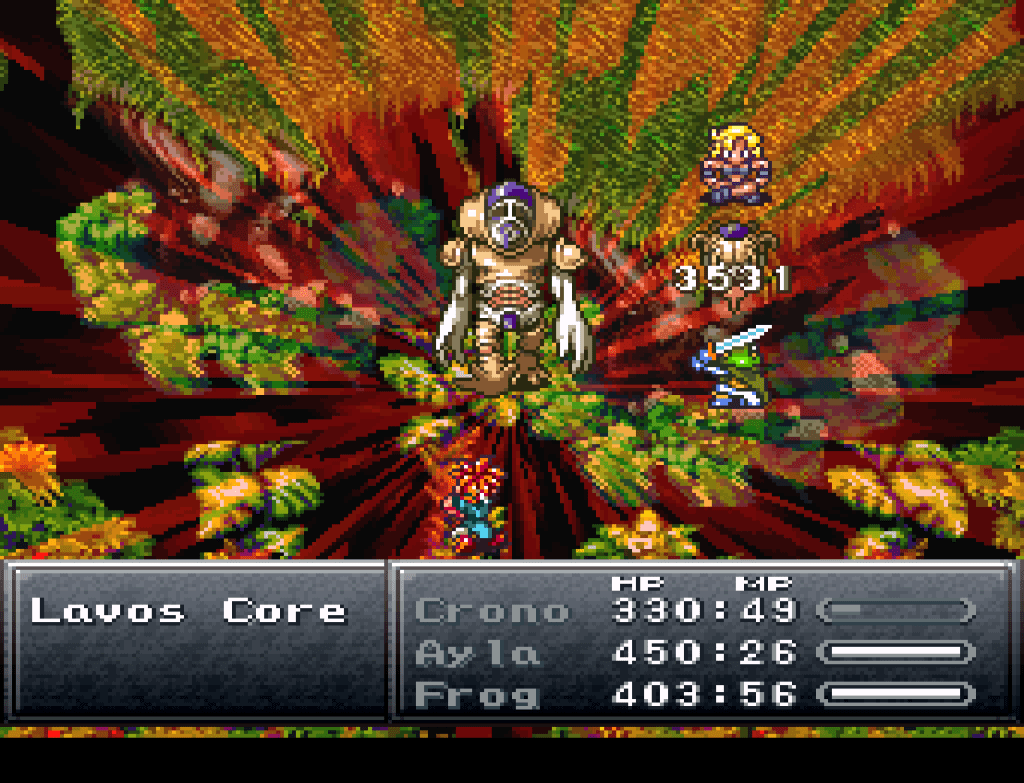
Also, I find the constantly changing background to be awesome. You see various moments of history throughout the world of Chrono Trigger. Great touch.
This encounter is the hardest hitting one in the game, which should be no surprise. If you don’t properly shield yourself, your more squishy party members can be killed instantly by its attack that causes ultimate damage.
In my run at the dev room ending, Marle got one shot by this move and it essentially became a solo battle. But once you know the trick to it, the battle isn’t so hard. I’m no expert at games, but I didn’t fall once in the 12 times I killed Lavos for the making of this retrospective.
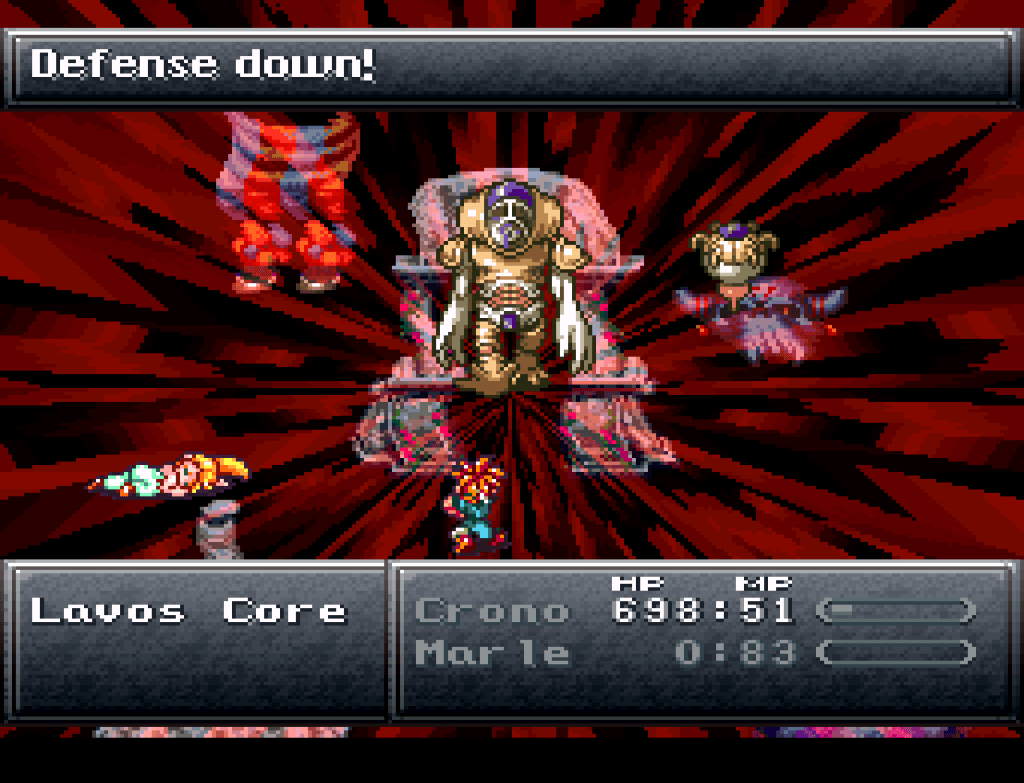
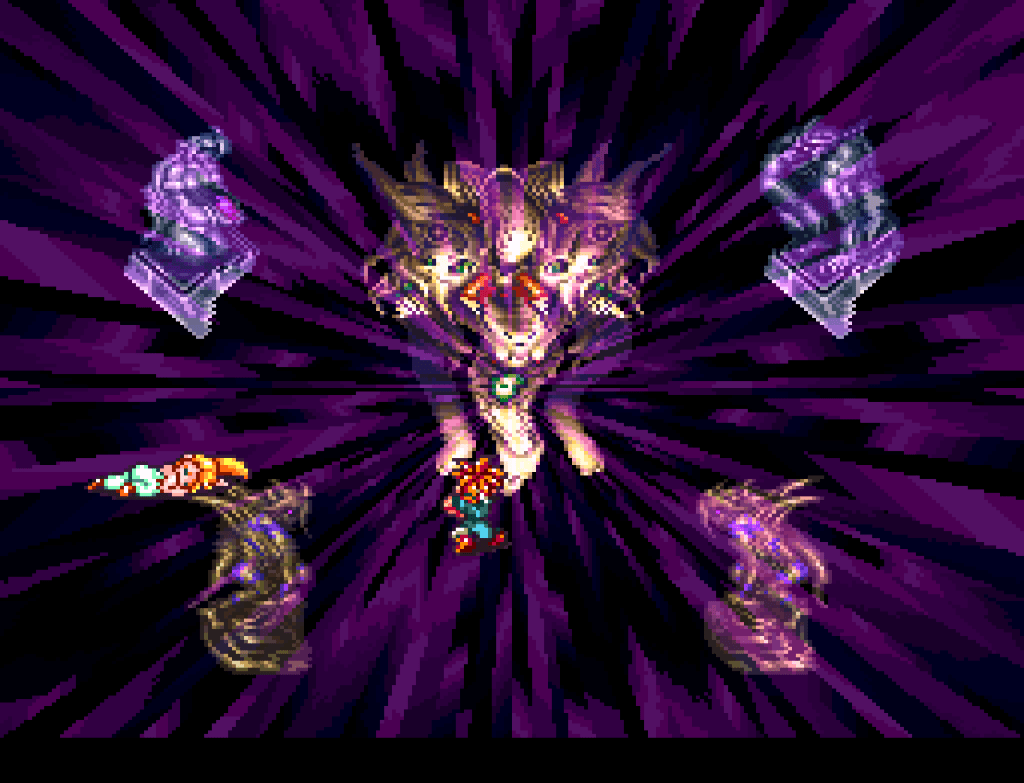
Poor Marle and Lucca though…the less said about how they fared the better. Look man, I didn’t have my items organized properly, I couldn’t get them the defenses they desperately needed! It’s not my fault they’re squishy!
Enjoy your ending!
Playable characters
Let’s finish off this thing with a breakdown of your party members. Seven time periods? Seven party members!
Crono
Believe it or not, this is the first time I’ve discussed a truly silent protagonist on this site. FF I and III had entirely silent parties, but for games with a little more character depth? This is new territory!
Silent protagonists were once a very popular mechanic to use in games. Gordan Freeman from Half-Life and Link from Zelda are probably the most well known ones unless you want to be an asshole and include characters like Mario and Kirby.
Their purpose is to serve as a player proxy. The idea here is that it wouldn’t rob immersion from the player’s experience if they decided to act ‘out of character’ because the protagonist has no character of his own.
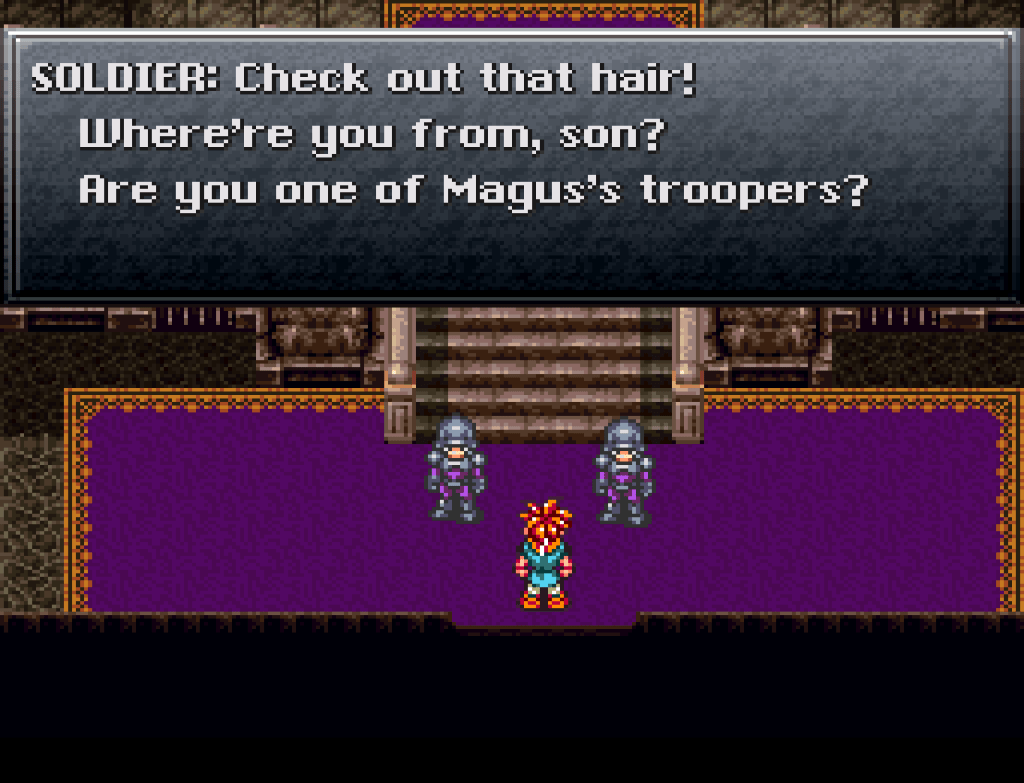
Would Squall in Final Fantasy VIII, if it were up to him, ever play Triple Triad? Unlikely. He’s too serious for that. But it’s rewarding to the player, so THEY will likely be playing whether Squall likes it or not. But Crono placed into Final Fantasy VIII wouldn’t have that conflict. There’s no putting the narrative and characterization aside to do whatever I want.
Now that isn’t to say silent protagonists don’t have any personality. Instead, how your party interacts with the character can help define that. You fill in the gaps based on what they’re saying to and about the protagonist.
I believe the game to pull this off the best is Earthbound. In that game, you get a pretty good idea of Ness’s personality through a late game dungeon and the city of Magicant, which is a city that reflects his inner most desires.
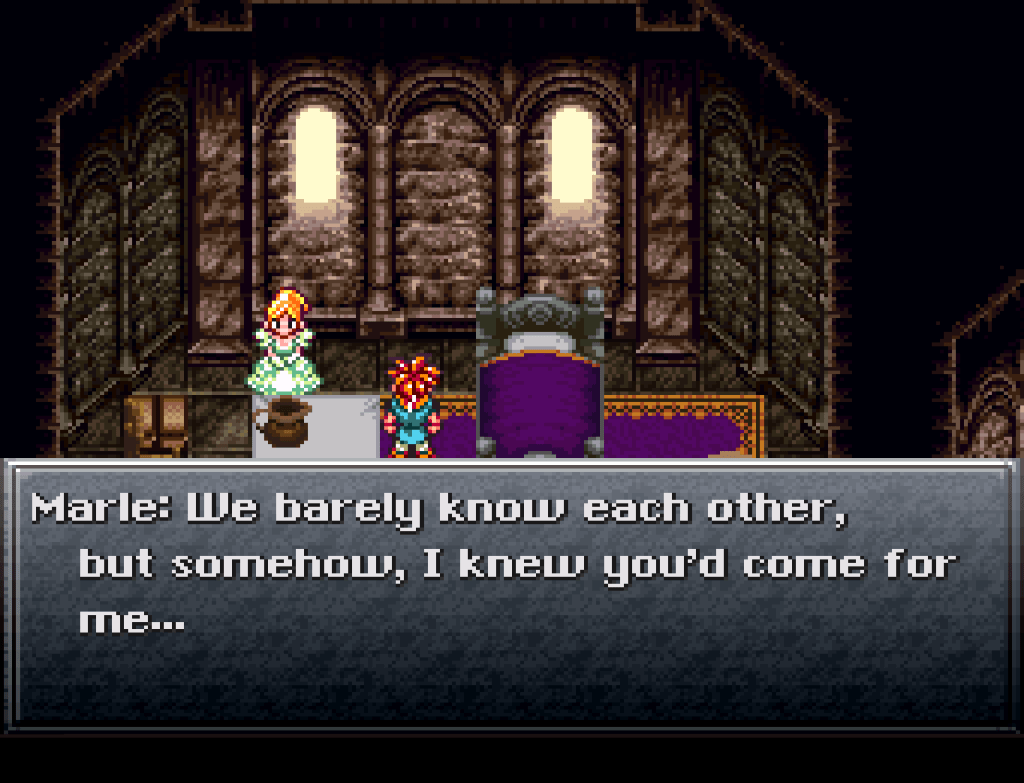
But this isn’t Earthbound! As much as I love Chrono Trigger, this game doesn’t give a lot of ‘unique’ traits to Crono. The trial segment is more of a trial on the player’s actions and doesn’t really mean anything to Crono as an individual. Here’s what I think Crono’s defining character traits and abilities based on dialogue and events in the game.
•He’s Lazy and likes to sleep in
•He’s heroic – sacrifices himself for a woman he barely knows in 12000 BC
•He can be a bit of a trickster – he blindsides a prison guard by playing possum and stabbing him from behind.
•He can’t hold his booze if the party scene from prehistory is to be believed
•Good looking/desirable – Every female party members is shown to have feelings for Crono in some way. Ayla, for instance, seems very physically attracted to the guy.
•Is a good swordsman – the best swordsman in the game, Frog, makes sure to mention it a couple of times.
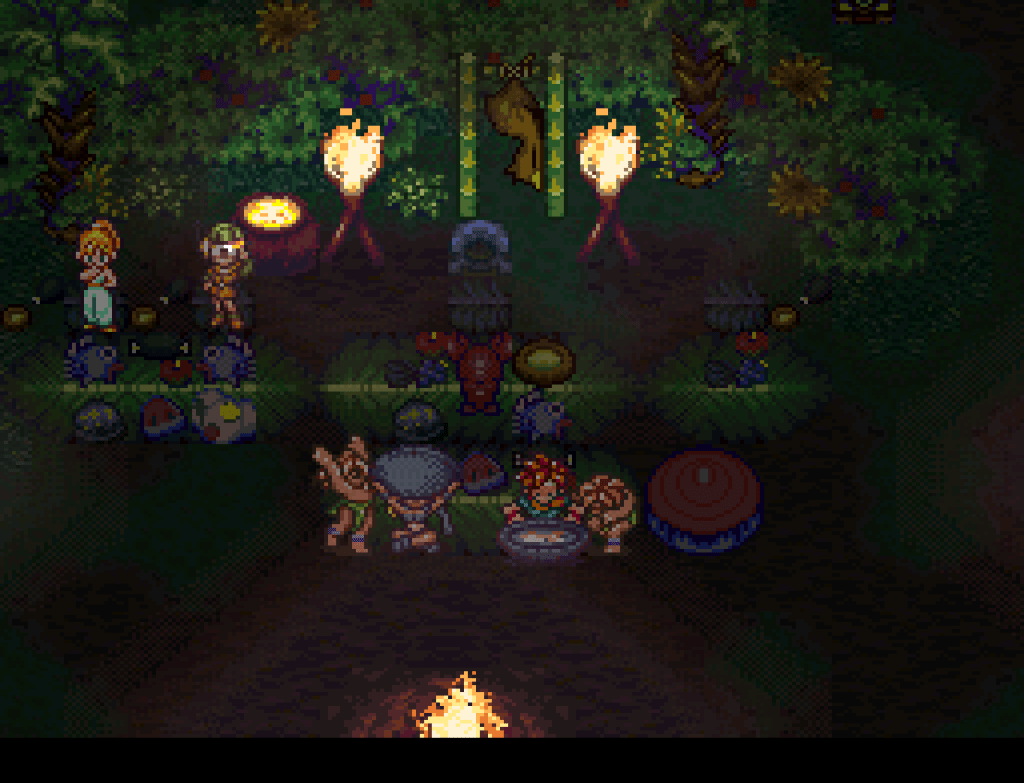
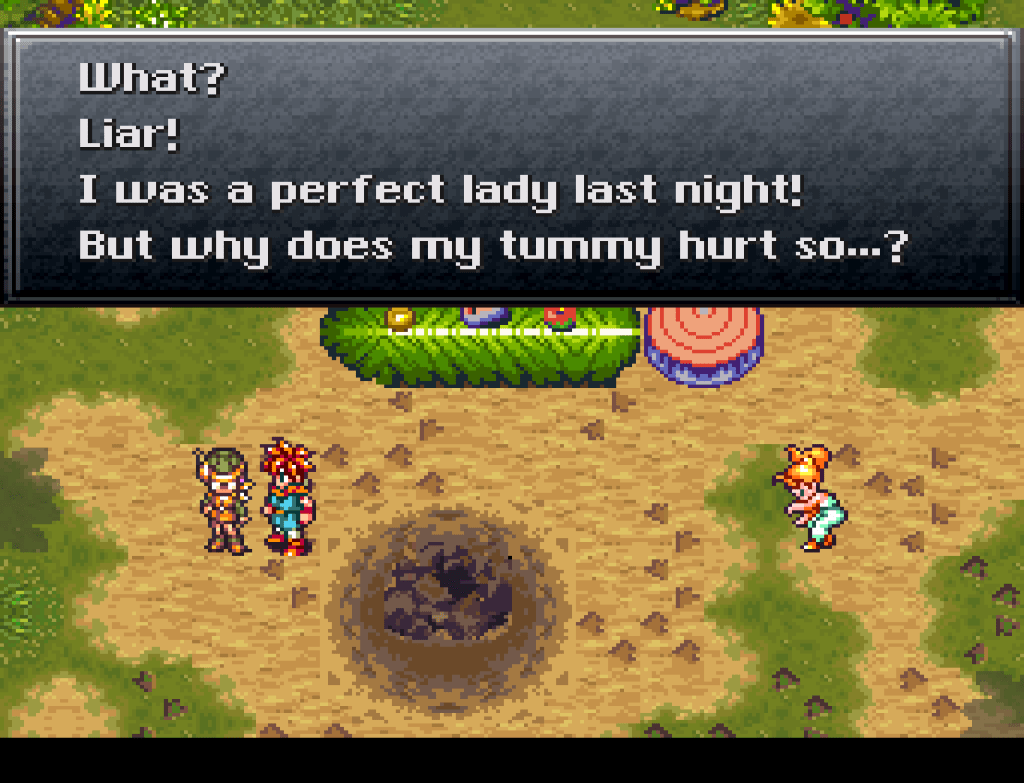
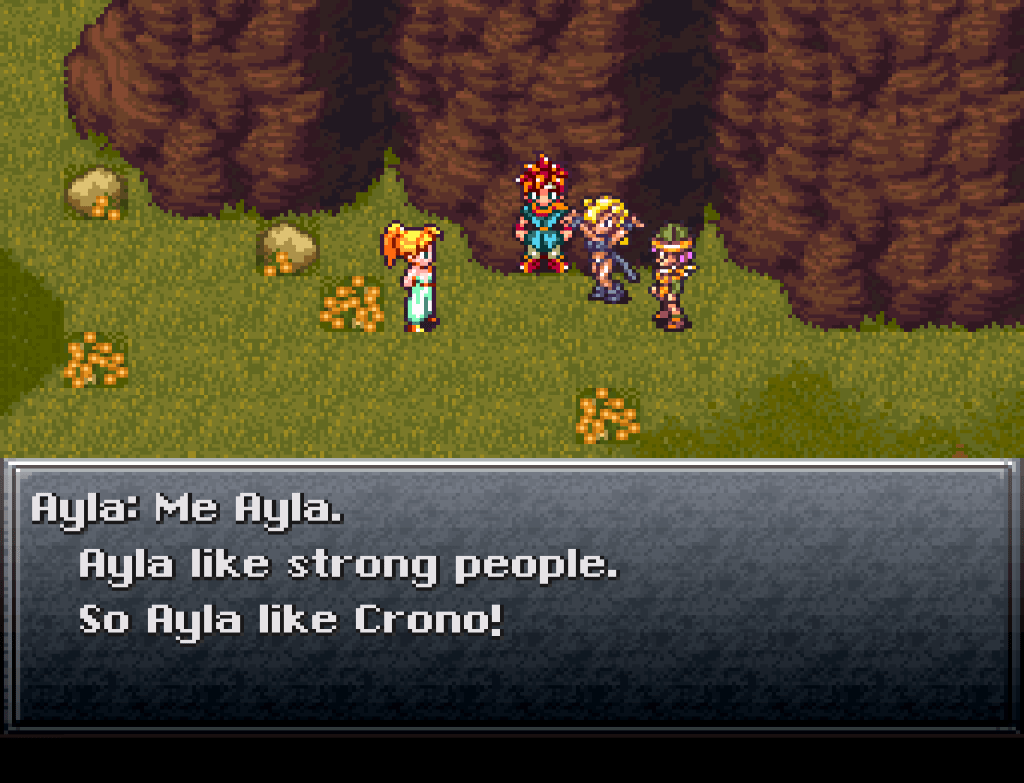
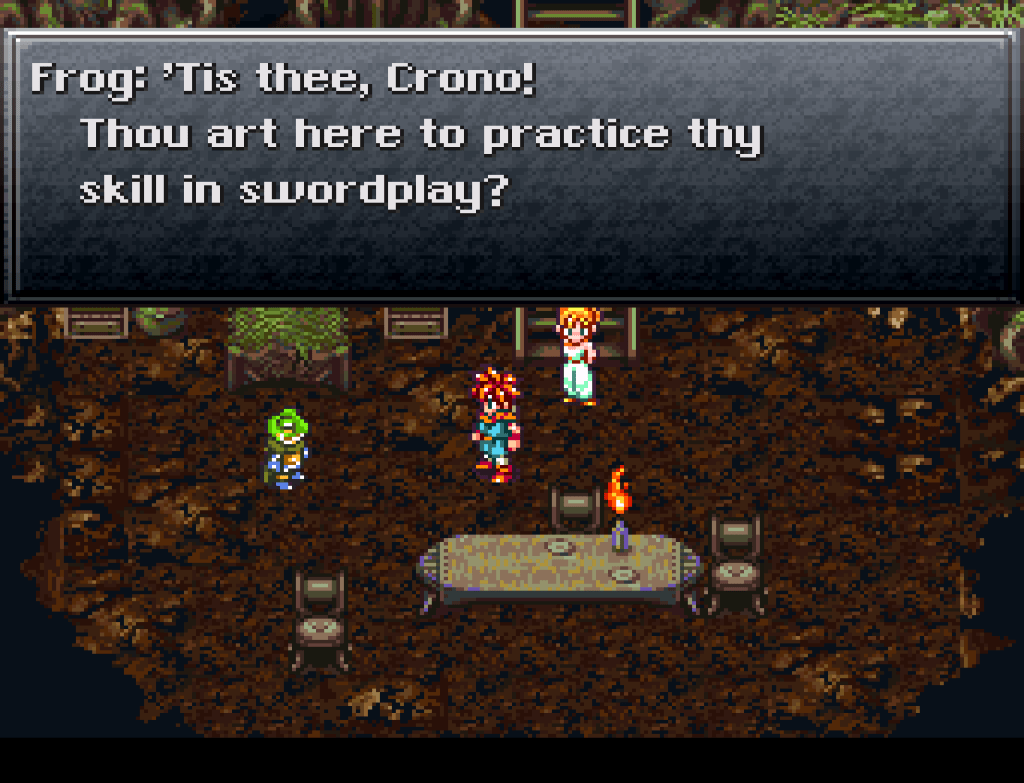
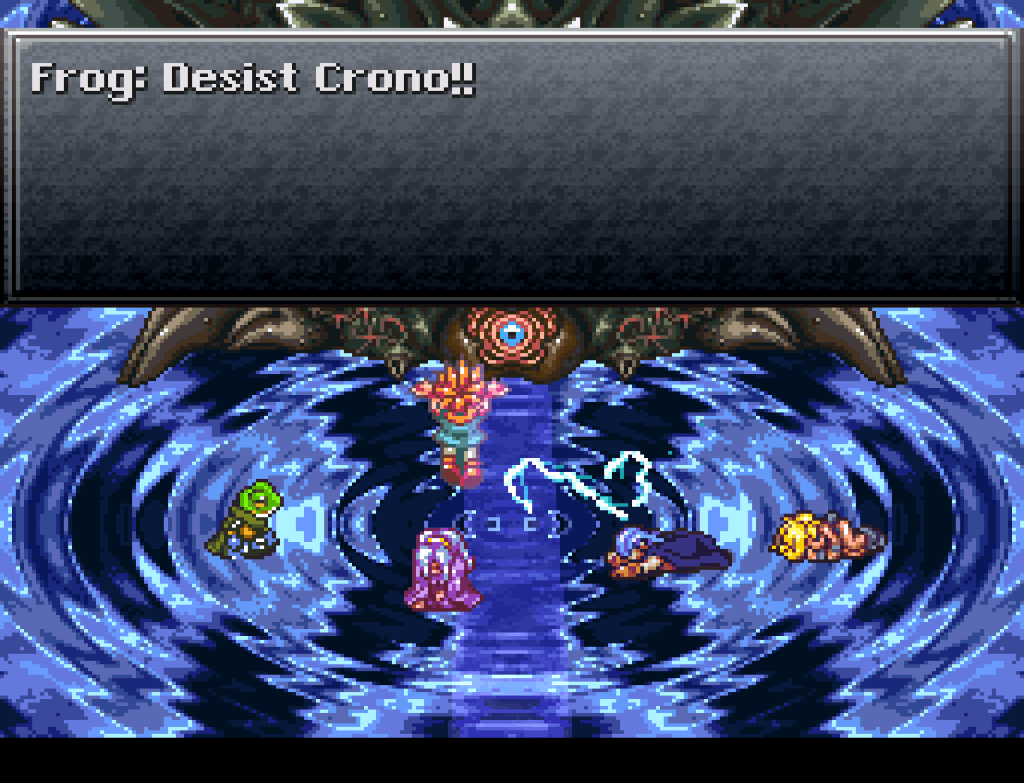
Very, very generic and boilerplate for a protagonist. Because of this, I view Crono as a true player proxy. Any attempts to read into his personality and feelings are meaningless because the intent is for him to be, uh, you.
He does get some actual meaningful dialogue in Chrono Cross where he yells at the player for…uh…playing the game. Did I tell you Chrono Cross is controversial yet?
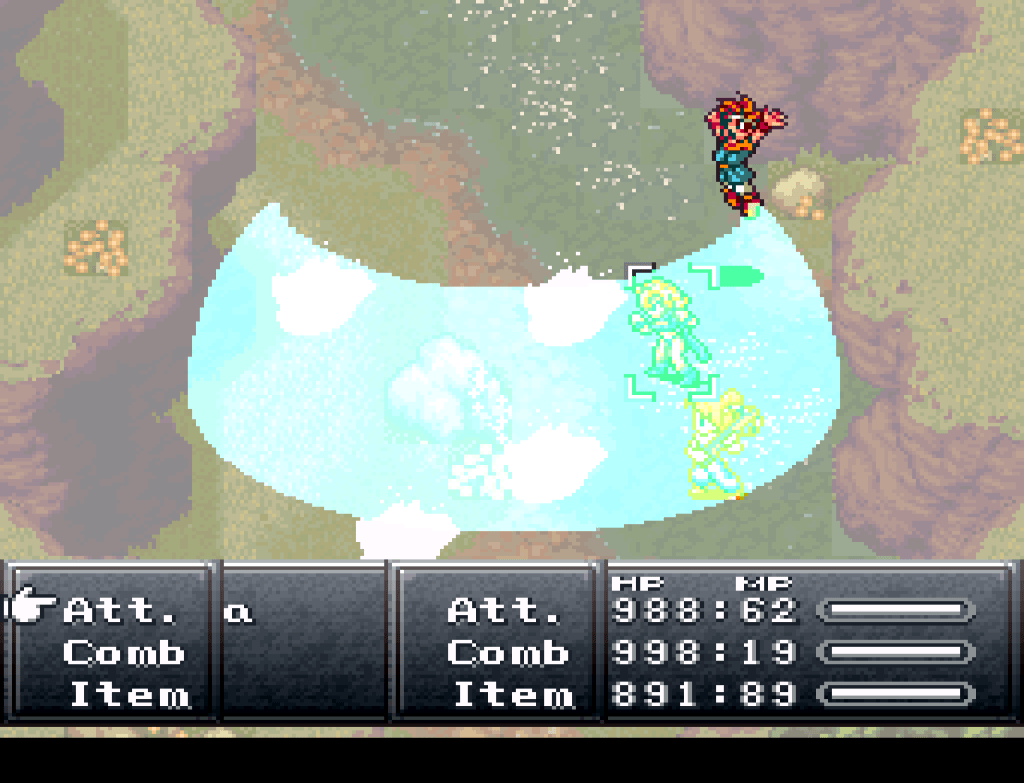
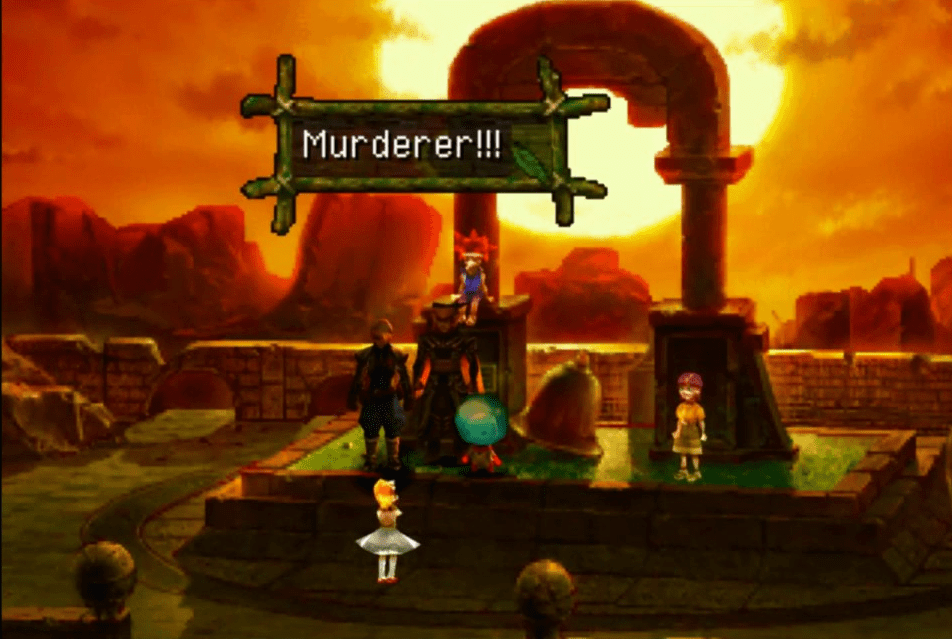
Gameplay-wise, he’s the best there is. He hits hard and his magic is not useless. His element is lightning and luminaire, at a hefty 20 MP, is tied for the best non dual tech move in the game. It creates a giant beam of light that hurts every enemy for severe damage. If you’re playing new game plus, dropping this bomb on bosses is simply a delight.
When you revive Crono, he is no longer a mandatory party member. I love when games do this because it gives the player a chance to experiment with unusual combinations. That said, Crono is so good that I typically just put him in the party anyway. He’s the protagonist for a reason!
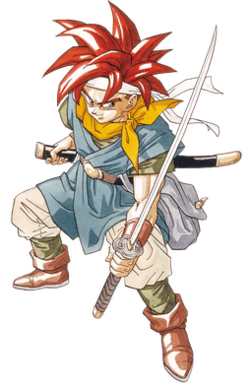
The Cross connection: He shows up in child form and berates – yes with words – the player for fiddling with time. This happens more than once and is always accompanied by gigantic plot dumps. People love lore in video games, so if you’ve ever been like ‘dang man, I wish I knew more lore about the world of Chrono Trigger’…you should probably play Chrono Cross.
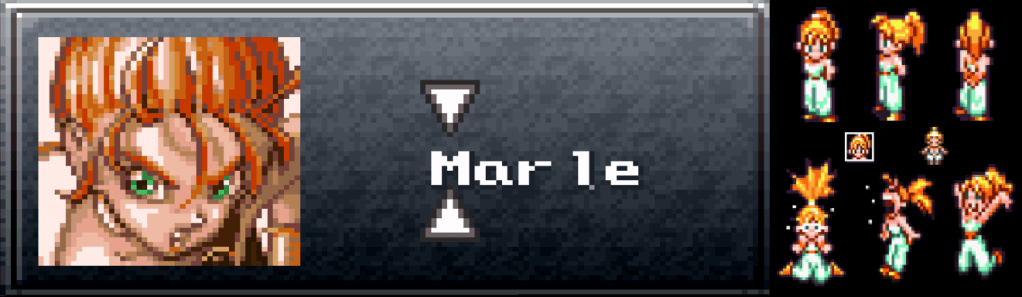
Marle AKA Princess Nadia
Guardia’s princess is a character you literally run into at the beginning of the game. The pendant that has been passed down from royalty sucks her into a time gate and gets the whole adventure going.
She basically only leaves the party one time – when she gets sucked into a time void in 600 AD because her ancestor is in danger. This never happens again to any other character, despite there being opportunities to do this, so it’s a little weird that it happens in the first place.
Marle’s main characteristic is that she’s a bit of a mischievous tomboy. Royalty is expected to be all stuffy and proper, but she clearly wants to go on adventures and live a little. When she runs into Crono, she can clearly see he’s an adventuring sort and just latches onto him. From here, it becomes clear that she’s supposed to be the primary love interest. Everyone likes Crono in some way but Marle ESPECIALLY does.
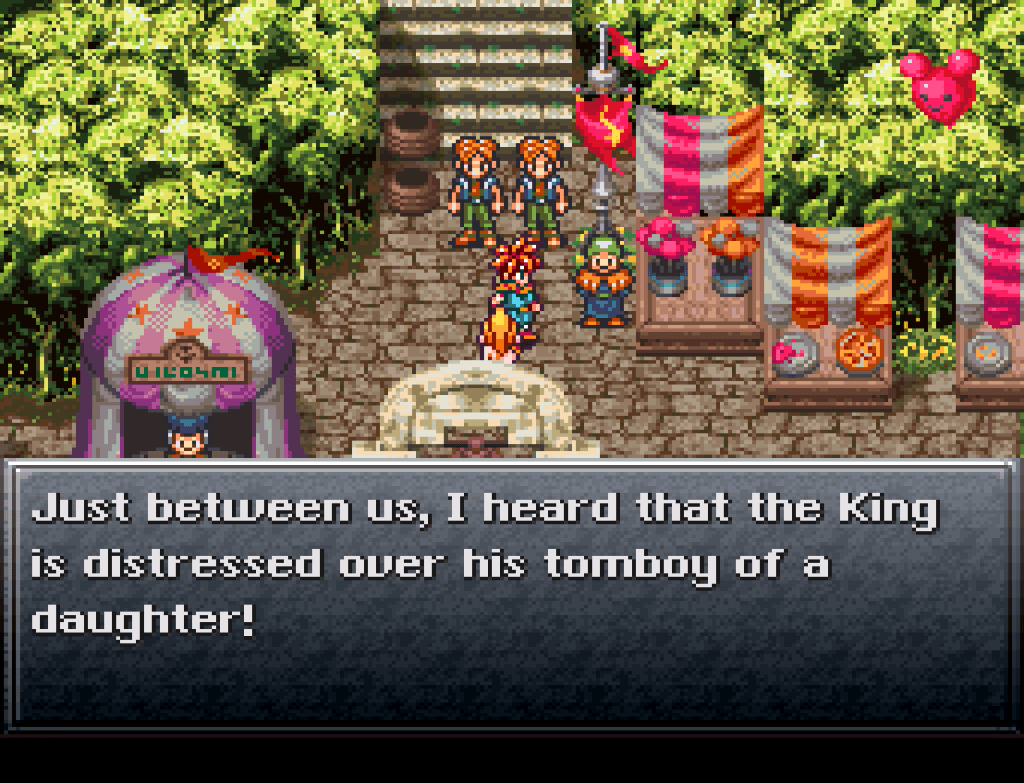
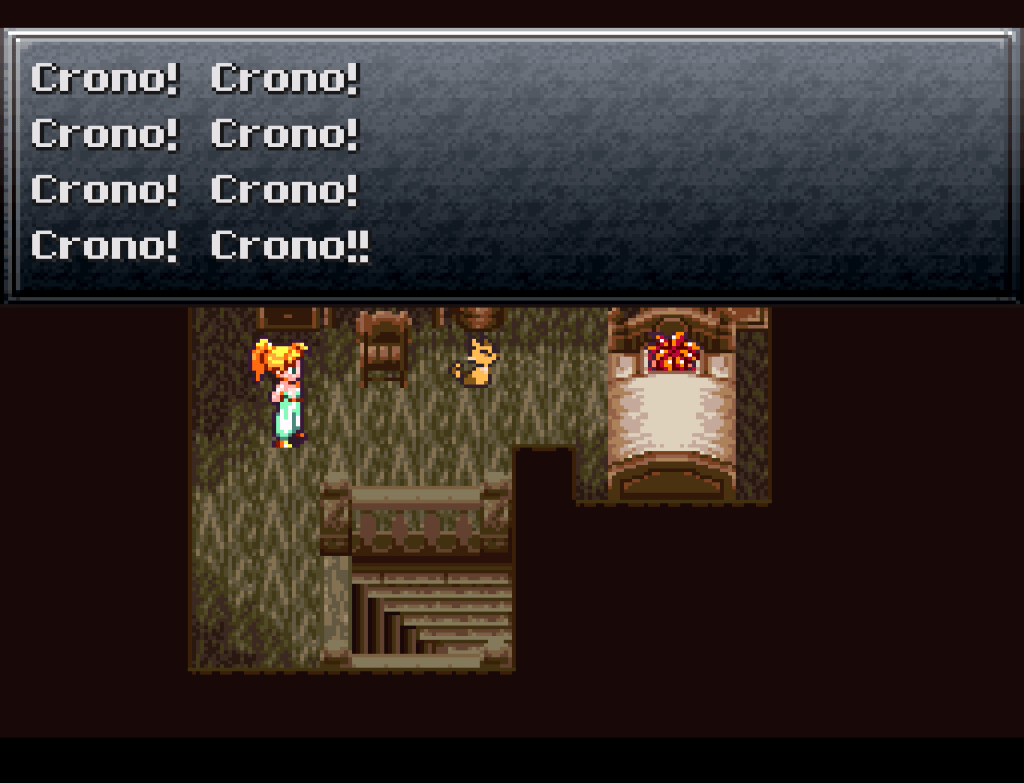
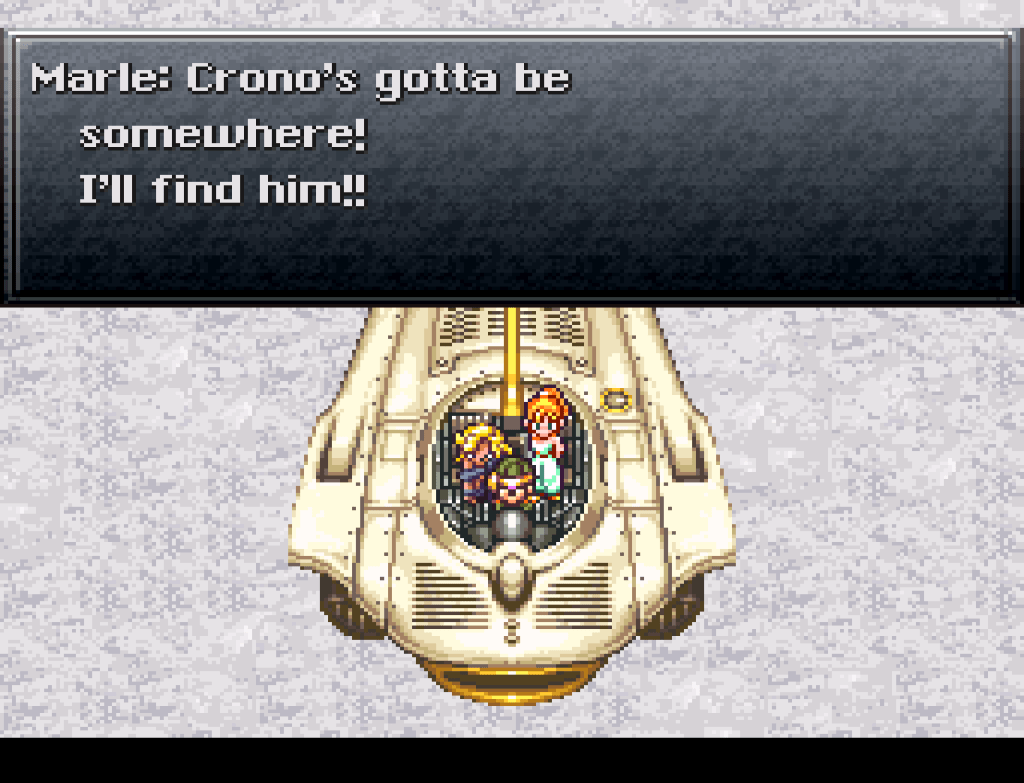
Sadly, because she’s designed to be the canon love interest, that’s where a lot of her characterization leads to. It feels like a lot of her dialogue towards Crono is flirty and you don’t learn a lot about her aside from ‘obvious crush on Crono’ throughout your journey. You learn about her family and her ancestory. But her?
She’s still likable – it’s fun seeing her dance around in prehistory like a true party animal – but she’s not terribly deep.
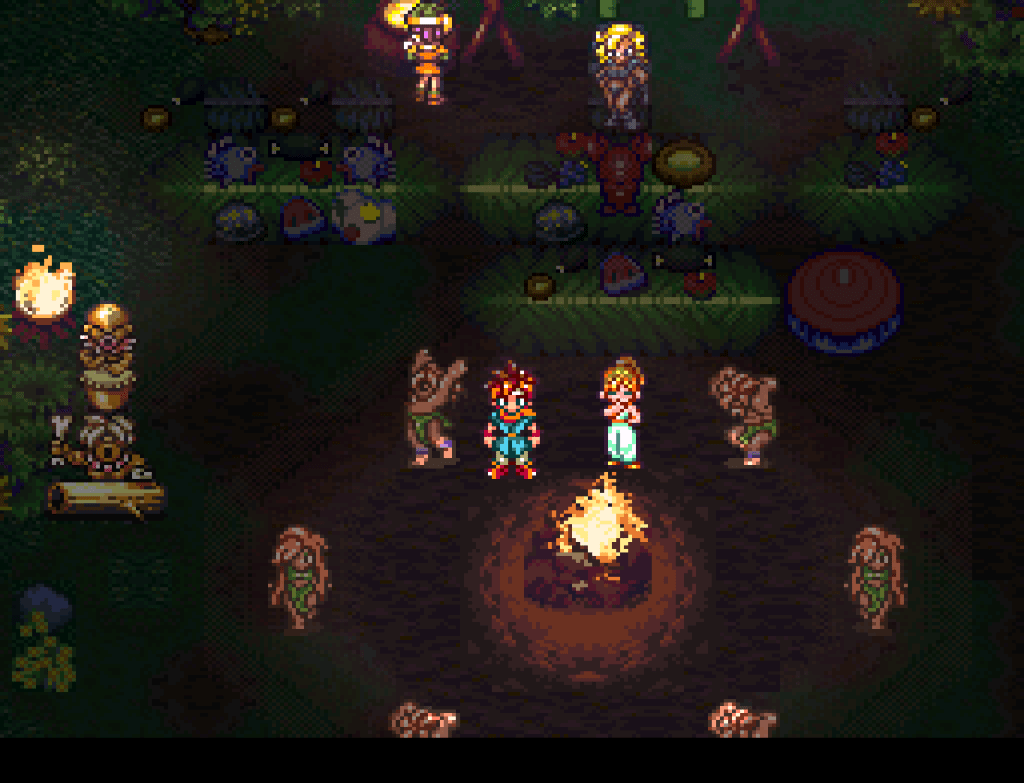
Marle is the first character we get introduced to that comes over with an alias. Her real name is Nadia, Marle is just what she uses to hang around the commoners. There are many characters who have a real name that doesn’t align with what the party uses – usually you learn this far after naming the character.
However, it’s notable that all of these true identities are five letters long. So if you’re playing a new game plus, you can just name her Nadia since you know that’s her real name.
It may seem like a minor touch, but I really like this. It shows this game knows players are jackasses who will give the characters their real names. Do you know how many times I’ve named Red XIII “Nanaki” or Dagger “Sarah” or “Garnett?”
They purposefully kept the real names short – technically Robo’s true name is Prometheus but his product number is five-characters – so the player could keep doing that. I appreciate it!
Or you could just name your characters swears, that works too.
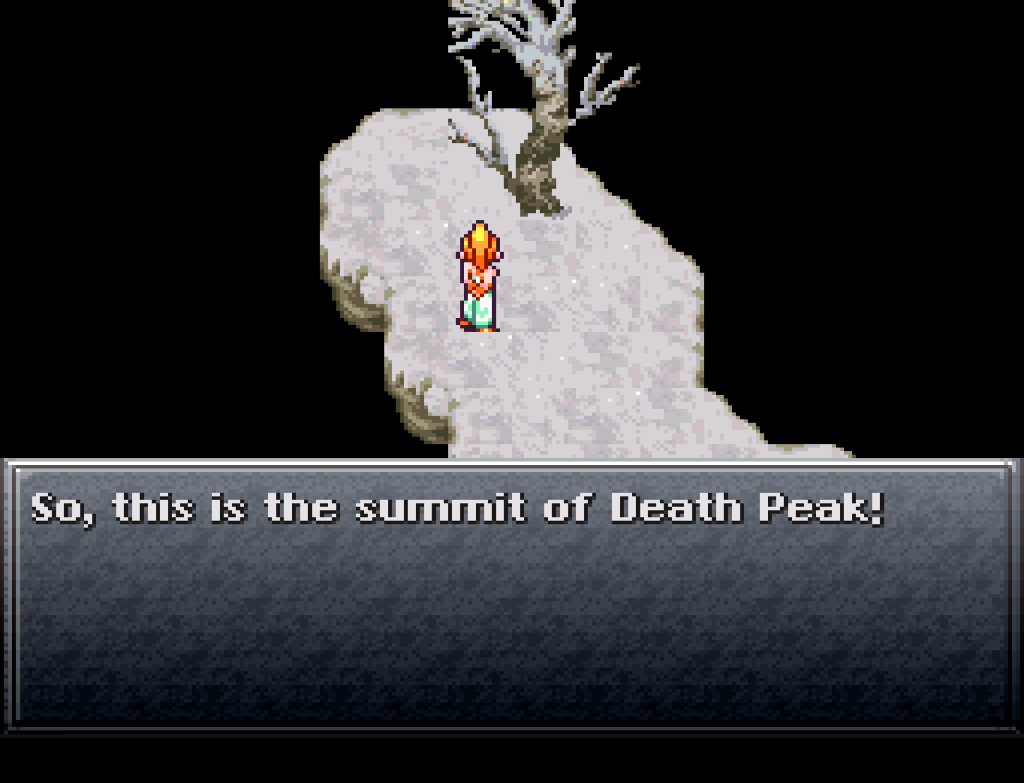
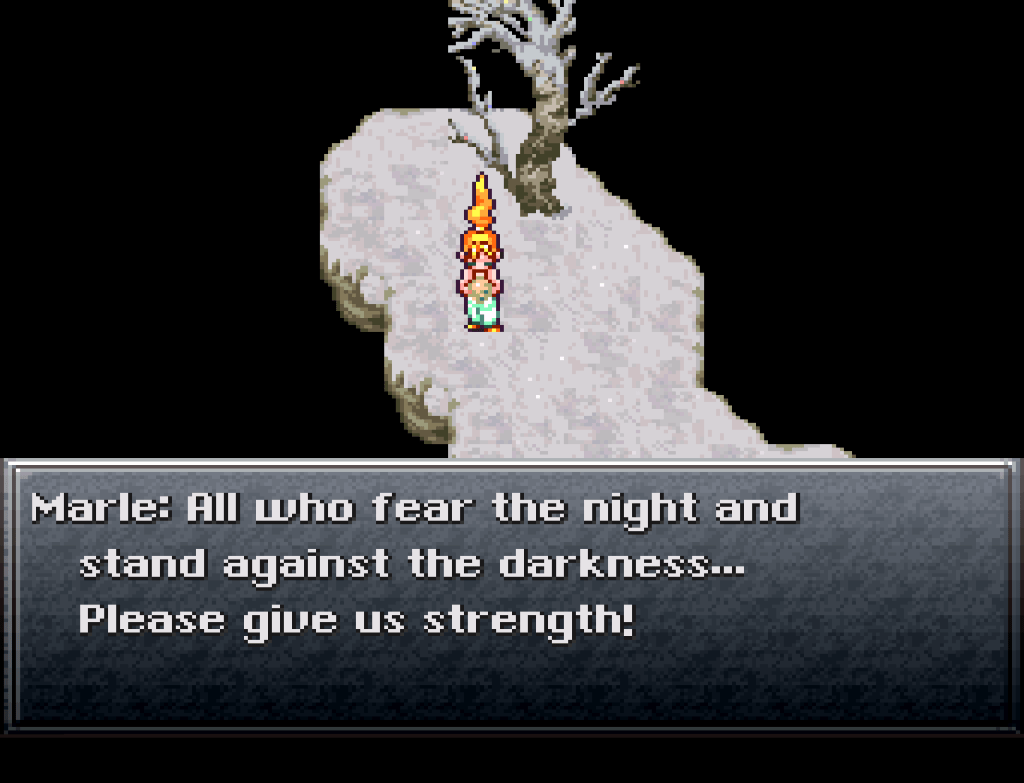
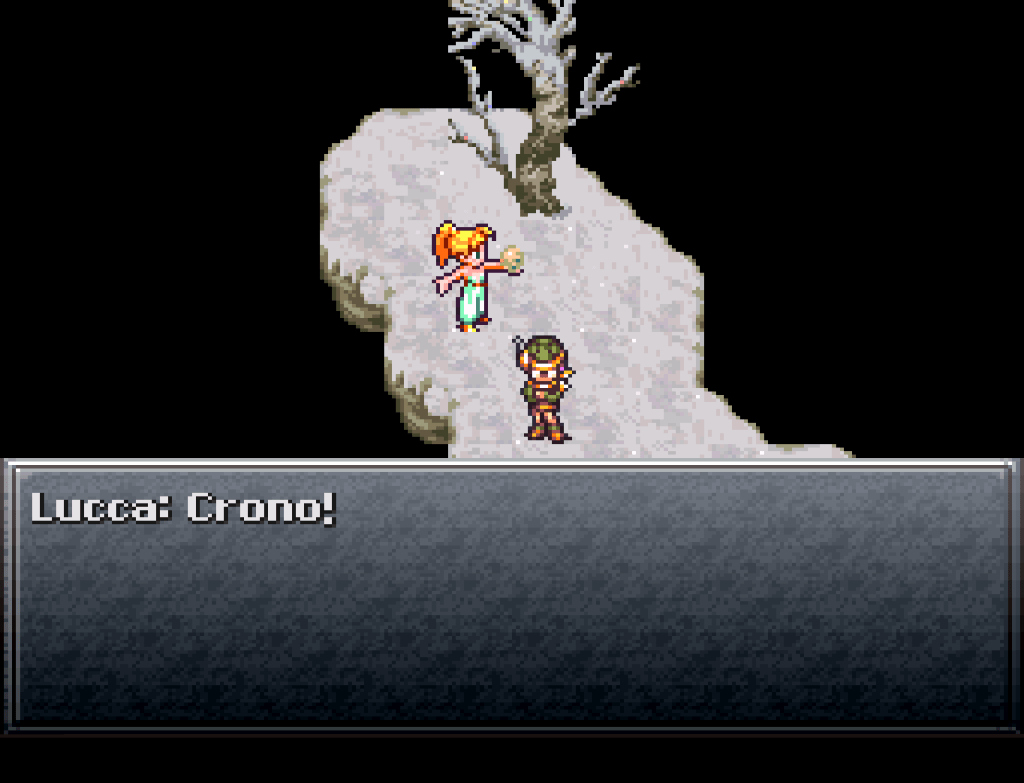
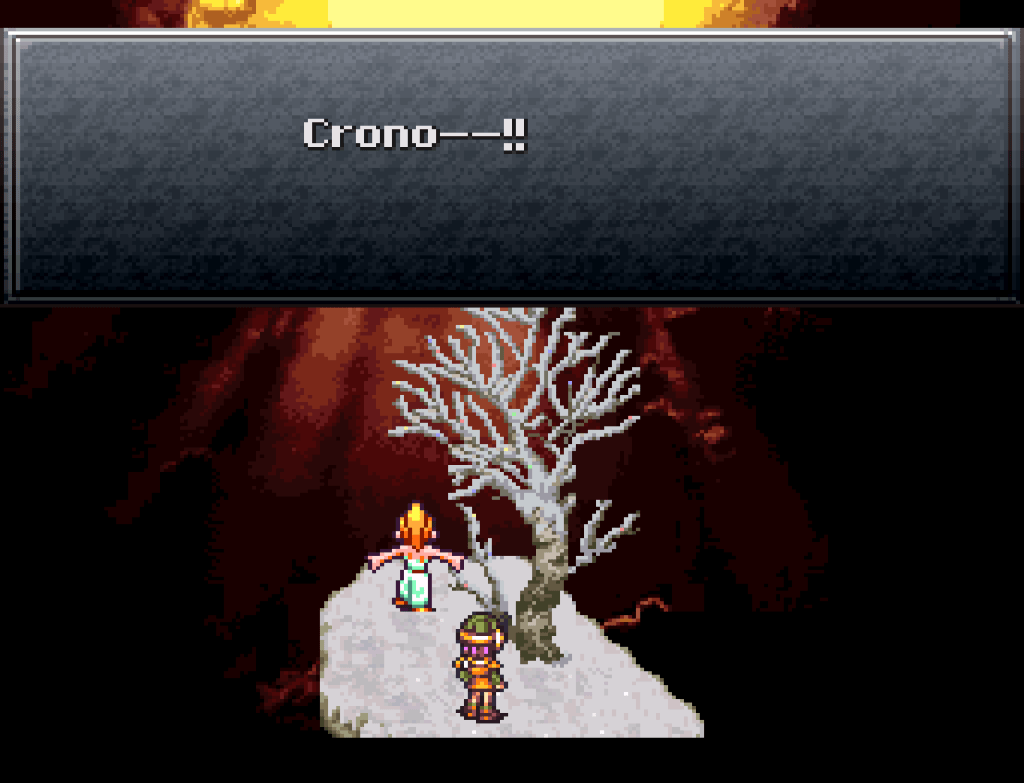
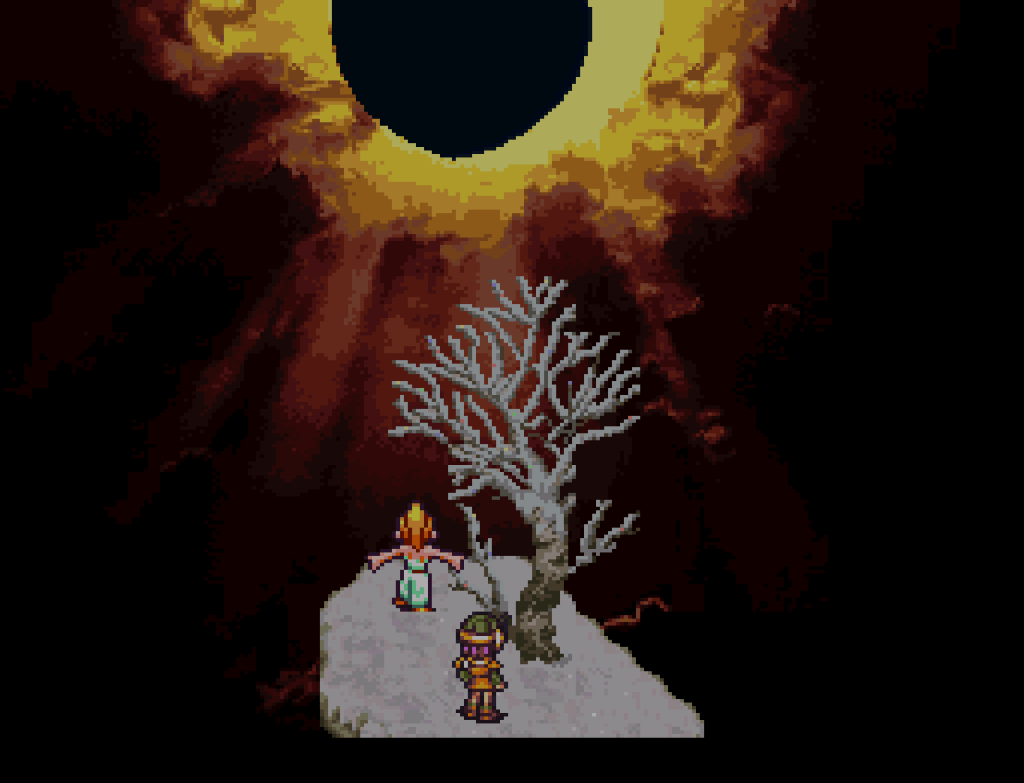
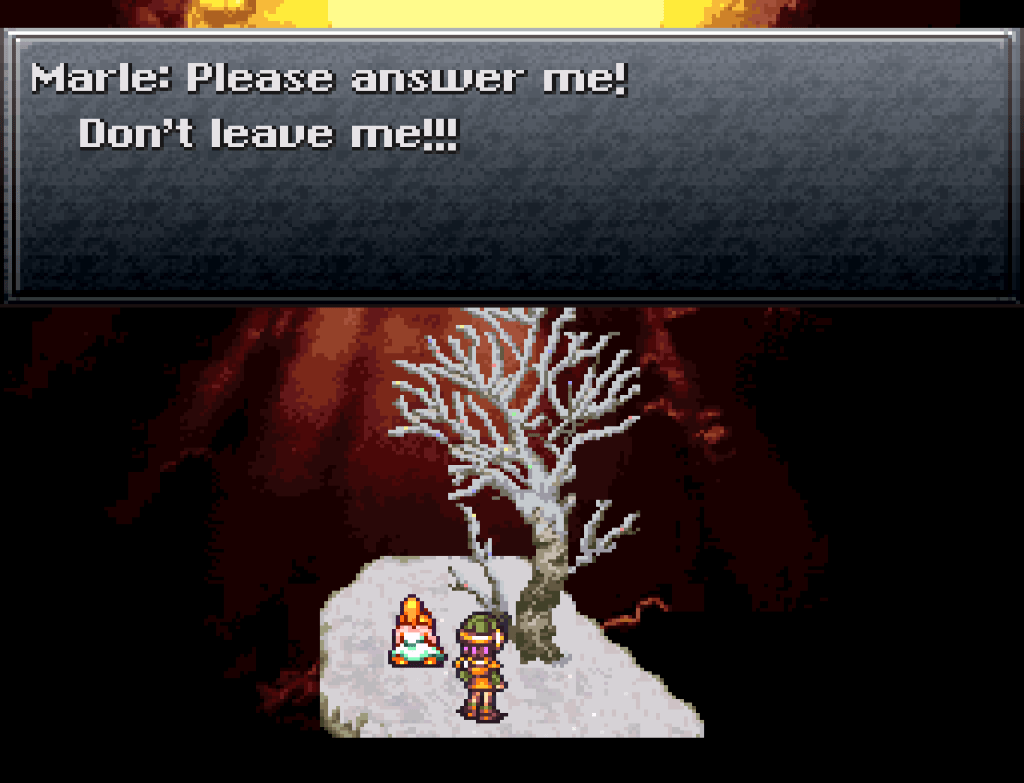
Her best moment in the story comes when Crono dies. She is constantly hopeful to be reunited with him. Even when it looks like the entire party has given up and views his death as final, she pushes on.
Her yelling on top of death peak while waiting for Crono to come back is pretty touching and is one of the more memorable moments of the game. The version of the ending the player gets if they beat Lavos with Crono dead plays into this too. It’s sweet.
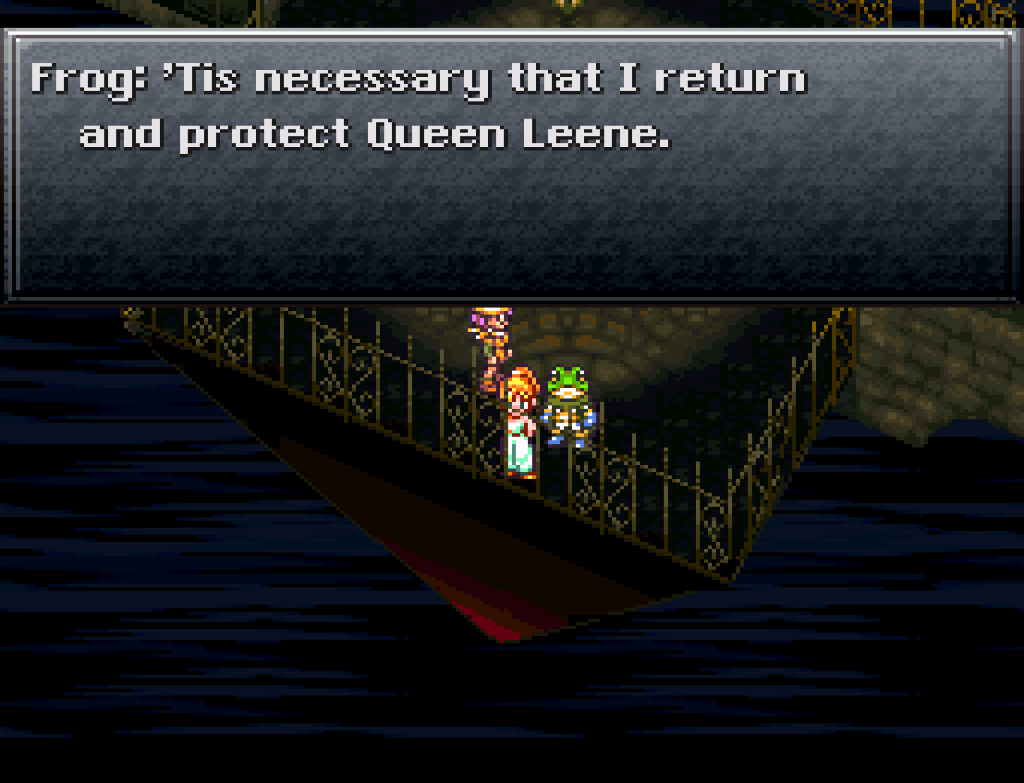
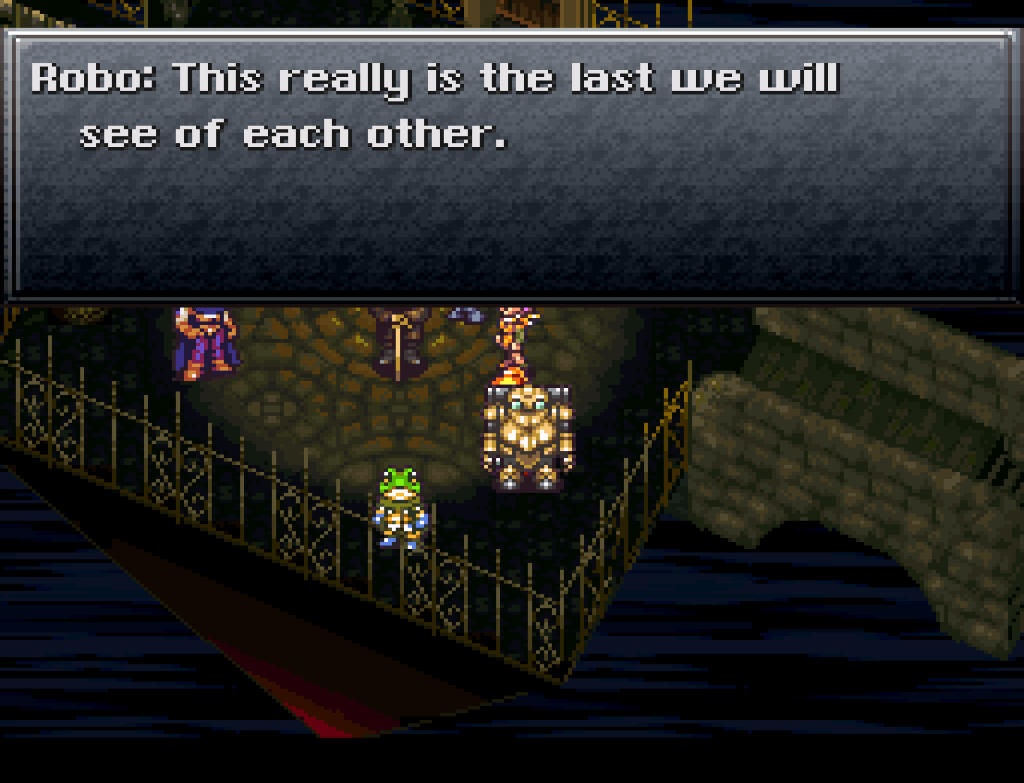
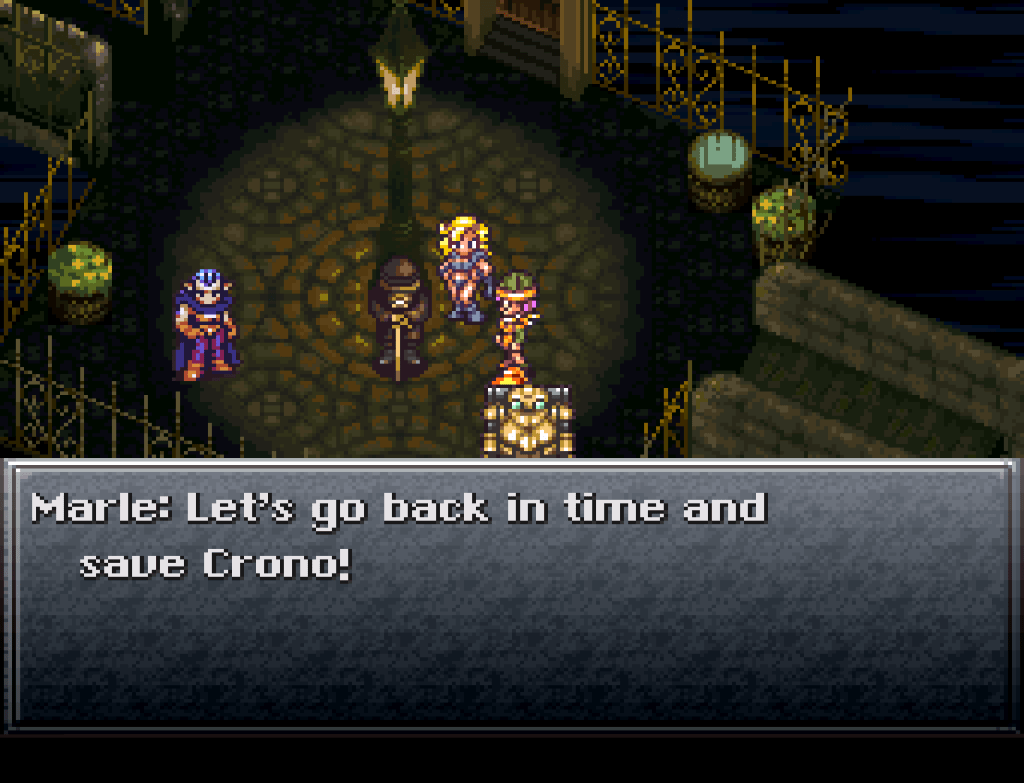
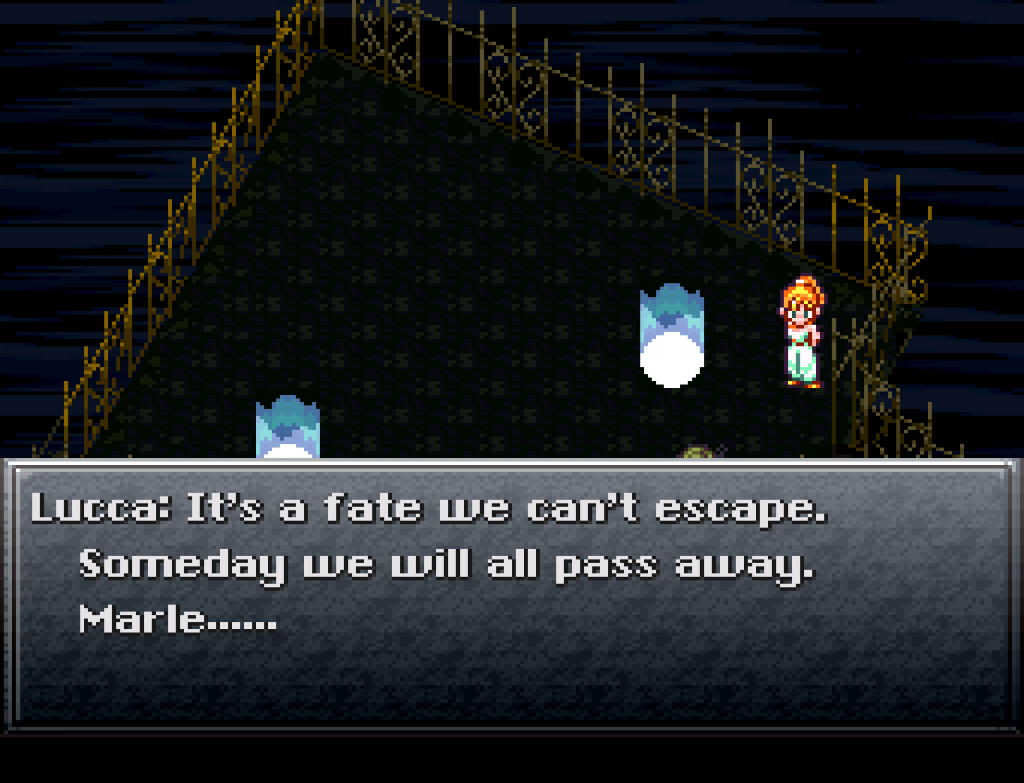
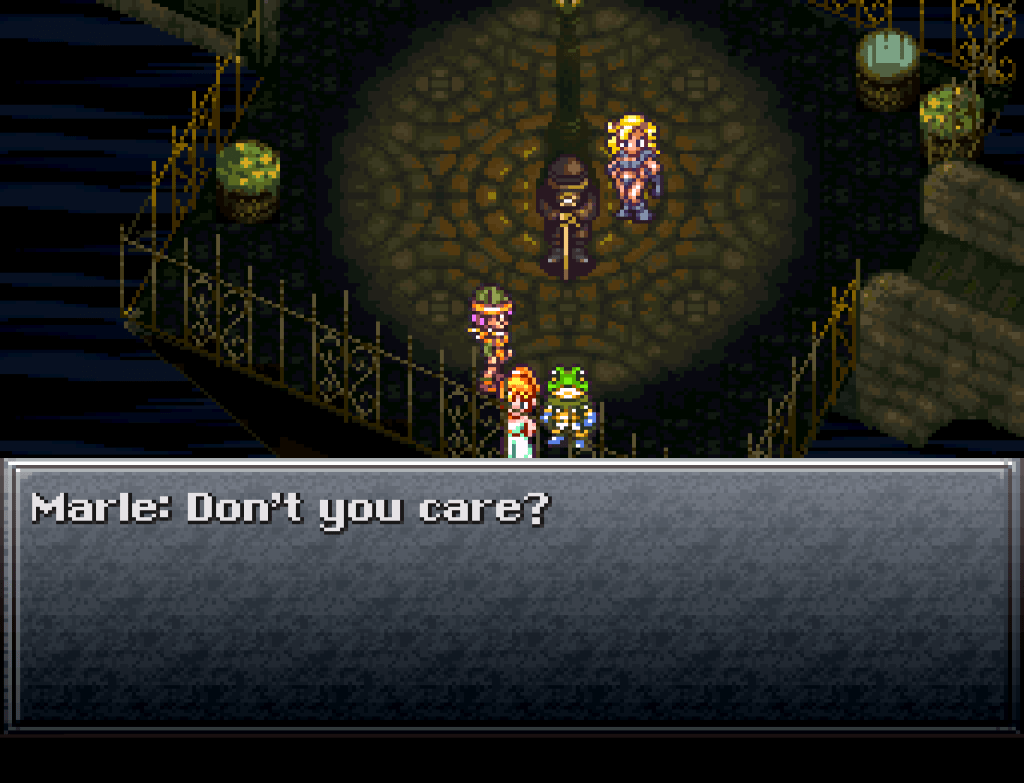
Though in that ending, all the other party members say “just kidding, we ALSO want to bring Crono back!” because they don’t want your entire party looking heartless.
From a gameplay standpoint, Marle is a healer. Her natural element is water – though she uses it in the form of ice to differentiate herself from Frog – but the attack power is not really where you’d want it to be. So if she’s not acting as the healer for your party, she probably is going to wind up on the bench.
And unfortunately for Marle, other healers in the game have better offensive options, so there just isn’t much of a reason to use her unless you specifically want to see certain scenes for her dialogue in them.
She doesn’t even get an ability that heals the entire party, all of her curative magic is targeted. So she’s not ideal as the primary healer in scenarios where the whole team is getting pummeled. Frog and Robo both get spells that do exactly this, making them preferable in several situations.
Life 2 (arise) is her final ability, so that can make her shine a little bit. It can revive and fully restore the HP of any one ally. I just think characters die so seldomly in Trigger that by the time the player learns it – essentially at the end of the game – it’s basically useless.
I can’t think of a single time where every party member is in dire straits and Marle is in position to do anything about it. Didn’t I tell ya she kept getting killed in my dev. room ending attempts?
Marle is a good character but she gets overshadowed by a stacked cast that is either more interesting or from a more interesting time. It’s unfortunate, but hey, people say Trigger’s main party is one of the best ever and I am inclined to agree with that!
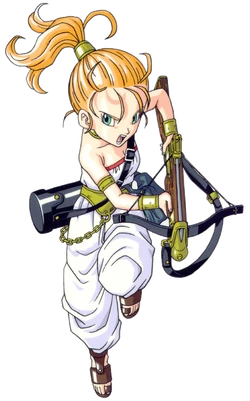
The Cross connection: Not really directly mentioned at all. However her kingdom of Guardia was invaded and conquered by Porre (curse you Dalton…) in 1005 AD. I don’t need to tell you what happens when kingdoms are overthrown, do I? Even still, most assume she and Crono both live on. She also appears in child form with Crono to berate the player at the end of Cross.
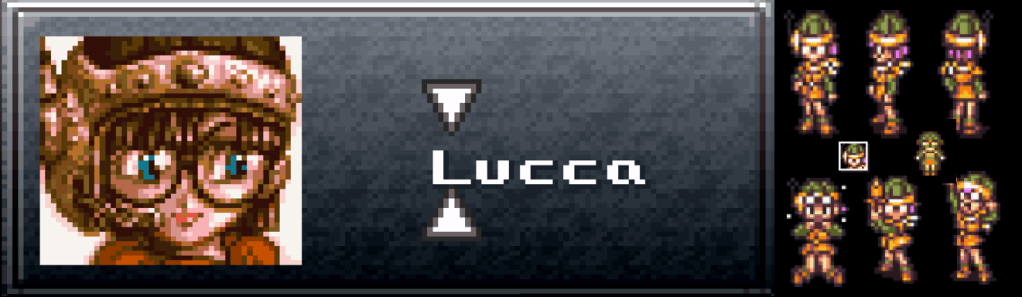
Lucca
Crono’s childhood friend and inventor buddy. Several NPCs toward the beginning of the game paint her as kind of clumsy with a knack for making inventions that go horribly wrong. As new players may be feeling suspicious of her, Marle gets sucked into a time portal while using one of the inventor’s experiments. Turns out, it wasn’t really her fault, but talking to NPCs before getting to this part could make the player feel notably wary.
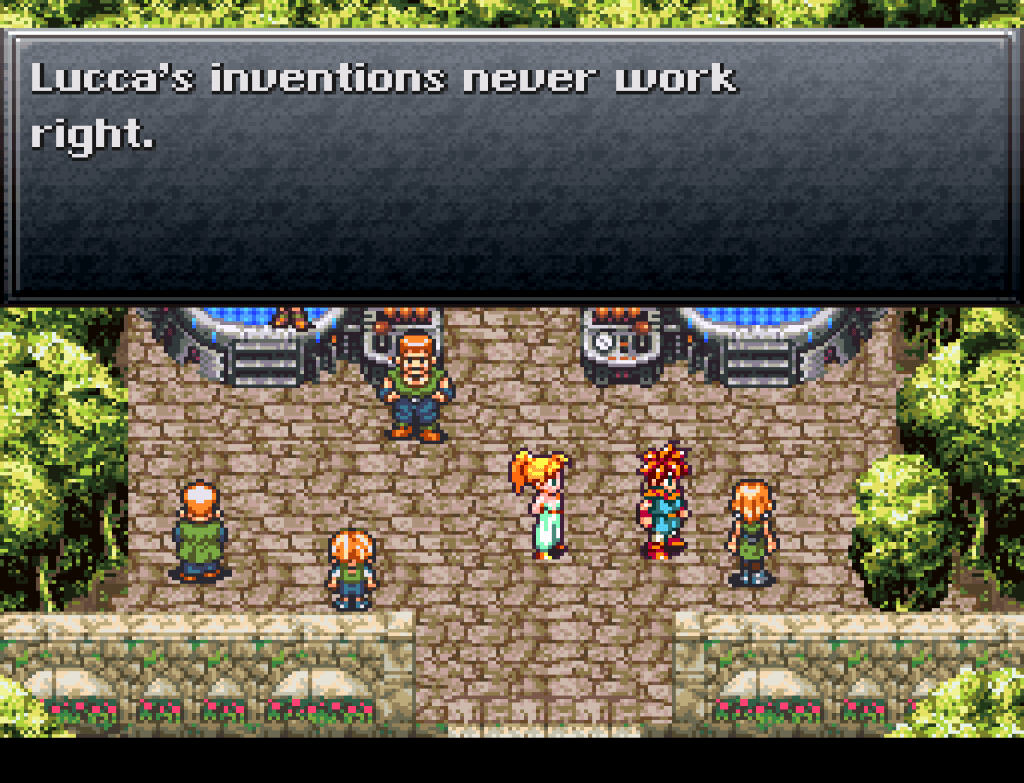
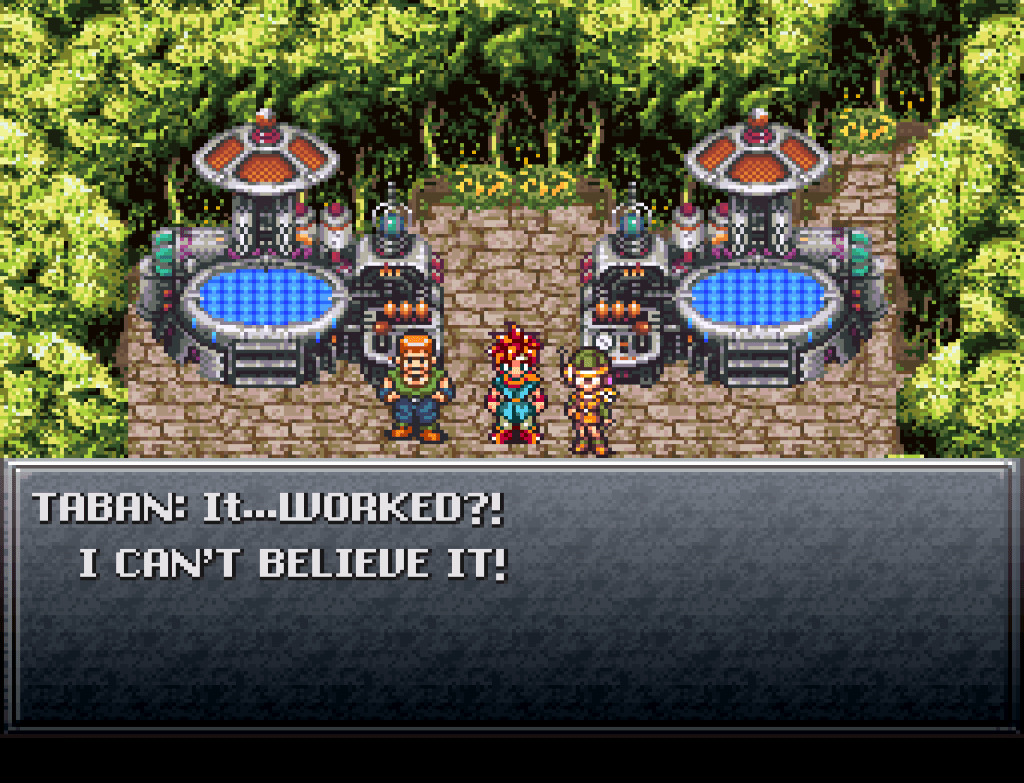
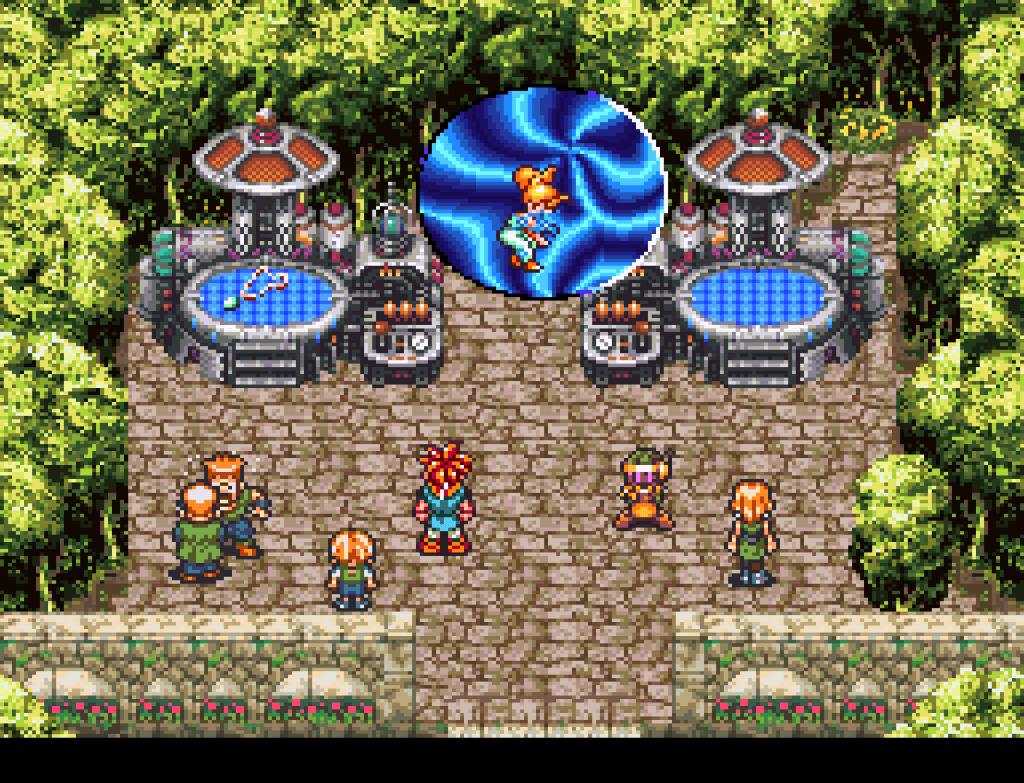
It’s amusing that the game starts out by depicting Lucca in this way because, uh, the rest of the narrative seems to forget this part. After Marle gets sucked through time, the bumbling aspect of Lucca’s character gets sucked up along with it because from this point on she is basically the smartest and most capable person in the world.
She looks like Bulma from Dragon Ball and honestly she may as well just be Bulma given how competent she is. This is a character that made a device that can interact with time gates and proves it by showing up in 600 AD unannounced. Marle had to use a family heirloom to do that!
She is from 1000 AD and can repair a robot from 2300 AD overnight. I know she made the robot you fought with in 1000 AD but you’re telling me 1300 years of progress meant nothing to her?
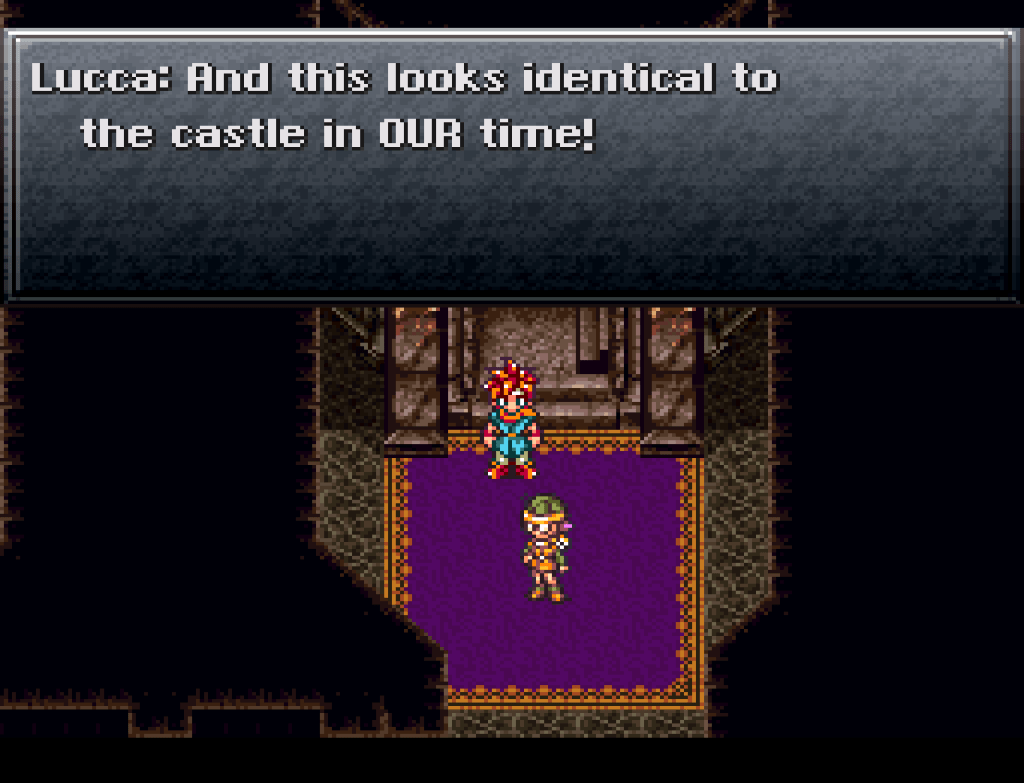
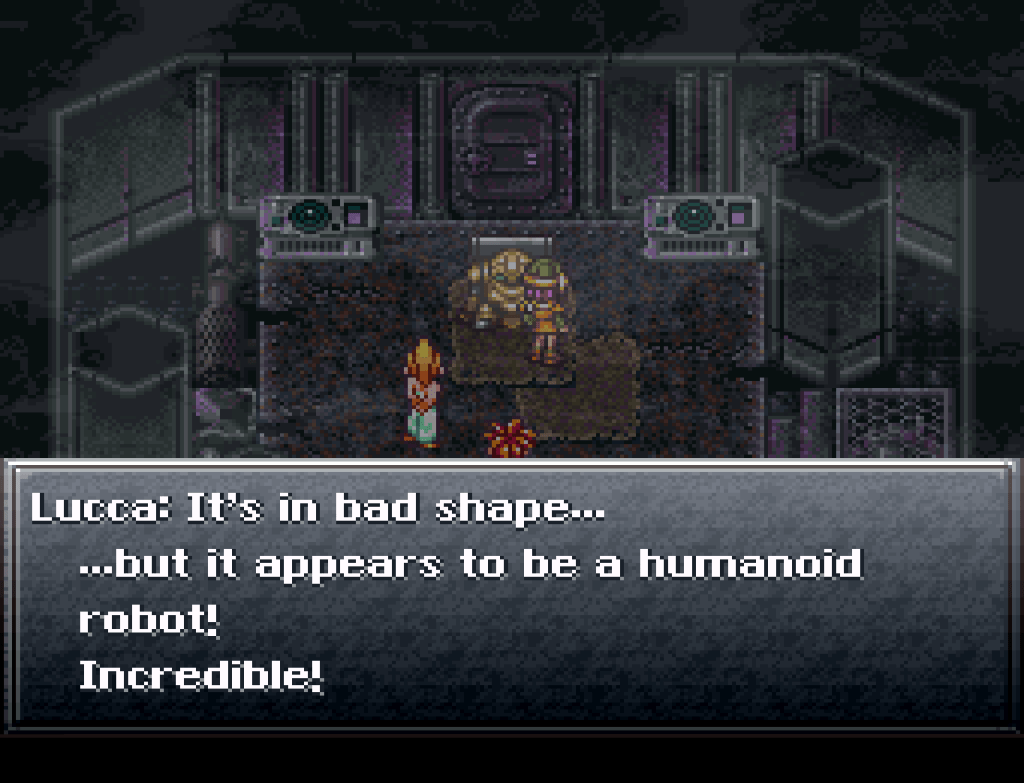
A genius, plain and simple. Her house is kinda cluttered, which goes a little with the incompetence NPCs accuse her of, but that seems fitting for someone like this. Her thoughts are organized, so why should it matter if her house is?
There could be another reason for that though…inventing runs in the family and one of her father’s inventions crippled her mother. You can save her via a sidequest even – the only character who can do anything to change their lived past.
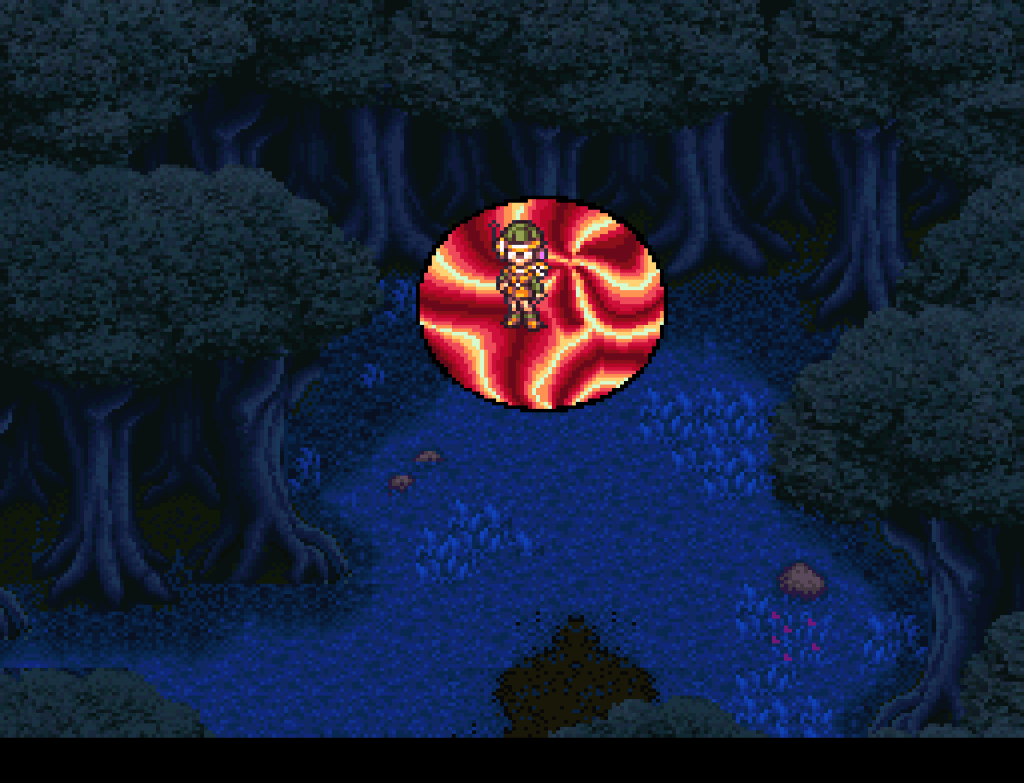
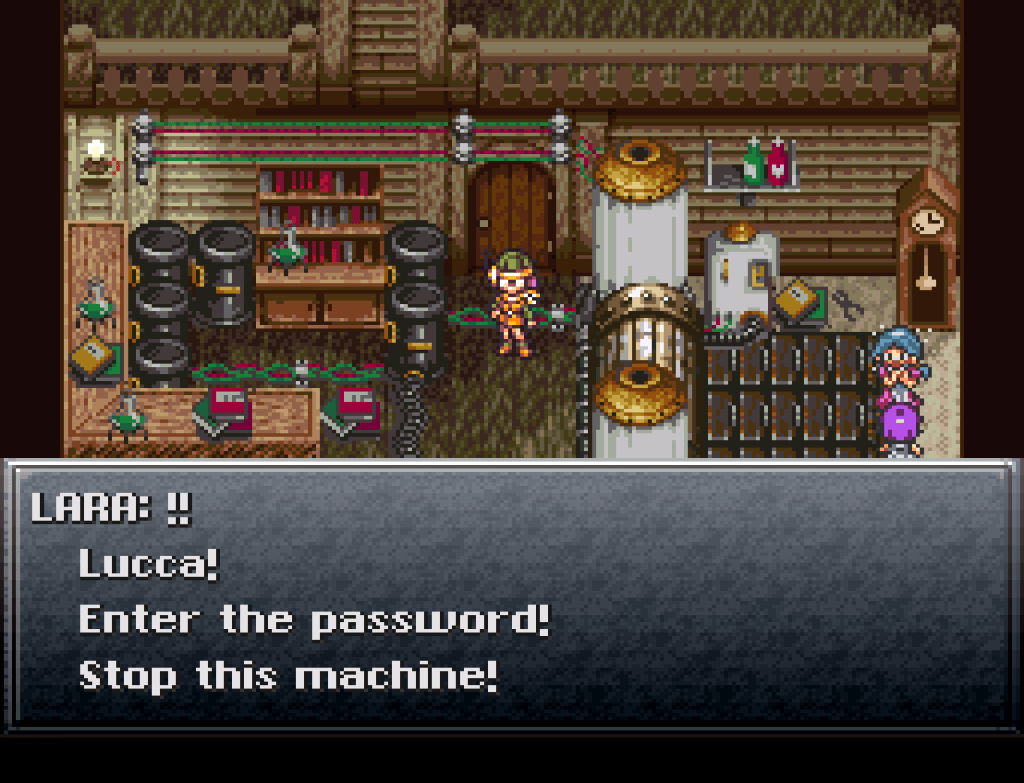
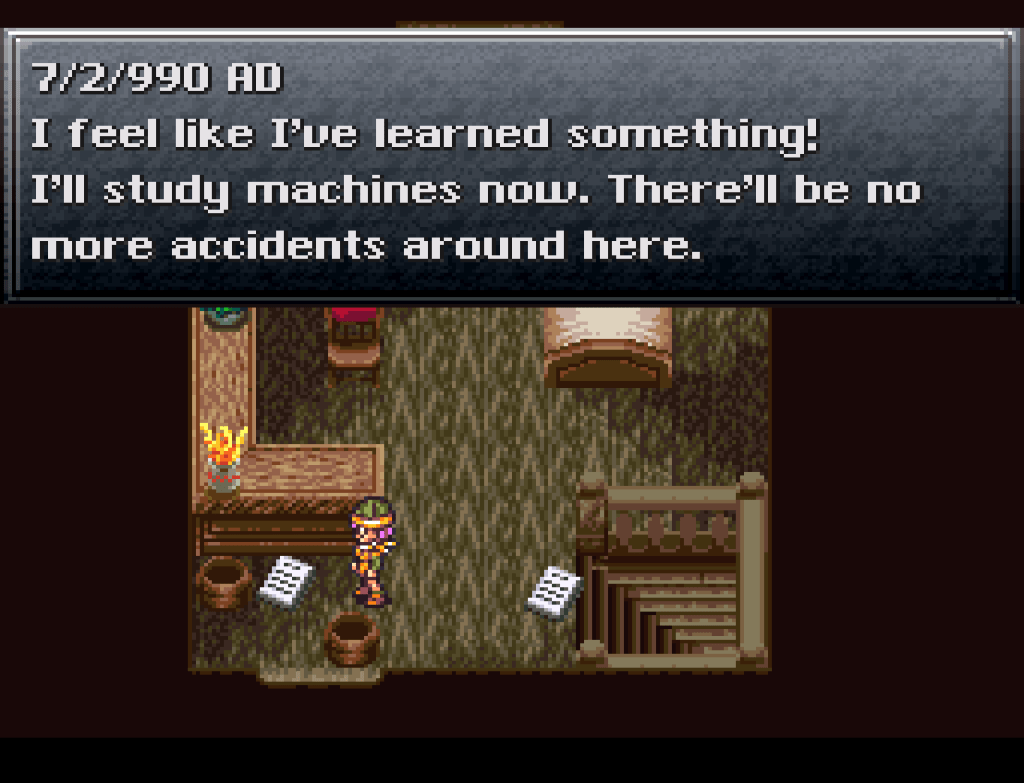
The cool thing about that segment is that the password is her mom’s name, Lara. Those letters are all conveniently on an SNES controller, so all you need to do is press L A R A on your controller and she’s freed!
Narratively, she is portrayed as Crono’s childhood friend. They’ve basically always known each other and her naming screen pops up when your mother asks you about your little inventor friend. The game isn’t as forthright with it as it is with Marle, but it’s also pretty obvious she has a little crush on Crono.
Her best relationship comes from the robot from the future she repairs, Robo. Intellectually there is nobody in the game that even approaches Lucca except for the robot she repairs. The two become very important to each other, with Lucca (yes, this is a giant cliche) helping Robo sort of discover his own brand of humanity. In return, Lucca acts as something of a mother figure to the robot. She will dote on him if the situation calls for it.
I’m not gonna tell you their relationship is super deep or anything like that, but it’s always nice when side party members have a relationship with each other that isn’t really dependent on the main character at all.
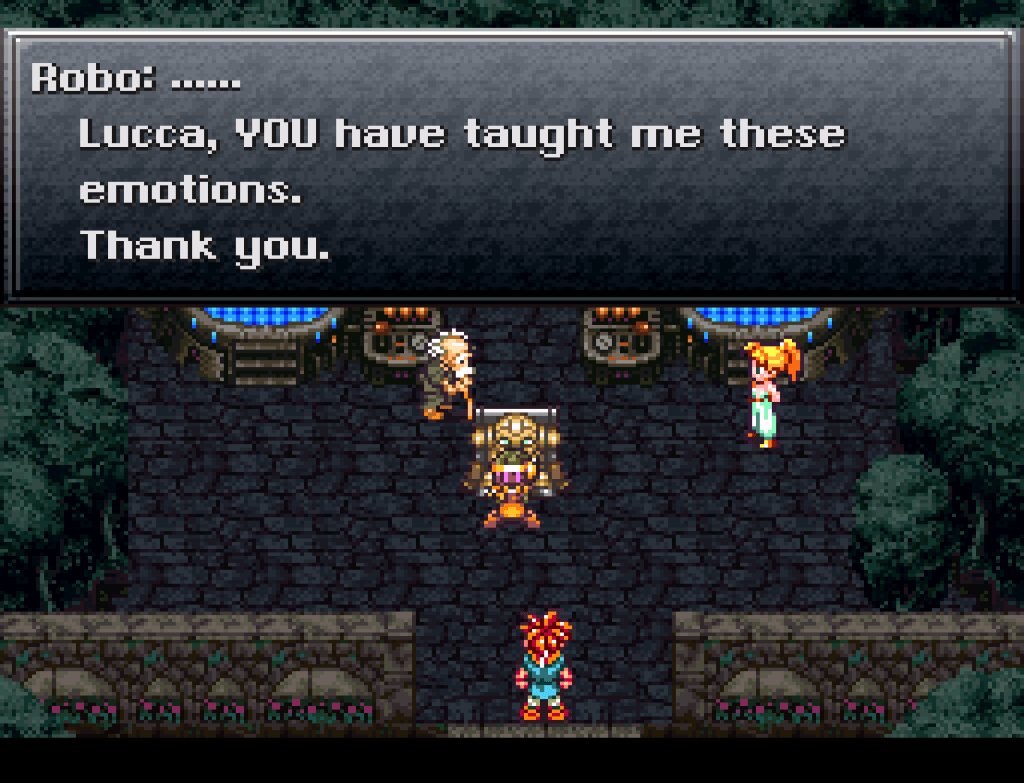
In combat, Lucca is unfortunately kind of just there. I find her to be similarly squishy to Marle and she doesn’t hit hard enough to make up for it. Basically every ‘DPS’ style character has better moves than she does and she can’t tank hits.
I will say, I do like how her chosen element works. She can use fire but she has access to it before speaking with Spekkio. Learning magic simply makes her able to use fire better.
Before that, it can be intuited that her scientific experiments allowed her to work on something akin to magic, which led to her being able to use fire. In fact, the first dual tech most players will use is probably fire whirl, which takes advantage of this.
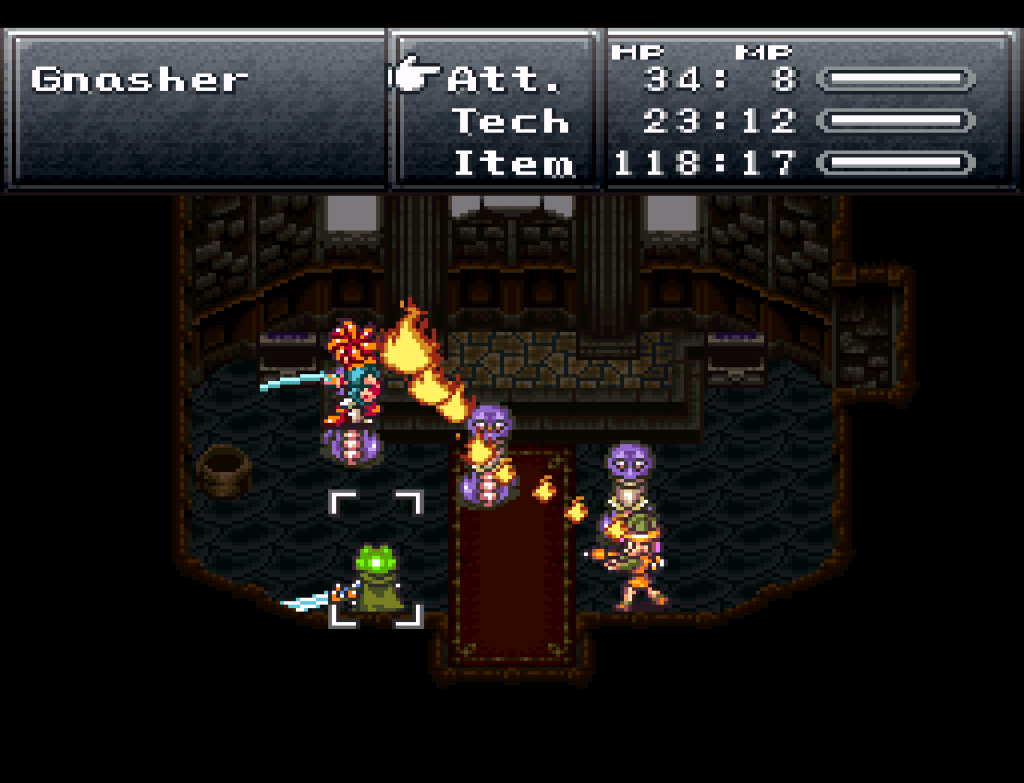
It’s a tiny, tiny example of the story impacting gameplay. Without our knowledge of her as a genius scientist, the use of fire would seem very random and give Lucca a kind of mystic quality she was never intended to have. But because we know she’s some sort of weird genius, we don’t second guess it.
I like Lucca a lot – probably because she’s essentially just a combat variant of Bulma – but she unfortunately also gets lost in a sea of interesting party members. Choosing Lucca and Marle to accompany you is much like playing as a human in an MMO – it’s a little boring.
Never mind that I almost exclusively use humans in MMOs…
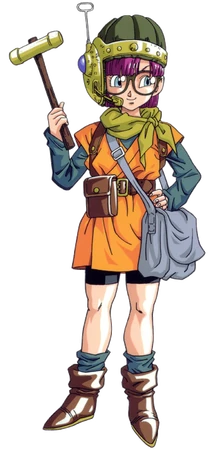
The Cross connection: She establishes an orphanage, which houses the game’s female lead. The orphanage burns down, naturally. She also gets kidnapped by the lead villain and then, at some point, killed. Very cheery! Like Marle and Crono, she pops up in child form to scold the player near the end of the adventure.
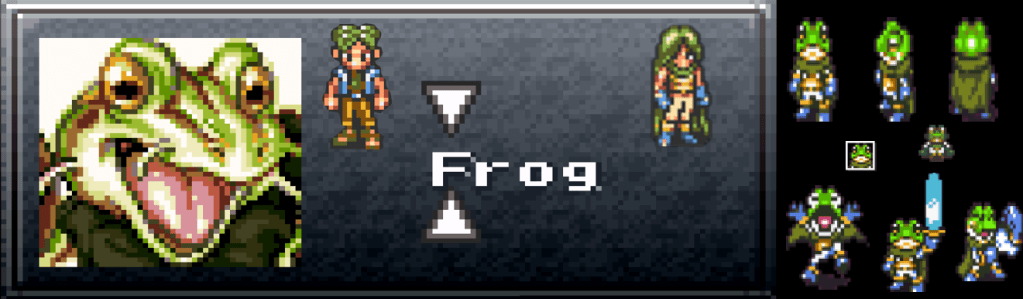
Frog aka Glenn
When the party goes back to 600 AD, Frog approaches your party hoping to aid in the rescue of the kidnapped queen. This is the first member the crew gets that isn’t from the present, and while he doesn’t stick around for very long initially, he makes an impression and sort of prepares the party for what’s to come. Essentially, brace for oddity!
Frog is one of the more fleshed out members of your party as the first half of the game essentially revolves around rebuilding his confidence. As a human, his name was Glenn and he was something of an understudy to the brave knight Cyrus. Cyrus aimed to rid the world of Magus, the scourge of 600 AD, but was ultimately felled when he made his attempt.
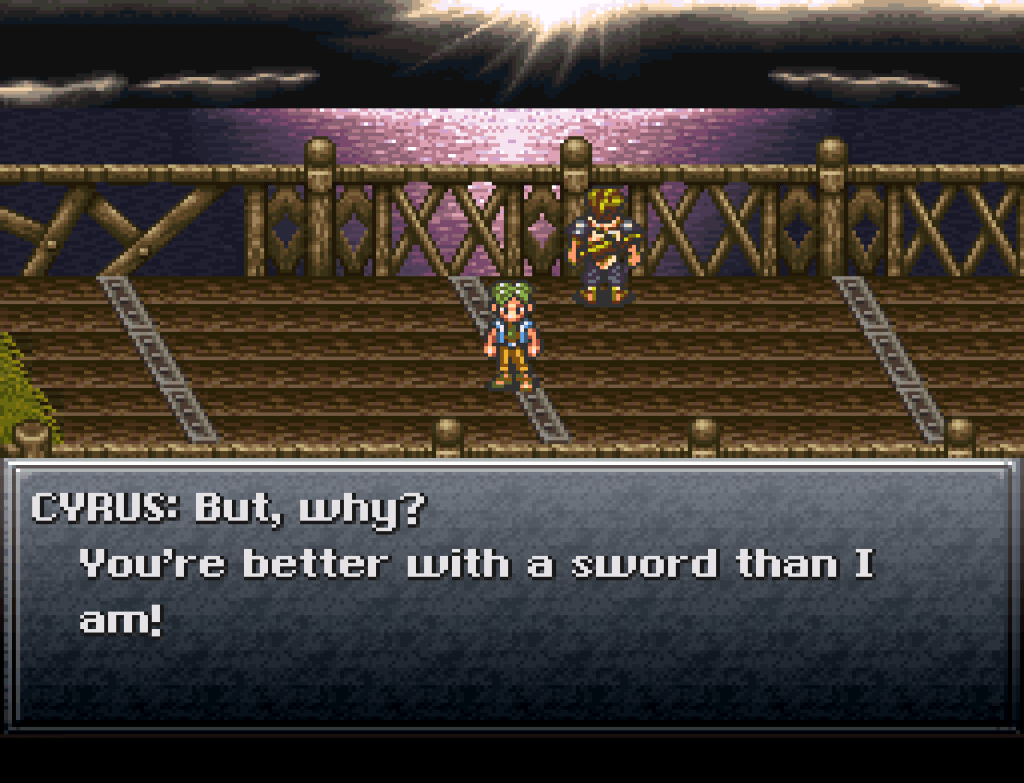
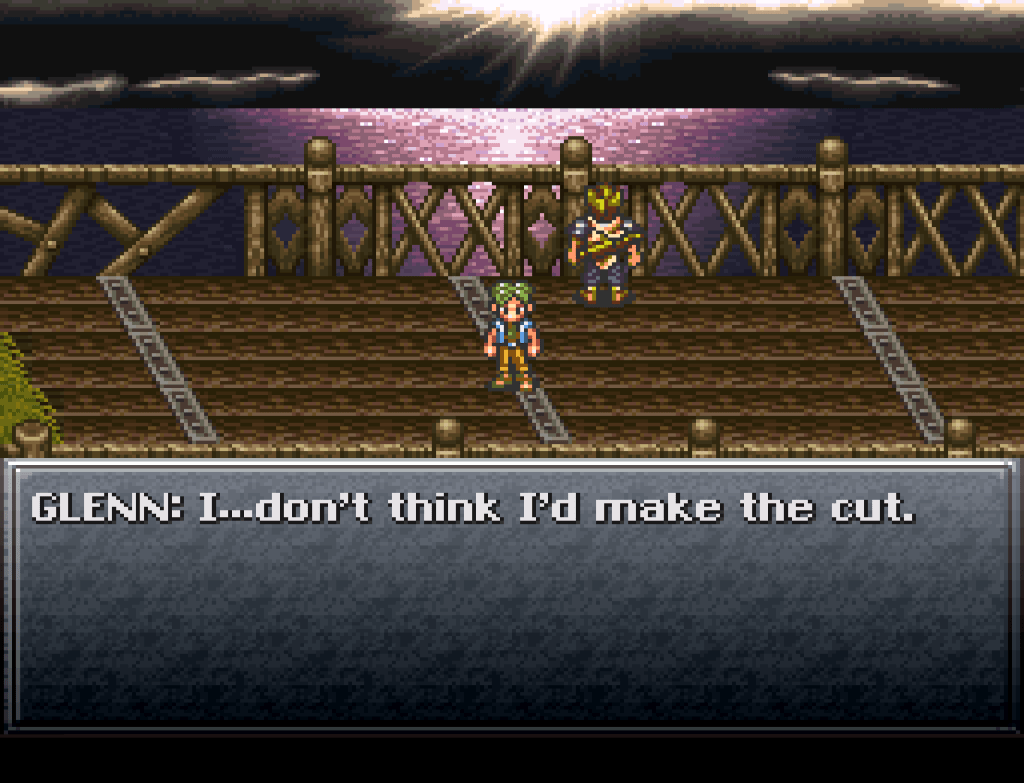
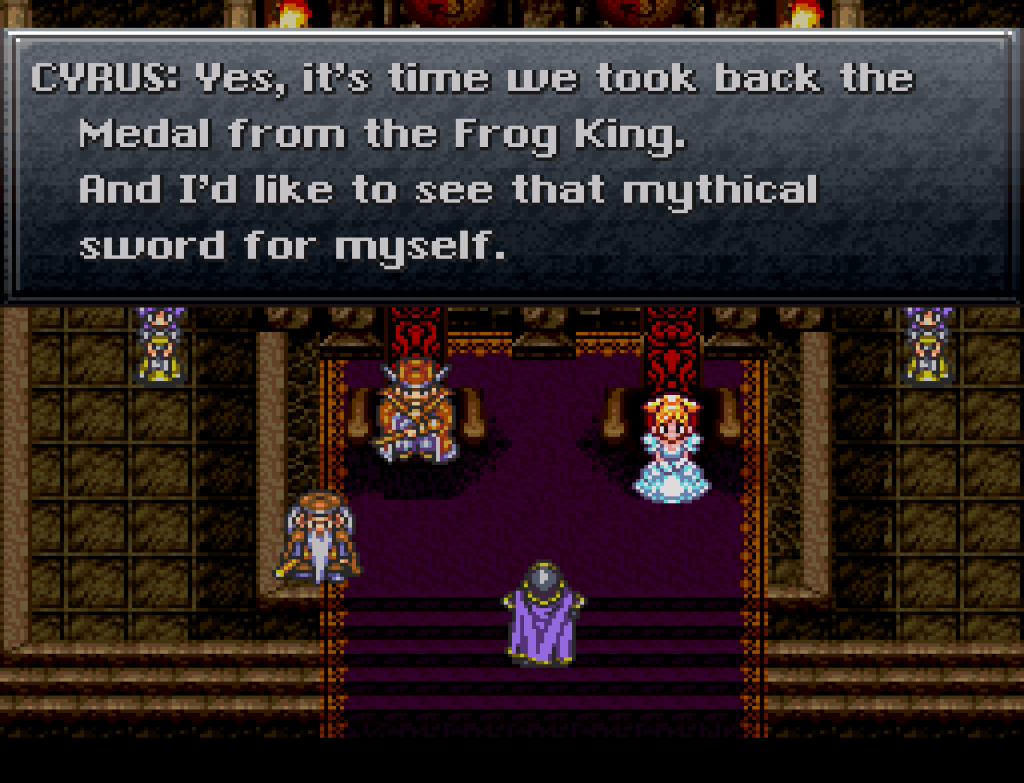
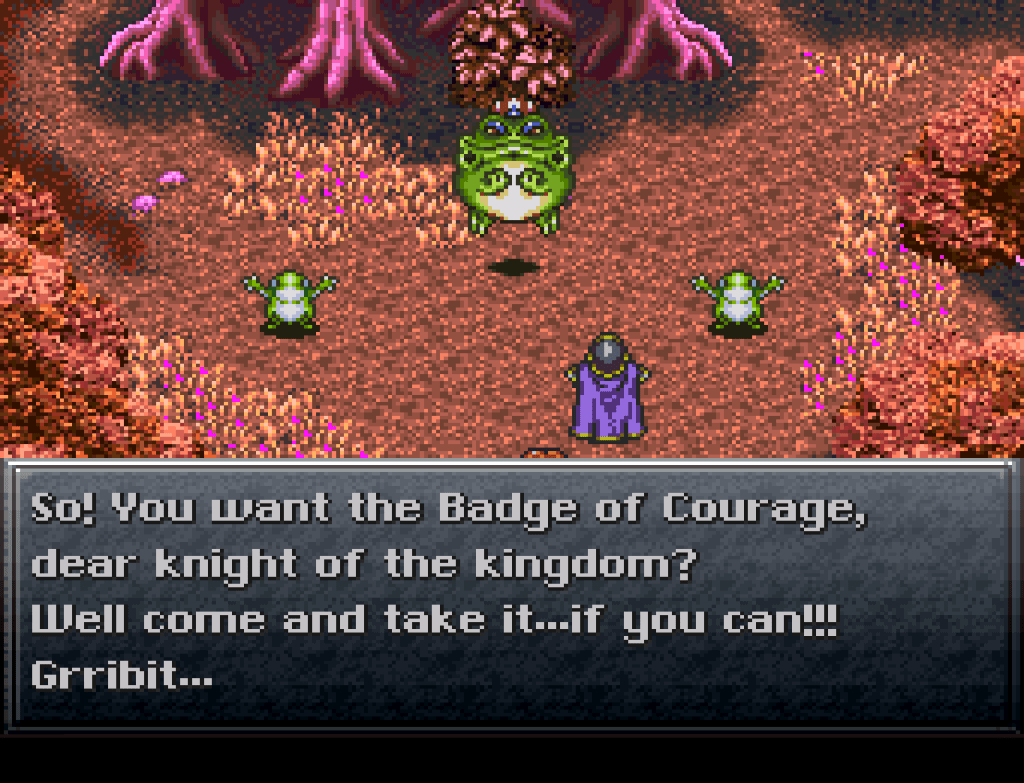
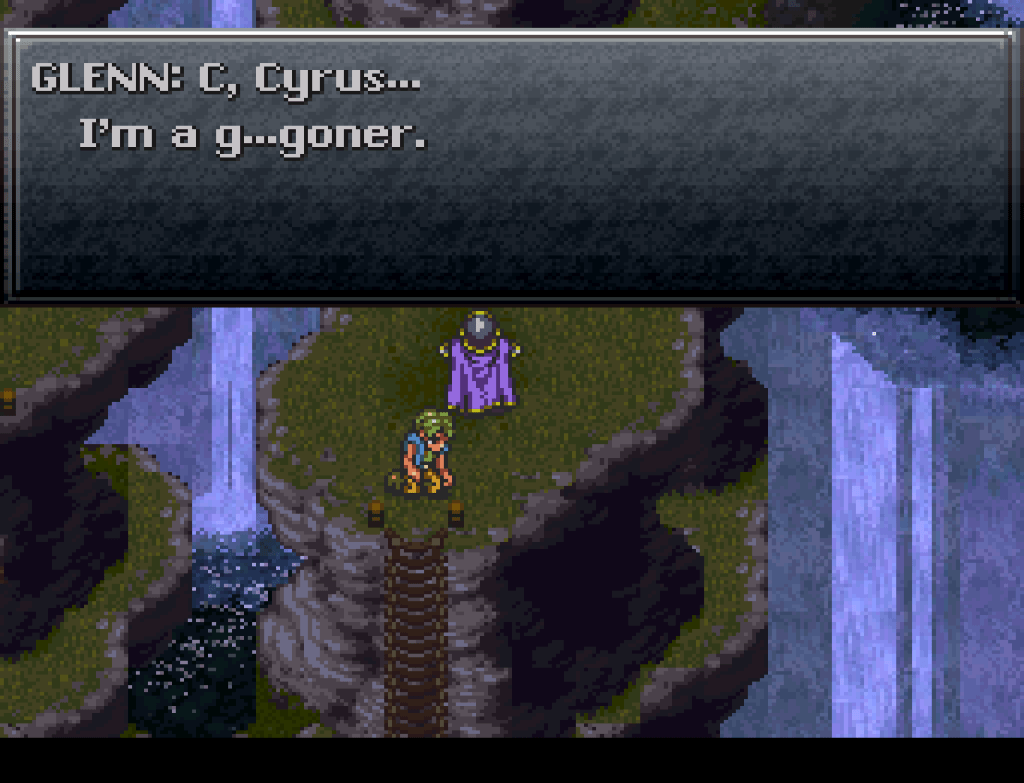
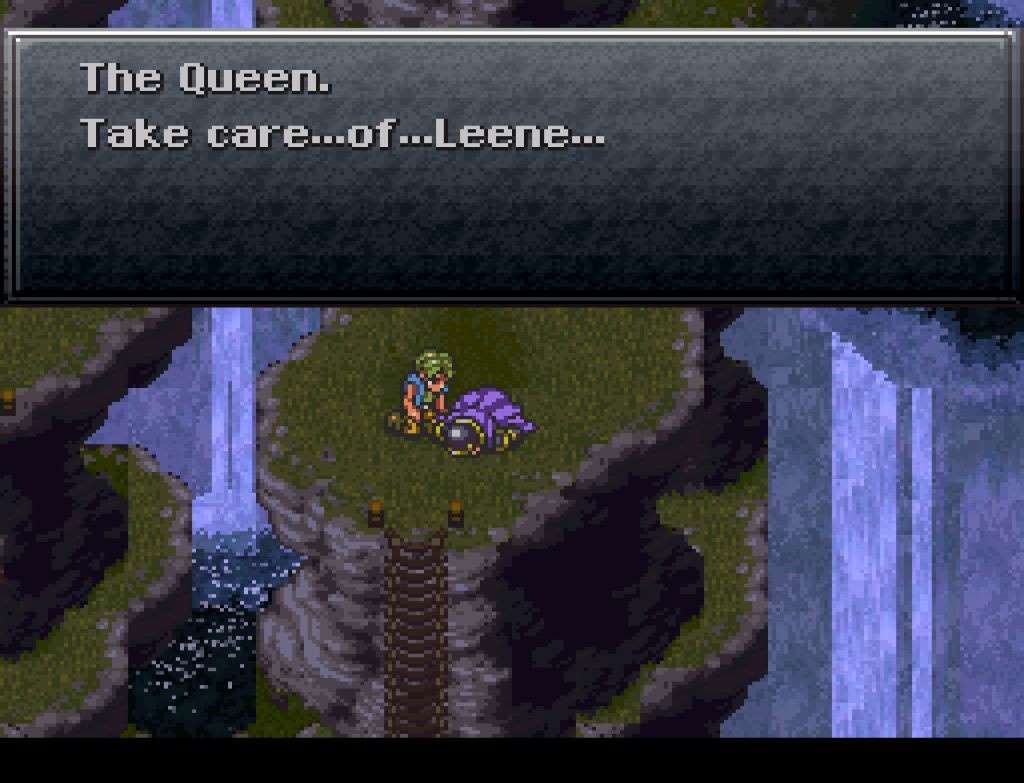
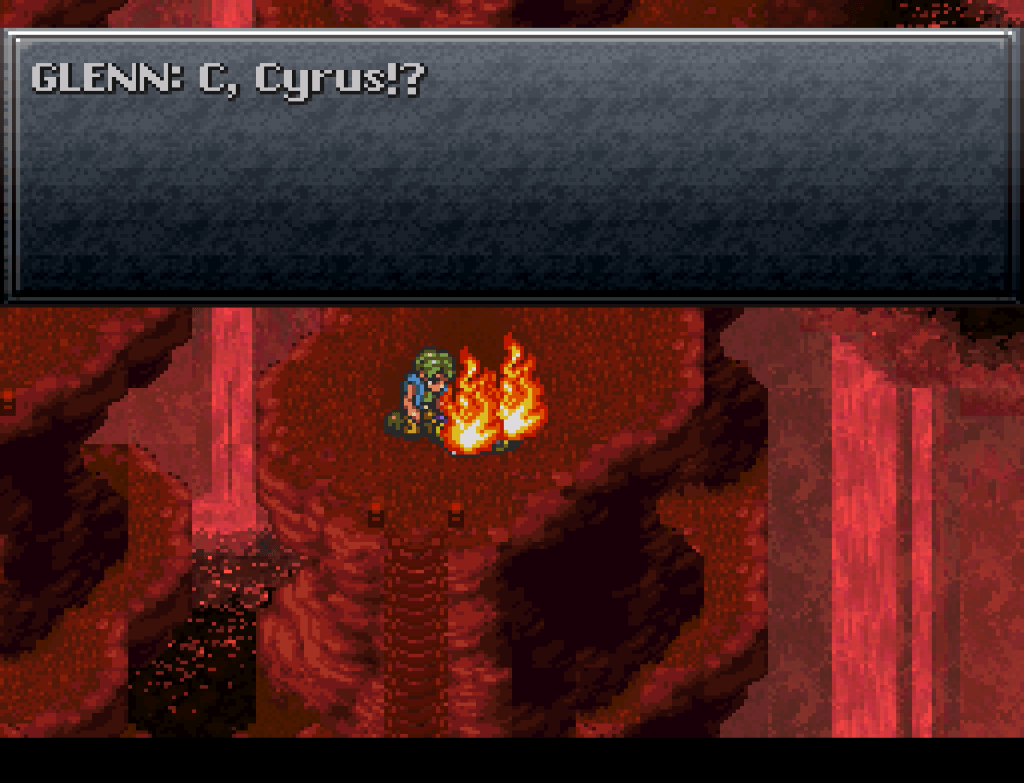
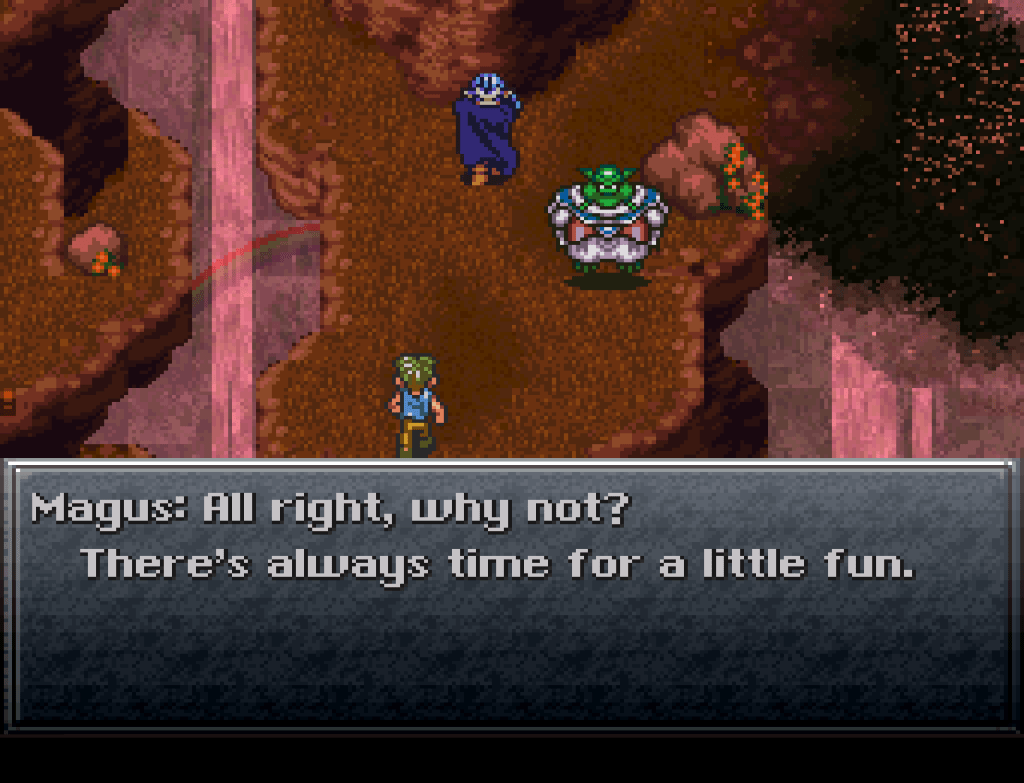
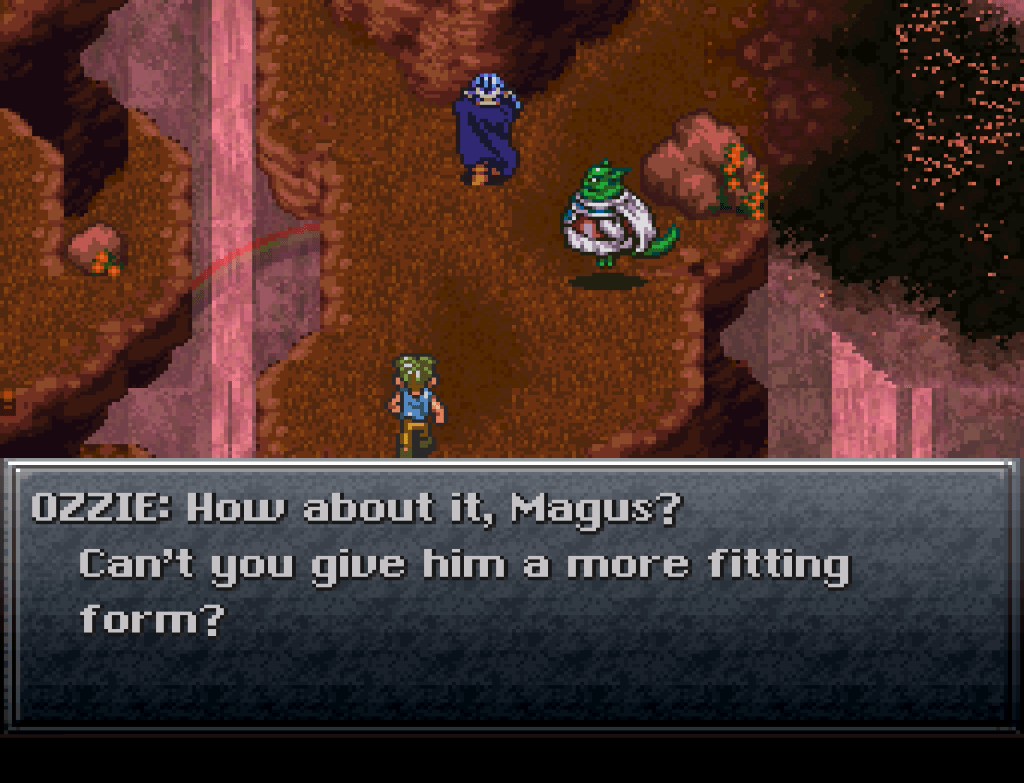
Glenn was there with him, but Magus and crew did not honor him with a warrior’s death. Instead, he was turned into a frog and left for dead. After this point, Frog does not have much faith in himself. He still had pride as a knight, as he hops in to help save the Queen when she’s kidnapped at the beginning of the game, but he does not feel like he can take out Magus and avenge Cyrus.
This feeling is multiplied when a young child shows up with a hero’s medallion, essentially a little trinket that marks someone as a legendary hero. Cyrus wielded a legendary sword in the Masamune, this little kid (Tata) had the hero’s medal. Frog had nothing. So he goes into hiding.
Since Frog is the only one with any real clue on where Magus is, it’s critical for the heroes to snap him out of it, so the plot focuses on doing what needs to be done to snap him out of it.
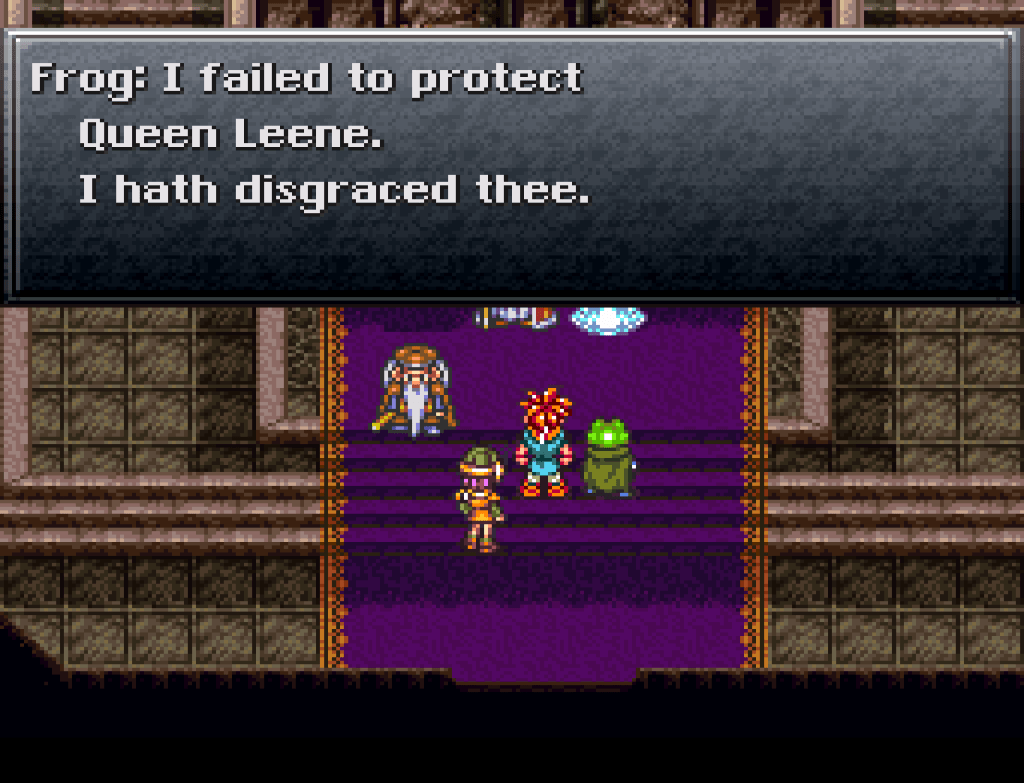
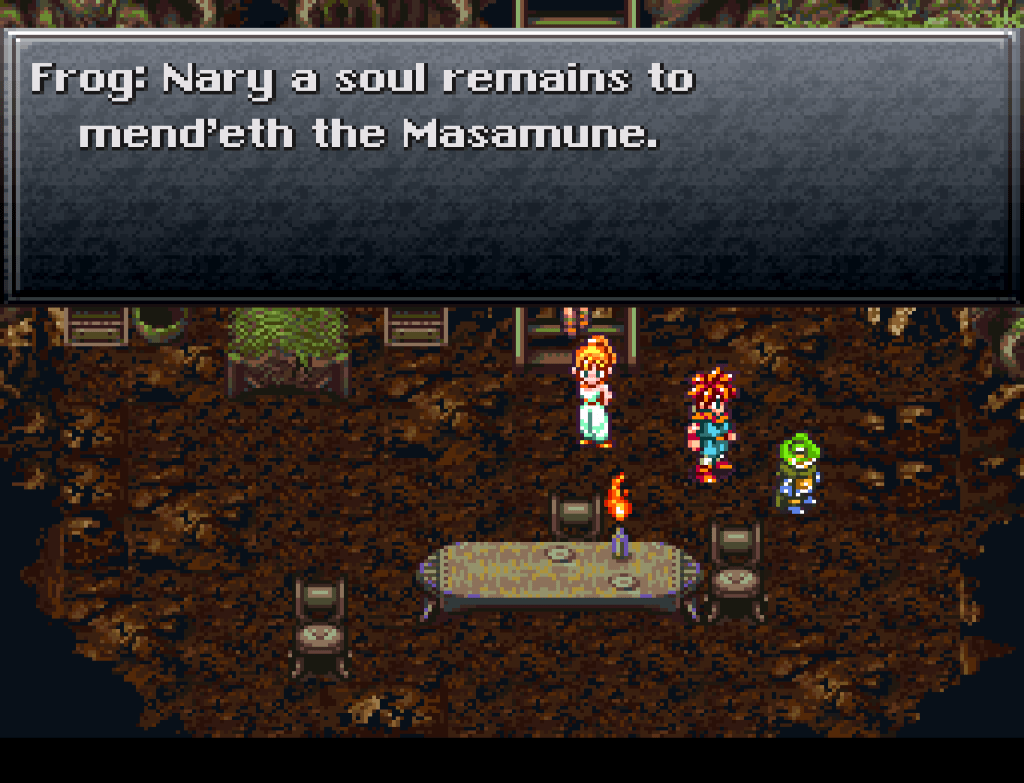
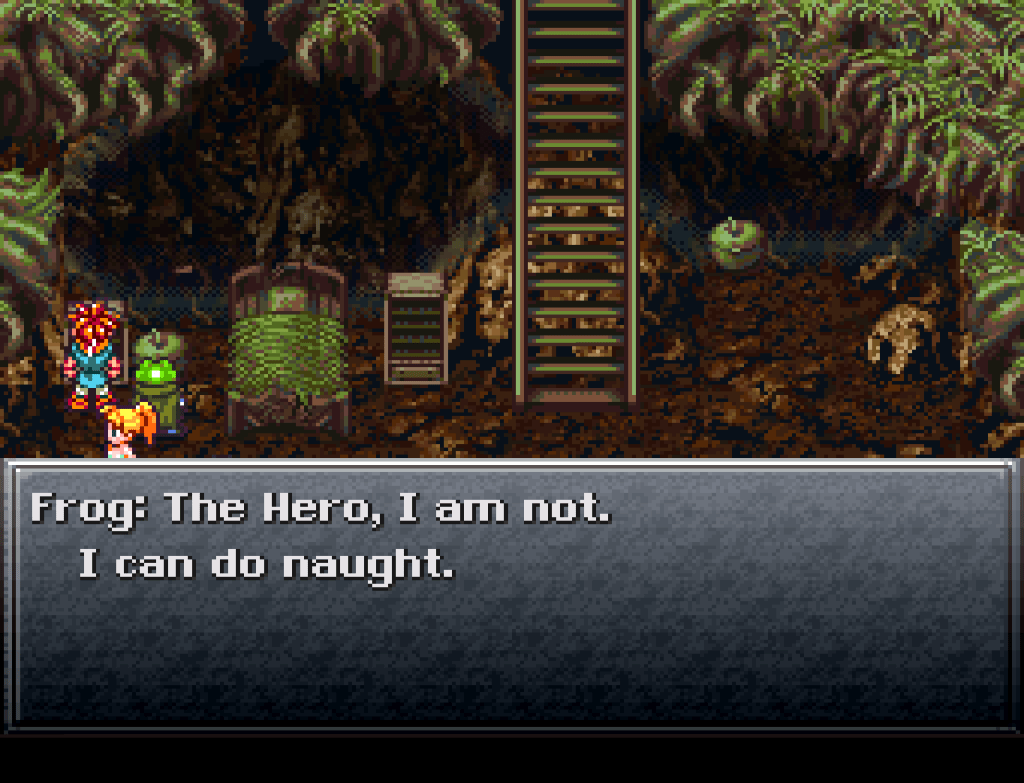
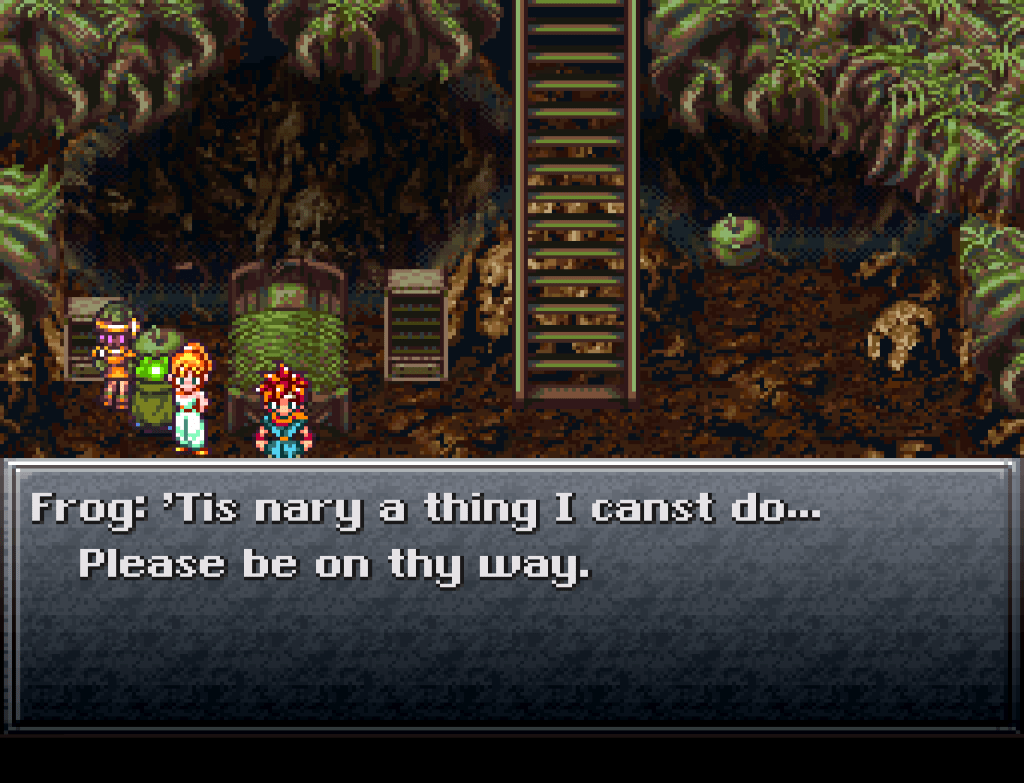
And of course, Frog does bounce out of it. In one of the coolest moments of the era, he cleaves a mountain in two with the newly fixed Masamune in order to forge a path towards Magus. After this, there’s no self doubt. He knows he’s a hero. He has no problems leading the crew to a showdown with Magus and then joining them to take down Lavos. The end of the world may be 1400-or-so years away but that doesn’t matter!
Frog is probably the character with the most fleshed out arc, and as a result, I feel he’s probably the most popular member of the team. Combined with his unique manner of speech – again exclusive to him in frog form in the SNES version – he is very memorable and probably the one party member people who haven’t played the game might have heard of. He’s certainly my favorite!
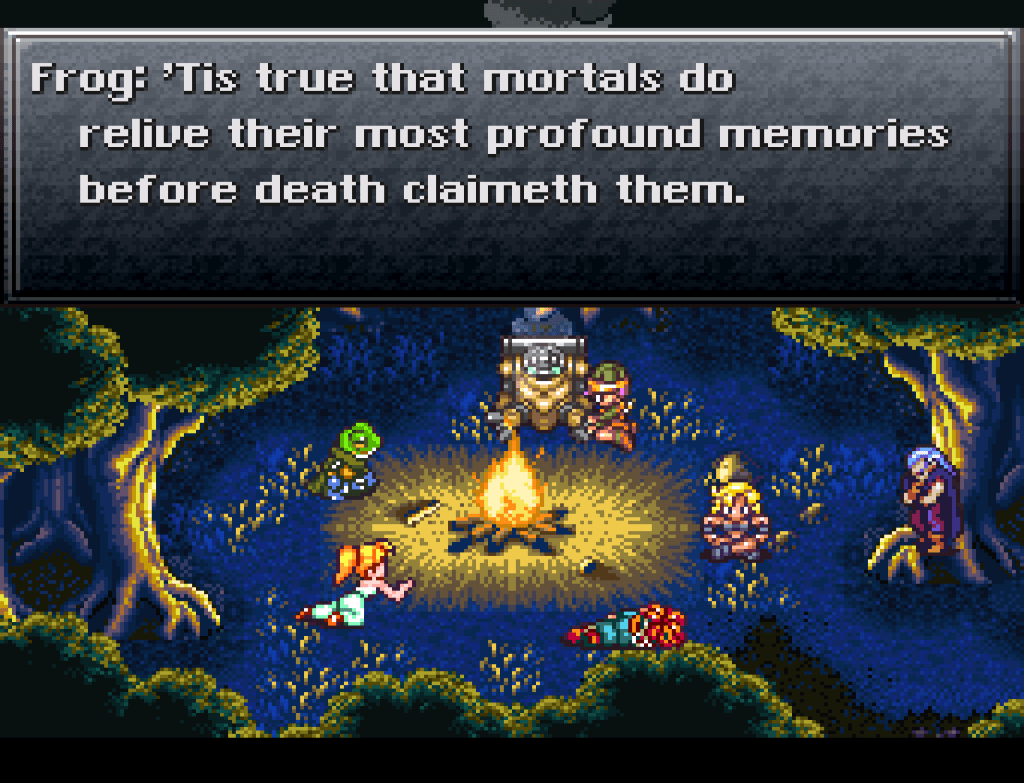
But for people who play games, characterization is not always enough to win the day. People want someone who is useful. Looking at Final Fantasy VI, Cyan shares a lot of similarities with Frog. But he is not one of the best party members in that game, his bushido ability really sucks in the original version of that game, so I feel his popularity is lacking behind characters like Terra and Sabin.
Frog does not have this problem. He provides decent attack power while also being the best overall healer in the game – essentially he fights like you’d expect a Paladin to. On top of being decent in a fight, he also has the coolest dual techs in the game with Crono. A lot of times, style means more than substance and in a game as easy as Chrono Trigger, it really goes a long way.
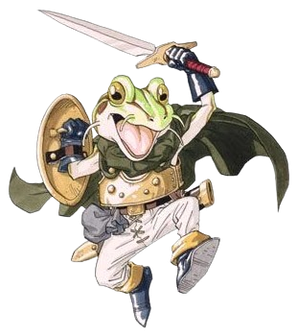
The Cross connection: Frog is so beloved that one of the most popular characters in Chrono Cross, Glenn, is essentially a remade version of him. These two are not the same characters – despite sharing the same name – but he can do Frog’s iconic x-slash dual tech with that game’s lead Serge and his personality is the same ‘loyal knight’ sort of thing. Cross’s Glenn is basically an homage to Frog and nothing more.
Most of the time, this sort of trick results in wide mockery. Soul Calibur 5 replaced a lot of its core cast with their children who acted more as homages to their more popular parents. And that game was a total disaster. Street Fighter 3 and Marvel vs. Capcom Infinite took similar approaches and – no matter how people talk about SF 3 today – they had a similar reception. What’s with fighting games, anyway?
But not Glenn. Chrono Trigger Glenn is cool, so too is Cross Glenn.
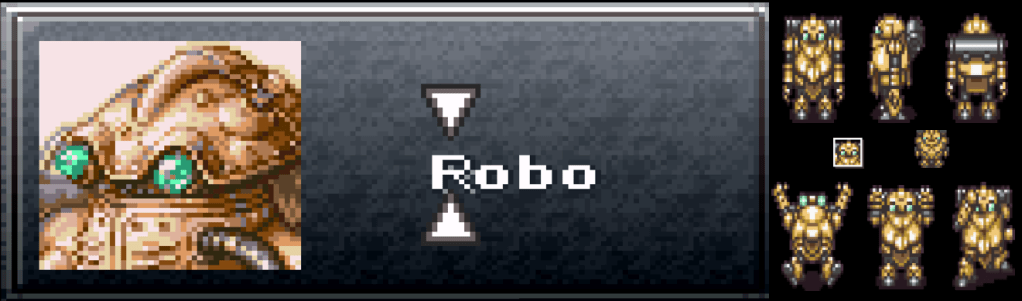
Robo AKA R-66Y
The party gets to the future. I think nothing says ‘future’ quite like a sentient robot, so naturally, Robo is your representative from that era. He shows up as a pile of broken junk, but the genius Lucca fixes him and he becomes a permanent party member immediately upon activation.
He doesn’t remember his past but given that every other robot from this era wants to kill you, I’m sure he’s probably fine.
Robo’s key function in the initial visit to the future is to essentially interact with the advanced tech so your crew doesn’t have to worry about it. Come on guys, I’m sure Lucca woulda figured it out at some point. The highlight of this period is his refusing to take up arms against his robotic brothers – palette swapped blue versions that I mentioned above.
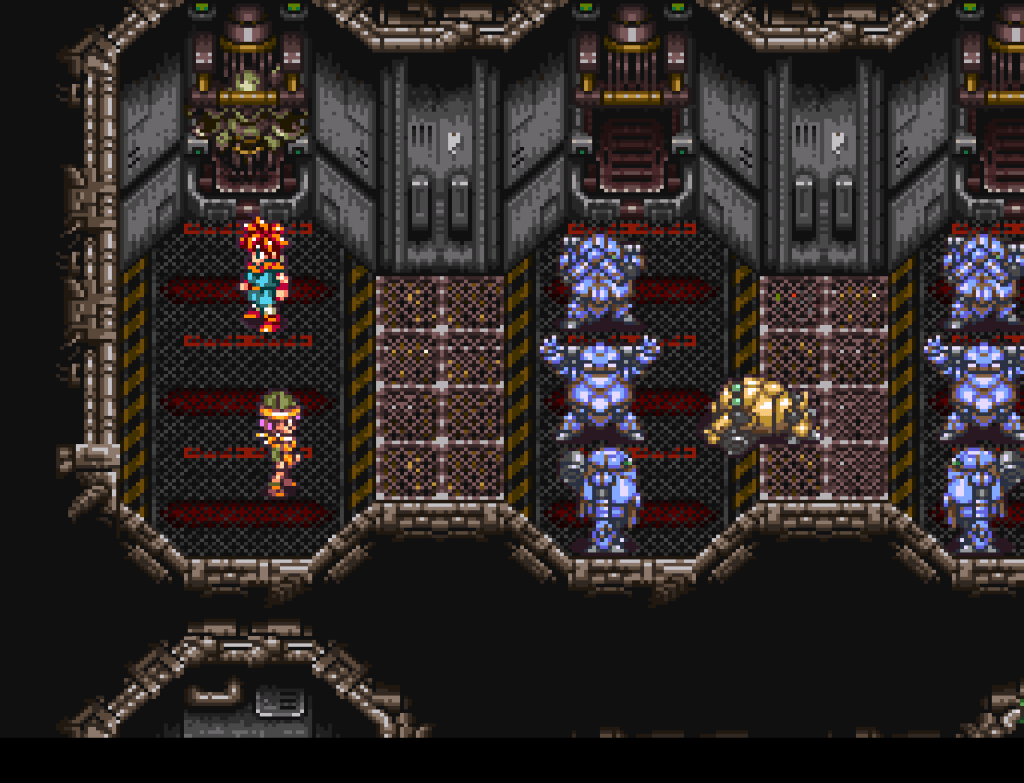
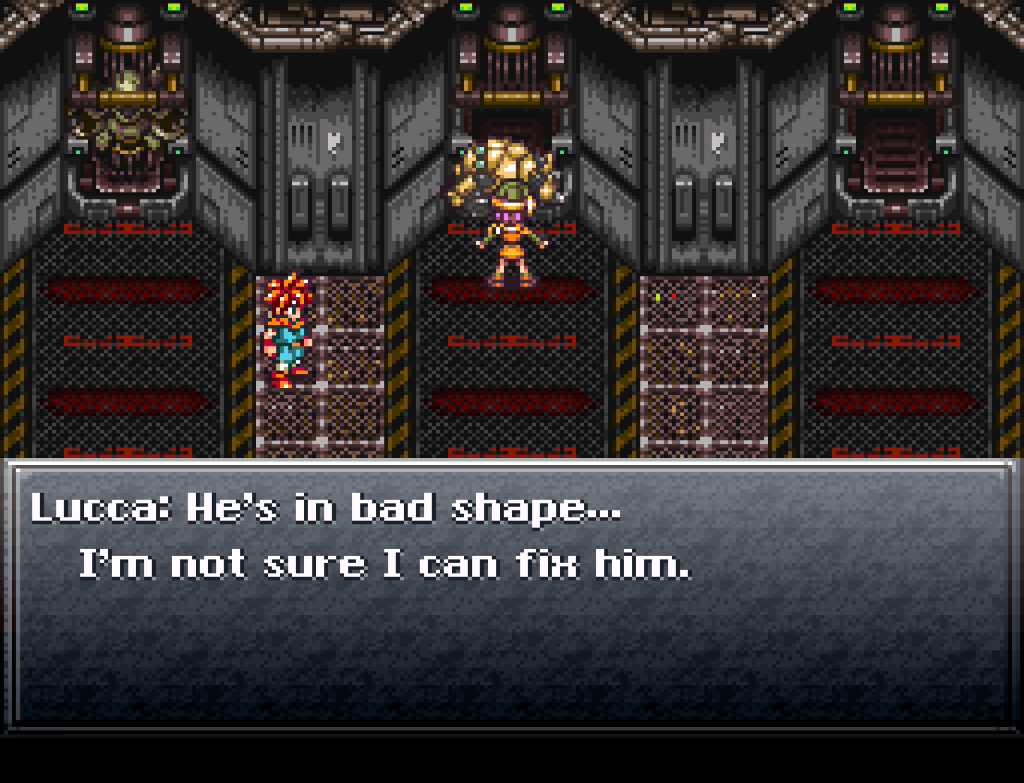
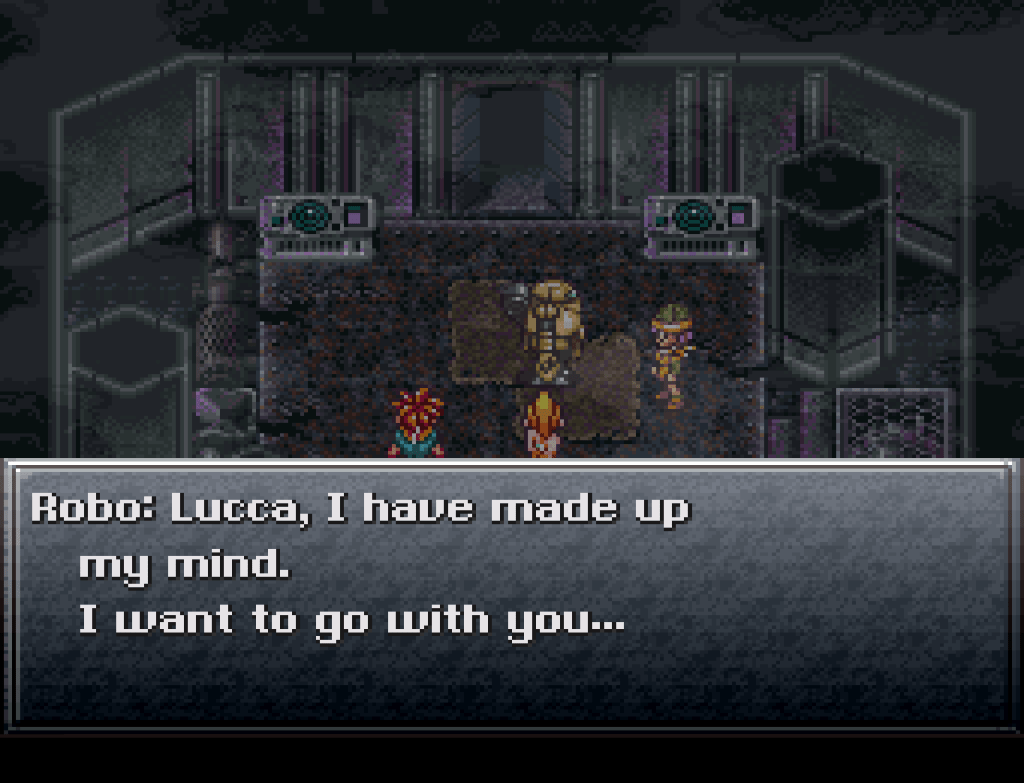
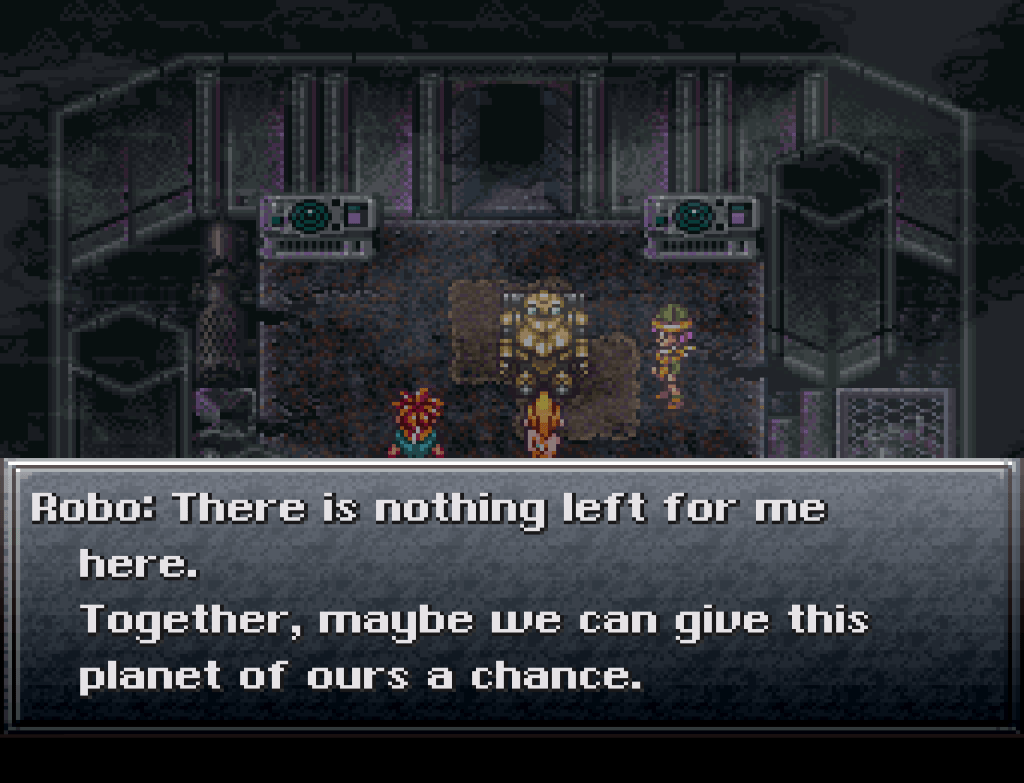
We find more about Robo a bit later on, as one of the game’s main end game side quests. He was made prior to the events of 1999 and had been asleep since the arrival of Lavos. He had been made to be servile towards humans while at some point his creator got corrupted and began forcing all robots of the era to rebel against the fragments of humanity.
As mentioned above, most of the time spent humanizing Robo is spent with Lucca. Through their conversations it becomes apparent that he isn’t just some sort of typical robot. He has curiosity and compassion.
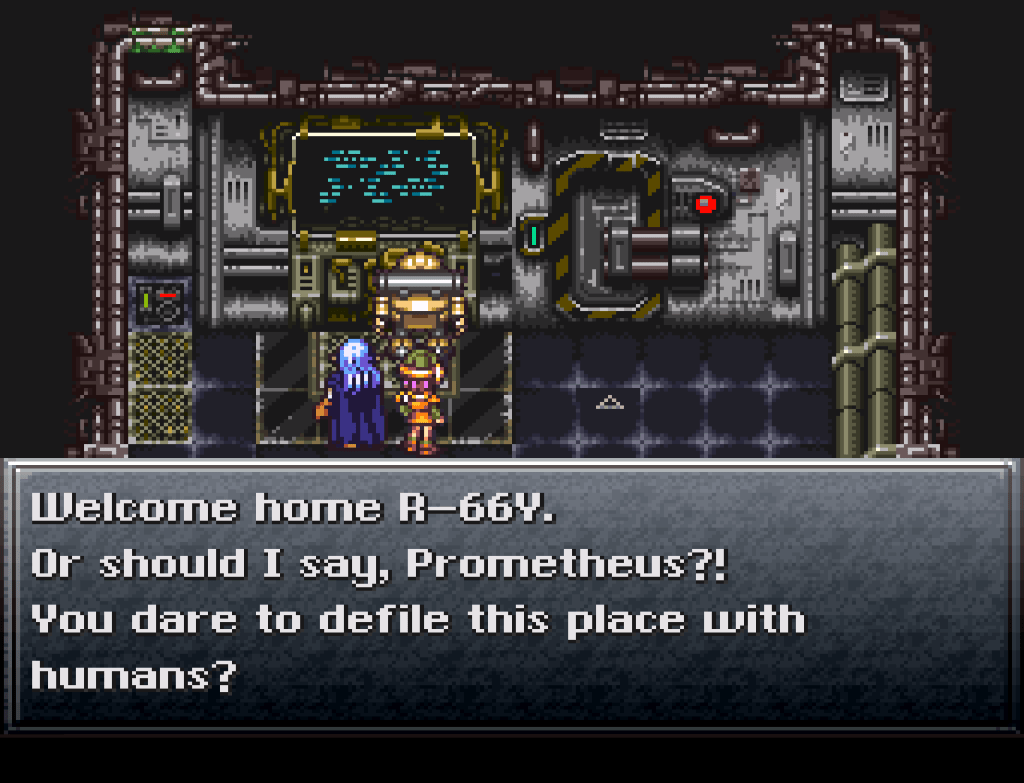
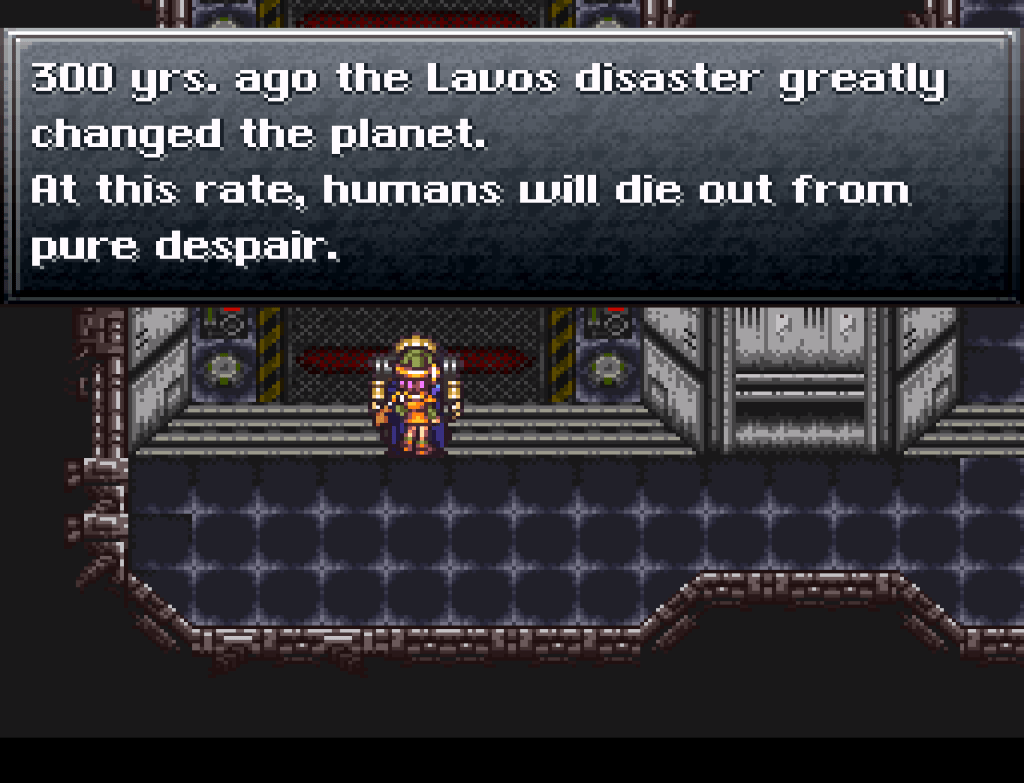
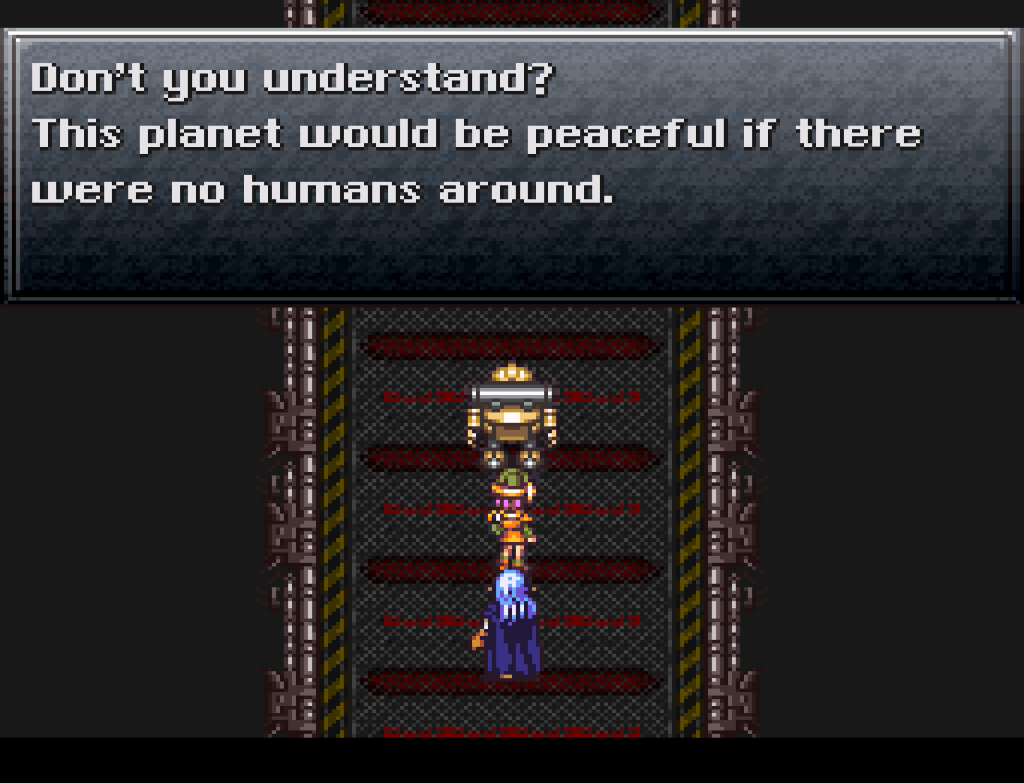
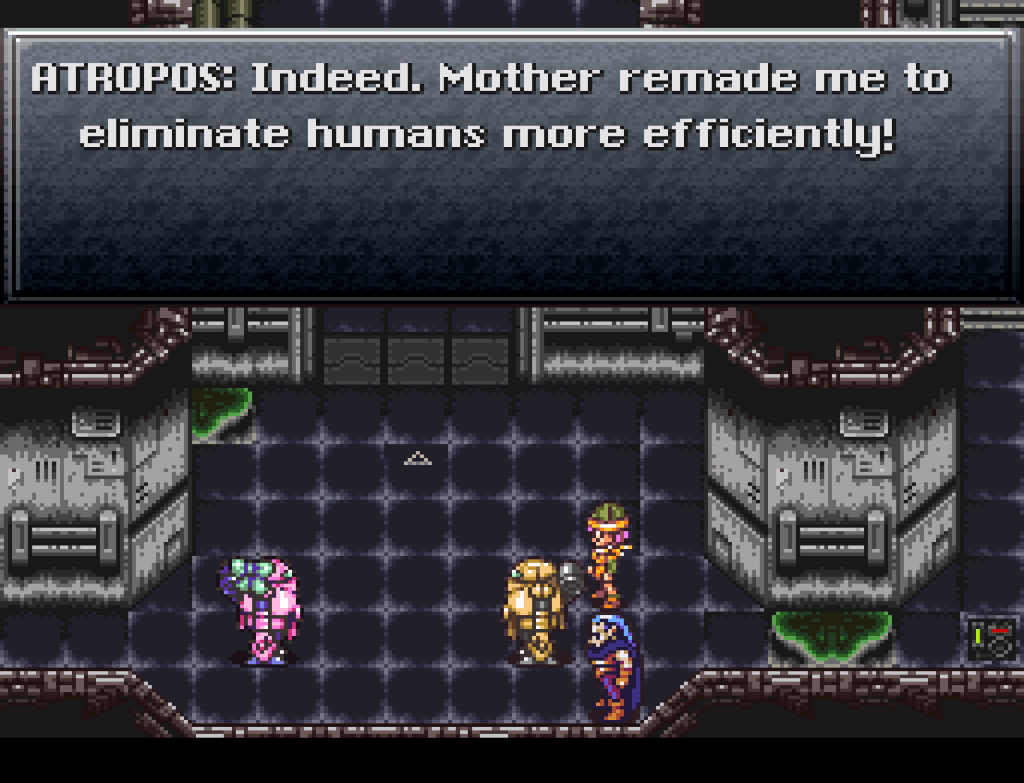
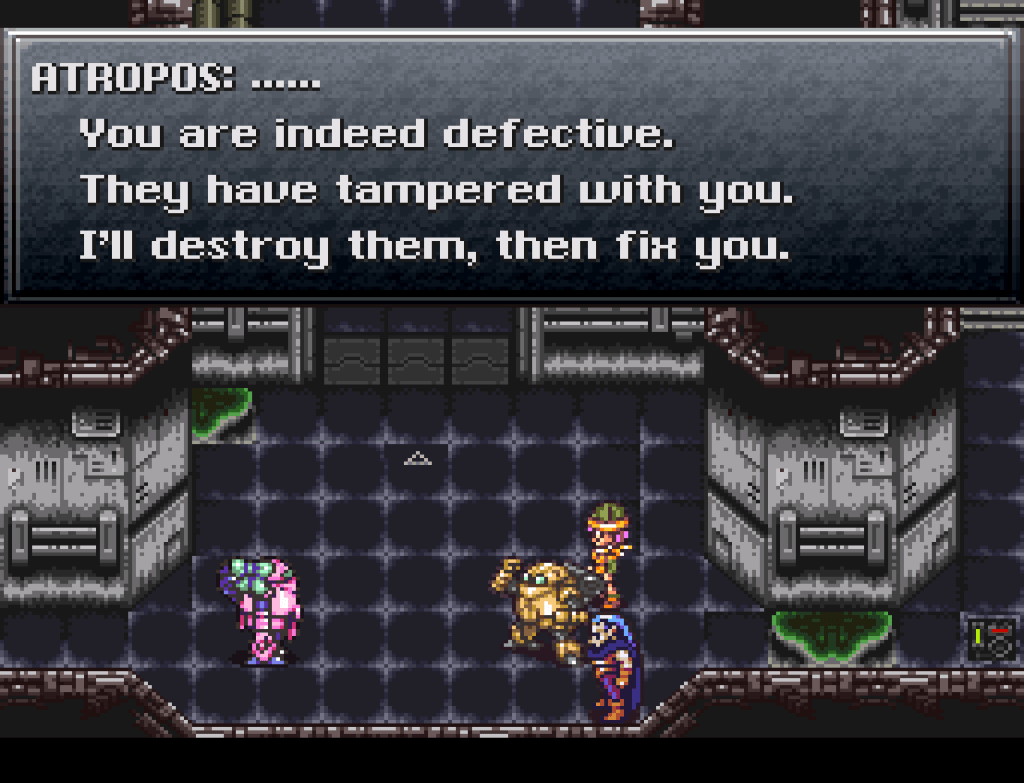
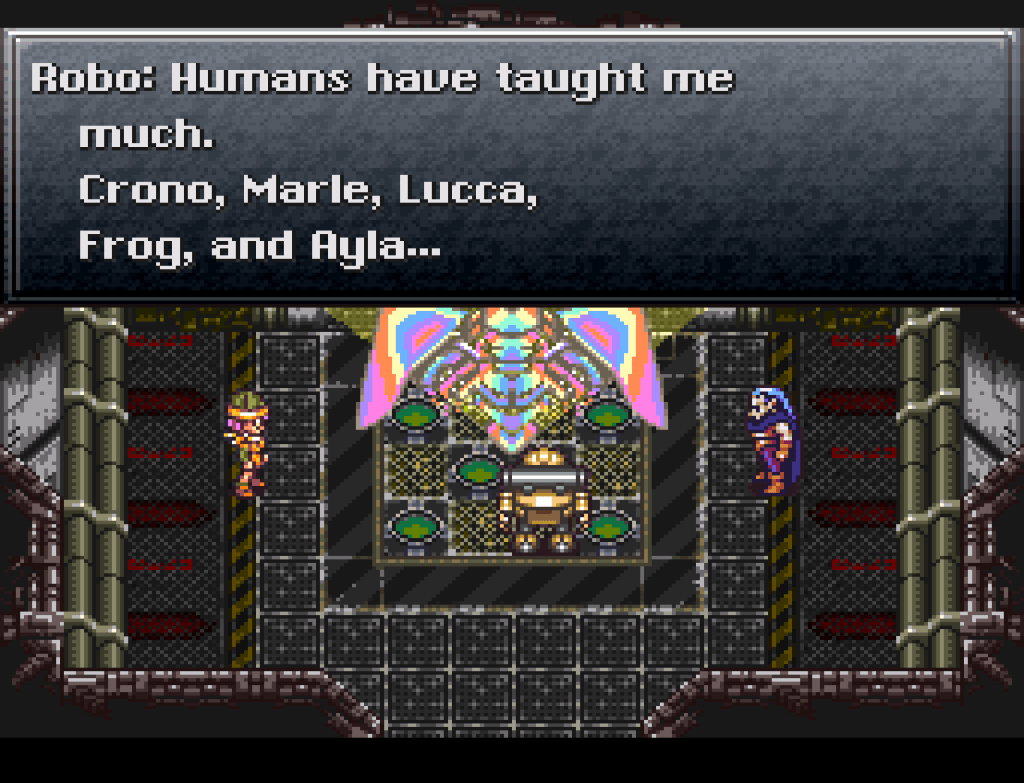
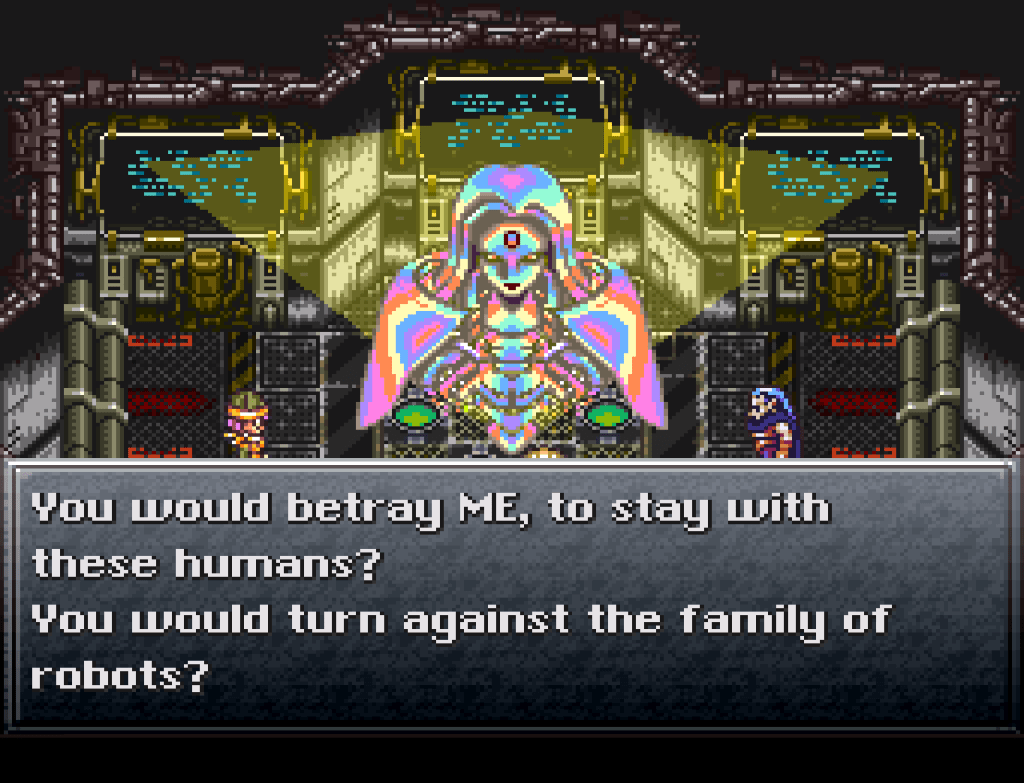
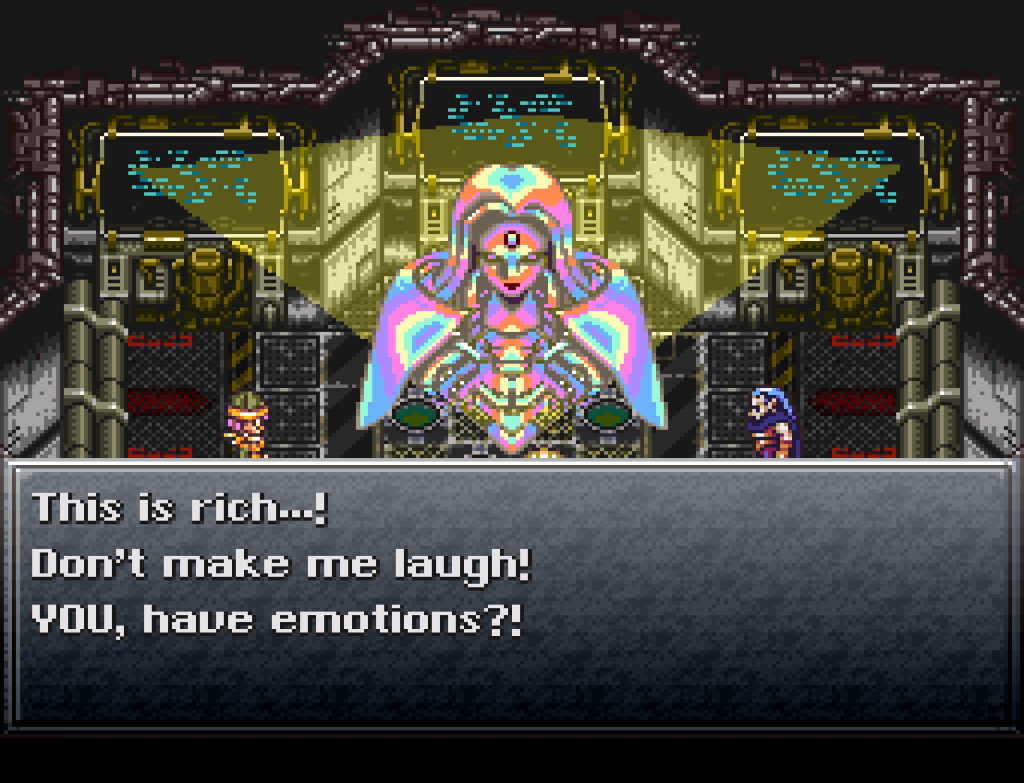
So while it’s a bit of a bummer that he was always acting as his programming told him to and Lucca isn’t some machine-speaking savant, it does make his demeanor make perfect sense. He was never tempted to turn against humanity because he was programmed to do the opposite. Since he was never corrupted like every other robot of the era, he was never a danger to the party.
Of all of the non-1000 AD party members, Robo is the most ‘normal.’ While he may not be flesh and bone, he talks most similarly to everyone from 1000 AD. He’s just a man of metal. I think the idea here is to make him as normal as possible so the player isn’t constantly doubting him. You’re supposed to immediately trust him and speaking in a robotic fashion might get in the way of that.
His most heroic moment comes in a different sidequest where the party is tasked with helping to restore a great forest, starting in 600 AD. Robo, being a robot and thus immortal, elects to stay behind for 400 years and do all the farm work.
When the party comes back, Robo is broken down and busted from giving it all to benefit humanity. Lucca fixes him quickly but the point here is that Robo did not hesitate to ask for this. There was no convincing him to stick there for 400 years, he just did it.
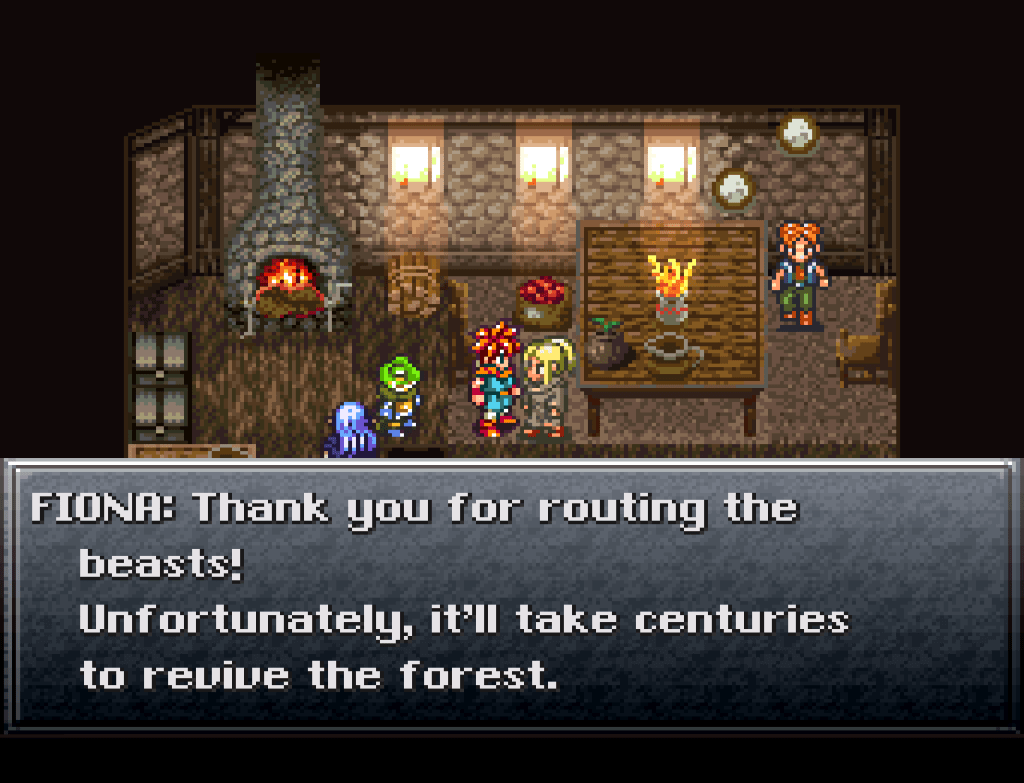
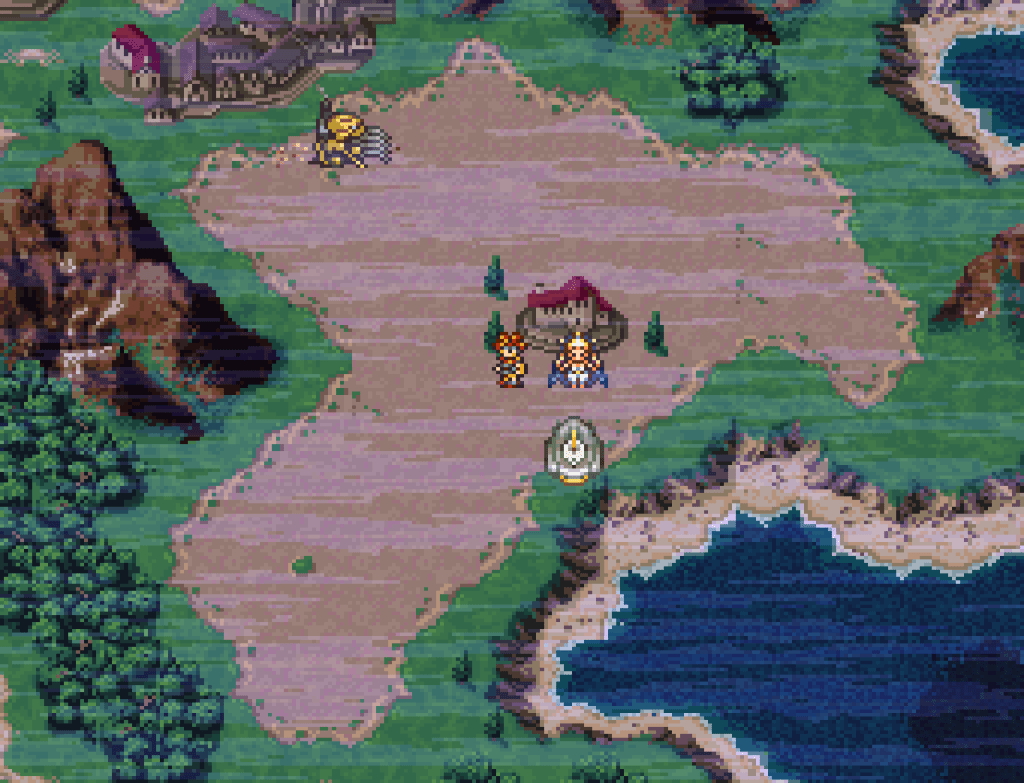
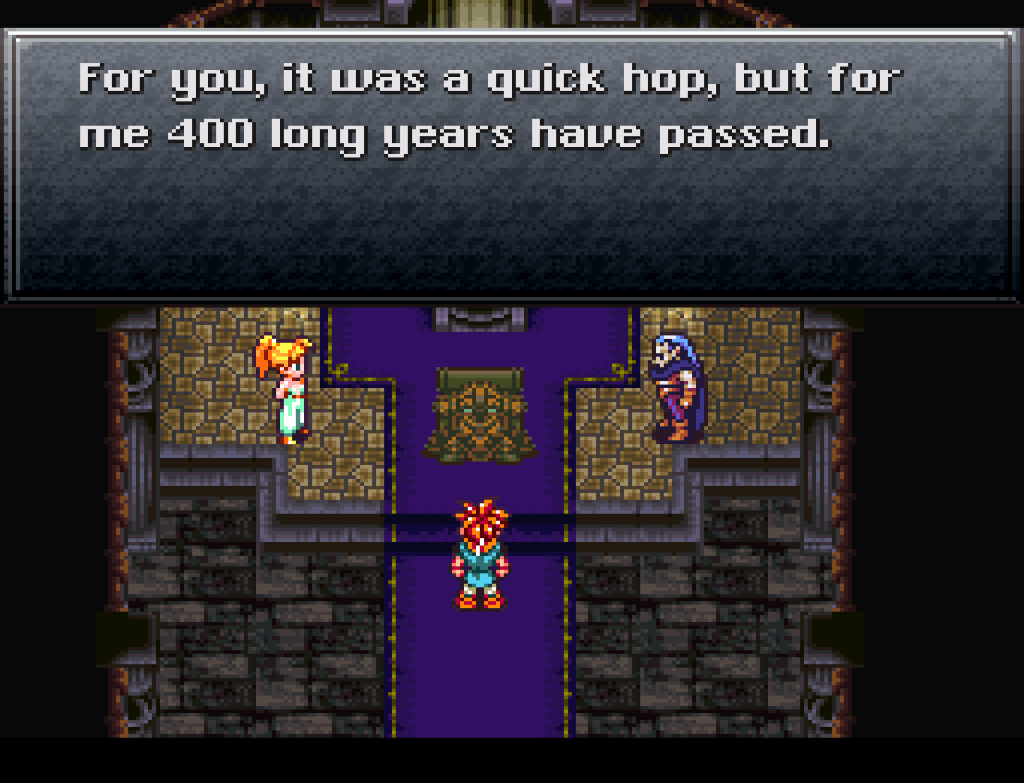
…probably because he was programmed to. Whatever. It’s weird how the Robo-centric quest actually ends with the Lucca saving her mom bit I mentioned above. At least Robo has that other sidequest to lean on because his moment totally got stolen here!
In combat, I put Robo as roughly the equivalent of Frog. He hits hard, he can take damage and his healing ability – while not quite up to what Marle and Frog can do – is respectable enough that he can function as a main healer for the team just fine.
That said, I basically never use the guy. He was in the party a lot in my new game plus playthrough, but that was simply because by the end of my first run through the game he had all of two skills learned. I think his placement in a party comes down to who you like better as a character between him in Frog, and for me, there really is no choice.
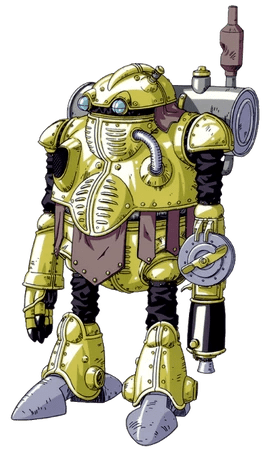
The Cross Connection: Robo’s fate in Chrono Cross is that he is killed by the evil kinda computer program FATE in service of humanity. He and Lucca are the only cast members that are 100% for sure murdered. They killed the robot whose whole gimmick is that he’s more human than he appears? Hey, have I mentioned that Chrono Cross is controversial yet?
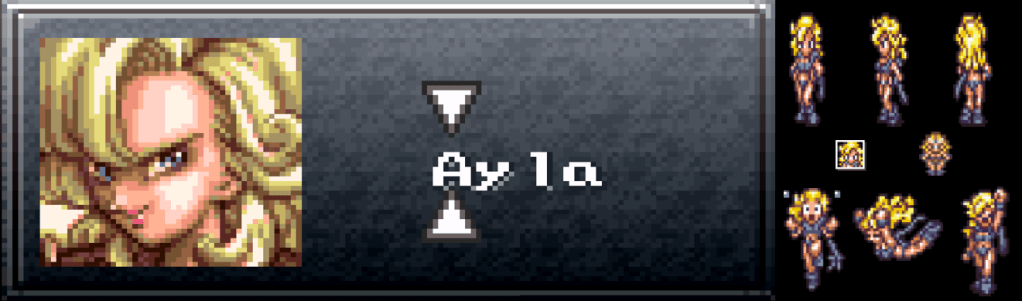
Ayla
The party goes back to ancient times in search of the Dreamstone to repair the Masamune. Immediately upon arrival, they meet this wild cave woman who pins Crono to the wall and talks about how attractive he is. That’s one way to make an impression!
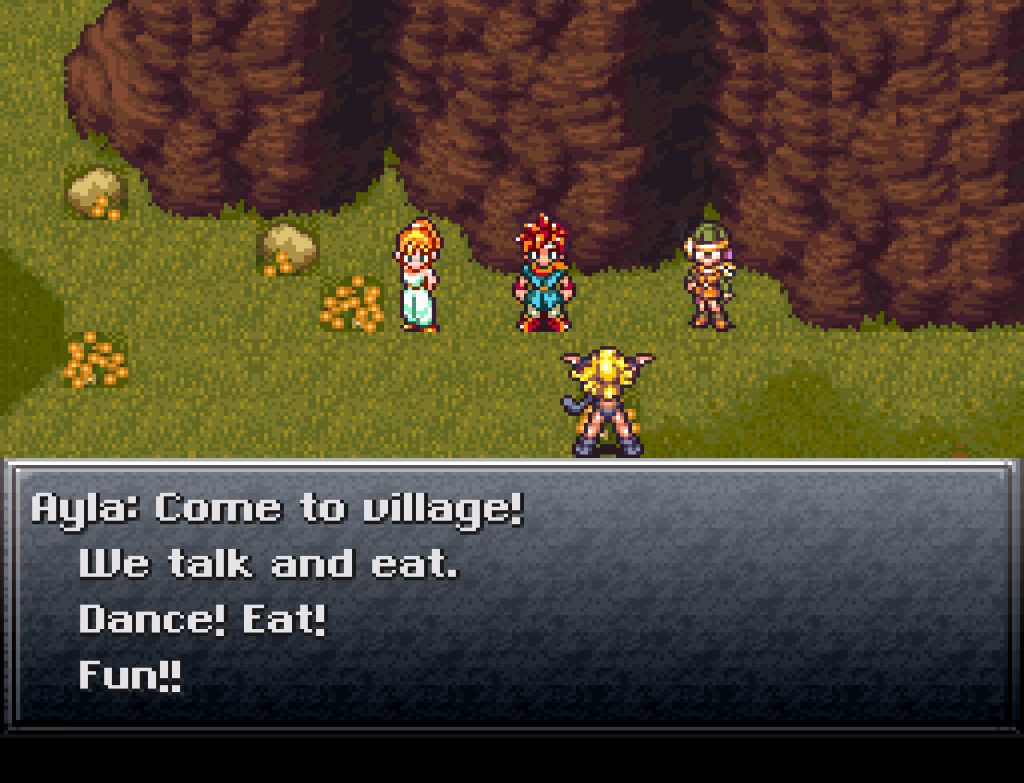
This is a primitive society, strength is respected above all else. Ayla is the leader of prehistory because she is the strongest person. Makes sense! The Dreamstone is given to the leader of these ancient tribes. As we know, the Dreamstone eventually becomes Schala’s pendant, which implies that Ayla is Marle’s ancestor. I guess having a thing for Crono must run in the bloodline, eh?
She has a love interest named Kino who gets jealous of Crono for this reason. Don’t worry too much though, Marle will still get born. Crono doesn’t get too in the way.
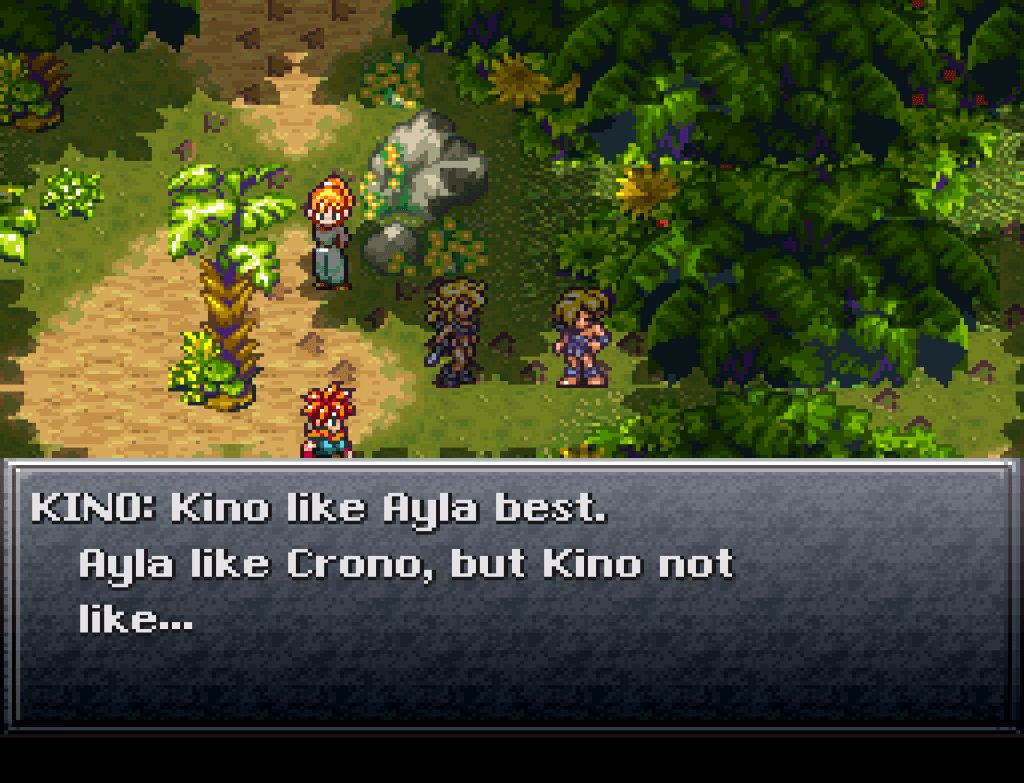
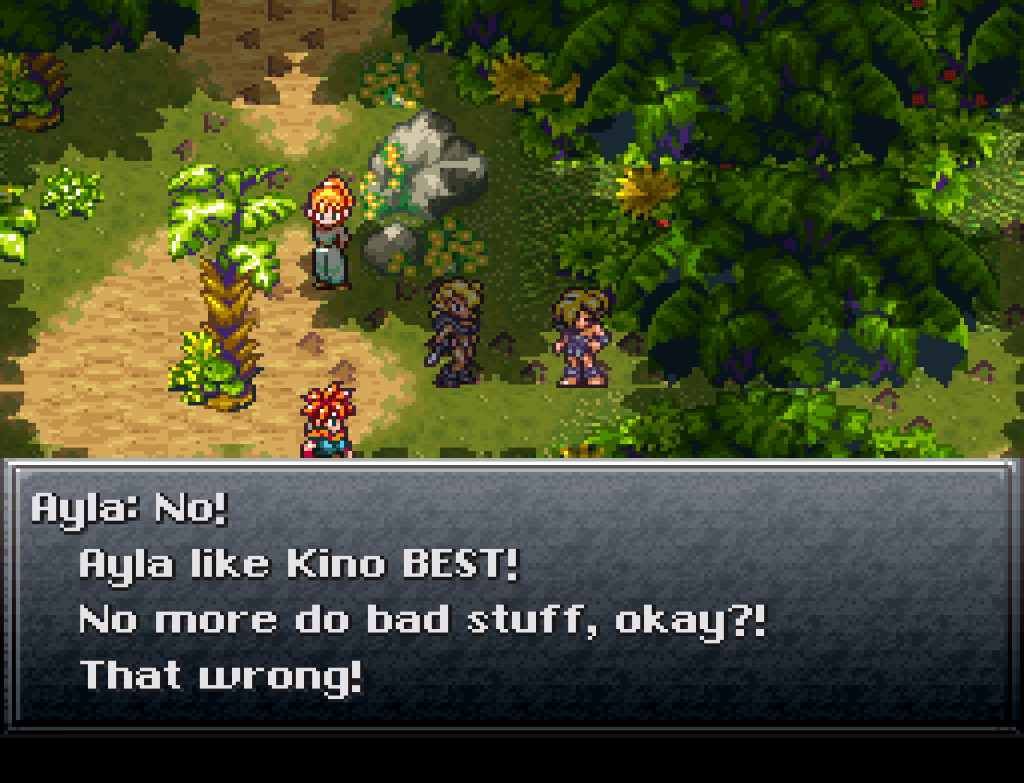
And as for characterization, that’s all you really need to know. She is a brave cavewoman who fights for her people. She is from a time before magic or much of the lore of this game even takes place, so naturally, she is very simplistic. If you have ever read fictitious caveman conversations, you kinda know how she speaks. Very short and direct statements.
People often accuse the SNES version of censoring Ayla slightly. When you meet her, Ayla makes sure to state that she has respect for both men and women due to strength. In the Japanese version, this is an opportunity to create some comedy. This line is altered in the English version. Here are the different texts, courtesy of legends of localization
Japanese: Ayla: “You people strong too. Ayla like strong people. Whether man or woman.” Marle: “Ohhh, so that’s what you meant.” Lucca: “I- I’m not into that sort of thing!” English: Ayla: “You strong too. Ayla respect strong people. Men and women.” Marle: “Oh, brother…” Lucca: “Where have they been keeping her?”
To me this comes across as more of a misunderstanding/jokey line. It was clearly altered to get rid of the more risque (remember, this is the 90s) elements of the conversation, but I think it’s another one of those ‘don’t think too much about it’ sorts of things.
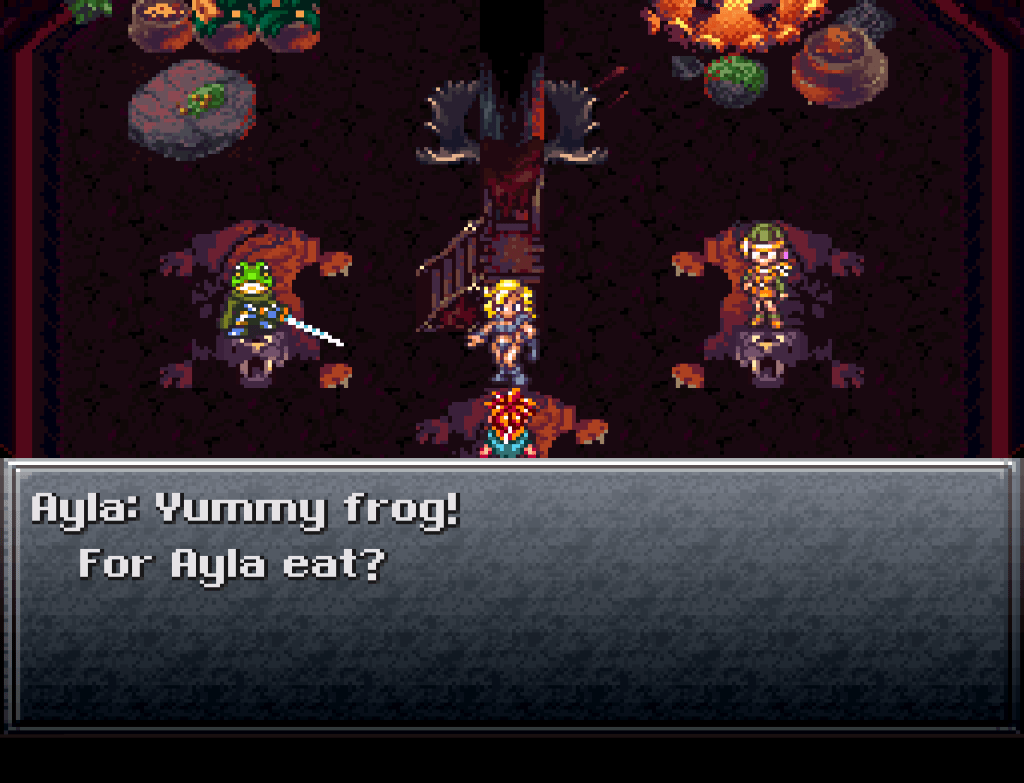
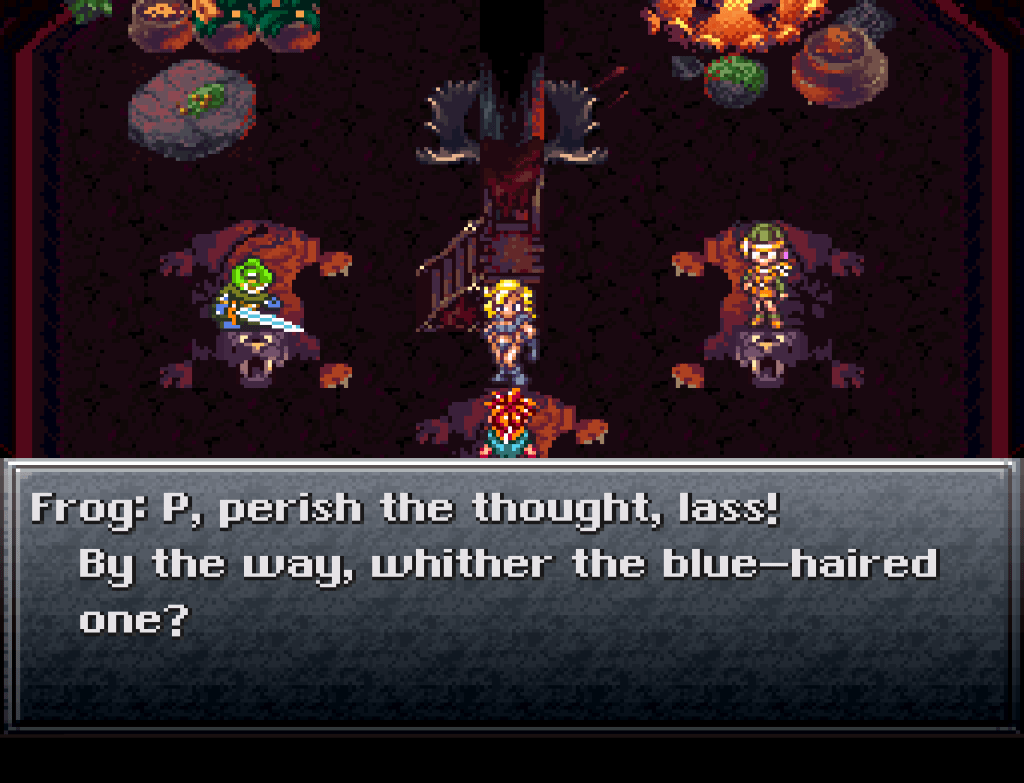
She’s a pretty simple character. She talks in that old caveman style way, so a lot of her dialogue can be seen as comedic.
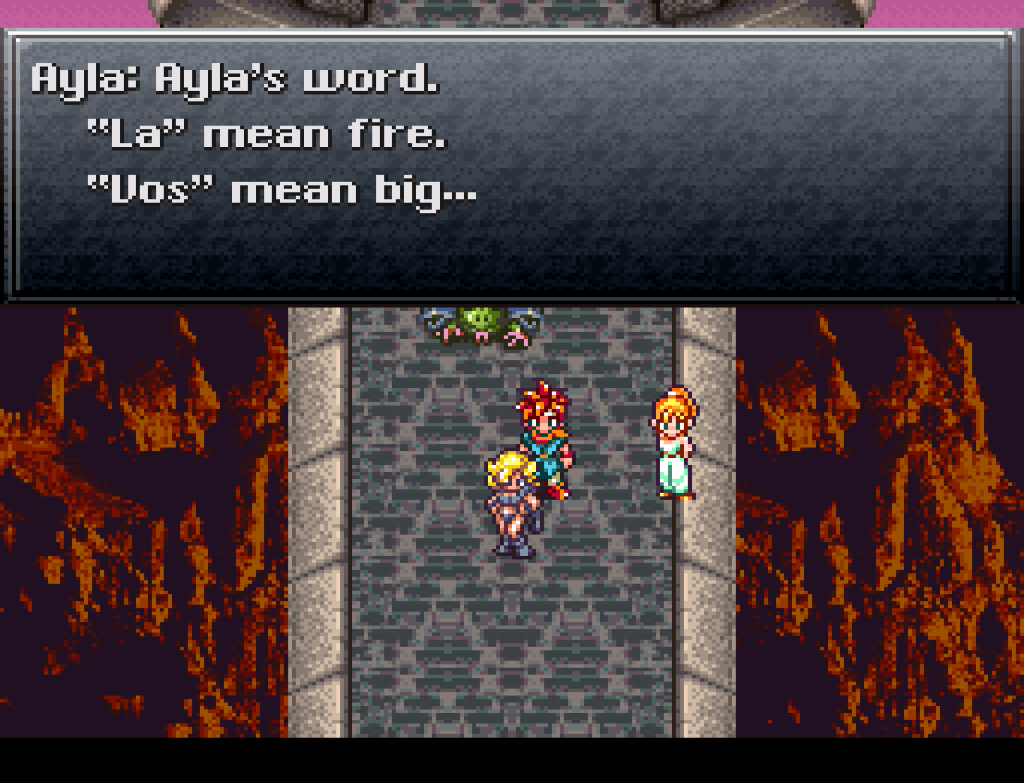
But she also kinda comes up with the name for the main villain, Lavos. Sure…the player has known it for a while because they went to 2300 AD, but in universe, how did we come to that conclusion? Simple! In Ayla’s tongue “La” means fire and “vos” means big. So there ya go. Lavos means big fire. That’s not inaccurate!
In battle, Ayla is a physical powerhouse. She immediately comes equipped with hard hitting normal moves as well as awesome dual techs with Crono. I mentioned Falcon Hit above, but she gets access to Drill Kick and Volt Bite (all Crono dual-techs, she ain’t beating those allegations) really quickly upon grabbing her.
These hit opponents very hard – so as long as she’s in your party, you’re probably doing okay from a damage output perspective.
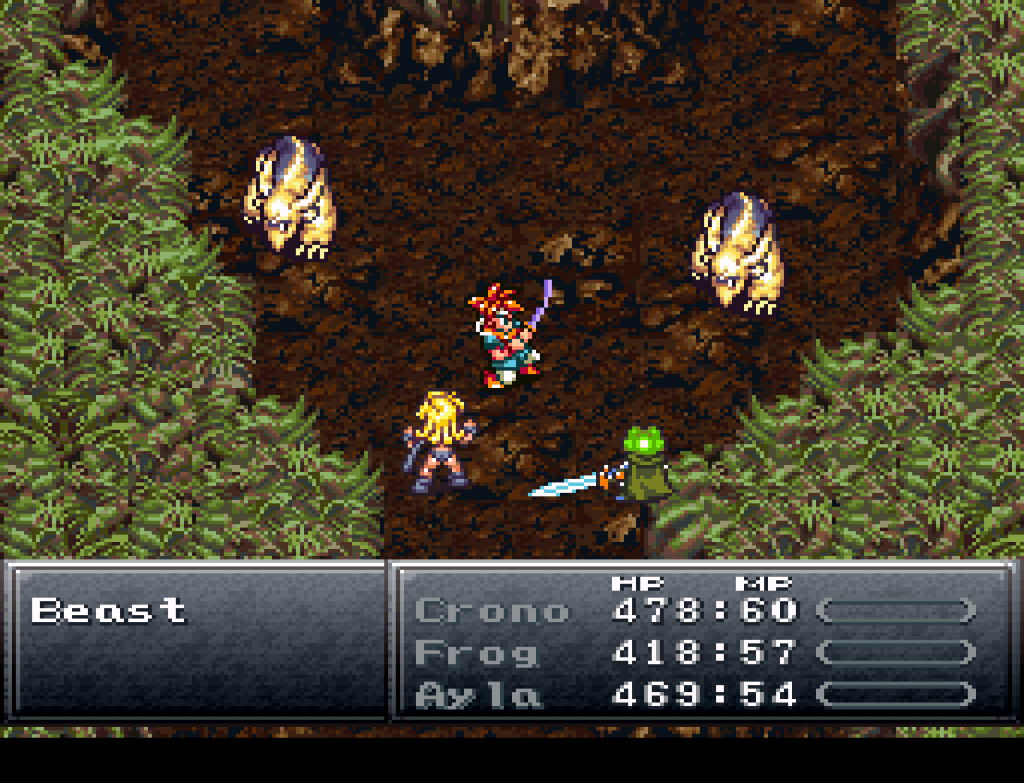
She also has the ability to heal slightly if you’re real down bad. Though her utility there is more in a dual tech with Frog (Slurp Kiss) and if you already have Frog in your party, you probably don’t that.
By far her most useful move is charm. This is the equivalent to ‘steal,’ but she accomplishes this by flirting with the enemy to get an item. In the black omen, basically every enemy gives something useful by using charm.
Stat ups? Elixirs? You got em, no problem. So if you want to absolutely break the game beyond belief and max out your stats – and I know you sickos are out there – Ayla is your key to doing just that. I will say, they also did a pretty good job making an ‘alluring’ 16-bit sprite for her.
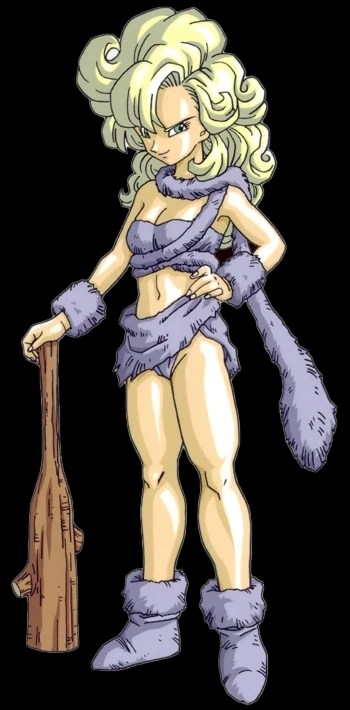
The Cross Connection: Ayla, like Frog, does not factor into Chrono Cross. Ayla also gets kind of an homage character named Leah. She’s a little caveman kid you meet towards the end of the game and she immediately goes on my bench every time I recruit her. Not nearly as cool as her inspiration. Frog got lucky!
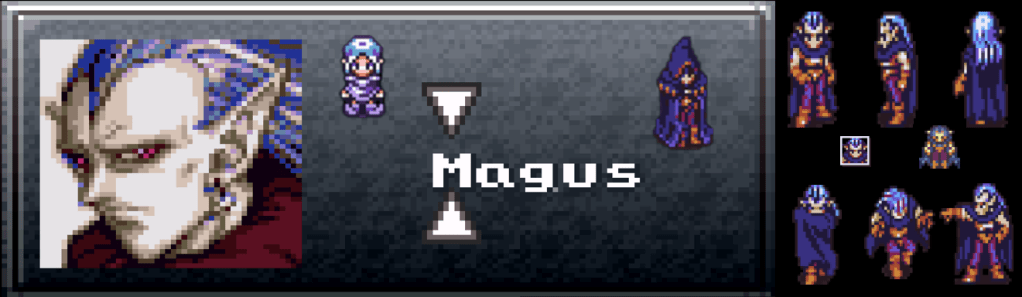
Magus AKA Janus
Magus is an optional party member. If you’ve played Final Fantasy VI or VII, you might be accustomed to slightly unusual methods of recruiting these fellas. No need to fear getting your materia stolen here though, the Magus recruitment is extremely straight forward.
In the Dark Ages/Antiquity after Crono dies, the party comes face-to-face with Magus one final time. By this point, they know exactly who he is. Do you still wish to take the fight to Janus, knowing that he isn’t really the reason Lavos is going to ruin the world? Do you want to rob him of the chance to get revenge for/find his sister?
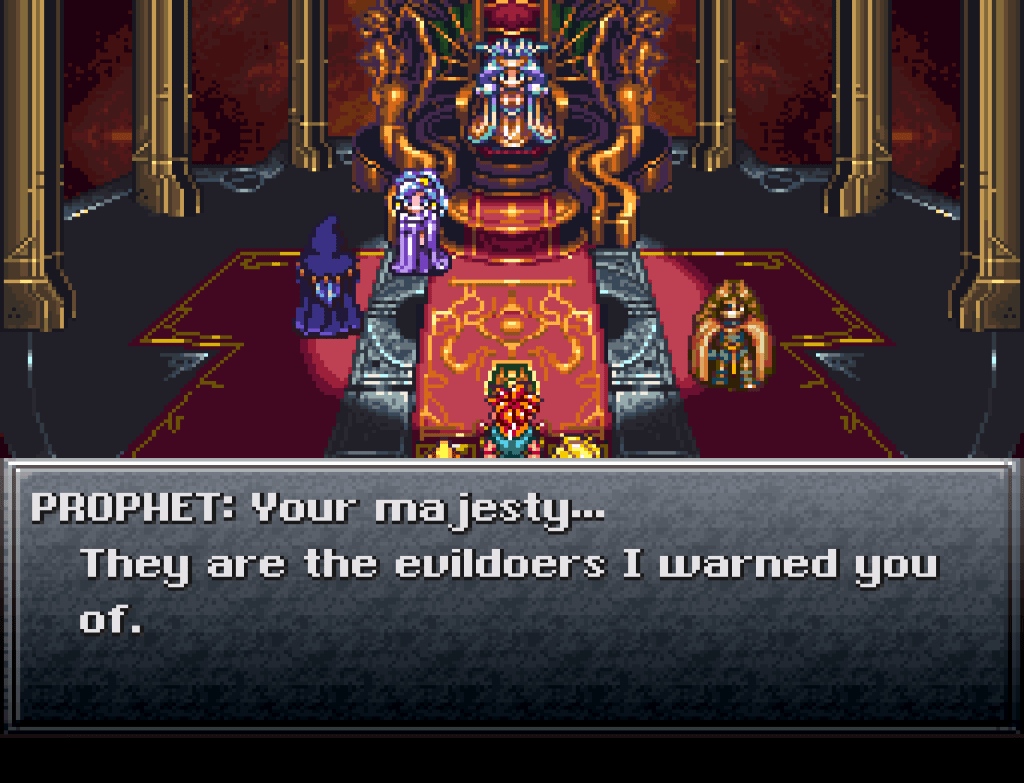
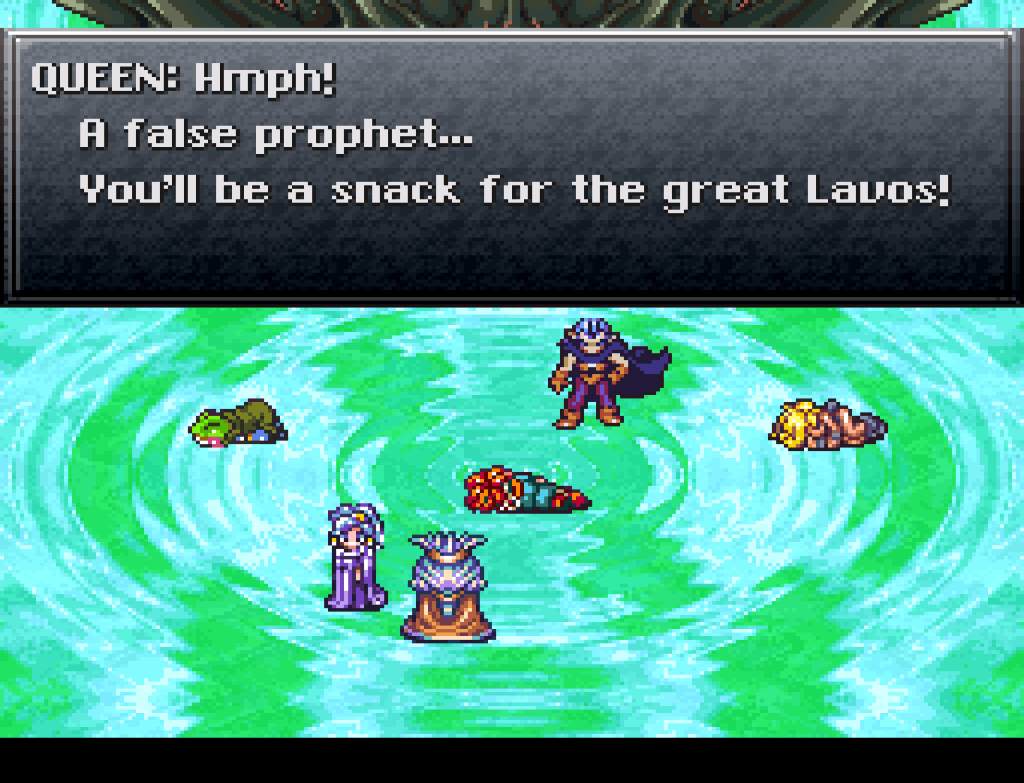
You might be thinking this is an obvious choice, but for first time players, that probably isn’t the case. Magus has been a constant thorn in the player’s side for the majority of the game and even when it becomes apparent that he’s not a true villain, he’s still a prick to you. When he gets sucked through time after his boss fight in 600 AD, he winds up in the Dark Ages/Antiquity and takes on the role of ‘prophet’ for the Queen of Zeal.
He is truthfully trying to get in close with her and stop her schemes before she can cast Schala into the abyss. But when he runs into Crono and crew – who don’t know who he is – he first tries to kill them. After having Schala intervene to save them, he then sends them to prehistory and orders the princess of Zeal to seal the way back up – which necessitates finding a time machine in 2300 AD. Despite knowing that we have the same end goal, he still does that!
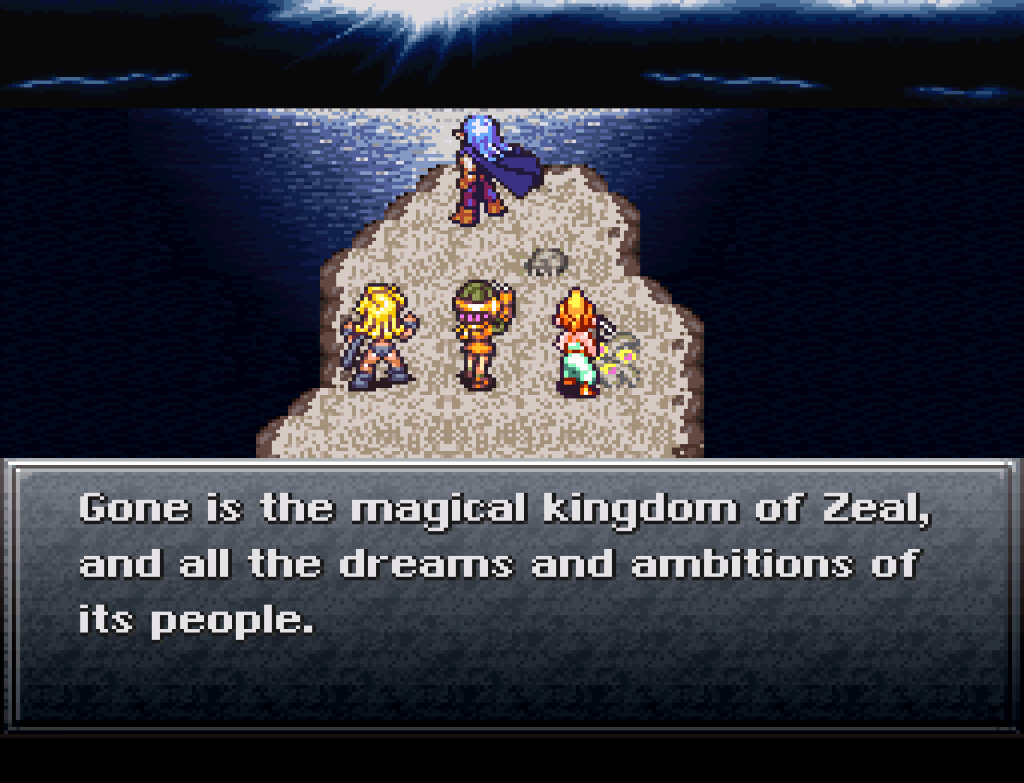
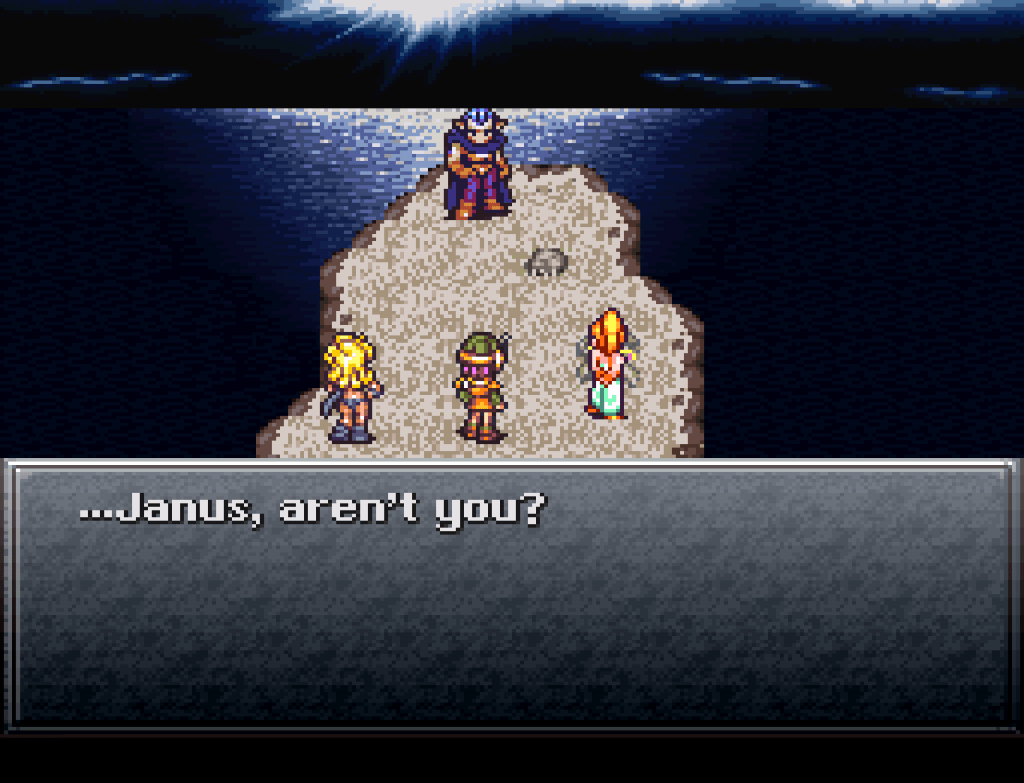
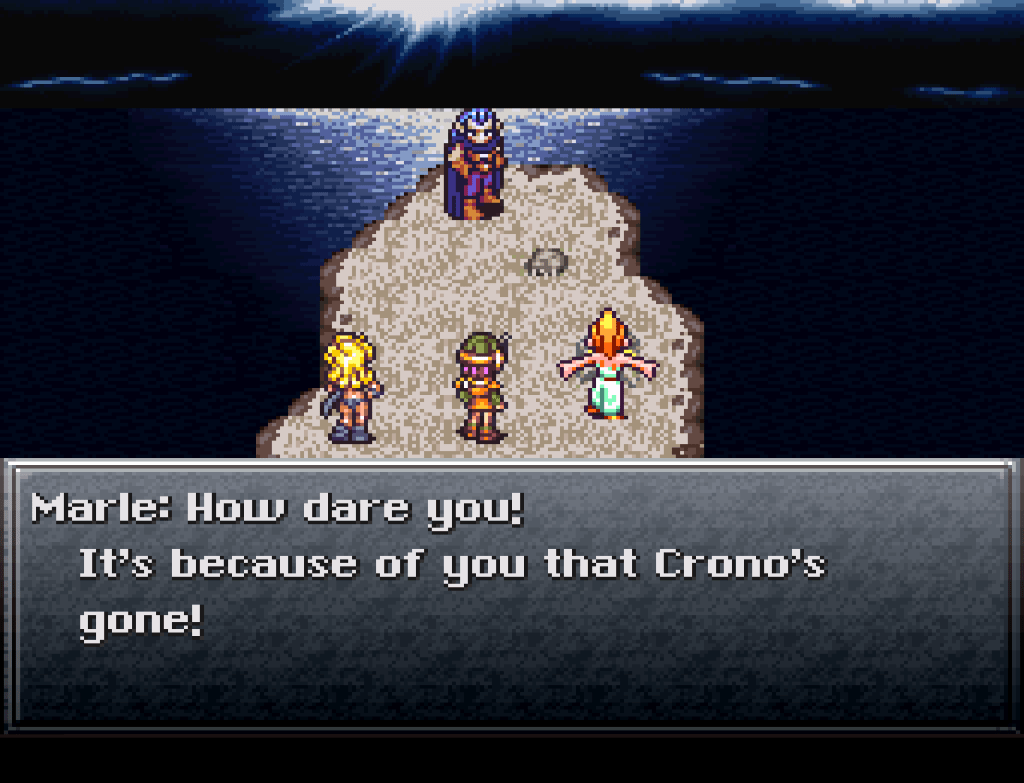
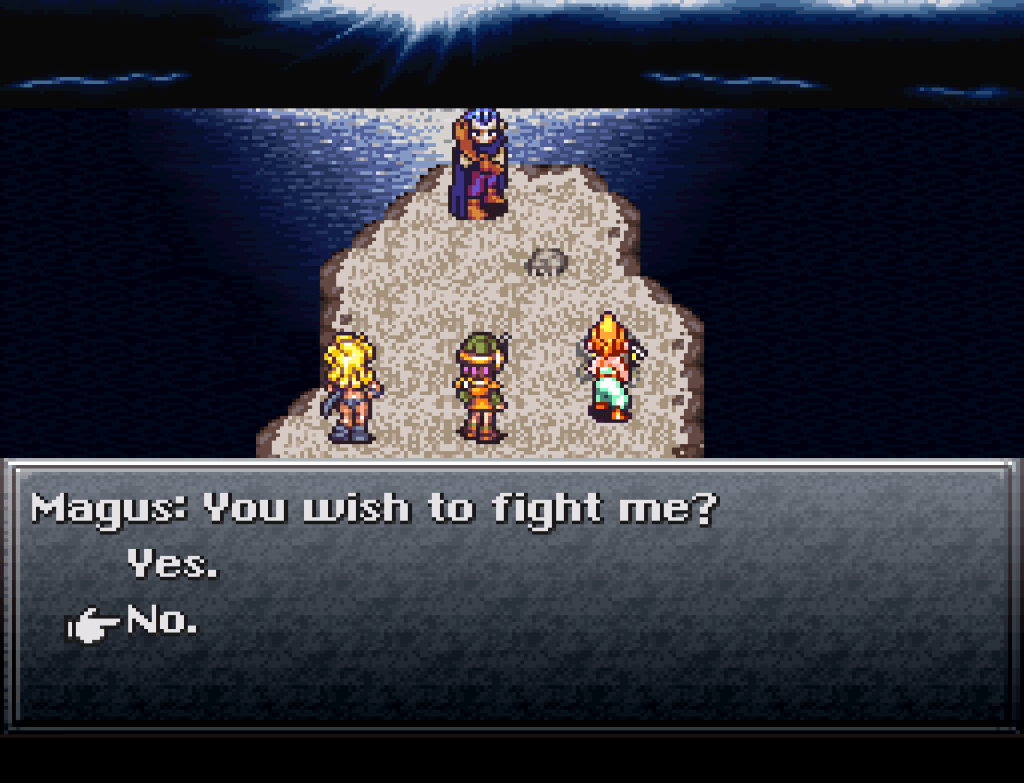
And then when you’re talking to him at recruitment time, he insults Crono directly and picks a fight with the party. Remember – Crono JUST died. The player has been dealing with this for about 30 or 40 minutes at this ppoint and probably isn’t quite sure how to feel. So this vampire looking guy starts mocking our dead hero…what are we supposed to feel here?
If you decide to take him up on the fight and Frog is in the party, you get a one-on-one duel. Those are always so cool in games like this and given the long beef between Magus and Frog, it makes sense. If Frog ISN’T along for the ride, Magus challenges the whole party to a match. Slightly less engaging, but hey, not everybody wants to bring Frog everywhere.
The ending differs slightly here if the party decides to off Magus here. Frog will show up in human form right at the end, which is why you see two different human Frogs in his nameplate up there. It is implied that the curse on Frog slowly lifts after the defeat of Magus – if the party doesn’t kill him, Frog stays a Frog.
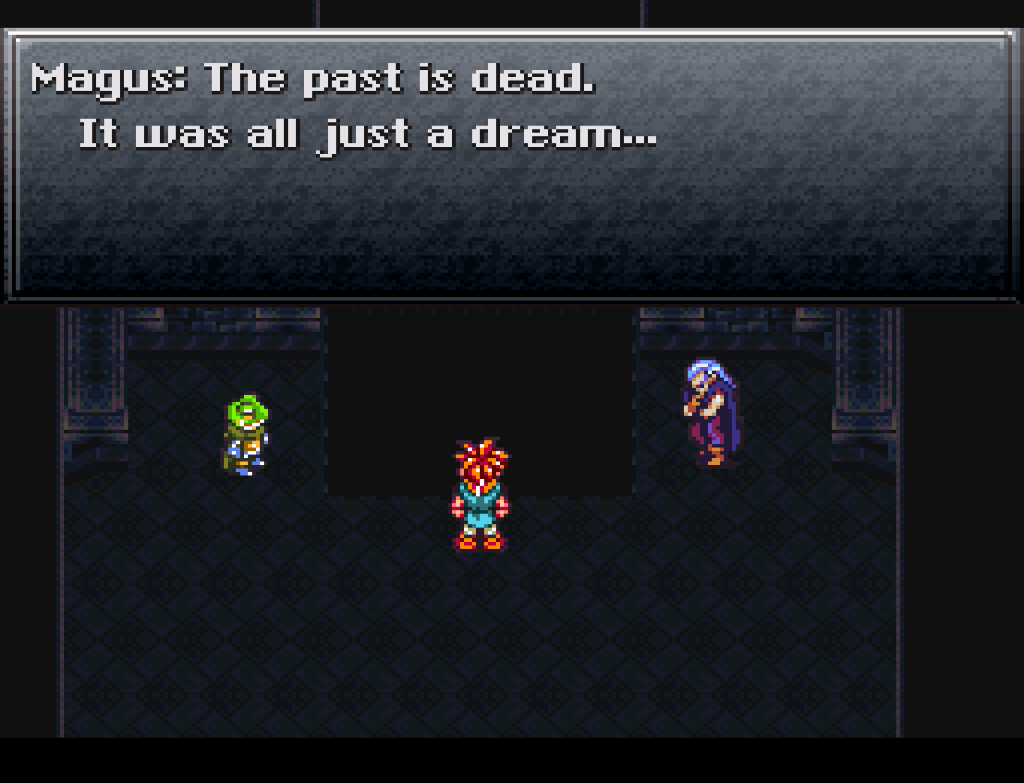
I went into Magus’s background as Janus in the section on the Dark Ages/Antiquity, so I’m not going to go into that as much here. He was a shy kid who was exceptionally gifted in magic but refused to use it because he was wary of his mother. When he got sucked into the middle ages, he fell in with Ozzie and co. because of happenstance. They saw him use magic – which humans at this time cannot use – so they took him in as one of their own.
Now the logical question might be ‘why is Magus trying to exterminate humans in 600 AD? Why does there need to be a war?’ In the Japanese version, it’s stated that the war is started in order to refine Magus’s magic. He is singularly focused on Lavos and avenging Schala. Now as to why he felt the need to keep Ozzie and co. along for the ride? That I have no answer for. Maybe he found Ozzie amusing? They both hate Frog a lot…
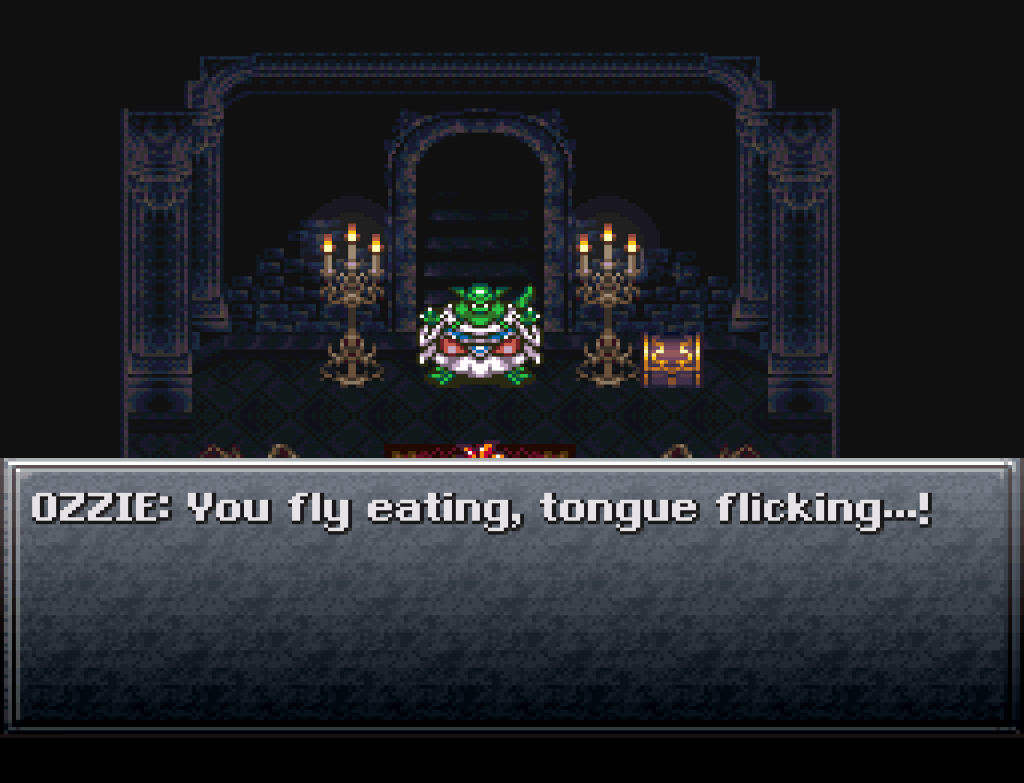
Magus is complicated. He’s a shades of gray character and never really overtly redeems himself. When he joins the party, it comes across that he’s only doing so because he views your group as having the best chance of finishing the fight with Lavos.
He doesn’t seem to particularly like any of the crew and during the ending, which is filled with tearful farewells, he kinda just silently slinks away.
From a gameplay perspective, this is reflected in him not having any natural dual or triple-techs. No matter how much magic you learn and what party combinations you come with, he does not work with any other character. You can equip accessories that give him access to moves like this, but these are hidden and I view them more as ‘what-ifs’ than him suddenly learning teamwork and cooperating.
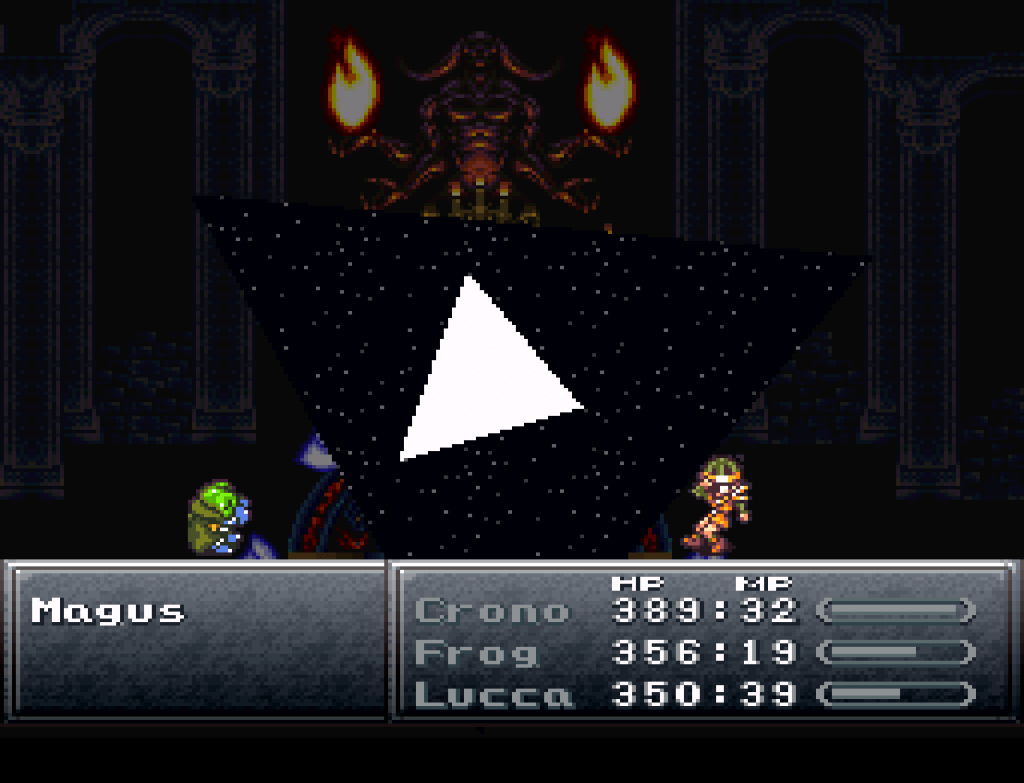
He doesn’t need that stuff anyway. Magus is, hands down, the best magician in the game. Turns out his pseudonym was Magus for a reason! He can use every element of magic and is also the only character who gets to use dark magic.
You lose your best offensive weapon around when this fella joins the crew and the former Janus is pretty much a direct replacement. He has access to every element of magic and his most powerful spell, Dark Matter, is the exact equivalent of Crono’s luminaire.
In gameplay, they are supposed to be two sides of the same coin. I imagine he is made this way to make it easier for the party to defeat Lavos should they decide not to resurrect Crono. The resurrection of the main character is technically optional, ya know. Naturally, since I always revived Crono as a kid, my end game party was almost always Crono, Frog and Magus. It’s lookin’ bad Lavos bros.
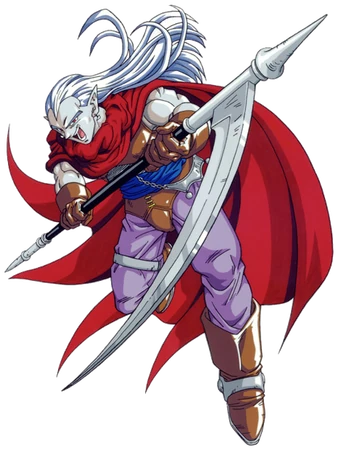
The Cross connection: Probably the most complicated. In Japan, and very recently in the U.S. – earlier for you fan translator chads – Chrono Trigger got a direct sequel visual novel called Radical Dreamers. This game would be essentially transformed into the introduction of Chrono Cross. In Radical Dreamers, one of your party members (Guile) reveals himself to be Magus at the very end of the game. He is still on his search for Schala.
In Chrono Cross, Guile shows up in this scenario too. But there are some key differences. First, he is an optional party member. He was mandatory in Radical Dreamers. The player is given three options to infiltrate a facility and Guile is simply one of those options. So the player can miss him entirely, though I do feel he is the one they make easiest to find.
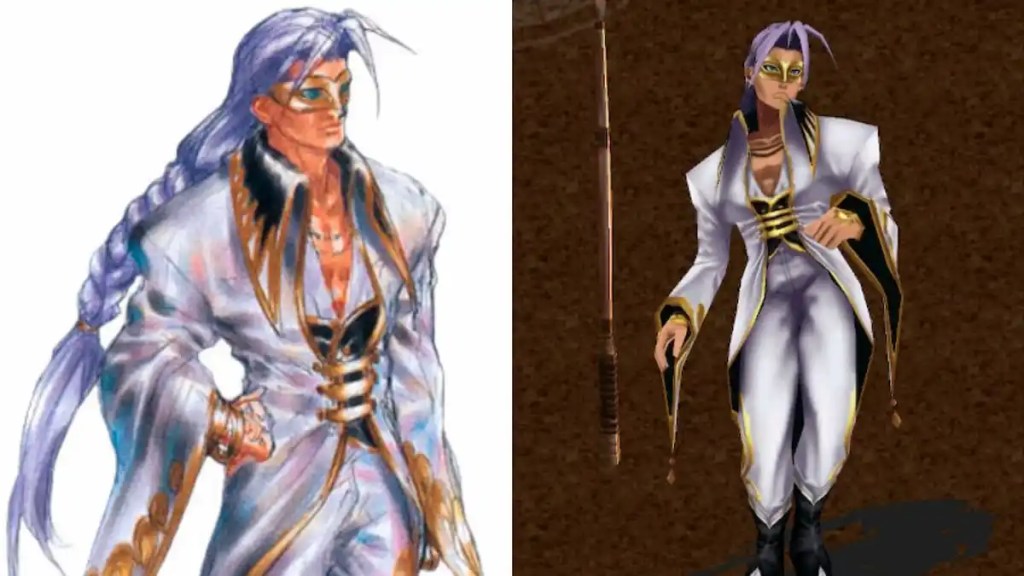
The second is that he is never directly stated to be Magus here. He fights using dark magic and is stated to be a great magician. But the links are not as direct. I believe the reasoning for this is that he’s not guaranteed to be recruited by the player. You don’t want to have one of the most important characters from the original game be missed by a number of the people playing.
The DS/PC version of Chrono Trigger alludes to this and hints that Magus comes to 1000 AD and loses his memory. But this was made well after the fact and is intended to tie some loose ends together. So no matter what you see online, Guile isn’t secretly Magus in Chrono Cross. He might be but any suspicions are simply theories.
In conclusion
Chrono Trigger is one of the best games ever made. Any complaints I have made in here in regards to narrative or a side dungeon or whatever should simply be looked at as nitpicks. This game is a roller coaster ride from start to finish and it should be mandatory homework for anyone with even a passing interest in turn-based RPGs.
I know I didn’t mention music much – I just don’t know how to write in depth about it beyond generic phrases like ‘uh it sounds real good’ – but this has one of the best soundtracks in history. Each character’s theme fits the attitude of that character so well and every track of background music just rules. I swear I’ve heard Zeal’s themes sampled a trillion times. It’s one of Uematsu’s best. Easily.
…And believe it or not, Chrono Cross is considered by many to be even better in that regard.
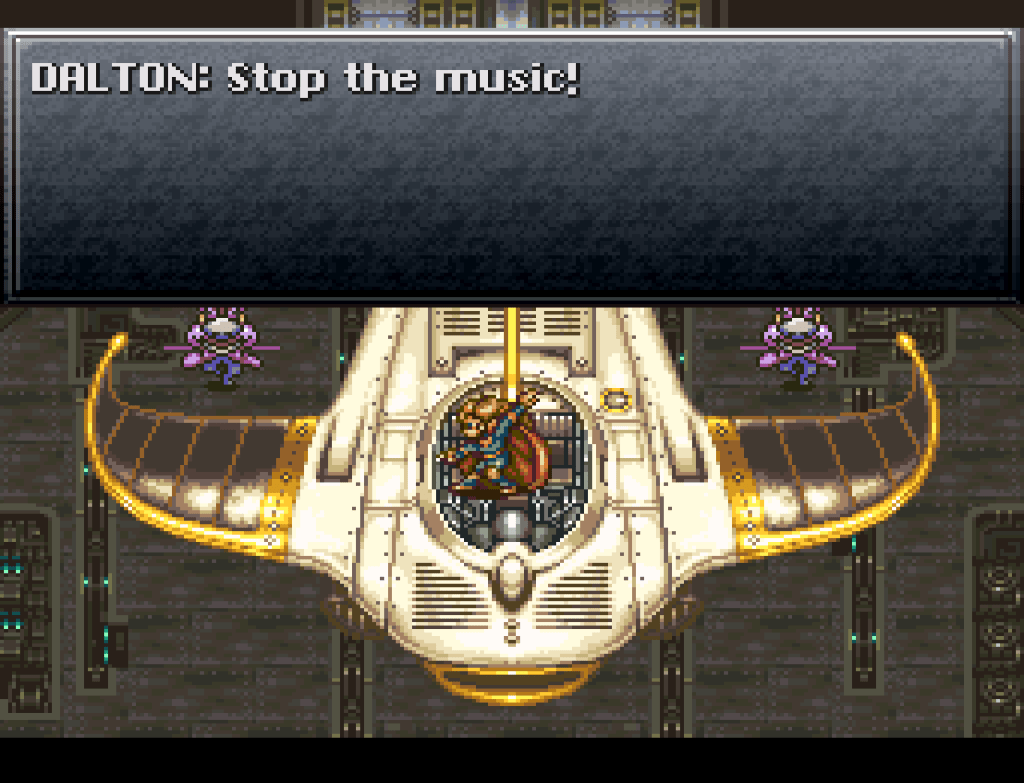
It is simply baffling that, on modern consoles, there isn’t an easily accessible port of this. Chrono Trigger is one of the most iconic games in Square Enix’s catalogue. Yes, it is extremely easy to emulate or simply play on PC, but it should be available for everyone to easily play on their television.
And please. Do not beg for a remake. There is no improving this game.
Score: 5/5
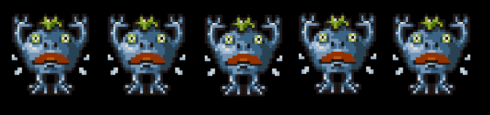
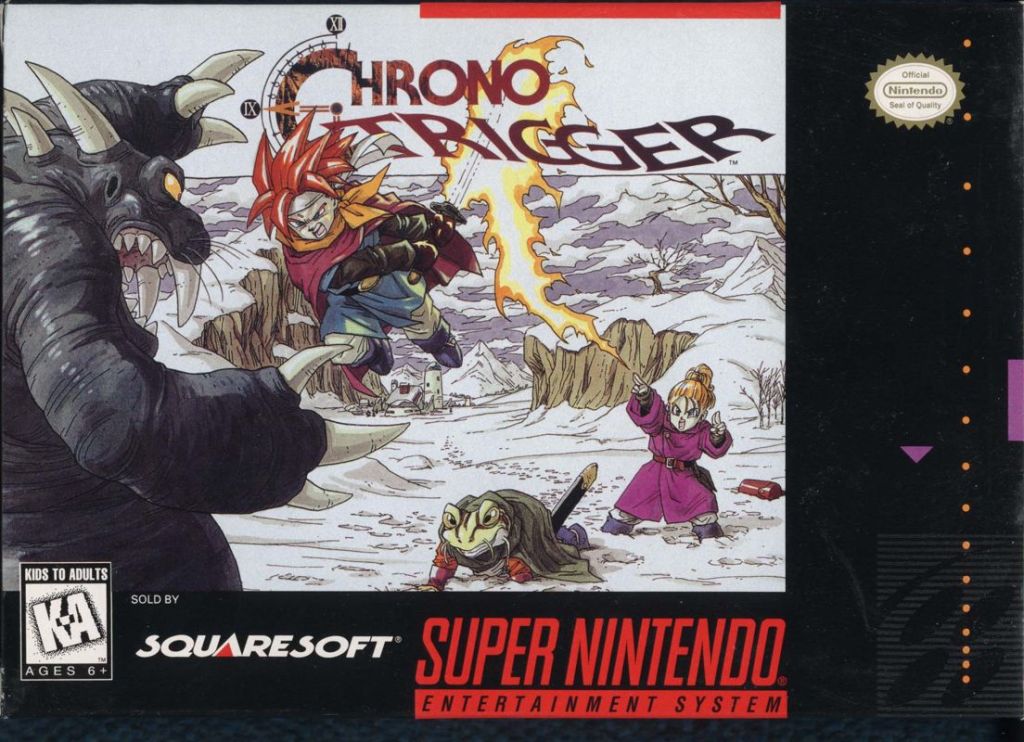
 Vidya Thoughts
Leave a comment