
- Pre-release and basic background information
- Gameplay-focused discussion
- Talk about super bosses and content added in Final Mix
- Narrative focused discussion
- World roundup
- Major characters
- In conclusion
Nuts and gum, together at last
Kingdom Hearts began as a franchise that was pitched as a merger between Final Fantasy and Disney. When I first heard about it, I was thinking that it was some sort of weird joke.
I was in my teens at the time, so I was in my ‘edgy’ phase, which really just meant disliking most popular things for the sole fact that they were popular. Disney was the height of this, and while I watched and enjoyed most of their 90s movies like every other kid of the era, I pretended I was above it all.
Magazines then started talking about this bizarre fusion. Screenshots started emerging of Donald Duck and Cloud sharing the same breathing space and I knew that I needed to be there for it. This wasn’t going to be a turn-based affair either, so I really wanted to see how certain things would look from an action perspective. Would you believe I was excited to see how FIRAGA would look at one point? What in the world was I expecting?
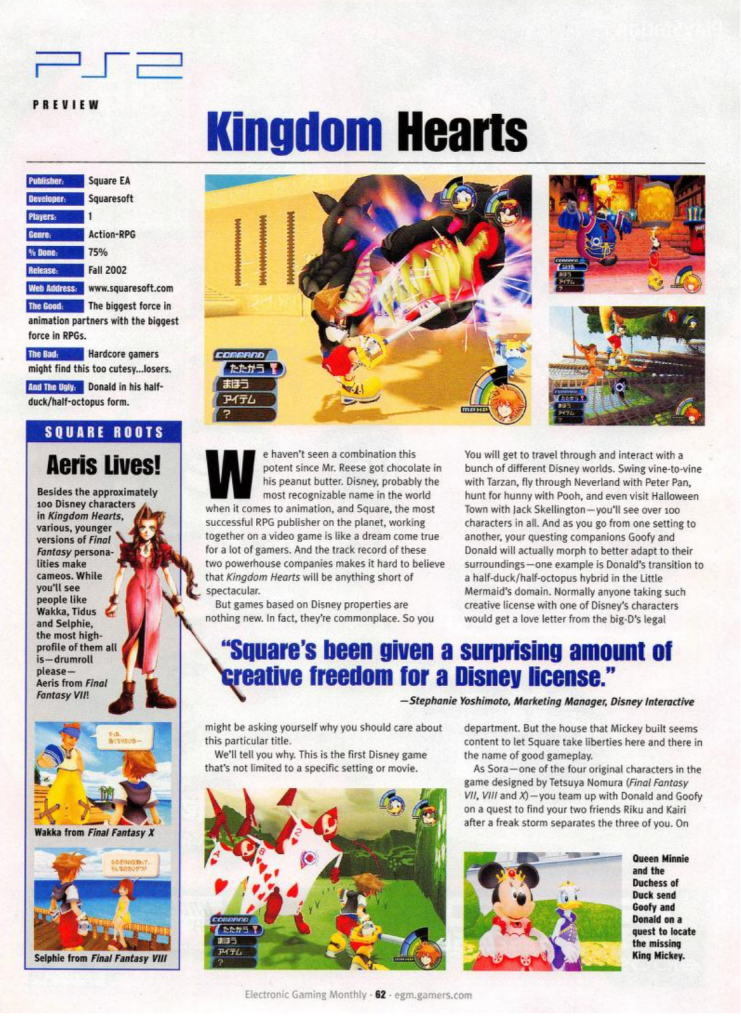
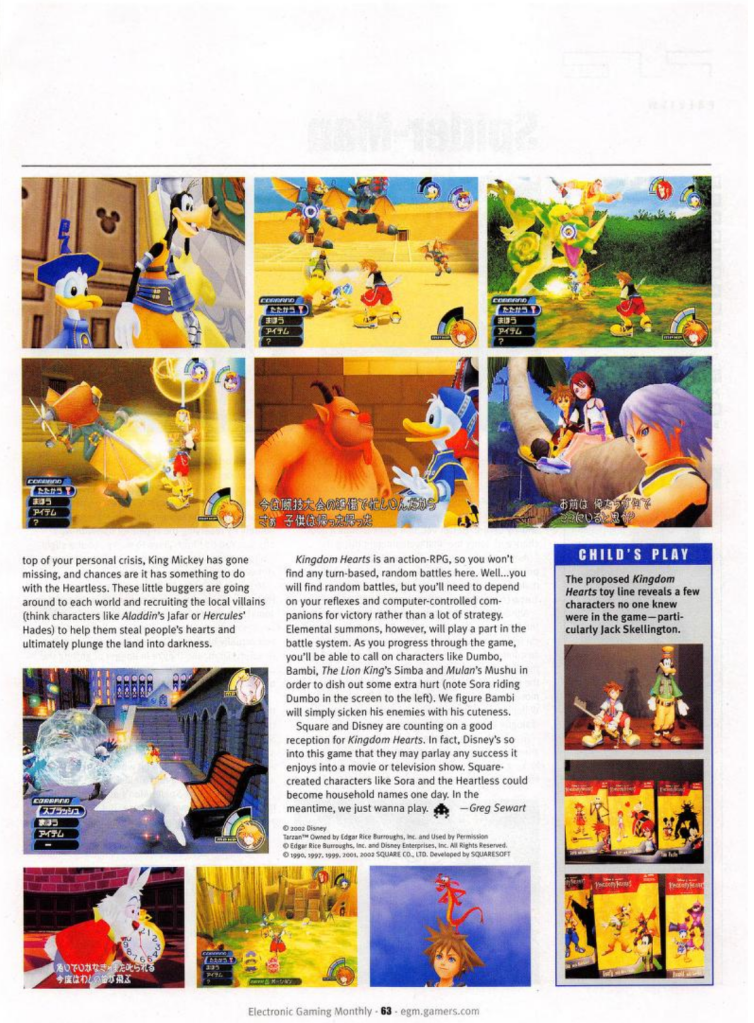
So I put my disgust aside. If Final Fantasy was willing to tolerate Disney, then so could I. Thus began my love of Kingdom Hearts. I appreciated the strange merge because I NEEDED to appreciate the strange merge. If I wasn’t into it, I couldn’t properly appreciate how cool firaga looked on screen, now could I?
Kingdom Hearts released on March 28, 2002 in Japan and September 17 in North America. Just like with Final Fantasy VII, extra effort went into the localization of the title to make up for the short wait and just like with Final Fantasy X, that extra effort saw an additional port later on in 2002 called Kingdom Hearts: Final Mix. The HD version of Kingdom Hearts 1 is based off of the Final Mix version of the game.
The most common telling of how this odd pairing came to be involves an elevator ride between Final Fantasy VII producer Shinji Hashimoto and Disney executives. SquareSoft and Disney shared a building in Japan, which allowed Hashimoto to pitch an idea for a crossover work. Talks went from there.
However, the idea for Kingdom Hearts started before this meeting. Tetsuya Nomura, most well known as the character designer for Final Fantasy VII, VIII and X to this point, had wanted to branch out from turn-based gaming for a little while. The revolutionary Mario 64 sparked something in his mind.
“The fully three-dimensional spaces and the freedom you had to run around them had a big impact on me,” Nomura said. “When I told my colleagues I wanted to make a game like that, they said “but Mario’s already a world-famous character. It would be impossible to start from scratch with an all-new character. … Somebody even said ‘The only way you could do it is with characters that are as well known as Disney’s.’ That really stuck in my head, so when I heard we could be working with Disney characters, I naturally jumped at the chance”
And the opportunity to do that would spring up after the chance elevator pitch. Nomura was in the SquareSoft offices for an unrelated reason and happened to overhear a conversation between Hashimoto and Final Fantasy series creator Hironobu Sakaguchi.
“When I arrived, Hashimoto-san and Sakaguchi-san were talking about a discussion they’d had with Disney, having an exchange along the lines of ‘Mickey Mouse would have been great, but we can’t use him,’” Nomura said. “At that moment I basically put my hand up and said ‘I want to be a part of this.’”
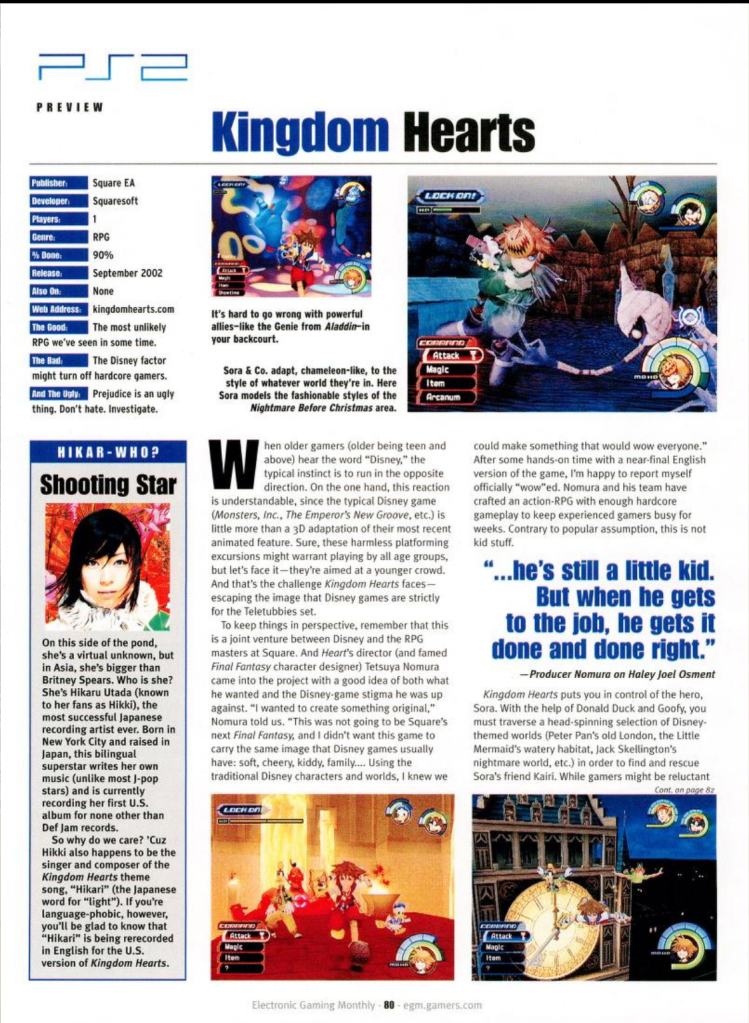
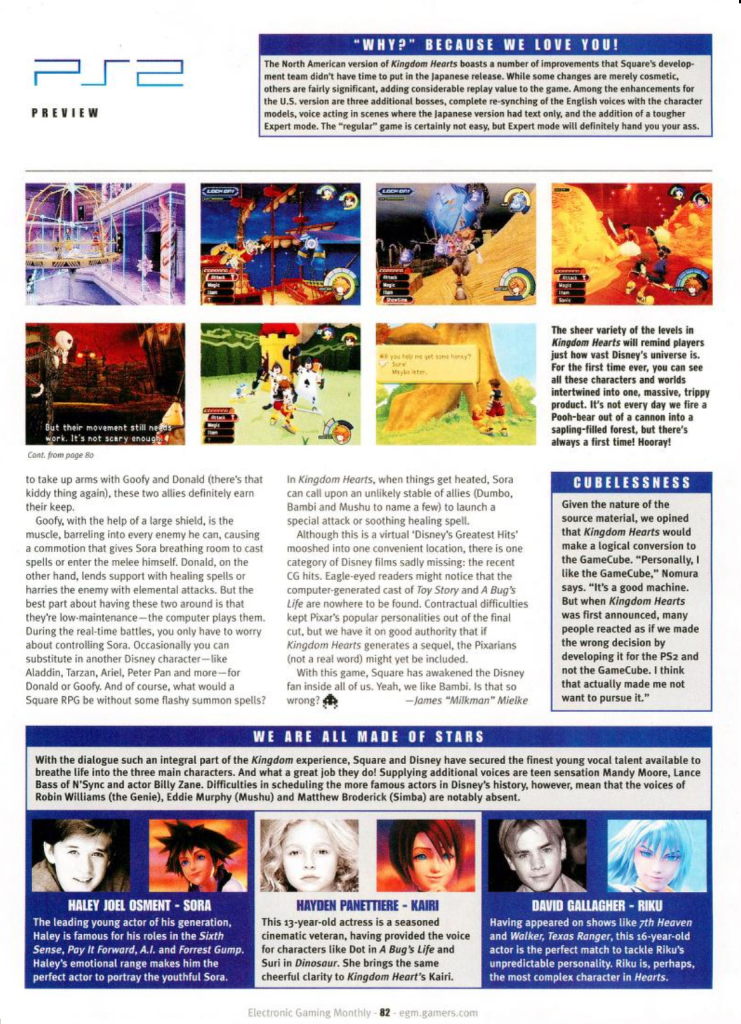
Unfamiliar territory
This would be Nomura’s directorial debut. One of the few things that stayed consistent throughout the development of the original Kingdom Hearts is how it plays in general. It was always supposed to be an action-oriented title. Nomura wanted to create something that took advantage of three dimensions and he would be getting his wish.
To me, the original Kingdom Hearts has always felt like an action RPG made by people who had no idea what an action RPG was even supposed to be. It’s slow, deliberate, makes use of a party system and tries to incorporate player agency in bizarre ways that don’t always work out. As a result, it feels pretty experimental and completely different than the rest of the games in the franchise.
Your basic UI has four options that you can select between with the d-pad. You almost always will be using the attack command, but if you need to select magic or items, you have to scroll down and select them manually. In more intense encounters, this is sort of cumbersome, so there’s a shortcut system where you can assign magic in order to whip it out in a more reasonable way. However, you can only assign three things there, so if you get in an encounter where you need to use something you don’t have assigned to a shortcut, ya better get used to digging.
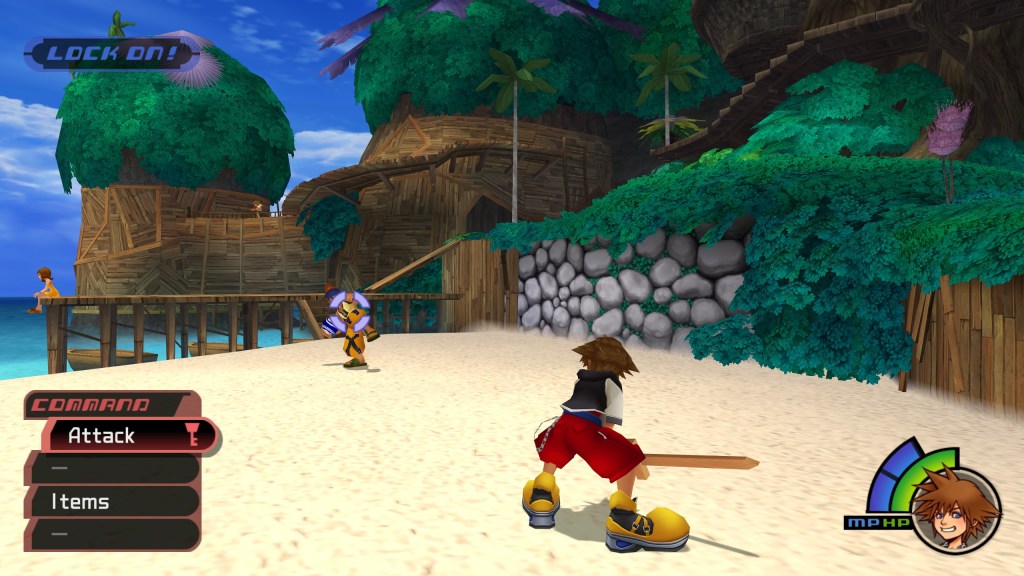
In the original version of Kingdom Hearts, interacting with objects involved using the d-pad as well. You needed to select ‘open’ or ‘grab’ manually in order to do that, which feels particularly foreign. The Final Mix version of the game replaces this with using an action button, triangle, for additional noncombat features. This is an amazing change to the formula and one that stuck with the franchise going forward, to the point that pressing the triangle button almost feels like a Nomura specialty.
Since Square was sort of learning how to make an action-oriented game, please ignore The Bouncer, I feel like this resulted in a decision to make combat more slow and precise, more heady. Final Fantasy often involves using tactics every battle, for instance in X, you would need to think about your next action if you wanted to be successful. How do you accomplish that in an action game? Well, lots of ways, but I think they landed on slow and deliberate for this game.
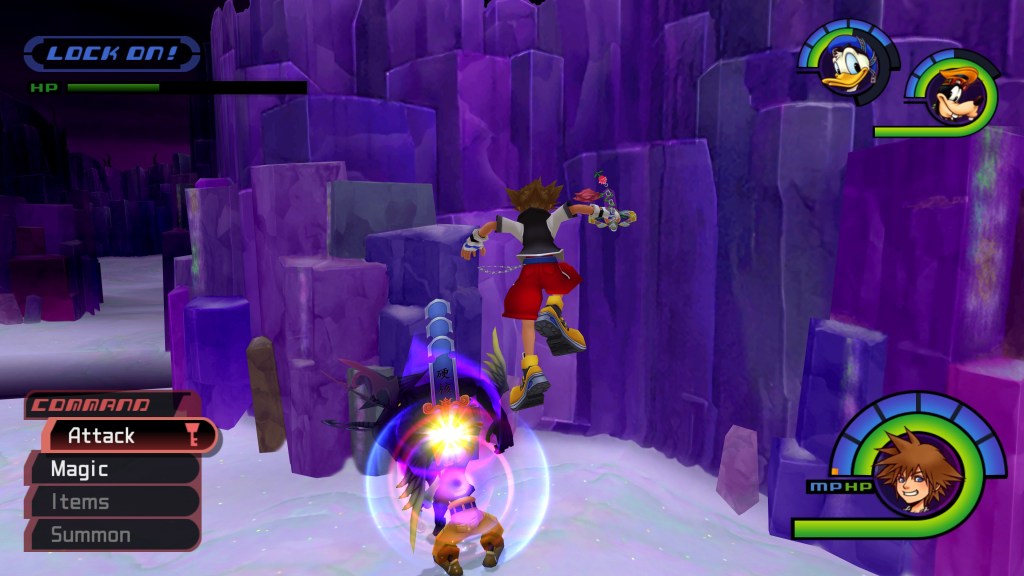
On standard difficulties, I don’t think this really comes into play too much. As long as you make sure to heal yourself, most fights are pretty manageable. Some would say it’s mashy. I’m talking out of my ass here though because I haven’t played on standard since my first playthrough of Kingdom Hearts. On Proud (Expert in the original NTSC U release), the more slow and methodical approach to gameplay really becomes more apparent.
As an aside, Proud mode is the way to play these games. Standard difficulty is too simple. Kingdom Hearts II and III can be straight up demolished with just mashing, with a couple of notable exceptions. When playing proud, it encourages the player to examine their skills and formulate new strategies. I think Proud is the way these games are meant to be played and if someone never tries it, I think they’re robbing themselves of a great time.
If you try to mash your way through Proud, you will not win. Too many enemies block or have counters that will absolutely wreck you. So it’s important that the player takes advantage of abilities in order to win the day, including block and dodge roll, which are the two most important skills of the game. If a player studies what the opponent is doing and guards accordingly, there aren’t too many fights they can’t handle.
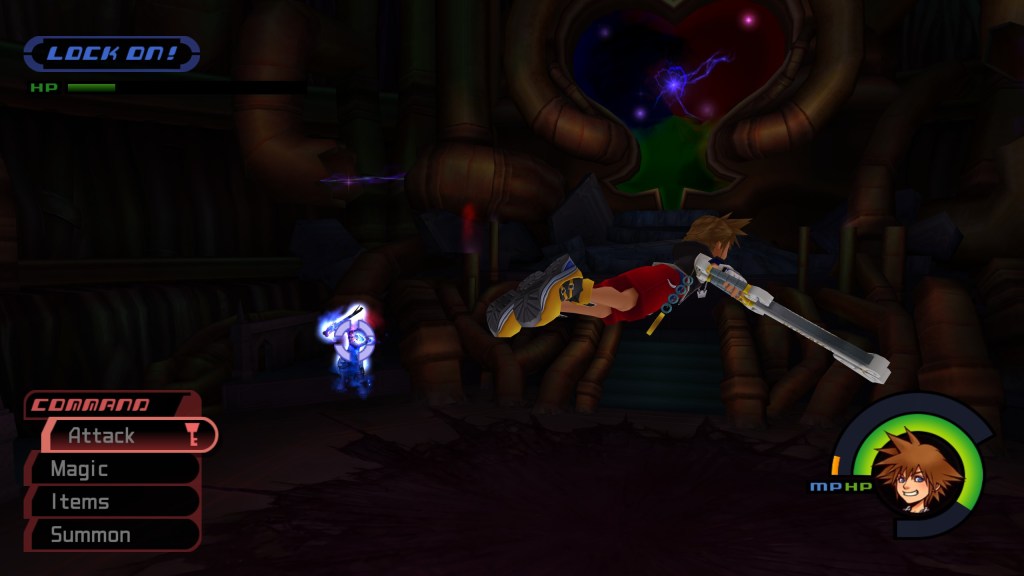
My favorite example of this is in a late game boss fight against the protagonist’s, Sora, best friend Riku. If you go into this just flailing away with your keyblade, the main weapon the protagonist wields, it probably won’t go well. I remember this fight giving me fits the very first time I attempted a ‘hard mode’ run. But then I started sitting back and paying attention to what Riku was actually doing, which led to me formulating a guard-heavy strategy. I haven’t lost the fight since.
Skill issue
While having the player lean on abilities seems good, the original Kingdom Hearts throws a bit of a wrench into things. The game starts by throwing Sora into a sort of black void where he must select a weapon of choice that symbolizes strength, magic or defense. Then you must discard one of these things to make a weakness. I don’t know about you, but when presented with a game-long choice like that, I freeze up and think for a while. Do I really want to go through this journey with weaker attack? Weaker magic?
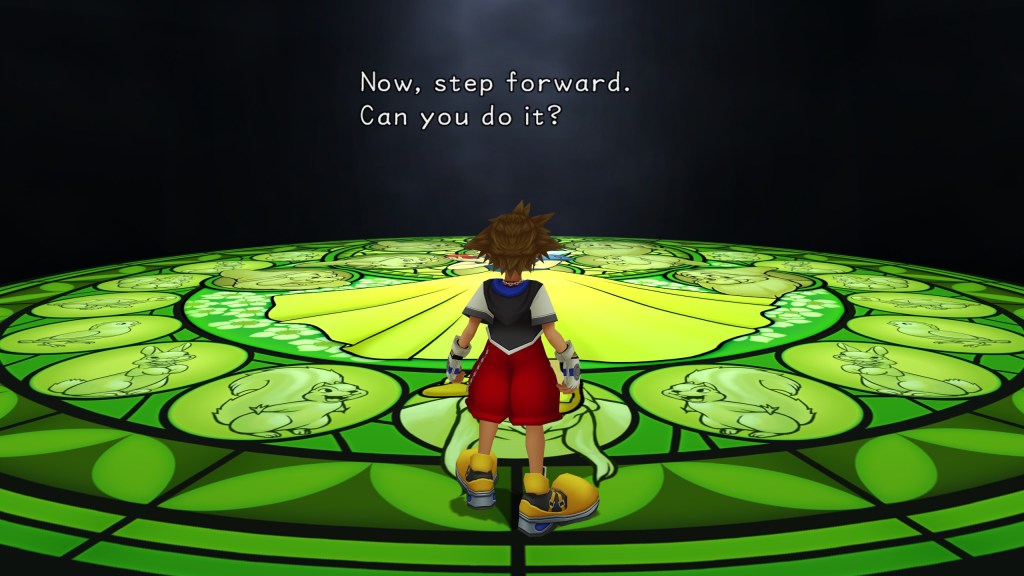
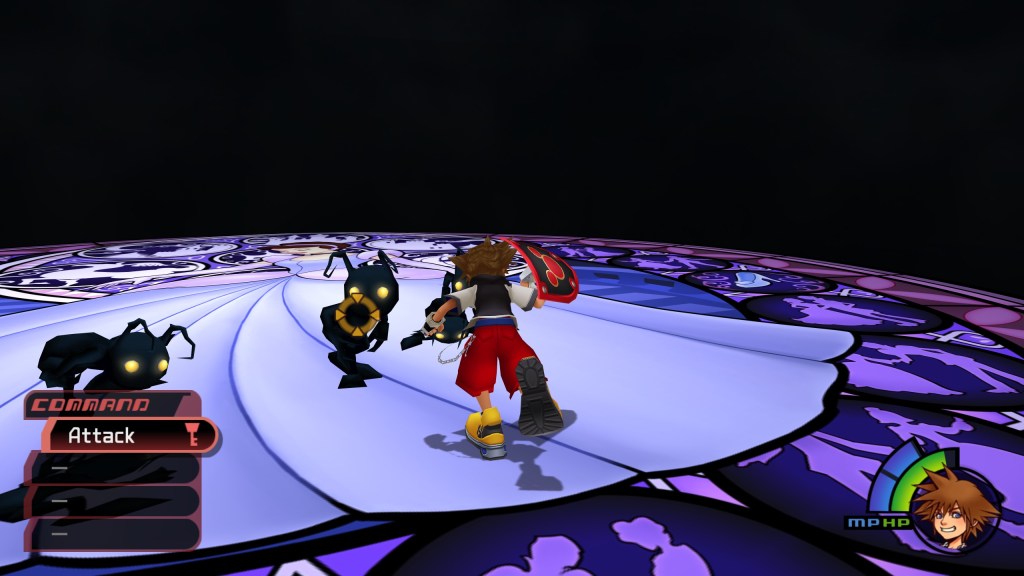
Your choice here impacts two things. The obvious one is your stats, but the less obvious one is when you learn specific abilities. This means that you will not receive certain crucial skills until later on. In proud, Guard is really important, but if you select the sword as your primary weapon, the ability isn’t learned until level 24. And for the staff? 33. You often approach endgame around level 50, so locking away such an important skill for over half the game is crazy.
Another skill that’s beneficial for action games is the scan command. It’s helpful to know how much health the enemy has remaining because it might impact certain tactical decisions the player makes. Why waste an elixir if the boss has a sliver of health remaining?
In most action games, you can just see enemy health bars, but because Kingdom Hearts is trying to emulate Final Fantasy in a way, you need to have an ability equipped to see enemy HP. This is fine, but shield learns this ability at level 21. Fairly late! This means a lot of encounters early on will feel like wailing against a wall.
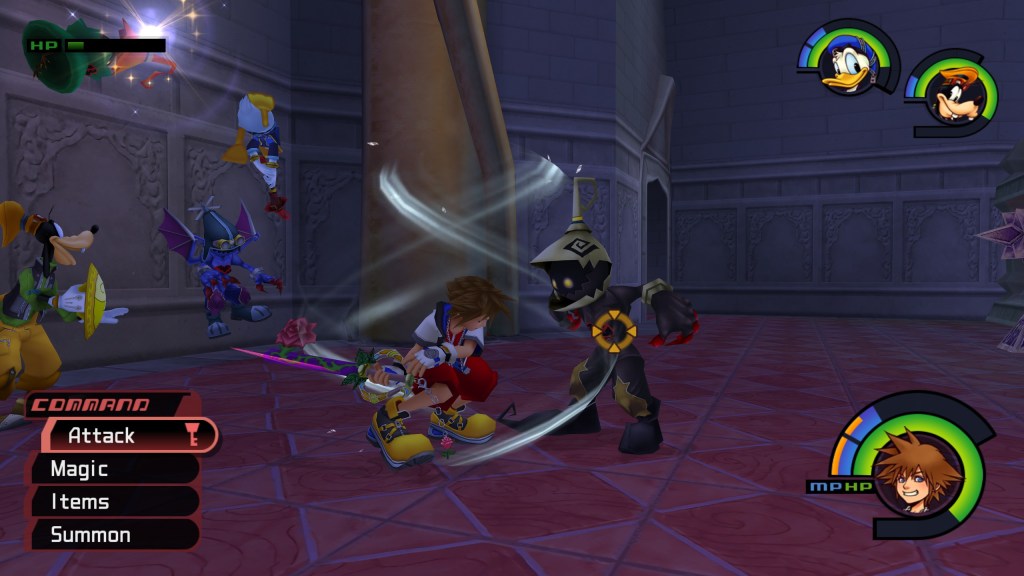
Obviously every game doesn’t need health bars. Monster Hunter, for instance, famously eschews them. However, Monster Hunter also makes enemies appear and act differently based on how much health they have left. Some bosses DO change tactics based on their health, but none of them aesthetically change, so taking away the ability to see your own progress makes things a little more annoying than they otherwise would be.
As a result of how the skill system works, I find the early portions of Kingdom Hearts to be a lot more difficult than later ones.
On this playthrough, the boss that took me the most tries to beat was the boss encounter in Wonderland. It has awkward platforming with no immediate easy way to smack the opposition. I chose shield this time, so I couldn’t see my progress, so a lot of my attempts were just spent hoping that I was doing enough damage. I had no way of knowing for myself until the boss died.
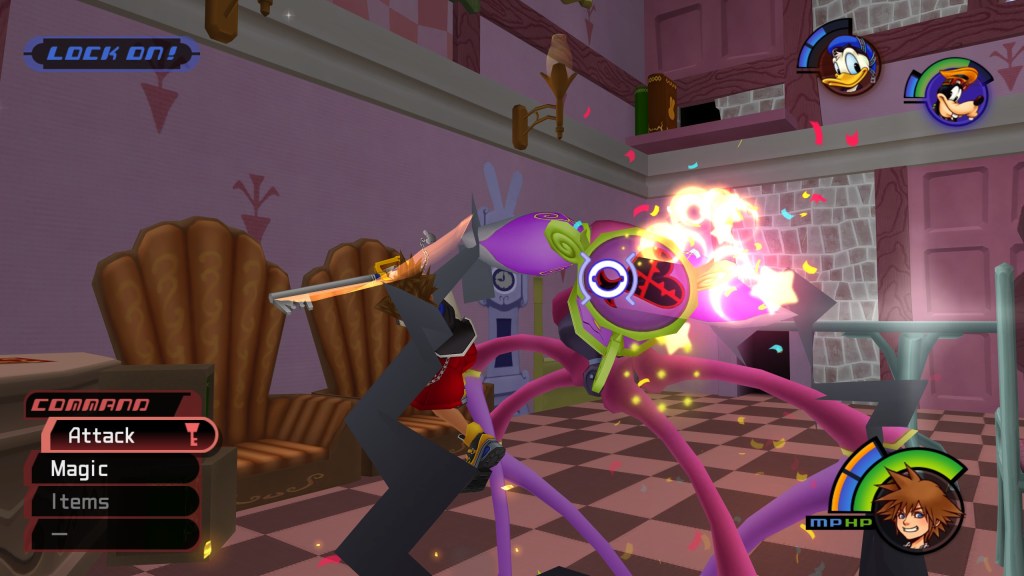
Kingdom Hearts II remedies this by giving the player guard and scan exceptionally early. You get your most essential skills right out of the gate, which makes things like level 1 challenge runs far more approachable. You have the kit to succeed, just not the stats. So go out there and try your best!
I mention platforming in that Wonderland boss because I feel that Square elected to make the environment really important for certain boss battles here. This was a concession of the game not allowing for strategy in the traditional turn-based sense. This is one of the main differences in how 1 and 2 approach boss battles. 1 wants you to take everything in whereas 2 wants you to focus more on the enemy moveset.
Heal me, dammit
Probably the most mixed feelings people have surrounding this game involves how your party acts. Simply put, they are stupid. Having a party is critical to this experience because it’s an evolution of the Final Fantasy formula, but you can tell they weren’t really sure how to approach letting the computer do certain things for you. You can tinker with how the AI acts a little bit, but I find for the most part, your team doesn’t really play into your strategy at all.
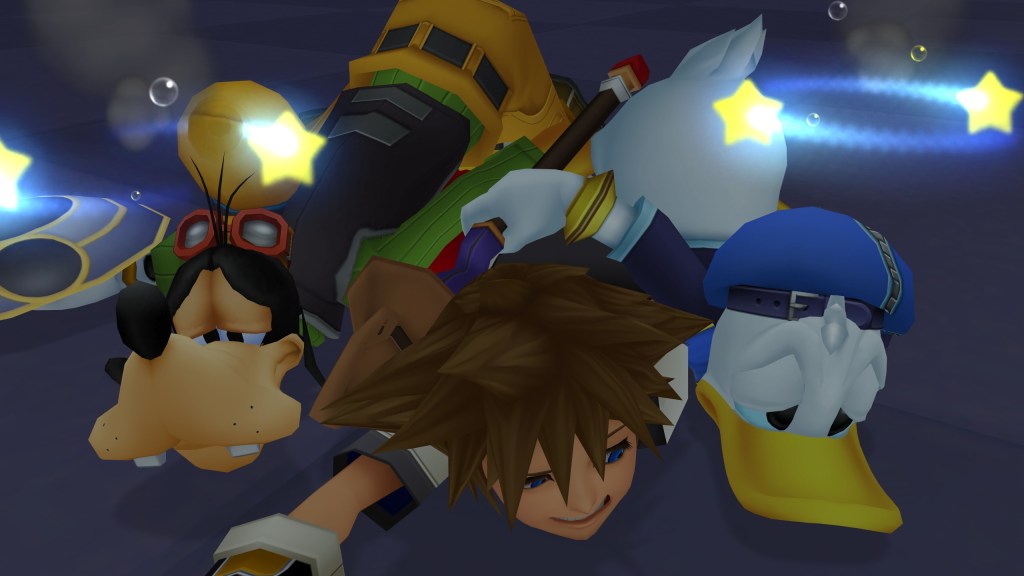
If you give items to your partners, Donald Duck and Goofy, they will absolutely be wasted in the dumbest possible ways. I find myself only giving them items in scenarios where they’re dying too much and I don’t want to waste a cure to keep them on their feet. Donald will often waste magic by healing too little or using the wrong magic entirely for an encounter.
I view the party here as a minor boost to the player. They help you cause a little more damage but that’s about it. Your strategies revolve around you and you alone.
In Final Fantasy tradition, the player is also able to switch around their parties every so often. As a kid, this had me excited because I was convinced there would be a secret Final Fantasy world where I could swap in Zidane or something, but this never happened. Instead, each new world you visit gives you a new Disney companion to swap in. They are better than your main party but there’s a major drawback to bringing them along.
There are treasure chests and elements in each world that are locked away behind abilities that require the core three to be in your party. If you sub Donald out for Tarzan, for instance, you’re prohibiting yourself from grabbing these things. Most players, especially in a modern sense, despise backtracking, so a lot of folks will only visit a world when the story tells them to do that. So switching in a different character just means someone might be locked out of valuable treasure.
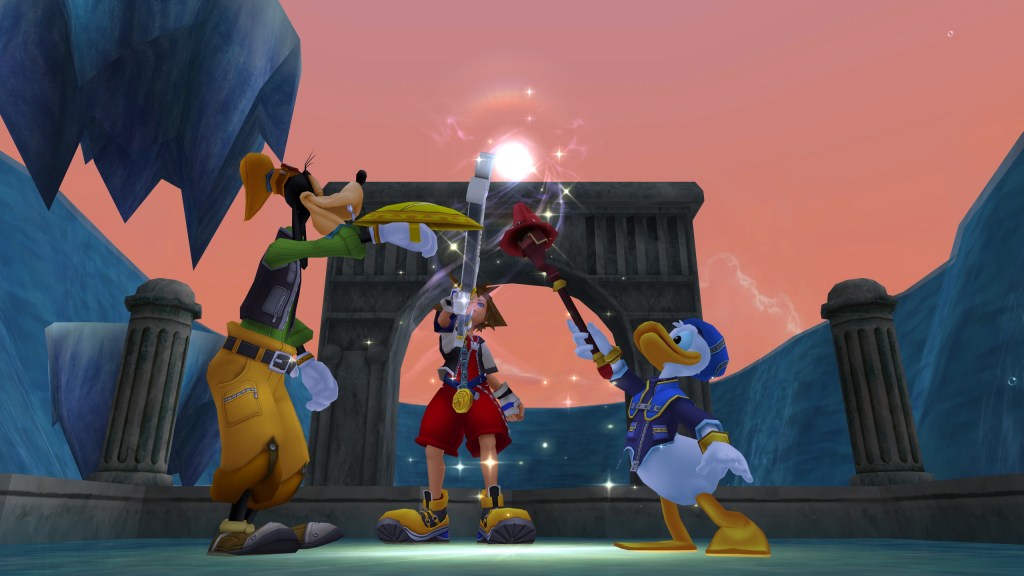
This is another thing 2 addresses by just doing away with that mechanic. Making your parties act differently based on makeup is a cool idea, however, the levels here are fairly open and beg to be explored. If you can’t change your party on the fly, punishing the player for switching things up by withholding treasure seems like a bad idea.
Kingdom Hearts 2 really compresses level design, taking away a lot of the feeling of exploration 1 has. I think the idea that ‘anything could be around the next corner’ fits well in Final Fantasy, so with 1 being pitched alongside the FF brand, the open design works pretty well.
However, with 2, the franchise moves in its own direction. And for what Kingdom Hearts becomes, far more emphasis on action and fighting, linear and closed off levels make more sense.

A real challenge
Speaking of ties to Final Fantasy, super bosses have steadily become more and more of a focus. They have appeared in every game since V and have only been put in more of a spotlight since then. Emerald and Ruby weapons were some of the most feared villains the franchise had seen to that point and FFX had a pretty expansive postgame compared to earlier entries.
Kingdom Hearts takes inspiration from this and throws together some really interesting optional conflicts. The original Japanese release only included one sole extra boss, Phantom, and it’s probably the most annoying one in the game. It involves monitoring a Doom counter (another FF mechanic) and casting specific magic while causing teensy bits of damage. Not challenging and not fun.
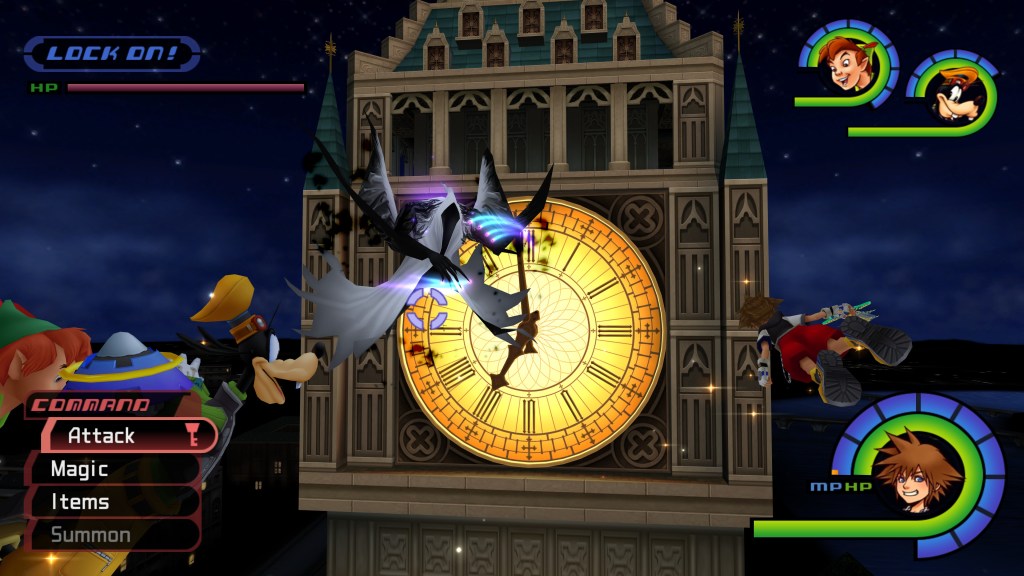
As mentioned above, a little bit of extra work went into getting extra content ready for the North American release and that’s where things really shine. Three additional super bosses are added, as well as an extensive late game tournament in the game’s arena level (Olympus Colisseum).
The first super boss is nothing special, Kurt Zisa. It’s most notable for being named after a contest winner, which gives it a very strange name (well, in comparison to other characters in this game). You basically alternate between physical and magic attacks to break down a barrier and then whack away at the fiend itself once its defenses are down.
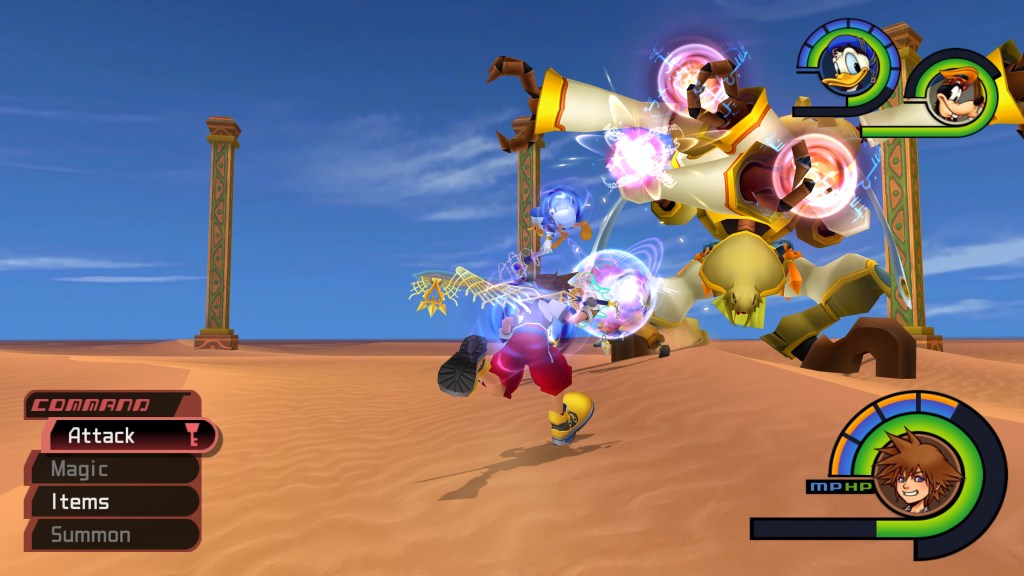
Outside of that, it’s all really solid content, particularly the additional tournament. Players might have felt the need to grind at the very end of the game to tangle with the final world, but instead they have a tournament that’s RIGHT at end game level.
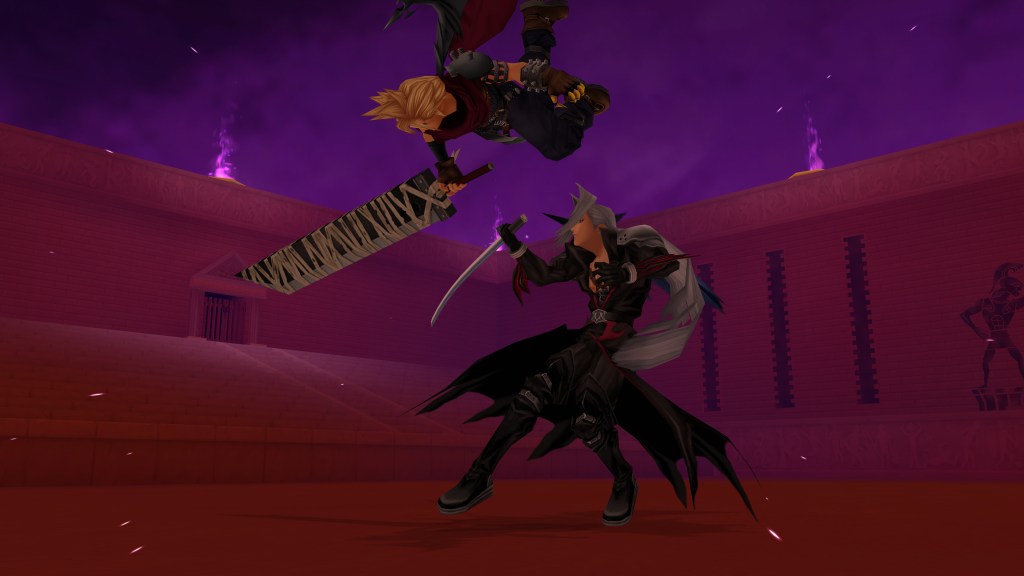
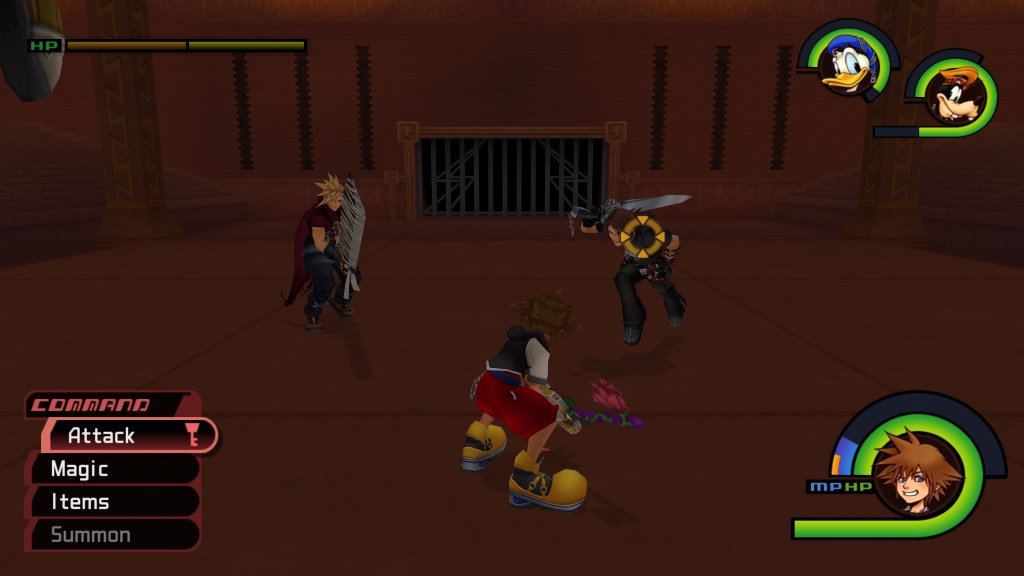
This tournament offers a way to level up without making the player feel like they’re grinding – you’re always gaining EXP while fighting in these things – and it also throws out some really interesting boss encounters. The final boss of the colosseum is really anticlimactic and easy, but you also get to fight Cloud and Squall at the same time, which in the year 2002 was the biggest slice of fanservice pie you could serve.
After you finish with this tournament, the Hades Cup, you get two special bosses in this same area. The first of which is the Ice Titan, brother to the final boss of the Hades Cup, Rock Titan. Jack Frost here tasks the player with staying mobile and timing blocks to bounce back attacks. The game has a spell that auto-reflects attacks aimed at you, aero, but the Ice Titan changes movesets when you try to utilize this, so the only way to win is to get good at monitoring the fight, understanding the terrain and blocking.
It’s a fantastic battle and can be completed pretty easily once you finish the Hades Cup. For me on this playthrough, the key to victory was simply equipping a charm that reduced damage by ice attacks and just paying attention to his attacks and learning where and when to move. No grinding needed, my favorite kind of super boss!
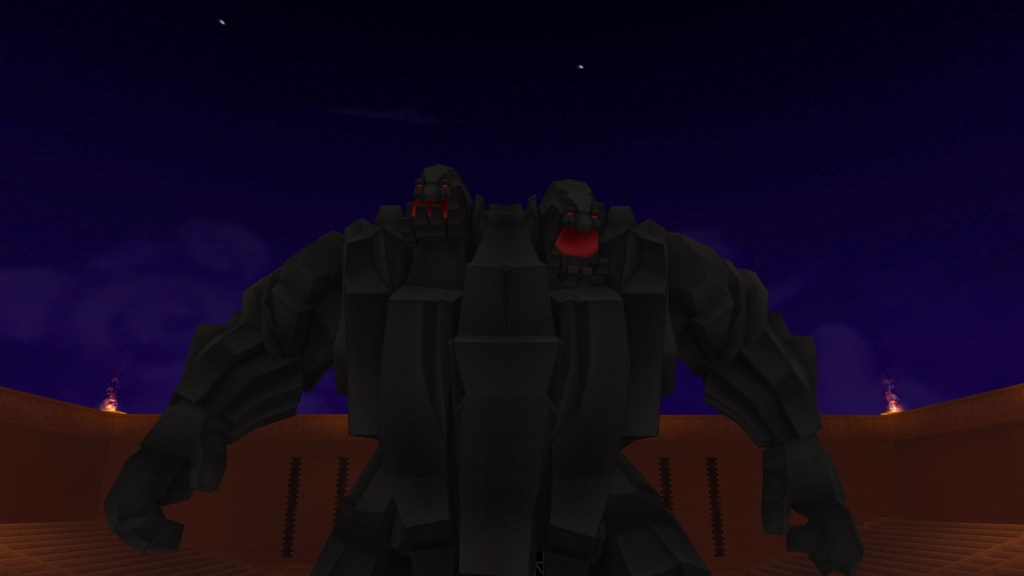


The other colosseum super boss is Sephiroth, a very fitting foe for what was pitched to many as a Final Fantasy spinoff. Ol Sephy descends from on high and is a pretty intimidating figure. The first time you fight him, the player has a good chance of being one hit. And even if the one hit doesn’t kill the player and Sora is able to get some offense off, Sephiroth’s health bar is so big that it doesn’t even display damage for a good few whacks.
If you’re going to fight him without grinding, it requires a lot of patience and studying. You need to know when it’s safe to jump in and swing, you need to familiarize yourself with his attack that drains all of your MP and all but one of your HP, you need to know when to expect his explosion counter and you need to have beneficial abilities like the one that makes you impervious to damage while casting heal. It’s a tall order but it’s possible, which makes this one of my favorite boss fights in the franchise.
That said, it’s hard and ultimately most players will decide grinding is probably the path of least resistance. KH1 is very kind with this, allowing the player to create infinite attack and defense increasing items, so if you know where to grab certain materials, you can up your stats considerably without needing to hit level 99.
With increased stats, I don’t think this fight is too hard. I like this approach though. Beatable to those who want a challenge, but also beatable to those who just want to see everything and are willing to put in the work for it.

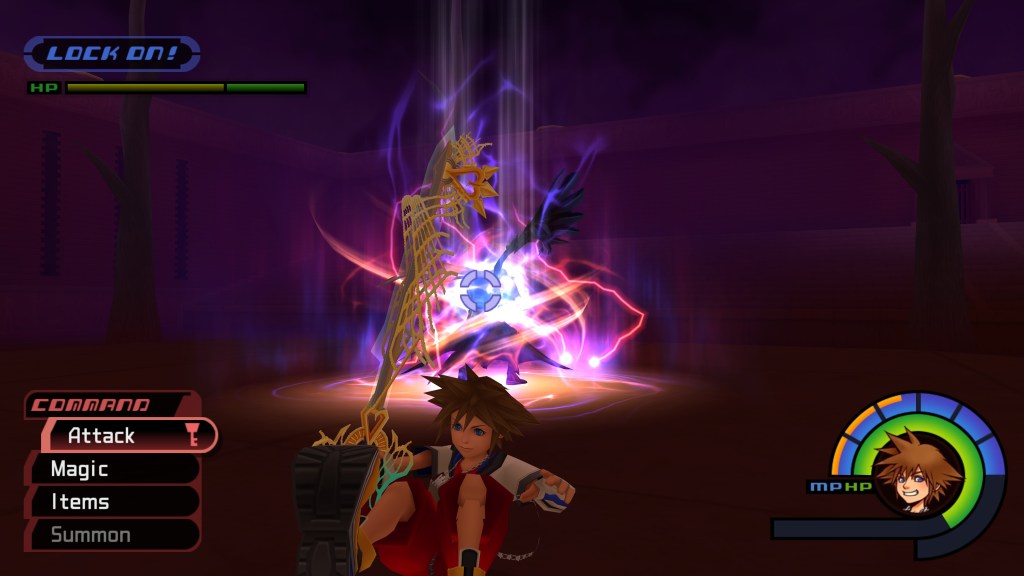
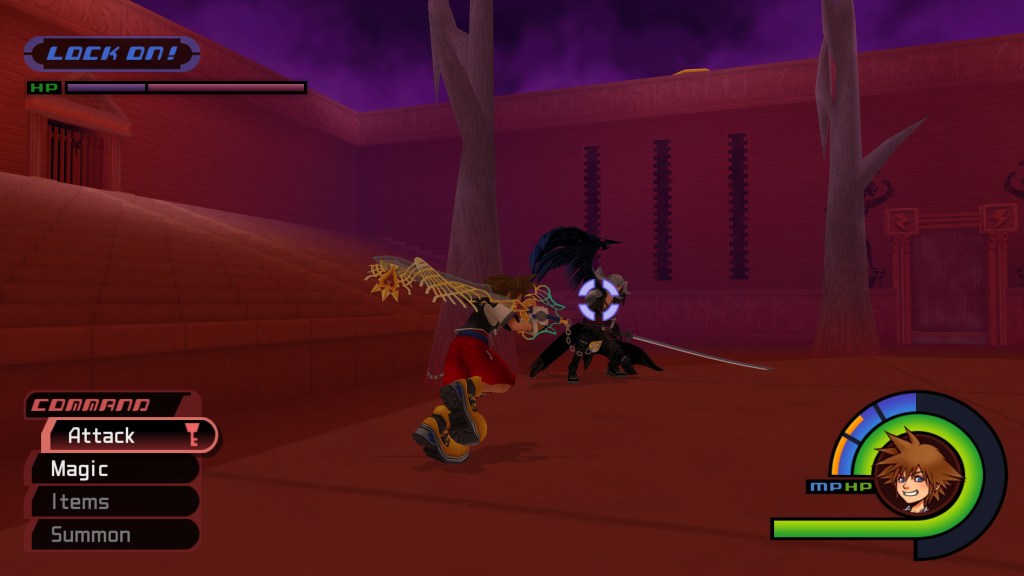
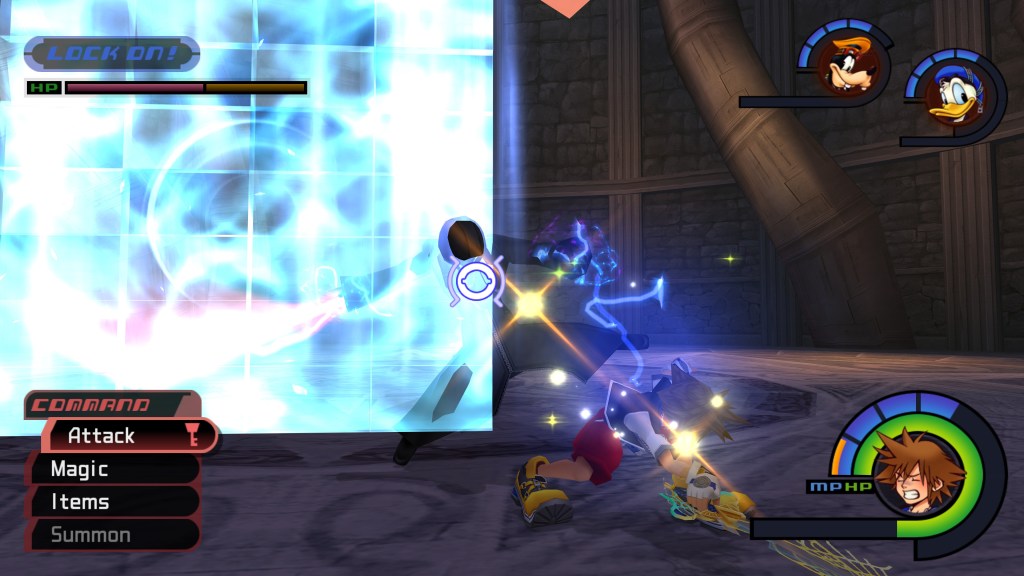
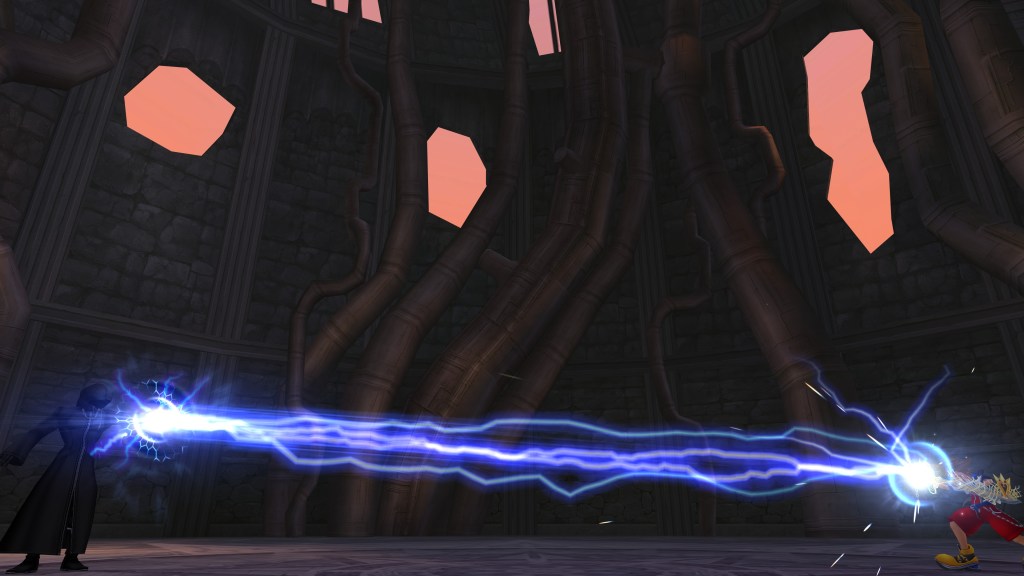
There is one final additional boss. With the release of Final Mix, it was pretty clear that there would be more than just one Kingdom Hearts adventure. So it seems fitting that the final extra boss would serve as a preview for what’s to come. He is named unknown and he serves as a bit of a preview as to what’s to come in future entries in the series. This marks the debut of the iconic Organization XIII black robe.
This is the hardest fight in the game and at times feels like a Kingdom Hearts 2 boss just got planted in the middle of Kingdom Hearts 1.
2 is a much, much faster paced game, so it’s a little jarring at first. He even borrows a move from the final boss (hint, hint as to his true identity) that hurts you if you don’t select the right command from your menu. Still, paying attention and acting defensively can win the day here too. I do think there’s some annoying elements in this battle that prevent it from reaching the heights of the Sephiroth encounter, but I will say this is a fitting conclusion to the bonus content in KH1.


Making sense of everything
Making a game with Disney, a company notoriously stingy with how they handle their intellectual properties, was a tall order. Most of the pitches Disney had for Square involving Kingdom Hearts were simpler tales more in line with what you’d see at the theater.
Nomura rejected them all and Sakaguchi confided with him that this team-up would be a failure unless they added some of that Final Fantasy spice to the equation.
“We talked about concentrating on the gameplay and just making a simple story, and we also thought about Disney’s target age range, and thought maybe we should avoid a complex story,” Nomura said. “I got a talk from Mr. Sakaguchi, saying that if we didn’t aim for the level that FF does, this project would be a failure. The gameplay was always the same sort of thing from the start, but we improved the story greatly. … We were thinking that you’d kill Maleficent and the game would end there.”
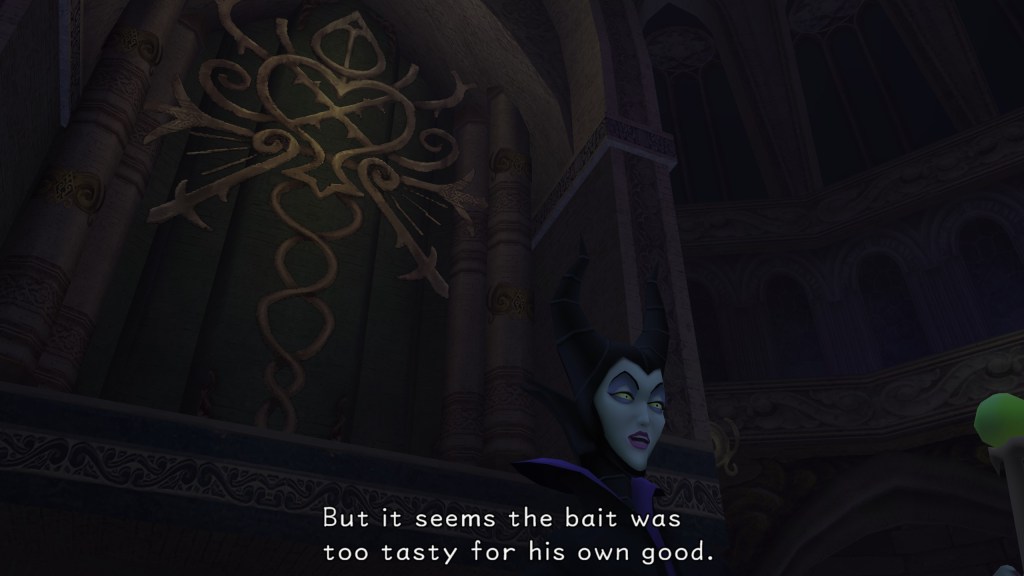
So simply having Maleficent be the big bad behind it all was unacceptable, they needed to dig deep into why the main characters are fighting, what their motives are and what exactly the villains are supposed to be. Simply saying ‘evil monsters must be killed’ might have worked for 8-bit Final Fantasy, but RPGs in general were a lot deeper at this point in time. Do you need me to break down Cloud’s mental decline again?
This leads to there being two concurrent plotlines going through most worlds. You have Sora and company aiming for the greater overall goal of finding their friends and king while figuring out the mysteries of the keyblade and heartless, but you also have the individual storylines for each world. The worlds do not interconnect in any way, something the game refers to as meddling, which is codespeak for “Disney will NOT let Aladdin throw a sword at Ursula” so the overarching plot is what ties everything together.
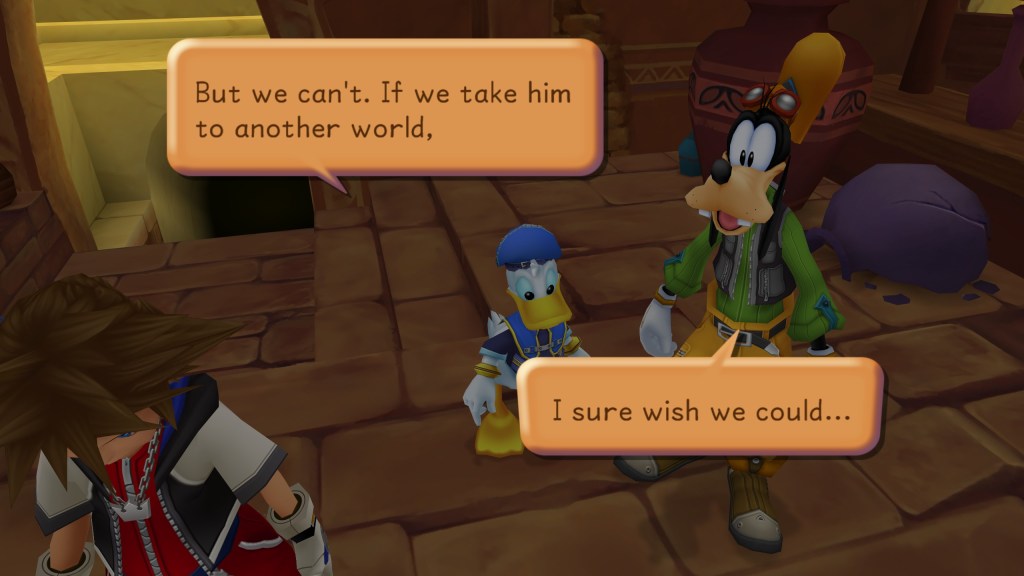
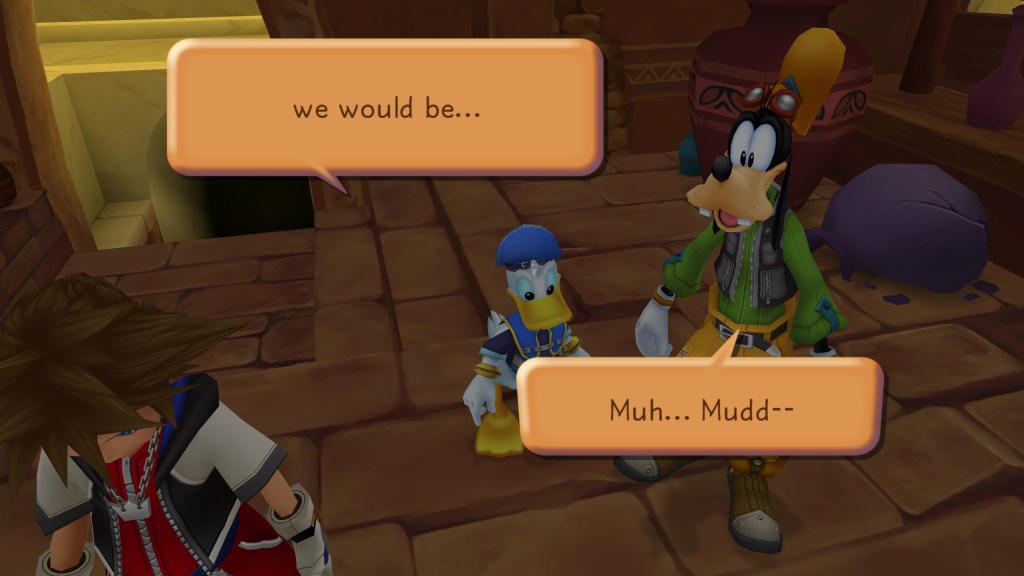
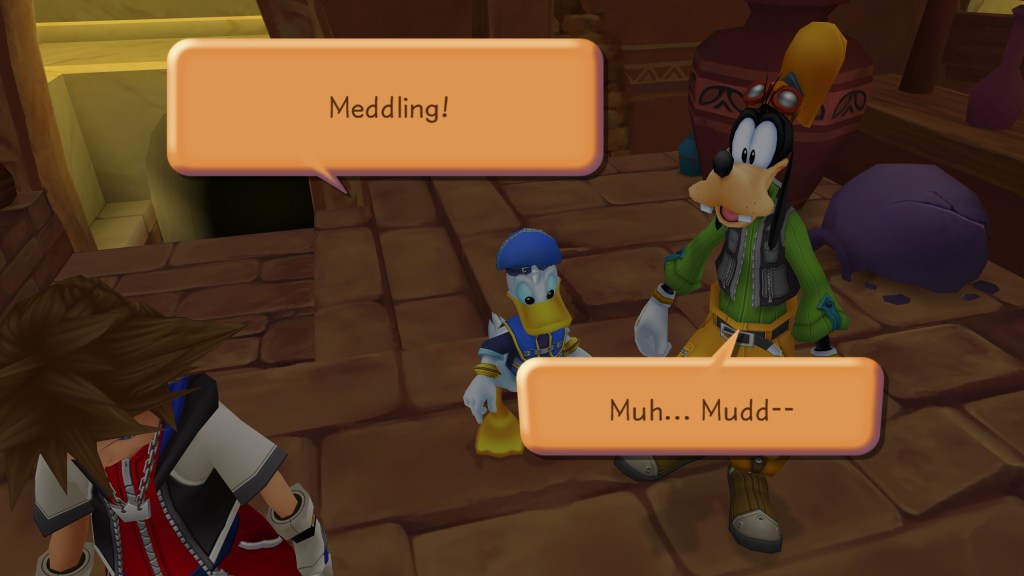
This is not the only game in the franchise where there is this sort of separation. Every single entry has to deal with this problem and each seems to have settled on a different solution. In Kingdom Hearts 1, the primary plot is often told via a roundtable of shadowy Disney villains conspiring in a black room. Usually at the end of each world, you’ll get a little update. Most worlds stick to the affairs of that planet until you finish the boss of there.
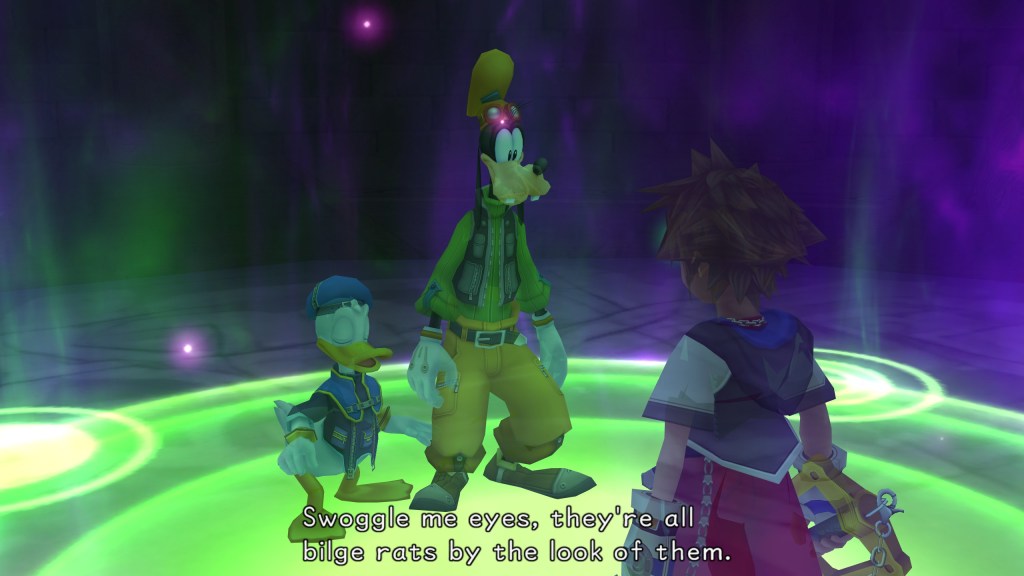
Where the “complication” comes in are journals from the game’s primary antagonist, Ansem. This is how you learn a lot of factoids about the heartless and how this whole mess got started. These are often relatively vague sounding, but they do make sense and they especially make sense on replays.
These journals also bring about more questions than answers and to be honest, that’s one of the charms of the franchise. Kingdom Hearts loves throwing out seemingly deep phrases and words that get your mind sparking about what could be behind the next corner. It’s that sense of discovery that a JRPG player might be accustomed to. Would this playthrough unlock new secrets to the universe that the player missed the first time?
Kingdom Hearts often gets accused of being convoluted or hard to wrap your head around, but during this introductory phase, before KH really discovered its own identity, I think everything is very simple.
Even with the little bit of Ansem plot details lurking behind the scenes, the story is very straight forward and easy to understand. There won’t be many people confused about what’s happening here. So those little bits of mystery go a long way to keep this simple tale from feeling boring.
Another Side, Another Story
They also tossed in a secret ending, which adds to any feelings of mystery. Final Mix adds an expanded version of this scene, but my take on it applies to both.
What you see in the secret ending is unlike ANYTHING you see during your adventures in Kingdom Hearts. It looks dark, moody and serious. You see cloaked figures fighting each other as mysterious words flood the screen. This ending made my mind go insane. What would a sequel look like? Why was it so brooding and dark? Was that Riku with the blindfold?
You get most of these answers in Kingdom Hearts 2 and the side game Kingdom Hearts 358/2 days. But this little teaser went a long way in making me want to see just what the hell was next. I know I spent a lot of my first KH2 playthrough just waiting for that cityscape to pop up. I spent all of that playthrough waiting to fight the neo heartless that show up there. Simple to follow but they give you enough crumbs to whet your appetite.
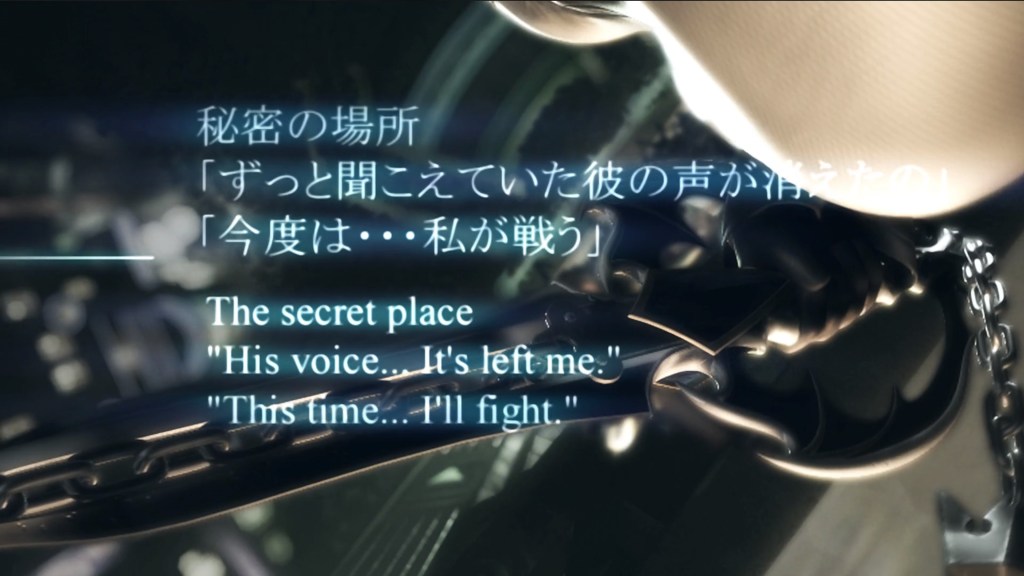
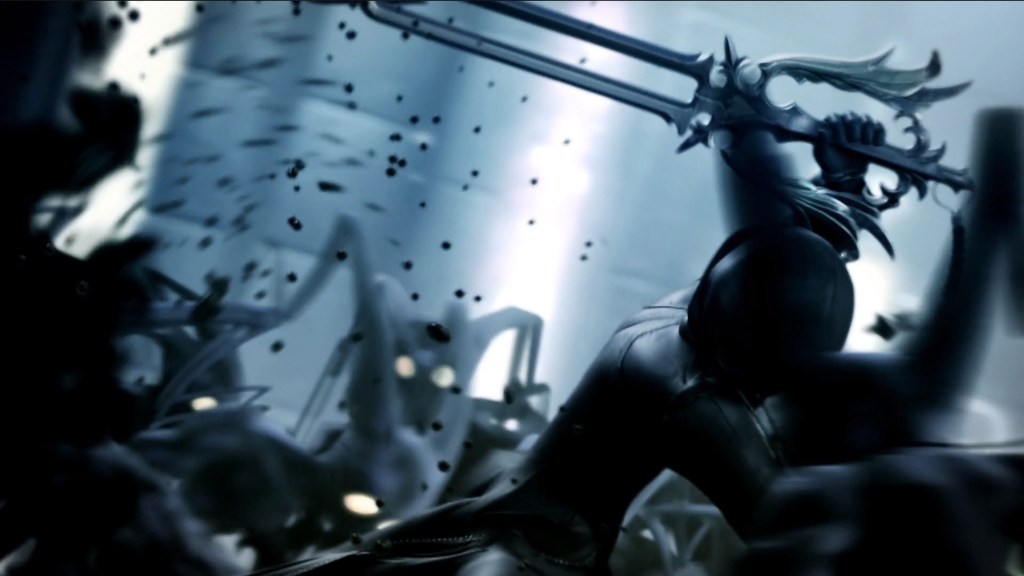
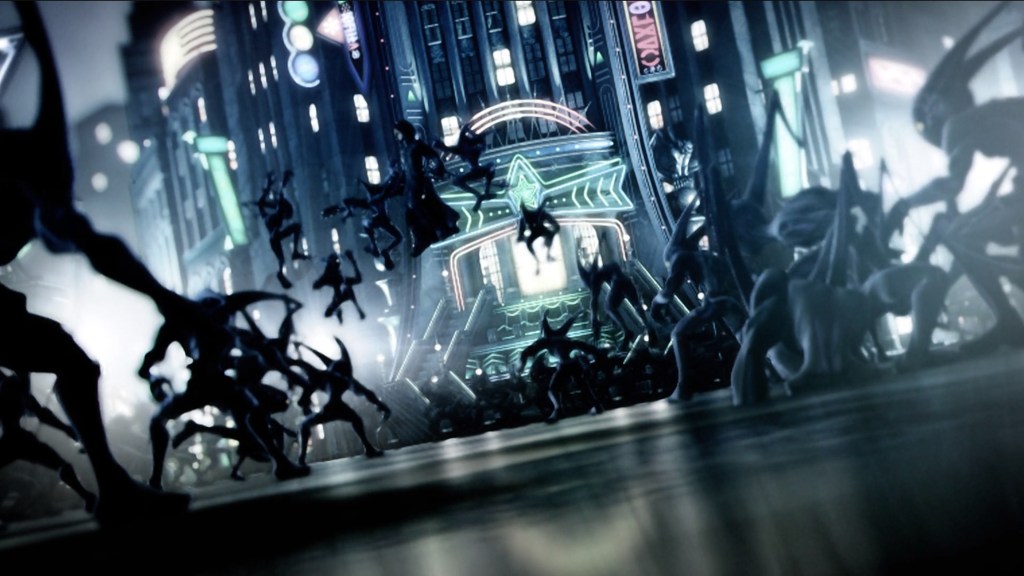

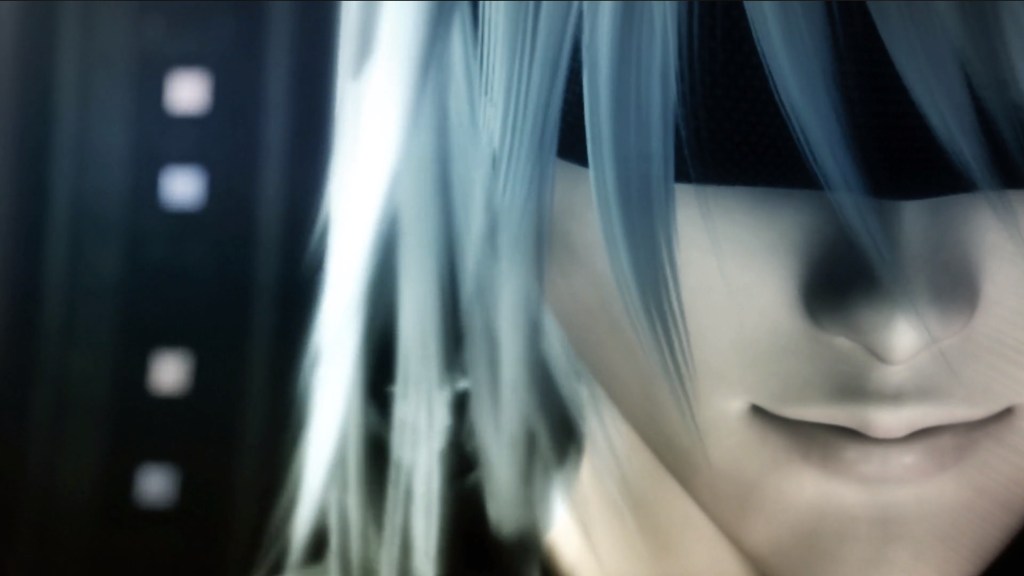
The reason I mention the dark tone of the teaser video is because Kingdom Hearts 1 absolutely does not have that tone at all. It’s a bright and cheery game. As a protagonist, Sora is the antithesis of this teaser.
The tone here is one of my favorite things about the franchise. A lot of media is afraid to be super cheery or positive or corny. Let’s take a look at Borderlands. It feels like any time there’s something serious discussed, there’s always a joke around the corner to break up the seriousness or downplay what’s going on. I view this as the author saying ‘I know this is kinda silly but they TOLD US to have a story.’
Kingdom Hearts has nothing like that. There are lines of dialogue that feel like they’re just itching to be picked apart by a smarmy comedic sidekick or a fish-out-of-water hero, but it just never happens. Everybody takes the darkness super seriously, it’s no laughing matter. I love how genuine Kingdom Hearts feels.
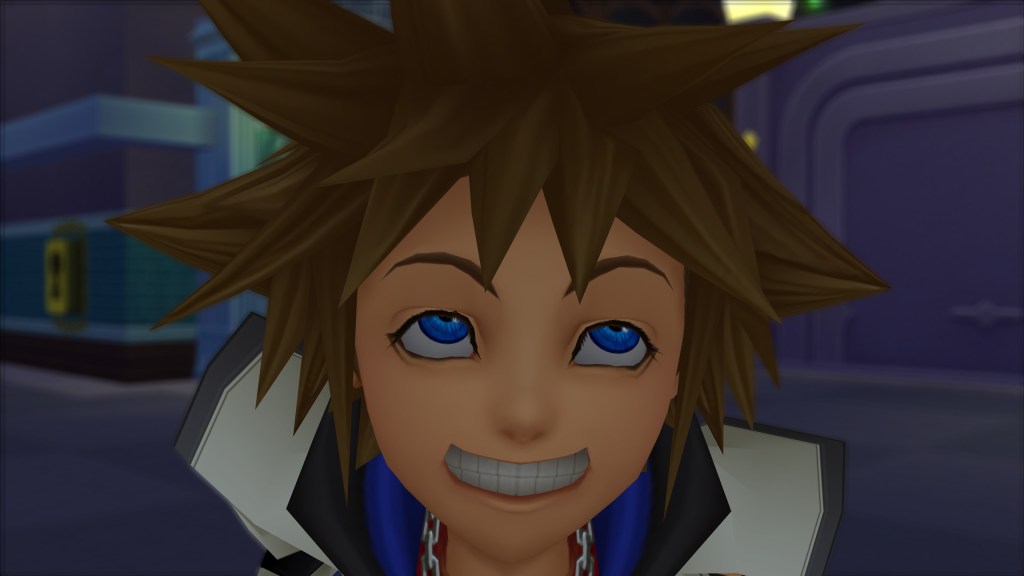
Yes, it can be corny, but the game never knowingly winks at the audience about it. You don’t see Sora rolling his eyes when Donald tells him to smile because it’s a ship full of smiles. He just does it and it makes your party bond. It gives this game some serious heart.
The tone plays well with the graphics. I’m getting away from graphical analysis in storytelling because we are approaching an era where game cutscenes just mimic modern forms of visual storytelling. But I feel it’s worth mentioning that Kingdom Hearts has an aesthetic that both feels cartoony, like something out of a Disney movie, and something more cutting edge, like an anime or Final Fantasy title.
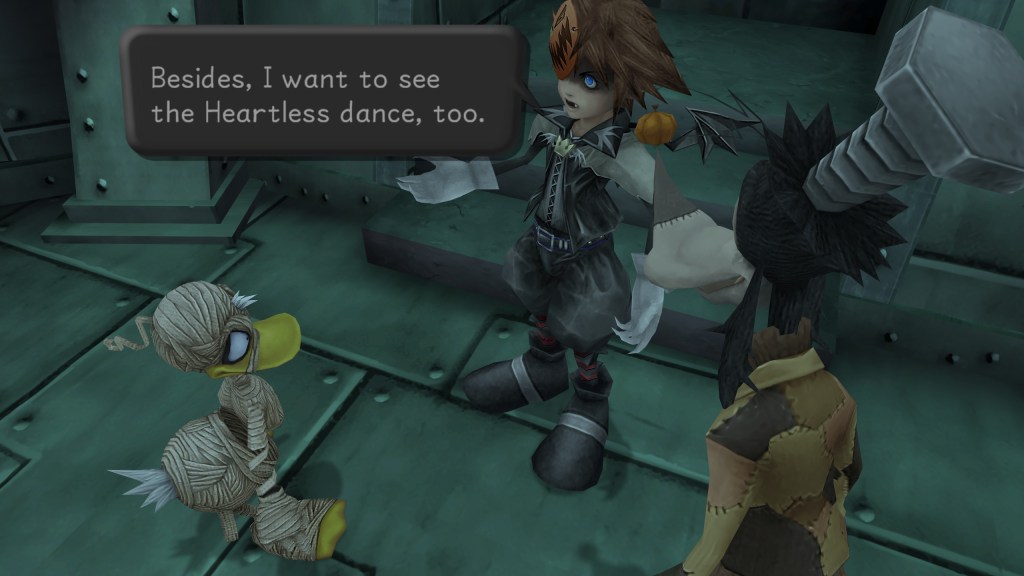
The cartoonishness really comes through in the individual worlds. Despite pulling from a lot of movies with a lot of different art styles, there’s never really a time where the characters look totally out of place. Sometimes there will be little touches to help match the game’s style more with the source material, most apparent in Halloween Town, but it never feels like the game is bending over backwards to make your party fit in with all these vastly different worlds.
It all fits in and it’s all very impressive. You’d figure a game that features both Sephiroth and Winnie the Pooh interacting with the same protagonist would see some jarring tonal shifts, but no, that never happens. You’ll just have to wait until the Pirates of the Caribbean and Tron worlds in 2 to see some true insanity!

World roundup
- Destiny Islands
- Traverse Town
- The overworld/gummiship
- Wonderland
- Olympus Colosseum
- Deep Jungle
- Agrabah
- Monstro
- Atlantica
- Halloween Town
- Neverland
- Hundred Acre Wood
- Hollow Bastion
- End of the World
This recap is going to shape up a little differently than the mainline Final Fantasy writeups. When thinking about characters to breakdown, there are only really four I have much to say about: Sora, Riku, Kairi and Ansem. And truthfully, for this entry, I have to struggle to think of what to say about Kairi. There are a LOT more characters than that, but they all sort of play in their own little worlds. So, let’s break down the sights you see!
I think the amount someone enjoys Kingdom Hearts might come down to how they feel about each individual world. A lot of the plot is centered around what happens in these distinct worlds, to the point that the locales feel like characters themselves, so it makes sense to me!
Destiny Islands

This is your introduction to the world of Kingdom Hearts. It’s a fairly standard tropical island that seems peaceful, well, until it’s not. An island is a perfect place to build motivation for the lead cast as being surrounded on all sides by water makes the three of them want to visit new worlds. Surely there’s more to life than what we have right here? And sure enough, they’re right.
Island life seems pretty peaceful until the heartless show up one night. Outside of the short tutorial, this serves as the introduction for combat and it’s a weird one because half of your time here is spent with a wooden sword that can’t harm the heartless!
It creates some tension as enemies that go on to become easy-to-kill mooks have crazy power over the player. It also helps communicate the importance of the keyblade, Kingdom Heart’s signature weapon. Without it, you can see how the general populace could be overrun by these little fuckers. Essentially, normal people have no defenses!
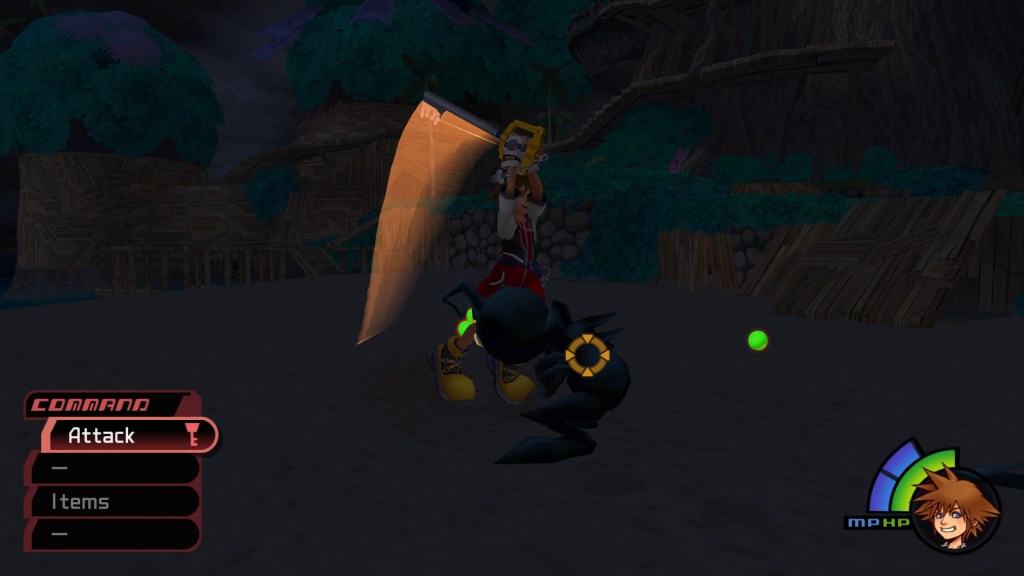
While useless against heartless, the wooden sword does get some usage in five different optional encounters. For whatever reason, three Final Fantasy characters also inhabit this island: Tidus (X), Wakka (X) and Selphie (VIII). You can challenge each of these three to individual fights, which are handy in that they can teach you the importance of counters – especially in Wakka’s case where the player needs to bounce a blitzball back at our favorite racist in order to stun him. They aren’t super challenging, but it can help a new player get up to speed with how the game feels.
You can also challenge three of them at once. It’s a chaotic encounter on proud and one I feel often comes down to luck because the player isn’t going to have a lot of key moves like dodge roll and guard. The strategy I always use is to target Wakka first because he can hit you with ranged attacks and then to just mash away on Tidus and Selphie. Takes me a couple of tries, but I always make sure to get at least one win over them.
The final optional fight on the island is an early encounter with Riku. This is a pretty challenging early game fight, but it can also teach the player some valuable lessons. To win, a player needs to pay attention to Riku’s movements. He has a kickup counter that will ruin your day if it hits you and he also enters a guard stance that renders him invincible. If you want to win on a consistent basis, you need to be able to read what he does and react accordingly. On new playthroughs, I always play this fight until I have more wins than losses.
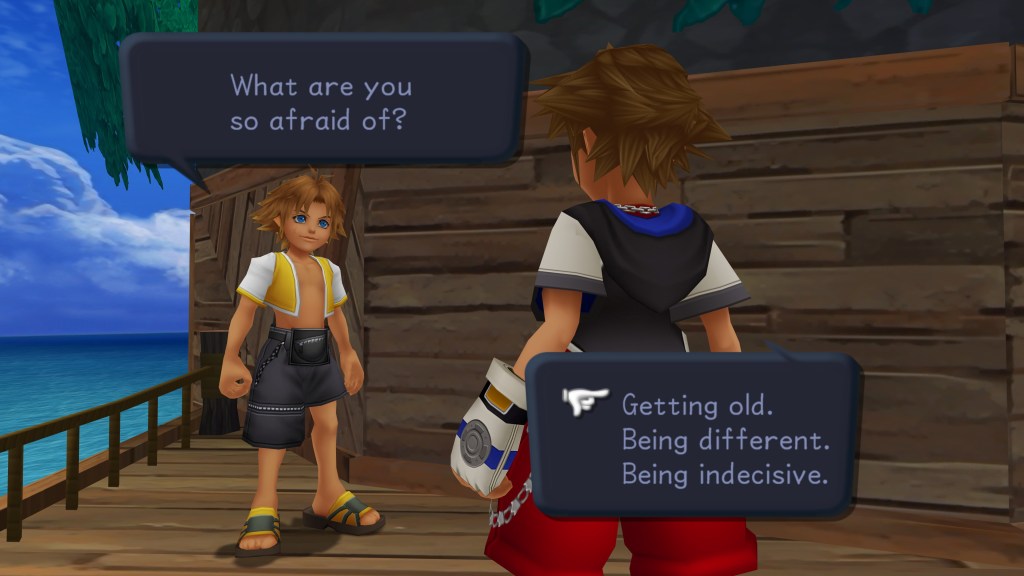
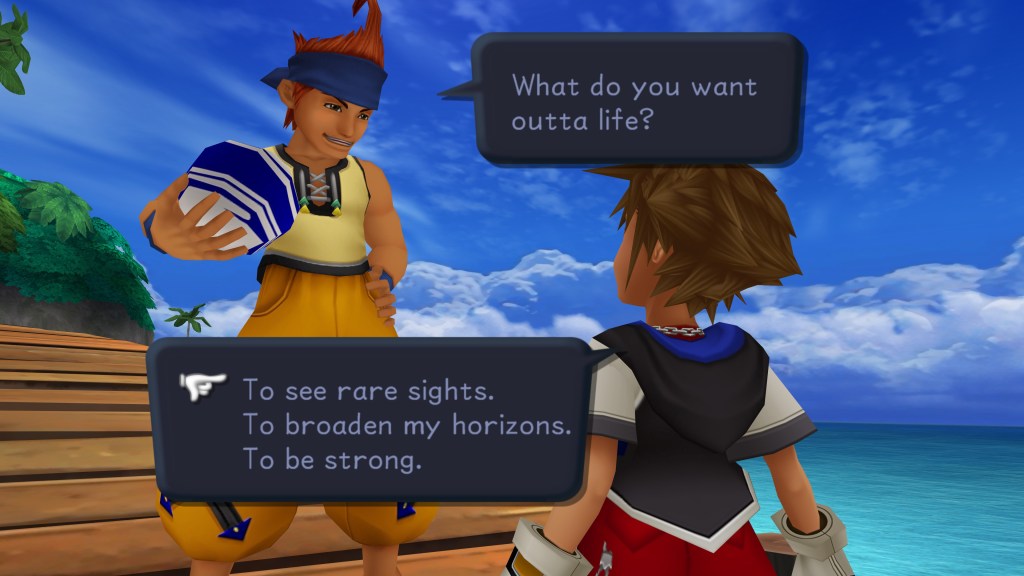

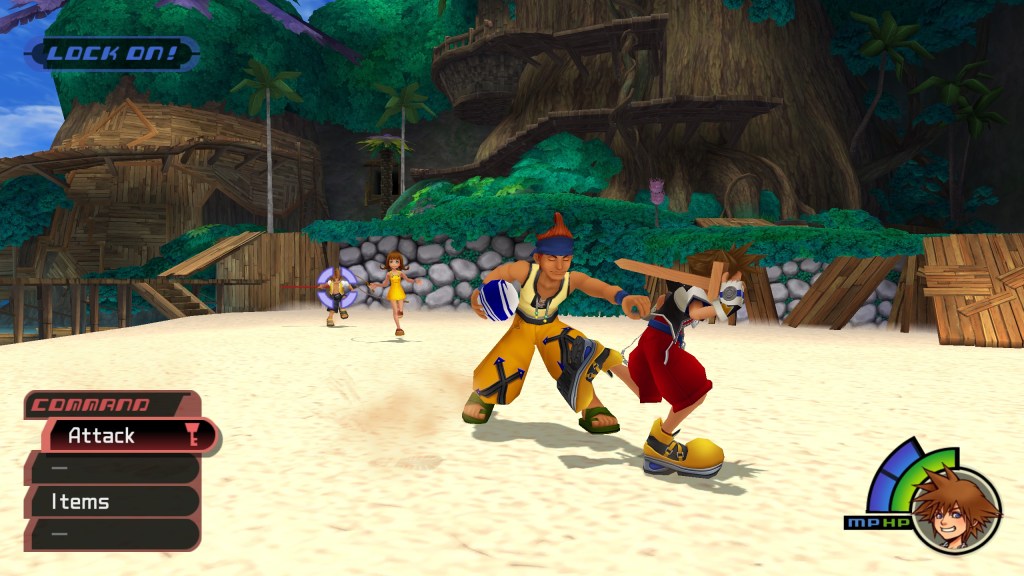
Younger me thought the selection of Final Fantasy characters here was strange, but upon reflection it does make sense. With Tidus and Wakka, you would assume that another X character would show up here. Destiny Islands looks kinda like Besaid after all, but when you think about the X cast, who could show up?
Yuna’s gimmick is summoner. X-2 hasn’t come out yet, so it’s difficult to bring that into early gameplay. Rikku, who is the most obvious choice, has a name that’s WAY too similar to the secondary antagonist’s name and Lulu, well, she’s probably a little more alluring than what they were looking for.
Since Nomura was the character designer for FF VIII, it makes sense they pulled from that game. Since everyone on the island is kind of young and plucky and school aged, why not bring the pluckiest student in your character roster? Selphie makes sense in that regard. Her main personality trait is ‘bubbly,’ so she makes a good substitution for Rikku.
As an introduction to the world of Kingdom Hearts, I find Destiny Islands to be compelling. It gives you a taste of Final Fantasy, a taste of originality and a taste of the forces of evil you’ll be dealing with for the rest of the game. B
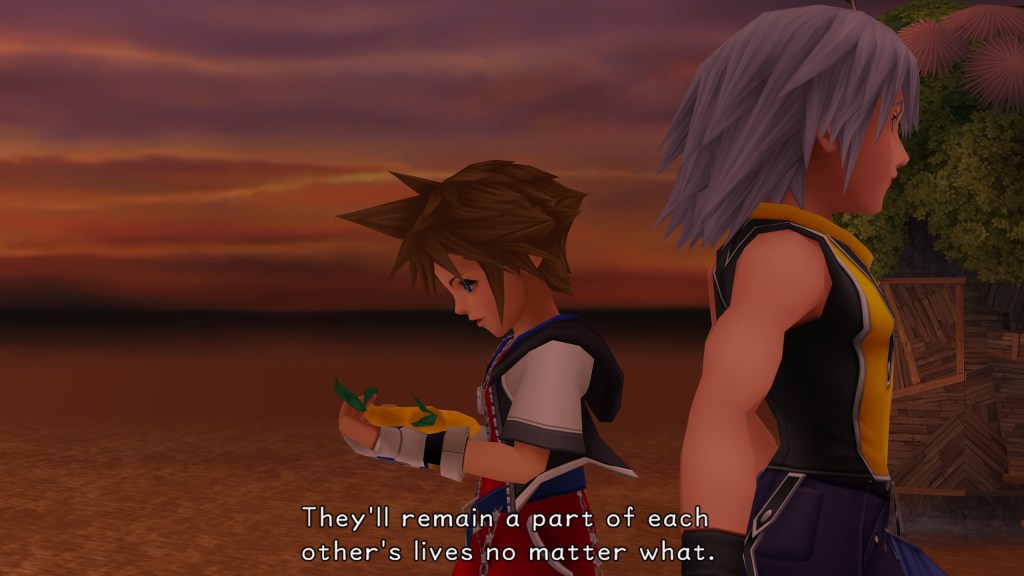
Traverse Town

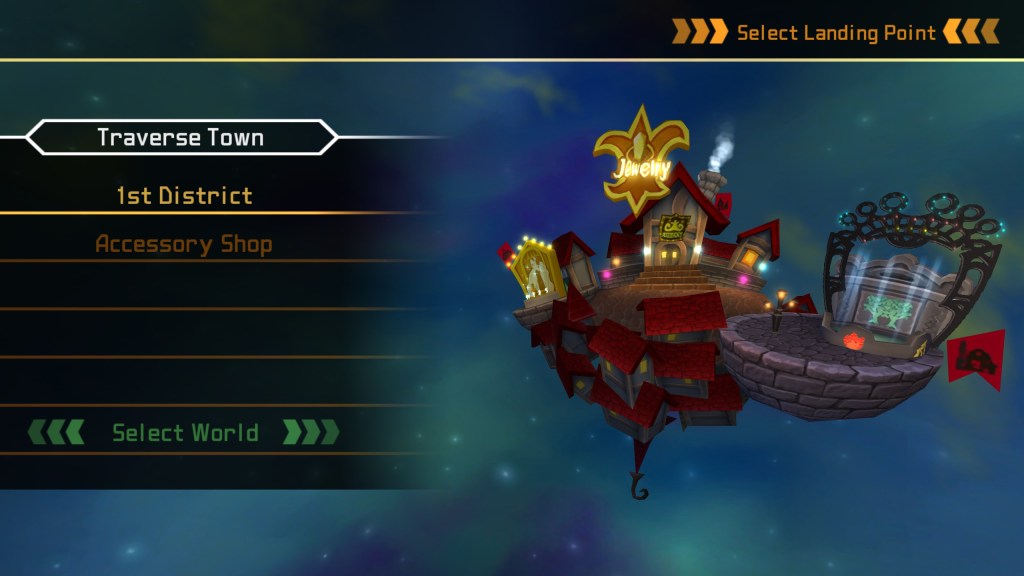
When the heartless invade Destiny Islands, Sora and company are jettisoned off of their home world. This is where you first wake up. It’s a pretty standard looking town that has no straightforward Disney affiliation. Sure, you have characters like the 101 Dalmations and Huey, Dewie and Louie, but they are sequestered to their own little environments.
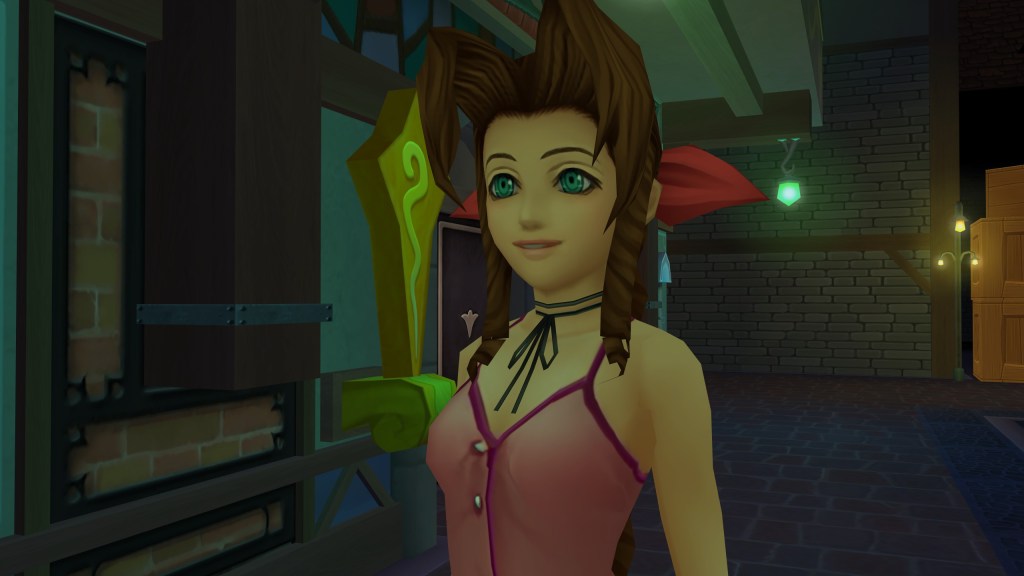
There are plenty of Final Fantasy characters here though. This acts as sort of their central hub for a large portion of the game. Young me absolutely wanted a Final Fantasy centric world, I kept telling myself they’d slip Zanarkand in here, but Traverse Town introducing the player to Cid Highwind (VII), Aerith Gainsborough (VII), Yuffie Kisaragi (VII) and Squa..err…Leon Leonheart (VIII) probably knocked that expectation away for most.
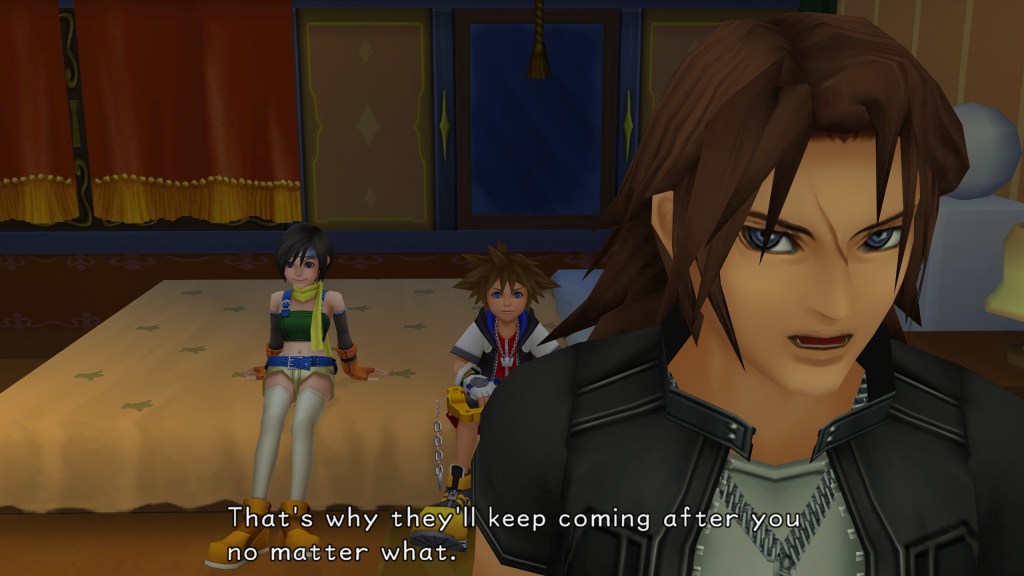
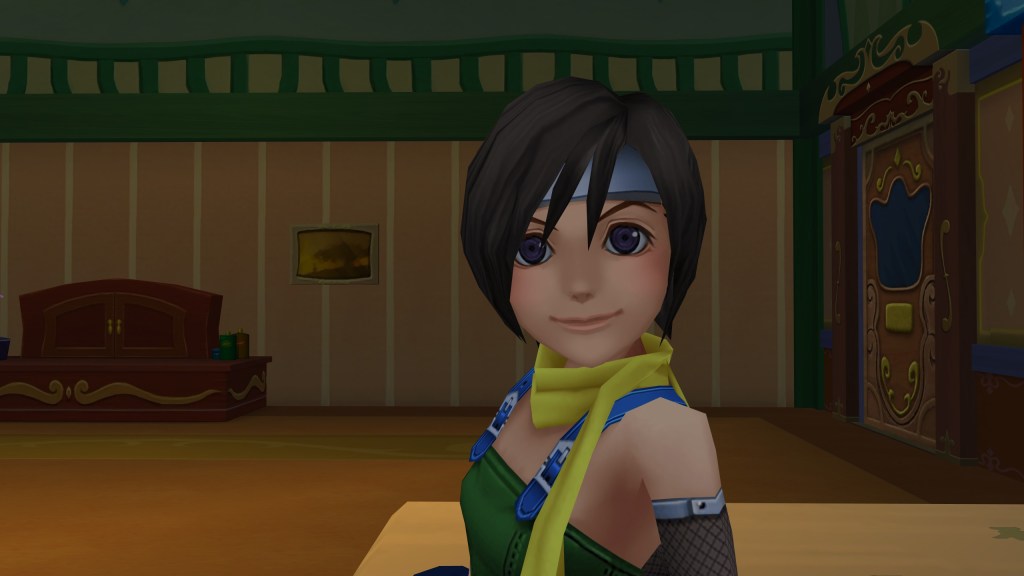
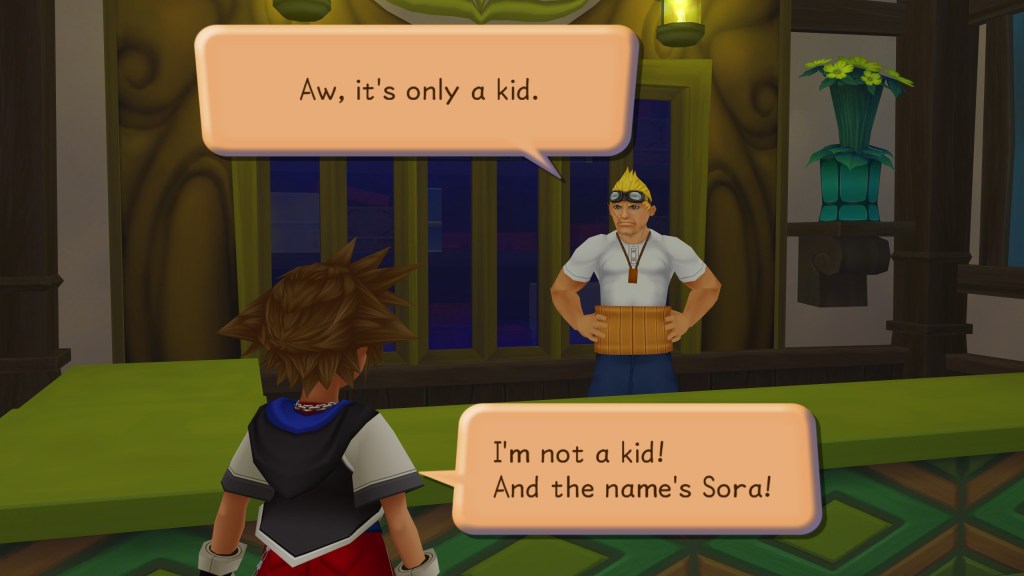
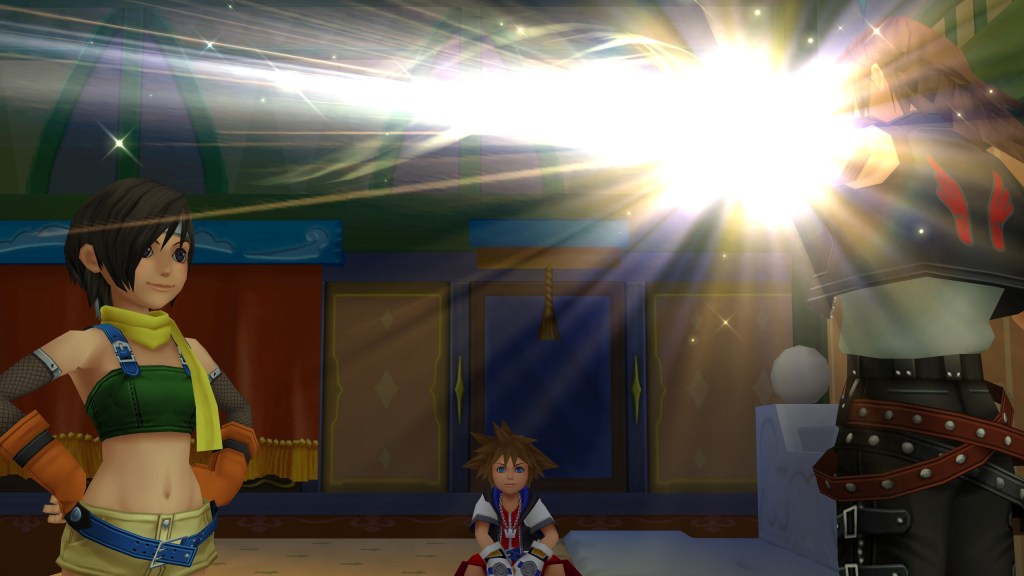
The Final Fantasy characters all come together to form almost a resistance front to the heartless. If you don’t know where to go next, odds are one of these guys can point you in the right direction. The most prominent is probably Leon, who acts like the post-Rinoa version of the character. You don’t really get the loner and emo aspects of his character, you instead see a lot of leadership. He seems friendly.
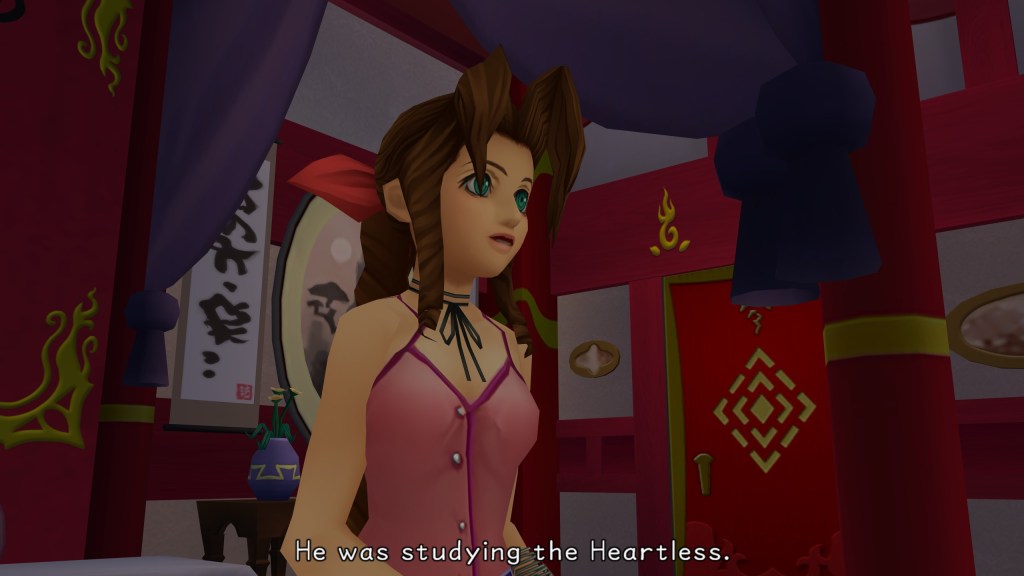
There’s not much to say about the rest, but I feel the need to point out the voice acting of these characters. It’s the first time a lot of these characters have received vocal work and I think they do a really excellent job with everyone here except for, uh, Cid. He doesn’t have a voice in this entry.
I especially want to praise the work of Mandy Moore as Aerith. She delivered a performance that was pitch perfect with the way Aerith always sounded in my head. She unfortunately gets recast in 2, probably a budgetary thing but also they were standardizing the FFVII vocal cast around that time for Advent Children, the FFVII sequel movie. The performance there was a steep, steep downgrade, so enjoy Mandy while ya got her.
As a note, this is the game that cemented Aerith’s English name as “Aerith” going forward. Until this point, we had just been calling her Aeris. If you don’t believe me, check the EGM preview I posted at the top of this writeup!
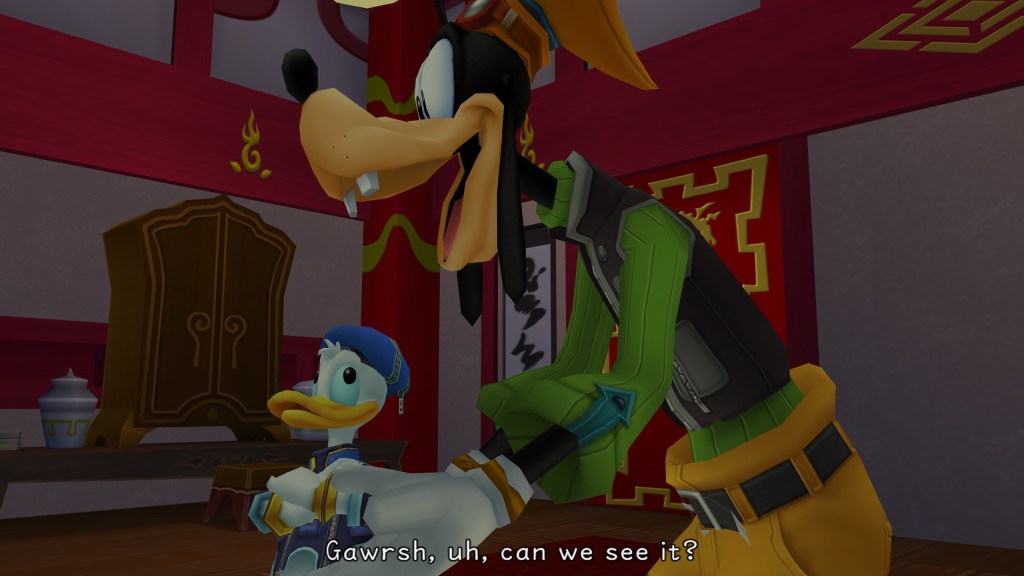
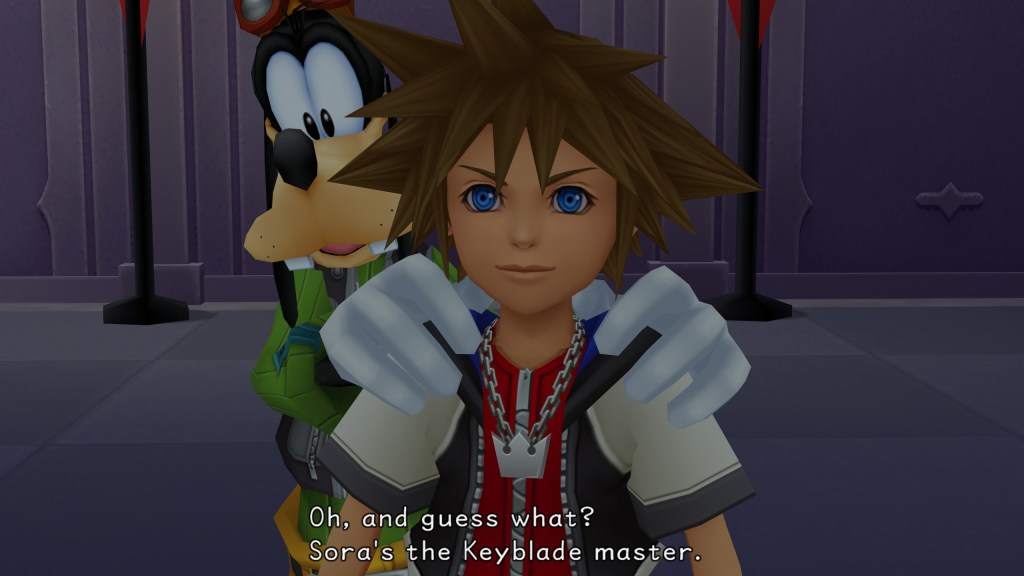
Traverse Town is where you end up meeting your main two party members, Donald and Goofy. They are searching for their king, a mysterious individual with two large ears who says things like “Gosh,” “fellas” and “did somebody mention the door to darkness?”
If you’re familiar with Donald Duck and Goofy, they act exactly as you think they would. Donald has a firey temper and is a little hard to get along with at times and Goofy is well meaning but kind of dopey. That’s it, that’s their characters for the rest of the game. They are perfect sidekicks to Sora because they mostly just exist to bolster him up.
Since Traverse Town introduces the player to Disney elements, this serves as a bit of a transitional world.
You have Final Fantasy characters just a couple of screens away from Disney characters who are just a couple of screens away from generic human NPCs. It’s getting the player used to seeing a lot of different things because, on an hour to hour basis, that’s what the game is like. These worlds are short, so you gotta get used to some character introduction whiplash.
This area later becomes a hub world. Your main shops are located here, you get equipment for your gummiship here and you also can learn summons here. Summons are one of the more important elements of the main Final Fantasy franchise, so it was imperative they got represented. They replace Donald and Goofy in combat and provide some offensive assistance or healing to the party.

I think I’m playing Kingdom Hearts wrong because I’ve never found summons useful. I never use them. The picture you see here is from me going ‘oh shit, I should get a screenshot of a summon for my review’.
The enemies in Traverse Town are standard baddies you encounter in a lot of areas in the game and the boss of the area is a pretty ho-hum looking suit of armor. It’s not the most exciting place to visit, but I really love how the Final Fantasy characters are used here – so I have a soft spot for it. B-
The overworld/gummiship
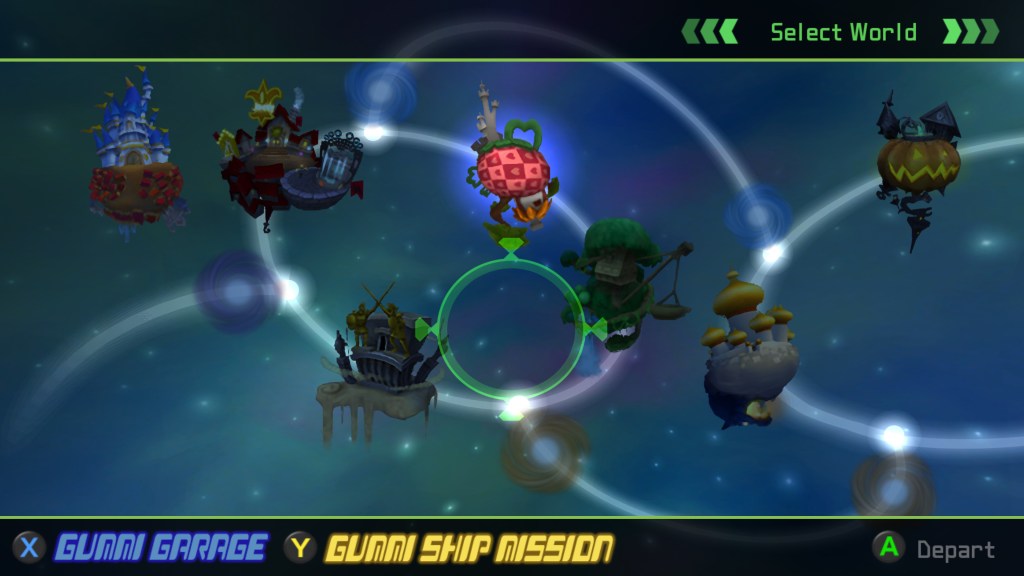
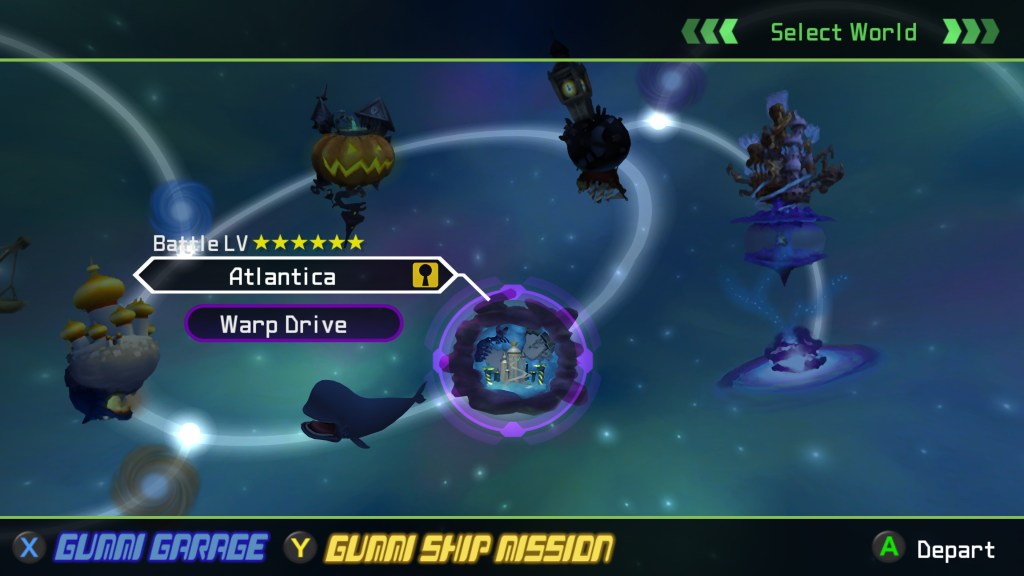
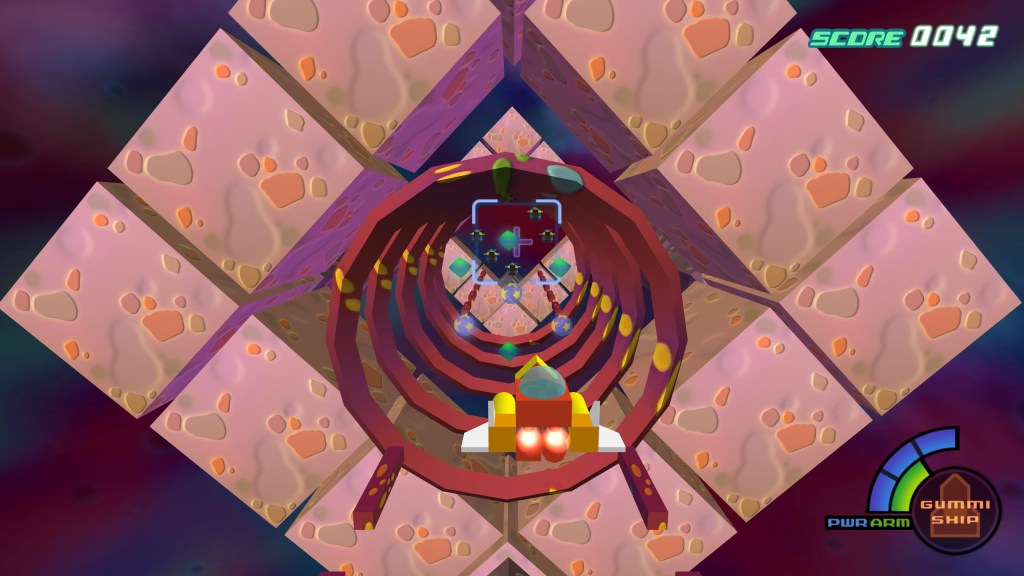
When the player finally leaves Traverse Town, they are introduced to the gummiship system. This is how new worlds are accessed, you literally fly to them in a spaceship. This is done via an on-rails shooting minigame that feels like a simplified Star Fox.
This is one of the most reviled things about the original Kingdom Hearts. I remember reviewers talking about how these sections slow the game’s pace down and are just not fun to play. The first time I played Kingdom Hearts, I expected this to be my big hurdle. “Okay, I clear this bullshit to get to the fun, right?”
However…I think the badness here is very overstated. Even on proud mode, I find the gummiship levels to be really easy to clear. On this playthrough I think I died once and it was because I was trying to get a screenshot and wasn’t paying attention to the level around me. And you’ll notice my pitiful health bar in the screenshots below.
If you simply know how to dodge and you hold the attack button, I don’t know how this could be a roadblock for anyone.

They offer you the ability to customize your ship as much as you want, to the point where it feels like a weird LEGO racing game. I’ll be honest, I’ve never messed with this. I always go with the main Highwind/Excalibur ship and just add an extra blaster to it.
The biggest crime of the gummiship is that it takes you away from the standard gameplay of Kingdom Hearts for like 3 minutes. It’s not the worst thing ever and I’m surprised people pretend this is some sort of glaring flaw to the game. It’s fine. C.
Wonderland
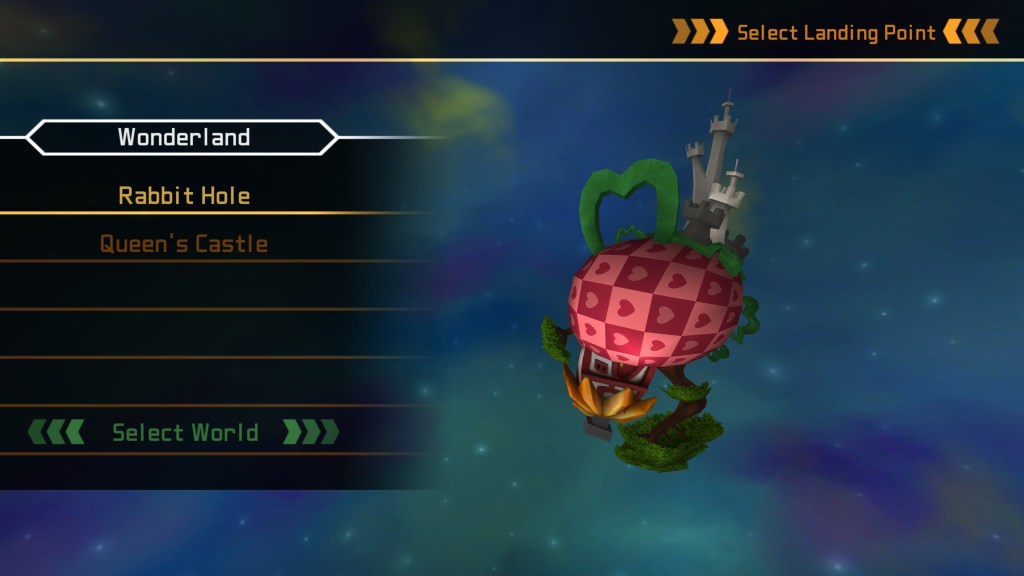
This is the first proper Disney World, which serves as an introduction to what you can expect out of most of the rest of the game. Technically you can visit Olympus Colosseum instead, but the game ranks its gummi ship course as slightly harder, which is KH’s way of saying ‘hey bro, go here first.’
I’ve never been much of an Alice in Wonderland fan and this world doesn’t do a lot to remedy that. I think it’s really boring to explore and I just don’t love the main gimmick. You’re constantly trying to find different ways to enter the main room in the game, fittingly called the bizarre room, so that it’s laid out differently. By the time you get to the main boss, you’re probably tired of seeing this place.


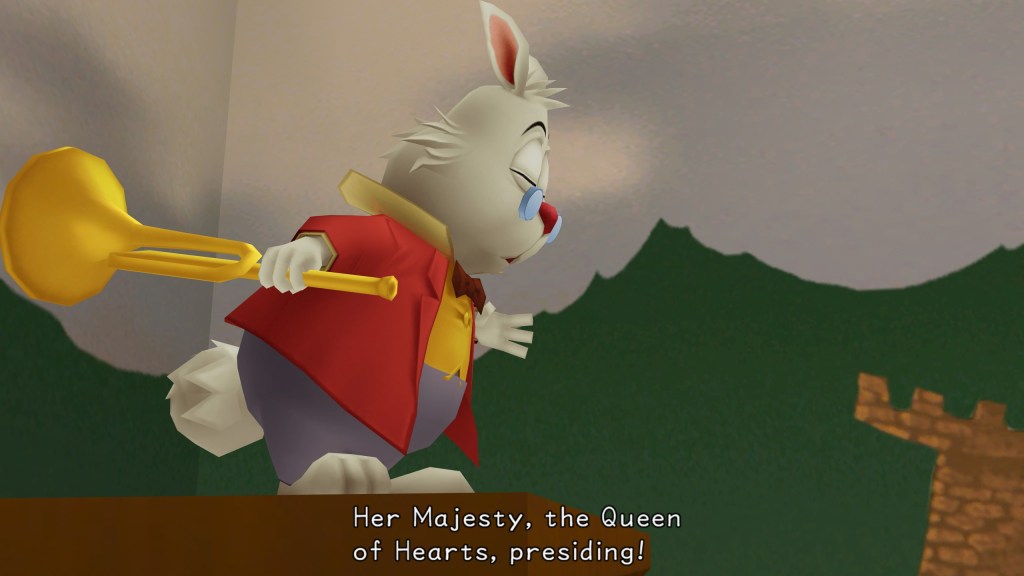
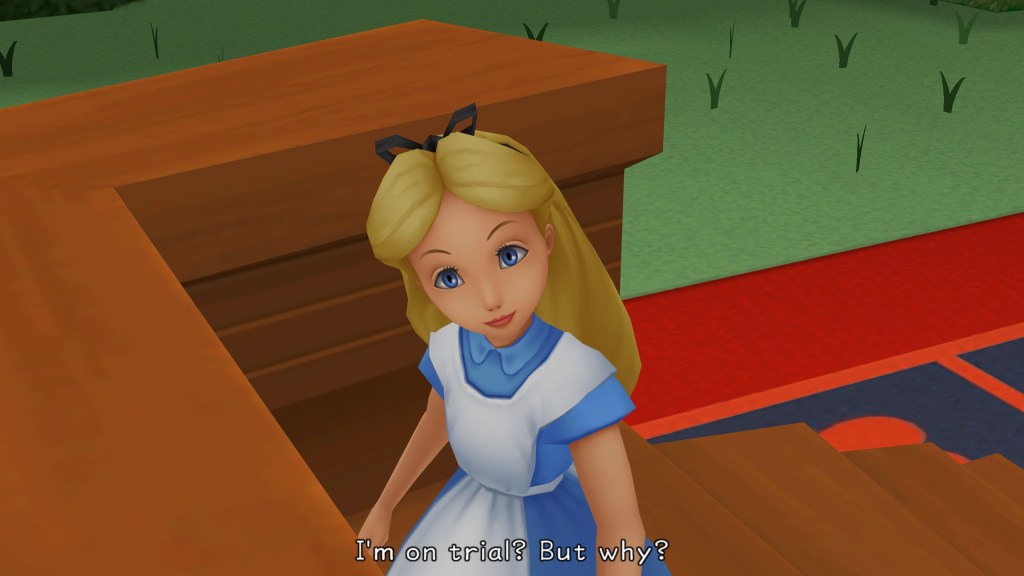
The reasons the game presents for doing this are many. The Queen of Hearts accuses Alice of a crime, so the party needs to hunt evidence to exonerate her and some of this is in hard-to-reach places in the bizarre room. It’s also where the boss of the location is hanging out and in order to drag him out, you need to flip the room in order to light a couple of lamps.
Speaking of the boss, this encounter has always been one of the most difficult in the game for me. It’s about using the environment to reach him, but often times he knocks your platforms away, so a lot of the fight is spent hoping your air combos can somehow reach him.
It’s a fight that FEELS like it should happen after the player gets the ability to jump higher, but alas. It’s one I kind of just flail away at until I win. I’m surprised such an annoying boss, one that isn’t even based off of a Disney villain, is what the game leads off with. I think this whole level might turn skeptical players off the game entirely.
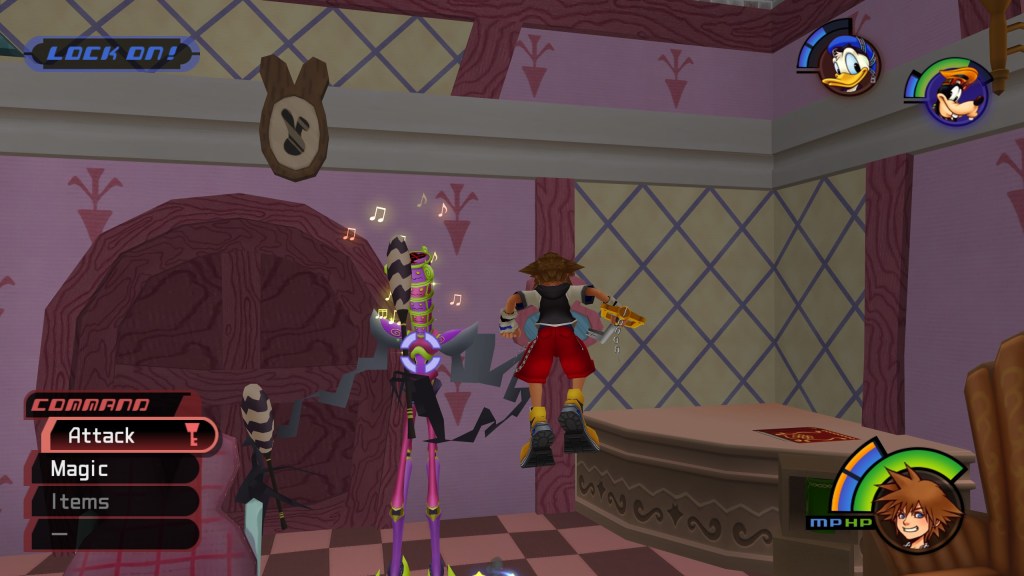
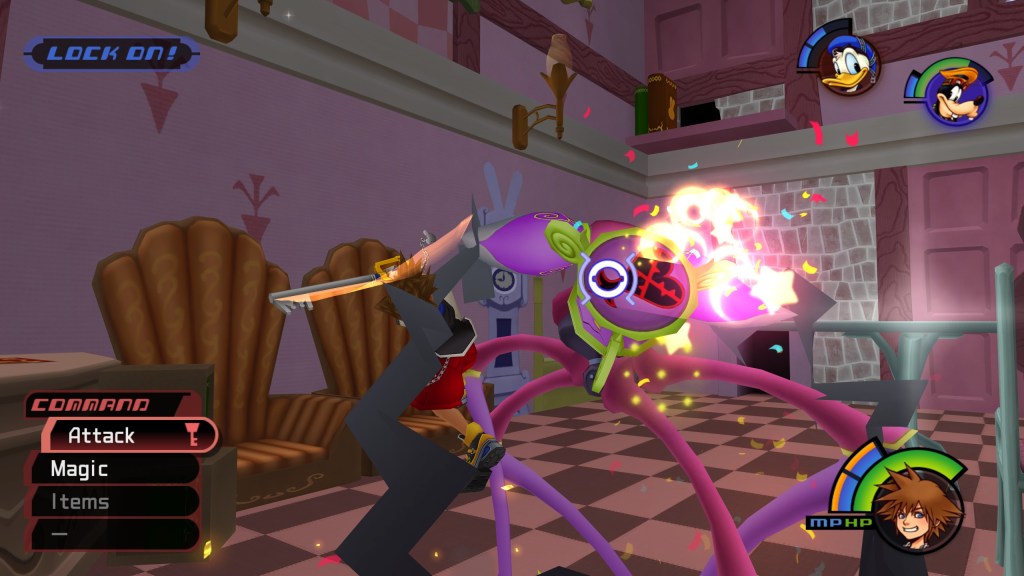
However, that’s not to say it’s all negative. A gimmick the titular Alice has access to in the movie is the ability to turn big or small, so I like that they work that into the level. It’s mostly for solving little puzzles and you’re only really big for like…10 seconds…but it’s still neat! I’ve also always liked the player card battle just because it’s neat when more minor Disney villains get a chance to shine.
For most, this is a “let’s get on with it already” level. D.
Olympus Colosseum
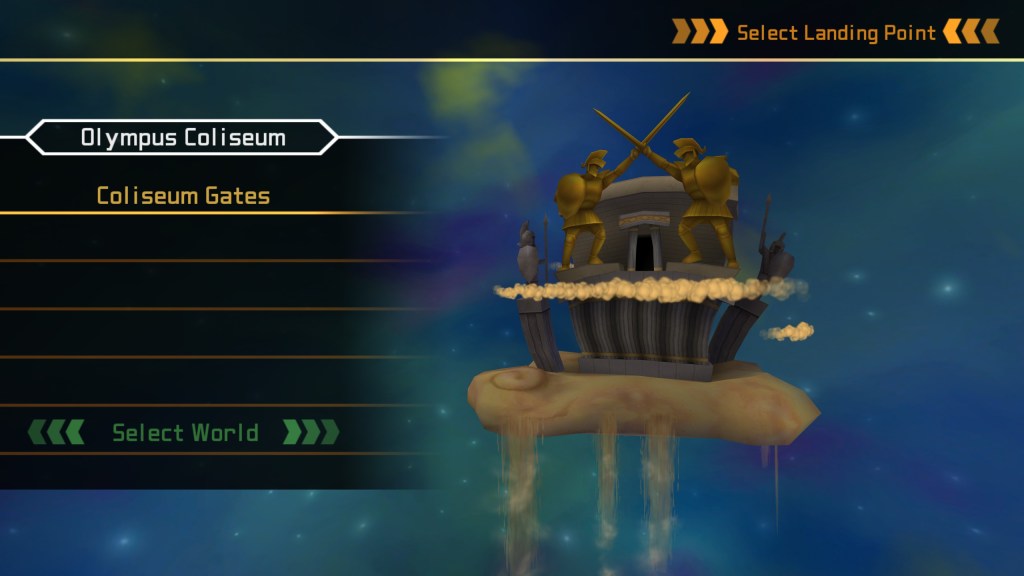
This is the world most people will visit second and in truth it isn’t much of a level. You get in, advance one screen, and are immediately introduced to one of the main characters in Hercules, Phil. The satyr tells Sora about the games (think Olympics) coming up and through a deal-with-the-devil, your crew ends up joining them. This introduces you to the gimmick of this level, it’s all done in the style of a tournament.
There isn’t really anything to explore, you just go up to Phil, say what tournament you want to enter and there ya go. These unlock slowly over the course of the game and are always put out right in front of the player. “HEY THERE’S A TOURNAMENT AT THE COLOSSEUM.” Unless you just ignore all flavor text, it’s impossible to miss. These consist of ten fights in a row with a difficult boss encounter marking the end of your journey.
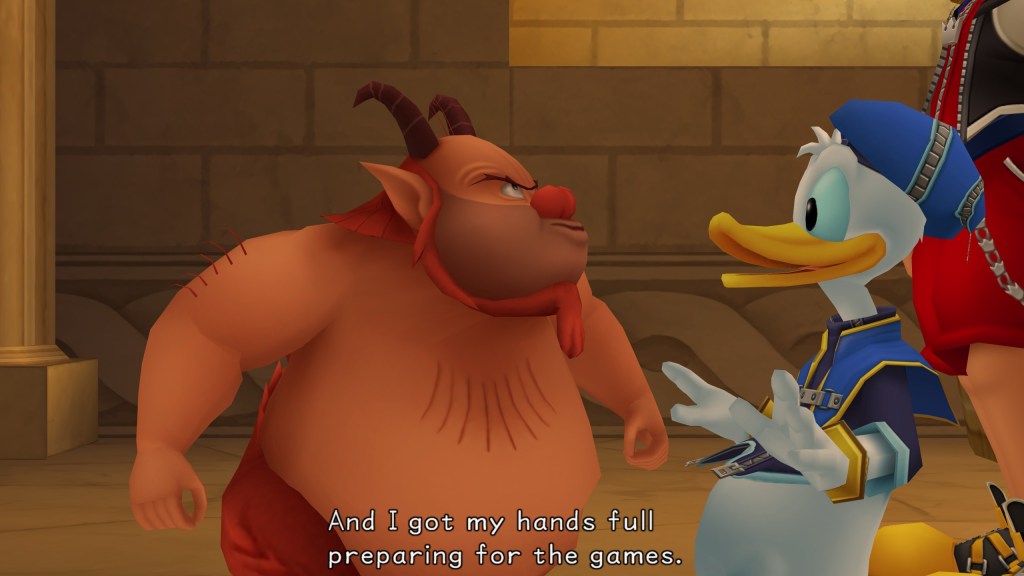
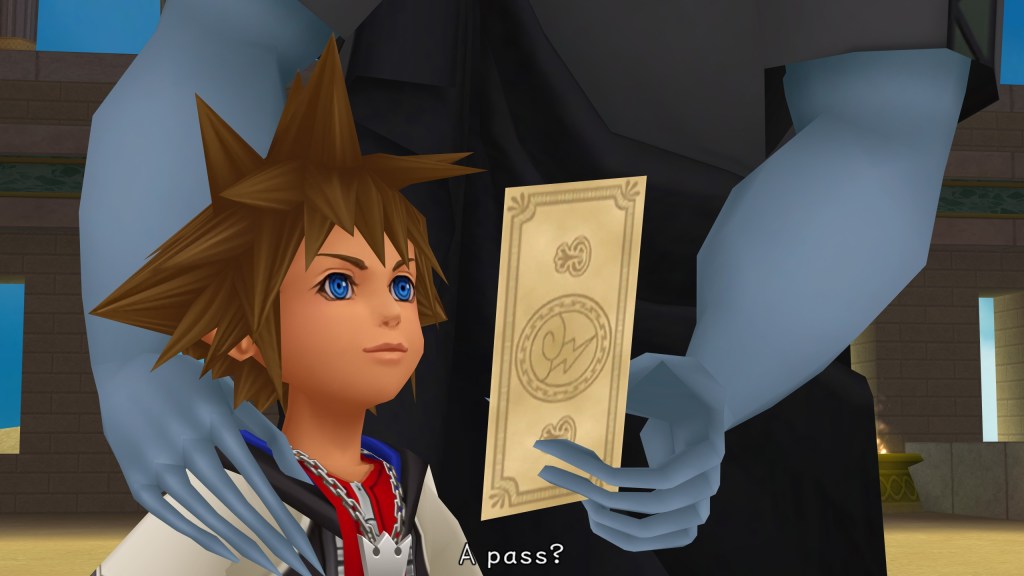
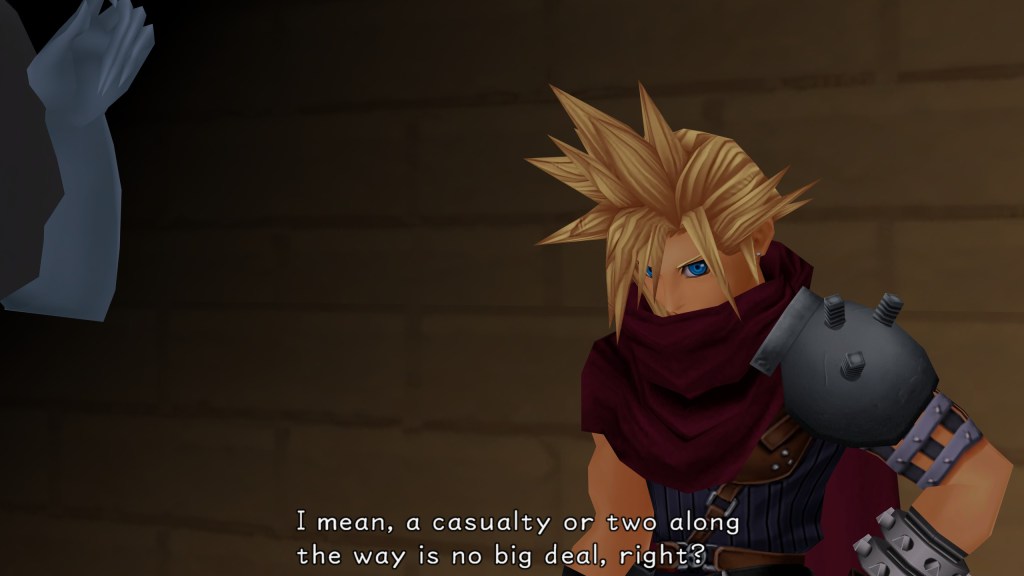
The first time the player comes here, they’re put in sort of a preliminary tournament. Most of the fights are against random heartless, but if a player chose the sword at the beginning of the game and sacrificed defense, this is one of the most difficult stretches you can go through. Enemy squads will one or two hit Sora and sort of keep your party in a holding pattern.
However, when you lose in a tournament, it doesn’t count as a game over like it does everywhere else in the game, so any exp you get from defeating enemies is retained. This makes grinding during the preliminary tournament extremely easy to do and as long as a player just throws themselves at the wall, it can be accomplished.
By the time you reach Cloud Strife, the end of this prelim and the only battle you can lose, you’re probably able to handle the real threat to Olympus.
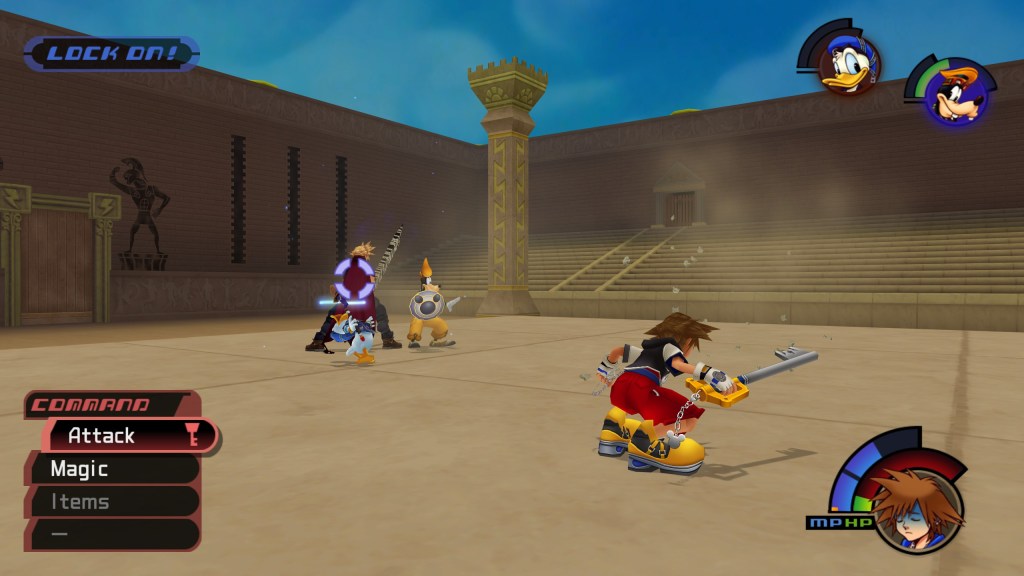
Cerberus is your initial final boss of Olympus. He has a pretty easy to recognize attack pattern, but it requires a little bit of patience and observation, which can make things a bit tricky if you’re the mashing type. The three-headed wonder also hits very hard, to the point that the official strategy guide recommends doing the next world first and looping back to Cerberus in order to get a leg up on the mutt.
I’ve always found this a good early fight. It encourages the player to watch for attacks. It’s not the first boss in the game to do this, but it’s the first mandatory one to do so! I also have to give bonus points for being a Disney movie boss as opposed to a generic heartless boss.
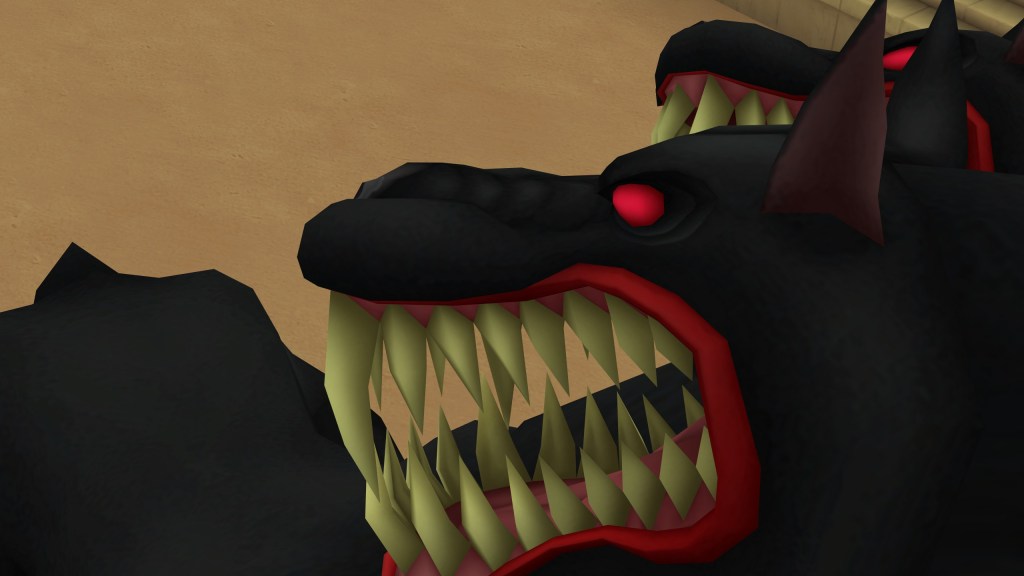
That’s one thing I didn’t like too much about a later game in the franchise, KH3, it’s a little lame to have a narrative villain for a large chunk of a level only for the villain to be swept aside of a giant heartless. I don’t care if the step mother from Tangled isn’t into fisticuffs, I want her to be the main boss of her level!
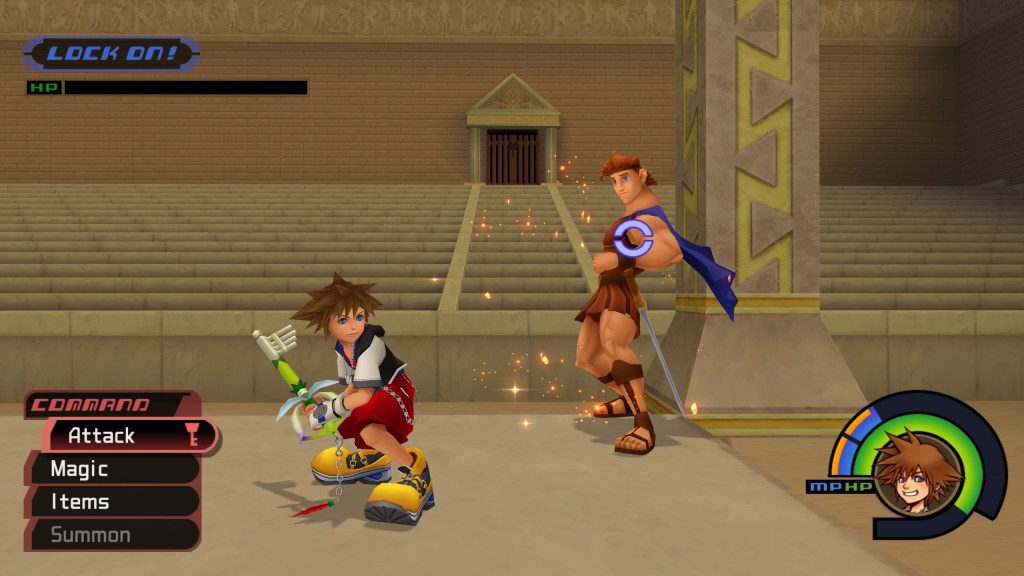
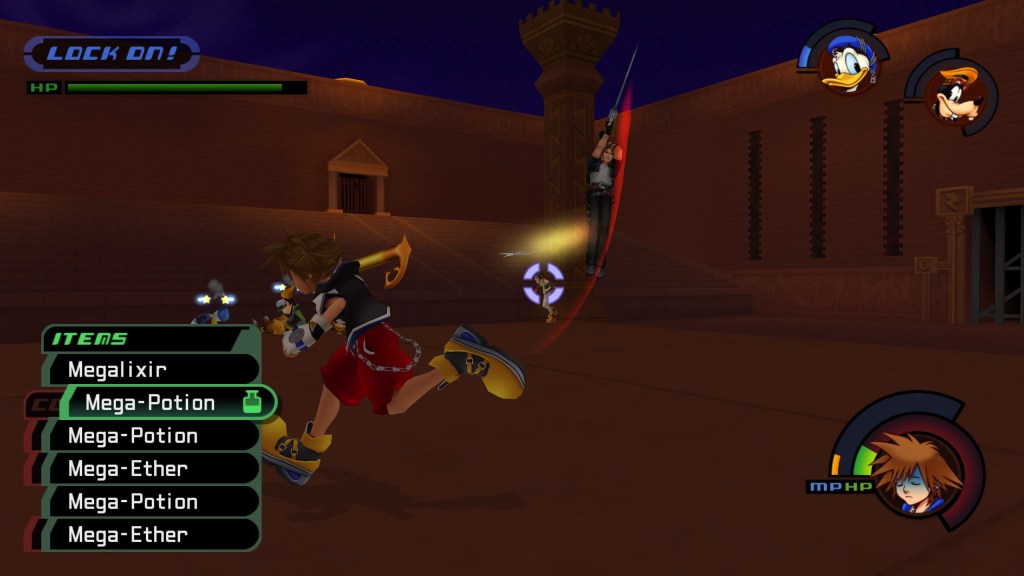
After you finish Cerberus, you frequently come back here for the tournaments that I mentioned above. I find these to be pretty enjoyable excursions with really fun boss battles and great rewards. After your introductory cup, the player gets assaulted with a cool Leon and Yuffie match in the second cup, a Cloud rematch (and a surprisingly easy Hercules solo fight) in the third cup and a whole host of interesting battles in the Hades Cup.
To people who have read a lot of this series, you’ll know how much I enjoy a good boss fight, and I think the Colosseum offers some of the best in the entire game. A lot of them are in the FF fanservice sweet spot that I’d want out of these games, but even the ones that aren’t – like Hades and Ice Titan – are pretty memorable and enjoyable. It’s by far the simplest level, but I have so much fun here in every playthrough that I have to rank it high. A.

Deep Jungle
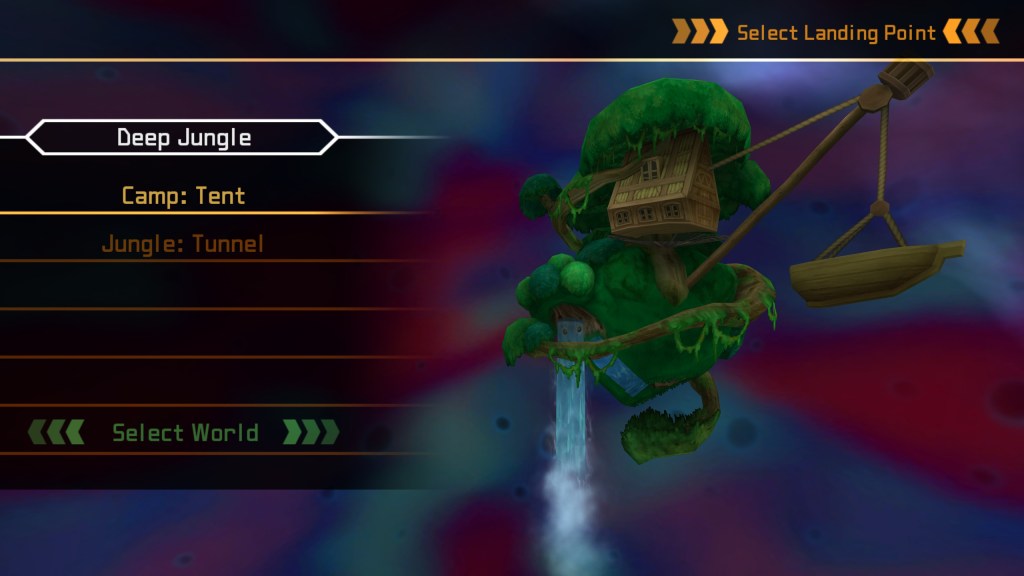
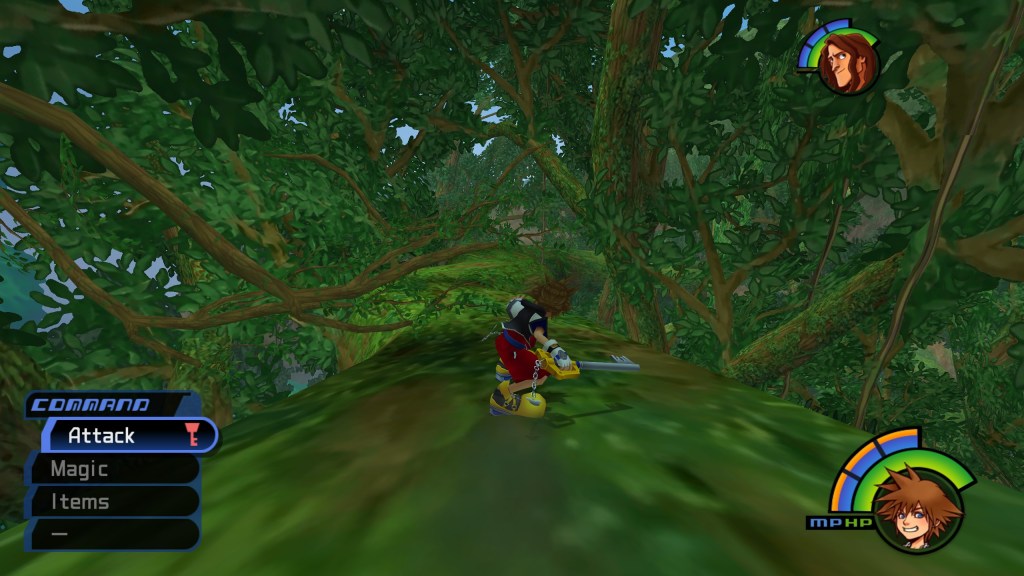
The last of the initial crop of Disney levels the player has access to. This one is themed after Disney’s adaptation of Tarzan and it’s one that was showed off a lot in previews. One of the main gimmicks of the movie Tarzan was the titular character grinding on vines and trees. So naturally, every single preview of Kingdom Hearts featured a picture of Sora grinding on vines.
These segments are incredibly boring and forgettable. You just slowly slide down a giant tree, occasionally jumping over branches. If you hit a branch, it’s no big deal because it causes like 1/16th of a hit point of damage, it’s nothing. It feels like something that Disney executives yelled at Square to include because it was THE thing about the most recent movie to appear in this game. But boy was I excited to play it because every single preview hyped it up.
The rest of the level is pretty boring too. Tarzan and Jane have befriended a group of gorillas and the other human there, Clayton, wants to hunt them. Also Sora and Donald are fighting over the best course of action to find their friends.
What follows is a lot of walking to the same three or four areas and then back to camp. You either are searching for Clayton in an attempt to get him to not shoot gorillas or you are searching for gorillas in an attempt to get heartless to not kill gorillas.

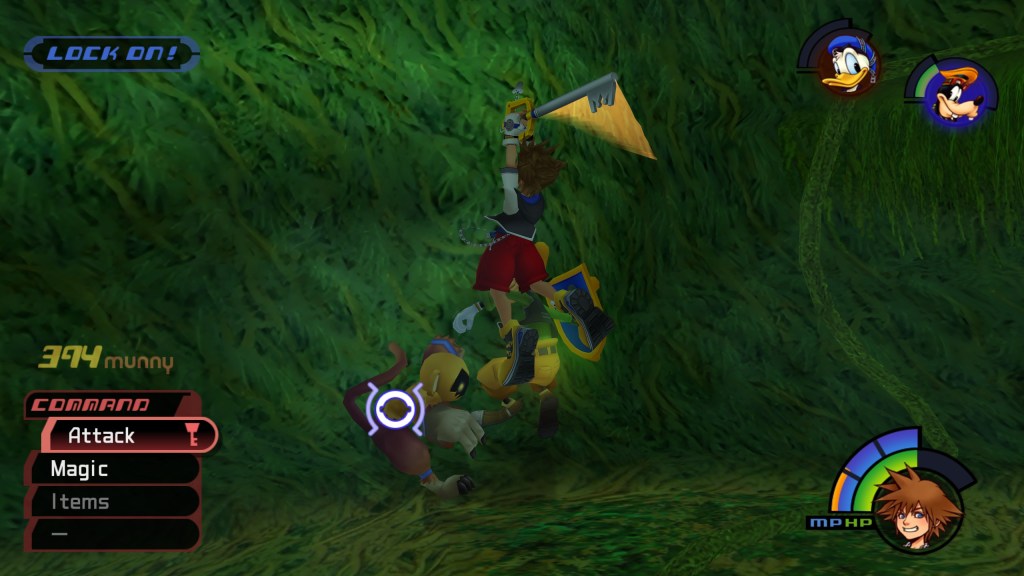
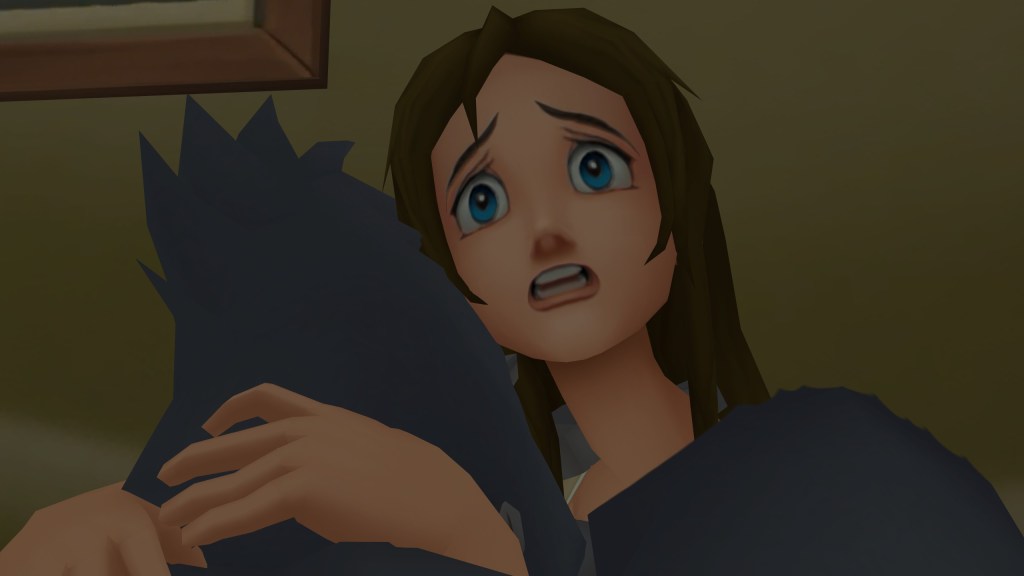
It becomes very repetitive. I find myself saying “oh great I have to go back to the treehouse again” on every playthrough which is of course followed by “oh fuck, I forgot I have to go through the swinging vines again.”
Your gorilla hunt is occasionally interrupted by Sabor, a leopard. It’s a breath of fresh air when it happens because it’s a break from fighting the wacky monkey heartless that Deep Jungle has to offer, but I can’t pretend these are compelling fights.
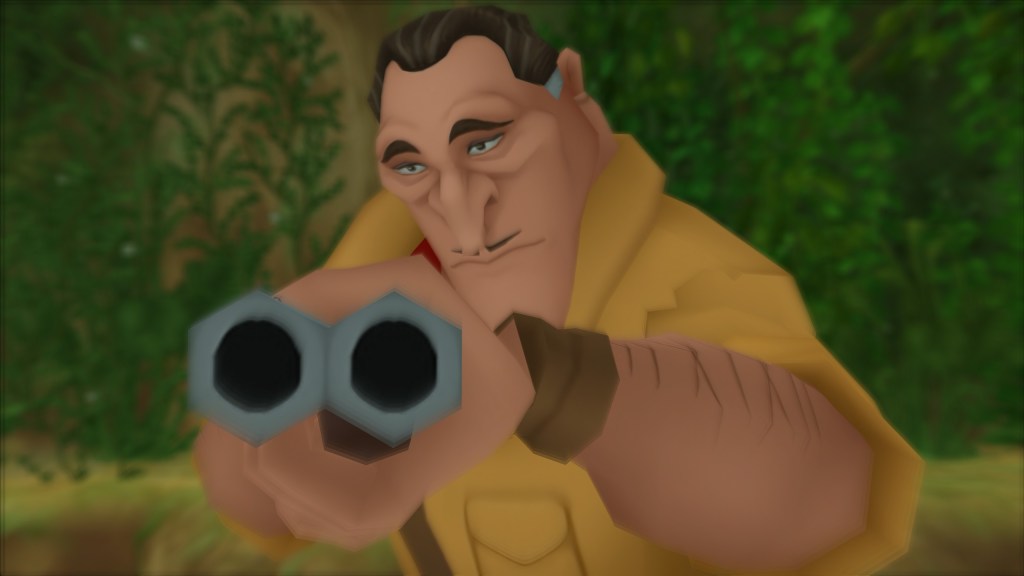
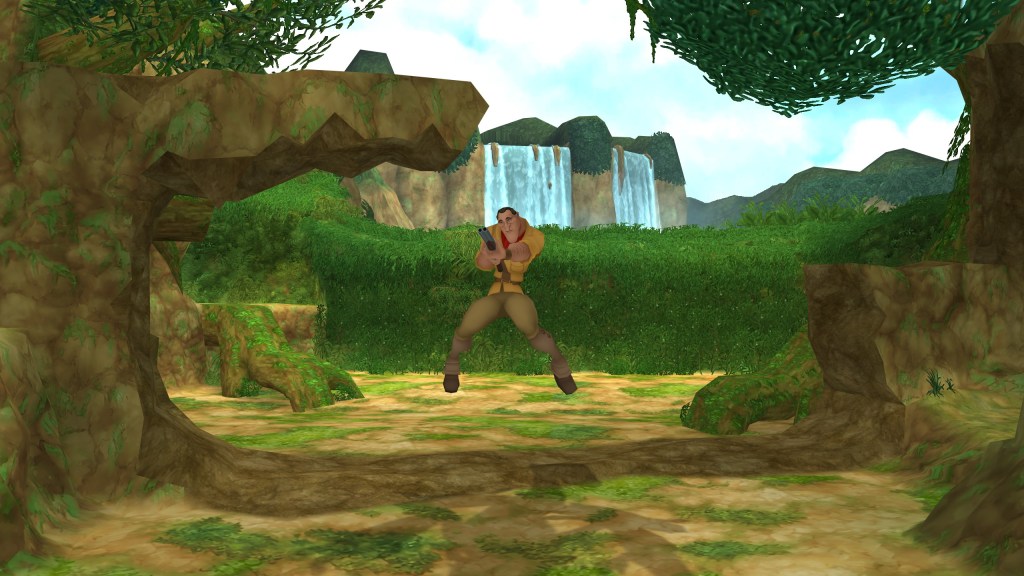
The boss is alright though. It’s a step up from Wonderland at the very least. Clayton and a chameleon heartless team up to pester the party. Clayton will constantly shoot at the party with his hunting rifle while the chameleon specializes in more close range combat (though it has a blaster move too).
For people who sacrificed the shield, Clayton’s pot shots HURT and can kill Sora in a hit or two. But if you kept your defense up, the pot shots are pretty inconsequential and the fight as a whole is pretty easy.
I mentioned it in Wonderland, but I think a lot of people who try KH1 and hop off of it for one reason or another do so because the first crop of levels isn’t anything special. D+

Agrabah

This is the first world of the second group of levels that the player is introduced to. The villains in these are frequently seen during the Maleficent bad guy huddles, so these end up feeling a little more relevant than the first group of stages. Jafar is probably the one we see the most of before landing in his world, so I suppose it’s fitting that his world is the first we come to.
The story of Agrabah is a very loose retelling of Aladdin. The hero wants to go into the cave of wonders to find a magic lamp in order to woo the princess, Jasmine. You see, the lamp contains a magical Genie that can grant almost any wish. Jafar steals the lamp and turns the Genie against you and that’s that. Throw in a couple of scenes with Maleficent and Jafar talking vaguely about the heartless and you get the picture.
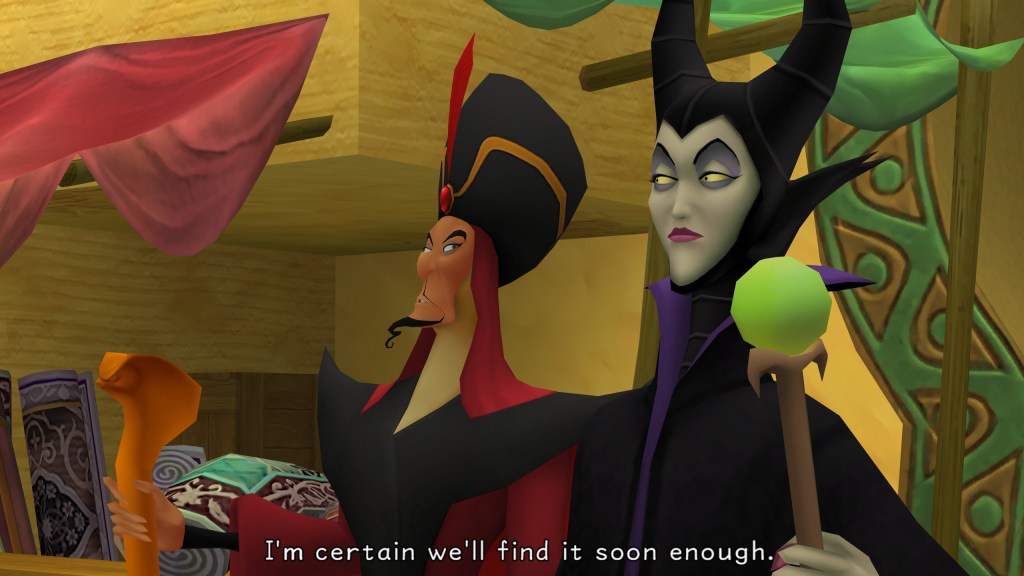
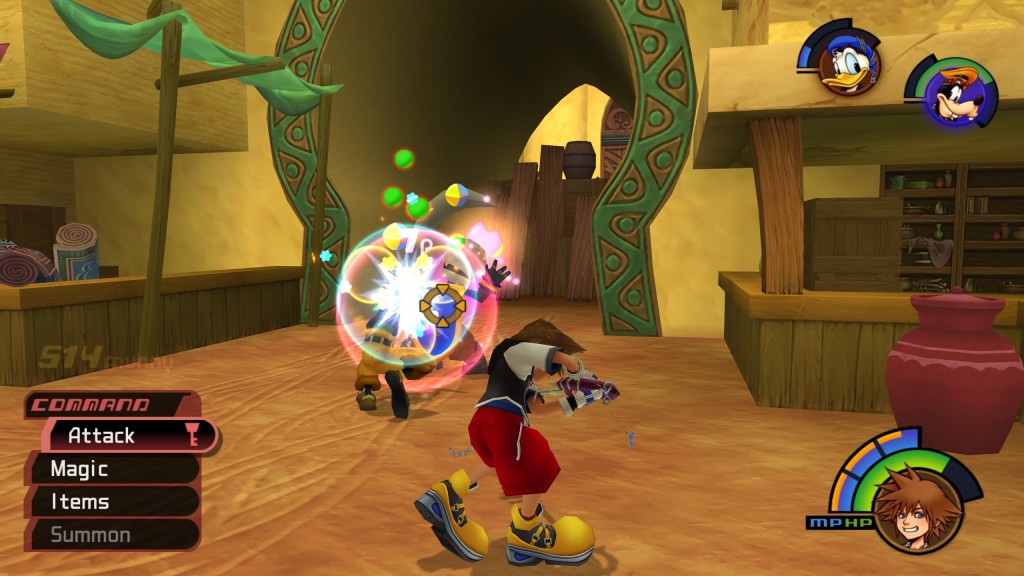
This level does a couple of interesting things I like. First, it’s separated into two zones. The first is the town of Agrabah itself, which is just a few screens where you hop along the rooftops of small businesses. When you first visit, the streets are littered with heartless and the immediate path forward is blocked by barricades, which forces the player to go through back alleys.
As an old fuck, the first Disney movie I saw in theaters was Aladdin, so I always liked how authentic-to-the-movie the locales look.
To end the city segment, Jafar summons a giant centipede monster thing, which has always interested me. Above, I mentioned how the city is just a few screens big, but each time you enter a new screen, you encounter a small load. However, in this boss fight, you have access to the entire town (well, minus side streets). It’s something that always seemed striking to me, like how did they pull that off technologically? It’s a pretty standard boss that doesn’t require any trickery from the player, but the neat environmental trick really helps it stand out.


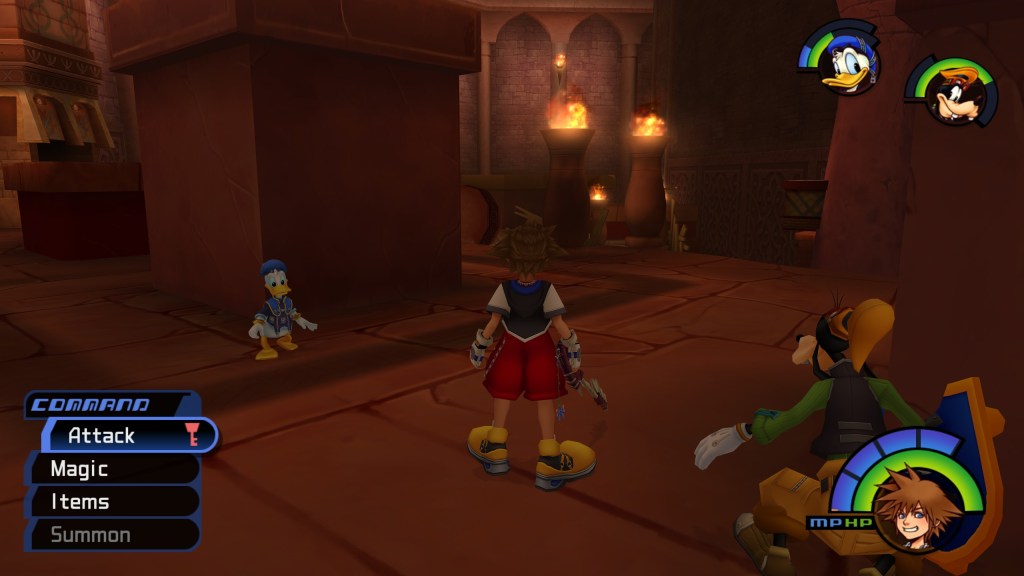
From there you enter the cave of wonders, a big set piece from the movie. This involves a boss fight with the big panther head thing that serves as the entrance for the cave. It’s an interesting choice for a fight because the panther isn’t depicted as a bad guy in the movie, but also as a kid I remember thinking that thing was next-level scary so I love that they threw it in here as a boss.
And that’s about all the good I can say about the venue itself. On the inside, the cave of wonders is a trap-filled hellhole swarming with heartless. It makes sense for it to be sort of hard to navigate because that’s how it’s presented in the movie, but fighting enemies here is annoying. There are pits all over the map and if you fall into one while fighting, which is very likely, you’re taken to an entirely different area. This can be frustrating.
So I try to avoid most of the fights in the cave. If there’s some heartless guarding a chest or something, sure, whatever, but nothing is worse than beating the hell out of one of those fat fire breathing heartless only to fall down a pit before you can kill it. You get zero EXP and a lot of wasted time for your effort. Gee, thanks!

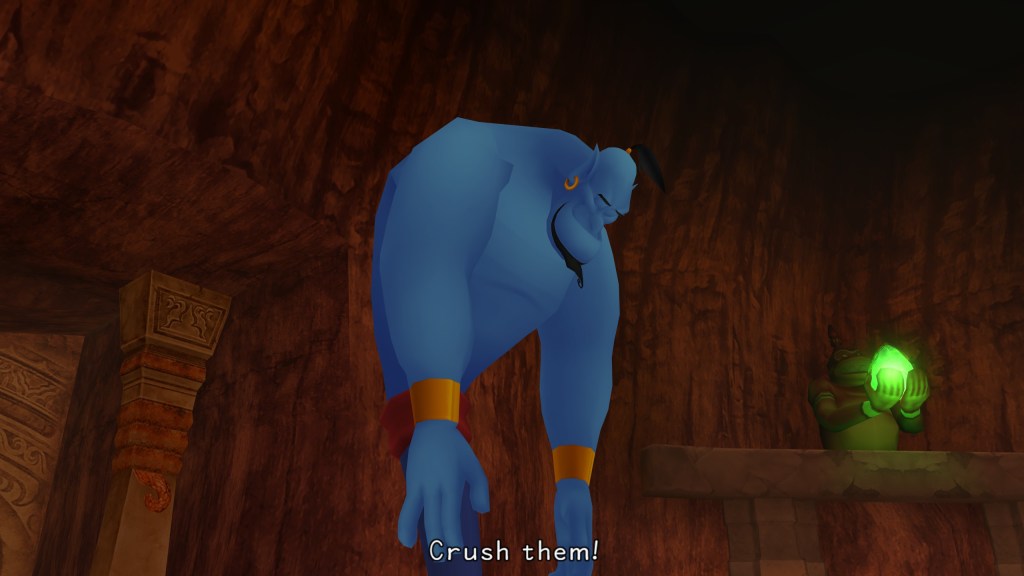
The boss of the area is pretty cool though. Jafar has two phases, as do most of the bosses in this set of worlds. The first one is the man himself. He mostly casts magic and uses his cool snake rod to shoot lasers at the party and then has the Genie (half-heartedly) attack the party while he turns into a wisp and zips around the map. I’ve always found this encounter pretty easy, just ignore Genie entirely and focus on Jafar as to not lose sight of him.
The follow-up is the iconic Genie Jafar fight. In the movie, this is an extremely quick moment where Aladdin says “nuh uh uh, Genies go in the lamp” and then Jafar just pops in there. Not so easy here as instead, the evil Genie hangs in the background lobbing fireballs at Sora while his pet bird, Iago, flies around the map holding the lamp.
This is an intimidating looking battle but it’s probably one of the easiest bosses in the game. You can’t hurt Jafar, so instead Sora focuses on the bird and as long as you stay locked on and attack frequently, I don’t know how you can lose. I don’t even pay attention to what Jafar is doing half of the time and I still come away okay. This is more about spectacle than anything else.
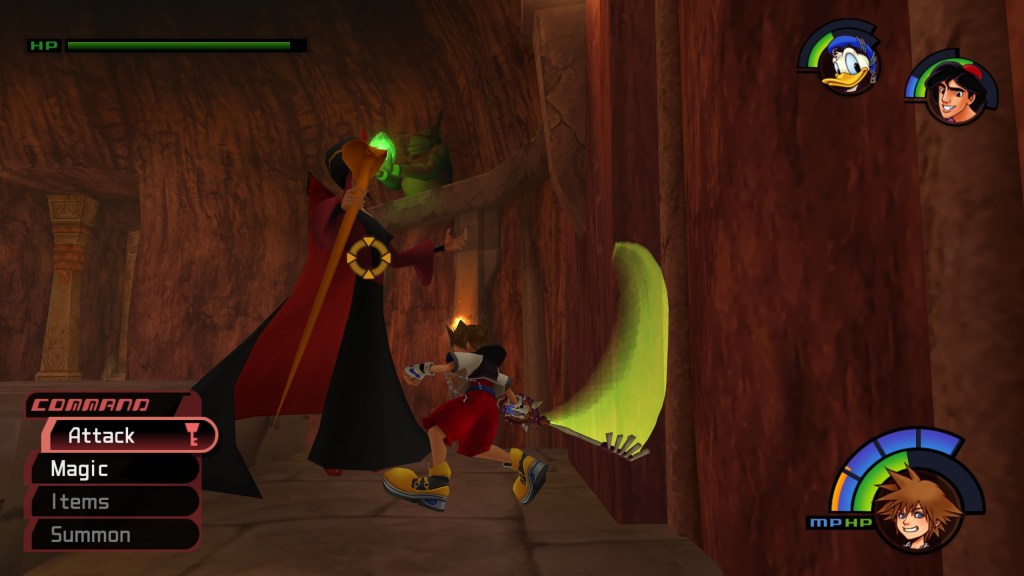
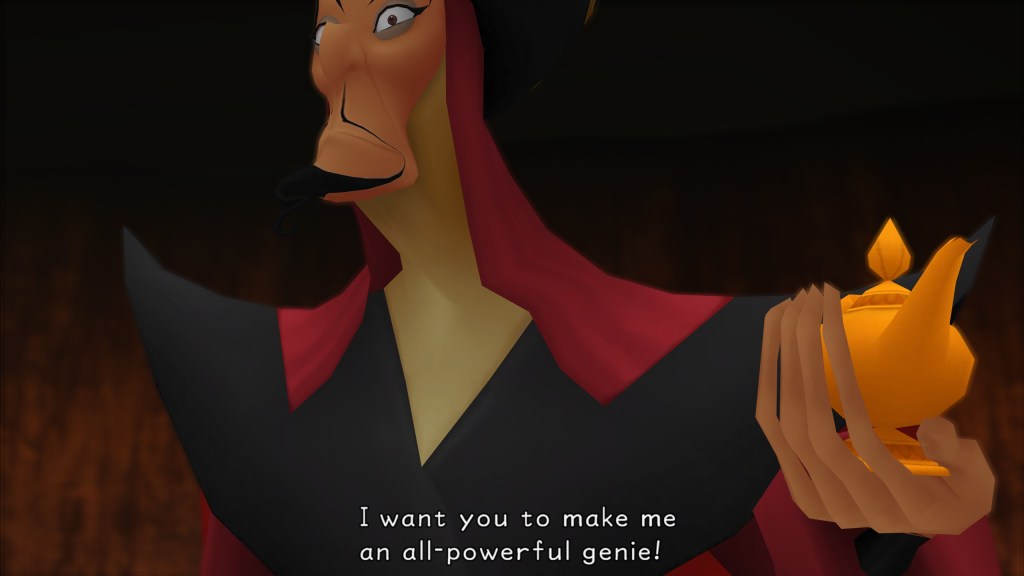
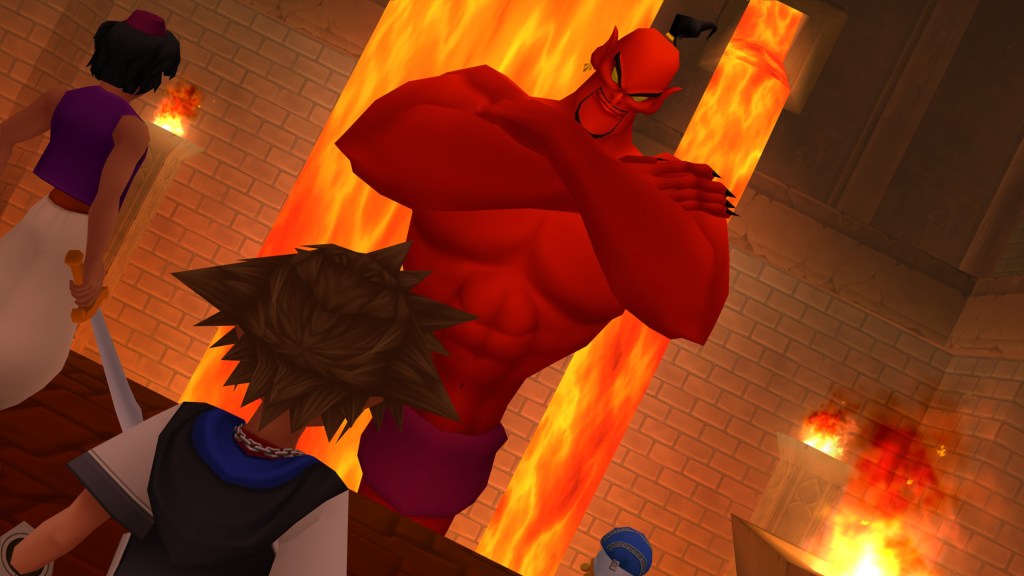
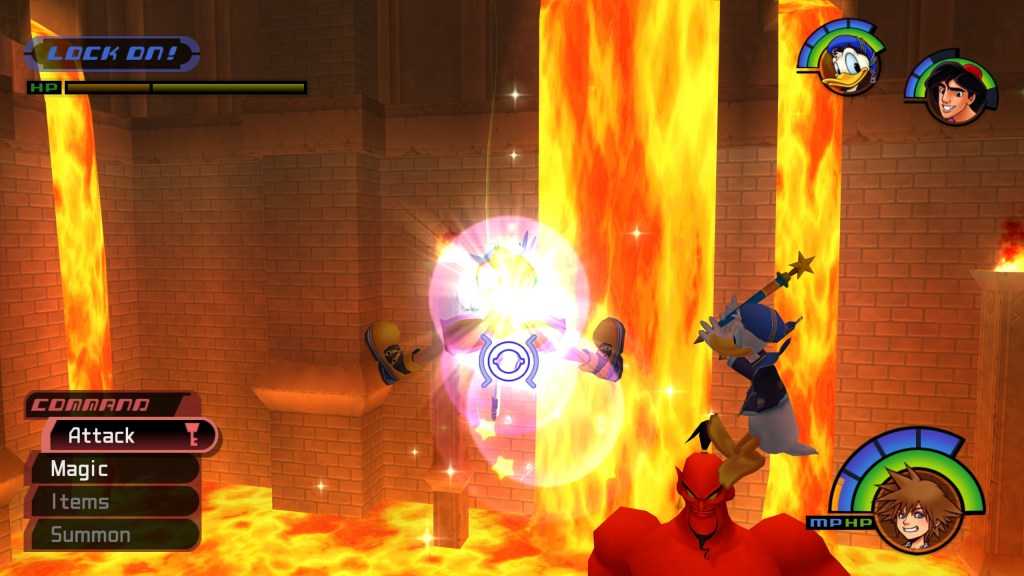
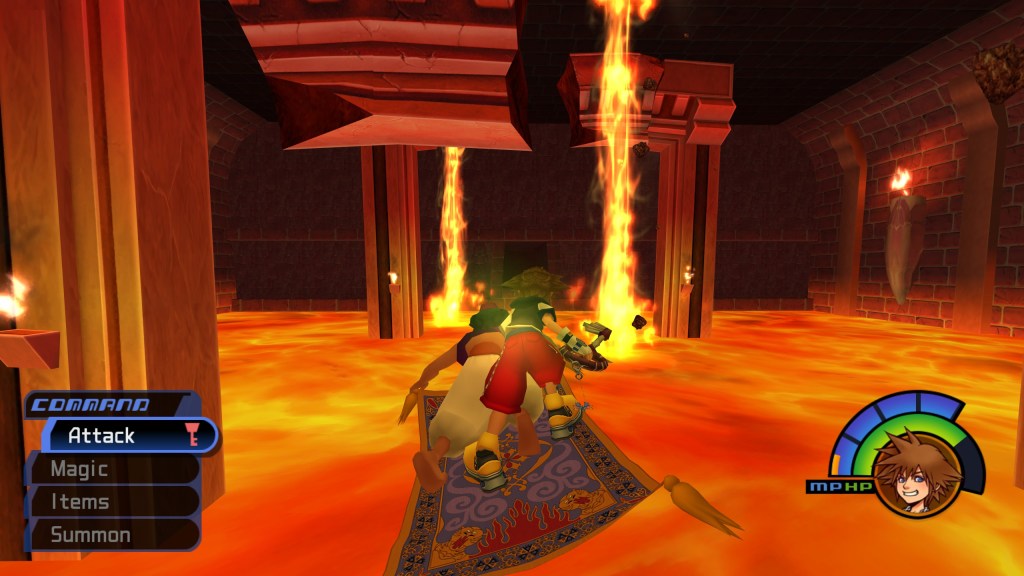
Finally, the world ends with a carpet ride out of the cave of wonders. It feels like a lot of work was put into Agrabah when compared to the first batch of levels. I have memories of having game overs during this segment, so I can at least say it’s harder than the stupid tree grinding, but in this playthrough I can’t say I was ever in any danger. Like Jafar, it’s about spectacle, and one of the cooler scenes from Aladdin involves the hero trying to escape the cave of wonders as it collapses, so it’s nice to see that represented here.
I feel like a lot of people are mixed on this level, but I think it’s a lot more interesting to go through than anything we’ve seen so far. I think it represents the movie well, has some fun bosses and it feels more significant to your journey than any other Disney world has felt to this point. Plus, I love Dan Castellaneta as Genie here. He does an impressive job of both sounding like Robin Williams’s Genie and not sounding at all like that Genie. B-
Monstro

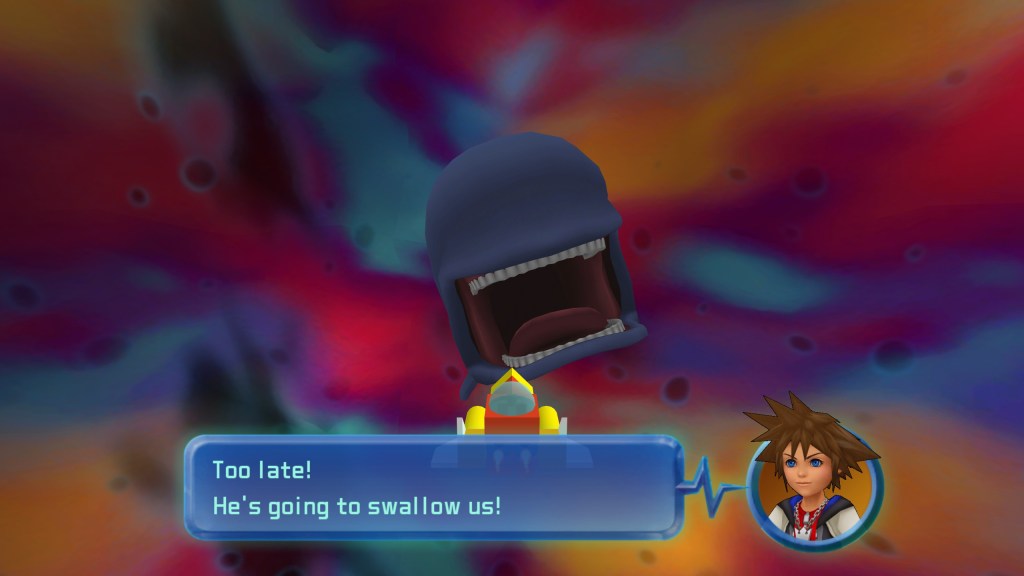
While the player is flying towards a totally different world, a giant whale pops out of space and swallows the party whole. There’s no hint that it’s about to happen, so it feels totally random. Monstro comes from the movie Pinocchio, and I feel like if you’re trying to recreate the ‘cast gets swallowed by a giant whale’ thing, that this is the best way to do it. Why tease it at all, make it come out of nowhere! Surprise the player like ol Pinoc’ was surprised! Who knew whales could breathe in space?
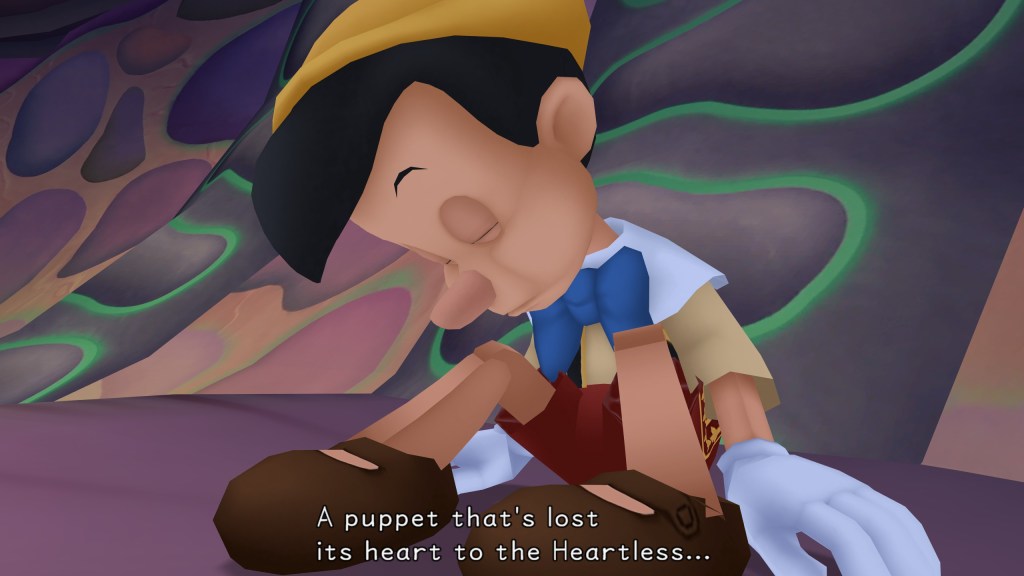
The story this level presents really has nothing to do with the movie Pinocchio outside of the characters from it being there. Basically this dopey little puppet has wandered off inside the whale’s stomach and Sora has to track him down but WAIT Riku is here! And something about the little puppet intrigues him. He wants to hunt the guy down because he thinks it might help Kairi.
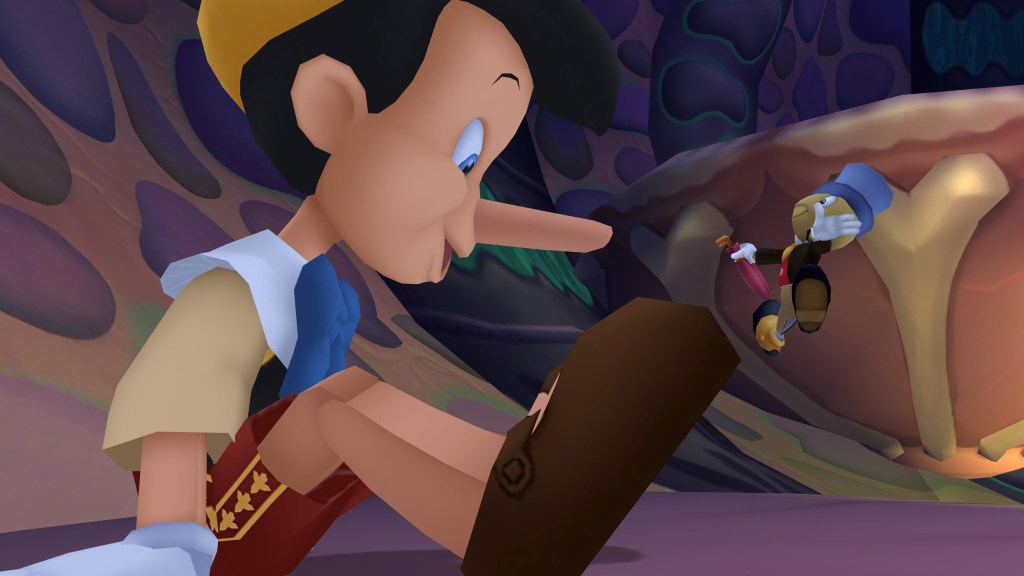
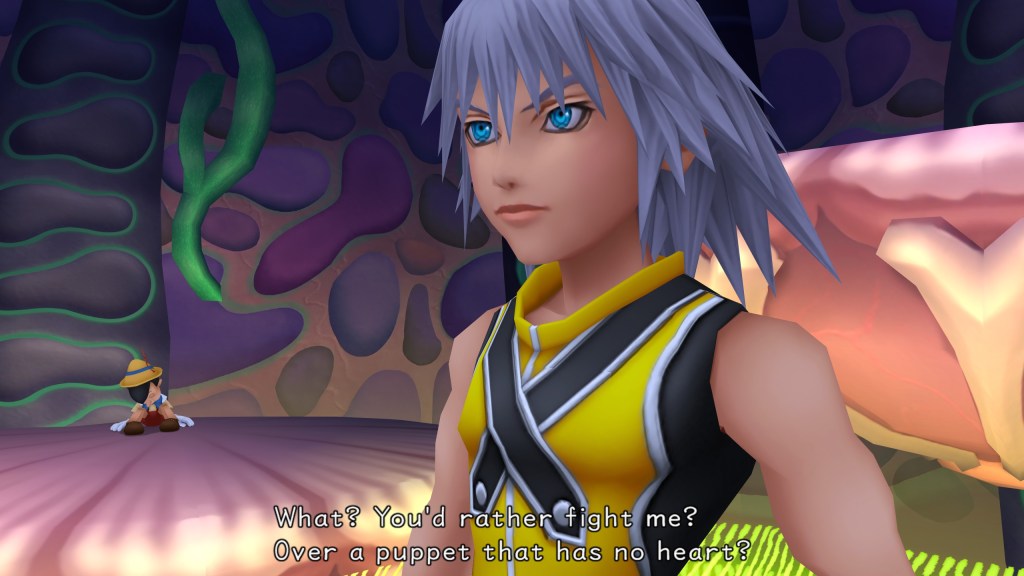
This level is a surprise ‘overall plot’ world as it focuses on Sora and Riku’s relationship and has the two interact for the first time since a short little meeting in Traverse Town. This level firmly plants Riku as a bad guy being manipulated by Maleficent. Sora and Riku have the same overall goal, save Kairi, but their approaches are different and thus conflict is born. You don’t actually fight Riku here, but the level builds up that a conflict will eventually happen.
The world itself is pretty bland. There are six main rooms in Monstro proper, as well as a throat, that all look pretty identical. Only so many ways to make the inside of a giant whale look, I imagine. It has sort of a weird rainbowy aesthetic, which is an interesting choice.
It’s extremely easy to get lost here because of how similar everything looks, so the player needs to pay a lot of attention to what specific room they are in if they wish to make progress.

The boss fight in Monstro is kinda neat in that it involves a Sora and Riku team-up. I understand that Riku has just become a villain about 20 or so minutes ago, but I am a gigantic sucker for when enemies team up to take out a common foe, and that’s what we get here.
It’s a generic heartless enemy that appears to be modeled after the parasite cage monster that traps Dagger and Vivi in FFIX. The fight is pretty easy, but I think the excitement of teaming with Riku makes up for that.

You also learn a very important ability about halfway through the level, the high jump. It about doubles Sora’s vertical movement and lets the player land on previously hard-to-reach platforms. This encourages the player to go out exploring because who knows what treasure is out there!
One of the main collectables in this game is the missing 99 dalmatians, so you better get to high jumping around worlds to see if you missed any! This also makes the odd bit of platforming you need to do significantly easier. Great skill.
I’m not going to sit here and pretend this is the most exciting level. The interior is repetitious and it’s easy to get lost. However, the world moves the story forward and feels plot important, so I’ve always looked forward to hanging out in here. Since the tie to the source material is a little looser than it is in other worlds, this almost feels like a transitional world like Traverse Town does. Almost. C+
Atlantica

This one got a lot of preview hype as well. Journalists of the era were really interested in the world specific costume changes, which of course made young Derek extremely interested in them as well. I was thinking almost every world would have something unique and unfortunately that just didn’t happen. Only two worlds got unique forms and since Atlantica features wildly different designs, that’s what got the most spotlight.
Lorewise, the costume changes make complete sense. Sora and company aren’t supposed to be advertising that they are from a different world, so they need to blend in. Most games in the franchise feature one or two costume changes, and I always look forward to seeing what they come up with. My personal favorite is the pirate getup you get to wear in KH III.

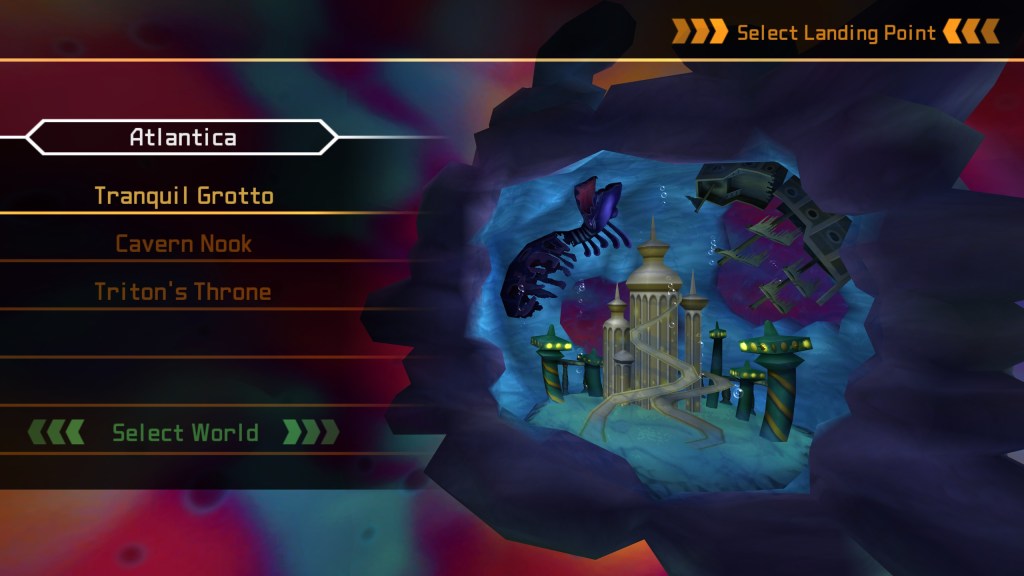
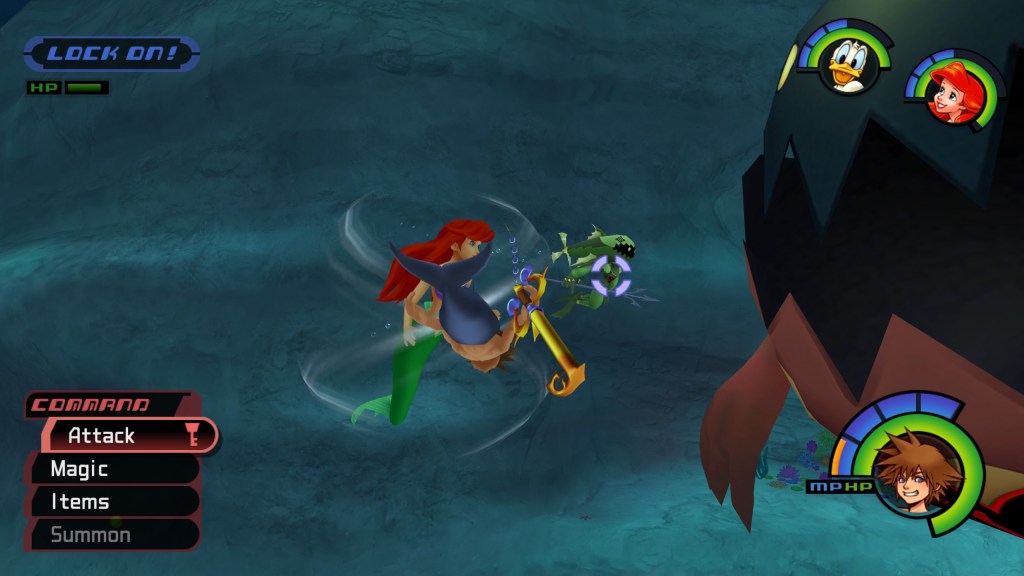
Atlantica itself is based on The Little Mermaid, which is a movie about a mermaid who wants to becomes a normal human. Since it’s about a mermaid, a lot of the movie takes place underwater, which means that they made KH Atlantica reflect that. This includes giving the player an entirely new movement tutorial to adjust to moving vertically, and it also means a slight reworking to how combat feels. As a result, this world really feels really unique.
Unfortunately…moving underwater is pretty awkward and doesn’t feel as good as battling on land. Navigating the world is kind of frustrating and complicating things is a faster current blockading progress to certain areas. You can bypass this by grabbing a dolphin, but the game doesn’t do a great job of pointing the player in this direction so a lot of time in Atlantica might be spent wondering where to go. It’s difficult.
I respect that they even tried though. Seriously, this world feels completely different from everything else in the game. I know Little Mermaid is one of the more iconic Disney movies, but I’m surprised they didn’t pivot to something like “Emperor’s New Groove” or an actual “Beauty and the Beast” level instead. It’d be a lot easier!
I think Yzma would be an awesome boss, do that in a future Kingdom Hearts game anyway.

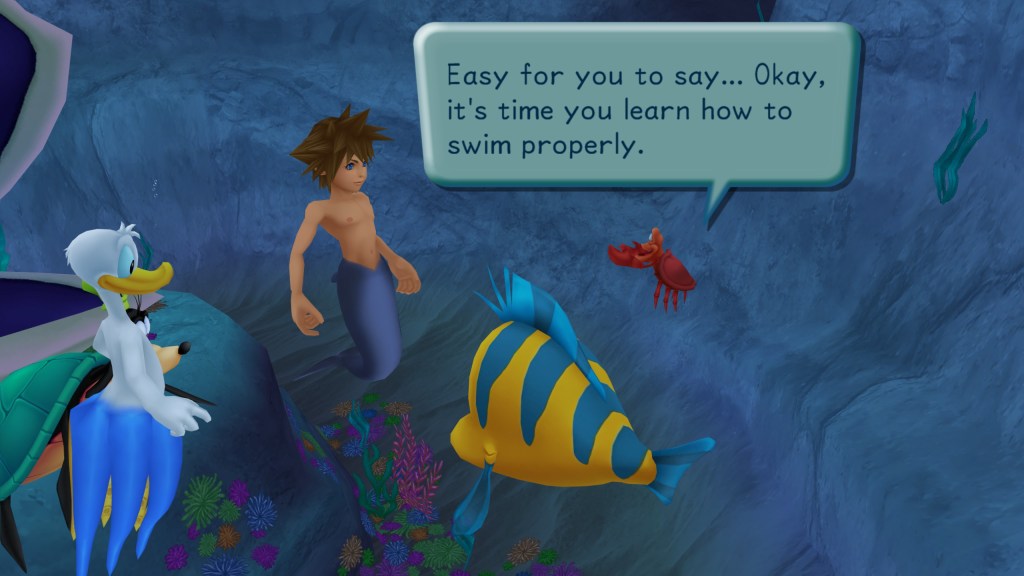
The difficulties with combat and traversal probably led to Atlantica being reworked into a rhythm game world in the sequel. That one is notorious for entirely different reasons.
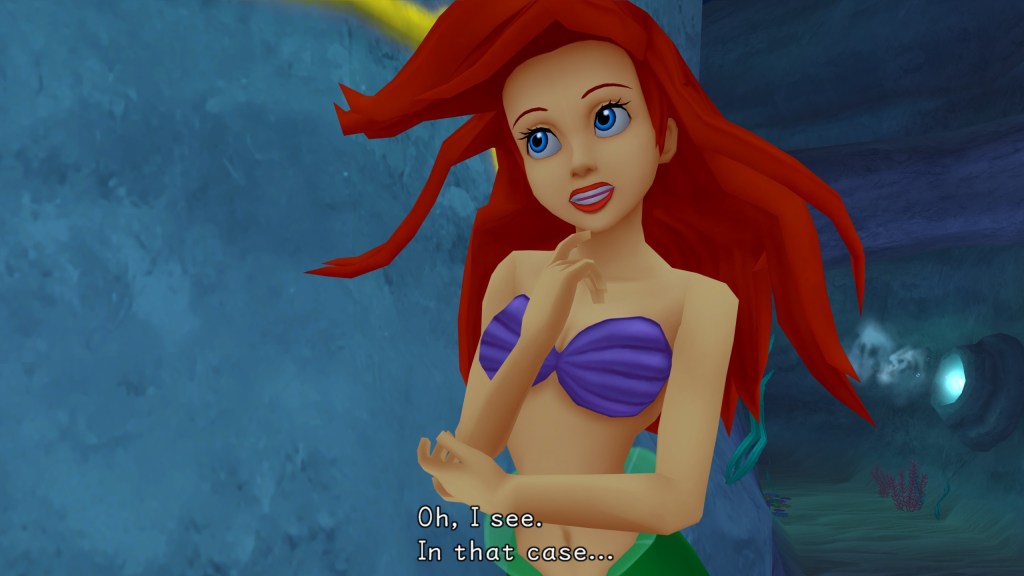
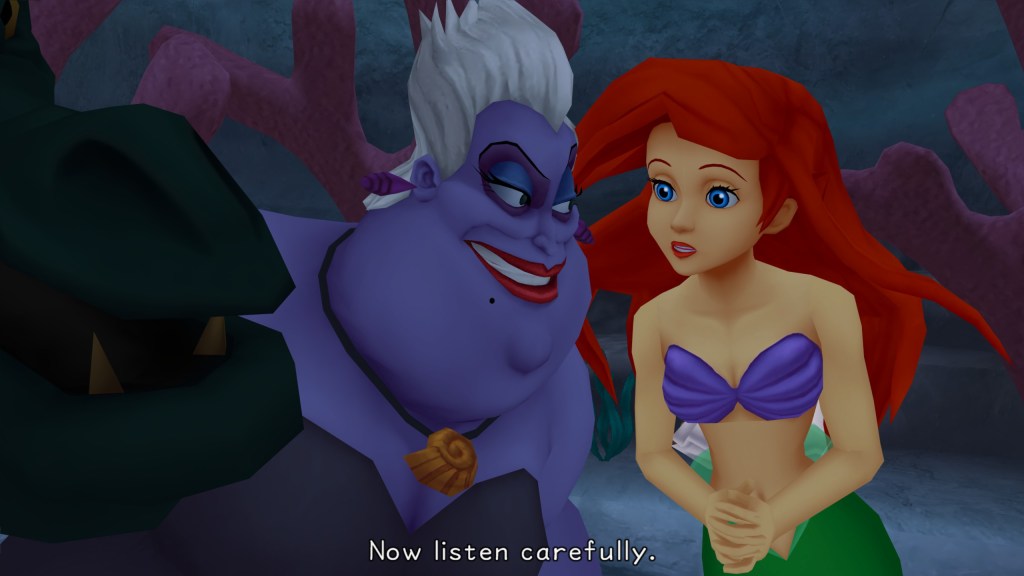
The story here doesn’t follow the movie so much as the love interest, Prince Eric, is nowhere to be found. Instead it involves Ariel’s other main love interest, discovery. It’s a small ocean dammit, she wants to see what all is out there! So her dealings with the main villain of the world, Ursula, has more to do with her adventurous side than her romantic side.
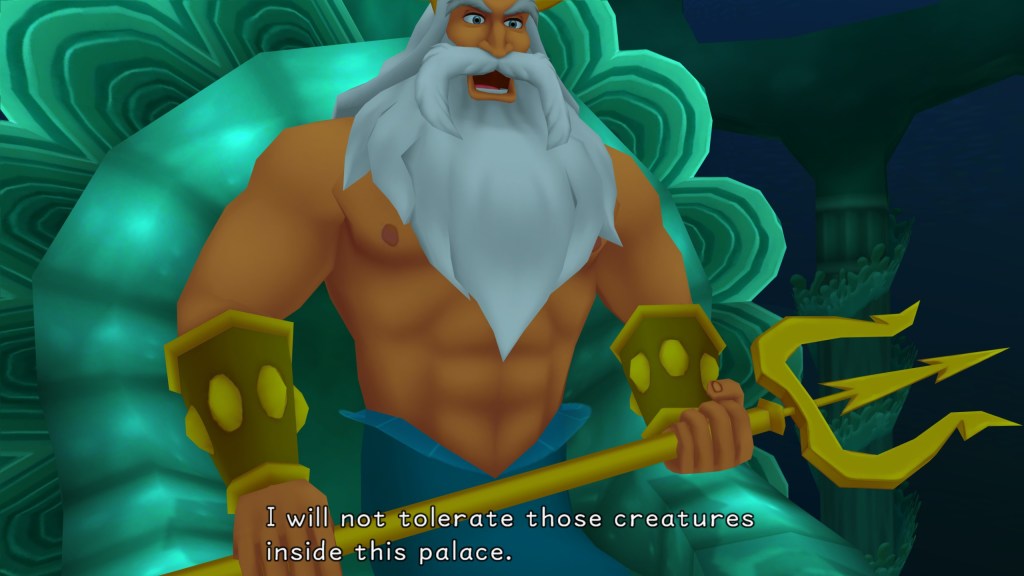
I like this choice because it gives the king of the world, King Triton, an excuse to talk about keyblades. He is somehow aware of heartless and other worlds and keyblade masters, it’s an unexpected twist considering world inhabitants have been pretty clueless about that stuff to this point. It helps this level feel more plot significant than it actually is. Good stuff!
Eric can get in on the finny fun in 2, don’t worry.
Unfortunately, I can’t speak as positively about the boss encounters. There are two main ones in Atlantica, both Ursula, and both are extremely annoying for different reasons. The first boss involves casting spells at a cauldron and making it backfire, which knocks Ursula out. She has absurd defense until you knock her out, so it’s crucial that the player interacts with this gimmick.
I have fought this boss 90,000,000 times in my life and I cannot figure out how to get the pot to backfire on a consistent basis. Sometimes an attack still bursts out of there and smacks me. It’s not hard, just tedious. Probably the most annoying mandatory boss in the game.
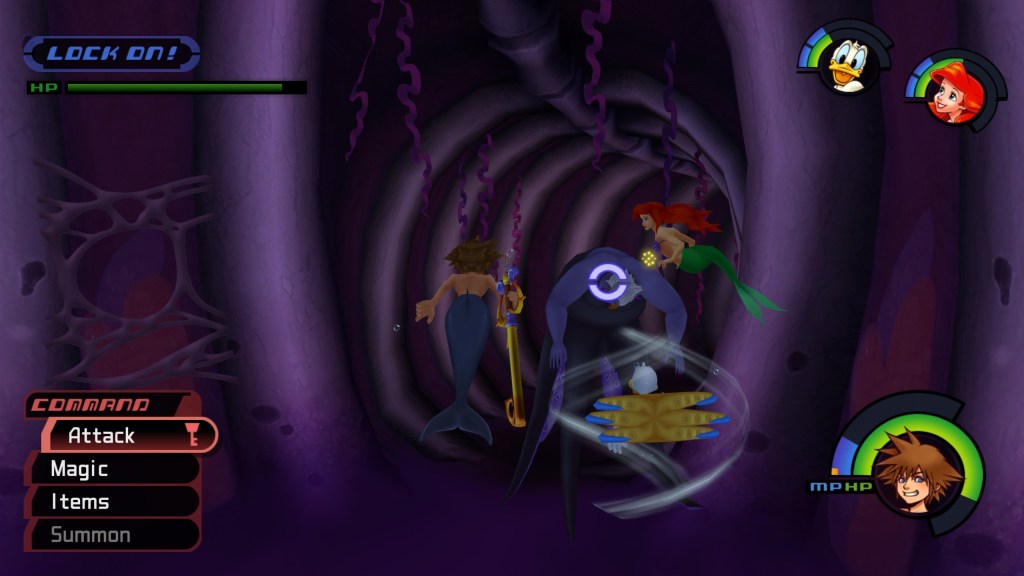
After that, the player gets the swift swim ability which allows them to access the true final boss room. Ursula upgrades into a giant boss monster with godly powers. Fighting this creature mostly involves swimming behind her head and whacking away at her.
Most of her moves are pretty telegraphed and easy to avoid until half way through when she changes her moveset to randomly have bolts of lightning smack the player if they’re close. She has a more focused version of this attack, but it’s pretty easy to see coming, so the random bolts are where the difficulty comes in.
Going back to the choices the player makes at the start of the game, if they sacrifice the shield, this battle is mind numbingly difficult. One shot of random lightning will put you at death’s door. So a lot of the battle involves swimming in circles at a safe distance, recovering MP, casting aero (a damage negation spell) and looking for safe spots to attack. It’s awful.
I don’t know what they were thinking when they came up with this fight, it’s the only encounter in the original Kingdom Hearts that feels unfair to me.
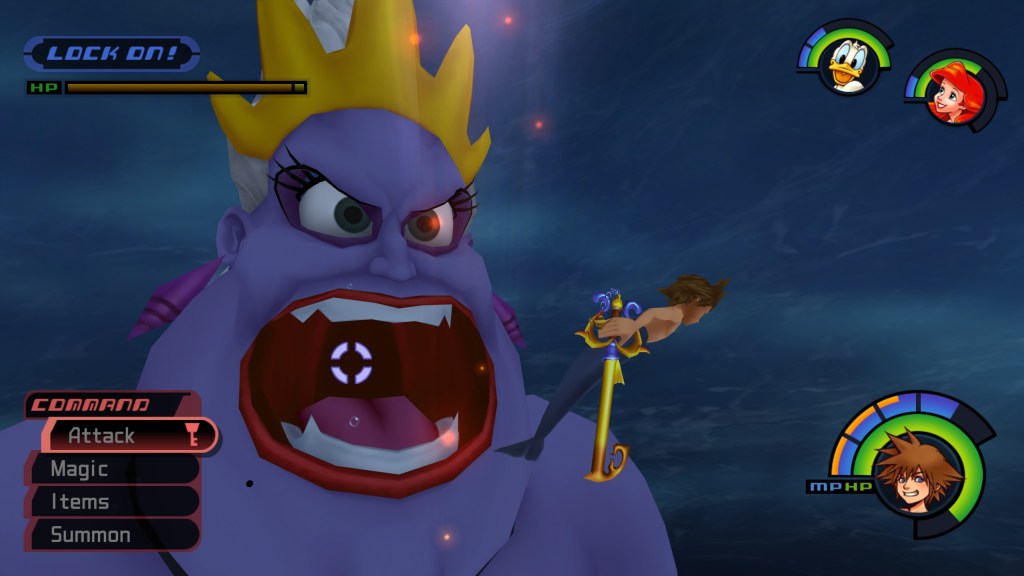
This playthrough, I kept shield, so it wasn’t as bad. I still kept aero up and tried to pick my spots, but the ability to tank a couple of lightning shots really makes things a lot easier. If you accidentally get hit by one of Ursula’s other attacks (a bite, an energy beam), it’s not the end of the world like it is in a shield-less encounter. It’s still not fun, but it’s significantly more sporting than what I had been used to.
I’m not going to sit here and tell you that Atlantica is this awesome, unmissable world. It has problems. But, I respect it for trying something different. It’s one I always dread playing through, but I also would not trade it out of the game for anything. It’s cool that it exists. C-.
Halloween Town
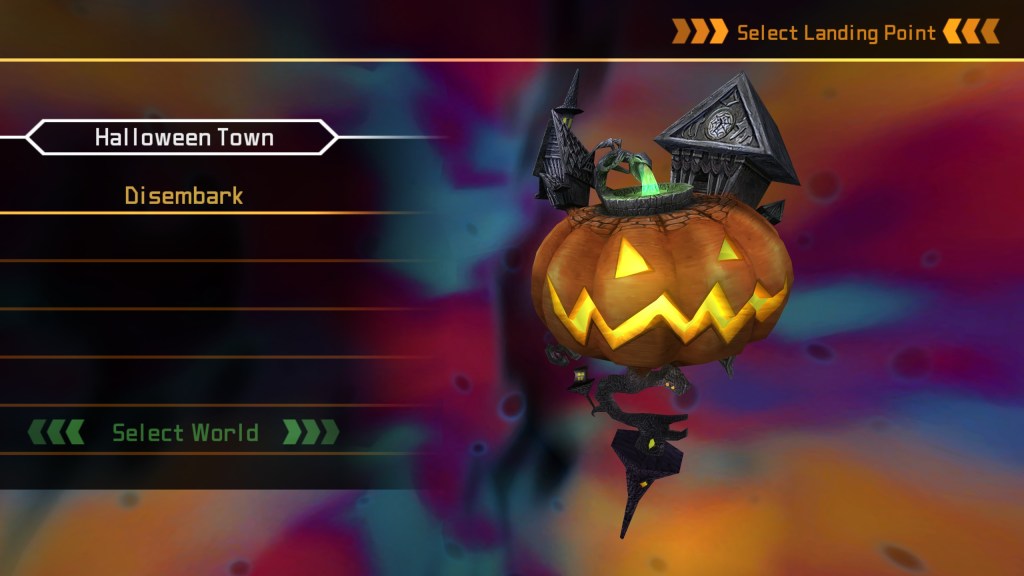
In the prerelease hype for KH1, Halloween Town was definitely the world I was most excited for. I was in that phase of life where anything remotely edgy was very appealing to me. The source material for this world, The Nightmare Before Christmas, was noticeably darker aesthetically than everything else, so what’s not to be excited about? My lasertag nickname alternated between “Dark” and “Sephiroth,” so I was absolutely there for it.
Plus there were unique costumes. Halloween costumes!
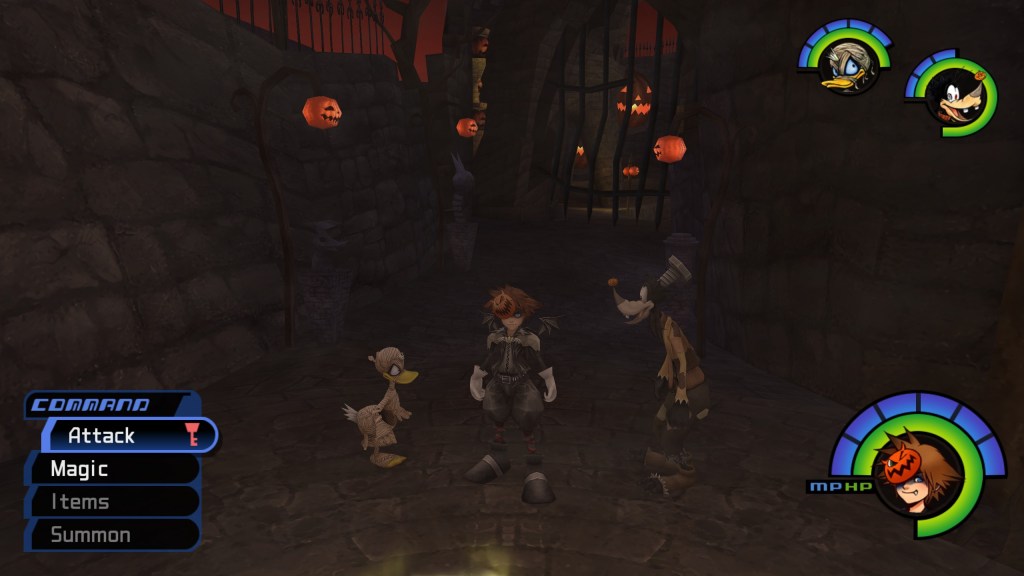
Once you get into Halloween Town, like with Atlantica, it’s pretty visually distinct from the other worlds. It does a good job of mimicking the movies claymation artstyle, to the point where you could almost trick yourself into thinking they could shove heartless into the original movie and nobody would notice. It’s neat! It feels faithful to the source material like Atlantica does, but without the gameplay swerve.
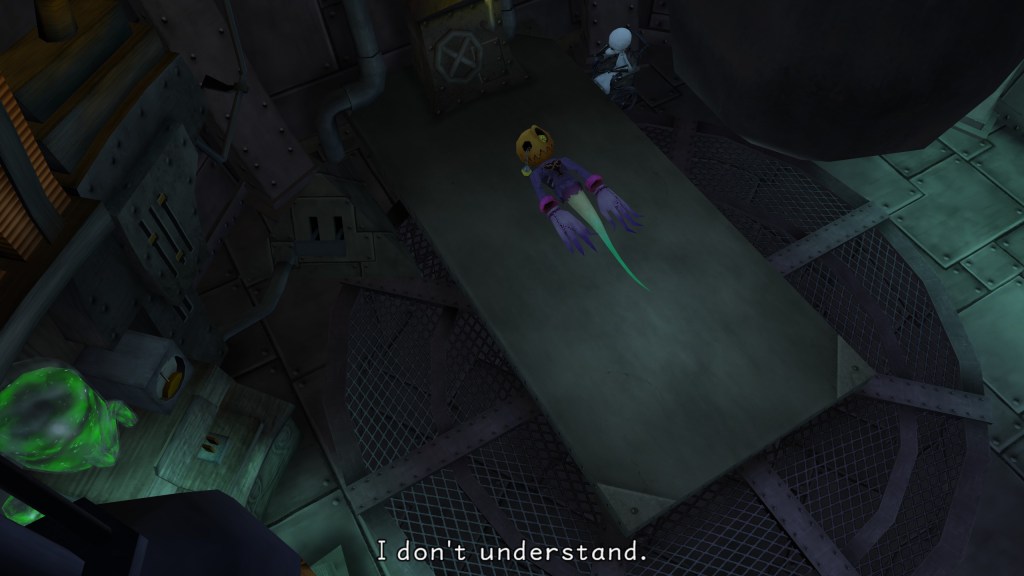
The plot of the world doesn’t follow the movie at all. Instead, it feels more like a slice-of-life event taken from the movie’s universe and placed into the game. This just revolves around the main character, Jack Skellington, trying to get prepared for the upcoming Halloween festivities. He discovers heartless and tries to do something with them, it backfires, and so our heroes come in to fix it. Simple!
I remember reading a lot of reviews stating that the camera in Halloween Town is especially bad and I’ve never really noticed it. Maybe I’ve built up armor to weird cameras over the years, I am a big fan of Mario Sunshine and Sonic Adventure, but I never found traversing this world problematic. Instead, it’s one of my favorites because everything is visually interesting and it’s hard to get lost. I’m not a hard man to please!
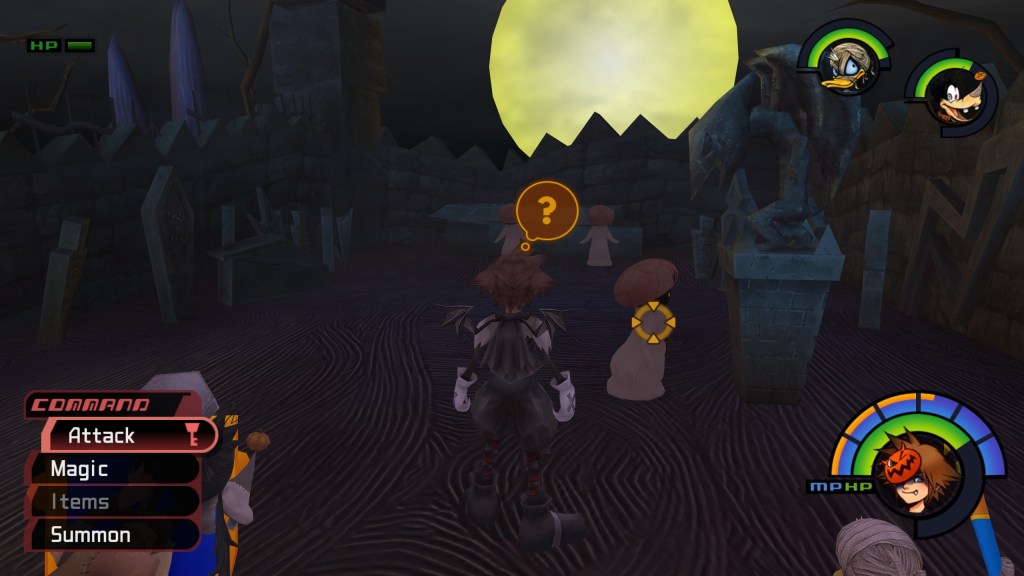
Probably the most distinct visual from the movie is the weird curly hill. I would wager even people who haven’t seen the source material could point it out. So it’s nice that they pop it in there and let the player actually use it. It just serves as a basic screen transition, moving you further along in the level, but it’s a nice touch. It helps give the world some personality.
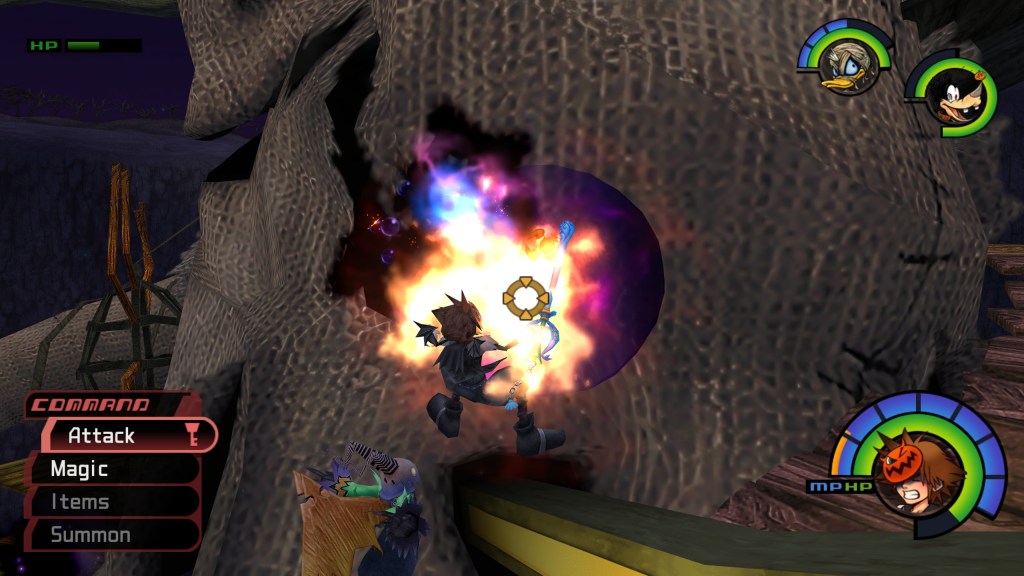
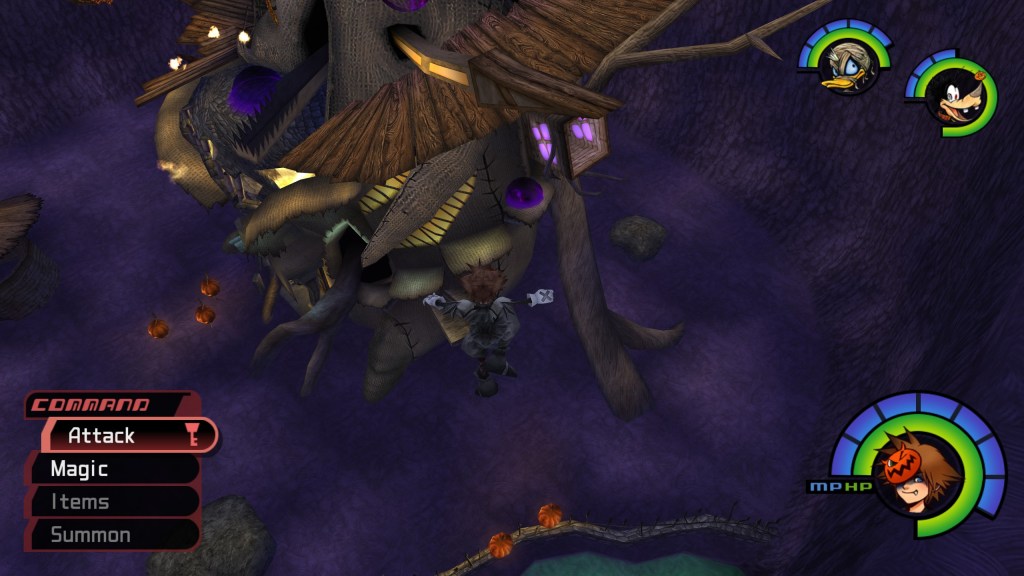
At the end of the world is a large structure, Oogie Boogie’s mansion. It’s a tall and hard to navigate piece of the world – falling off and having to make your way back up is quite common. This section of the game really shows how much more platforming heavy the first game is than the rest of them. It was probably wise for an action RPG franchise to pivot away from such precision.
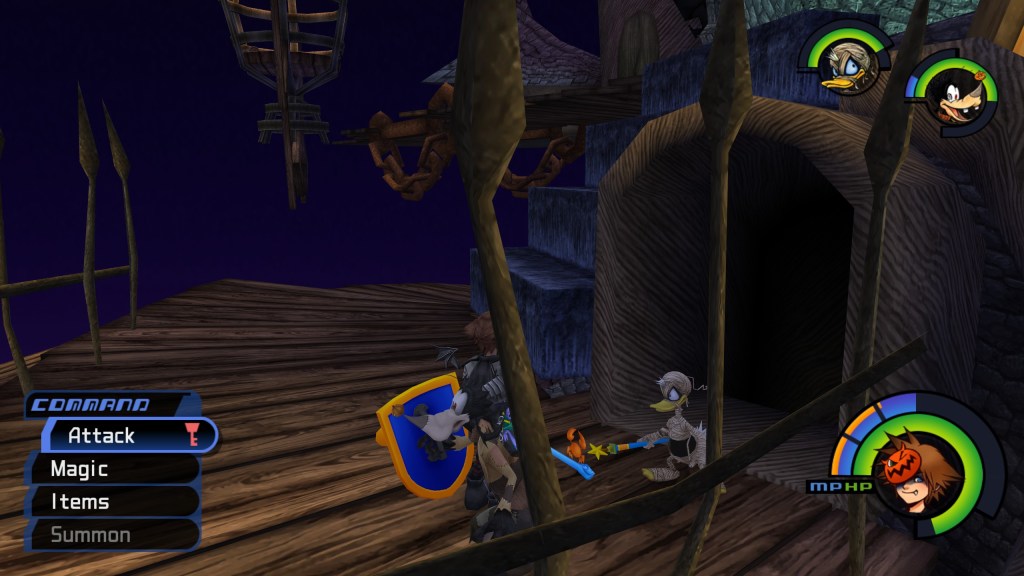
Waiting at the top of the mansion is Oogie Boogie himself, the main antagonist of the movie. This is a gimmick battle where the party fights on a roulette wheel while Oogie walks above the group, just out of reach. The fiend will roll dice that will throw various traps and enemies at the player.
In order to succeed, you need to pay attention to where he is on the field and then press a button while relatively even with him in order to elevate yourself and the party up so you can pummel the baddie. Rinse and repeat. It’s a pretty easy encounter once you get the mechanics.
After that, Oogie transforms into the mansion itself, which is a spectacle moreso than an actual boss fight. Like with Agrabah, loading screens are eliminated for this encounter, and the player needs to climb the mansion again and defeat various purple boils in order to eliminate the threat once and for all.
This isn’t too difficult, outside of the platforming I suppose, but the boils will occasionally shoot at you so it’s important to watch out for that. Still, compared to big ass Ursula, this is nothing.
I feel like this is a level not many people go to bat for, but I’ve always enjoyed it. I just like the aesthetic. C+


Neverland
Believe it or not, this is the final themed Disney world. We’ve made it so far! However, much like Monstro, this one doesn’t really pay attention to the plot of the source material at all and instead furthers the main story in preparation for the climax. Basically all one needs to know about the source of this world, Peter Pan, is that Captain Hook doesn’t like the little flying elf kid and also said elf kid can fly. That’s it!
Most of your time in this world is spent on a pirate ship. The interior of it is pretty teensy and samey, but like, it’s a ship. There’s only so much you can do to that interior to make it pop, ya know? If that’s where the world started and stopped, it’d be bottom tier, near Deep Jungle.
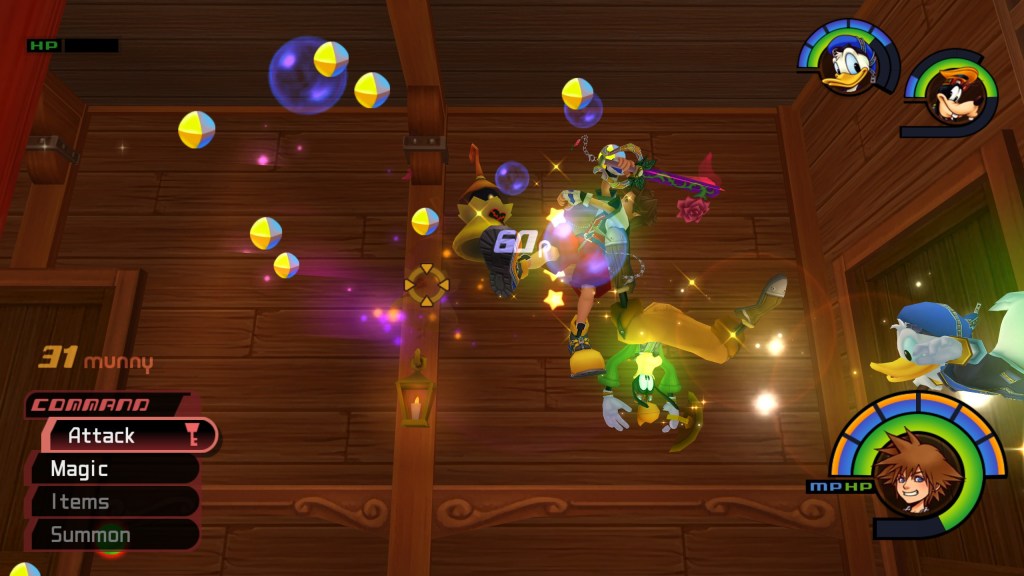
However, that’s not where we stop. Remember that little bit about Peter Pan being able to fly? Well, Kingdom Hearts imports that gimmick into this world and unlike with Atlantica, I feel flight works excellently.
Fighting heartless while flying around is a lot of fun. It’s very fast paced and just different enough from standard combat to feel refreshing. You don’t earn the ability to fly until the very end of the level, but once you can sour, it definitely leaves an impression.
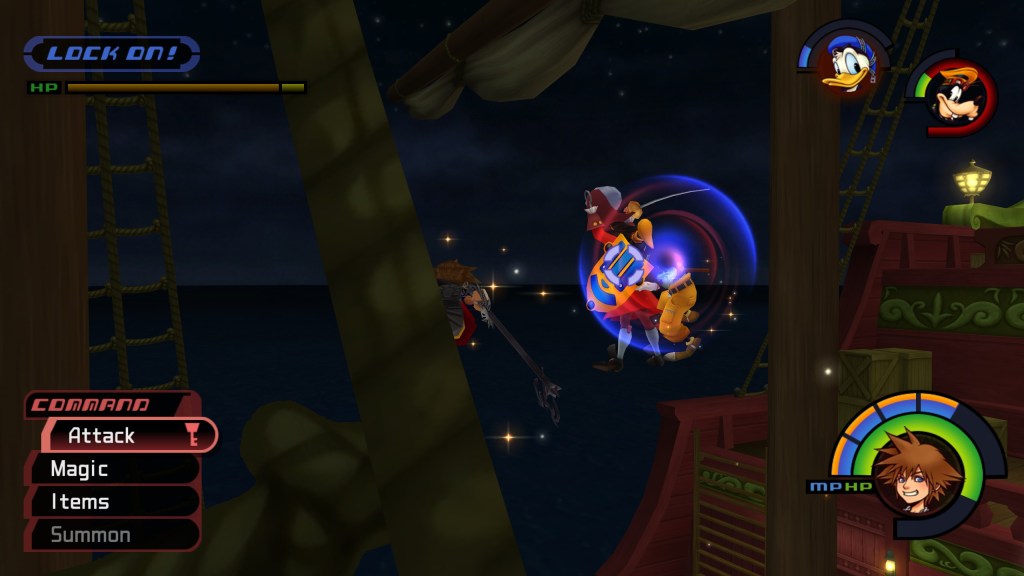
This carries over into the main boss fight of the world, Captain Hook. It’s a fun battle that can certainly be fought on land and you can certainly guard and counter his movements like you would a traditional ‘duel’ style boss, but what’s the fun in that? I always take flight and zoom around and whack at the guy in that fashion. A bit slower than a standard fight, but why not immerse yourself in the main gimmick the world gives you? Beats the hell out of grinding on vines.
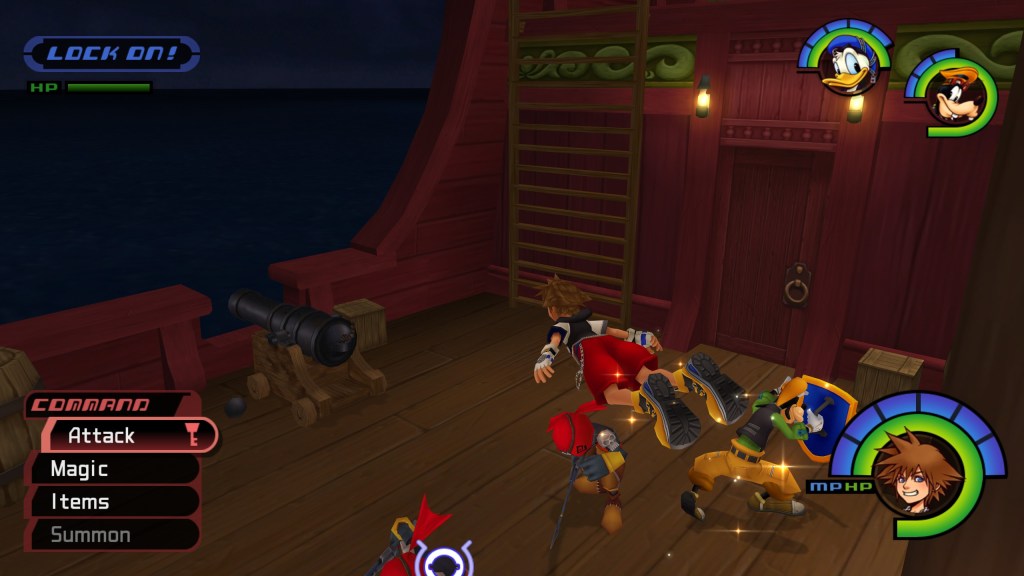

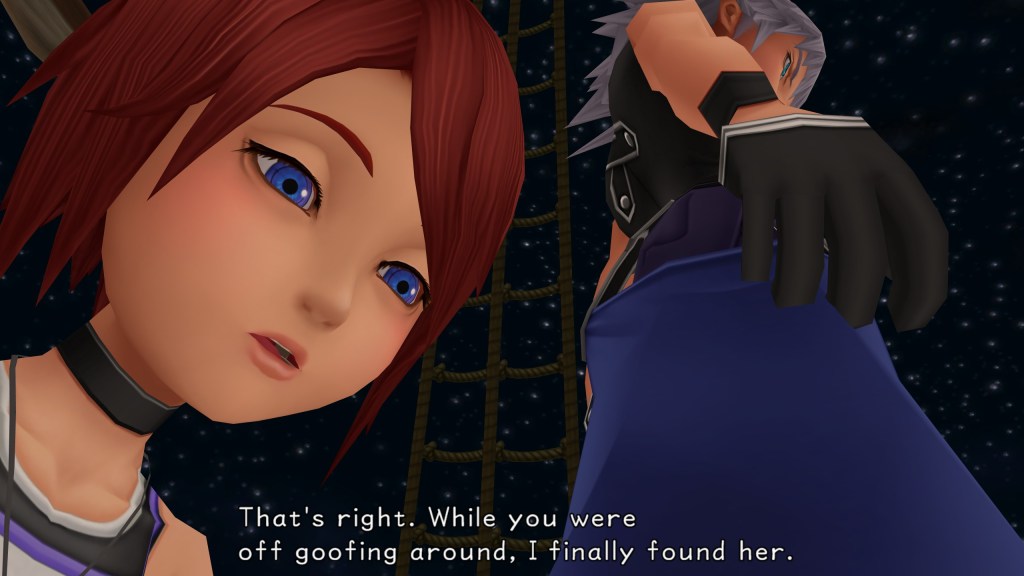
Since this world pushes the narrative forward, you spend a lot of time building up the coming showdown between Riku and Sora. Our former friend shows up with an unconscious Kairi and taunts the protagonist. This is where Sora is very different. Most main characters would see their ex best friend show up with the corpse of their love interest and sulk about it for a while.
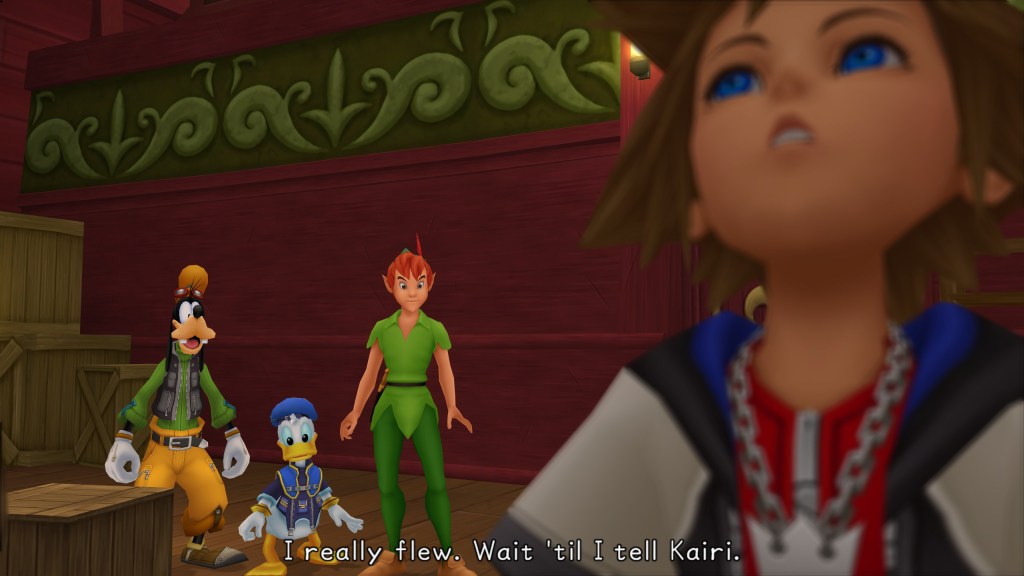
Not Sora. He gets mopey at times, but he’s a beam of positivity and light. Instead of dwelling on the hopelessness of the situation, he instead talks about how he’s excited to tell Kairi about how he was on a pirate ship. In a different game that’s a little less confident with its dialogue, you might have a side character interrupt Sora and say “ARE YOU SERIOUS RIGHT NOW?” but instead, they just let him be. Sora is genuine, he’s looking beyond the fights ahead and just sees peaceful times. As I’ve said, for as corny as KH can be at times, I like that it is also genuine.
Sora is Sora, all there is to it.

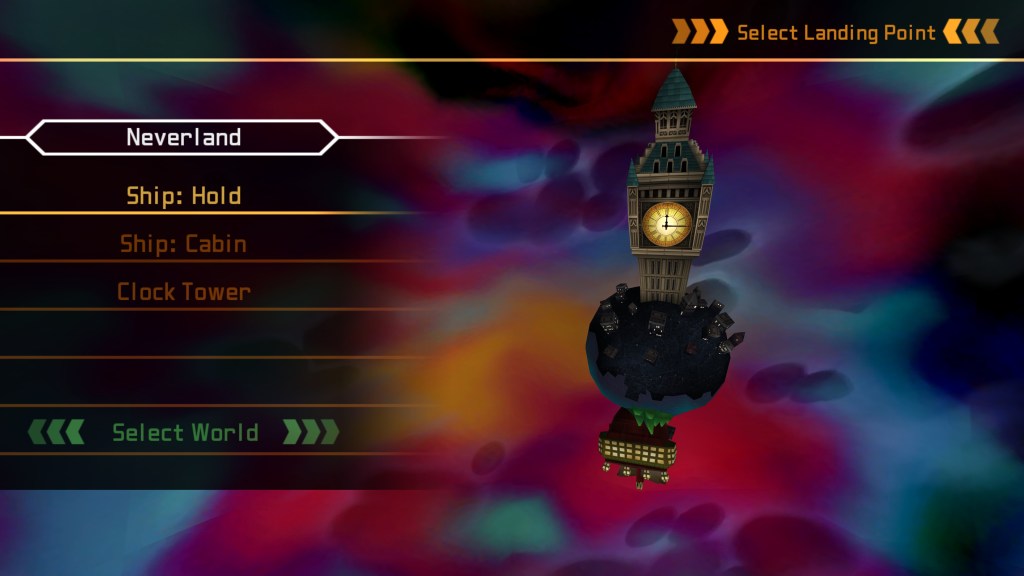
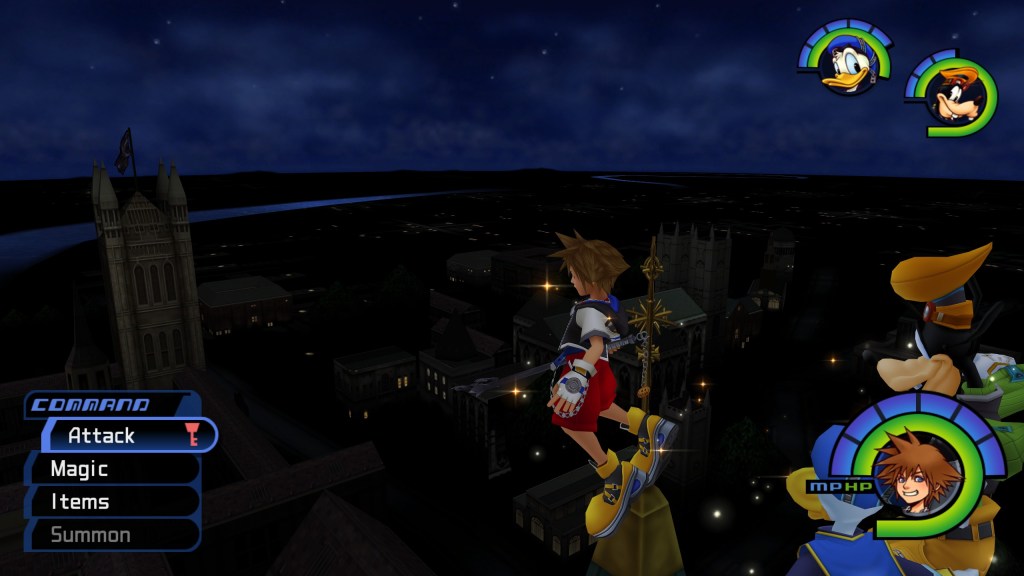
After dealing with Hook, the player gets sent to Big Ben. You can fly around this area and explore, which is actually a hint that an optional boss lurks here – a really shitty one at that, but as a youth I would just fly here for a while hoping to somehow break the barrier and get to explore the town. What was I smoking? Did I think Square designed an entire town and just prohibited the player from ever accessing it for no reason? Ah, the wonderment of youth.
I love this level. It might not be very long, but it’s a lot of fun to play and it’s probably the most important narratively to this point. You also get the crucial glide ability from hanging around here, which when combined with the high jump, makes traversal even easier. I really wish the Neverland world in Birth By Sleep brought back flight, but alas. Enjoy it while you can! B+
Hundred Acre Wood
I mentioned that Neverland is the final themed Disney World, but what I omitted is that it’s the final TRADITIONAL Disney World.
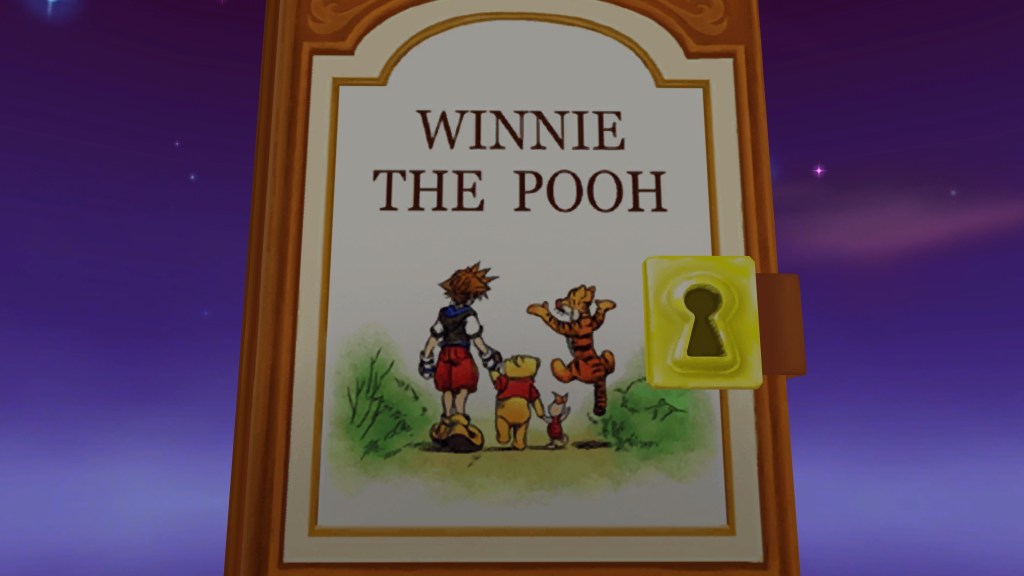
If the player discovers key items known as torn pages, they can reconstruct a book that tells the tale of Winnie the Pooh and his friends. These are scattered throughout the second set of worlds the party travels through. On a first playthrough, most players probably won’t grab everything right away, so it slots right before Hollow Bastion in this writeup. However, for most second-timers, you’ll have complete access before your trip to Neverland.
Since this world is formatted like a book and you’re collecting ripped pages, the inhabitants of the book are without their memories until the player gathers all the pages and plays the content associated with them. Each page that’s discovered unlocks a new minigame to play with Pooh and friends and in order to lock the keyhole of this world, they all need to be played. There are no heartless in this level.
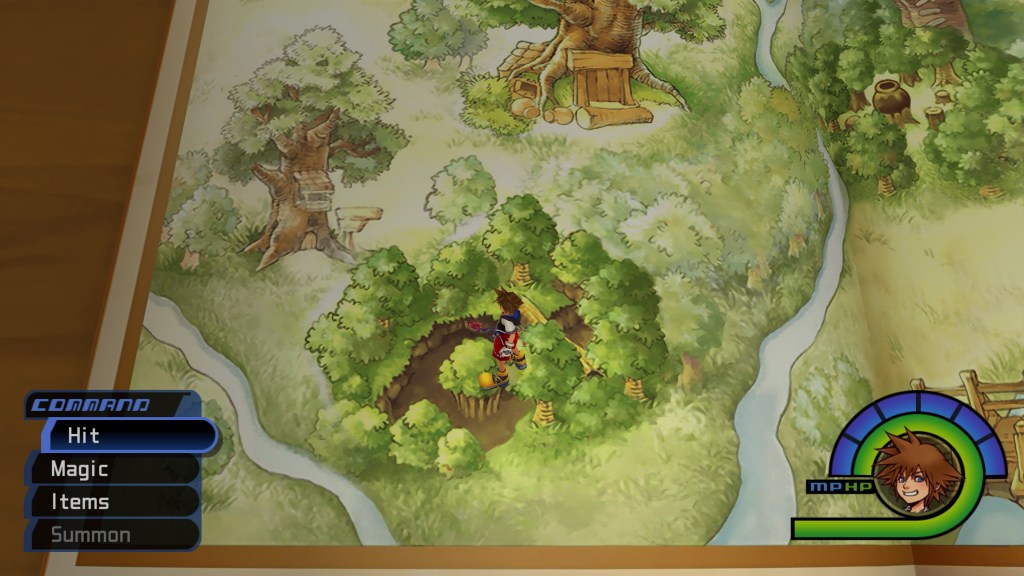
This is the proper approach to including Winnie the Pooh content. It’s a peaceful world, violence really isn’t in play here, so it makes sense for everything to be a minigame of some sort. Unfortunately, every single one of them sucks ass. I hate this world. It’s the worst part of Kingdom hearts and it’s a true bummer that it’s a requirement for the secret ending. If it wasn’t, I would skip it every time.
Nothing is particularly hard, it’s all just annoying and time consuming. The first minigame is one where Pooh flies on a balloon to grab honey from a tree. Sora must hang on the branches and swat bees away from Pooh. It’s insultingly easy and a waste of two minutes. The next one involves stopping Tigger from jumping on crops. The controls in it are weird and I’ve never been good at it.
The third is the best one. You push Pooh on a swing and it takes about three seconds to accomplish. Perfect. Next is jumping around logs in a set pattern, another Tigger themed game. This one is also very easy, but despite my camera prowess that I mentioned above, the camera DOES bother me here and I occasionally mess up my jumps as a result. Great!
The last minigame involves slowly navigating a maze to find Pooh’s hiding friends so they can…hide again, but in some brush this time. You clear obstacles so a slow-footed Pooh can meet his friends and it is just a pain.
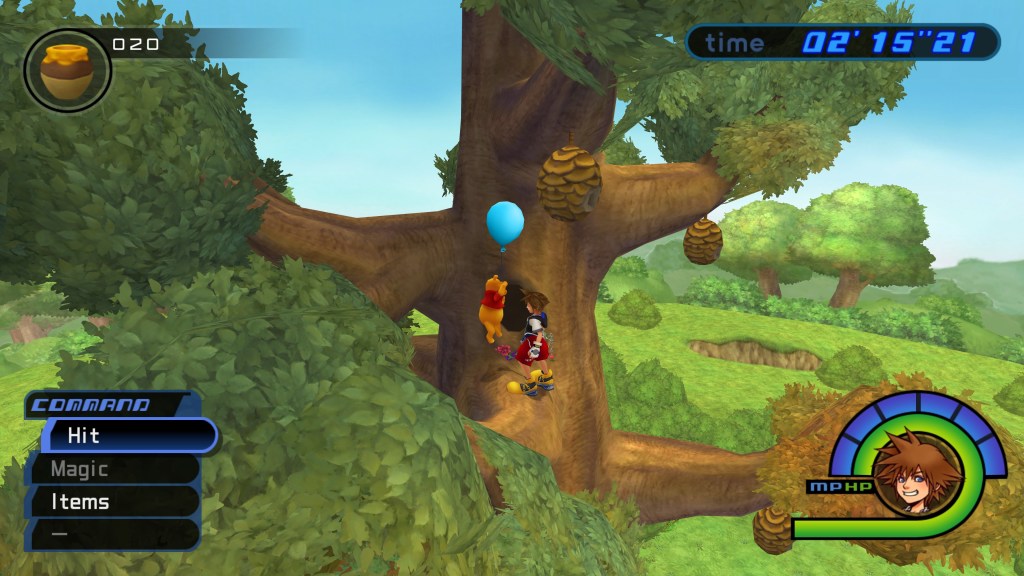

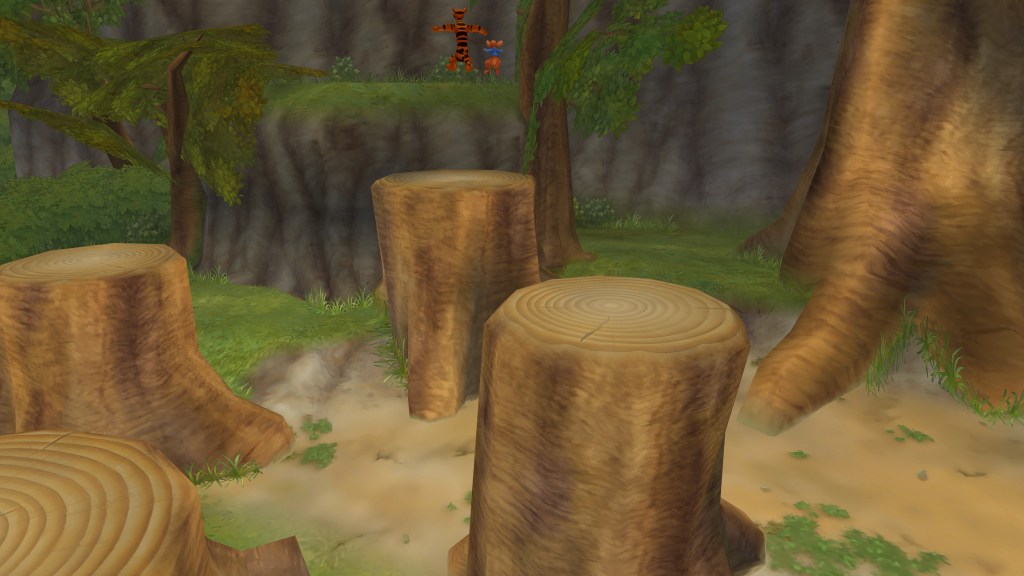

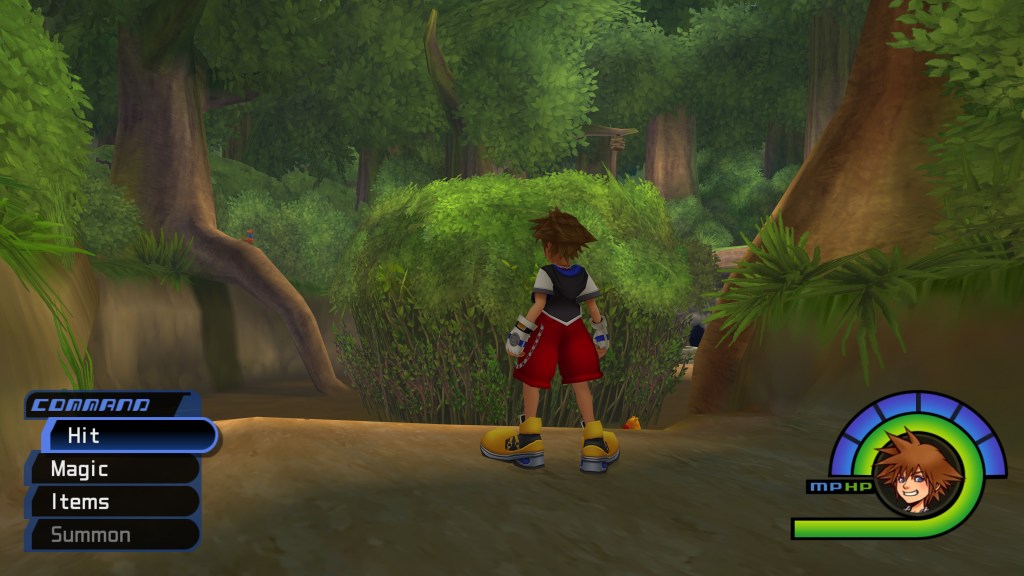
All of the mainline KH games have a Hundred Acre Wood segment and all of them suck. The second one has better minigames than the first, not that it’s hard. The third one, for whatever reason, takes all of 15 minutes and is just the same minigame over and over again. Since it only takes 15 minutes, it is easily the best Hundred Acre Wood segment in these games.
Maybe if I was some gigantic fan of Pooh, these levels would resonate with me. Whenever I shit on this segment of the game, I have a buddy who will vouch for it, but it’s just not for me. I think the type of whimsy that Pooh comes to the table with just doesn’t land with me. Sorry! F

Hollow Bastion

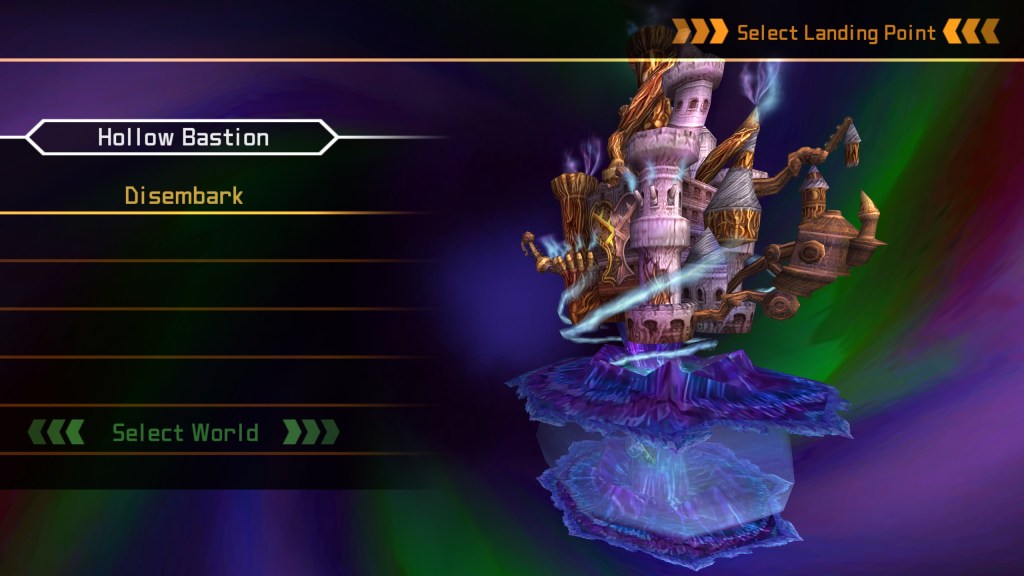
The second original full world in Kingdom Hearts and the base of Maleficent. When the player gets here, almost immediately Riku swoops in and steals your keyblade and the gameplay experience changes for the first time in a while. Sora is now only equipped with the same wooden sword that he had at the very start of the game. Once again, he is unable to do anything against the heartless. Once again, you are helpless.
But Kingdom Hearts is about relying on friends when you can’t accomplish something for yourself. In this world, since his castle was being saved for the sequel, Sora pals around with Beast from Beauty and the Beast. Beast has no problem tearing heartless to shreds, so the first bit of gameplay in this world involves pointing Beast towards heartless and slowly moving around the world.
Not the most compelling feeling bit of the game but it’s a neat idea to send the protagonist back to his helpless beginnings.
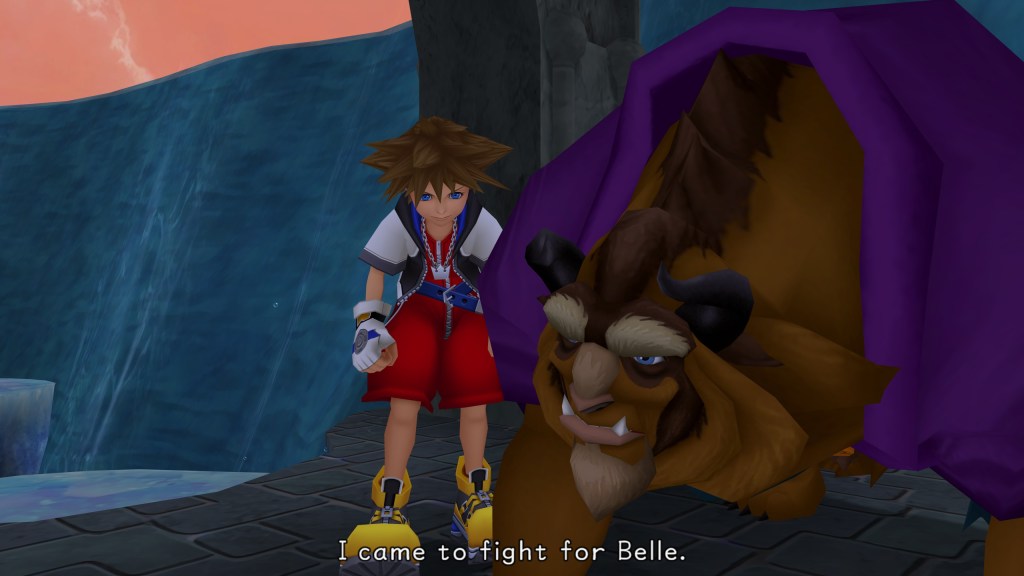
Donald and Goofy also abandon Sora during this portion of the game because they are blindly following King Mickey’s orders. He ordered them to stay with the keyblade. Sora no longer has one but ol Riku does, so they tag along.
This bit of the plot is an interesting idea, but they back away from it way too quickly. Within an hour of leaving you, the two sidekicks return because they suddenly remembered the power of friendship. It might have been interesting having to go through the whole world with just Sora and the Beast and only getting your other allies back at the very end of the level when Maleficent faces down our heroes.
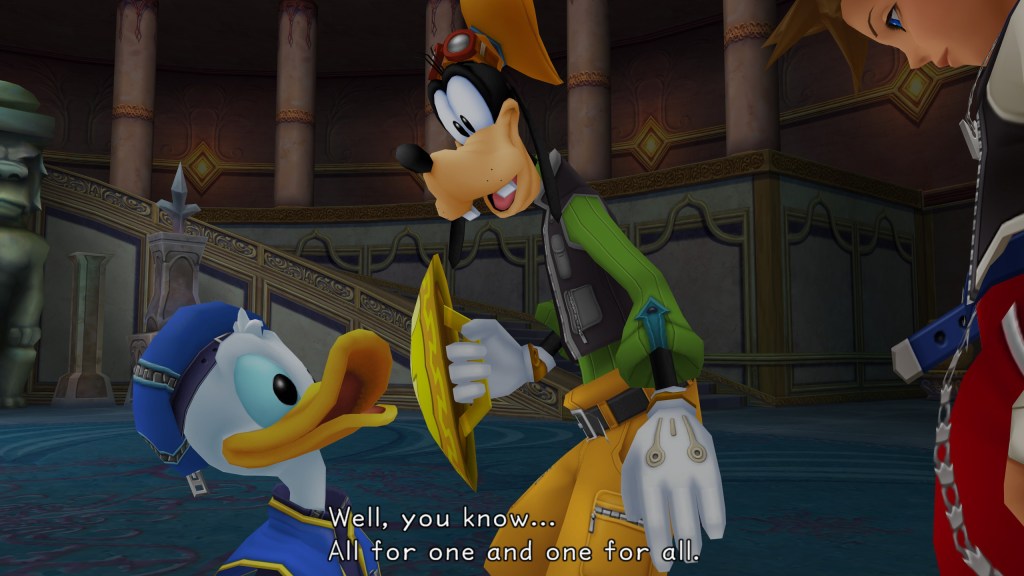
Speaking of gameplay, this is the most complicated world yet. Most worlds in Kingdom Hearts are only a couple of screens large and don’t take very long to explore. In comparison, Hollow Bastion feels monstrous. It’s like you’re really exploring a castle at times. Some of the terrain makes battles against normal enemies tricky – you are often at risk of falling from ledges and losing a ton of progress – but the scale is really appreciated. It makes this level feel significant.
At the very end of your journey here, Sora finally tangles with the main Disney villain of the game, Maleficent. It’s a battle that has been built up since, essentially, the start of the game.
The initial fight might seem like a bit of a let down. The baddie just floats around on a platform while summoning minions to bother you. It’s nothing particularly challenging at this point in the game and almost feels like a rehash of the Jafar fight.
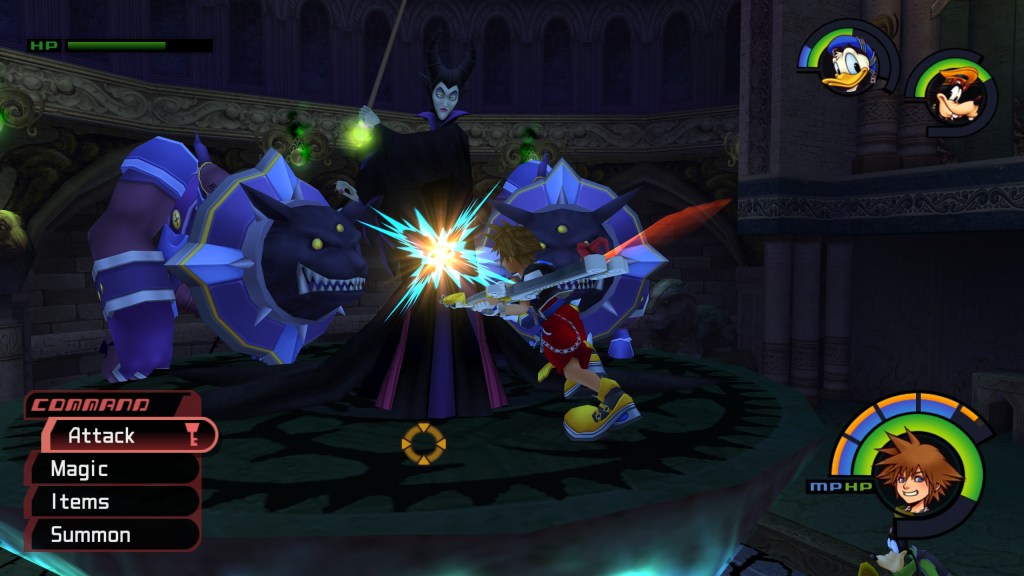
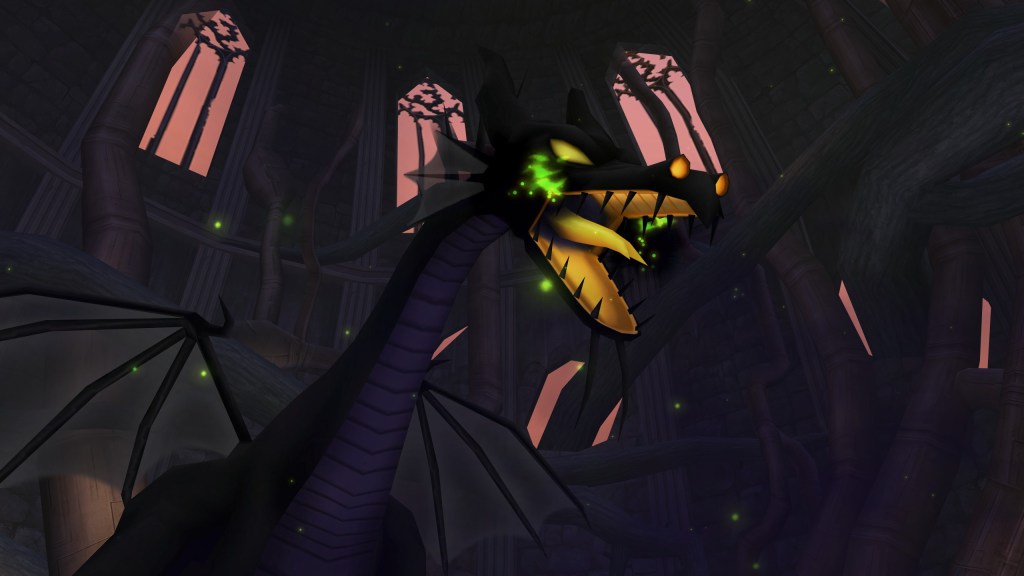
The player probably has been conditioned to expect a second ‘final’ boss battle of the world because most every level in the second half of the game does this. You had Oogie Boogie followed by Oogie Boogie’s house. You had Jafar followed by Genie Jafar. You had Ursula followed by Ursula’s big fat head. Now you have Maleficent followed by Dragon Maleficent. Now this feels like the encounter the entire game has been building towards.
It also kicks off in a way that makes it blatantly clear that you have more work to do. Your buddy Riku has clearly been possessed by something and that something, a force of darkness, takes the ailing Maleficent and uses the darkness in her to transform her into a big dragon, a form she took in the movie “Sleeping Beauty.’
The figure of darkness has been sort of lurking in the background the entire game. His name is Ansem and he is introduced to the party in a bit of a lore dump early on, where he’s described as a heartless researcher and leader of the Final Fantasy homeworld. He’s also at the very beginning of the game, though he does not get named explicitly.
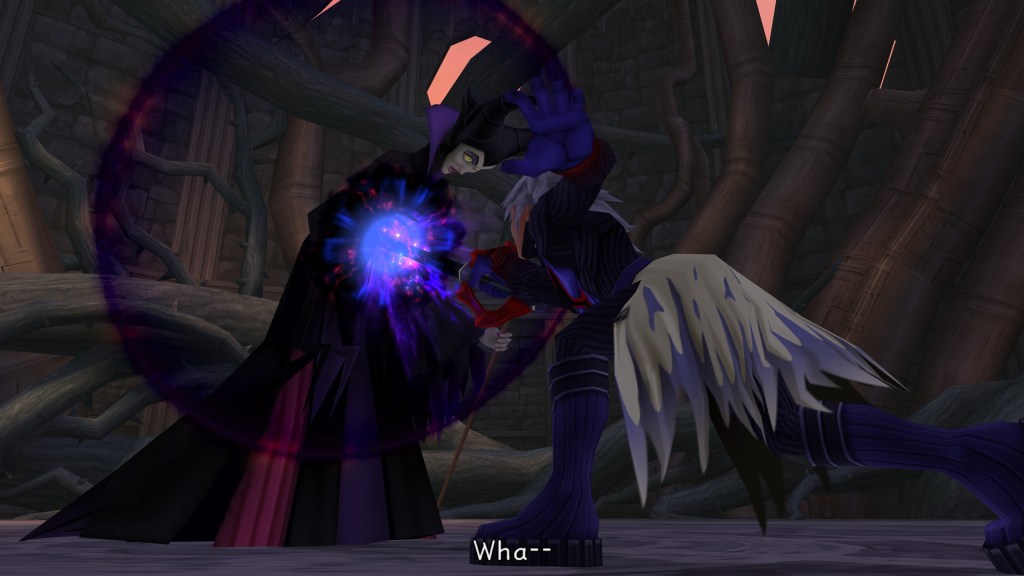
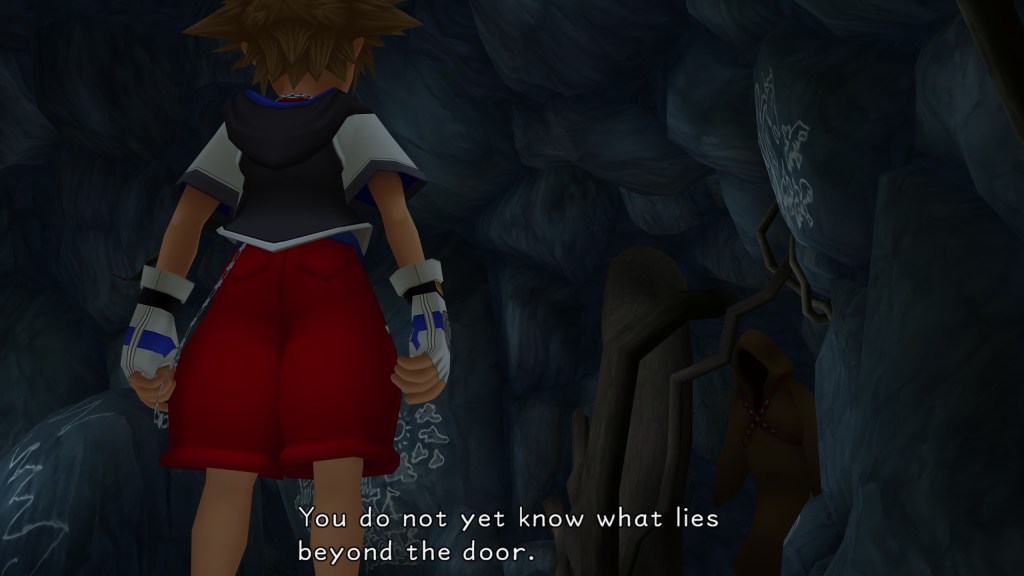
Throughout the adventure, the player will find various journals left behind by Ansem that tells things from his perspective. You never get outright told he’s a bad guy before this point, but I imagine the player’s reaction to this twist depends on how much they paid attention to the stuff around the main path. I feel it’s either a “wow, they even got ANSEM” or “who the hell is Ansem?” type of thing.
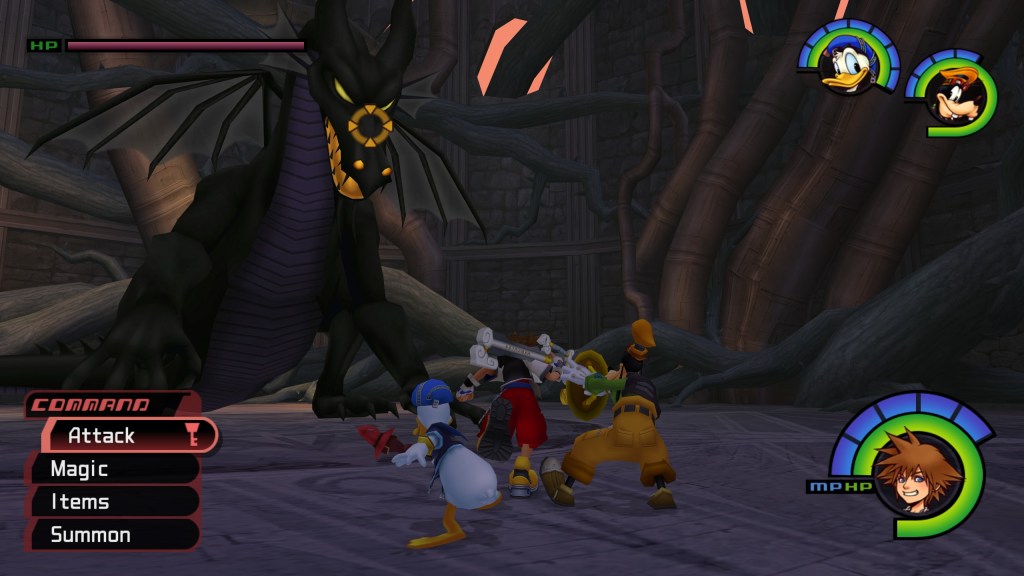
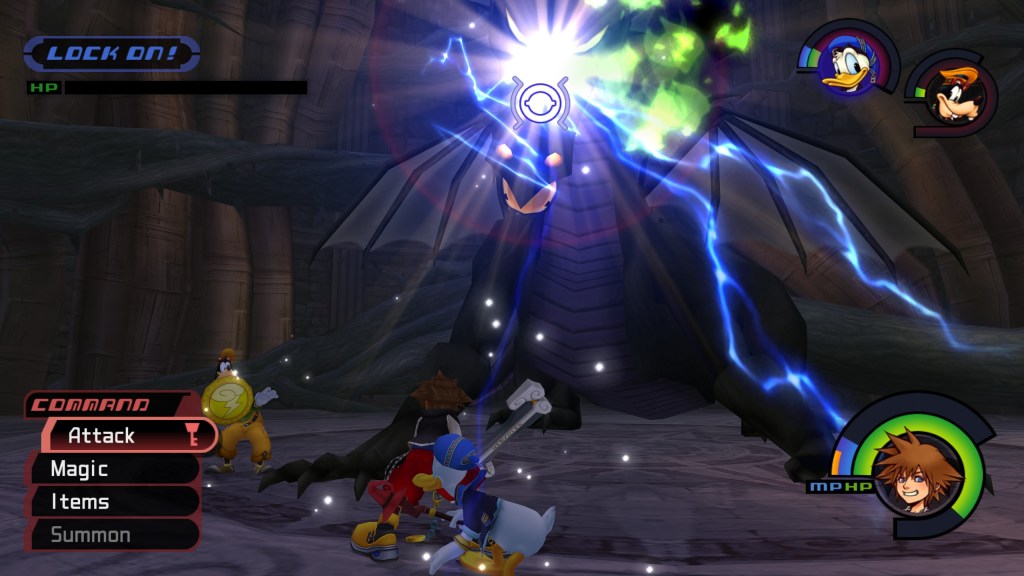
But there’s no time to think about all this, there’s a dragon to fight! This is one of the more difficult boss battles in the game, but doesn’t venture into the unfair depths that the second Ursula fight does. You need to constantly be aware of your surroundings in order to prevail.
If Maleficent shoots out a bunch of flames, you need to be aware of where those flames are because they stick around for a while. Sometimes the best course of action might be to find a way on top of the beast to wait until things cool down. And you will always need to keep your protective spells (aero) up because one or two hits will spell doom for your party.
Even though the player (I would hope) knows this isn’t the final boss battle, it still feels like it could be. It’s a memorable encounter and one of the most entertaining fights in the game. Despite this praise, it’s not even the best boss fight of this world. That is still to come.

Basically everything comes tumbling down. More about this in the character section but a long series of events goes down and Sora and crew have to leave the world without sealing the keyhole. He is reunited with Kairi in the process but since there’s still business to take care of, our heroes have to find their way back into the fray. And when they do, it culminates in a battle with Riku.
Riku is fully possessed by Ansem at this point and from a personality standpoint, is not recognizable from how he is portrayed at the start of the game. However, the gameplay of the fight is very similar. He feels very connected to the version of him you could fight at the very beginning of the game on Destiny Island. Just jazzed up a bit.
This isn’t the final fight against ‘Riku’ either, but after this point he fights entirely differently. I would like to think this is the game’s way of telling you, through gameplay, that he is clinging on to his personality by a thread. And this series has shown how much I love narrative told through gameplay!
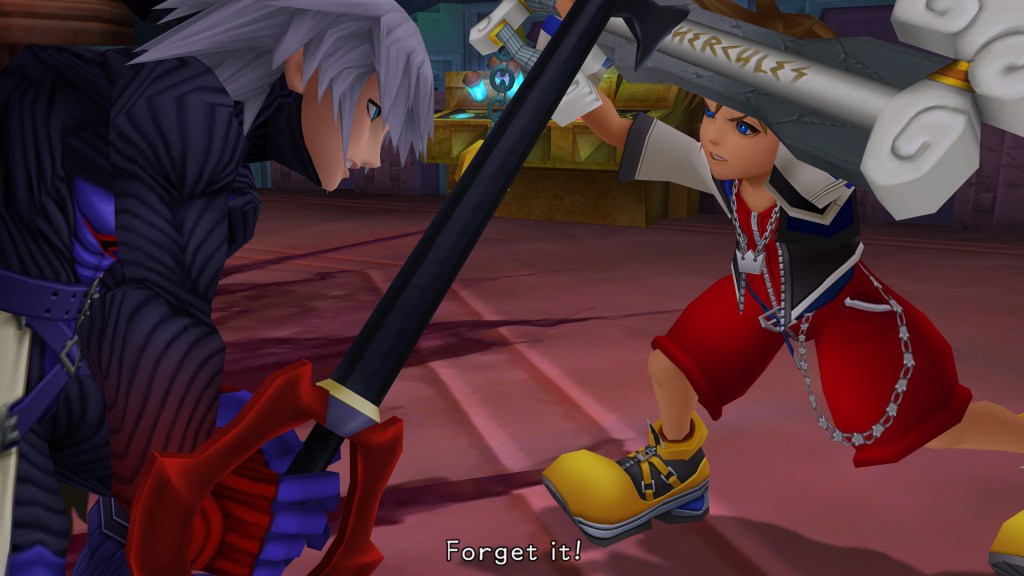
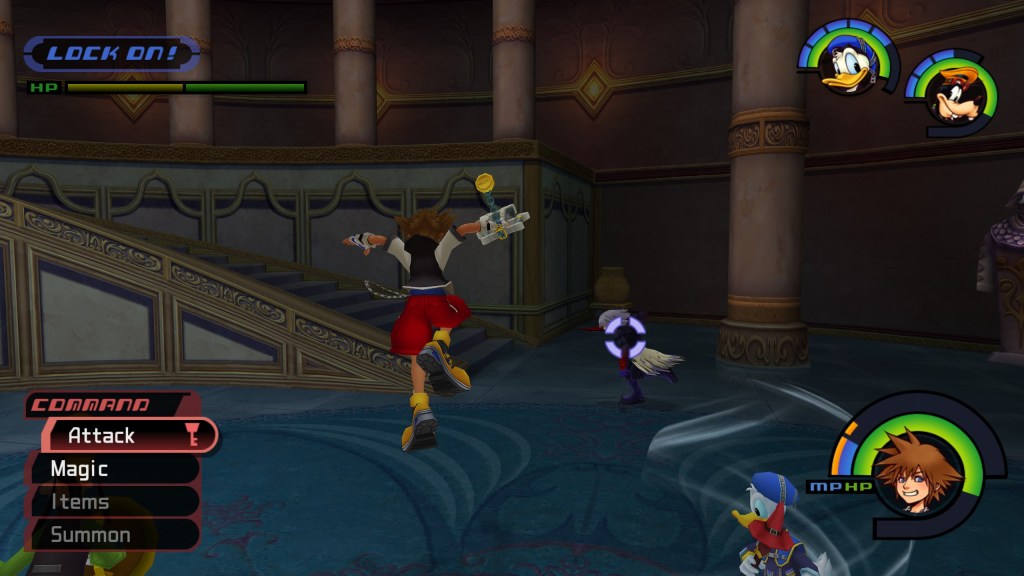

This battle is a one-on-one duel and it is just awesome. I think it is the best fight in the entire franchise and Kingdom Hearts has some excellent boss battles. I just think it relies on your mastery of reading your opponent and guarding against attacks. This fight will likely take first time players several attempts because, for the most part, boss battles don’t require as much attention as this one does. If you don’t know when to guard or when to back off, you’re probably going to lose.
Combined with the tension one might feel when facing off against a former friend, this really gets your blood pumping. Before this battle, Kairi wakes up from her long coma, so the path to the three friends finally reuniting is there and looming in the player’s mind.
If you can just knock some sense into your friend, it’s over, everyone can be happy again! This is a top notch fight and a big reason why I don’t understand the big push against boss battles that was happening online a few years ago. Kingdom Hearts is a worse game without this fight.
As the penultimate level in the game, it does a great job of ushering the player into the finale. A.
End of the World
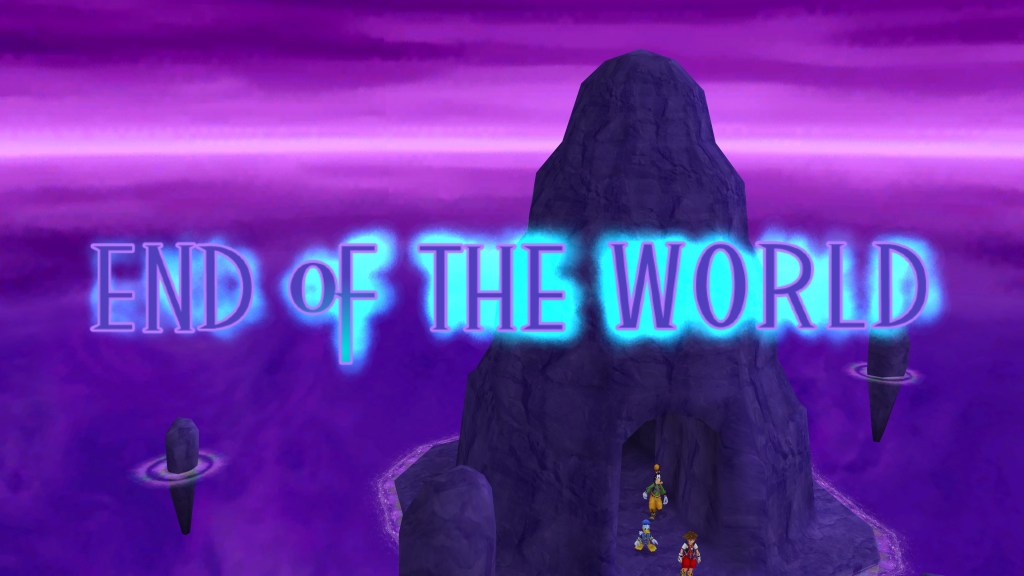
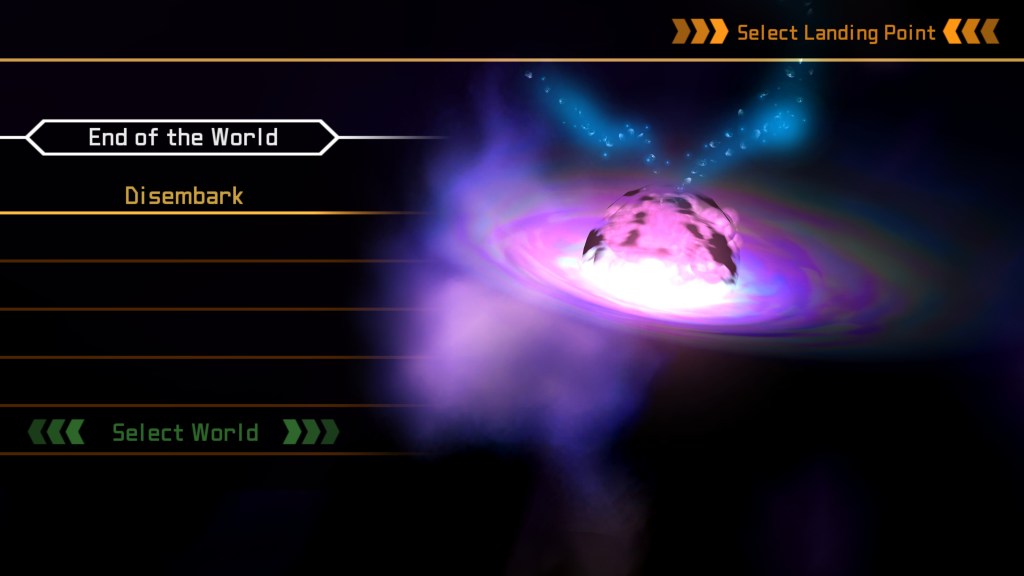
The final world of the Kingdom Hearts journey and another original affair. Sora has Kairi back now but there is still the matter of Riku. The guy who possessed him, Ansem, has escaped from Hollow Bastion and he is waiting for the player here. The world is described as the remnants of a lot of worlds that had already been destroyed by heartless.
They try to achieve this aesthetically by making the initial landscape look barren and empty except for small little islands. It’s an unusual world to traverse, and bleak, but a fitting final location for the crew.
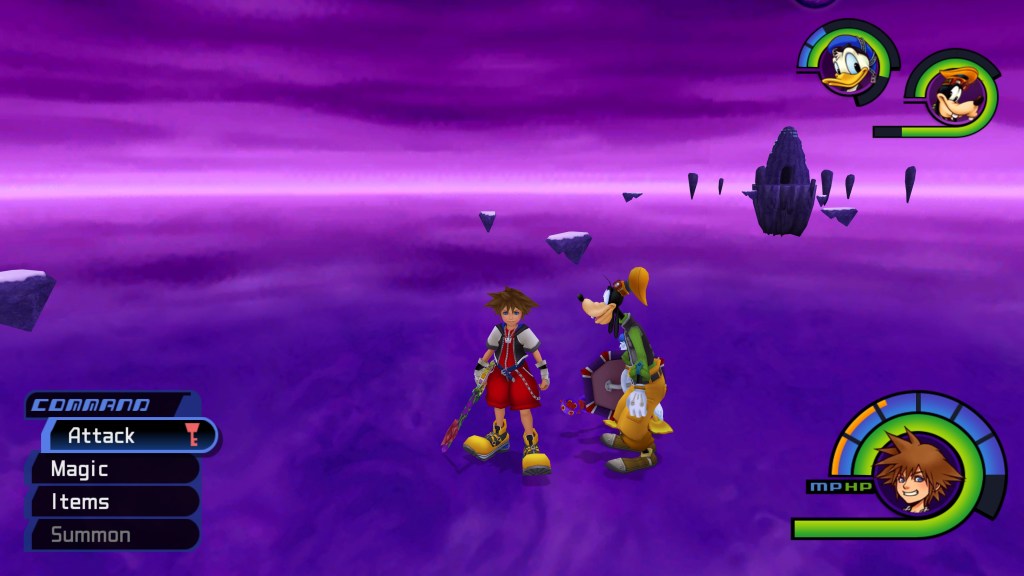
I feel like this world is a complete sprint. The player goes from battle to battle pretty quickly. There is a very short platforming segment that utilizes the glide mechanic from Neverland, but mostly it’s a pretty straight line to the finish.
I really like this kind of pacing for a finale. I’m not trying to do platforming at the last minute when tension is crazy high, I’m trying to save the world here, and I think this level does a good job of keeping your motivation high.
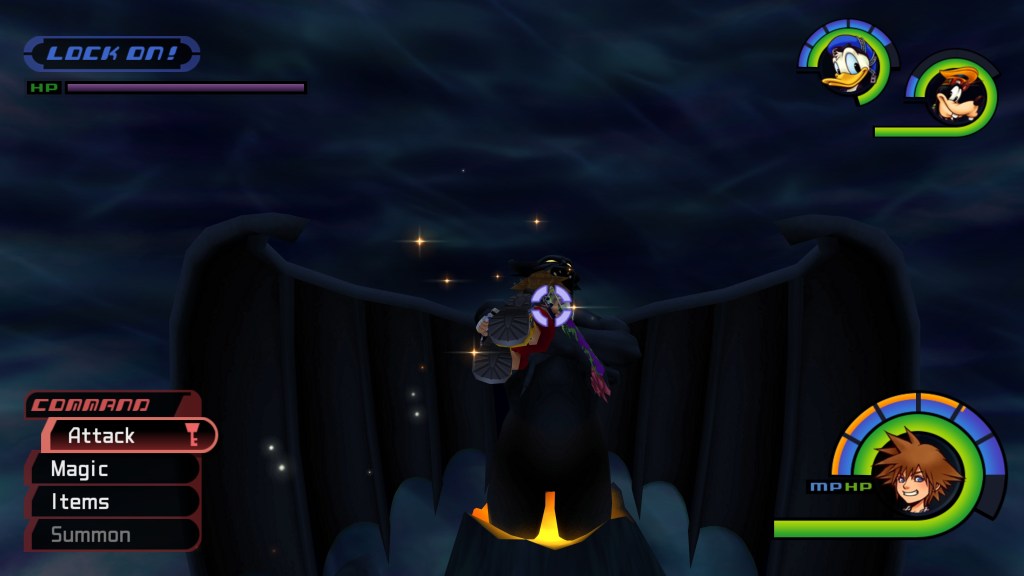
Midway through, you fight something of a spectacle boss in Chernabog from the movie “Fantasia.” The fight uses “Night on Bald Mountain” which is the same music that accompanies him in the movie, which makes the creature feel very imposing and sinister. This is the second boss in the game that lets you use the flight mechanic and helps this fight feel more significant than it really is.
In most other worlds, this would be a filler fight – think of the endless Sabor fights in Deep Jungle – but the presentation really helps it stand out. Not a difficult fight, but a memorable one.
From here on, we get a very video game sequence where the player has to go through portions of all the worlds they have been through so far.
The player travels on, essentially, a straight line to reach portals that carries them to a lone screen from a previous world. On this lone screen, you fight the various heartless that you might encounter in these worlds. This is the equivalent of a boss rush in a Mega Man, it’s a nice way to remember the places you’ve been in this journey.
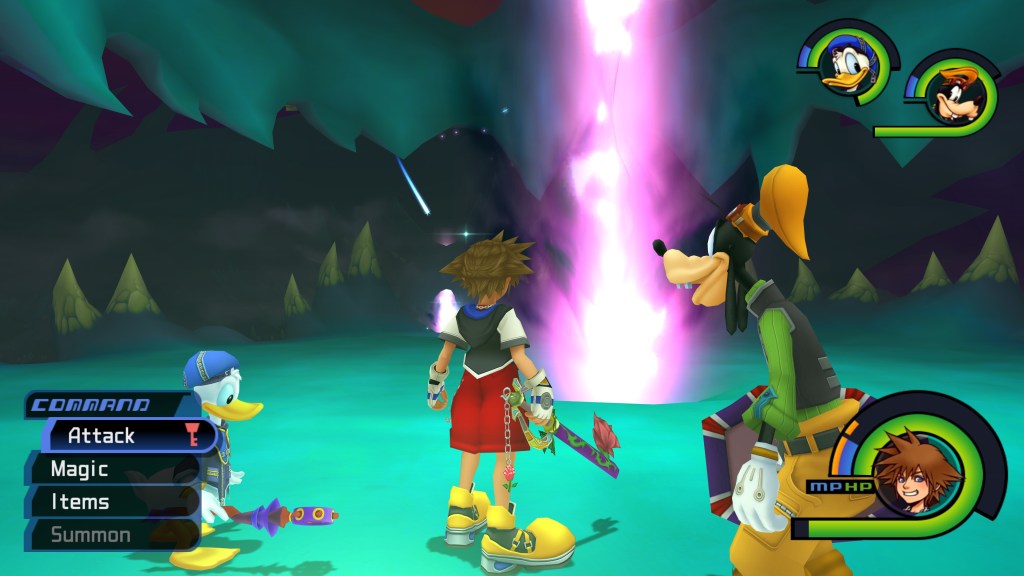
This all leads to the final confrontation. The guy at the center of all this, Ansem. He has stolen the body of your friend, he kidnapped your kinda girlfriend for a long period of time and he is believed to be responsible for all these heartless going around and destroying every world. He’s a problem!
And in true Final Fantasy fashion, this final boss fight is exceptionally grand and tosses multiple phases at the player.
The first is a pretty standard feeling encounter that requires the player to pay attention to a mechanic where he sends a creature to possess Sora. When he does this, the player needs to pay attention to the action bar on screen because occasionally an option (like attack) will be replaced by another option which will have this creature grab and restrain Sora momentarily, leaving him prone. It’s not so hard.

The second part is a rematch against the hulking heartless behemoth known as Darkside that is encountered at the start of the game.
This fight should tell you how far you’ve come in this journey because it fights exactly the same as it did in the beginning. It should be a piece of cake. It was back then too, but now the player has a lot more tools available to them, so it’s a nice way of looking at how far you’ve come. Darkside is never challenging, but I always like seeing him. Must be some nostalgia.
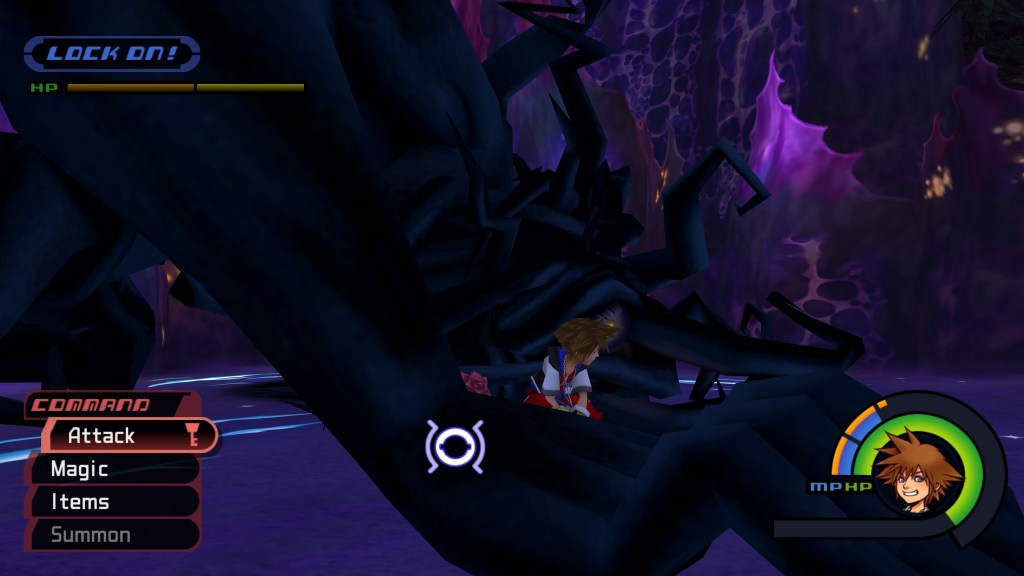
The third part is definitely the trickiest. I am weirdly skilled at it, but I know he acts as a roadblock for many first time players. Ansem separates Sora from his friends, which turns this into another duel. The player might notice the parallels between this fight and the last fight with Riku in Hollow Bastion.
Ansem now fights totally differently, the friend Sora has is entirely gone. He uses a lot of the same tactics as he does in the first part of this battle, but when you’re fighting solo, you don’t have as much room for error.

It can be tricky! If you’re good at guarding, knowing when to heal and paying attention to when you’re possessed, the fight is manageable. But it’s a big challenge if you’ve been mostly mashing to get through battles to this point.
The fourth fight is when the Final Fantasy beast truly emerges. Sora is launched into a space like environment and the flying mechanic from Neverland returns again. Ansem turns massive and becomes some sort of wacky heartless battleship at this point. The fight progresses as Sora destroys little areas of battleship Ansem. You start the fight solo but slowly your party comes back to you. It’s a bit more of an action-packed way of doing the party reuniting segment from Hollow Bastion.
This part of the battle isn’t particularly challenging. Just heal and flail away at Ansem and you’ll eventually win. It feels like the third phase of the fight is the true final battle with this portion of the contest feeling more like a spectacle than anything. Which is fine by me, if you’re not going to be challenging, at least be memorable.
And I am always gonna remember striking a keyblade at weird bumps on ship Ansem’s body.
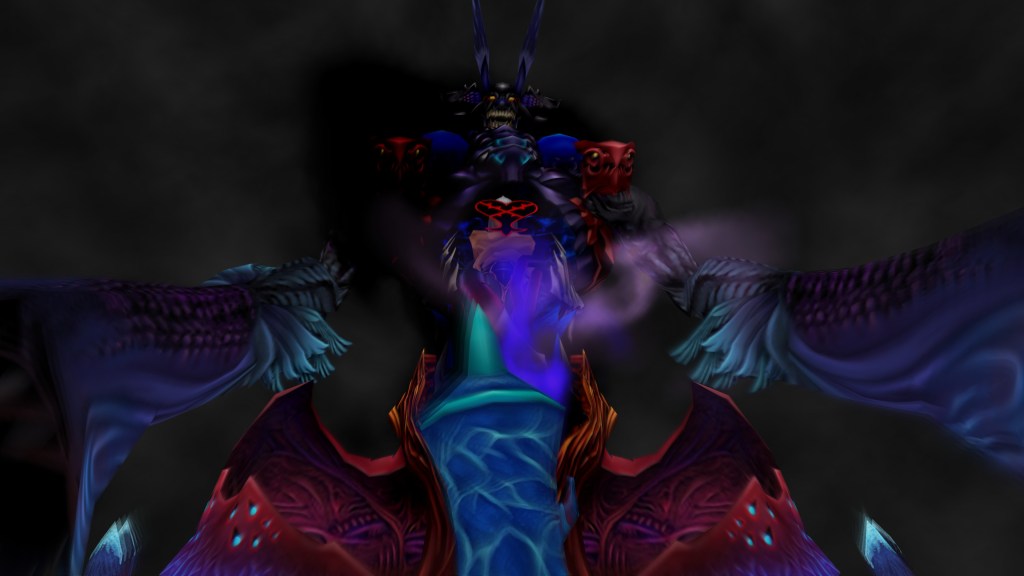
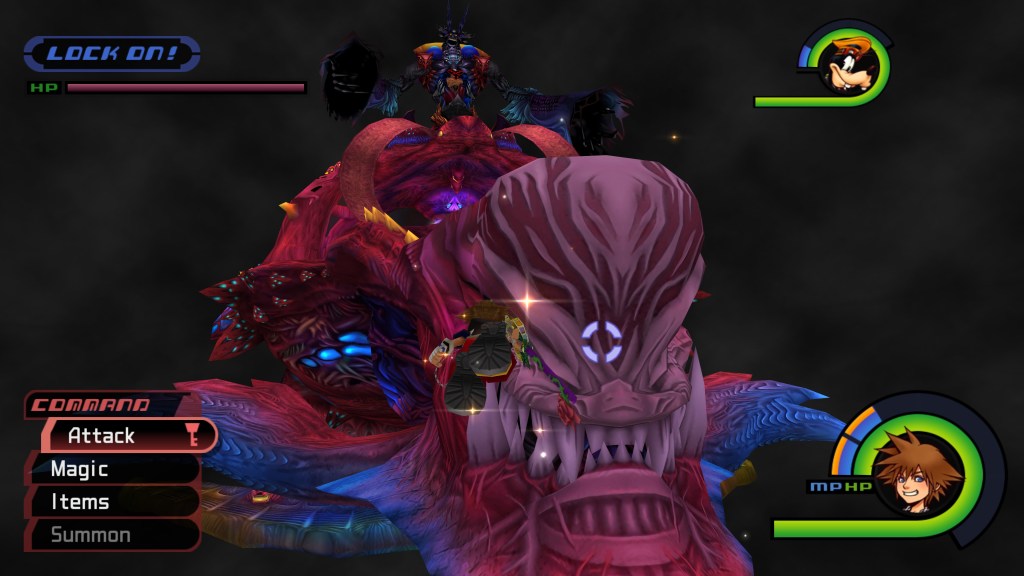
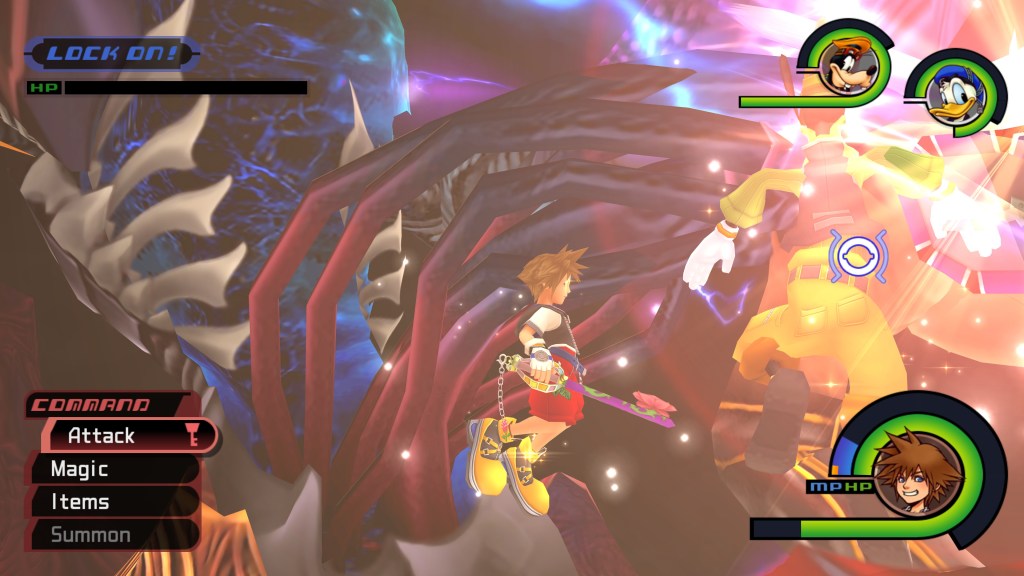
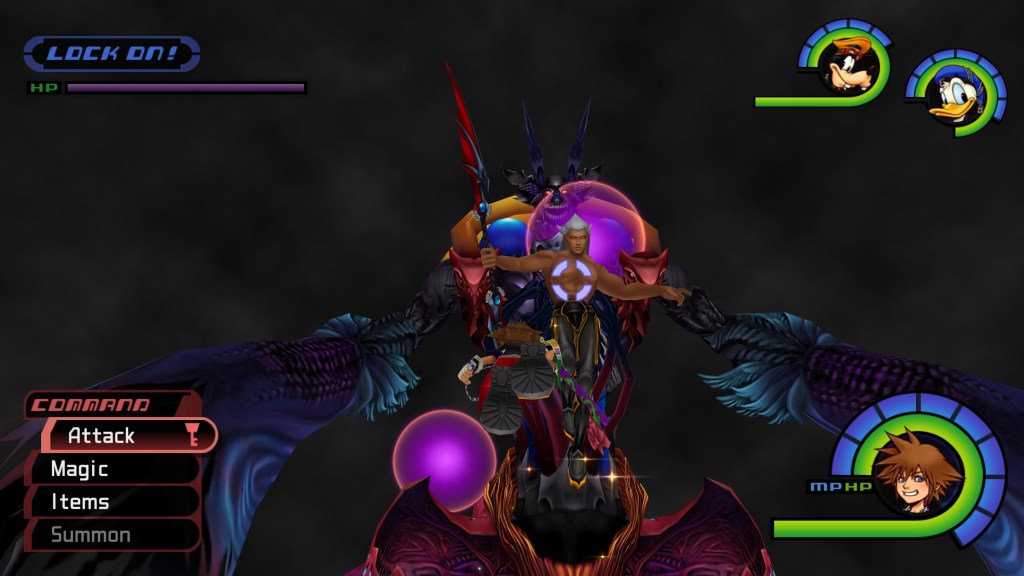

And then, you win. After a long journey, Riku is freed and King Mickey finally shows up. Unfortunately, Ansem being taken care of does not mean the heartless just up and vanish, so just as the friends are reunited, Riku sacrifices himself in order to seal the heartless away for what he thinks will be forever. With the threat gone, the worlds that comprise the end of the world want to heal, which will theoretically prohibit travel between worlds.
Just as the three friends get reunited, they get separated. “I’ll come back to you, I promise!” “I know you will” SIMPLE AND CLEAN IS THE WAY THAT YOU’RE MAKING ME FEEEEEEL TONIGHT. A.
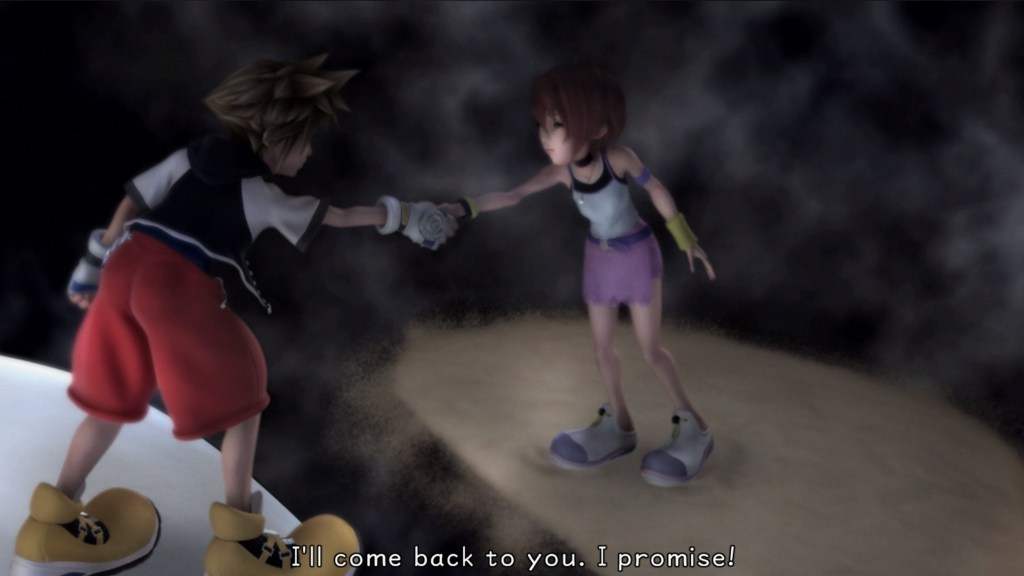
Major characters
There are a whole lot of characters in Kingdom Hearts, but not a lot of them are really important to talk about here. Most everybody you meet is contained to one world. On top of this, most everyone here is from a different source material and generally act how they do wherever they came from.
This is true of both the Disney characters, shocker Aladdin still acts like Aladdin from the hit movie Aladdin, and the Final Fantasy characters. Cloud is noble and enigmatic, Aerith is kind of self-sacrificing, Yuffie is peppy and Cid still is a total grump (no cigs, please understand, this is a family game). So this section will be a little shorter than previous character sections
Sora
The main character of this affair, voiced by Haley Joel Osment. It may not seem like a big deal to have Osment as the voice of Sora in 2025, but in 2002, unveiling him as the voice of the protagonist communicated to the public that this game was supposed to be a big deal.
In 1999, the movie “The Sixth Sense” took the world by storm. If you don’t know much about that movie, you probably at least know the phrase “I see dead people.” In 2000 he was in “Pay it Forward” and in 2001, he was in A.I. – less remembered now but it felt big at the time. This was a major on the rise child star who was going to be the center of this Final Fantasy/Disney video game. It immediately communicated that this was not going to be a low budget effort.
His main weapon of choice is a keyblade, literally what it sounds like, which immediately makes him unique among RPG characters. As a kid, I had assumed the keyblade was a way around using a sword because swords were too violent, but I was clearly an idiot. Sephiroth, Cloud, Leon and Hercules all use swords (or gunblades) just fine.
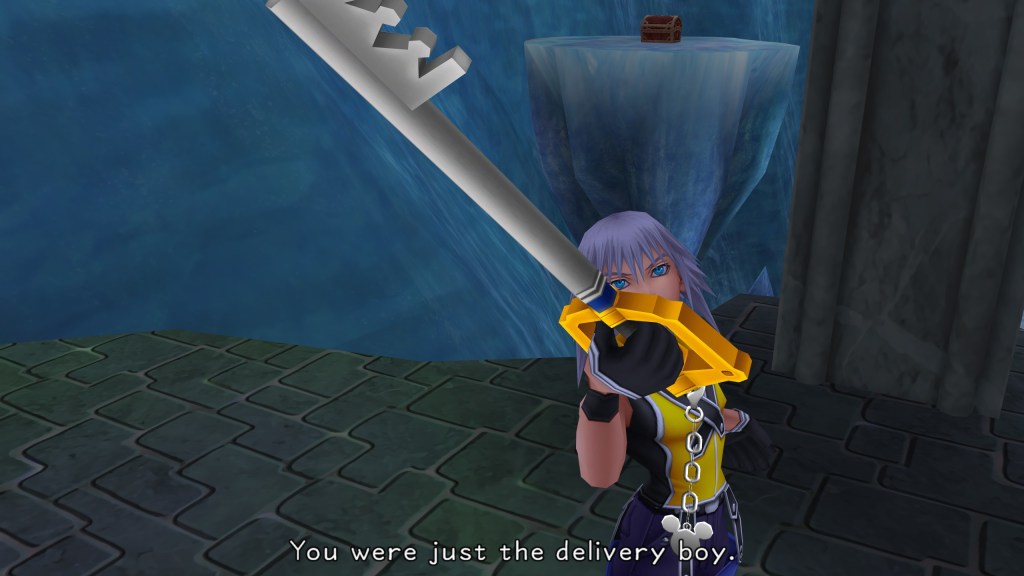
The keyblade gets a lot of explanation down the road. The concept of keyblade masters in THIS game ends up changing in other games. Here the blade is sort of mysterious, but it basically is treated like a fabled weapon that can lock and unlock the hearts of various worlds or people. It is thought of as the ultimate weapon against the heartless. Why it exists and what deeper purpose it has is not truly discussed here, it’s more treated as a weapon of destiny.
As a character, Sora is a pretty plucky and positive protagonist. His defining personality trait is loyalty. If he considers you a friend, he will fight to the end to save you. The vast majority of his journey here is spent looking for Kairi and even though lots of obstacles gets thrown in his path, he never really gets down about it. He never doubts himself or his friendships, he just pushes forward.
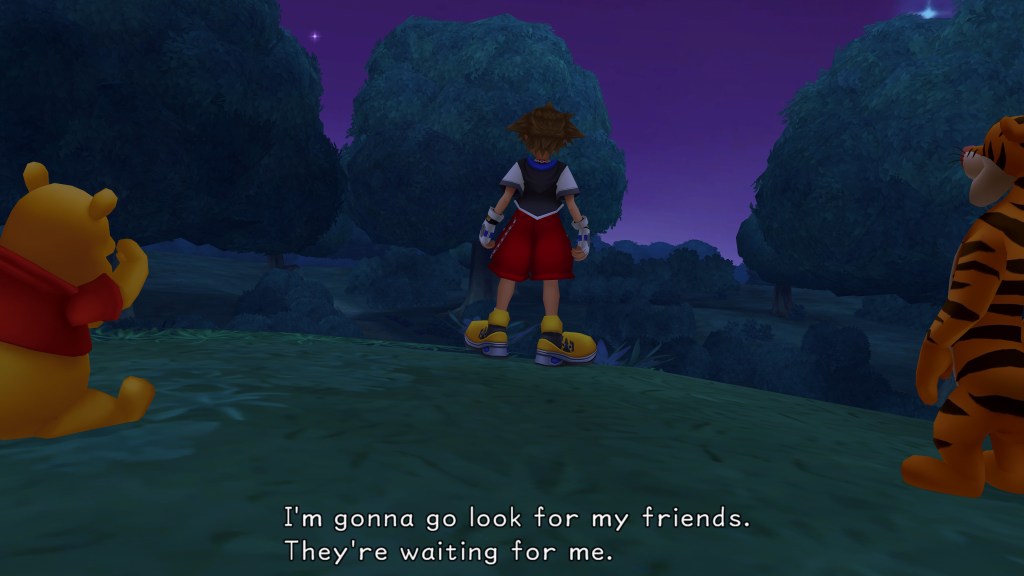
This includes his friendship with Riku. The guy turns on him for Maleficent and Sora never gives up on him. He never doubts his friend, he never thinks Riku is permanently a bad guy, he just wants to knock some sense into the silver haired wonder and bring him back. He’s just positive and believes in the best of everyone.
As a result, he never really develops much. He never goes through a period where he doubts his bonds. You see Sora’s relationship with Donald and Goofy evolve, but it’s more of a “oh we’re friends now” thing as opposed to a “oh this is what it feels like to have friends” thing that we’ve experienced in the past with guys like Squall.
The Sora you see at the start of the game is the Sora you get at the end of it.
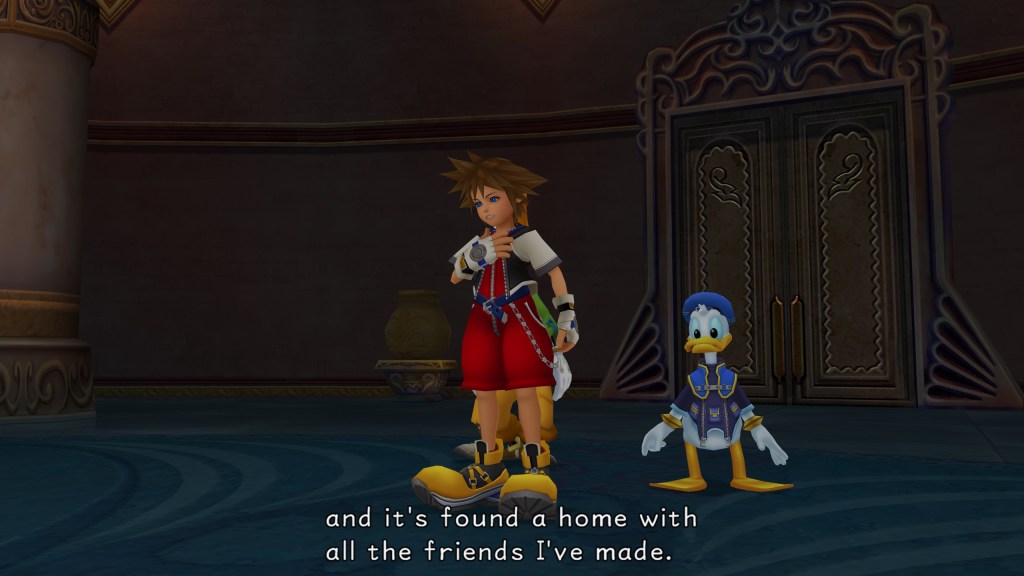
And you know what? I’m okay with that. As I mentioned above, what I like most about Kingdom Hearts is that it is unafraid to be sincere about what is going on. The narrative in Kingdom Hearts can feel incredibly silly, but the game never tells the player how silly everything is. They just present it and let the player judge.
Lines like “KINGDOM HEARTS IS LIGHT” and “My friends are my power” are delivered with complete sincerity. There are a lot of elements of this game that could be considered cringey and instead of running away or feeling embarrassed about it, Kingdom Hearts embraces it.
The franchise always does that too. In a world where every character is too cool for the piece of fiction they are in, something like this is refreshing.
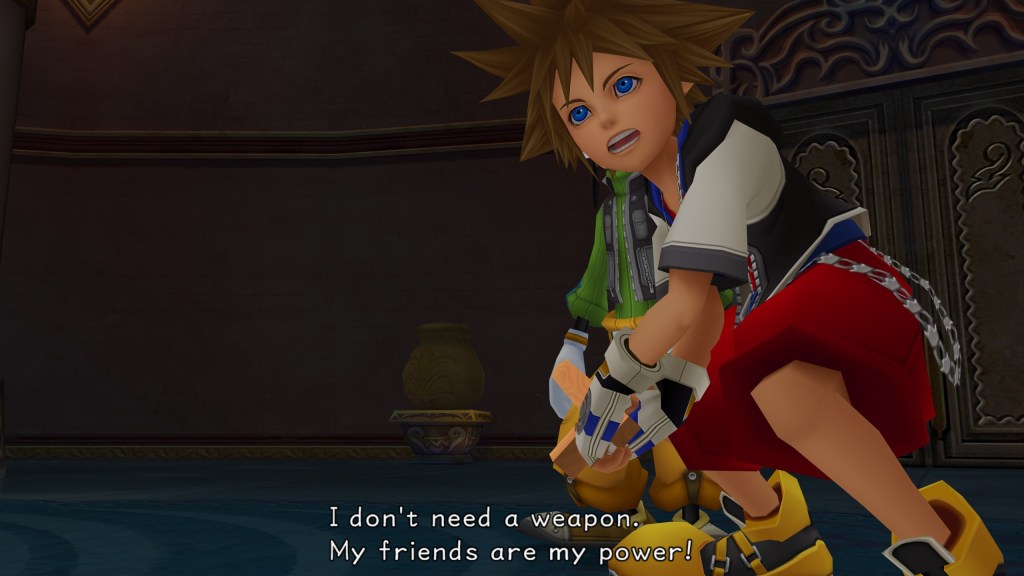
And at the middle of it is Sora. A protagonist who says what he means and isn’t ashamed of how he comes across. He’s completely sincere and I think it just works. A guy who is endlessly positive who just has stuff go off around him is good for what this title is going for. A more broody guy like Cloud or Squall just wouldn’t work as well here.
Probably the shining moment for Sora’s character happens when he is finally reunited with Kairi after the battle with Maleficent. It is revealed that her heart lives inside of him. Without a second thought, and knowing what losing a heart can do to a person, Sora sticks the keyblade into himself in order to save his friend. Basically as soon as he realizes he can do this, he does it. He doesn’t care if he lives, but his friends must.
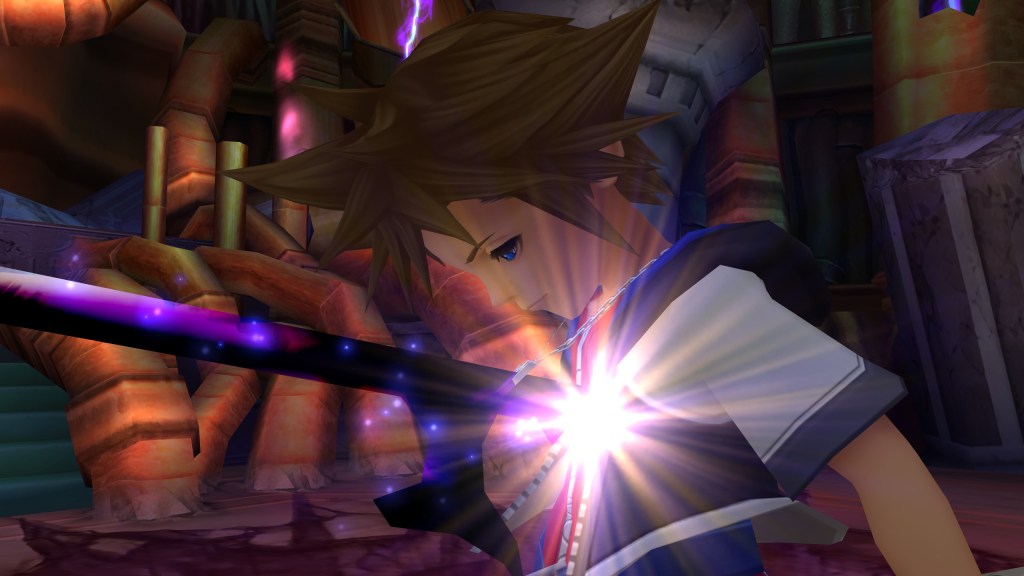
What follows after this is a segment where you play as a generic heartless enemy trying to follow Goofy, Donald and Kairi. When I say generic, I mean the short little guys you see at the start of the game, the lowest level enemies you can find. Essentially, the Kingdom Hearts version of the slime enemies from Dragon Quest.
You can’t do much during this but I always found it interesting that Square elected to turn Sora into a tiny generic heartless instead of turning him into some of the more powerful variants.
This communicates, to me at least, that Square wanted the player to know that Sora is just a guy. He’s not some legendary warrior, he doesn’t have a lot of secret powers outside of the keyblade, he’s just a kid. And if he fell to darkness, without his friends, he would just be a generic grunt. His friends make him who he is.
In segments where the player is without a party, Sora feels weaker and more helpless. But in segments where everyone is assembled? Sora feels like the keyblade master.
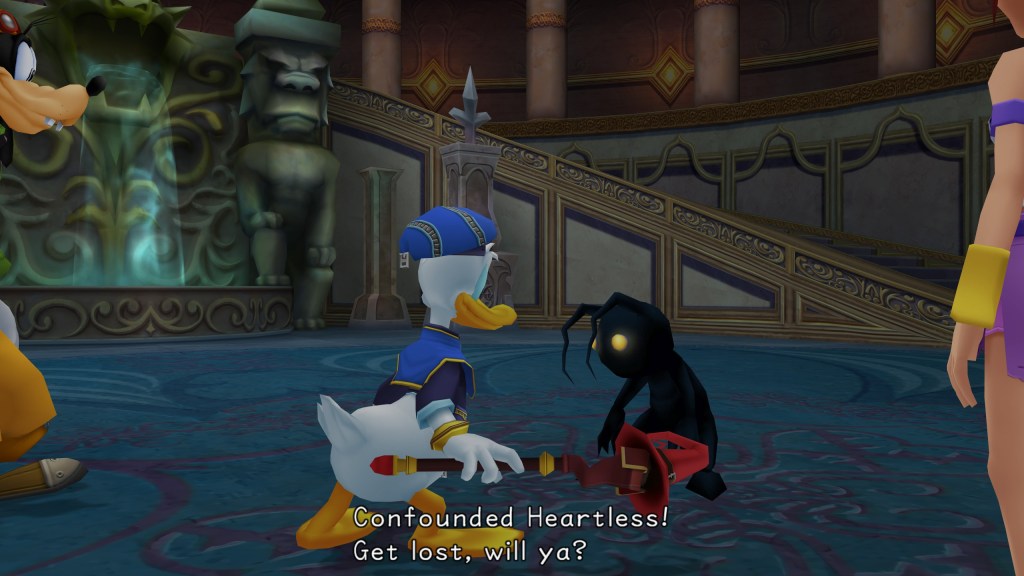
One other thing I feel is important to mention is his relationship with the main party members, Goofy and Donald. Goofy and Donald are portrayed much like they are in Disney media. Goofy is a little clumsy but he has a big heart and Donald has a firey temper but he ultimately is a good guy. They don’t really deserve a whole character section – but I do feel they provide a good bouncing off point for the protagonist.
It wouldn’t fit for his character to be aggressive or sassy towards other non-villains, so Donald is there to occasionally cut into some people. Sora shouldn’t be making dumb mistakes and talking to clueless people about multiple worlds, so that’s what Goofy is there for. Their presence allows Sora to be simple and straightforward. While they don’t really do much as individuals, having them along for the ride allows Sora to be Sora.
English voice actor report: Osment does a great job as Sora. At the point of recording for this game, he was still a pretty young kid, so Sora sounds age appropriate and properly spunky. I feel the voice direction in Final Fantasy X was a little weird but I think they got it together for Kingdom Hearts. A.
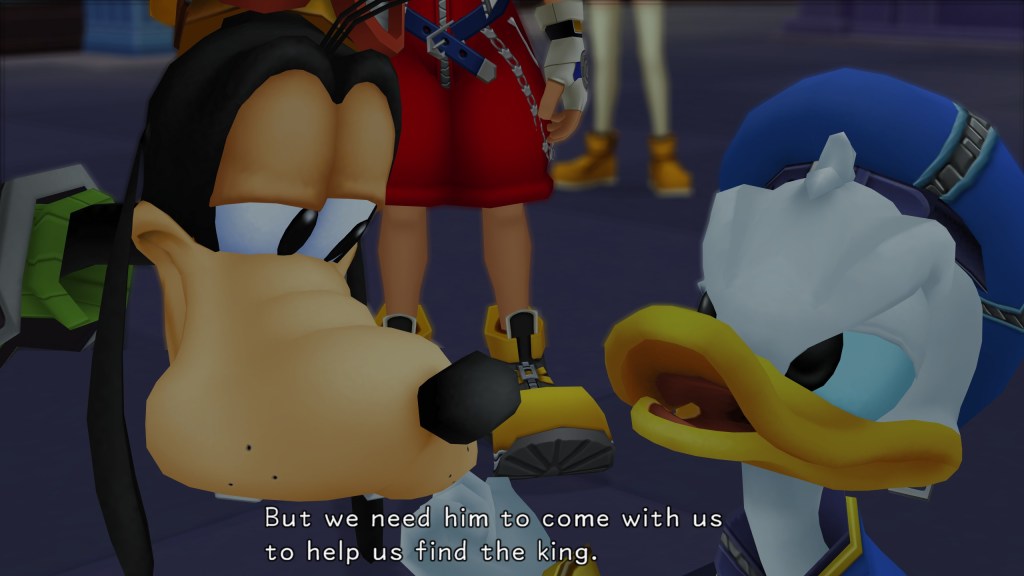
Kairi
The leading lady of the game spends most of the total playtime out of commission. At the start of the adventure, she is shown as having a playful relationship with both Riku and Sora. Just like Sora, she wants to explore worlds beyond her own.
It’s told that she is likely closer to Sora than she is with Riku. There’s an old legend that says that two people who share a fictional fruit, the paopu, are destined to be together. It becomes apparent that Sora wants to share this fruit with Kairi, though we’re not totally clear (initially) how Kairi feels on the subject.
Also there’s a little bit at the beginning where Kairi (in a “joke”) suggests they leave Destiny Islands without Riku. Rude.
But when the Destiny Islands are attacked, she disappears for a long time and her role shifts from ‘friend, possibly more, of the protagonist’ to ‘damsel in distress.’ She’s gone, we don’t know why, but we gotta find her. And for most of the game, that’s her state.

Eventually, she does show up. She is in a comatose state and is said to be missing her heart. It is thought that it was stolen by the heartless during the beginning of the game but in reality, it was hiding in Sora all along. Her mind retreated to avoid danger and basically sent her to the safest spot she could think of, with Sora. She couldn’t physically do it, so the heart went for the ride.
When she eventually wakes up, her first thoughts are of Sora and Riku and how to make things right again. When Sora leaves for the final world, she makes him promise that he will return to her. She hands him a special keepsake and that’s that.
In this specific title, she doesn’t have much of a character. She exists to be saved and she exists to give Sora a relationship with someone that is distinct from his relationship with Riku. Kairi gets explored more in later games, but here she basically exists as plot motivation. Sora spends part of the game searching for her. He finds her but alas, she is in a coma and Riku has kidnapped her, so he has to find her again and also save her.
And after the game is over, Sora needs to get back to her, so even if there never was a sequel – in the player’s mind – Sora would be going on an endless journey to reunite with his loved one.

This makes Kairi the least interesting character of this whole affair. Will she improve later on? Well, I guess we’ll see.
English voice actor report: She is voiced by Hayden Panettiere, who appeared in “A Bug’s Life” and “Remember the Titans,” but was not a major character in either of those films. So, a child with experience, but not as notable a casting decision as the lead. Since Kairi spends a lot of this game out of commission, she doesn’t have a ton of lines, but I always have liked her delivery. For some stupid reason “Sora you lazy bum” has stuck with me since the very first time I played the game. B.
Riku
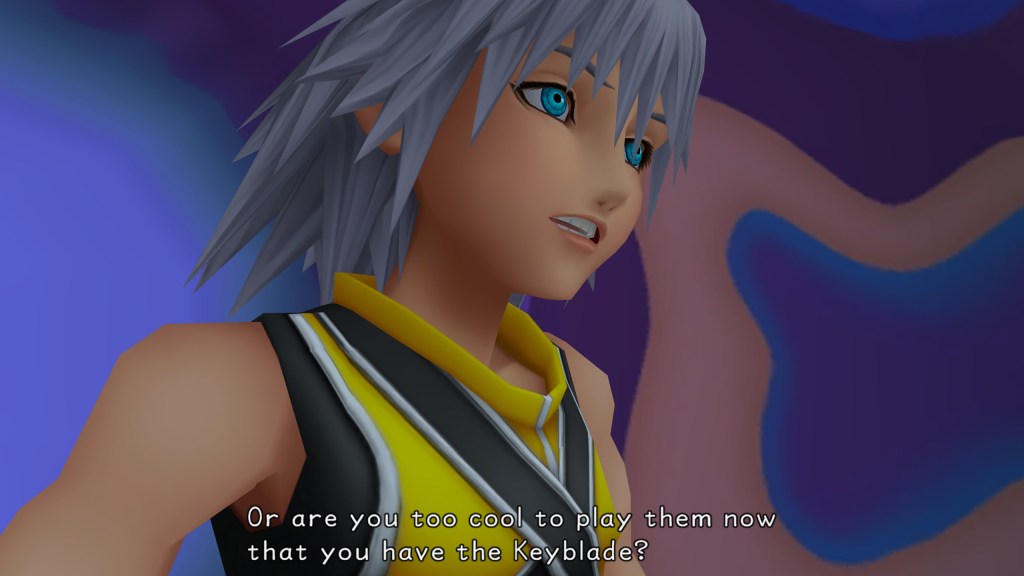
Sora’s main rival, best friend and the most interesting and complicated character in this whole affair. At the start of the story, he is depicted as an adventurous child with a bit of a dark side. He is similarly playful to Kairi, but he has a bit of an edge to him.
When Destiny Islands get attacked at the start of the game, you also see Riku fighting them off before he vanishes away, so you’re immediately shown that he is a fighter much like the protagonist.
After your first set of worlds, Riku shows back up and immediately you see where they are going with him. He is shown to be slightly jealous of Sora’s new friends and he has (what we think is) the main antagonist in his ear feeding those fires. Those fires eventually ignite and Riku decides that Sora has forsaken him and that his only path to save Kairi is on his own, without Sora and without friends.

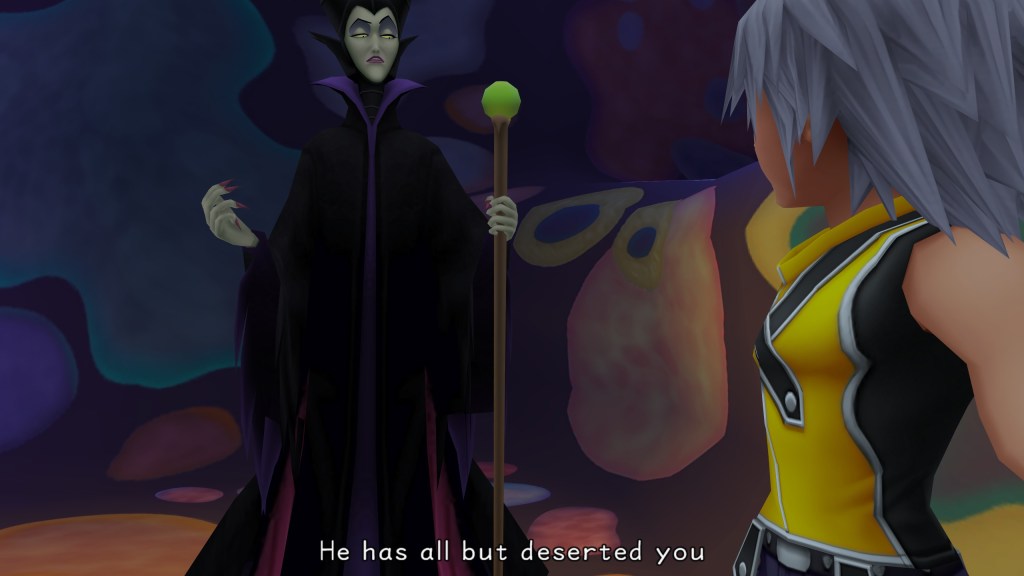
Riku is the other side of the coin to Sora. Whereas the protagonist is an endless ray of sunshine, a guy who almost never doubts himself, Riku is a confused young man. He doubts his friends, he doubts his feelings and he doubts his place in the world. He might want the same things as Sora does, but he keeps it locked up tight.
Essentially, Sora embodies the light of humanity and Riku embodies the darkness. The side of ourselves that is constantly doubting others and questioning their role in things.
Sora and Riku are of similar builds and statures in this game, so the juxtaposition is meant to show how things could have gone for the protagonist if he stayed alone, if he never found anybody after the start of the game. Sora finds Donald and Goofy and never really loses his optimism and never doubts himself. Riku only finds people who want to use him, he never has any real friends, and thus he is more dark and unsure.
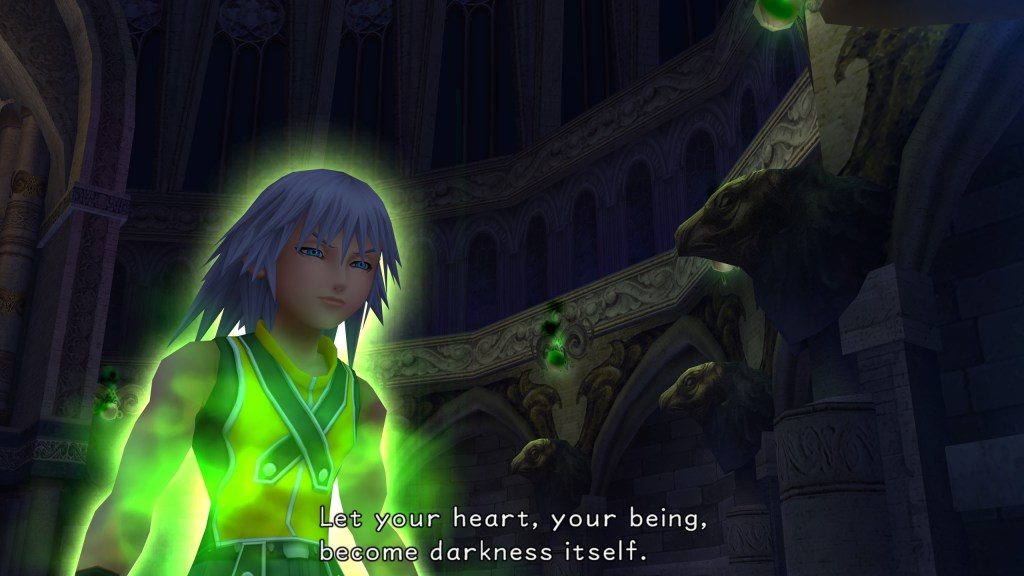
His lack of confidence and unsure nature leads him to be more corruptible. Maleficent takes him in and eventually Ansem takes over his being. The Riku we see over the second half of the game is a character who has surrendered himself completely over to the dark side. Since he didn’t have friends to set him right, he fades and fades until he completely loses himself.
Then at the end, something in him snaps and he sees he is being used. He is able to break free of control and finally the guy from the start of the game is seen again. He reciprocates the endless affection Sora shows for him and sacrifices himself, something of a make good for all the bad things he took part of over the course of the game.
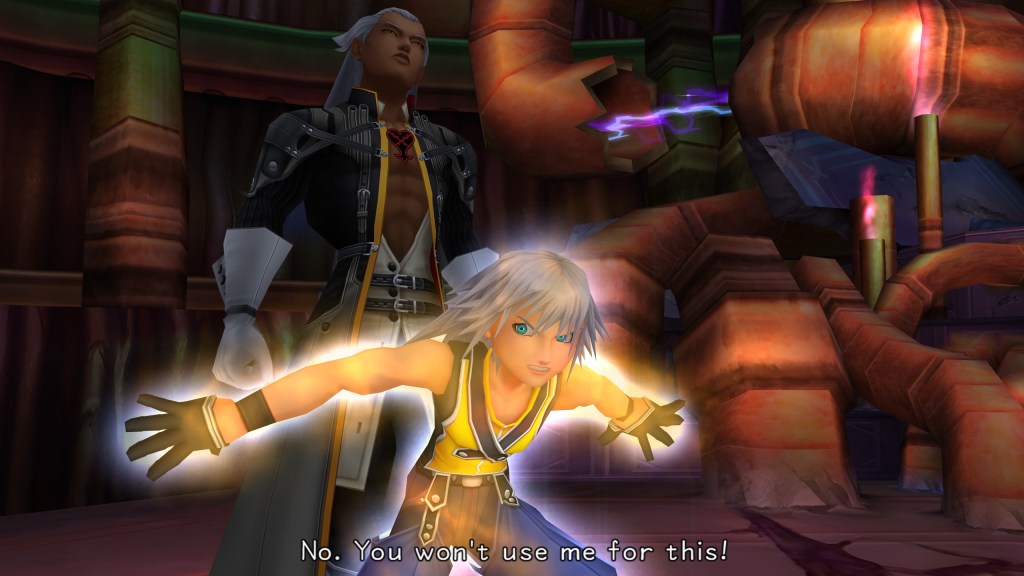
Riku is really the only character in this game that I’d say has any sort of arc. He’s easily the most interesting fella here and is an exceptional foil to the protagonist. If Sora is the perfect lead for this sort of game, Riku is perfect in his role too. Without him around to constantly measure against Sora, Kingdom Hearts is a much weaker game.
English voice actor report: David Gallagher is the voice of Riku. Like Panettiere, he was not quite as big of a star as the lead, but he did have a long role in the Christian drama show “Seventh Heaven.” I feel a lot of shows from the 90s get random revivals and I am kinda glad that one is mostly forgotten. I don’t think I could stomach more than like five minutes of it as a kid.
He does an excellent job in this game. I would say he gives the best performance out of anyone in the cast and I think part of why this character is so beloved is because of his voice. It just fits him very well. Osment and Gallagher still voice their characters to this day and I think they were both perfect for it. A+

Ansem…
and Maleficent kinda
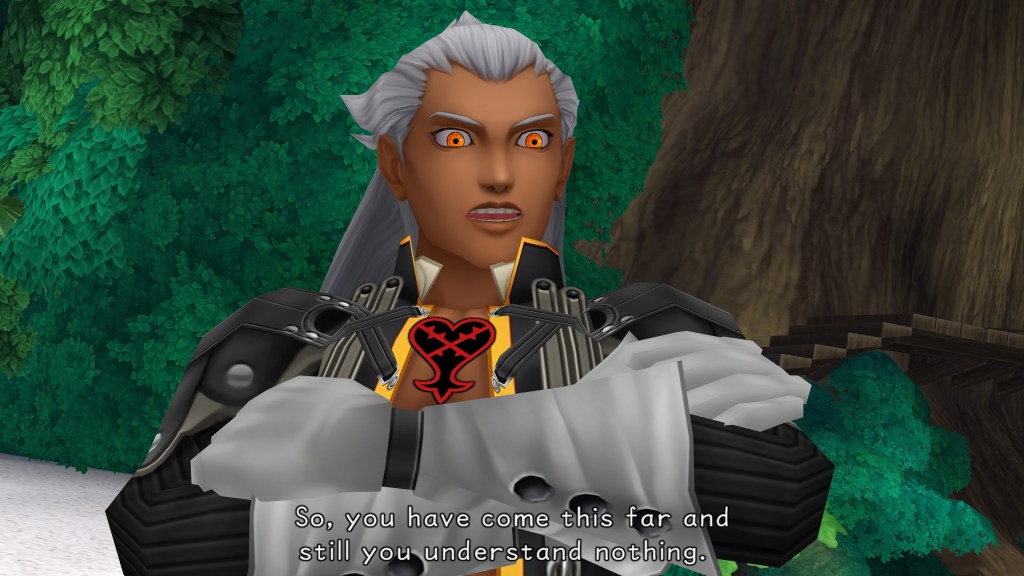
Ansem becomes a pretty complicated figure later on. But this game takes place before anyone had ever heard of Xehanort or Xemnas. In 2002, Ansem was the heartless guy, the seeker of darkness. He was the one obsessed with finding out what Kingdom Hearts was and that is who we are talking about here.
Before the events of Kingdom Hearts, Ansem is a researcher who is looking into what exactly the heartless are. His kingdom is falling and understanding what these beings are is the key to saving everything. During his experiments, he gives up his heart to the darkness and becomes sort of a wandering figure in robes.
He shows up very briefly at the start of the adventure and is even mentioned by name early on, but first time players might forget about it because a lot of screen time passes before he shows back up.
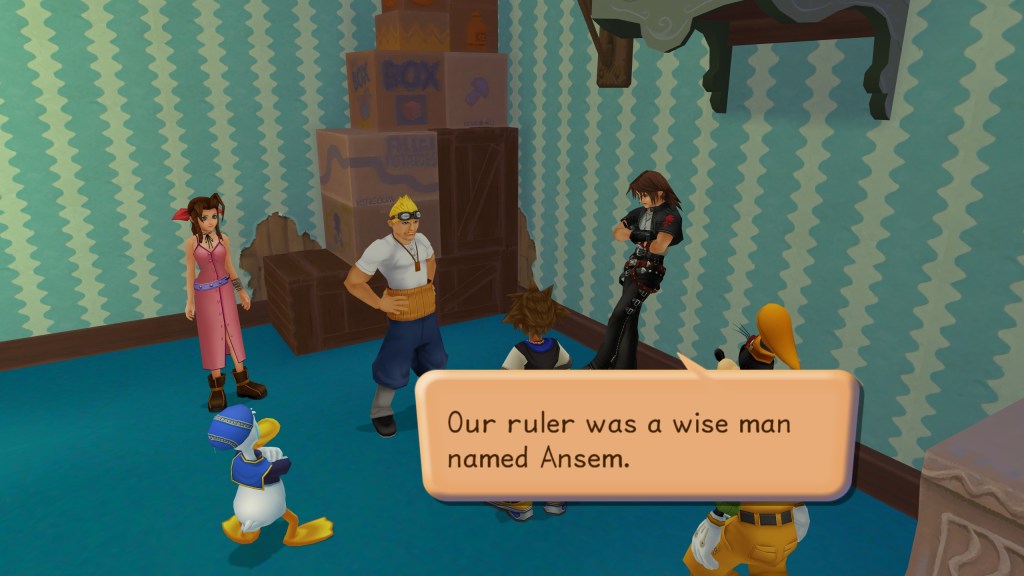
He is key to the destruction of Destiny Islands. He alludes to a coming darkness to a very confused Sora and then shortly after this happens, heartless overrun the hero’s home.
It’s implied that he’s maneuvering things behind the scenes throughout the entire game, but the main antagonist for a large portion of the title is the Disney villain Maleficent, from Sleeping Beauty.
She is pretty similar to how she is depicted in that movie in the sense that she is pure evil and wants to rule over everything. She is there to make the Disney villains look organized and move the plot along, but she doesn’t do much other than act menacing. She’s there as a figurehead, Ansem is the true force of work.
However, since Maleficent doesn’t receive her own section here, I will use this space to say that I think she was a great choice as the primary Disney villain.
She feels more like an incarnation of pure darkness than any others. I think villains like Jafar and Ursula are similarly pure evil without any redeeming or ‘shades of gray’ qualities, but Maleficent is the only one of those three that feels like she comes from the same world as these heartless creatures. She’s a totally one dimensional character, but I love how evil and sinister she is.
Plus, intentionally or not, I like how similar the relationship between her and Riku feels to the relationship between Ultimecia and Seifer. It feels like he’s her knight. I just don’t get that vibe from the other potential lead Disney villain choices. She does get fleshed out a bit in the sequel at least!

Back on Ansem, his main goal in the game is to gather seven princesses of heart in order to open the final keyhole, which opens up a path to the heart of all worlds, Kingdom Hearts. Ansem, corrupted by the darkness, assumes that the heart of everything is darkness. So by opening the door to darkness, it will overpower all light in the world and darkness will reign. The seven princesses are scattered across the worlds Sora visits and their abduction helps move the plot along as well.
It is revealed that Kairi is the seventh princess, which is why Riku (possessed by Ansem) has been keeping hold of her. The goal is to extract Kairi’s heart from Sora, complete a keyblade made up of all seven hearts and let darkness flood into the world. Very simple, cartoon villain stuff. But a perfect fit for a simple Disney and Final Fantasy cross over story.
At the end of the game, Ansem opens the door to darkness which leads to Kingdom Hearts. Unfortunately, KINGDOM HEARTS IS LIGHT and it shines through the door and finishes off Ansem. This part of the game is particularly confusing for first time players, with a lot of people assuming that the door Ansem opens is Kingdom Hearts itself.
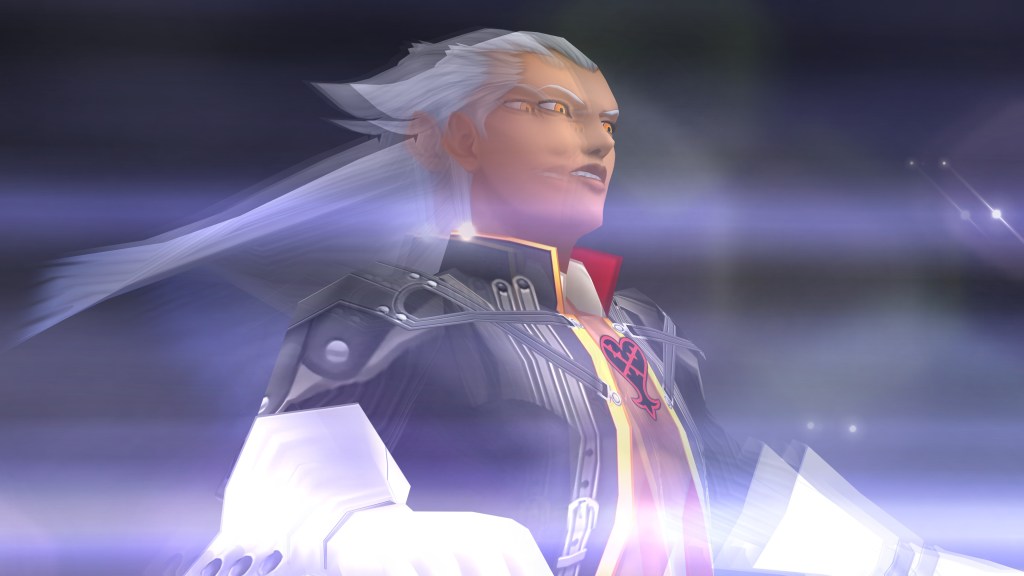
Since Kingdom Hearts 1 keeps lore talk and specifics pretty bare, I don’t know if the main game does a great job explaining what exactly is happening at the end. A lot of questions like ‘what exactly is Kingdom Hearts’ might linger on. Sora seems to know what it is, but I don’t think every person playing picks up on it.
Future games delve into the history of this universe, what a heart is, what darkness is, what Ansem is in pretty great detail. But here, I feel a lot of things are left up to the imagination.
There is a little bit of heartless lore that gets dumped on you at the end of the game though. Instead of summarizing it, let me just pop some of it in for ya. The second set of lore is exclusive to the Final Mix version of Kingdom Hearts and contains a little bit of a nod towards Kingdom Hearts 2 and Chain of Memories.
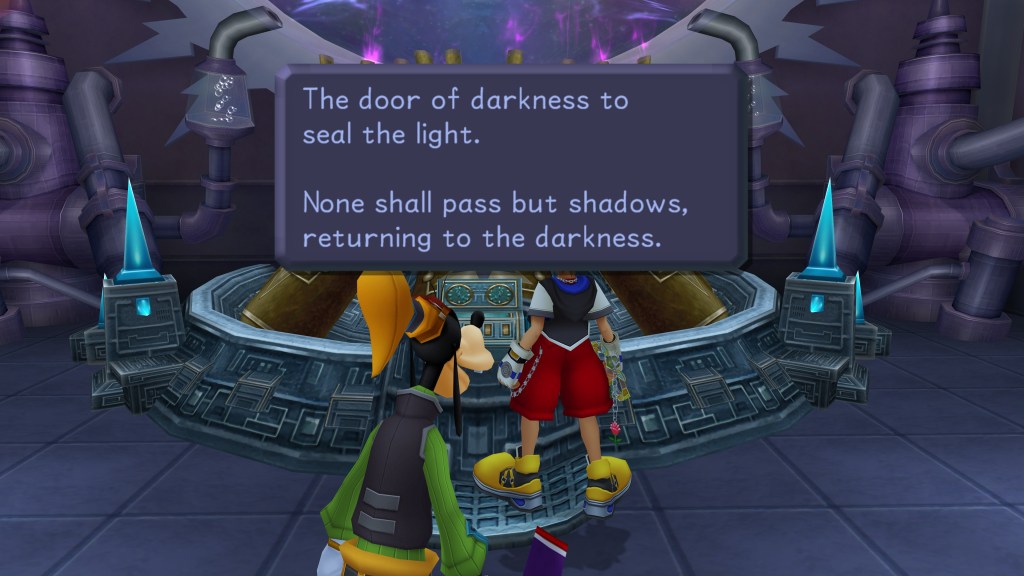


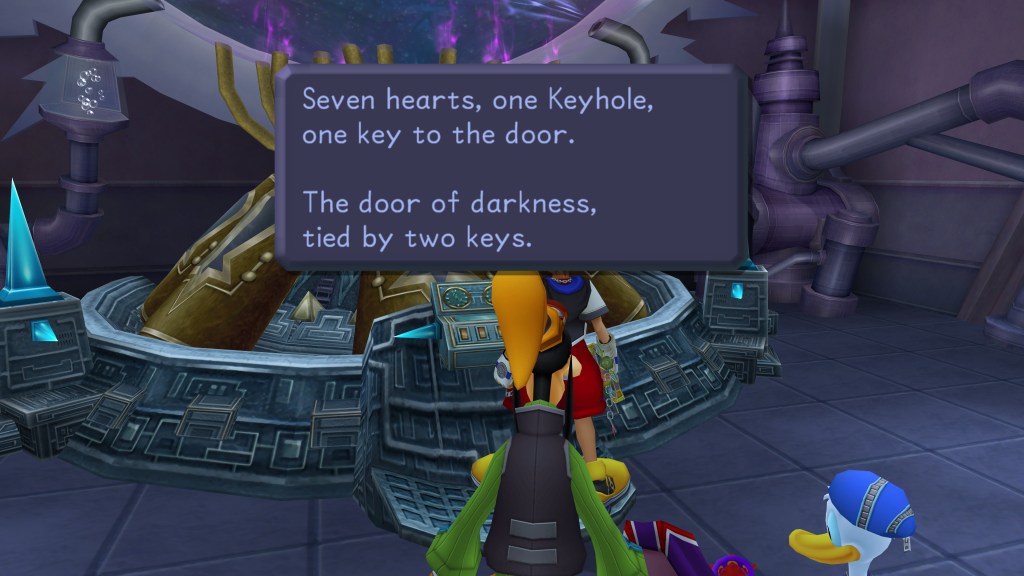

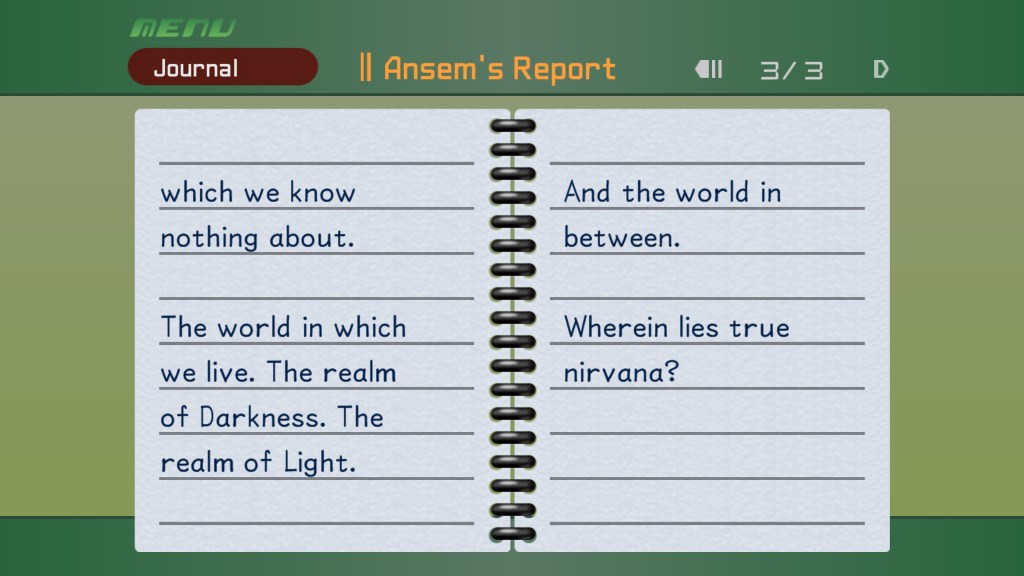
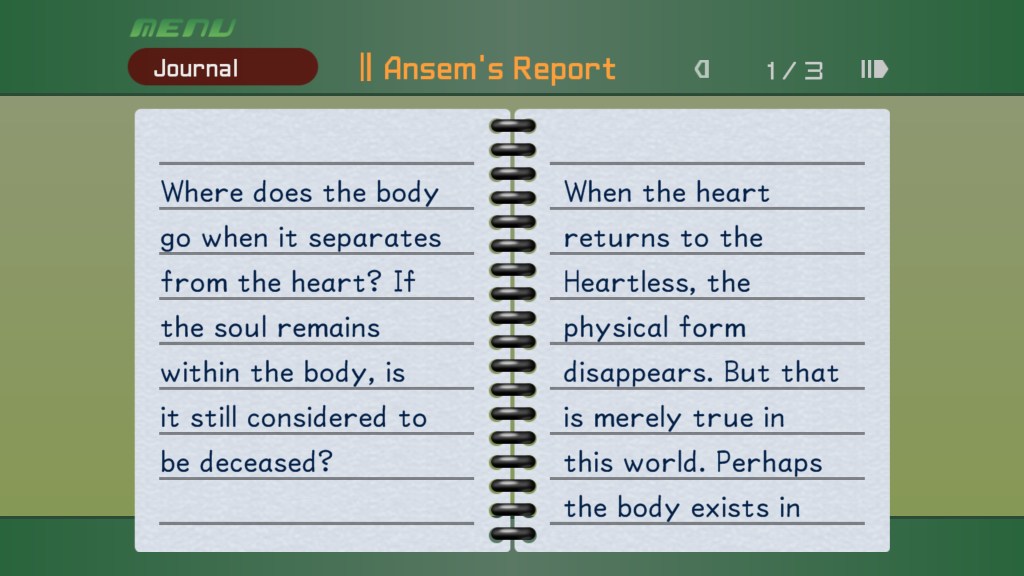

Ansem is conveyed as something of a fallen hero. I believe the original idea behind his character is to show that even people with the best of intentions can be corrupted. Riku was sort of the beginning of what that journey looks like, with Ansem representing the endpoint of the progression.
The journals you can read throughout the game explain his thought process a little and flesh out his character beyond ‘mindless villain who wants to destroy the world.’ I’m not saying he’s compelling, his motivations are very simplistic, but I think the simple minded Sora being paired off against a similarly simple minded villain is pretty fitting.
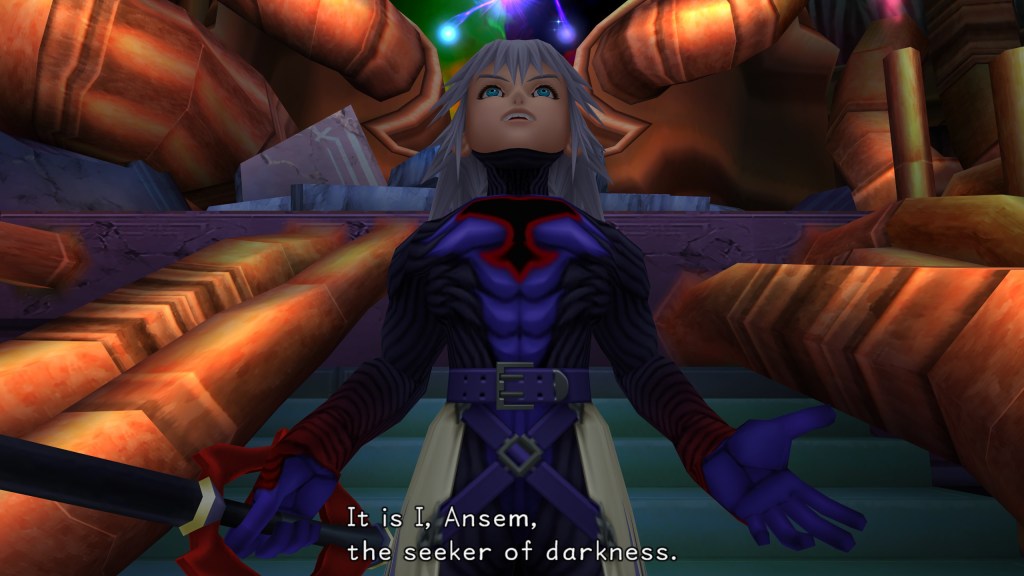
In conclusion
Kingdom Hearts is a game that is very dear to me. I got it on the day it released and I think I finished it within a week. It’s a little hard for me to look at it objectively.
From a gameplay perspective, 1 is a slower paced game than its sequels. The player really needs to focus on enemies in combat and think things through, I don’t think planning out abilities in advance is as important here as it is in later games.
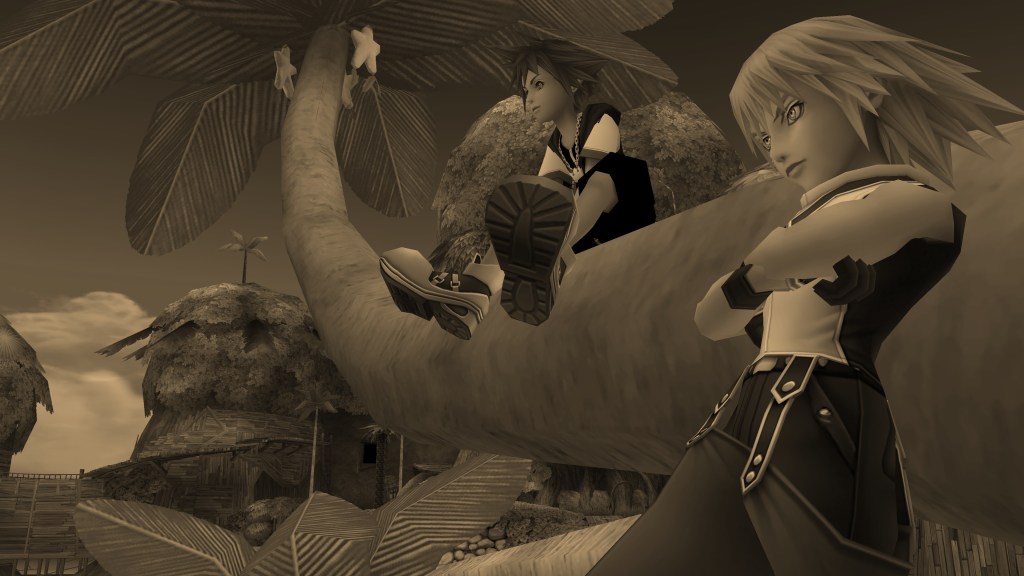
In Expert/Proud mode, this approach makes for some really interesting battles. Some fights might feel unfair for players who are playing for the first time, but once you grasp what’s going on, I find them to be very engaging.
This is a fanservice game. It doesn’t feel like the overall plot was pondered on too much beyond being a means to connect characters from various worlds together.
I know there were a million sequels released for it, but this specific game feels very straightforward and could have acted as a standalone title. Later games get more complicated and explain the lore – this one is just simple and clean.
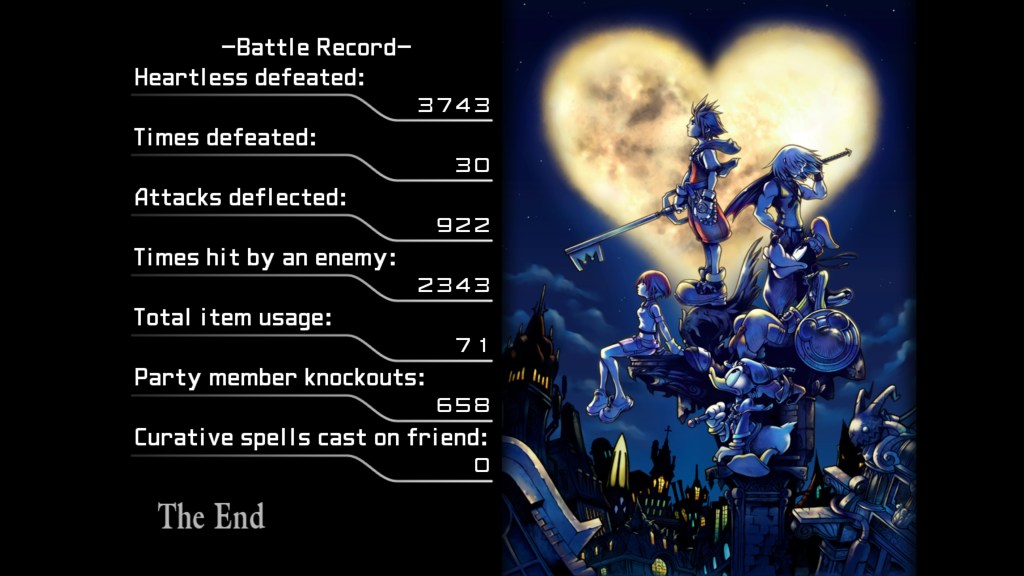
My score: 4/5
Up Next:
What can I do for you?
And also, eventually
These aren’t single player anymore?
 Vidya Thoughts
Leave a comment