

- Narrative focused discussion
- Gameplay focused discussion
- Notable characters
- Lifestream explainer
- Stuff new to this game
My Final Fantasy, part 2
In the summer of 2000, I finally got my hands on a Playstation. The Playstation 2 was set to come out later in the year, so the original Sony box was finally affordable enough to be a birthday present. This was a mandatory grab for a young Derek because Final Fantasy IX was also coming out in 2000 and I was already two games behind on this molten hot franchise. I wasn’t going to miss the very next new release.
My dad let my brother and me each pick a game for our new console. As a child, I believed ‘new is better,’ so if Final Fantasy VII was considered the greatest game of all time in 1997, then 1999’s Final Fantasy VIII must have been even better. Thus, my first Playstation game was Final Fantasy VIII, while my younger brother got Final Fantasy VII. I was thrilled to have it, but my eyes were set on VIII.
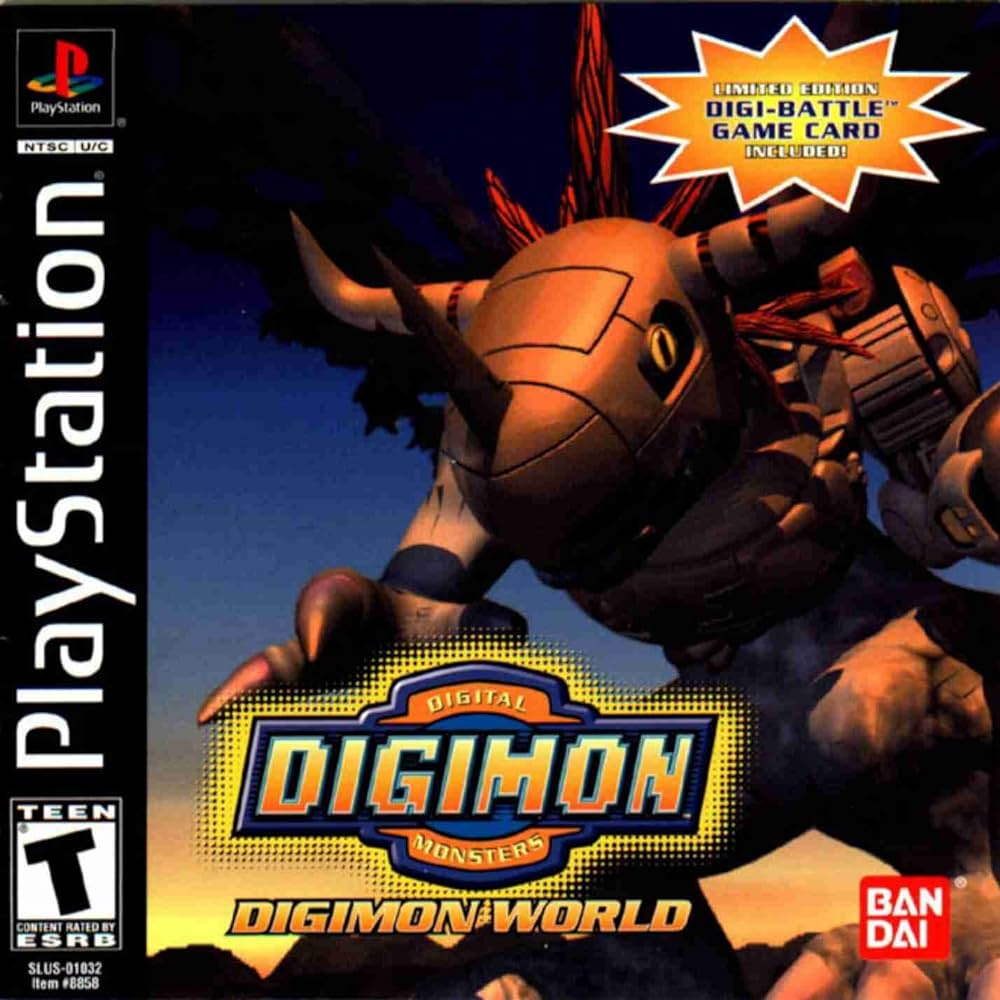
Well, and Digimon World, which would be my second game. Hey man, Digimon was hot as hell in the year 2000. I needed to have a little Patamon of my own and not on one of those little dinky Tamagotchi screens.
So even though VIII was the one I was excited to play, I fell off for one reason or another. I think I didn’t quite understand the junction system. But hey, I had another Final Fantasy to try. My brother’s copy of VII! Immediately memories of this game I had been dying to play just a couple of years ago came flooding back and I was hooked. Instantly my usernames online became stuff like XxXSephiroth666XxX.
One day, my brother was playing VII. The nerve, playing his own game. He was probably a little young to latch onto it properly, so he was still in the wall market portion of the game. I wanted to play so I took over for him and went to find a save point. In my haste, I overwrote my Disc 2 save and was sent all the way back to the very beginning of the game.
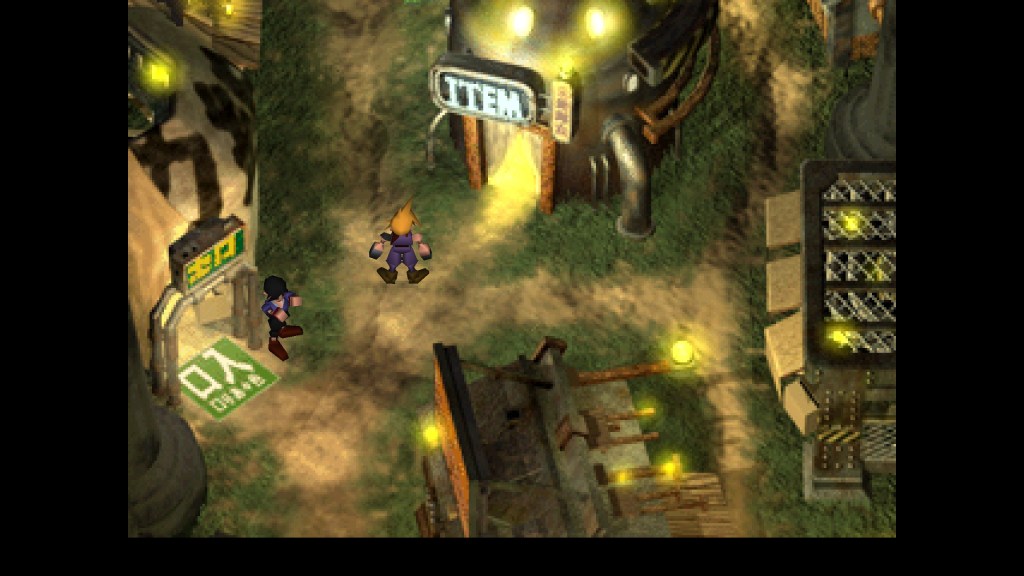
All my progress was lost. This sort of behavior has killed many gaming odysseys of mine in the past, but my love of VII was so severe at this point that it didn’t deter me. I just immediately relived the adventure again. The very first time I cleared Final Fantasy VII, Cloud’s name was ‘Drew.’ It’s something we still joke about to this day.
Fast forward a couple of decades to September 8, 2018. My wedding day. The song I chose for myself to walk down the aisle to was a piano rendition of Aerith’s theme. It’s a song that still makes me feel things whenever I hear it, so I felt it was appropriate for a day where you’re supposed to be very emotional. Needless to say, Final Fantasy VII means a great deal to me.
You might be thinking ‘his wife let him use a Final Fantasy song on his wedding day?’ Nope. She let me use two! The second one we can talk about at a later date.
My fondness for this specific title isn’t unique. There’s a reason why people have been clamoring for a remake to Final Fantasy VII for years. Something about this game just speaks to people. It’s one of those games that frequently gets called overrated because fans of the franchise prefer other entries while this one gets all the press. It comes with the territory. Games like Ocarina of Time, Super Mario 64 and Resident Evil 2 get called overrated all the time. Good company to have!
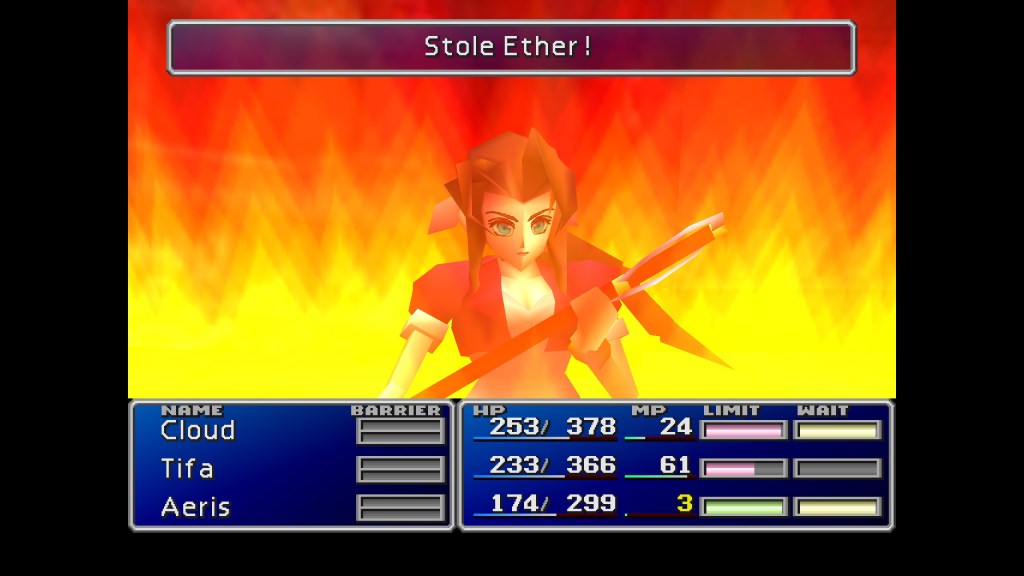
Console wars
For everyone else, Final Fantasy VII released in 1997 for the Sony Playstation and in 1998 for PC. It marked a bit of a divorce between SquareSoft and Nintendo, the company who had hosted the previous six entries of the franchise.
A Final Fantasy title would not release on Nintendo consoles again until 2003’s spin-off title Crystal Chronicles. A mainline Final Fantasy title would never launch on Nintendo hardware again. Given how graphically intense the most recent entry in the franchise is, XVI, I feel pretty safe in saying that we’ll never see it happen again.
The reason for the separation comes down to how games would be released to the masses. Nintendo went with the decision to release games on cartridge while Sony (and Sega) went with a CD-ROM format. The Nintendo 64 cartridge is capable of holding 64 MB, which is a pretty sizable increase over the 6 MB maximum the SNES had.
CDs held 650 MB. Final Fantasy VII had three of those. Final Fantasy VIII and IX had four.
SquareSoft saw the writing on the wall with the video game industry. Polygonal graphics with larger worlds were going to be the new norm and they did not want to be limited or left behind. The company was concerned that if they did not make something big and impressive for this new 3D market, that the franchise would be forgotten about.
Can you name a great JRPG for the Nintendo 64? If you said Paper Mario, congratulations, that’s where my mind went to as well. That’s the one! As much as I like to dream about Mother 64, we never got it. Ogre Battle 64 could count if you expand into the tactical genre, but otherwise it’s slim pickings. Lots of companies likely felt what Square felt.

A common belief is that Final Fantasy VII started as a Nintendo 64 game. This is because of a technical demo released at a conference called SIGGRAPH that occurred in the summer of 1995. This demo featured 3D versions of characters from Final Fantasy VI and a revamped battle system. Magazines credited this as an ‘in development Final Fantasy title’ at the time, but it wasn’t true. It was just a tech demo.
Surely the tech demo thing wouldn’t bite them in the ass again…right?
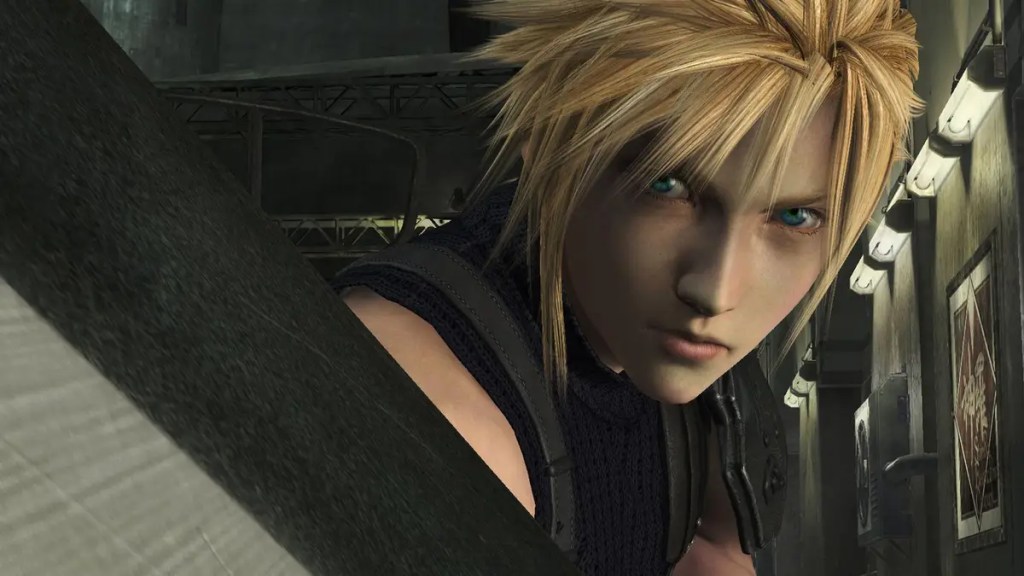
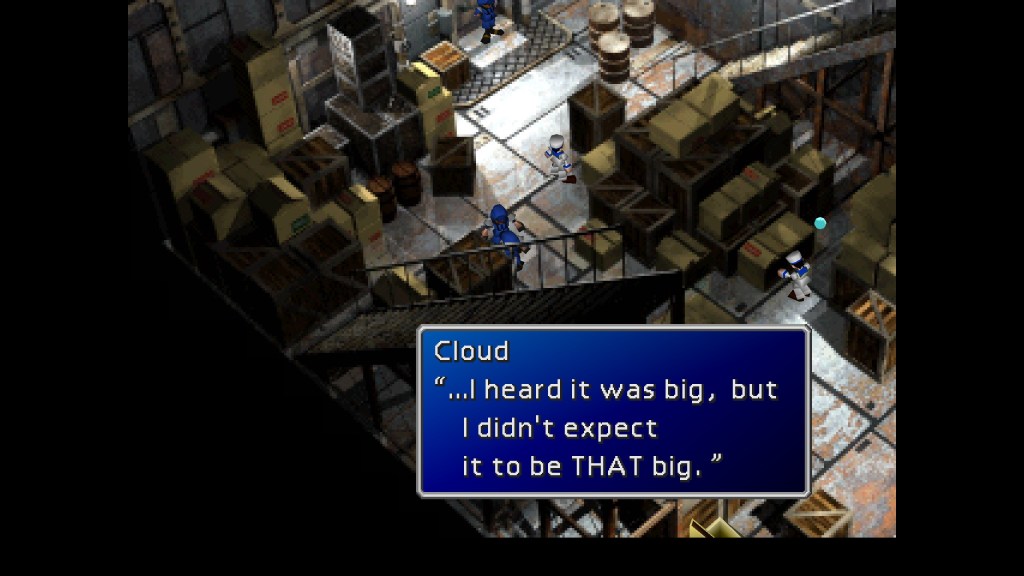
They looked into the N64 early at least, but work never got very far. FF VII’s director Yoshinori Kitase says that when Square is doing R&D on the next entry in the franchise, they will usually use the Behemoth creature as a bit of a test model.
“We made a 2,000-count polygon version of Behemoth for the Nintendo 64, but when we rendered and animated it, the framerate was way too low,” Kitase said. “To properly display Behemoth with that technology, we needed 2,000 polygons, but it was a little too much for the hardware. That was part of the problem with choosing Nintendo.”
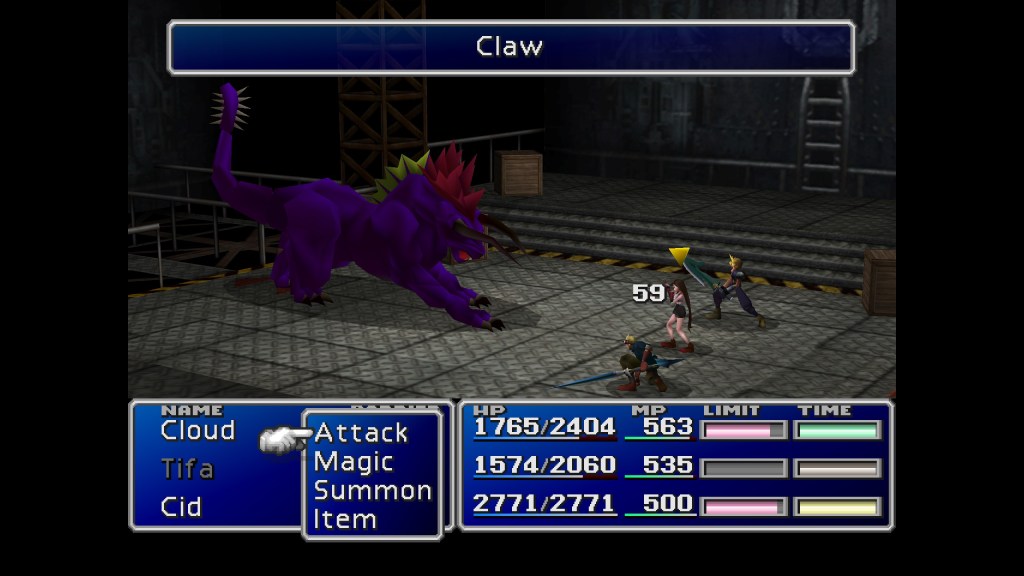
FF VII was announced for the Playstation in January of 1996, less than a year after this tech demo was released. I know game development is far different in 2024 than it was in the 90s, but do you believe a game as massive and expensive as Final Fantasy VII halted development somewhere in late 1995 and came out a little over a year later on completely different hardware? Work likely began and ended with the Behemoth.
AAA gaming
And when I say massive, I mean massive. Final Fantasy VII brought in leading CGI people from Hollywood to make a staff of 120 artists and programmers. The budget for this production was around $45 million dollars in US currency, which was astronomical for the time of release. That’s $87M when adjusted for inflation, just $13M shy of the budget for 2023 smash hit Baldur’s Gate 3.
It was the single biggest production in video game history up to that point. Could Square squeeze $45M onto a Nintendo 64 cart? Doubtful.
That money did not go to waste. Commercials for Final Fantasy VII showcased the impressive CG graphics of the time and hooked people that would never ever look twice at something like Final Fantasy VI. I distinctly remember my uncle, whose gaming knowledge extends as far as Road Rash, owning Final Fantasy VII. He couldn’t make it out of Midgar, but the mind blowing graphics opened the door for people.
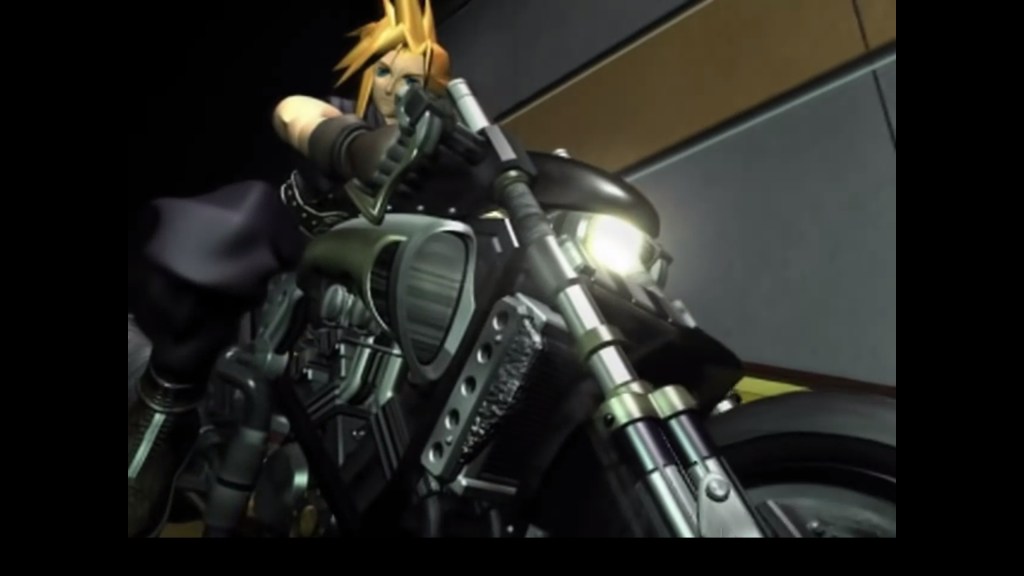
I know you might look at these screenshots and think “mind blowing? yeah right” but trust me. Cloud on a motorcycle was not something people thought they could be seeing on their gaming consoles in 1997. People were just getting used to seeing Mario in 3D. Stuff like a realistic enough human riding on a detailed motorcycle was unheard of. You would need to pop in a VHS copy of Toy Story to see those kinds of graphics, but a console being able to show that off? Wild.
Final Fantasy VII is not a console exclusive. As mentioned above, it was released on the PC in 1998. But when I think of the original Playstation, Final Fantasy VII is one of the first games I think of. The way it used its massive budget to push forward technology helped show that the “32 bit versus 64 bit” conversation was pointless. PC players were already used to improved graphics, so the technology point feels more muted there.
The N64 simply couldn’t produce something like Final Fantasy VII. And it wasn’t just the visuals. The N64 was stuck using midi files while the PS1 got access to MP3s, which led to higher fidelity audio experiences. Think of something like the famous Sephiroth song. I don’t know if it’d sound as memorable coming out of an N64.
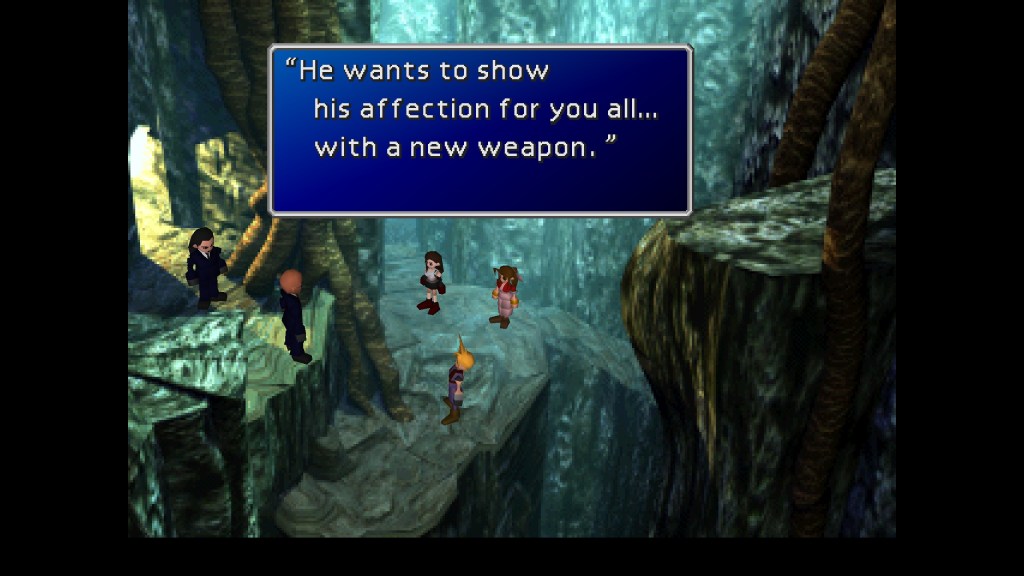
I also like to think about the crazy amount of dialogue in Metal Gear Solid. There’s no way something like that could fit onto a cart. Third party titles like MGS, FF VII, Crash Bandicoot, PaRappa the Rapper and Resident Evil helped establish Sony as a brand for video games. They are a big part of why Sony is still a power house in the console industry to this day.
I don’t consider console tech to be a big selling point in the modern days because EVERYTHING looks good to the naked eye. A casual isn’t going to hear about the jump from 4K to 8K and give a damn. Joel still looks like the Joel you saw on the PS3 but he has some more shading. I can tell the difference. You can probably tell the difference.
But your mom and dad can’t. That was not the case in the 90s. A lot of people can’t point out what ray tracing is. It’s diminishing returns. Everyone can spot the difference between pixels and polygons.
Movin’ and groovin’
The graphical differences would have a major impact on storytelling. You can only convey so many emotions with how the SNES FF pixel graphics looked. The pixel expressions in Final Fantasy V were impressive, but they were limited in what they could do. It’s a bit harder to convey something a bit more subtle. Even with the modernly simplistic graphics of Final Fantasy VII, there are more options to convey how characters are feeling.
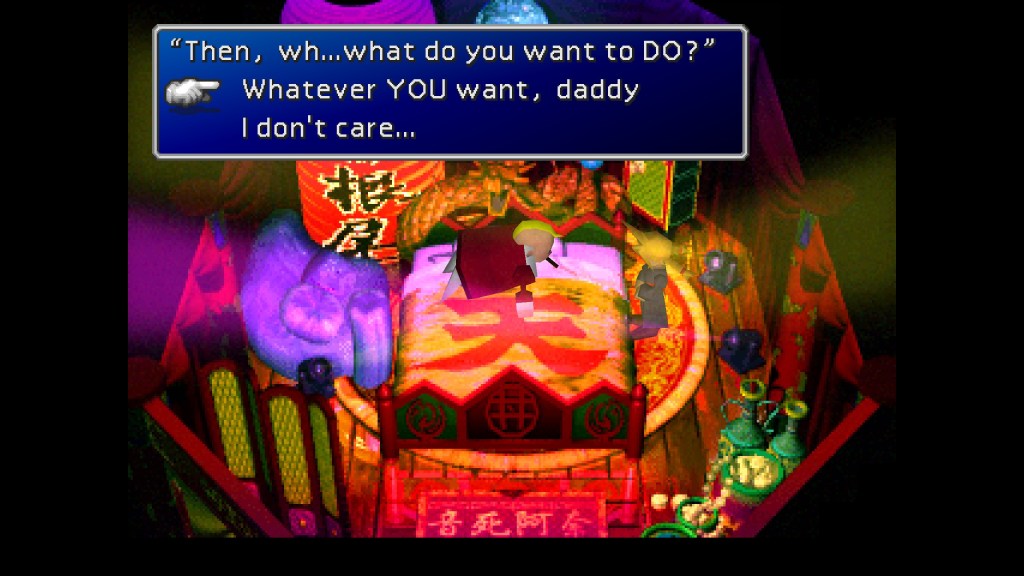
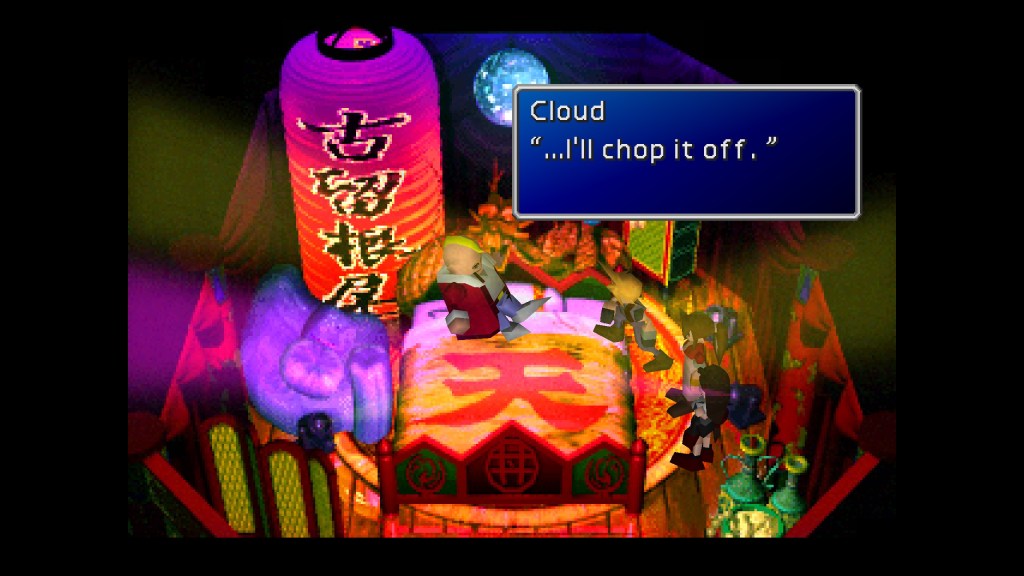
For instance, let’s look at a scene from early on when main characters Cloud, Tifa and Aerith are threatening minor villain Don Corneo. The dialogue here could have played out exactly the same as it did on the SNES. They are threatening a man with cutting off his testicles.
However, in this scene, you see Corneo scooting along a bed which helps classify him as a sex pervert. Your heroes later confront the lecherous slezeball and threaten him and as the characters deliver their lines they take a dramatic step onto Corneo’s bed while talking. It’s a simple, simple animation but it helps convey their dialogue as especially threatening. It takes what you are reading and adds a bit of oomph to it.

Probably the second most important portion of the game takes place in Disc 2, where Cloud is confronted with an identity crisis. To this point Cloud has been a pretty confident character but here he gets presented with a bit of information that completely destroys his mental capacities. The character we have been controlling to this point is actually an entirely different person than who we think he is. The player is sent into his mental world in order to sort this mess out.
Final Fantasy VI had similar character revelations. I’m thinking of when Terra discovers her heritage as a half-esper. It’s told in a way with just a pixelized people talking to the screen. It’s emotional and interesting and adds to her character, but the visuals add very little to the scene. You see her half esper form, but that’s the extent of it. In the picture below, Ramuh has just turned himself into some magicite. If you don’t remember, this is what happens to Espers when they die. You can see an expression of shock from Setzer, but that’s about it.

Now let’s look at how FF VII handles its big character revelation.

It’s difficult to make out in this screenshot, which is going to be a thing going forward as these games become more reliant on tech and movement, but a giant figure of Cloud is shown grasping at his head in this dream world. It’s extremely on the nose and over the top, but something like this just wasn’t going to happen on the SNES.
Cloud would have had the same dialogue and you would have seen the same flashbacks, but the gigantic Cloud grasping at his head as Tifa maneuvers around his mental scape just wouldn’t have happened. Heck even the more laid back looking Cloud to the left of that screen wouldn’t have been possible.
That scene
It’s just little touches like that, which make the characters feel more alive. Let’s now talk about THE most important scene in the game. Everyone knows it. People who haven’t played the game know this. It’s the closest thing video games has to “Soylent Green is People” or “Rosebud was his childhood sled.”
Aerith dies.

In previous Final Fantasy games, when a character dies they usually get a little bit of speech and then they just blink out of existence. Let’s look at Final Fantasy II briefly for an example of this.
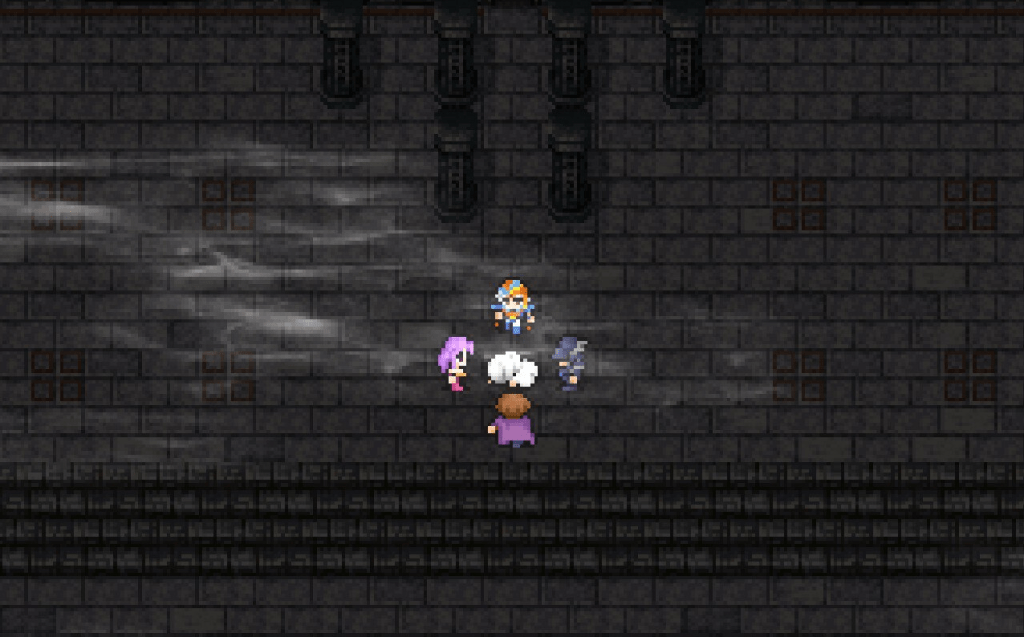
This is the final scene of a character I seem to reference in every one of these recaps, Minwu. The characters gather around him and mourn his death and he just plops out of the game. This is the Pixel Remaster version of that scene and even here it’s quite simplistic. It’s people gathered around a corpse and feeling sad about it.
Let’s look at how the death of Aerith is handled.
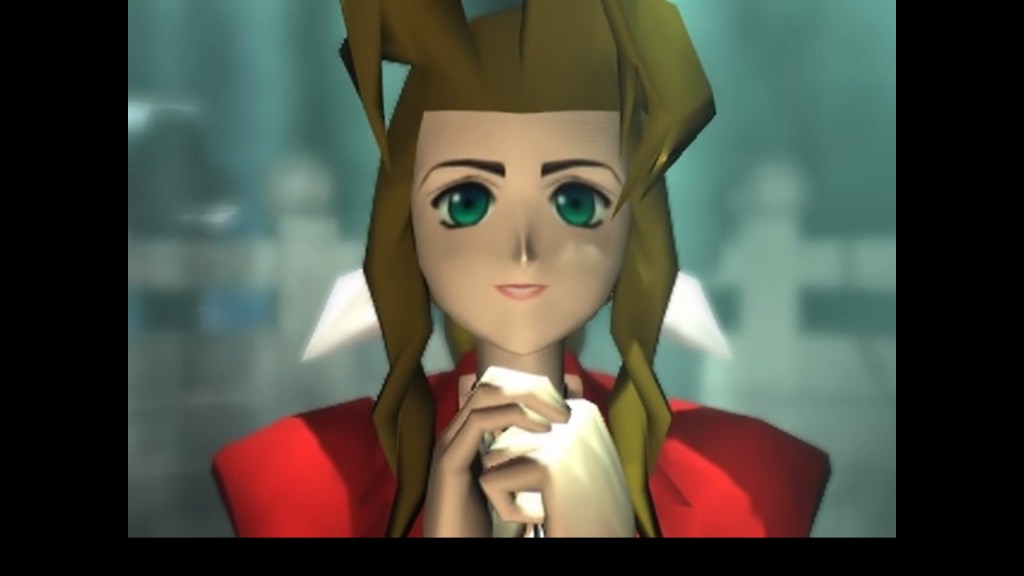


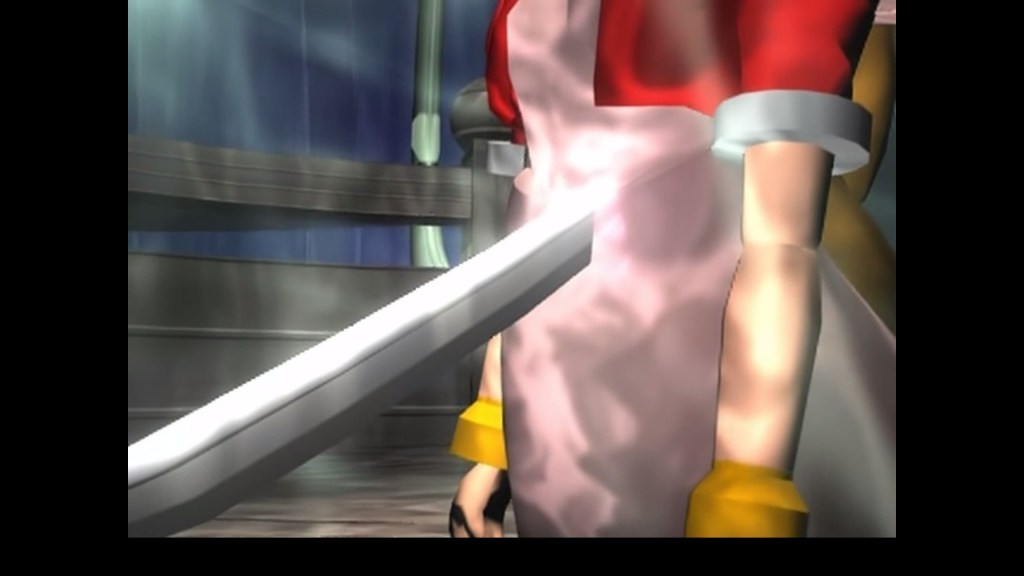
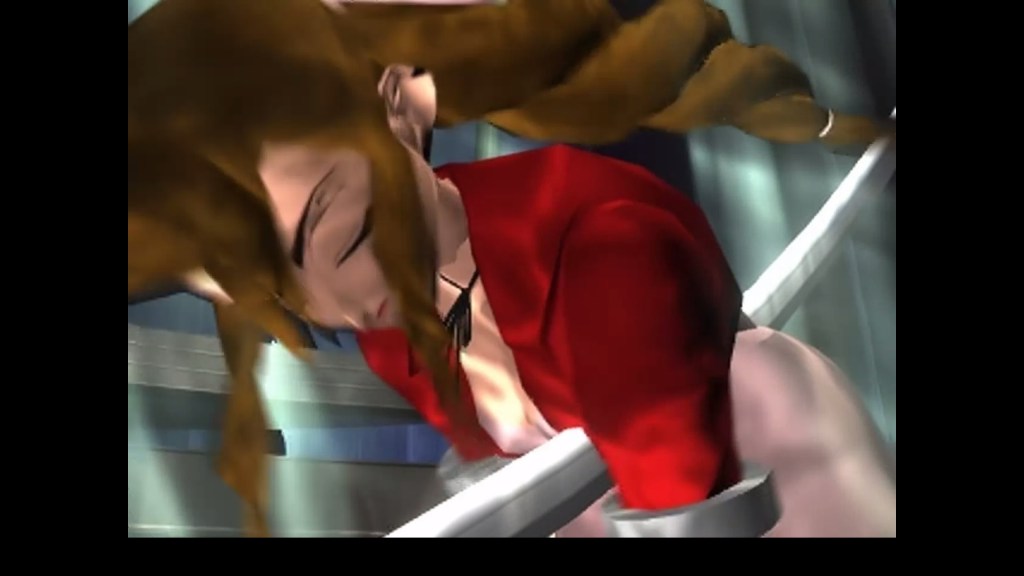


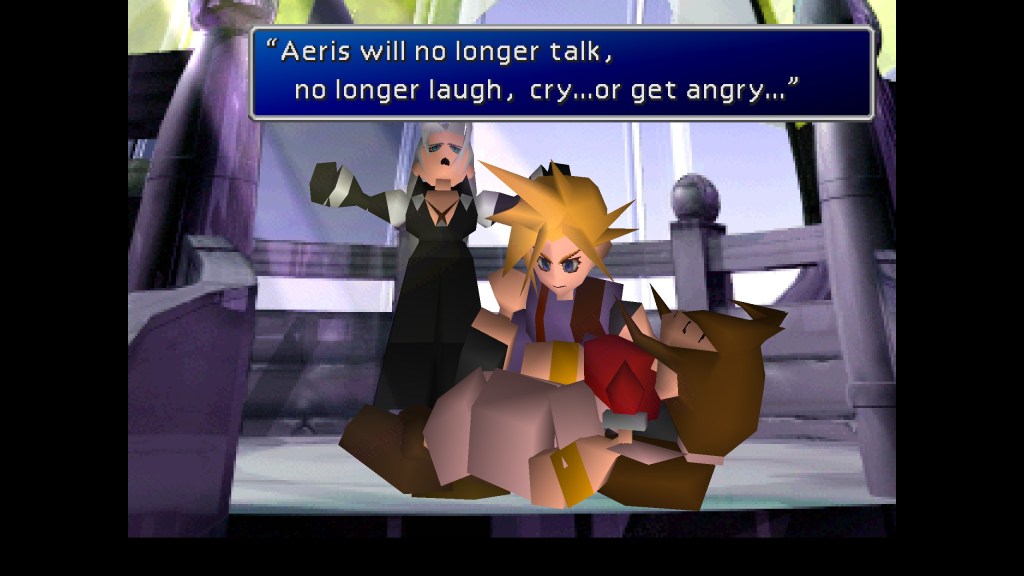
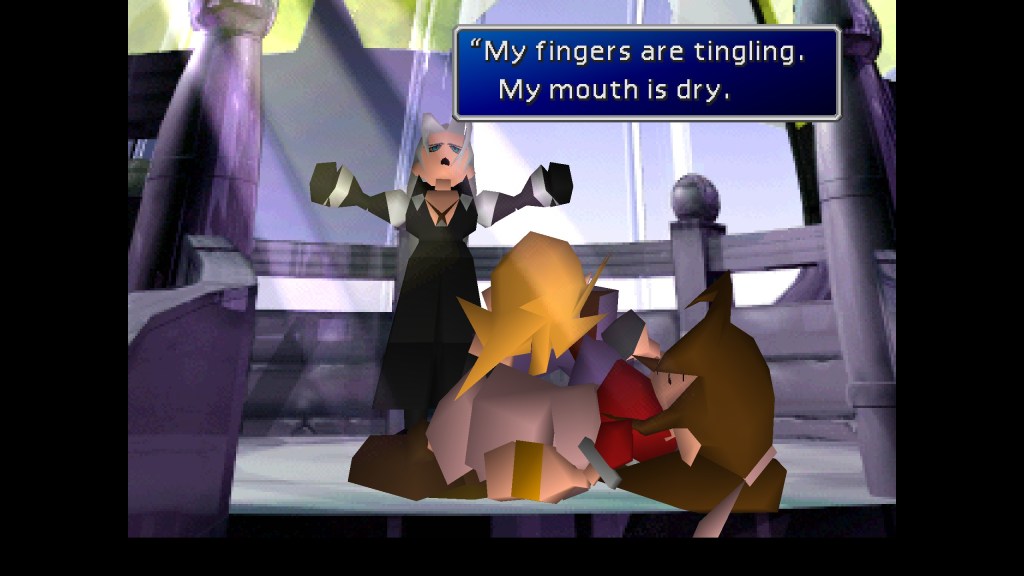
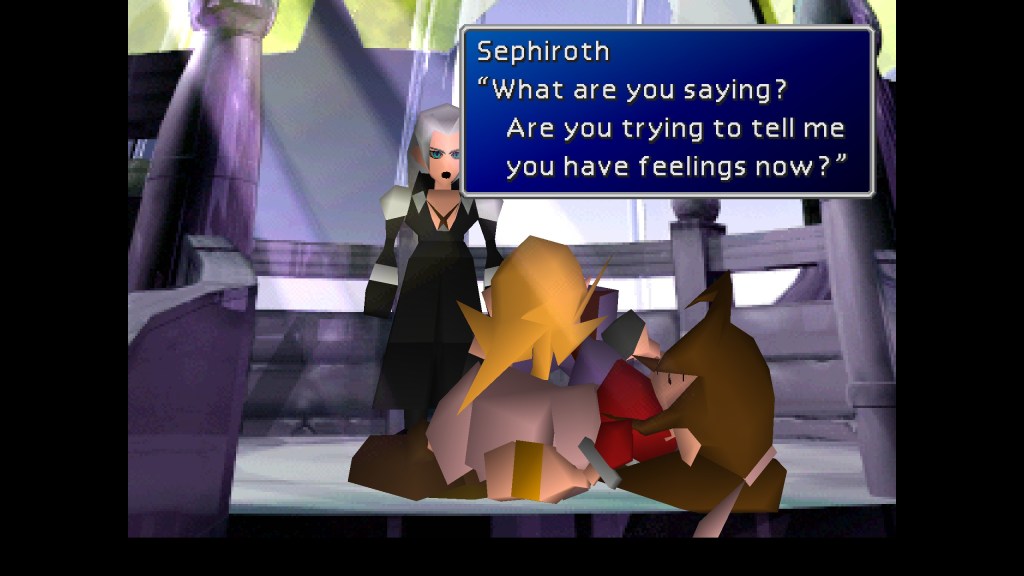
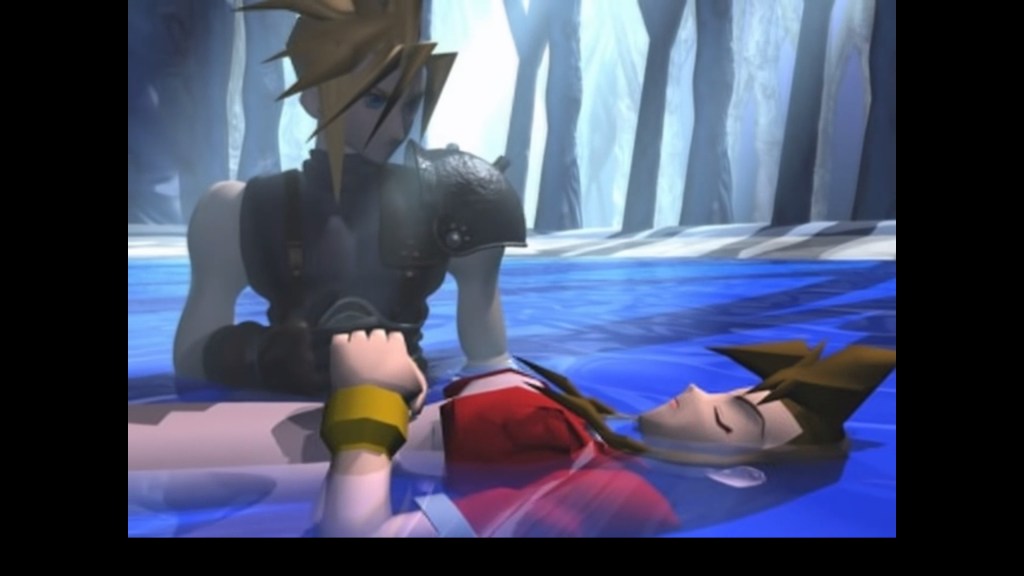

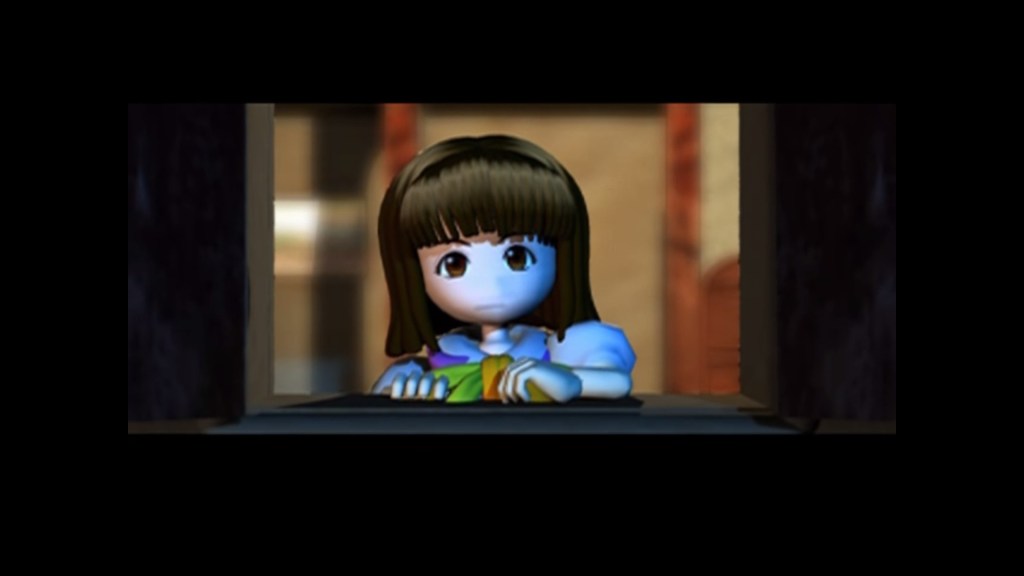
On top of the CG scene which shows her execution in a fair bit of detail, you have the follow up screens. You see Cloud holding the corpse of what many players probably felt was his canon love interest up to that point. You see him lower his head in anguish while Sephiroth, the main villain of this game’s narrative, has his hands outstretched as if to bask in the glow of his kill. Heck, even the text frame with Cloud interrupting Sephiroth wasn’t something that I remember seeing on the SNES.
The move to 3D helped the characters feel more alive, which helped the game feel more immersive. It is often over-the-top because such actions are required for these modernly simplistic looking graphics, but these 3D models feel more like real people than what you got before now. You got to read about how everyone was real sad about Tellah passing away but you got to see how sad everyone was with Aerith’s death.
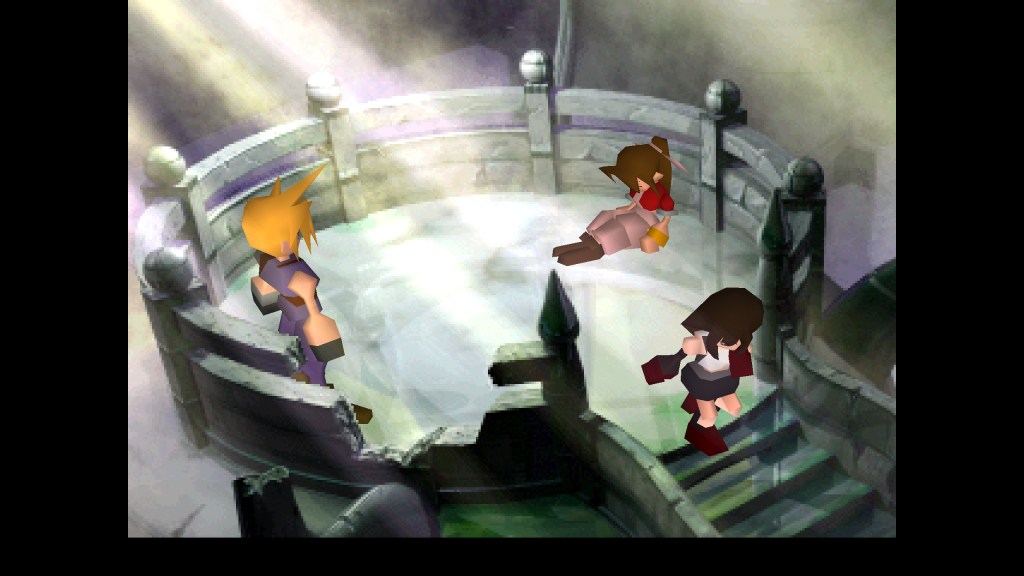

It’s part of why I think this particular death is so remembered and talked about. Half the discourse around the Final Fantasy VII remake project was about what in the world they were going to do with Aerith. Would they still kill her?
This isn’t the first party member to die in the franchise. Not even close. Even going outside the franchise, Nei’s death from Phantasy Star 2 is treated with similar narrative importance. But this is the one people remember and mourn. Why? Because she felt real. You saw her animations throughout the game, you saw how people mourned her and you felt it too.
I feel a bit bad for Legend of Dragoon. It has a very similar moment in the death of player character Lavitz, but you very rarely see people not intimately familiar with the game talking about it. The benefits of coming first and being in a franchise, I reckon.
This isn’t to say the storytelling in the NES/SNES titles is lesser. It’s just different. This was the first step in a new direction. For a medium that relies on visuals, this was an entirely different game.
It’s a big world
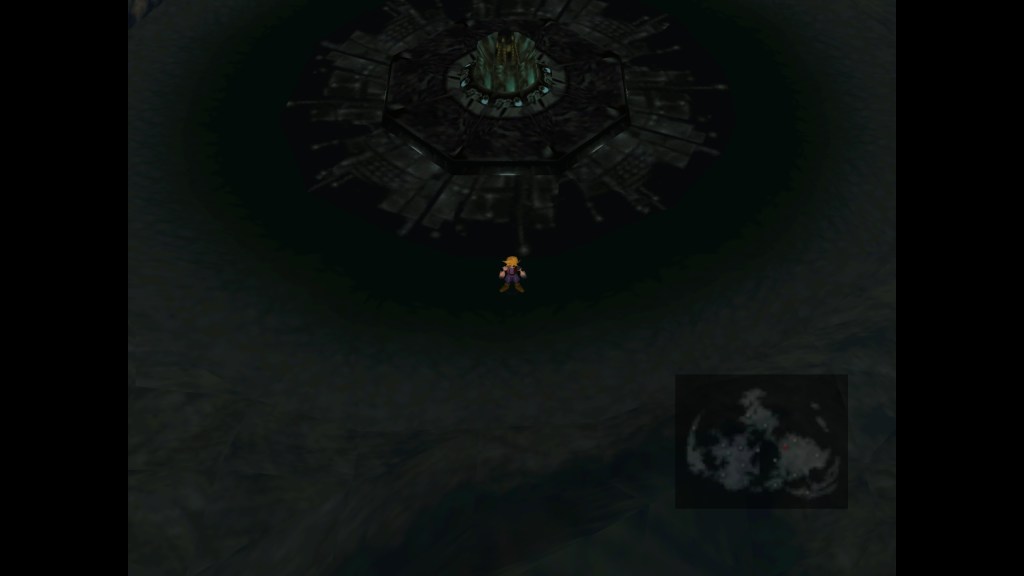
The narrative difference isn’t just through technology. Final Fantasy VII starts the adventure out in the city of Midgar. Every Final Fantasy game to this point has treated towns as pitstops. You are there for a short amount of time to get filled in on some narrative and then you shuffle off back into the wilderness. FFVI saw towns with more personalities like Narshe, but the amount of time you spend there is still relatively small.
Midgar is a whole different beast. On a player’s first playthrough, they will probably spend around four or five hours traversing through it. In complaints about Part 1 of the FF VII Remake series, you occasionally see people claiming they made it through this segment in like an hour.
I’m sure it’s possible, but that’s reliant on the player jamming on buttons to bypass all the dialogue and zooming from place to place. If you experience it as SquareSoft intended and talk to the NPCs and try to immerse yourself in the world, it’s a lengthy, hours-long ordeal.
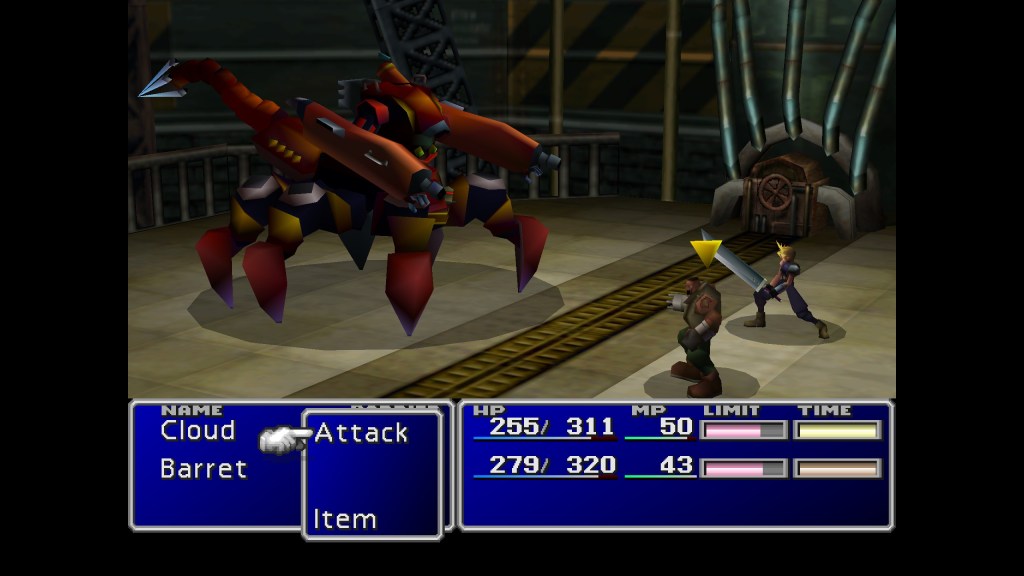
This makes this area feel massive and significant. Midgar is hands down the most important location in Final Fantasy VII. Most of your playable characters have origins in Midgar and one of the game’s major antagonistic forces, Shinra Inc., emanates from there. During replays it’s shocking at how quick this section can take because it feels massive. I think it’s because this early portion of the game is more on-rails than anything the franchise had seen up to this point, so the player gets to have a good look at the entire city.
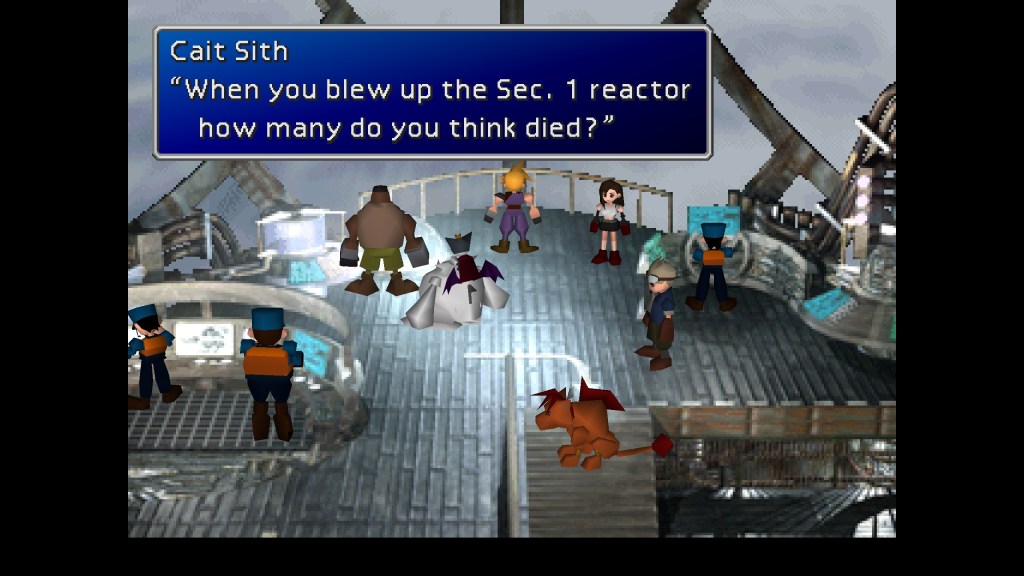
And that city feels alive. You can see the impact that the evil corporation has on the average citizen. You can see your impact on it as well. After you complete the game’s initial mission which features your characters bombing a facility, you see the flames and the aftermath. People fleeing the scene.
When you’re transgressing between the slums and Wall Market, it feels like the trek from Narshe to Figaro Castle from FFVI. If it’s your first time, you might think Midgar IS the entire game. The first game in the Remake project takes this idea and runs with it.
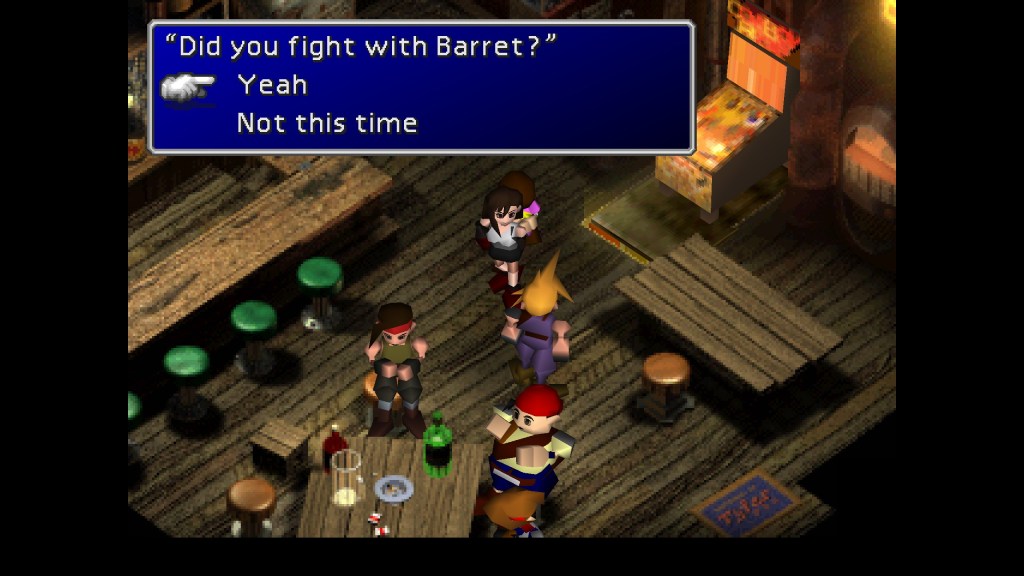
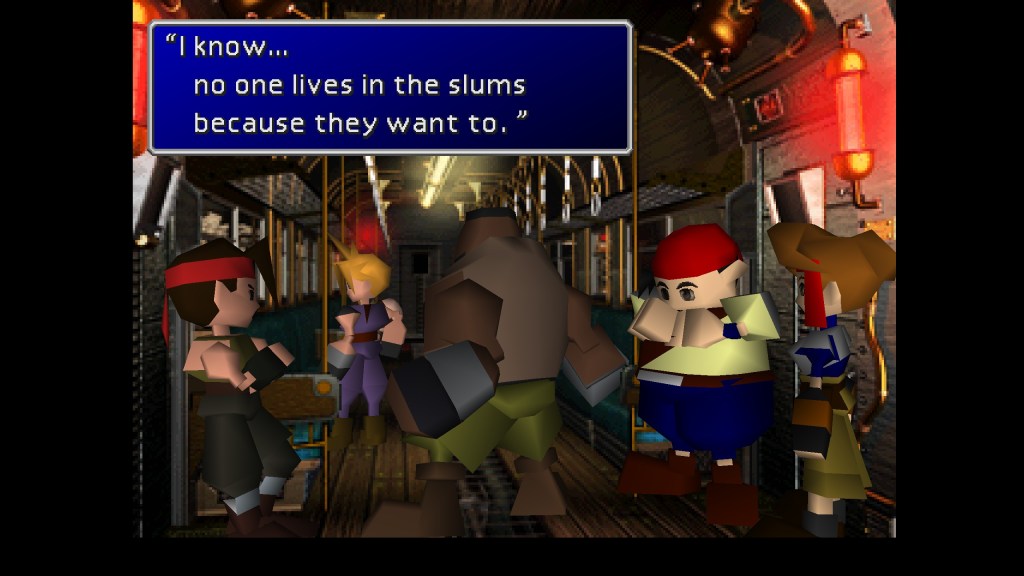
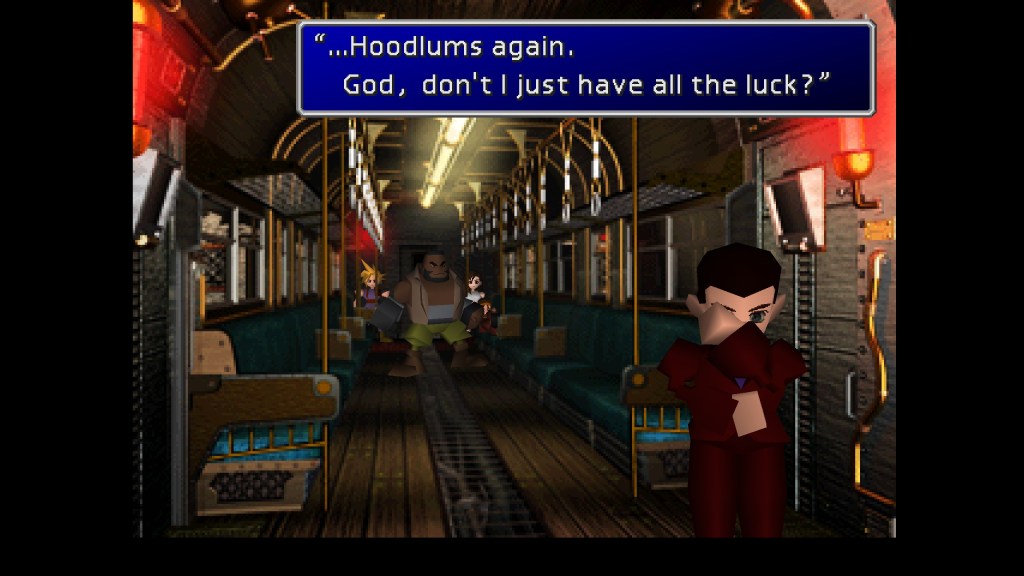
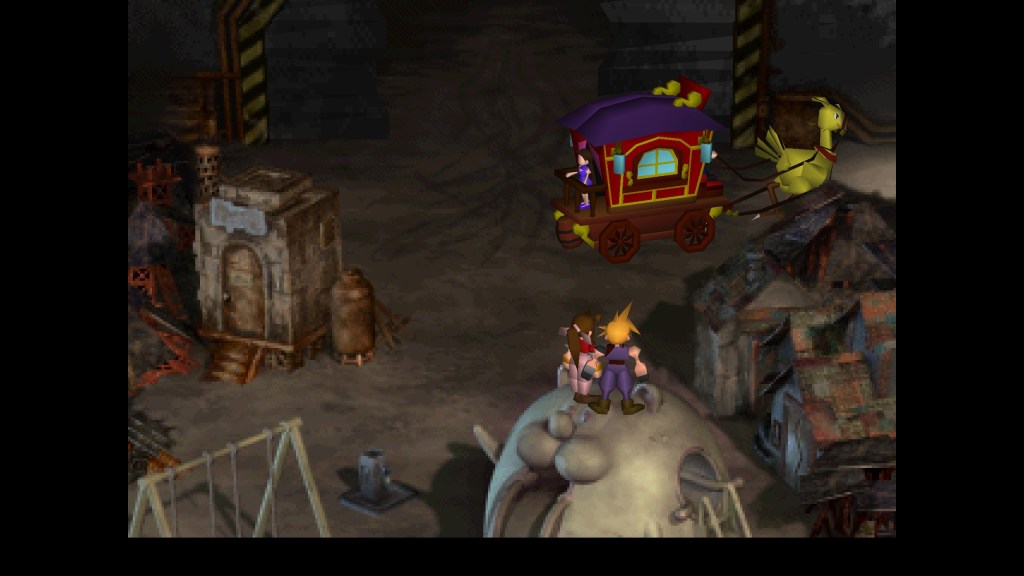
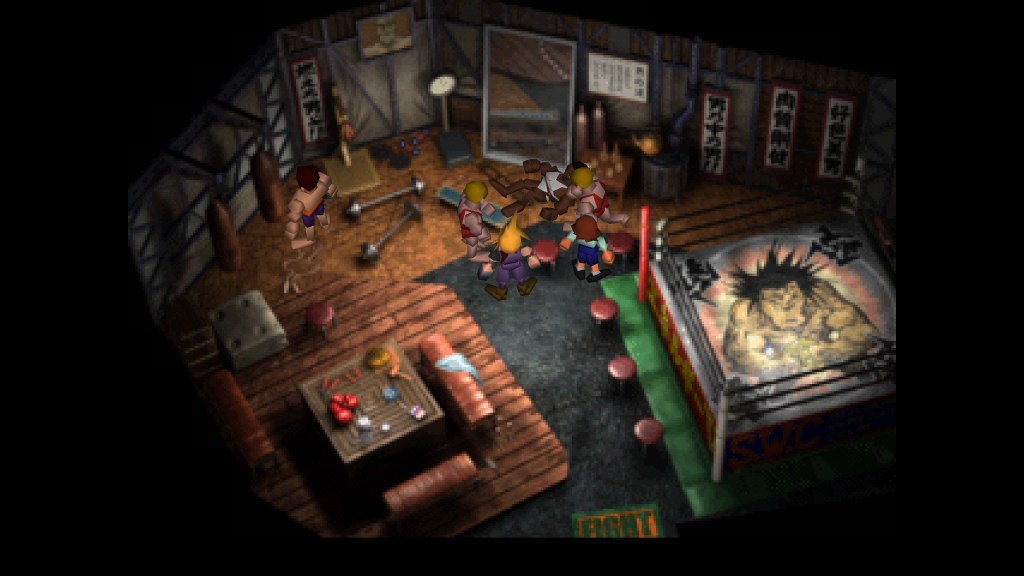
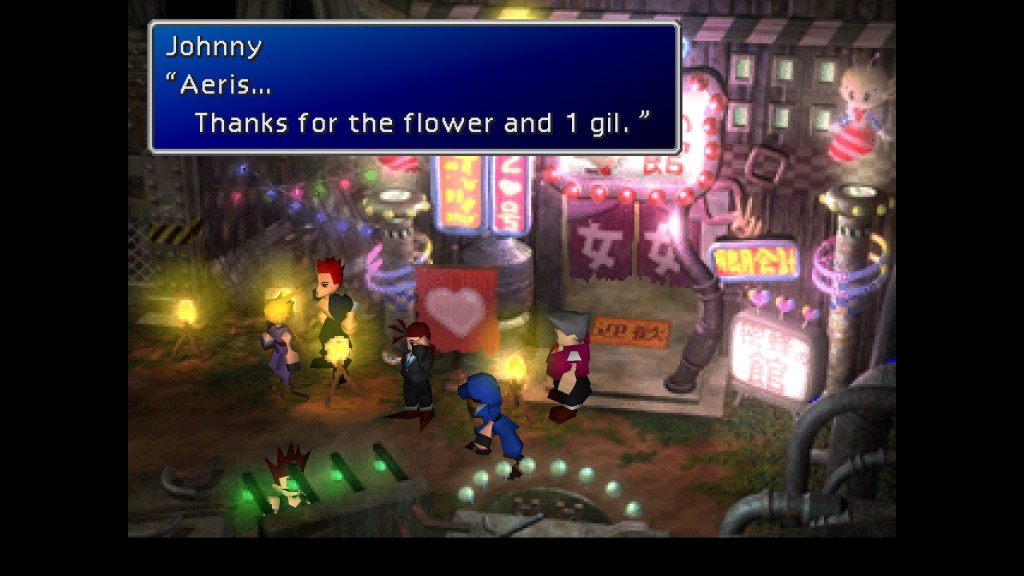
So it’s particularly jarring when you are ejected from Midgar about five hours in. You’ve only been walking down hallways to this point. Once you’ve made it out, you get a glance at FF VII’s world map and it feels massive. You see the giant city you spent five hours in and it’s just a little blip on the radar. The planet needs savin’ Cloud and there’s a lot of it.
If you pull up the world map, the dot for Midgar and the dot for the player’s next destination, Kalm, are about the same size. It’s a simple trick, because the player will find out very soon that places like Junon, Kalm and Cosmo Canyon are nowhere near as large as Midgar. But the world map treats it as such. It makes the world feel gigantic and makes the player feel the need to explore each and every corner of the map.
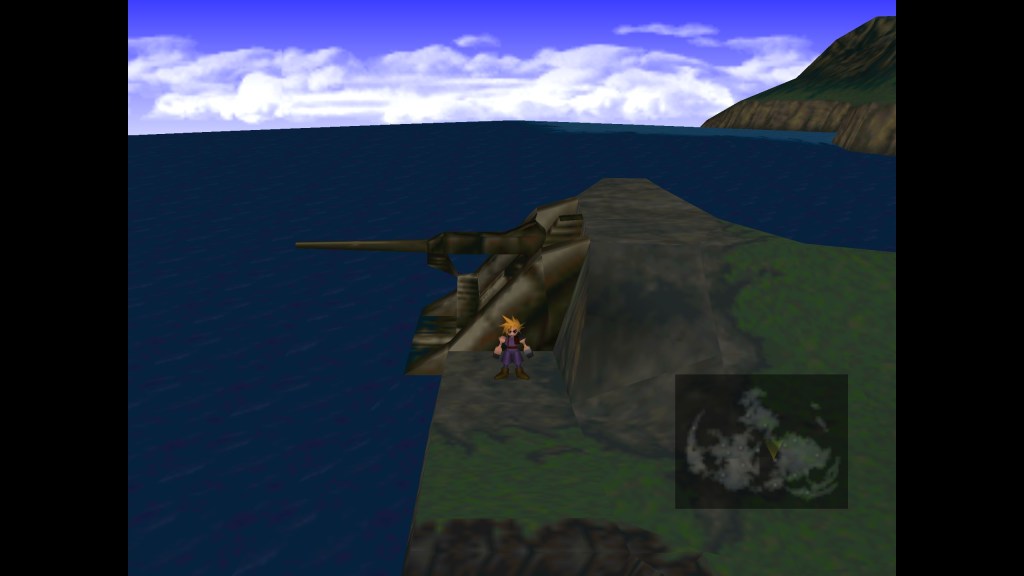
If you play the (as of this writing) two remake games back-to-back, you can capture this feeling a little bit. The first game takes about 30 hours to complete and is a totally linear story driven experience. There are open portions but it’s straightforward. If you have played Final Fantasy X or XIII, it feels very similar in structure to those titles. Midgar is all there is to it.
I know people scoff at the remake series for being three titles, but since they went that route, I think making Midgar its own game was the correct call. That’s what it felt like to me the first time I played FF VII. Midgar was its own game.
When you move on to the second title, Rebirth, and make it out of the introductory sequence, you are faced with what feels like a whole massive world that you can explore. The open environments in Rebirth do a good job of capturing the wonder that was in the more simplistic environments of the original FF VII open world. In that game there is something around every corner, whereas in the original it simply felt like there was something around every corner. It does a good job of replicating that feeling.
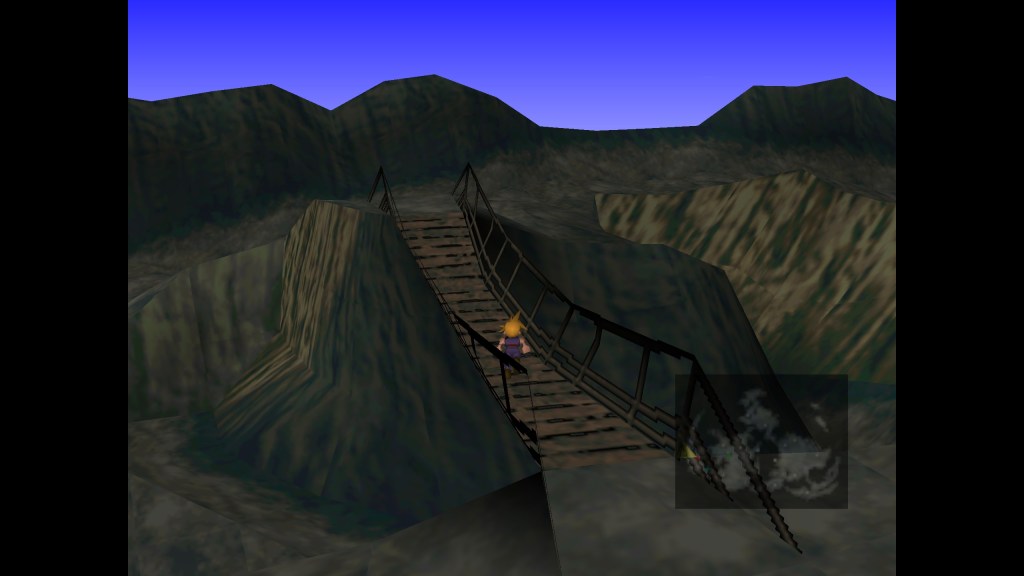
The previous four Final Fantasy titles all featured multiple world maps. Final Fantasy VII reduces this down to one but thanks to the sleight of hand pulled off by Midgar, you never really notice it.
I don’t think Final Fantasy pulls off a trick like this quite again, but the focus on singularly important areas comes back over and over again. As I said in my writeup of VI, a lot of the towns before that entry felt boiler plate to me. I can’t tell ya much about Canaan or Troia, but I can go on and on about Balamb Garden or Lindblum or Zanarkand or Dalmasca.
Sounding the alarm
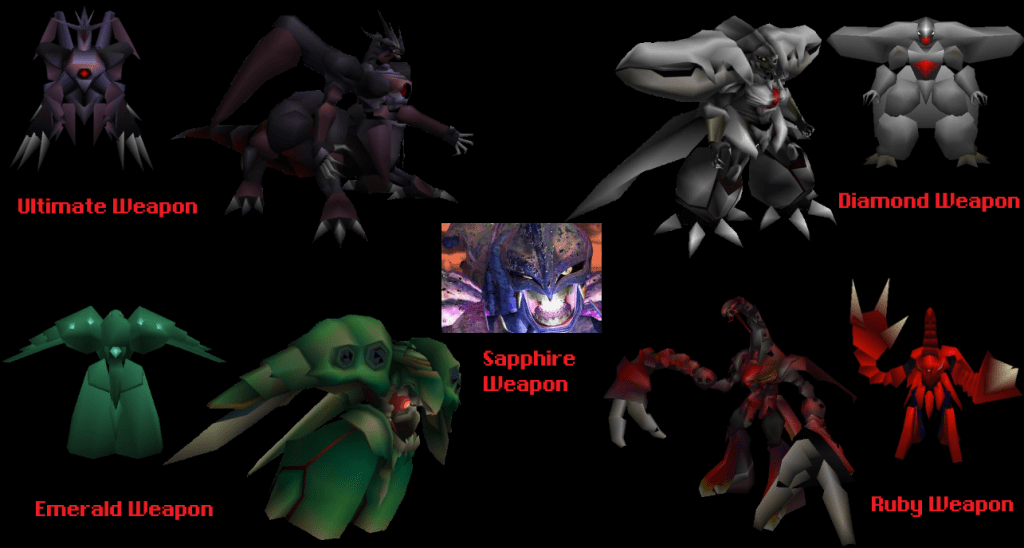
One final little narrative thing this game does that I feel like I should mention is a complete tonal shift that takes place in the middle of the second disc. When Cloud undergoes his crisis of character, another giant event is going on in the world of FF VII: Sephiroth awakens. I’ll discuss what the hell I mean by this in the Character section below, but the awakening brings about ancient protectors summoned when the planet is in grave danger: Weapons.
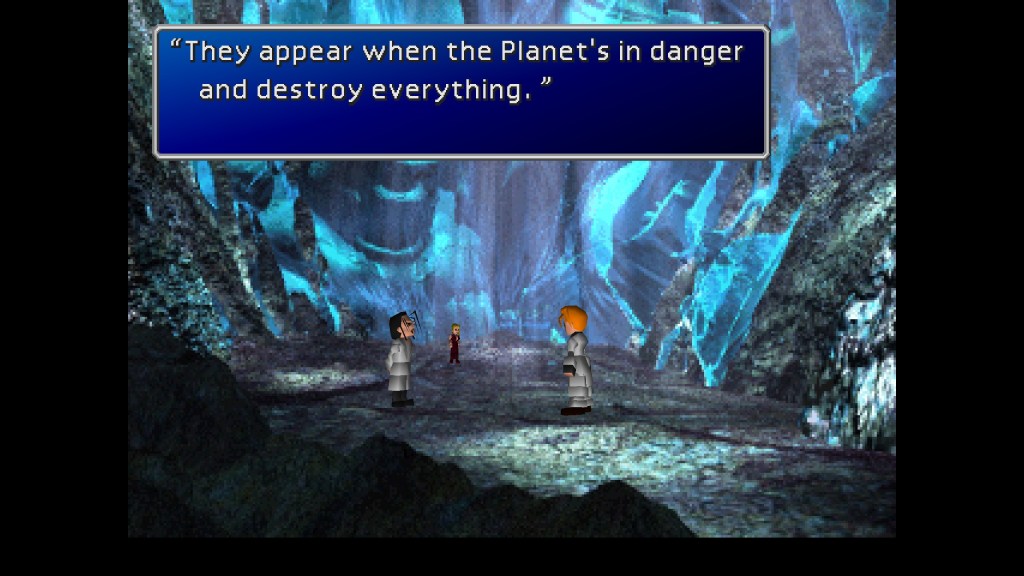
Weapons are gigantic beasts, think kaiju, that roam around the world and cause mass destruction. Their presence is treated like a gigantic deal and requires the attention of every force on the planet – both good and bad. Having the creatures visible on the world map sets them apart from every other encounter in the game and makes them feel both very important and threatening.
The only other creatures you see outside of random battles are bosses and the Midgar Zolom. First time players who encountered the Zolom probably are in no rush to replicate that experience.
I love that a lot of the events in Disc 2 are centered around the Weapons causing fear in the general public. Shinra plans a public execution of your party in order to raise morale and wouldn’t you know it, Weapons show up and everything comes to a standstill. Sirens blare and your old foes Shinra no longer care about your party, all they care about is driving back the gigantic beasts of legend they managed to summon. Humans against the forces trying to protect the interests of earth? Hm….
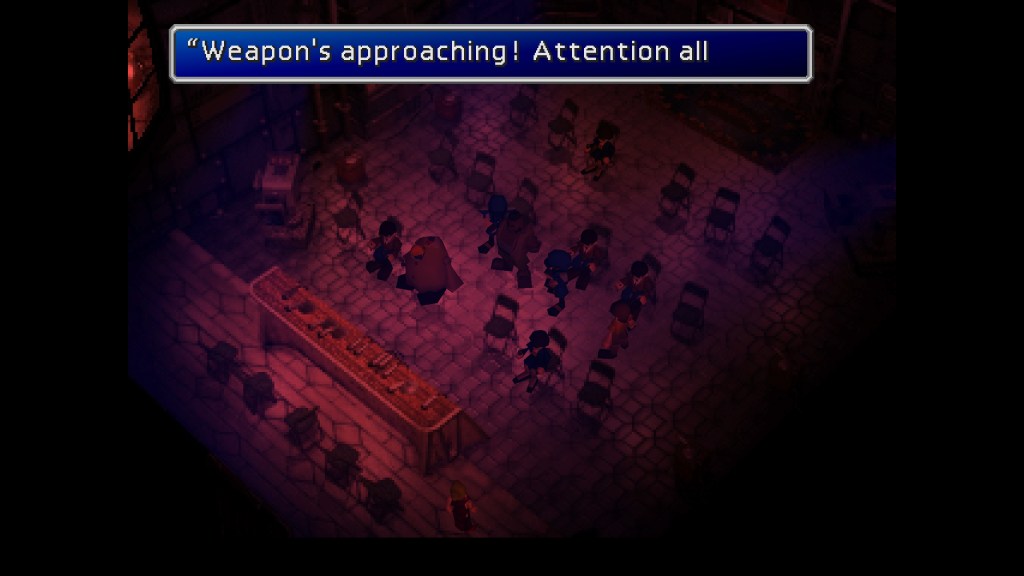
Weapons prowling around combined with the threat of meteor, the ultimate apocalyptic event brought on by Sephiroth, constantly hovering around the world map gives the game a sense of impending doom. It’s not as stark of a transformation as the world of ruin in Final Fantasy VI, but FF VII manages to replicate the sense of gloom that the World of Ruin had without bringing in an entirely different world map to accomplish it.
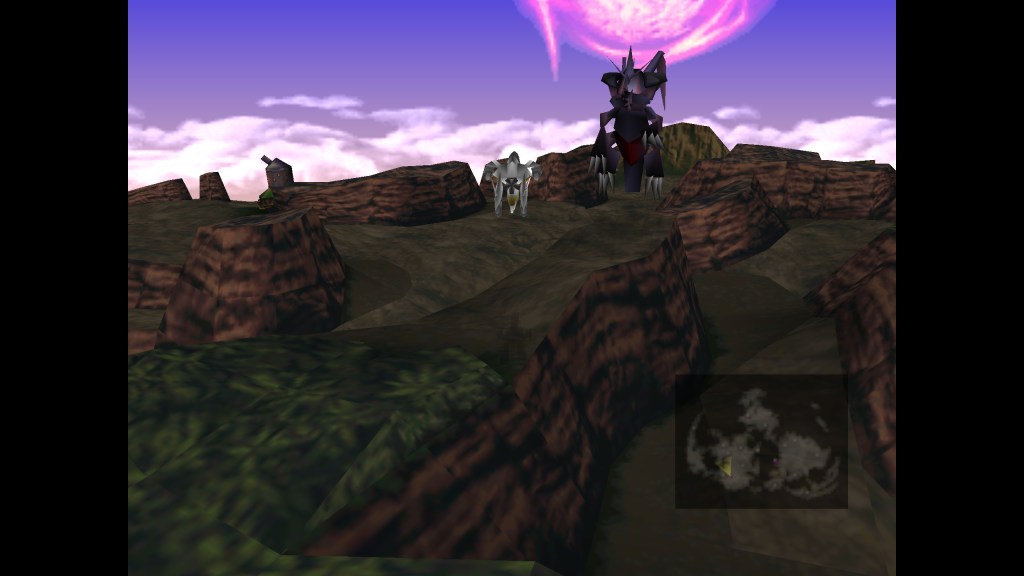
A thing I love that this game does likely isn’t intentional since it wasn’t in the original Japanese release, but it’s still worth noting. When the player acquires the submarine shortly after Cloud snaps back to his senses, there is a good chance one of the first things you’ll see underwater is Emerald Weapon.
Emerald Weapon is one of the game’s super bosses. First time players may not realize this and try to run into the beast. Hey, maybe you’re supposed to fight this thing? They will then get absolutely obliterated, which will require a reload. Emerald Weapon will hit your party for numbers that likely haven’t been approached and it’s a real wake up call.
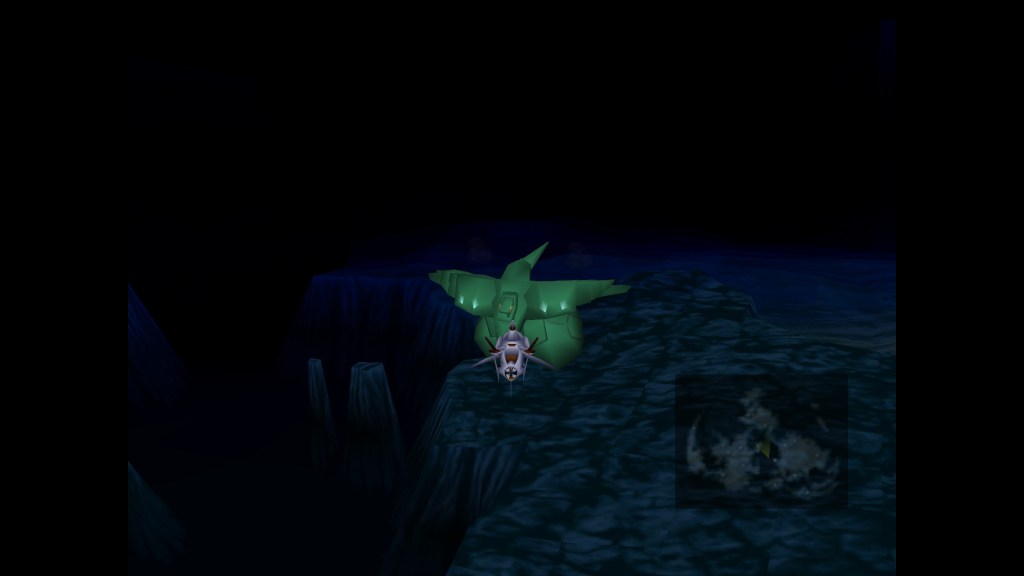
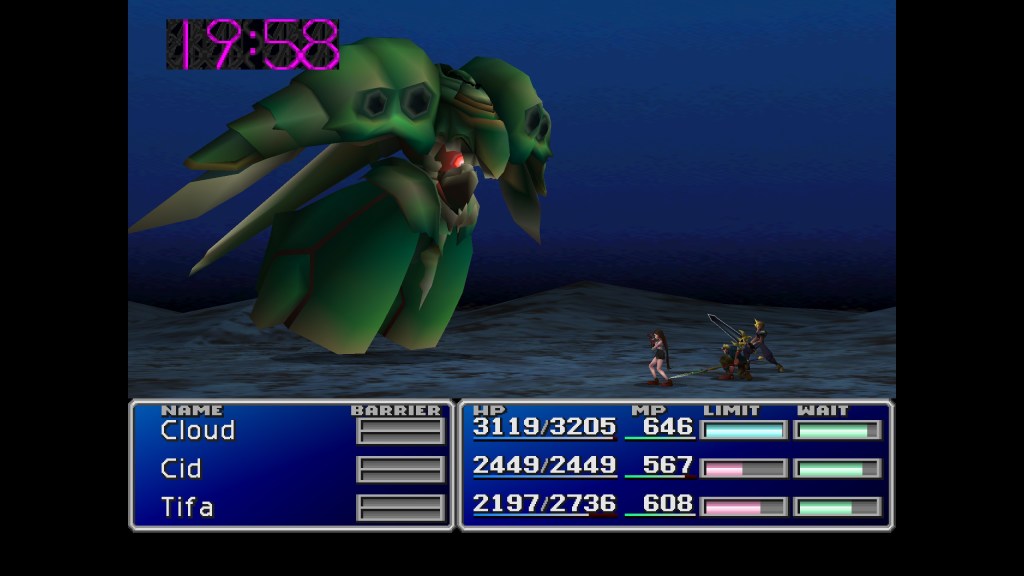
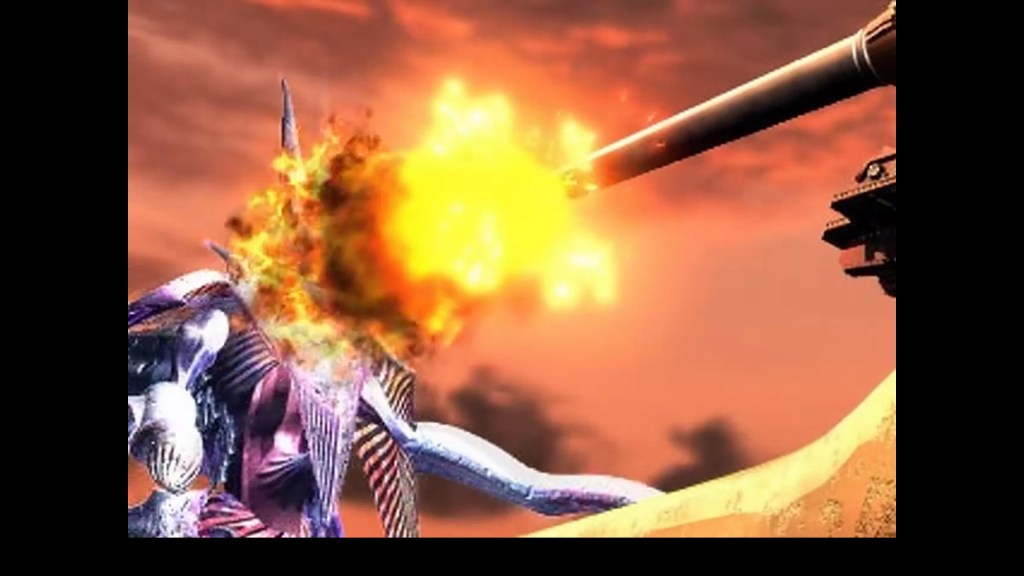
This teaches a lesson: the planet’s defenders are not to be messed with. It helps the player feel the same sense of urgency the NPCs of the world feel. It drives home the point as to why evil Shinra might be a little distracted. The cutscenes that detail Shinra trying to blast through these monsters with a giant cannon are some of the most compelling of the game. It even gives one of the most loathsome characters in the game an exceptionally memorable moment.
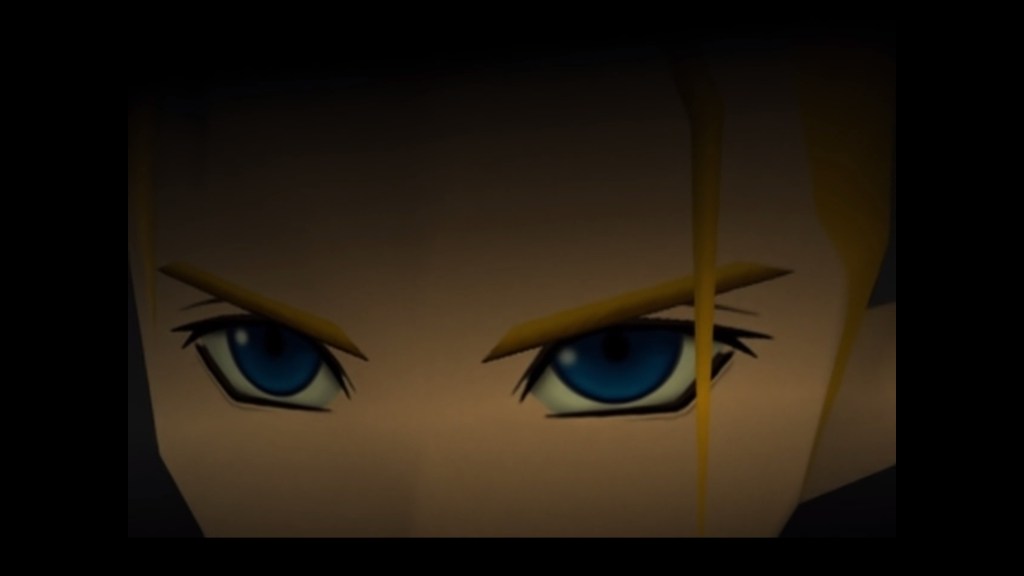
Calling card
On the surface, Final Fantasy VII’s gameplay is nothing revolutionary for the franchise. The combat is another iteration of the Active Time Battle (ATB) system we’ve been dealing with since Final Fantasy IV but this time the party size has been reduced to three. Three would go on to be the standard size for the series as only IX, a game that’s meant to serve as a celebration of the franchise’s history, really revisits the four-man party concept.
The first thing the player is likely to notice when getting into combat is a second meter apart from the ATB. Introduced in Final Fantasy VI as Desperation Attacks, Limit Breaks are featured extremely prominently here. As characters take damage in combat, the meter slowly builds until it fills up, which allows for the usage of an ultimate attack. These are unique for each character, which can help your party feel distinct.

These often play into the personalities of the crew. Tifa, who is a martial artist, learns a series of martial arts moves to unleash on opponents. Chain smoker Cid gets a limit break where he uses his cigarette to light up bombs. Barret makes use of his gun arm and explosives. Vincent turns into a variety of monsters because he was experimented on. I think the majority of first time players compose their parties based on how cool the limit breaks are. It was a very sharp move to expand on the somewhat obscure mechanic from FFVI and make it a focal point of VII.
That’s where character individuality and the similarities to old ATB games come to an end. The way this game handles magic and abilities is through something called the Materia system. Materia is the central ‘magic’ force of this world, which is created through highly compressing the oil equivalent of FF VII, Mako. If you want an explanation of what Mako actually is, do a ctrl+f for “Bugenhagen” to wander on down to his character section and read about it. Your weapons and armor contain Materia slots and that’s where your customization comes in. Materia can alter stats and give you unique abilities.
This can be fun to mess with. Materia slots can either be individual things or linked units. With linked units, you can have Materia play off of each other. A simple example of this is by equipping the all Materia and pairing it with the fire Materia. With this, the player can hit every enemy on screen with the fire spells they have learned.
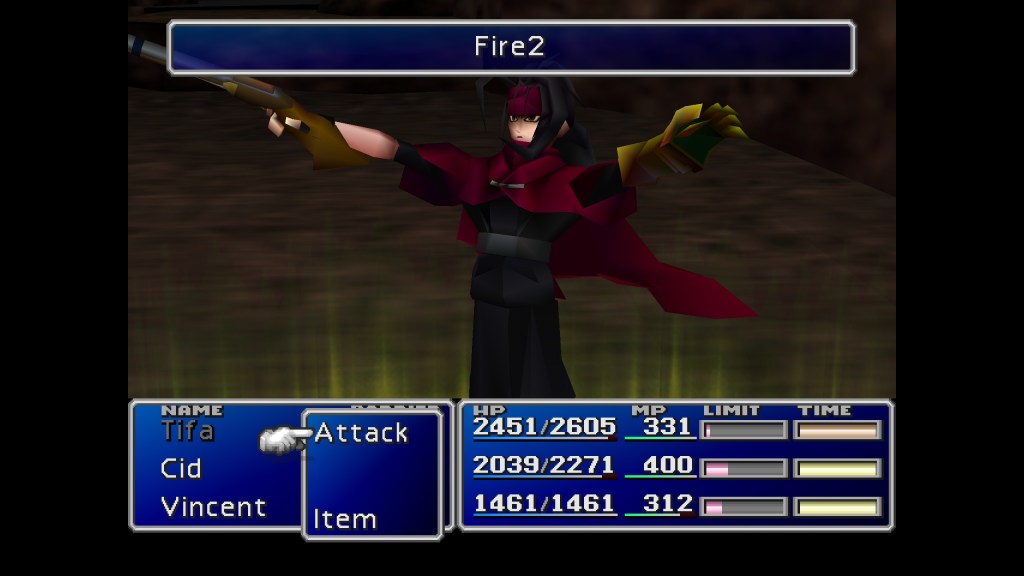
In a more advanced example, if you equip the Added Effect Materia with the Odin Materia onto a piece of armor, you become immune to the effects of instant death. Through using this, you can make use of an accessory called the ‘cursed ring’ which casts Doom on whoever wears it in exchange for boosted stats. This overcomes the handicap, which is a reward for players experimenting with the gameplay.
Or you could just look it up I guess.
So as a result, most characters feel the same. Yes, someone like Aerith is innately better at using magic skills than Cloud, but you can make Materia combinations that offset this. Each character feels like a total blank slate that the player is responsible with melding. It feels a bit like how V handled the job system. No two players will have parties that look the exact same in abilities or stats but your party ends up feeling like empty shells for you to meld.
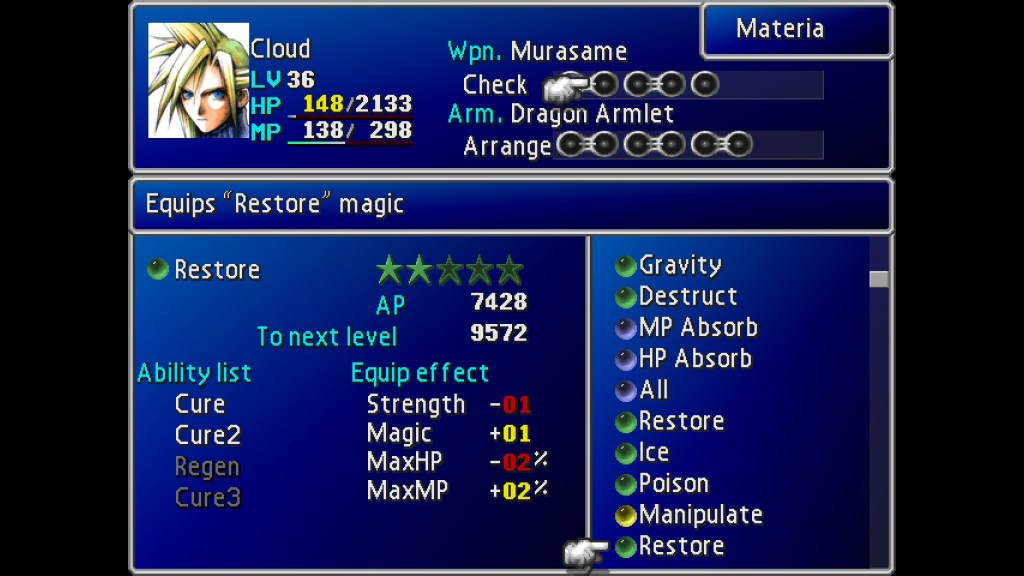
A minor complaint I’d like to just get out there is that going through your Materia is a chore. Unless I missed an option in every single playthrough of the game I have ever had – which is certainly possible – there is no way to sort your Materia. So when you’re changing your equipment up, unless you’re very organized, it can take a lot of time to find the Materia you have leveled. I think this probably just leads to a lot of people not tinkering around to find interesting combinations. Why spend 5 minutes finding that level 2 Poison Materia you have wasting away when a perfectly good Bolt spell is right there?
The lone exception to this would be the limit breaks. That’s why the limit break system is so crucial. It injects a teensy bit of personality onto these blank shell combat characters. It’s not much, but it’s something. VIII takes the blank slate thing even further, which I will get into with that game eventually.
It seems like VII and VIII really struggled with how to make the playable characters feel unique. Some characters are able to hit enemies with long-range weapons, which can make them feel different, but you can find a Materia that just lets every character do that.
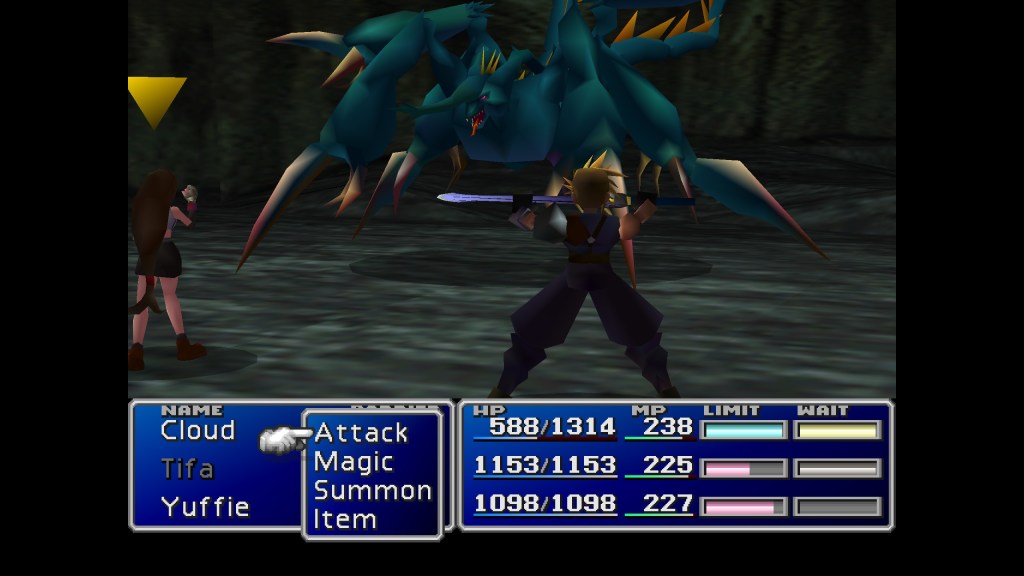
I think this system is a lot of fun to experiment with, but I think a melding of how VI and VII approached combat would have been ideal. In VI, each character had a unique skill that set them apart in combat. They felt like empty customizable shells outside of that skill, but it was always there for you to mess with. Every battle. You probably aren’t going to use Limits every battle so the party distinction is only felt every fourth or fifth battle.
Speaking of Limits, there are four limit levels. You start each level with one limit and you can unlock a second one by using the first one over and over. You can unlock a new level by killing a certain number of monsters. I don’t think they ever outright tell you how to unlock more limits, so it feels like natural progression for the player. It’s a good way of making you feel stronger even if your Materia combinations aren’t giving you that same sensation.

My one complaint about how this is handled is that the highest ranked limit breaks require a lot of grinding to achieve. In this playthrough, my main party typically consisted of Cloud, Tifa and Cid. I purposefully tried to avoid grinding until the very end of the game where I briefly considered fighting the super bosses Ruby and Emerald Weapons.
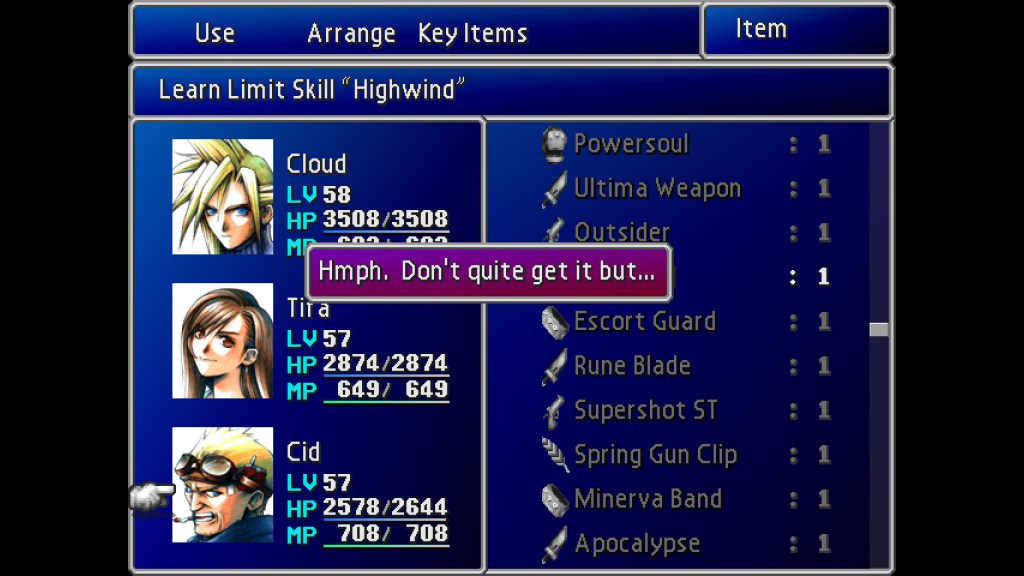
Only Cloud and Cid had level 3 limits at this point. And it was just the first of those. This was right before the ‘point of no return’ in the final dungeon of the game. Tifa hadn’t even unlocked level 3. So I think a player who isn’t conscious of how to unlock limit breaks might go through the game without experiencing the coolest ones.
It’s a shame. You can get the items that teach your character how to use their best limit breaks but you can’t actually use them until you unlock their first six. So if you’re not using a guide, you might see the flavor text associated with trying to equip Cid’s level 4 limit break Highwind but never know how you go about being able to use it. Even Aerith gets a level 4 limit break and I cannot imagine a world where someone just stumbles into it. So if you want to see all of the unique abilities in the game you have to do some serious grinding.
Next level challenges
I know some of you might be thinking “grinding? that’s just gameplay.” And yeah, it is. But Final Fantasy VII is not a difficult game and it does not require grinding to finish the narrative. The only reason to grind is to fight the super bosses and to max your stats. None of the game’s challenges outside of that requires you to worry too much about your stats. So to me, it feels like the grinding is pointless. You either do it for the super bosses or you don’t do it at all.
And that’s another issue I would like to bring up. I vastly prefer the way Final Fantasy V approaches super boss conflicts. In that game, I did not have to grind at all in order to match up with its toughest bosses. I just had to think of an interesting strategy that made use of the job abilities I learned as I played through the title normally.
Go ahead and look up strategies for how to topple these bad boys. Most of them involve mastering Materia in order to stat max. I’ve even seen some absurd ones that suggest mastering counter attack like seven times. I don’t consider this mastering the Materia system or the game’s combat. I think of it as ramming your head into a wall repeatedly until the wall cracks a little bit.
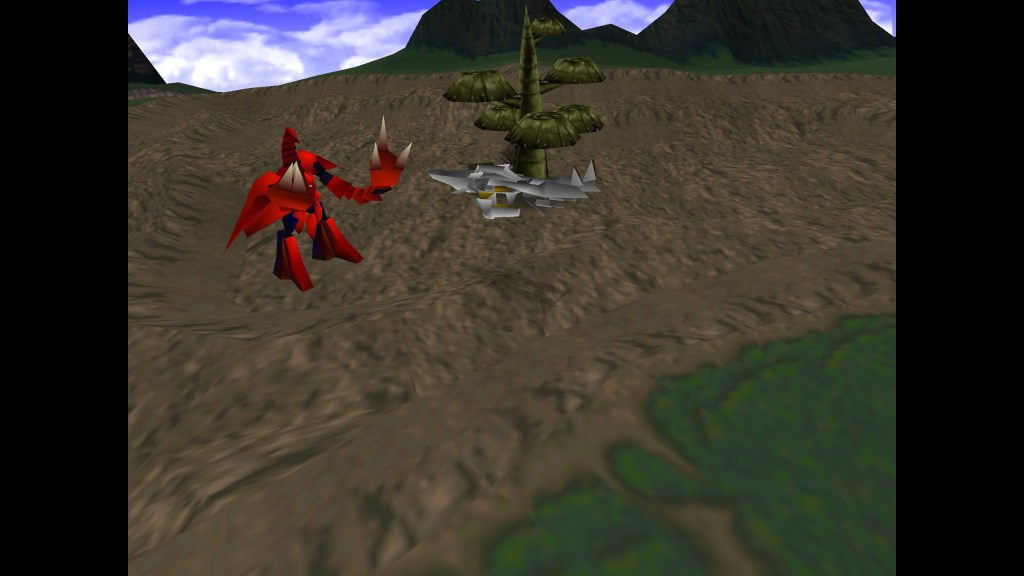
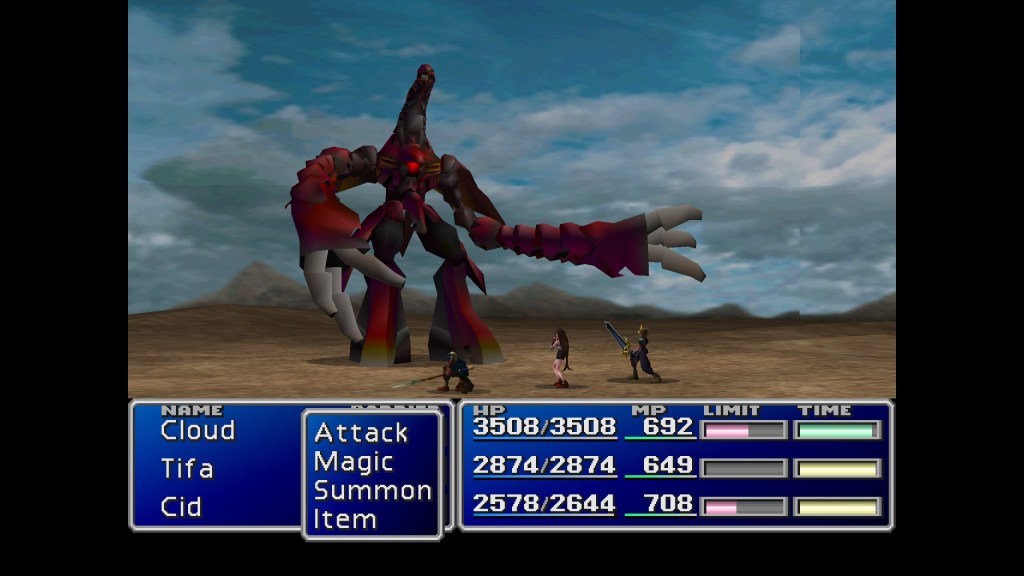
These two bosses I’m bitching about weren’t even in the Japanese version, so maybe I shouldn’t be surprised that the thought process for engaging with them feels less fleshed out than V’s super bosses. So in the original release, what even is the point of grinding? You have these awesome things you can achieve but no utility for them. Cloud wept because there were no more beasts to conquer.
I adore Final Fantasy VII. I think the Materia system is excellent and the customization it affords you feels nice. But there are scores of people who clear the game without ever engaging with or understanding the mechanics. You definitely couldn’t do that with V’s job system or VI’s magicite system. As a result, I think for all the advancements this game made from a narrative and graphical standpoint, the combat of VII is a bit of a step back.
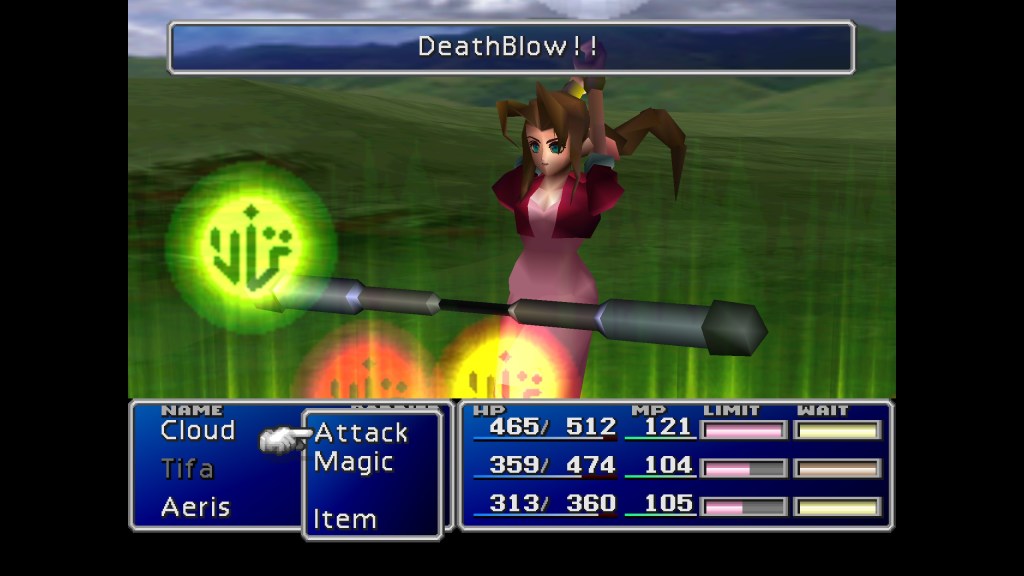
Still satisfying. It’s better feeling than the NES games. You still need to use strategy in enemy encounters, so it’s not a ‘mash attack’ fest like some of the earlier games are. But the encounter-by-encounter experience pales in comparison to V and VI. The fancy-pants 3D graphics and camera angles help fights feel fresh and cinematic but when you strip that away from the title it just feels like it’s missing something.
The whole picture
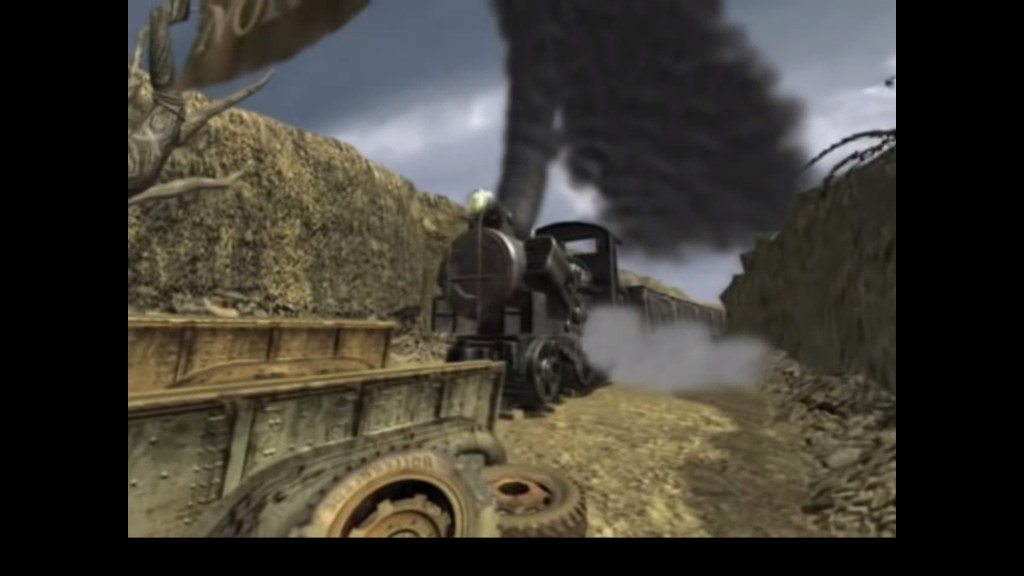
Gameplay encompasses more than combat. This is where FF VII steps out of the shadows of its predecessors. You are given a host of minigames and smaller scenarios to engage with. You need to perform CPR on a kid in Junon, you gotta play a little RTS to save the people of Fort Condor, you gotta ride on a motorcycle to get out of midgar, you gotta pull off sweet tricks on a mountain, you gotta stop a rampaging train, you gotta hunt down submarines and you can inbreed chocobos if you so choose to.
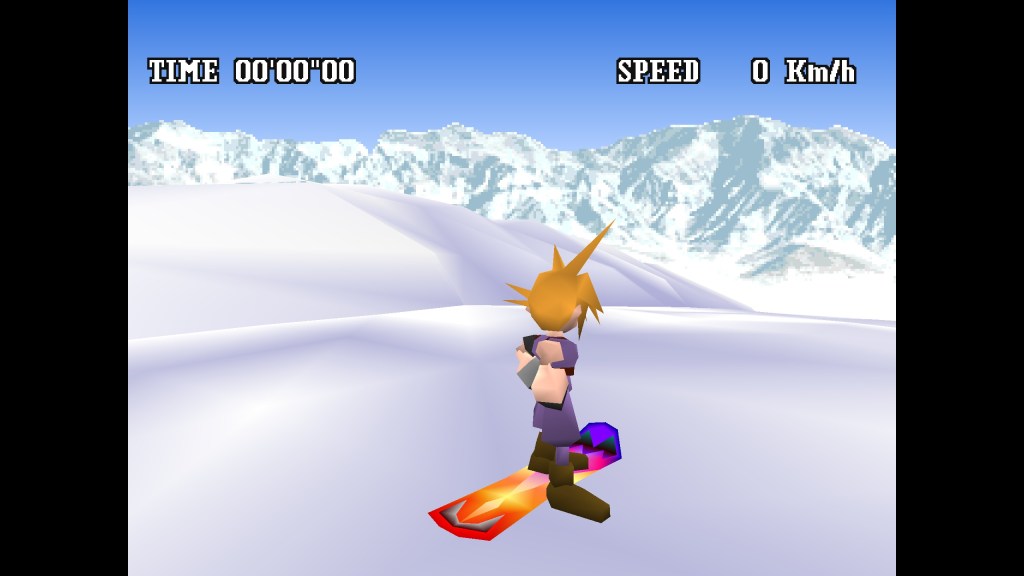
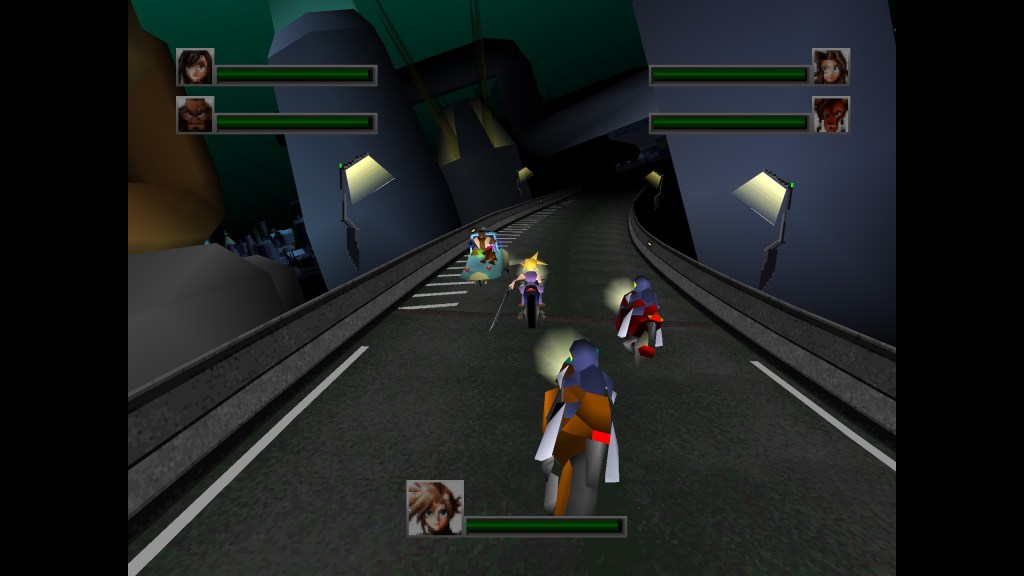
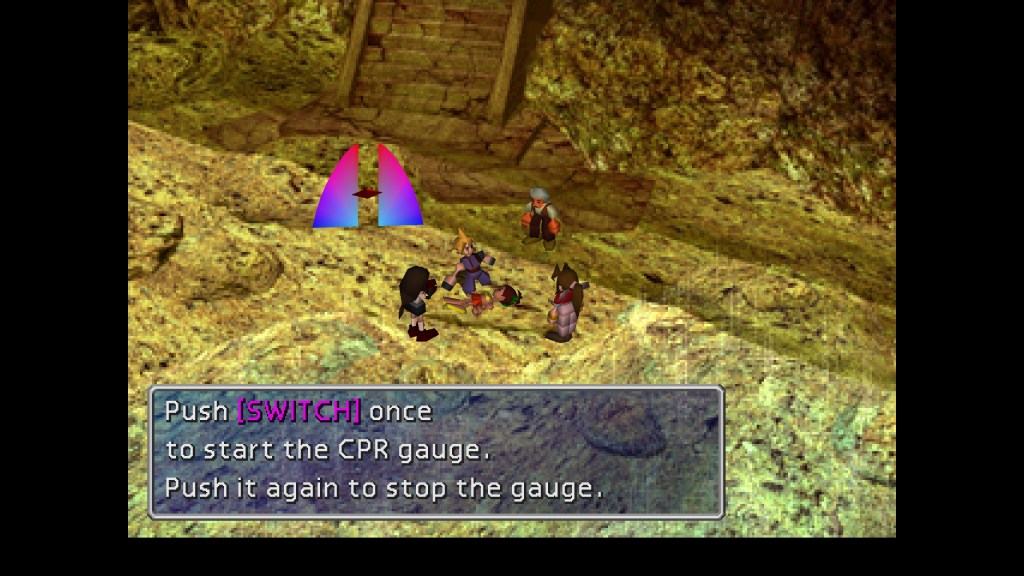
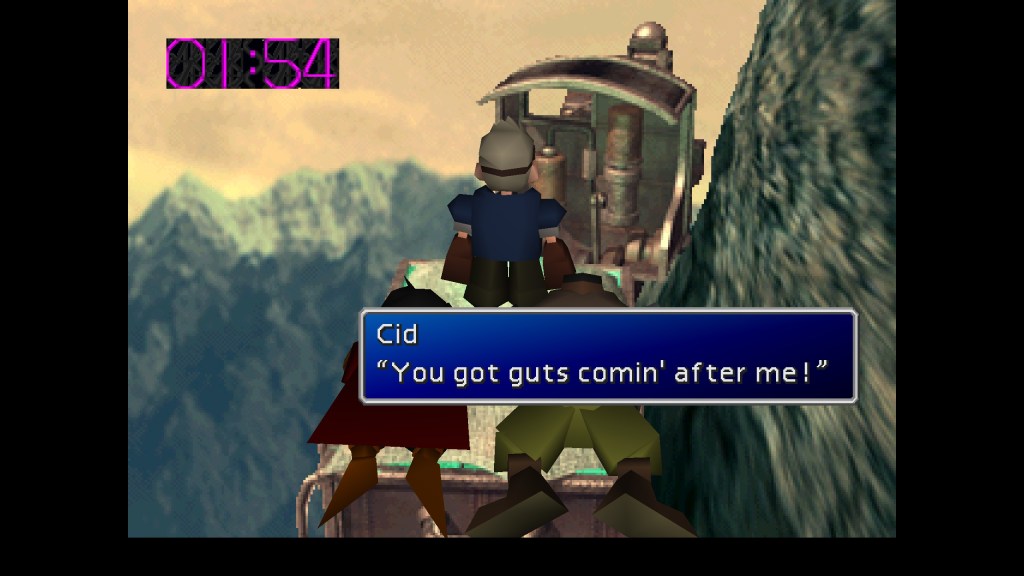
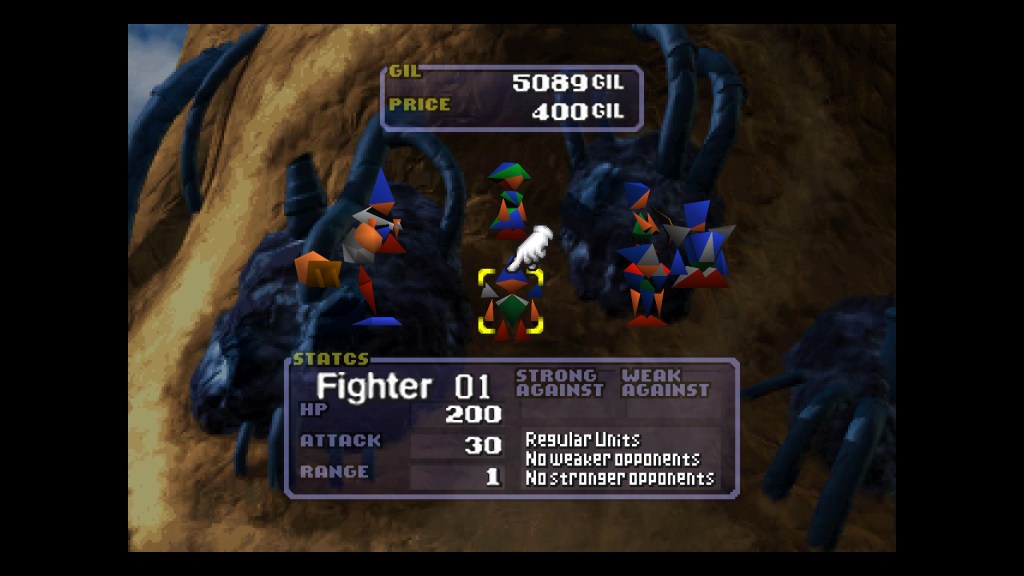

Such variety was not in any of the previous titles. There were a couple of minigames or side activities in the NES and SNES games but they can’t hold a candle to the number of things you can do in FF VII. The side activities feel like true diversions and do a good job of breaking up the random battles and combat. When you unlock the Golden Saucer, the average person will probably spend a crazy amount of time there just goofing off and experiencing all the random activities.
There’s a reason why that music is so ingrained in the heads of players. They spent hours there. This is why the second game in the remake has so many damn side activities. In the original, it felt like there was a new gameplay mechanic being introduced constantly. In the remake, there actually is. Some are hit or miss, but did anyone actually enjoy every minigame in the OG? I hate Fort Condor in the original. I hate Gears and Gambits in Rebirth! Very faithful.
A little bit of gameplay and story intertwining is used here as well.
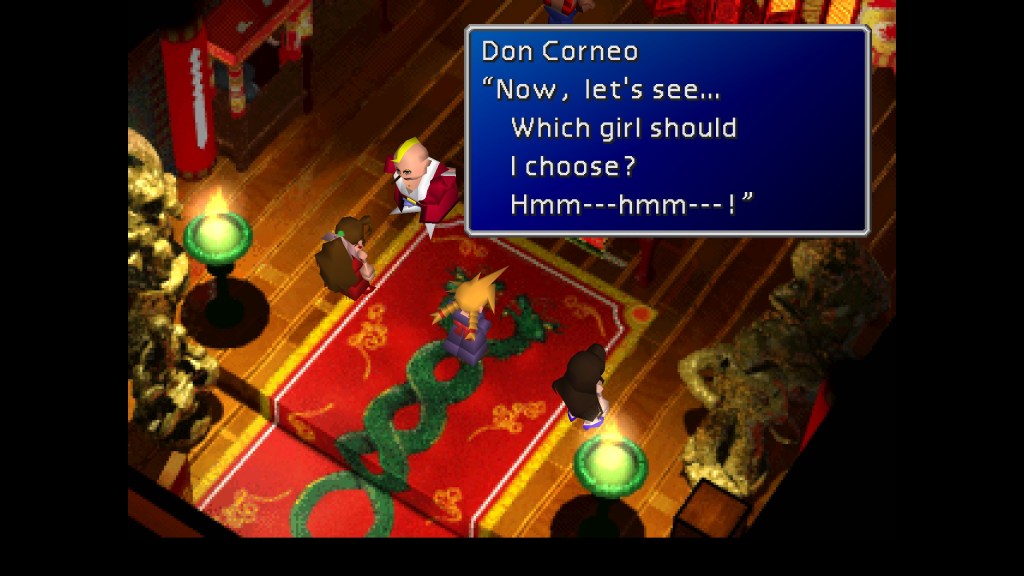
First let’s start with the one everybody knows about, dressing Cloud up in drag in order to score a date with Don Corneo. The player can choose a variety of outfits and stuff to bring to the date but only performing well and exploring Wall Street will result in Cloud being chosen by Corneo.
You don’t miss out on anything by not being chosen, you don’t get met with a game over, but your activities determine how the scene will play out. It adds something there that simply forcing the player to win Corneo’s hand would be missing.
In the background, Final Fantasy VII incorporates a secret relationship mechanic that only comes into play once. During a date scene at the Golden Saucer. Throughout the game, little choices you make impact how your characters feel about Cloud. A first time player might consider these choices inconsequential but it’s really cool seeing how decisions you’re not even thinking about come into play for one particular scene.
On replays, you can sort of see where these scenes are, so you might aim for other characters instead of who you got in your first playthrough. It’s a tiny touch but it makes Cloud feel more like a combination of the player and the avatar. You unconsciously checked on Tifa before you checked on Aerith in the Midgar sewers, so the game treats it as Cloud preferring Tifa.
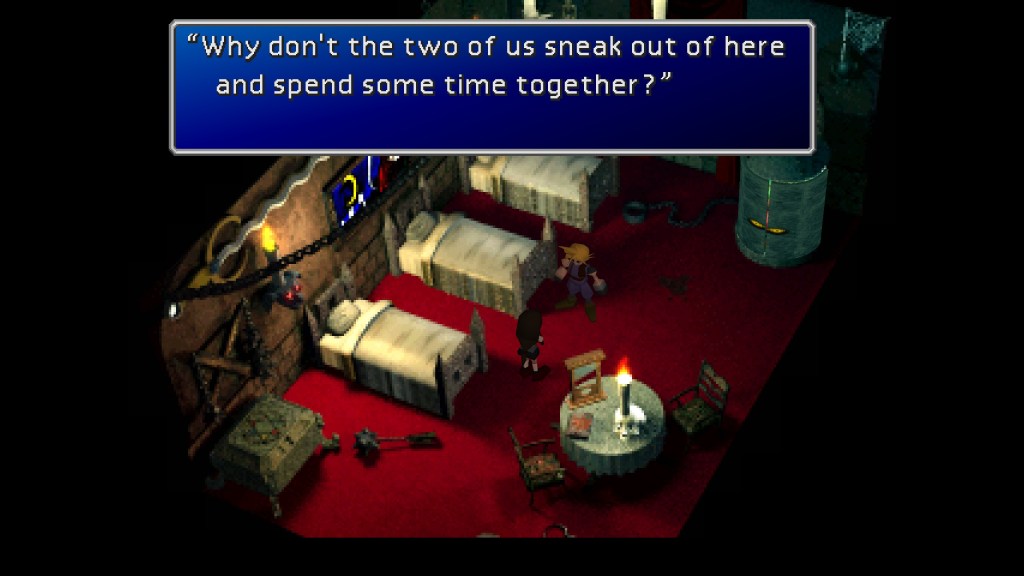


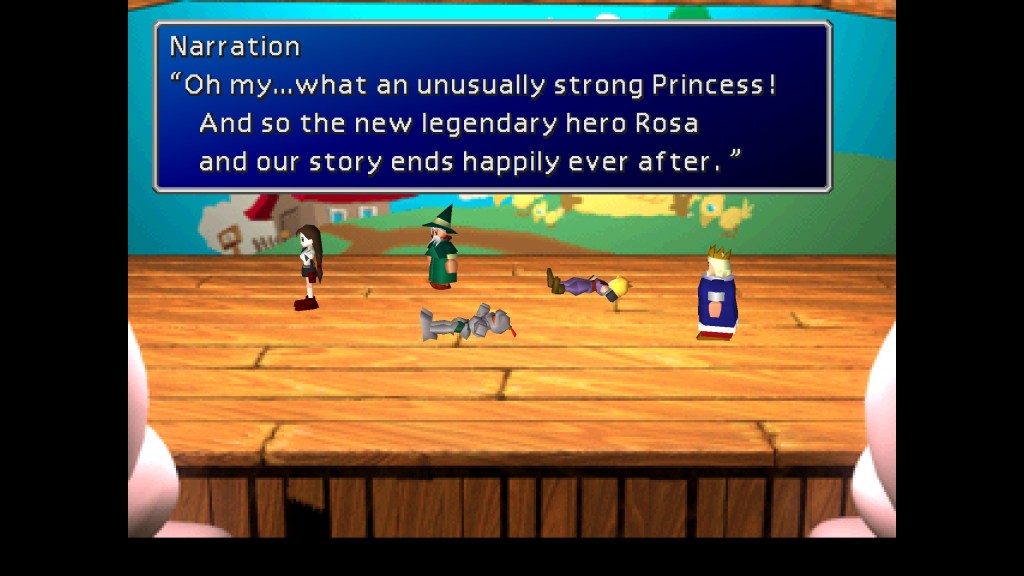
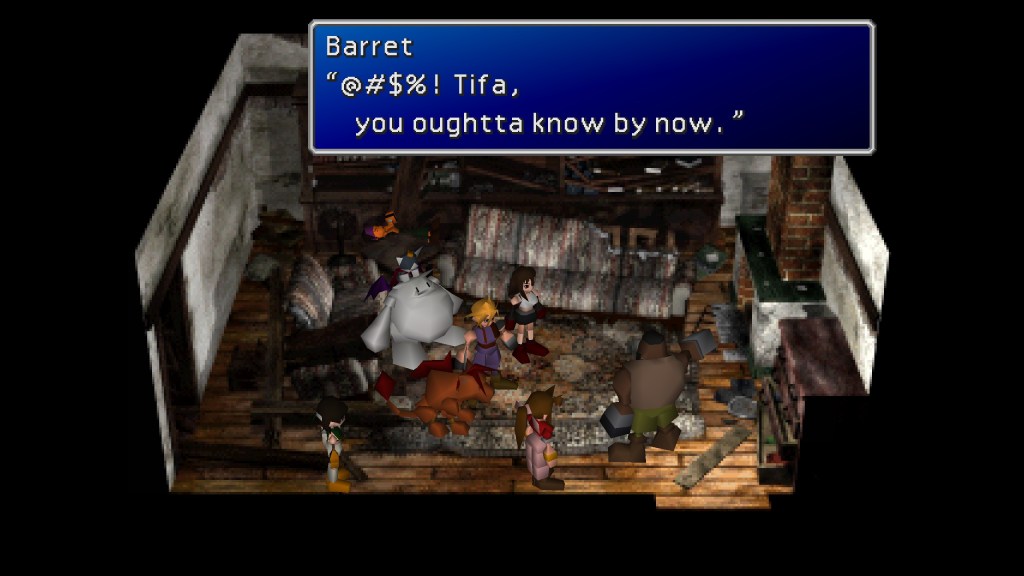
I don’t like that Rebirth visually shows you these relationship values. One of the cool things about this mechanic is being surprised with who you wind up with. I think I accidentally went on a date with Yuffie once. That would never happen in Rebirth. Yeah, you’re probably not going to stumble into the best date scene (Barret) but I like that it’s theoretically possible to do. The date feels like a choice the player made without making it while in rebirth you can just choose.
So as I said. On the surface, this game offers very little new to the gameplay and it’s not befitting the status of a ‘legendary’ game like Final Fantasy VII. However, once you look at the bigger picture and see the stuff on the outside of combat, VII really shines. It’s a joy to play. That said, if someone approaches VII from a surface level, I could see how one might think this title ain’t all that.
Notable characters
A couple things before I get started. When doing the Pixel Remasters, I grabbed my PR comparison shots directly from screenshots I took in my playthrough. In Final Fantasy VII, the battle camera makes it difficult to capture entire player models. So I had to grab my battle models from other sources. These models are mostly from the Final Fantasy Wikia, but I also used VGCartography for Cloud, Barret and Tifa. I also grabbed overworld (chibi-looking) characters because I didn’t have very many clean shots to grab models from in my playthrough. These are either from the FF wikia or Models Resource.
In each character profile, I mention how they are treated in the remakes. These sections are clearly marked. I spoil a little bit about certain things, so if you are extremely spoiler averse and you have not played both remake titles, you should skip those parts of the profiles.
Cloud Strife
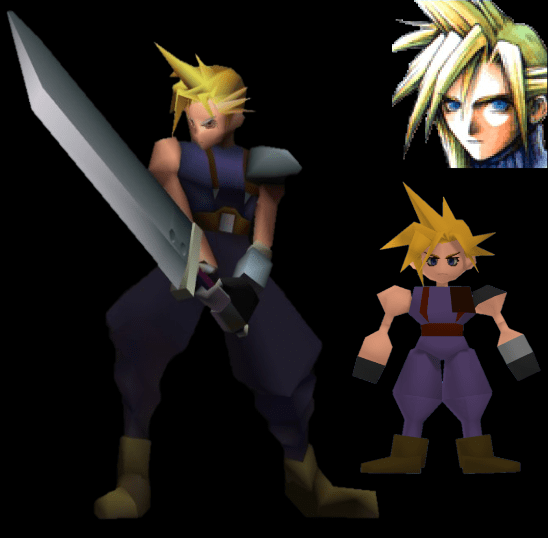
Unlike Final Fantasy VI, FF VII started life having exactly one lead character that the plot revolved around and here’s our man. Cloud has to be one of the most recognizable video game protagonists ever. The very 90s spiky hair combined with his gigantic Guts-style blade and shoulder pauldron make him stand out.
Character designer Tetsuya Nomura deserves a lot of credit for how popular Final Fantasy VII became. Yeah, the tech stuff helped make it a smash hit at the time of release, but every single main character design is excellent and memorable. You know what other game was technically amazing when it came out? Crysis. Can the average person tell you anything about what the characters in Crysis look like? The design work here helped ensure these characters would live a long life after players put the game to rest. People get on him for being the ‘belts and zippers’ guy, but he is really good at what he does.
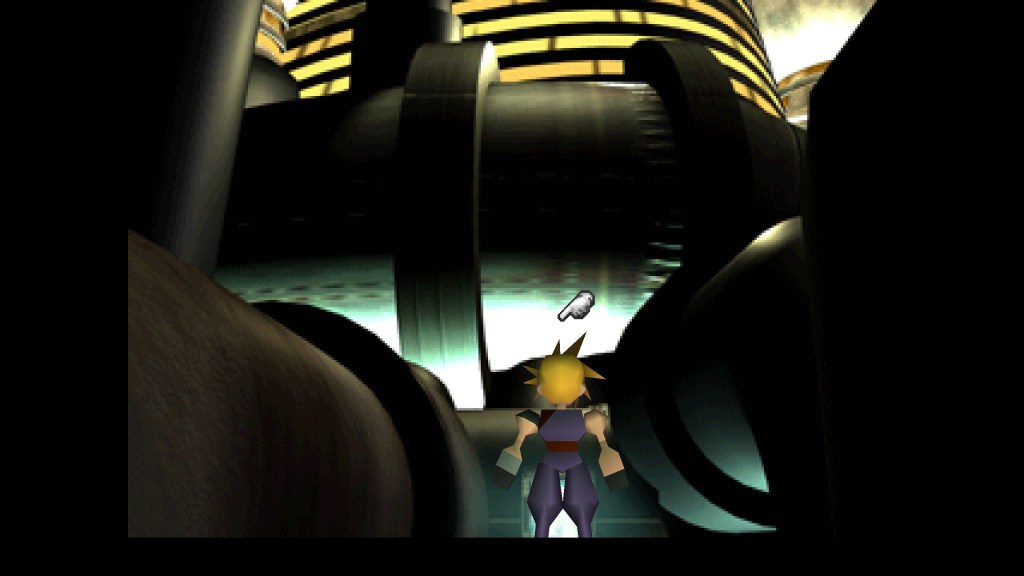
Cloud is introduced to the player as something of a brash and overly confident veteran of combat. He was part of a group called SOLDIER, he carries a gigantic sword and he doesn’t seem to care for much beyond getting paid for his job. Occasionally when Cloud is answering a question, the screen will flicker before he provides the answer. It’s very noticeable but it happens infrequently enough that it won’t always be on the player’s mind. It just simmers there. There’s something beneath the surface that we just can’t see.
I want to talk briefly about SOLDIER. SOLDIER members undergo intense injections of Mako, which gives their eyes a faint glow. This is thought to drastically reduce their lifespans. The reason for their shortened lifespan has less to do with the Mako and more to do with something else they were injected with, which I will cover later. Cloud has the same faint glow, though it is revealed later on that he was never a member of SOLDIER. He attains this glow after being the subject of intense experiments by the Shinra scientist Hojo.

As the story goes on, we slowly learn more and more about Cloud. This starts with the retelling of how his home town, Nibelheim, was burned to the ground by the main antagonist of the game Sephiroth. It helps fill in on how Cloud and Tifa know each other and establishes them as lifelong friends.
This Nibelheim tale occurs immediately after the group gets out of Midgar and a first time player probably just assumes that the purpose of this story is to show your main characters primary motivation for dealing with Sephiroth. It’s because Sephiroth destroyed Cloud’s hometown. While this primary motivator remains true, everything we know about the scene is not.
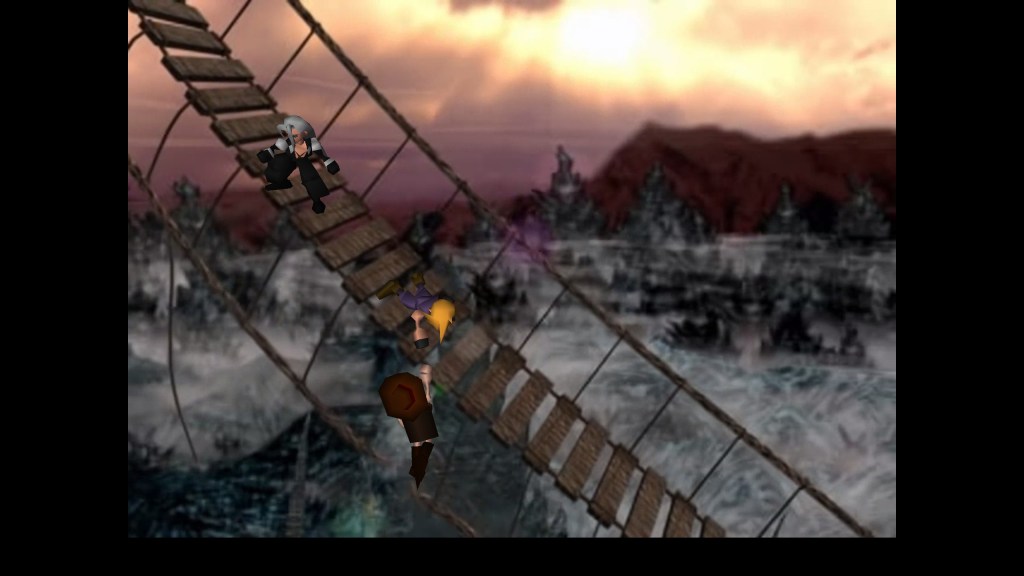
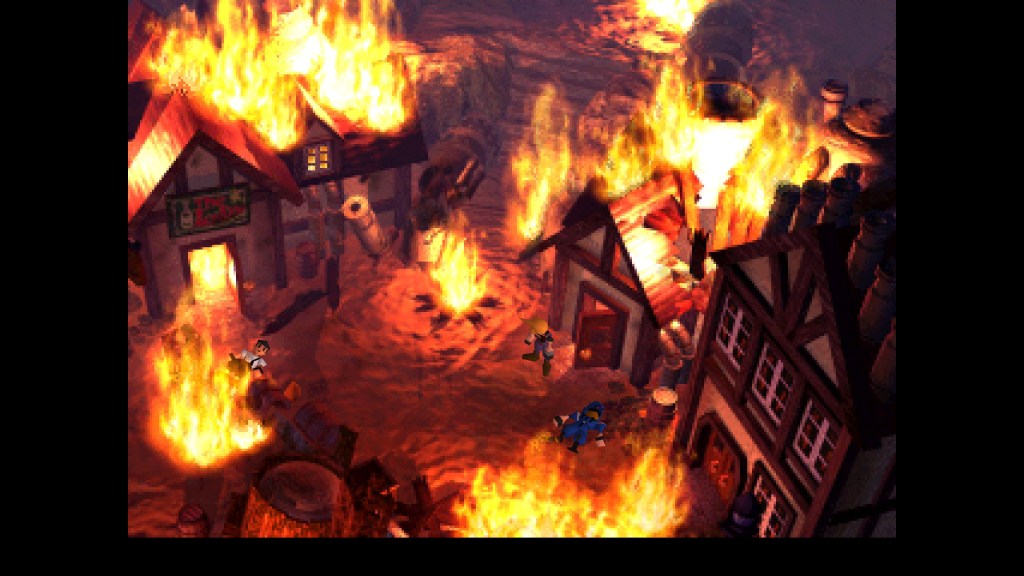
Instead, FF VII borrows a little bit from literature and gives us an unreliable narrator. Cloud’s telling of the Nibelheim catastrophe is full of holes. This gets noted from time to time, but I assume most first time players brush it off.
It just simmers into the background until midway through Disc 2 when the main antagonist, Sephiroth, lifts the curtain and reveals that Cloud has been wrong about everything, including his background as a member of SOLDIER. He has been lying to the party and he has been lying to the player. Most everything you know about this man is a lie.
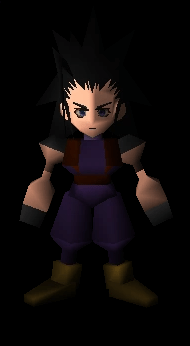
What you think you know about Cloud can be attributed to this man instead, Zack Fair. In the base game of FF VII, Zack does not get very many lines. He has one hidden cutscene where he talks about his life with Cloud in a truck, but outside of that you don’t spend much time with him. The player still feels like they get to know the guy because they spent so much time with a character that was pretending to be him.
The Zack twist would prove to be so effective that Mr. Fair would go on to star in his own prequel game, Crisis Core. He even features prominently in the remake trilogy. Not bad for a guy that has one or two lines of dialogue the player gets to see on the main path of the game.
Back to Cloud, the revelation about his backstory sends him into a shock. He is briefly convinced that he is some sort of lab creation/clone of Sephiroth made by Hojo that was given fake memories. He needs to find himself, which leads to the extremely memorable sequence above where Cloud and Tifa delve through Cloud’s psyche in order to find the real man behind the myth.
It turns out Cloud is the opposite of Zack in a lot of ways. He’s insecure, he’s self conscious and at the end of the day he just wants to feel wanted. He left Nibelheim to join SOLDIER for no reason other than that he was trying to get the attention of a girl.
He thought that if he was as strong as the legendary warrior Sephiroth, maybe he wouldn’t be so lonely. He felt great shame about not making it into SOLDIER and he witnessed the destruction of Nibelheim because he just happened to be there as a faceless Shinra grunt. He wasn’t the hero of the story, he was a side character.
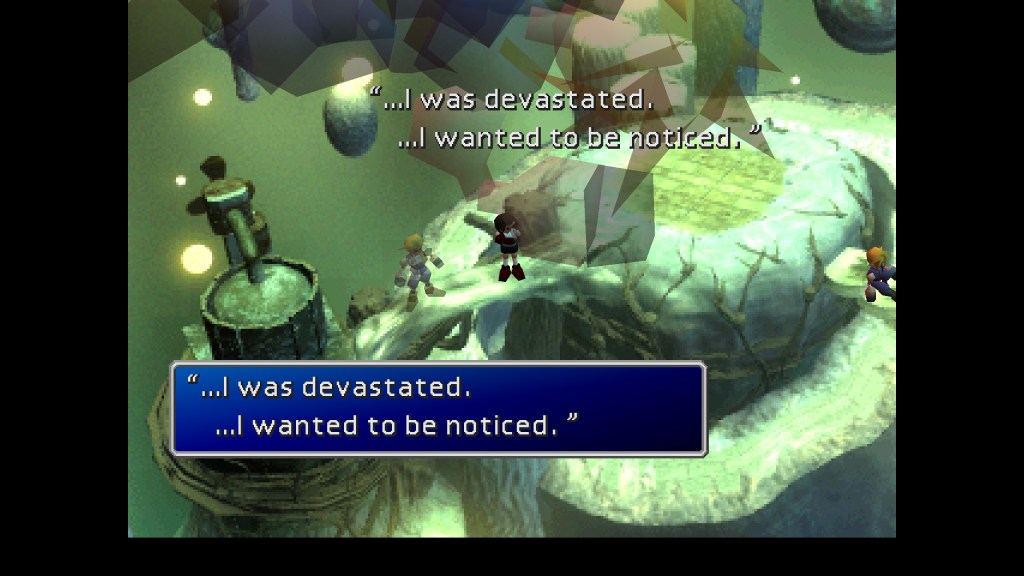
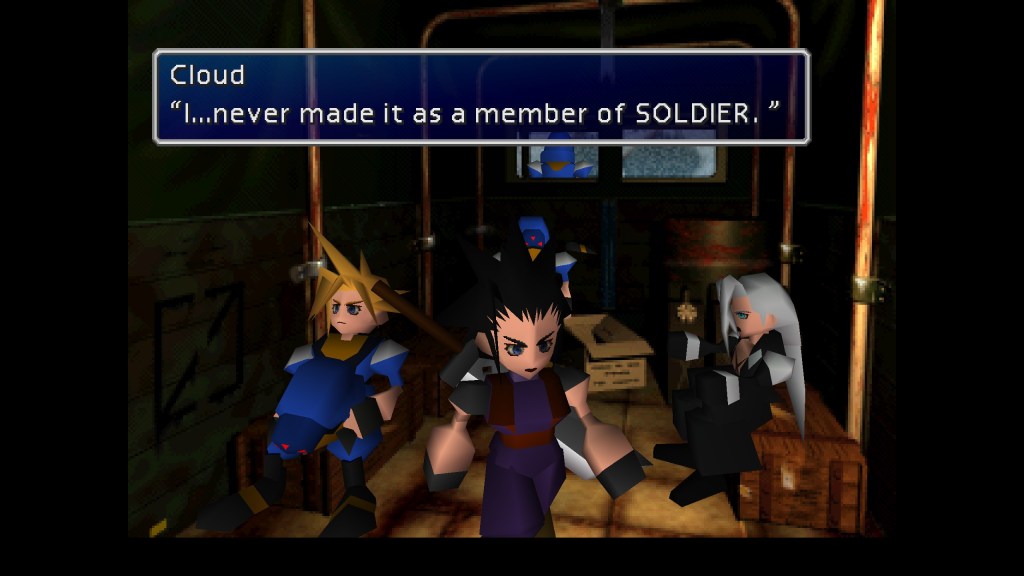

Cloud’s backstory is by far the most complicated one told about a character in the franchise to this point. As the series moved into three dimensions, it was important that the main character also felt multi-dimensional and they accomplished that. Cloud’s struggle with his identity makes him feel relatable and human. FF VII hit a home run with this guy.
After his crisis of character has concluded, Cloud doesn’t really have anywhere to go. At this point he becomes sort of a plucky everyman protagonist who is happy to share both his triumphs and shortcomings. I think one of the best examples of this is during a little chat you can have with Yuffie aboard the main airship of the game, The Highwind. Cloud just casually chats about how he gets motion sick. It’s small and insignificant but it shows how he’s changed.
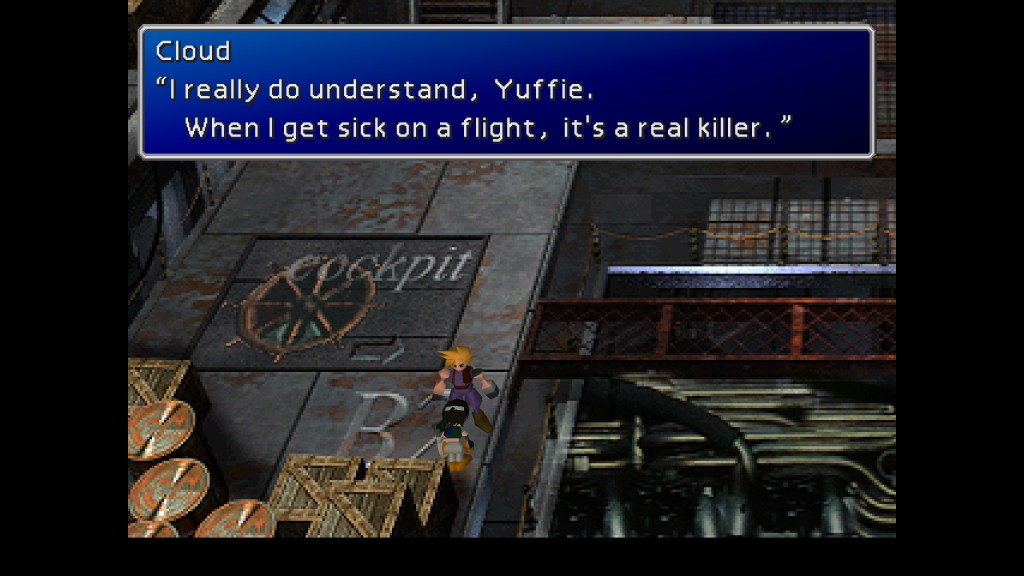
Our boy deserves some time to not be complicated, ya know?
Since Cloud is THE main character, he doesn’t spend a lot of time out of your party. Really just the portion of Disc 2 where he’s going through his identity crisis. So as a result, he will see a lot of usage. In my party, Cloud was primarily a physical threat who could equip cool summon magic if I needed it. He almost always had access to counter attack abilities and Materia that lets him inflict additional damage.
He’s one of two characters that I used enough to manage to get a level 4 limit break for in this playthrough. Getting his ultimate ability, Omnislash, requires the player grinding for 20-or-so years in the Golden Saucer Battle Arena. It’s not a particularly enjoyable gameplay experience. It involves dealing with random handicaps as you fight a string of eight battles over and over. You have to stay in the area until you get enough points to earn Omnislash, if you leave you have to start over. It’s tedious.
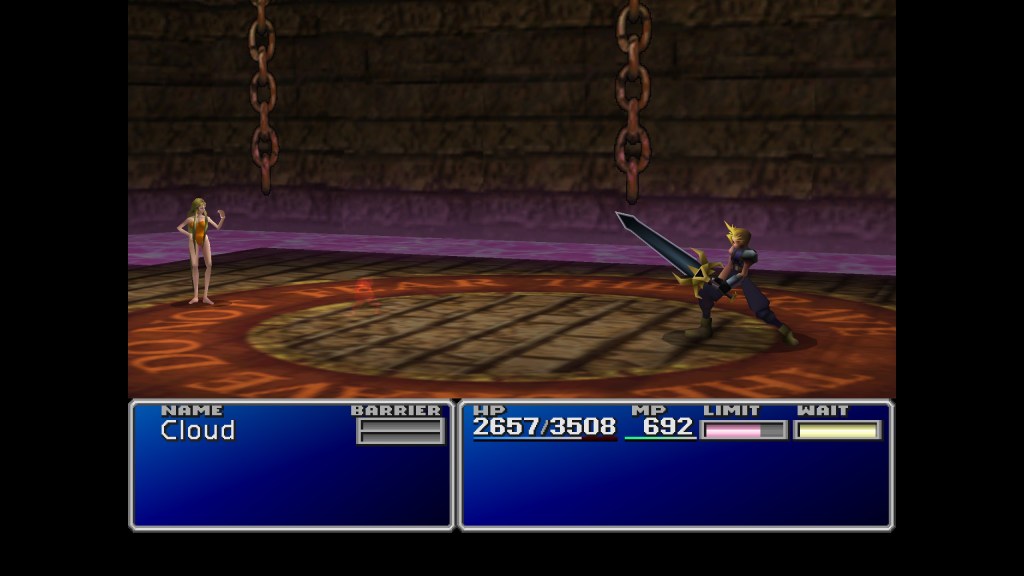
It’s also the one level 4 Limit Break that everyone who has cleared the game has probably seen because you get it for free when you beat Sephiroth. It plays into the final boss fight! I prefer it in this way to be honest. While it’s cool to have Omnislash available to use on any bad guy I want, lookin’ at you Turks, I think the idea of a secret final move that unlocks when you need it most is really neat.
Cloud marks a turning point for main characters in the franchise. Yes the lead has been the most fleshed out person in each game to date, but from VII on (except you XII), the main protagonist has a little more meat to their bones compared to your other cast members. Everyone has some development, but there is no mistake about who the most important cast member is.

How the remakes treat Cloud: Pretty faithful to his character. He is a bit more of a smart mouth than he is in VII, but this helps convey his brash and somewhat arrogant attitude. The end of Rebirth suggests that he is going to undergo a similar, but different, mental break in the third game. They have him say the line “I remember Zack” at one point so it will likely not have as much to do with an identity crisis.
Barret Wallace
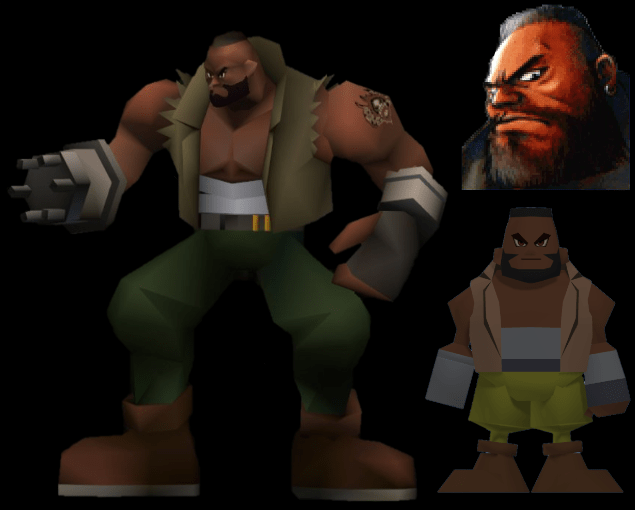
Barret has another iconic design. Your eye immediately gets drawn to his gun arm. How did he get that? Why did he make his arm a gun instead of like…another hand? You can hold a gun with an extra hand! You find the answers to these things through the course of the game but you immediately want to know more the first time you see that guy. I love it.
The second main character you meet in the game and head of the rebellion group Avalanche. Avalanche is a faction that is concerned about the health of the planet and wants technology super power Shinra to take a step back from draining the essence of the world (Mako) to power the various technology you see. This is often taken to the extreme, as your very first mission of the game is to bomb a Mako reactor. Actions like these make it very easy for Shinra to frame Avalanche as a terrorist organization.
While on the surface the grudge Barret harbors against Shinra is about the damage they are doing to the planet, it is revealed that he harbors animosity towards them for more personal reasons. The saving of the environment is a benefit of his revenge crusade, but to say it’s his primary motivation isn’t quite accurate.
Before the events of FF VII, Barret’s town of North Corel takes on a Mako reactor. North Corel had been a coal town before this but the powers that be at Shinra convince the population of this place that it is in their best interest to get with the times and adopt this new form of power. Barret is a driving force for getting the people of Corel to accept this and it all blows up in his face when the reactor suffers a meltdown.
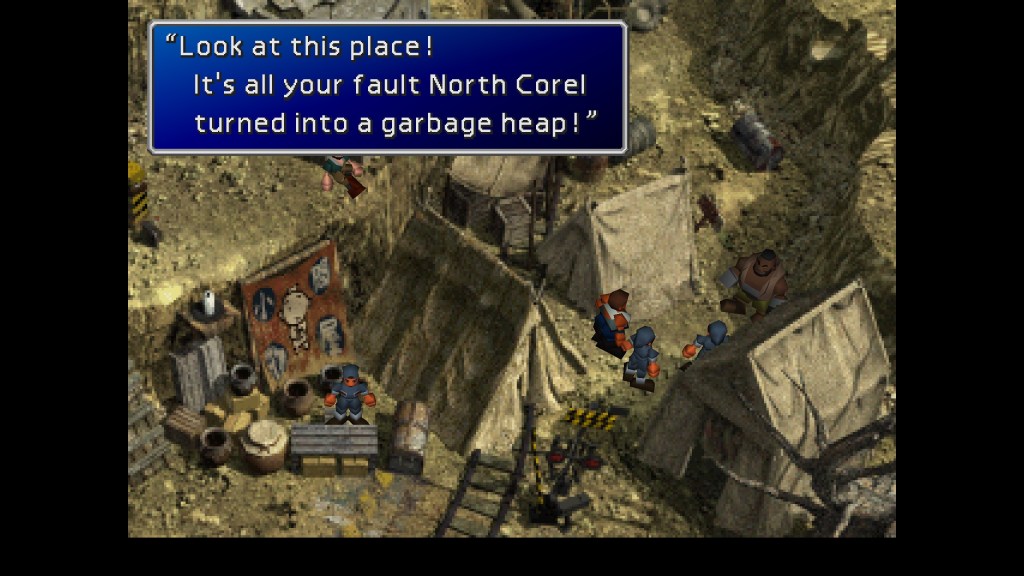
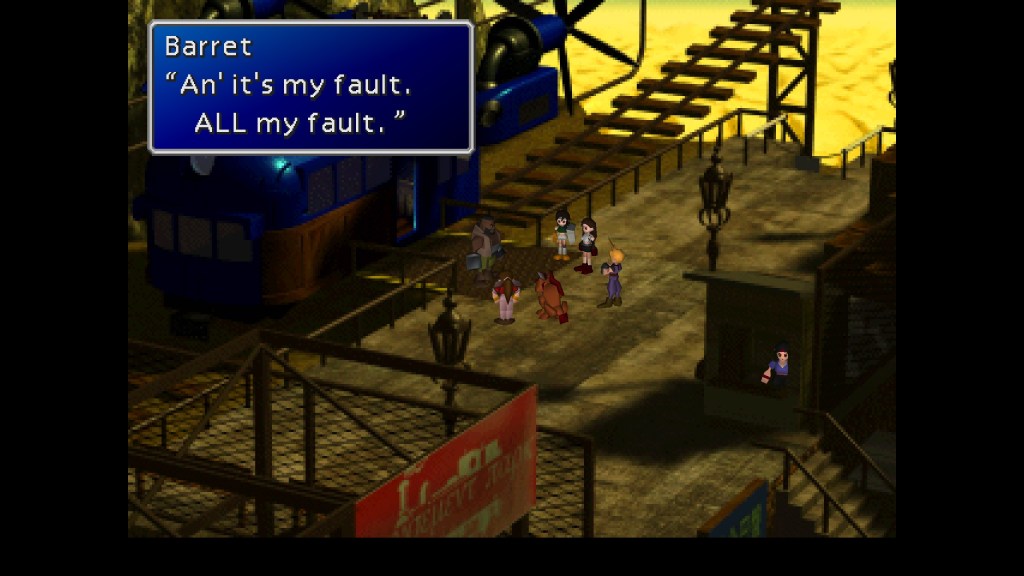
Shinra proceeds to perform a mass slaughter of the people of the town, most notably killing Barret’s wife Myrna as well as his best friend Dyne. The people need someone to blame for their lives being miserable, so they turn their ire to Barret and cast him out of town. The man with a gun for an arm takes the daughter of his best friend and makes for Midgar. A grudge against Shinra born.
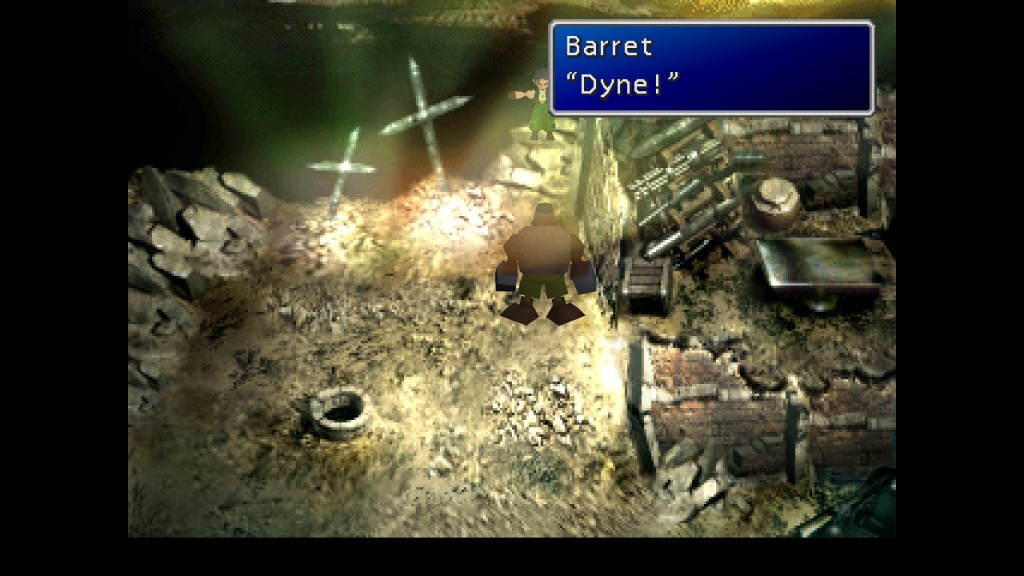
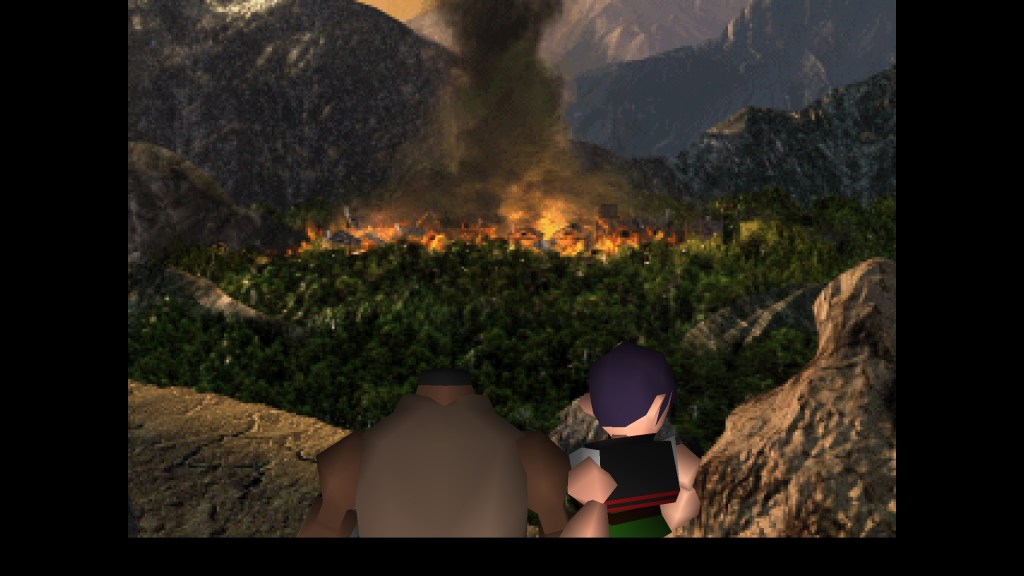
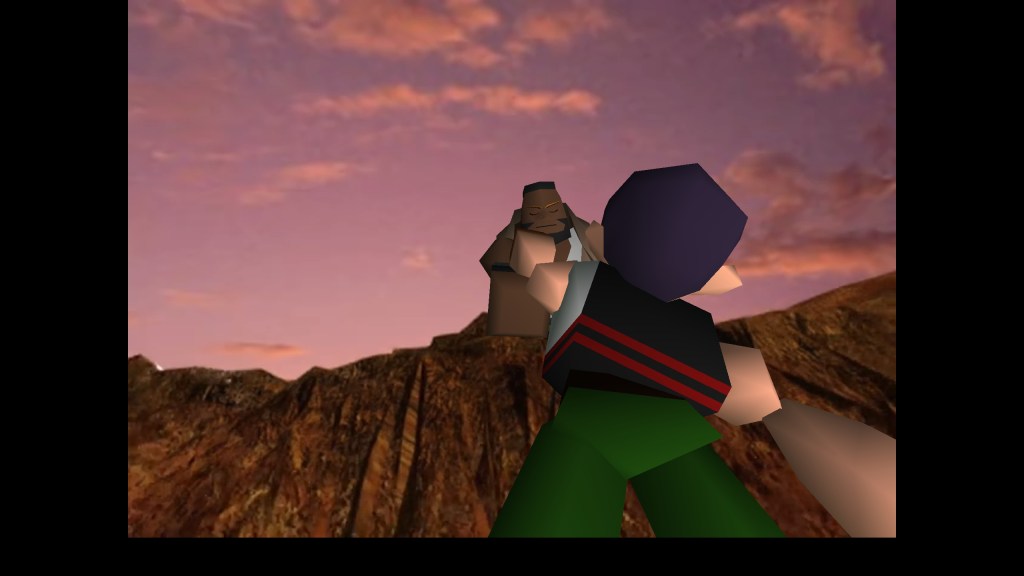
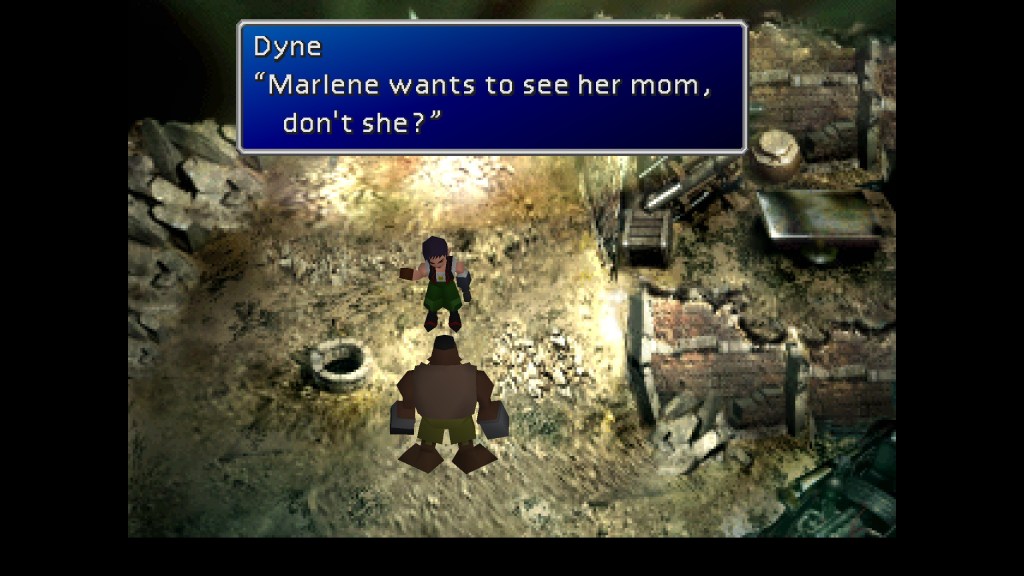
The quest where you discover all this leads to the revelation that Dyne is still alive and is quite unstable. He has taken Barret’s grudge against Shinra to the next level and will just murder solders and people affiliated with the corporation for seemingly no reason.
A mini arc of Barret’s involves him coming to grips with the consequences of his actions, that innocent people had to die for him to achieve his goals. I think seeing his old friend – who also has a gun for an arm – helped kick off those feelings.
One of the big take aways most people will have about Barret is that he really loves his adoptive daughter, Marlene. He will do basically anything to make sure that she has a future in a world worth living in. It’s an endearing trait for a man who is otherwise very ‘tough’. It’s not an uncommon trope but I feel it’s very effective at humanizing the leader of Avalanche.
The other big takeaway is how over-the-top Barret is. Mr. Wallace is the first Black main party member in the franchise and his dialogue is often blackspoloitation-esque. He curses a lot, probably second most in the cast! You’d be lucky if you got more than a single ‘damn’ before VII but here we are with censored ‘fucks!’
I think the extreme bravado that comes with this style of speaking suits his character well, but I can see how it would turn some people off. Some of this might also have been due to the famously shaky original translation of the game. Future versions of his character tone this aspect down a little. He’s still kind of a goofball but it’s not as extreme.
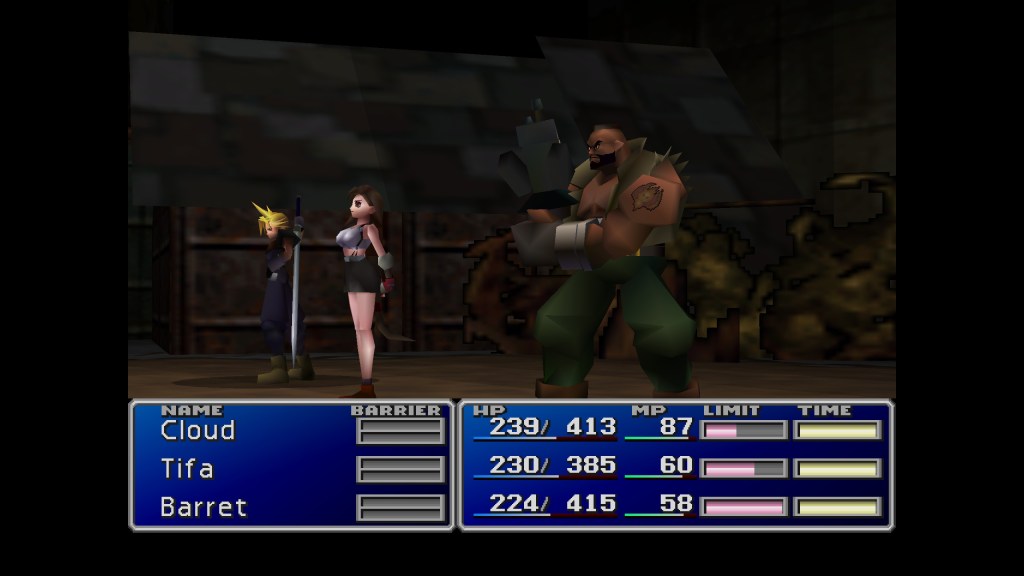
This playthrough didn’t see Barret get a lot of usage. I do not think it’s wise to switch up your party too frequently in a standard playthrough of the game because you will never get all of the stronger limit break abilities for your characters. So your characters will all be similarly leveled but they won’t have that one big punch that can help win the day.
Barret is unique in that most of his equipment can target enemies from a distance. Honestly…this comes up just a couple of times in the game, definitely not enough to justify keeping Barret on par with the other party members if he’s not one of your main guys. Especially considering you can just use a Materia to accomplish this if it ever becomes a real sticking point. His limit breaks do make use of his gun arm though, so they definitely accomplish the goal of ‘this attack can only be done by him.’
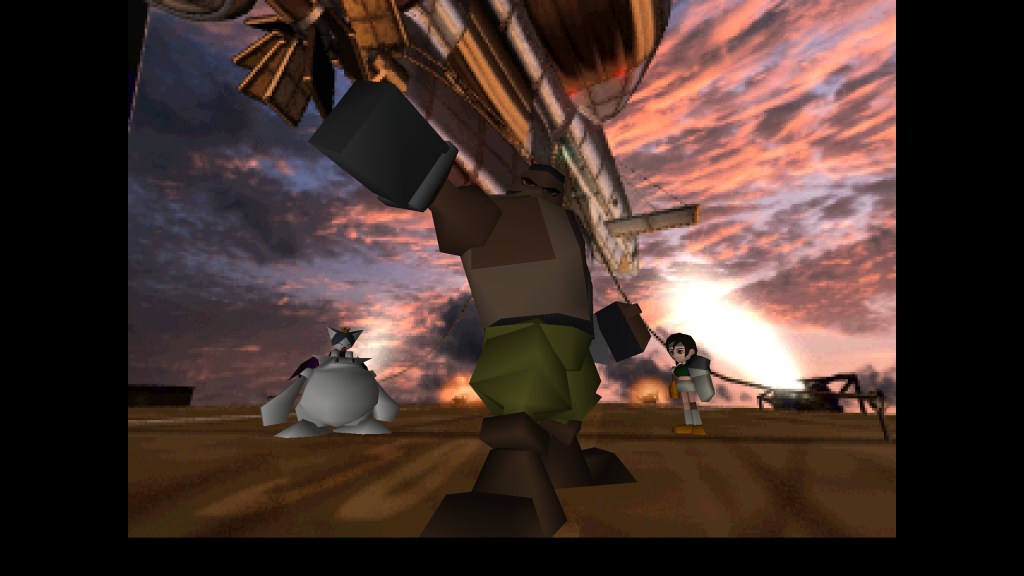
How the remakes treat Barret: He is still very gung-ho about taking down the Shinra. The first remake takes away his culpability for the initial bombing mission in the game by having the bomb be a dud that Shinra themselves detonate. He thinks he ‘set them up the bomb,’ but the player knows he didn’t. I just think that’s a less effective approach.
They also turn up his obsession with his daughter Marlene. In Rebirth, it feels like every other conversation with the big man involves how he wants to see Marlene grow up and prosper and how he dreads her dating and stuff like that. I think this was done as a way to tone down his more bombastic personality traits from the original but I personally feel he comes off a bit flanderized.
Aerith Gainsborough

The flower girl. I don’t think there’s anything instantly eye grabbing about her design like there is about Barret or Cloud, but I do think her gigantic bow is a nice touch. It helps portray her as something of a girly girl – the remake touches on this by having her ride chocobos side saddle. It also helps that the ribbon hides the super important White Materia and she’s really only seen without it posthumously.
Before getting anywhere, I wanna touch briefly on her name. In the original translation her name is Aeris. This was an inaccurate translation but I don’t fault SquareSoft for altering her English name originally. The “th” can come off as a lisp so Aeris is slightly easier to say when you’re just reading the names in your head.
I was surprised when I launched the PC version of VII for this playthrough and saw that her name still defaults to Aeris there. So that’s why her name is “Aeris” in all my screenshots. I have a rule where I won’t change default names for this series. I fought the war on the side of calling her Aeris for years and years but I concede. I lost the war. Accuracy wins.
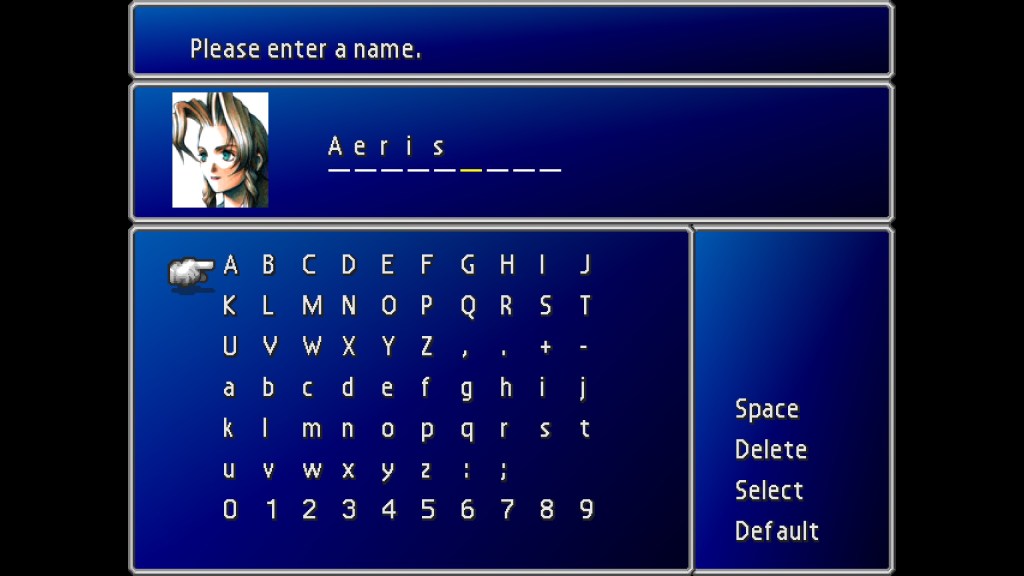
The player meets Aerith shortly after the initial bombing mission and she comes across as just a random NPC. If you didn’t know she was a party member – and truthfully if her design didn’t scream playable character – you might think this was a one time only thing. It’s actually the very first time the player can interact with the hidden romance mechanic. Cloud runs into her again after taking a massive fall during the second bombing mission and she is in the party for most of the rest of her life.
Aerith is portrayed as a girl who is aware that she has a larger place in the world but doesn’t necessarily want to embrace it. She wants to enjoy the simpler things in life like having little crushes and selling flowers. It wasn’t in the books for her since she is the last in the line of an ancient civilization of planet wanderers called the Cetra (referred to primarily as Ancients), which leads to her being chased around by Shinra, but I never got the impression she was enthusiastic about saving the world or doing these dangerous things. It was just her fate.

Her being hounded by Shinra, more specifically a force in Shinra known as the Turks who are sort of a special ops group, plays into how she meets Cloud and why she tags along with the crew. She requests our spikey-headed buddy to be her bodyguard in exchange for one date and their relationship goes from there. Shinra wants her because they believe she (or her heirs) could lead them to the Promised Land, which is a location that is said to have basically infinite Mako energy. More profits!
A lot of her dialogue towards Cloud is cutesy or flirtatious. She mentions that she has a previous boyfriend named Zack and if she’s in your party when you meet his parents, she will expound on it, but it’s never pointed out to the player that these are the same people. You infer it with dialogue you see throughout the game, but they never smack you in the face with it and I like that.
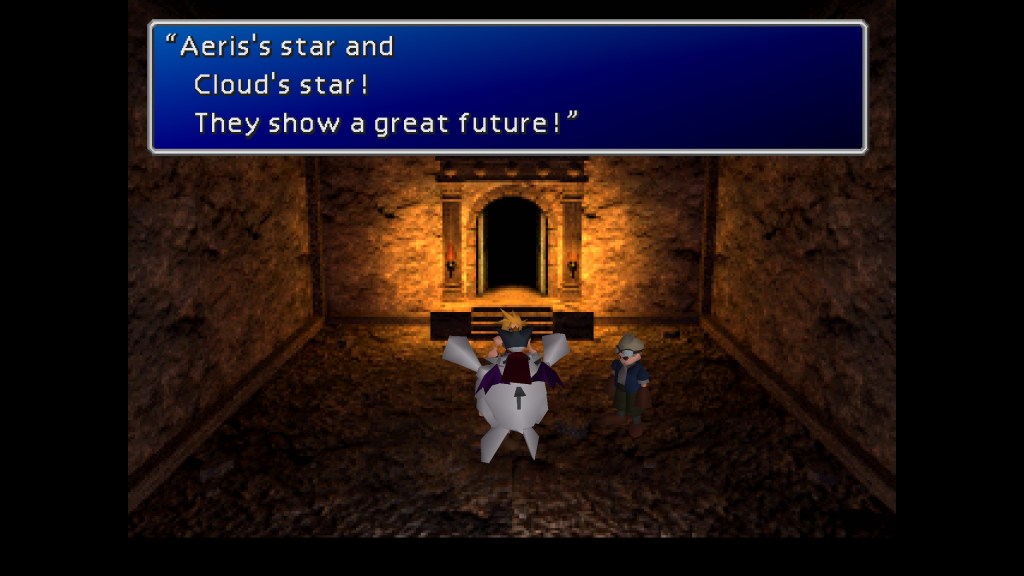
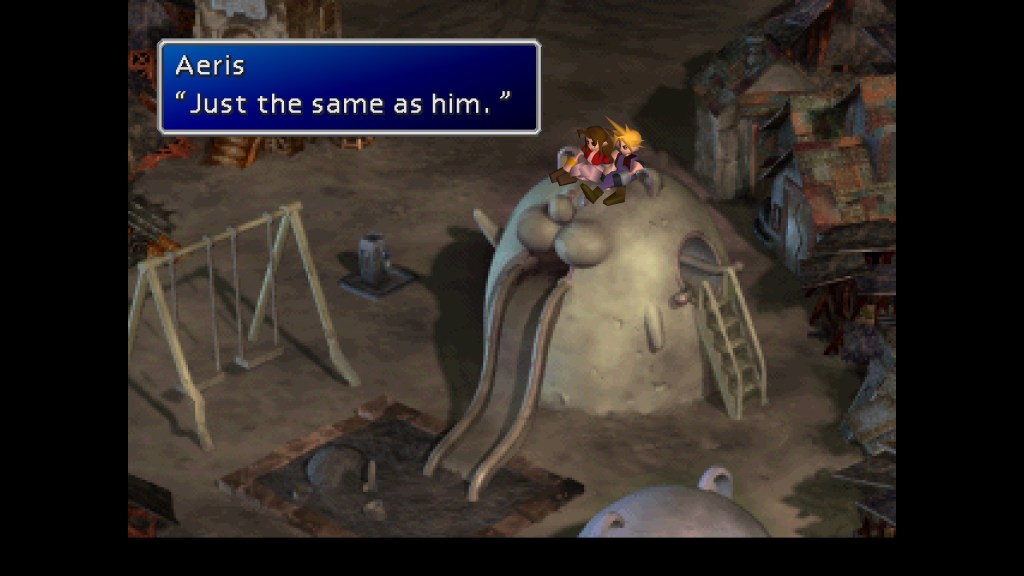
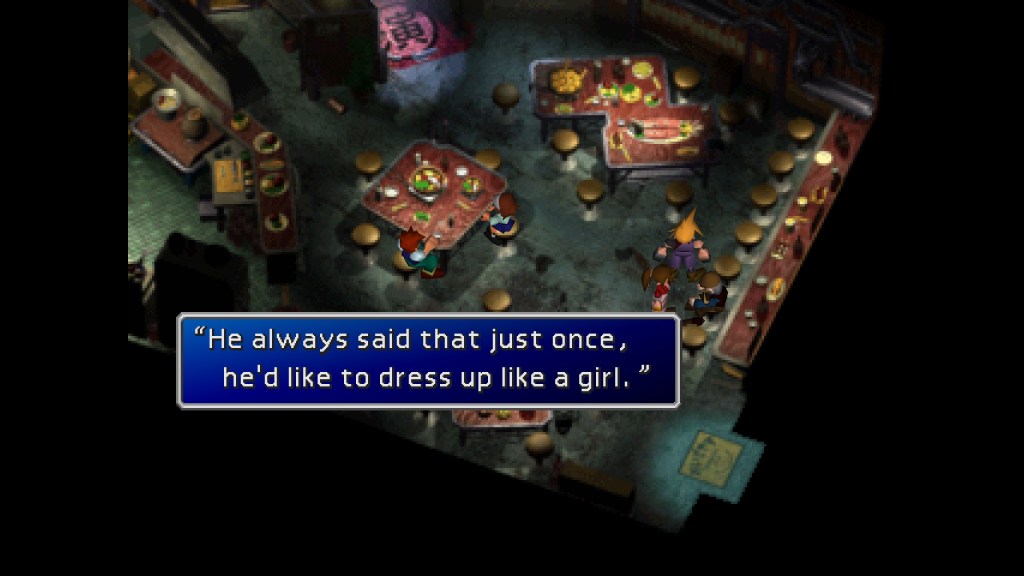
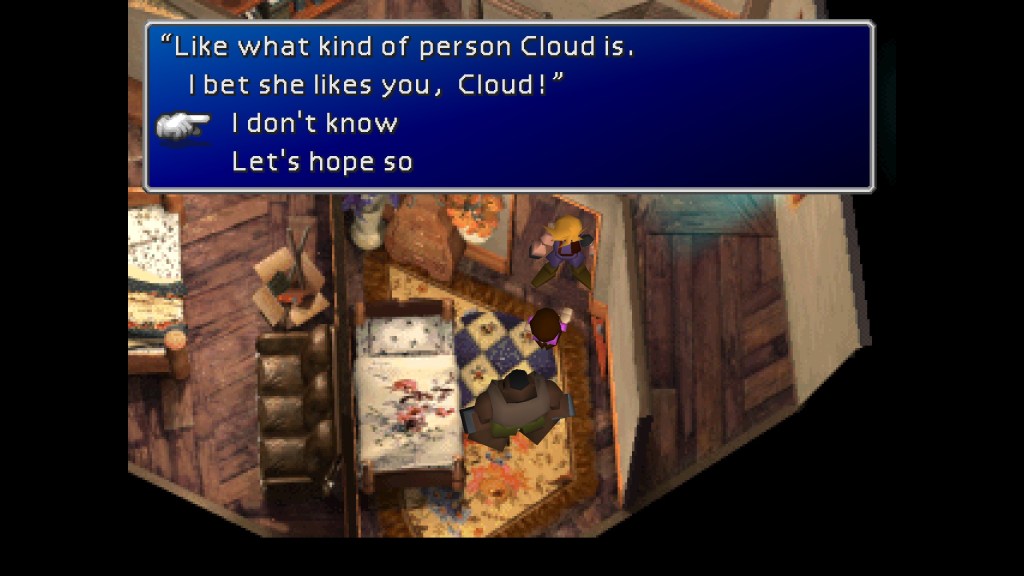
Aerith’s purpose in the plot at large is to die. She is a character that was never going to make it past the first disc. She is there to make the player care and then feel something when she is lost. Her death serves a purpose to the grander plot in foiling the major bad guy’s scheme – more on that later – but that’s surface dressing.
The game wants you to form a bond with this character, one that it treats as almost a co-lead to Cloud, so you feel something when she permanently leaves the party. Her death cannot be meaningless, the player should not just shrug it off. Kitase has said one of the themes of Final Fantasy VII is “life” and death is a part of that.
This was profoundly successful. Aeris(th)’s death is a moment people remember. When the remake for Final Fantasy VII was being talked about, the big question on the minds of people playing it is whether or not they would still kill Aerith. I am not kidding when I say people spent hours trying to find ways to revive her. I used the school ground analogy when talking about reviving General Leo in my writeup of Final Fantasy VI. Take that and multiply it ten-fold.

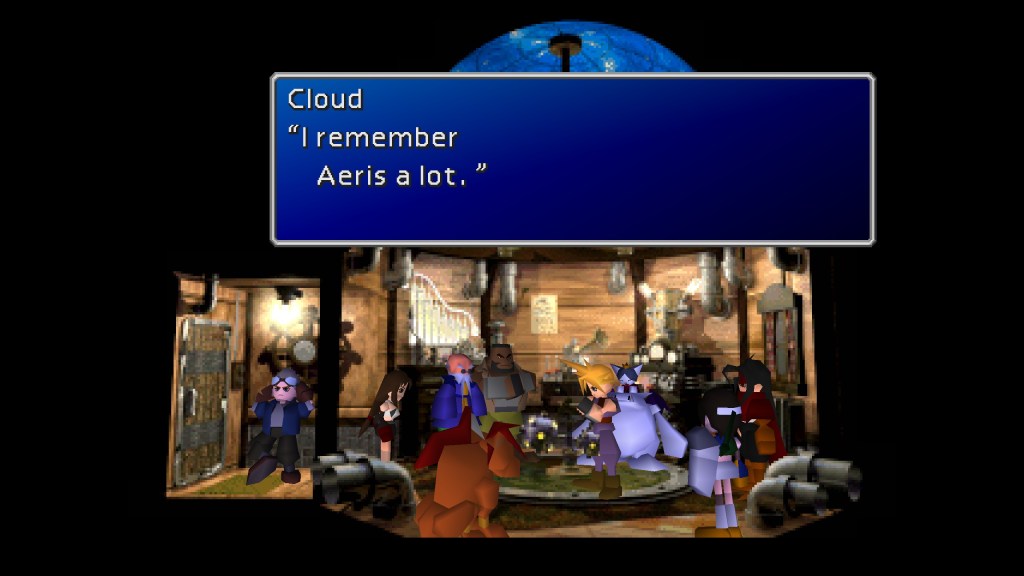
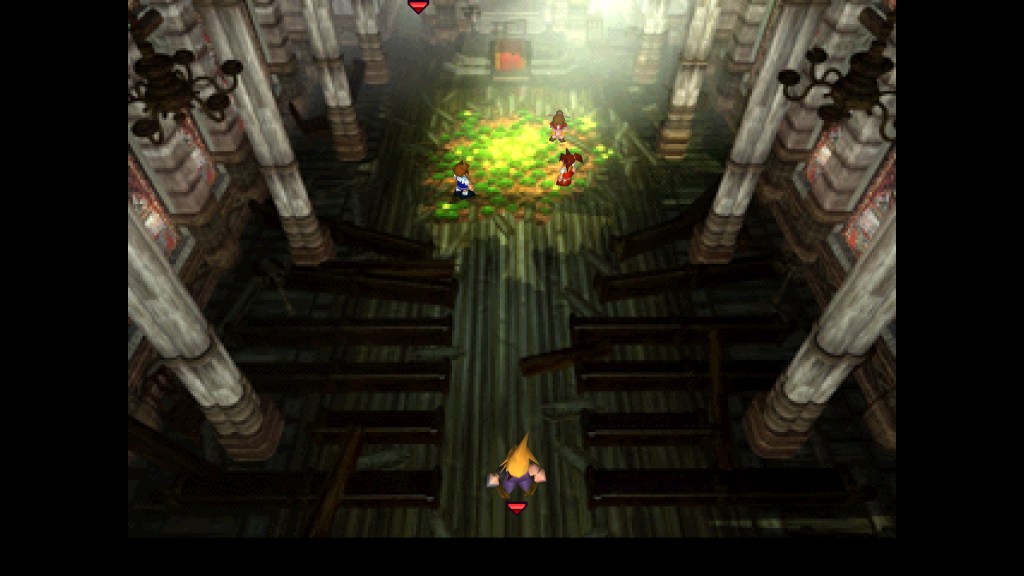
It was the most important moment in one of the most important games in video game history. Instead of accepting the narrative at its value, people tried and tried to avoid the inevitable. But no matter how many weird oddball quests you embark on, you face the inevitability. She will die at the end of Disc 1 and there is no way to bring her back. Life continues. Nothing will stop the inevitable. This concept is toyed with a little bit in the first remake with creatures called whispers who act as arbiters of fate.
For me, Aerith was never my favorite character. I vastly preferred Tifa and felt they tried too hard to make the player like Aerith. She seemed a little too perfect. I am willing to admit that my take on this was wrong. Kitase and SquareSoft played this part of the game perfectly. Making the majority of people care probably requires coming on a little strong. And people clearly cared.
Her relevance to the plot does not end with her death, but I’ll talk about that more in Sephiroth’s section.
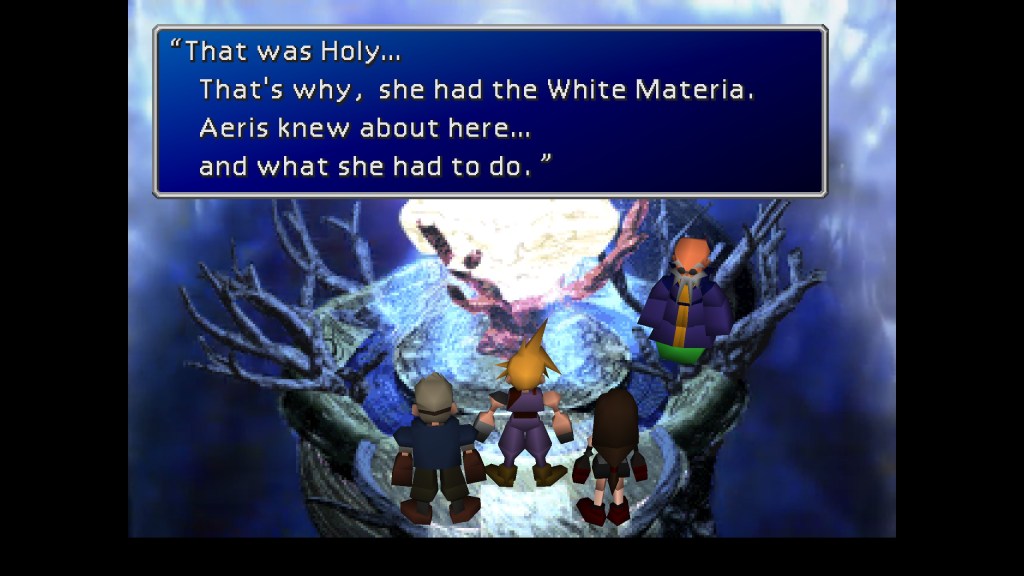
One last thing I want to mention here is a cool storytelling thing they do with the visuals of Aerith. Right before her death, there is a scene where Cloud is haplessly chasing after Aertih as she fades into the background. During Cloud’s mental breakdown, there is a scene where Tifa chases after Cloud in a similar manner. It sort of communicates “if one character died, why can’t another?”

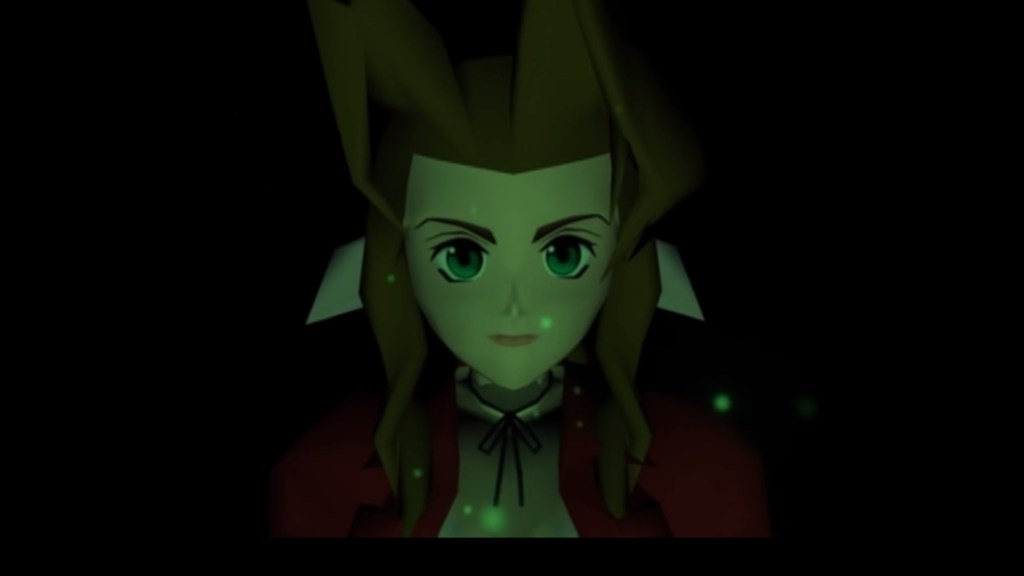
They also do a cool bookend thing. The game starts with a quick flash to Aerith’s face during the opening cutscene. One of the very last things you see in the final cutscene is a similar shot of her face.
From a gameplay perspective, Aerith is almost always pigeon-holed as a healer for me. She is an excellent magic user but her level 1 limit break involves healing the entire party so I have always just taken this as the game going ‘she should be a healer, dude.’ Other than my very first playthrough of VII, Aerith very rarely cracks my main party because I know she’s going to die and the effort to raise her limits is futile.
I did get her level 4 limit break one time on the PS4 version of the game but I used the in-game cheat they offer to give her limit breaks over-and-over again to accomplish this. People who have actually legitimately gotten her most powerful limit break…I salute you. You have far more patience than I could ever have.
How the remakes treat Aerith: Maybe I’m just older now and these tricks work better on my feeble brain but god damn do they make Aerith excellent in the remakes. She is one of my favorite characters in the entire franchise here. It might just be her excellent voice acting but I really feel like they hit a home run with her. She’s so likable that I have seen people say “well they can’t kill off THIS version of Aerith, surely.”
I will not tell you whether Square Enix kept with the SquareSoft version of Aerith’s fate. The game just came out in February. Just know that I think the handling of the most important scene in the franchise’s history was poor. They botched it. I love Rebirth, but the one scene they needed to nail was a complete flop.
Tifa Lockhart

Cloud’s childhood friend and his canon love interest. She is a martial artist whose weapon is her fists, so her relatively simplistic design is good for that. Of course, her design being ideal for a by-the-books fighter isn’t the first thing most people will notice about her. I’m not going to be too crude, but Miss Lockhart was definitely the sexual awakening for a lot of young boys and girls. This has endured over the years to the point that her bust size was a topic of controversy when the remakes came out.

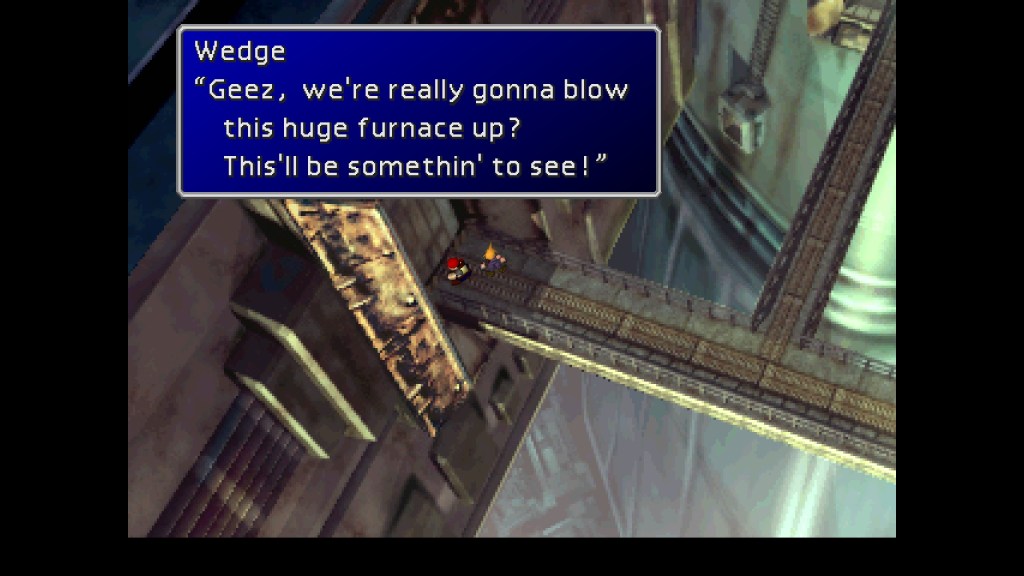
She starts out your journey as a bartender in the slums of Midgar called Seventh Heaven. She’s a member of Avalanche, though she seems secondary in rank to people like Biggs, Wedge and Jessie.
By the way, I am sorry they didn’t get their own sections here but they are far less important here than they are in the remakes. Jessie has a crush on Cloud. There. I described their characters for you.
Anyway, she spends much of the first disc being a sort of ‘the other girl’ to Aerith. The details of her past with Cloud, including the very important Nibelheim flashback and a childhood promise, are covered but she is not framed as the primary female character. She’s just Cloud’s friend from a long time ago. Disc 2 is when she starts to get some time to shine.
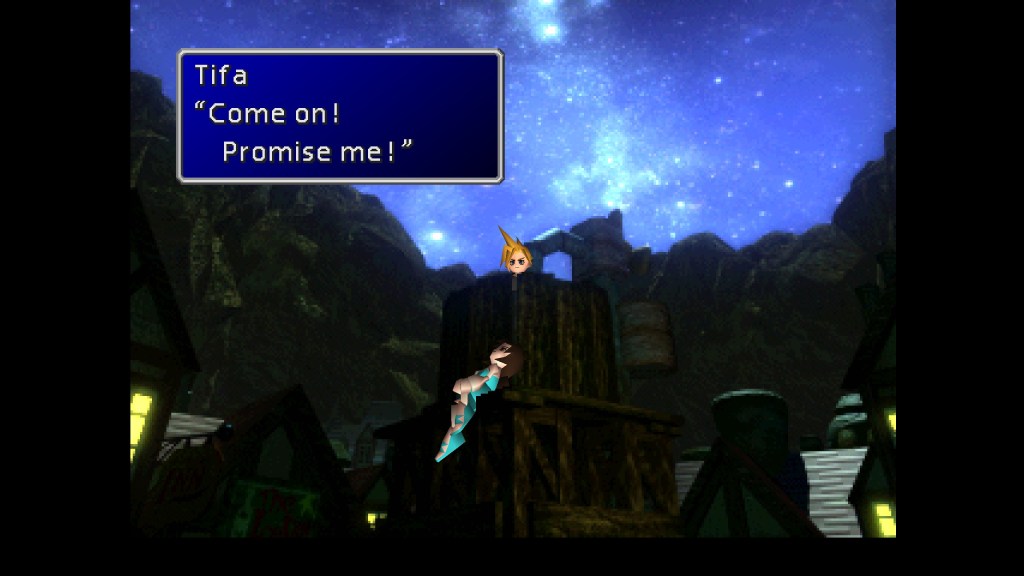

When Sephiroth reveals to Cloud that his life has been a lie, Tifa mentions briefly about how she knew the Nibelheim story didn’t line up. She saw the holes in it and didn’t say anything because she desperately wanted to believe the spikey haired guy from SOLDIER was still the same one from her village of Nibelheim. She wasn’t 100% sure but wanted to believe, so she deluded herself into ignoring all the questions that popped up along the way and just went with it.
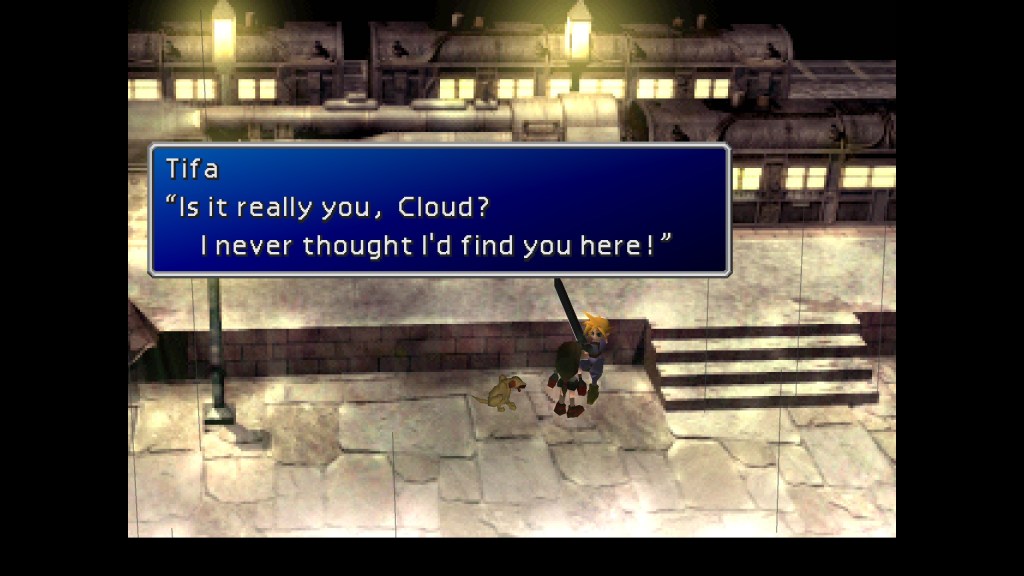
This is highlighted in a scene where Tifa discovers a wounded Cloud at the train station in Midgar. She isn’t sure it’s Cloud but when he asks if it’s him and he affirms it and proceeds to say something that doesn’t quite line up with her memory of events, she just ignores it. For convenience, she wants her childhood friend to be alive and be the guy that’s been journeying with her the whole time. She is willing to lie to herself about it even!
When Cloud goes into his identity crisis, Tifa has a bit of a self revelation. She truly only cares about Cloud. The planet, Midgar, Sephiroth…all of that is secondary. She just wants Cloud to be okay and she wants to verify who this guy is exactly. So during Cloud’s mental crisis, she walks him through his life and matches memories with him. Through this, Cloud realizes that he is indeed the Cloud of her childhood and Tifa’s efforts pay off.
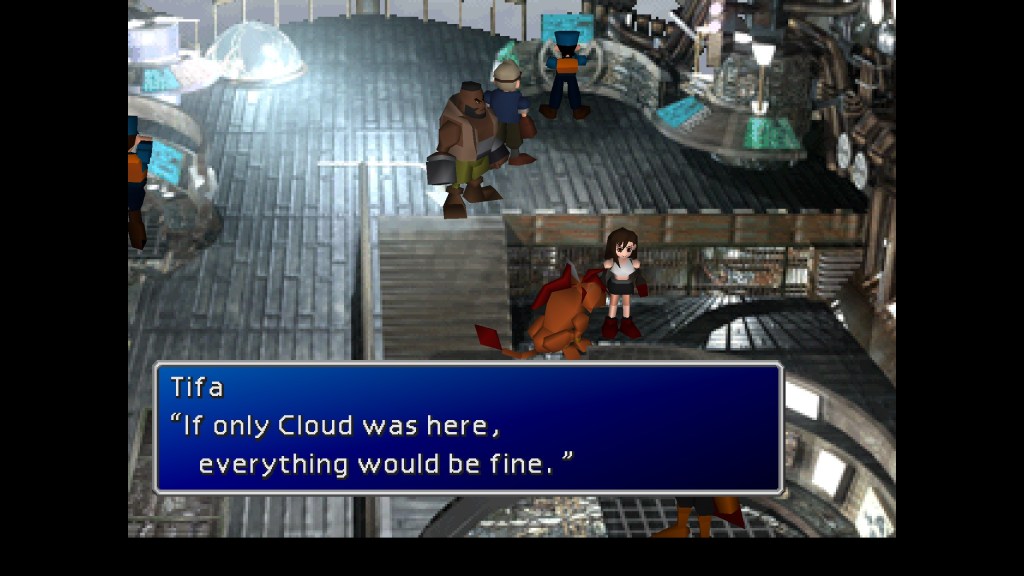
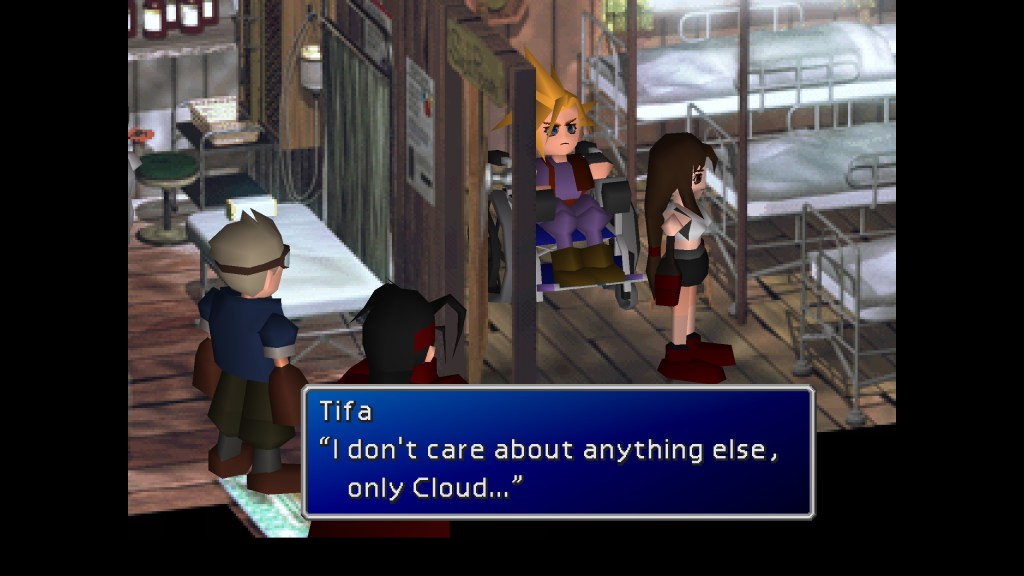
I like that she is knowingly selfish about how she approached Cloud. It would have been simple to say that her mind had been clouded by Jenova or some such thing and that’s why she didn’t chime in during the Nibelheim flashback to correct Cloud. It helps make her feel more like a real person. People aren’t perfect and they pursue their own desires. Much like Tifa.
I also like that the game briefly hints that things aren’t on the level, but Tifa is too afraid to confront reality. I’ve been there. The truth is scary sometimes.
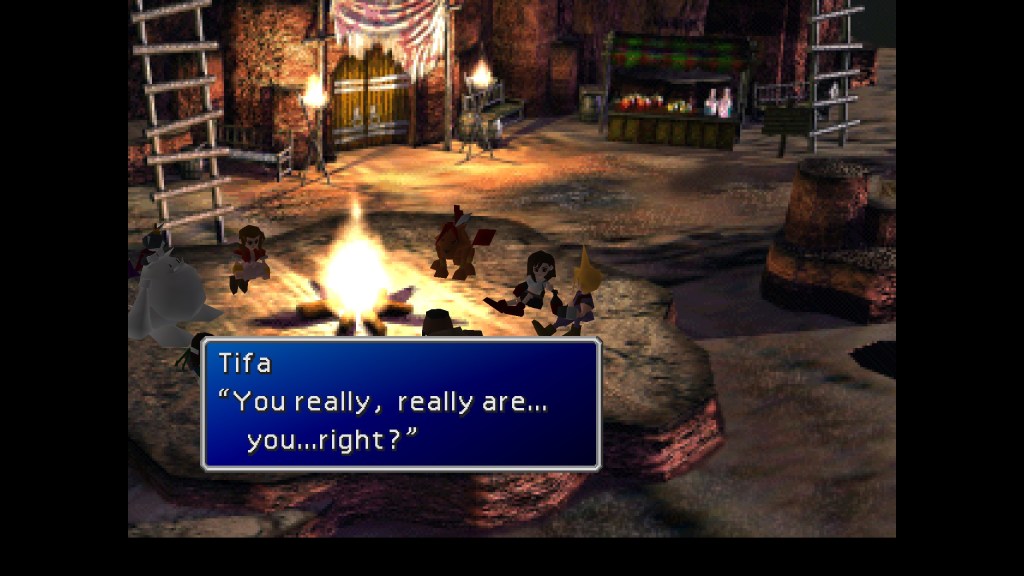
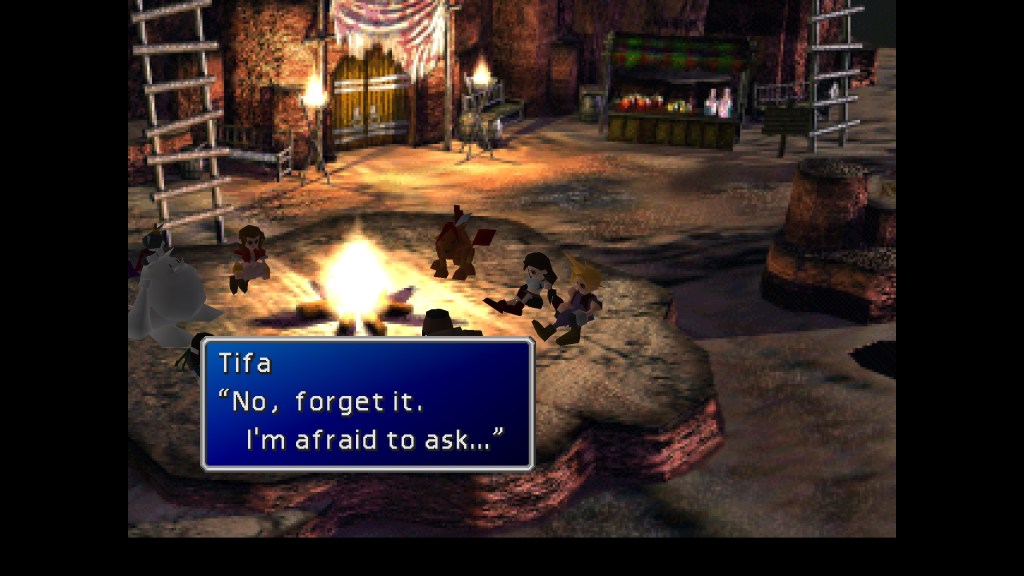

After Cloud recovers, she is true to her word and basically only exists to care for and dote on him. It makes her exceptionally one-note but her main purpose in the story has been fulfilled. At the end of the game, Cloud asks the party to find out what they’re fighting for and come back only if they truly mean it. Tifa never leaves because she never has to find her purpose. It’s Cloud.
It also leads to the first sex scene featuring main characters in the franchise. It’s not as blatant as what Clive and Jill experience in Final Fantasy XVI or to what Fei and Elhaym do in Xenogears, but to me there is very little doubt as to what this scene infers. Not everything can be as literal as Terra’s parents in VI!
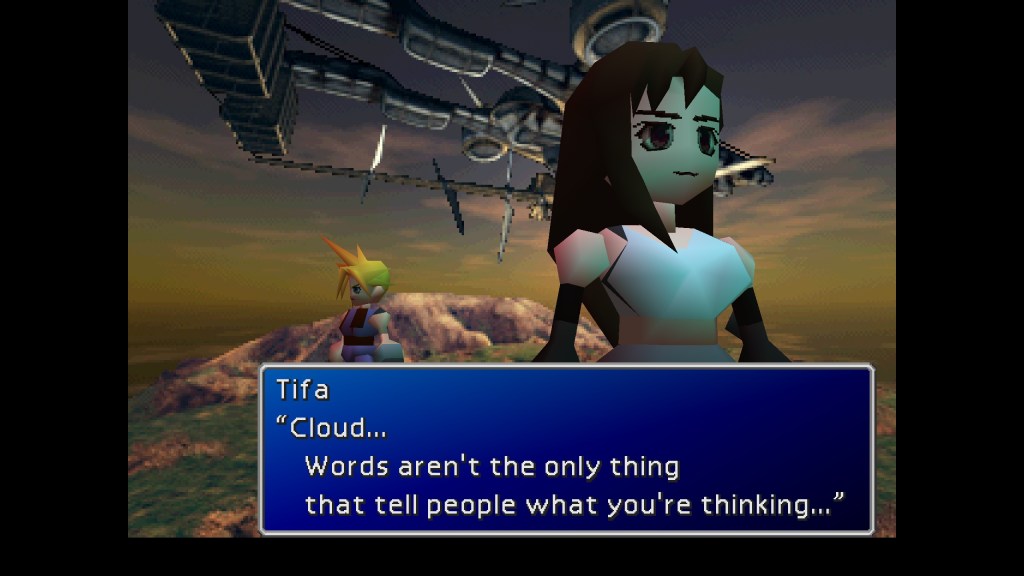
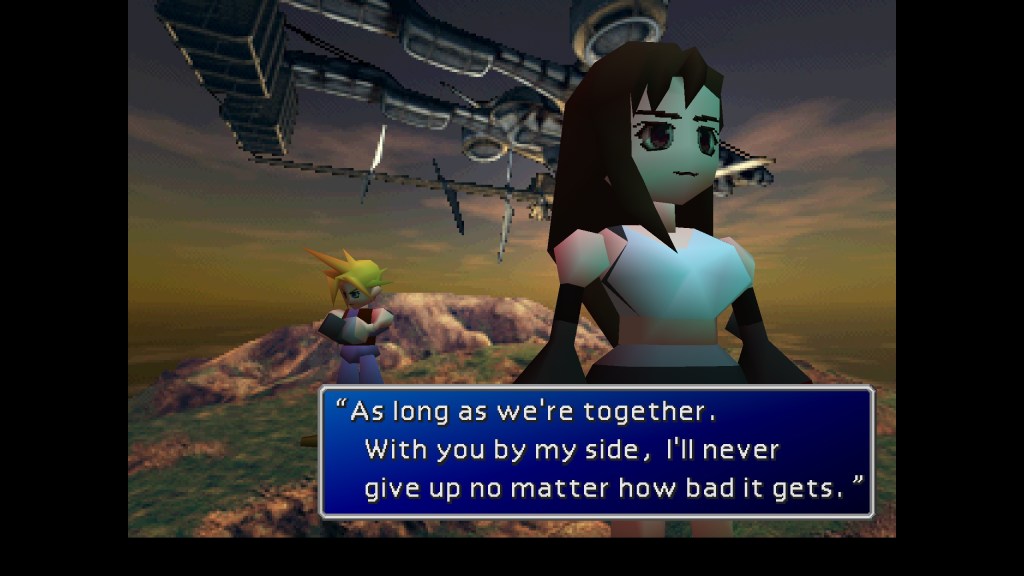


It helps our character feels more human. Humans have relationships and sex. Just feel it’s important to note, especially considering Final Fantasy VIII’s entire main focus is on the relationship between the two lead characters.
From a combat standpoint, Tifa was one of my main party members this go around. This exposed me plenty to her limit breaks. They are fitting to her character but are annoying to use in practice. Every time you unlock a new one, a reel is added to her limit screen and you need to land on anything except MISS to score a hit. With the slower framerate of VII, it’s a little hard to land on the critical hit with any precision (for me anyway), so I found myself mashing through limits a lot. This meant a lot of time skills just weren’t being used.
Not that it mattered. Despite being in my party for 90% of the game, Tifa still hadn’t unlocked level 3 limits by the time I cleared the game. Oh well. She was my main person for summoning Neo Bahamut and casting Ultima so I’ll take that much at least!

How the remakes treat Tifa: Despite the fears of many, she is still a martial artist bombshell. I think the way she is handled in part 1 is mostly on par with how it’s handled early on in the original game. She has a bit more personality I suppose, but I think she pretty clearly takes a back seat to Aerith.
In Rebirth, they really play with Tifa knowing about the Nibelheim flashback. She directly confronts Cloud after he gets done telling it to the party and it feels like the game is about to go in a wildly different direction and it just…doesn’t. It gets mostly dropped. They reference it here-and-there – bizarrely with CLOUD questioning whether TIFA is the real one – but it doesn’t do anything different. Which is kind of unfortunate.
That’s actually a beef I have with Rebirth. The first remake tried to make a real solid point about how fate was no longer in play and how anything can happen. Rebirth toys with going off the rails but typically just falls back into the original story of Final Fantasy VII. I think more departure would have been good, especially since Rebirth turns into a multiverse story at some point. I think they were tryin to please both people who wanted a straightforward remake and people who wanted something different and in the end wound up in the middle. For better or worse.
Red XIII
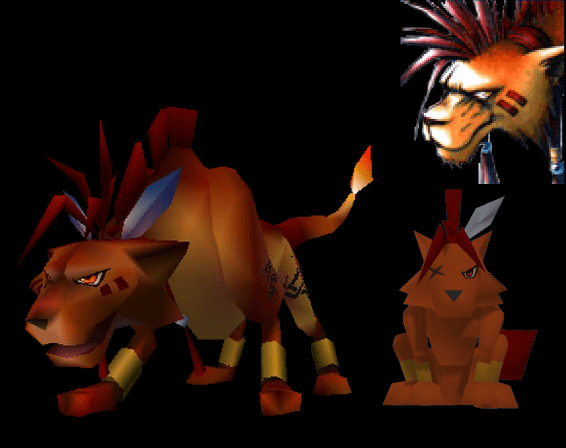
Red is completely different from any of the party members. While he isn’t the first non human party member, he’s definitely the first one that doesn’t walk on two legs. It helps this cast feel otherworldly and different.
At the end of the Midgar portion of the game, the cast raids Shinra HQ in order to free Aerith. The party meets Red when it is revealed that Hojo, a scientist employed by Shinra, is trying to breed the two endangered species with each other. You see, Aerith is the last ancient and Red is the last…sentient cat-dog thing. It’s one of the most bizarre scenes in the original game and I was actually kind of miffed they didn’t bring it back for the first remake.
Ya brought back the crossdressing side quest but not the weird Hojo breeding plot? Come on man, how am I gonna get hyped for inbreeding chocobos without this?


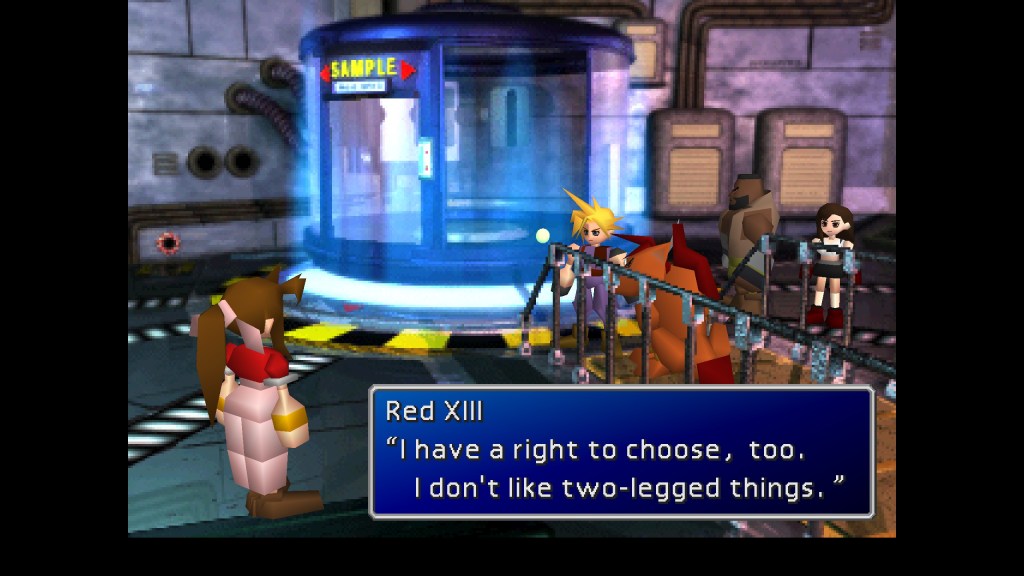
When you get him, Red tells you that his name isn’t actually Red XIII and it’s just the name and number that Hojo assigned him
Red is portrayed as something of a noble but self concerned warrior. When the cast leaves Midgar, he tags along but only so he can get as far as his home town. He is mostly quiet and stoic through this part of the game. You do get a slight glance at his silly side during a scene where he is forced to dress up as a Shinra sailor in order to blend in with people.
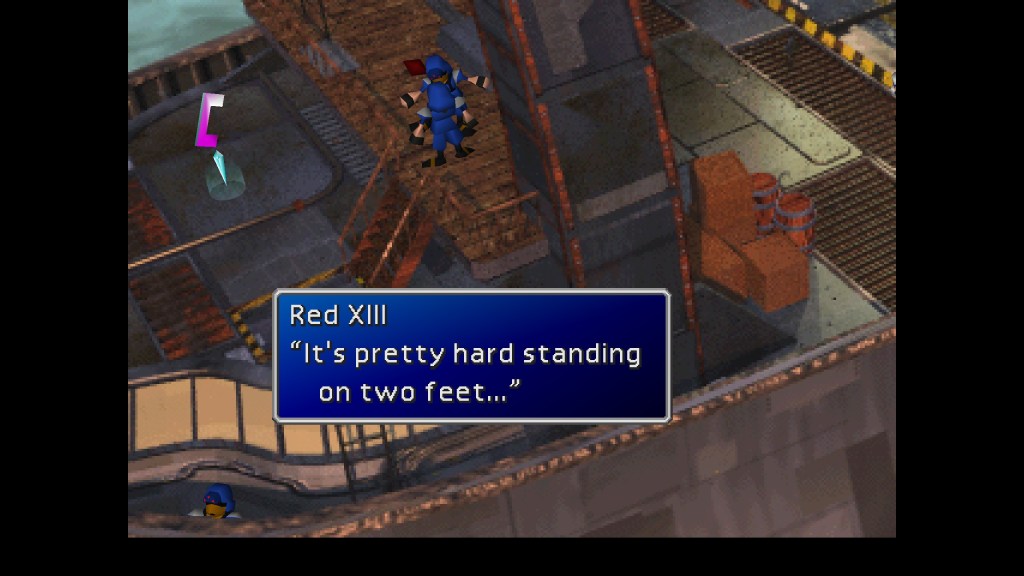
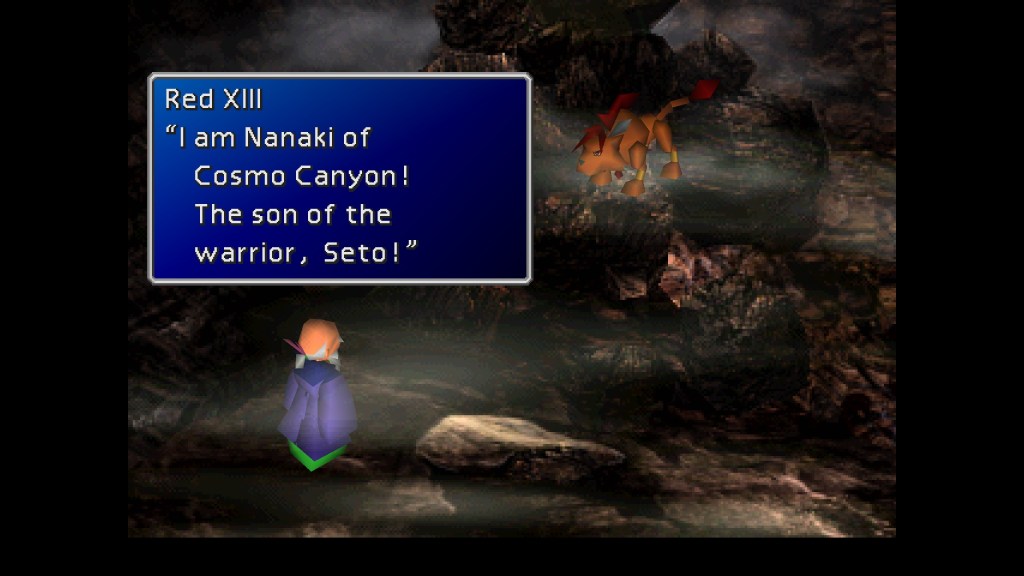
When you finally reach his home of Cosmo Canyon, you start to learn some things about Red. For starters, his real name is Nanaki. 99% of the time when I play Final Fantasy VII, I rename Red into “Nanaki” just for the line of text where Red reveals his real name to everyone. I have a garbage sense of humor, I know. Curse my rules for these playthrough.
It’s also revealed that he is the equivalent of a teenager for his species. I didn’t find that his personality changed too much after this, instead it was a “well gosh he’s awfully mature for a teenager” sort of thing.

Red talks about how he hates his father. How teenager of him. He thinks his father abandoned his people and the folks of Cosmo Canyon in their time of need. There was once a horde of planet hopping bad guys named the Gi who tried to invade Red’s homeland and Red had assumed that his father, Seto, had fled from battle and left his mom and the people of Cosmo Canyon to do all the hard work. A coward.
This wasn’t the case. Instead Seto fought bravely to the bitter end and was in fact turned to stone. His stone monument self stood watch over Cosmo Canyon for years after his death. After this Red feels a change of heart about his father and thus devotes himself to leading a life worthy of his heritage. Which leads to him reneging on his claims that he would ditch the crew once they got to his homeland. Now that he has some clarity on his past, Red wants to join the fight to save the planet.
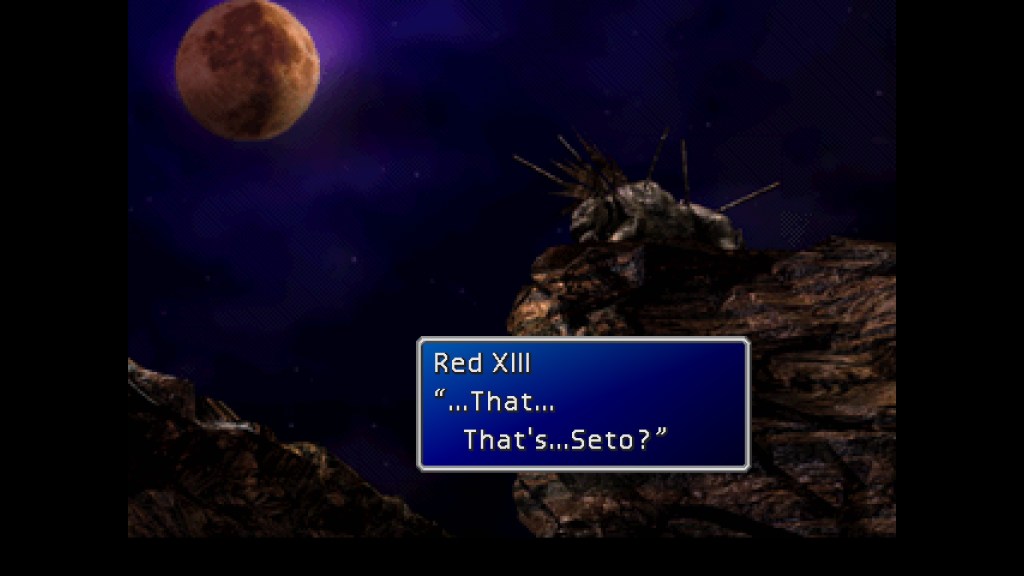
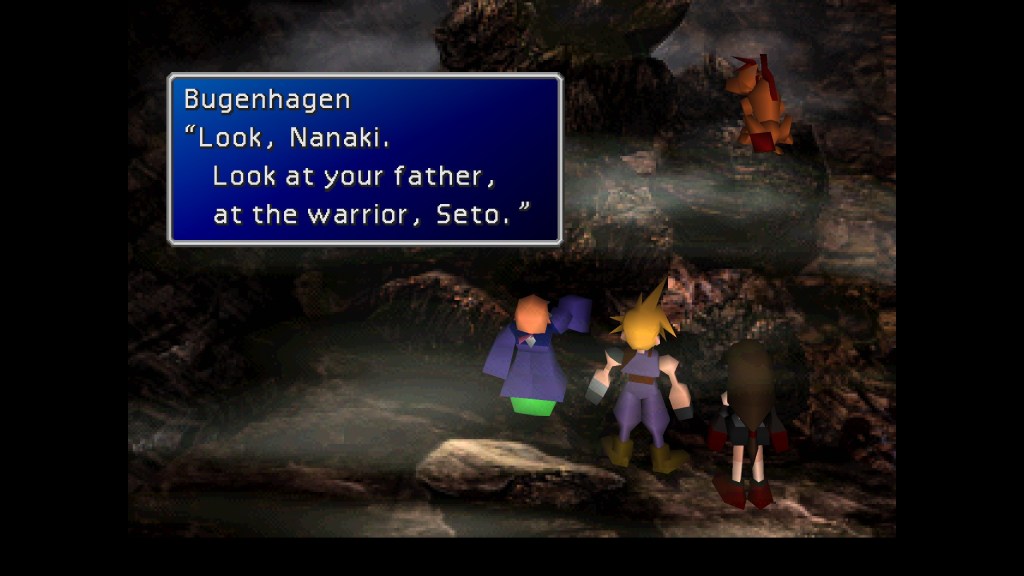
And that’s it. Except the ending, which I will talk about later. Nanaki kind of just hangs around the party after this. He mostly exists to tie your party to Bugenhagen, a guy who understands a lot about the lore of the world, the ancients and all sorts of stuff that requires several text boxes to explain. As a result, I’ve never been the biggest fan of Nanaki. He’s the most boring member of a really exceptionally interesting cast.
His limit breaks all sort of play into his animalistic appearance, so that’s cool at least? I got nothin’. I have had zero playthroughs of Final Fantasy VII with him as one of my main three party members. Sad.
How the remakes treat Red XIII: He shows up at the very end of the first game and doesn’t leave much of an impression. But he is a very important part of Rebirth and I felt was one of the best character in the entire game until Cosmo Canyon. Maybe it’s the excellent voice work that Max Mittelman does, but I feel his mysterious and stoic nature played off the rest of the cast quite well. I was convinced that this remake was the best thing to happen to Red.
You’ll notice that I said until Cosmo Canyon. When the truth about Nanaki is revealed, his personality undergoes a complete 180. His voice changes and he becomes completely childish. The game even foreshadows this by having Aerith talk to Nanaki behind closed doors. He uses his real voice there and they both sort of act confused when Cloud asks if someone else was in the room.
I understand that he’s supposed to be a teenager but this is such an extreme shift that I find it hard to believe that he was ‘acting more mature so people would take him seriously’ for the entire run time to that point. They’re just two entirely different characters. Nanaki once again became one of my least favorite cast members, but for entirely different reasons this time.
Remake Red XIII is cool. Remake Nanaki I want to shove into a locker.
The Turks
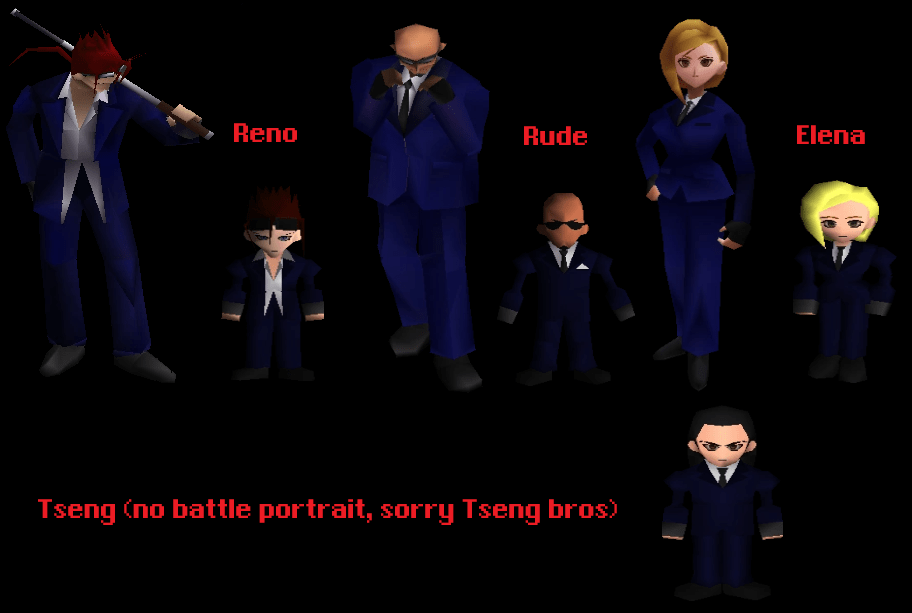
The special operatives of Shinra. They all have pretty distinct personalities but at the end of the day they are cool, calm and collected professionals who excel at things like assassination and kidnapping. You know they are a big deal when the typically chill Cloud talks about how much of a threat they are when he discovers that the group have been pursuing Aerith.
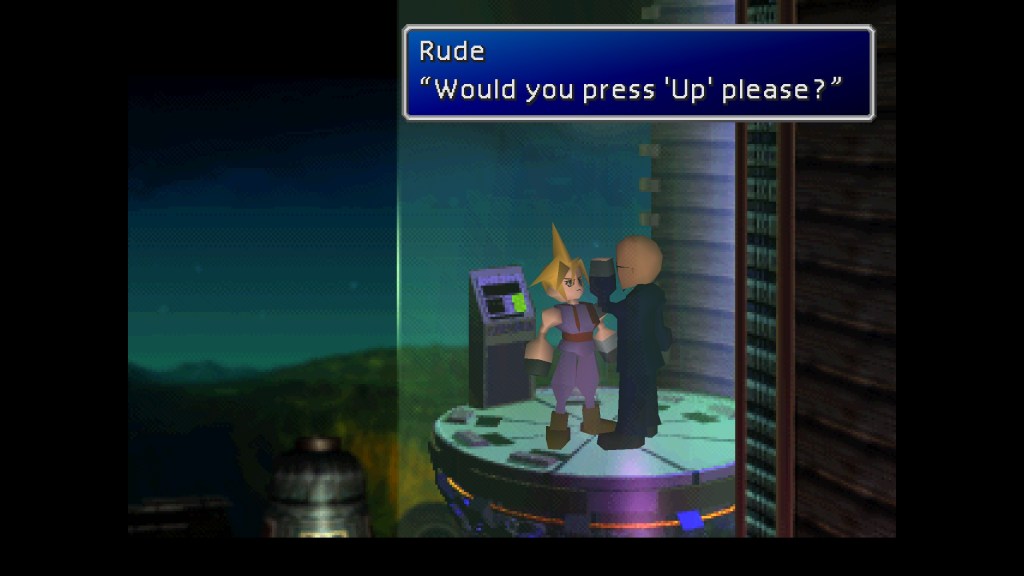
Reno is a bit of a wild child, he feels like a shonen protagonist took over the body of an evil villain and he just decided to role play a bad guy for funsies. Rude seems to be very serious and is a man of few words. One of my favorite scenes in the early game is when he pops into an elevator as you’re trying to leave Shinra HQ and just points up. Your party knows they are screwed but Rude is just so cool about it. I love it.
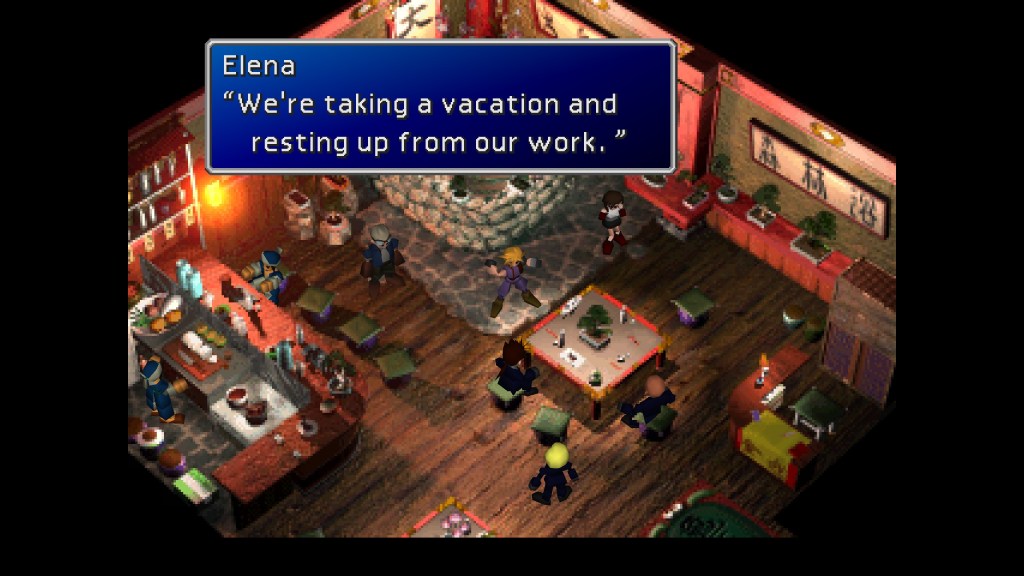
Elena is extremely professional and job oriented. She has a bit of a temper but she spends a lot of her game time trying to get the other members of the group to focus. My favorite bit of this is when you run into the group in Wutai, a tourist trap town that used to be a major world power. Elena knows it’s their orders to apprehend your party but the Turks are on vacation and have none of it.


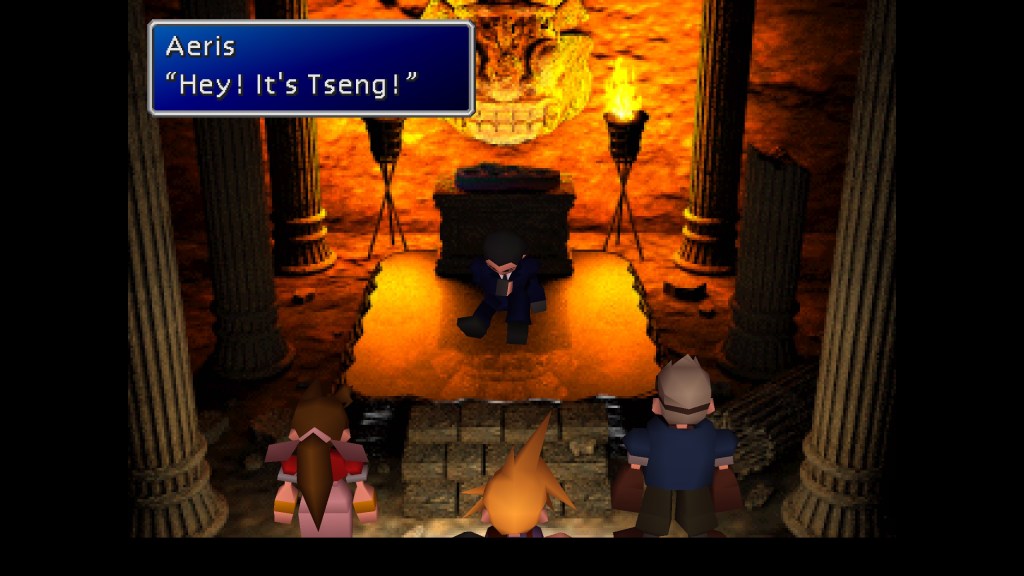
Finally, there is Tseng. He is portrayed as the leader of the group and is all business. He has a past with Aerith, they knew each other growing up, but he is pretty tight lipped for the majority of his in-game time. You are led to believe that he is killed at the end of Disc 1 by Sephiroth because he never shows up again but the sequels say otherwise. That’s fine. I’m ambivalent towards Tseng, the other Turks are the ones I care about.
I like that the game talks about their softer side from time-to-time. You encounter them just casually talking about who they have crushes on at one point for instance. There’s that scene in Wutai. Heck when you are first introduced to the Turks, Reno specifically makes a point to say that he doesn’t want the bad guys messing with Aerith’s flowers.

Of course…he stepped on them himself to get there. That’s part of the fun of these guys, though!
They are recurring boss fights throughout the game and aren’t particularly difficult. The ‘scary’ part is that they are boss encounters with multiple people, but I’m not sure I have ever lost to these guys in any playthrough of VII. My favorite encounter with them is the final one in the game because it plays into their personalities. They know the world is doomed and don’t want to fight you. If you simply let bygones be bygones they leave and that’s that. You don’t gotta fight em.
Narratively it makes a lot of sense but it’s the one encounter in the game where I think you can actually steal stuff from them so it’s in the player’s best interest to fight. But, uh, I didn’t this time. I just didn’t feel like it! It felt like a Turk thing to do.

How the remakes handle the Turks: They’re pretty consistent with their original appearance. In fact, Elena is one of the most enjoyable characters in Rebirth. They even give Rude a goofy little side quest thing where he’s in some sort of bald man’s club full of baldies. It’s cute and it feels like a scene that would fit right into the original game. Tseng is still there too!
Shinra, Inc
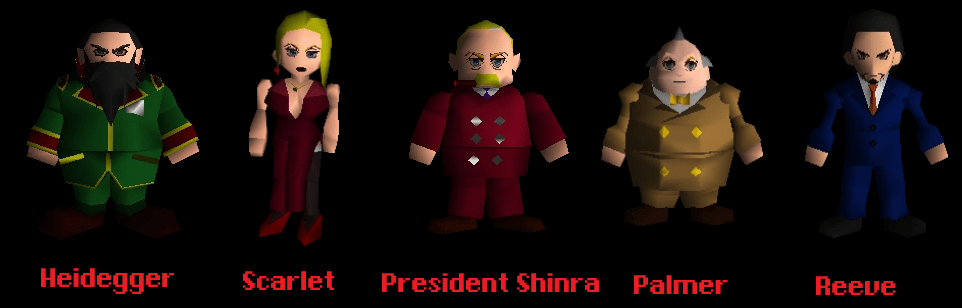
These are the corporate suits who run much of the world of Final Fantasy VII. They (well except Reeve) are hilariously cartoonishly evil and feel like what you’d read in text books that decry the evils of capitalism. Heidegger and Scarlet in particular do not give a single solitary fuck about any normal citizen of the world. They care about making more money, harvesting more Mako and controlling more of the populace. The people they trample along the way are inconsequential.
Final Fantasy VII takes place in a cyberpunk style world, which means corporations act as a form of government. They have their own military situated in Junon and they seem to rule over Midgar. There is a mayor in town but he is nothing more than a figurehead with an office at Shinra HQ. Make no mistake about it. They run the show and they want to drain the planet of its resources.
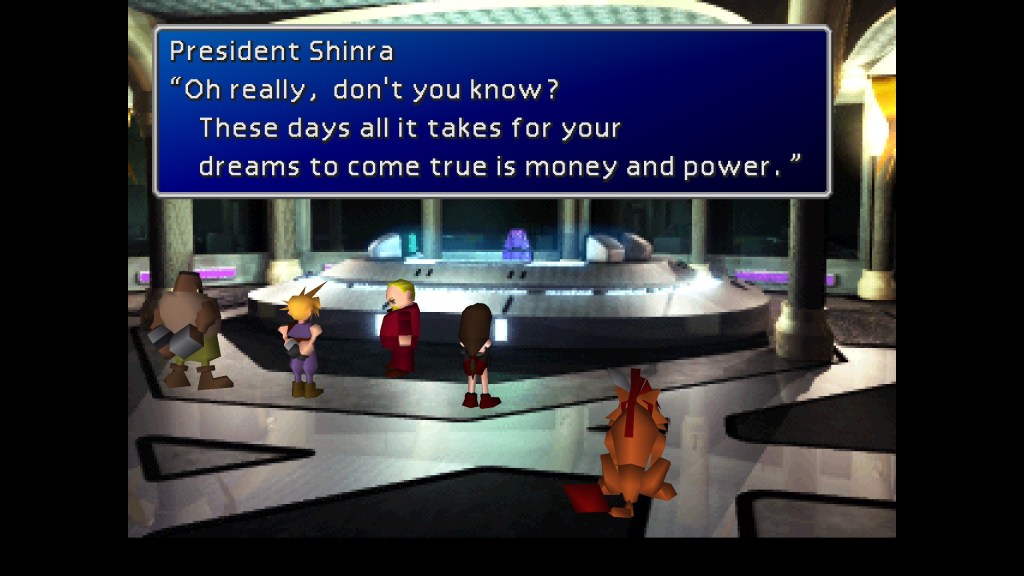
Heidegger and Scarlet don’t have a lot of actual personality traits in the original release of Final Fantasy VII. Heidegger has a really distinct laugh and leads Shinra’s security forces while Scarlet is exceptionally cruel and catty.
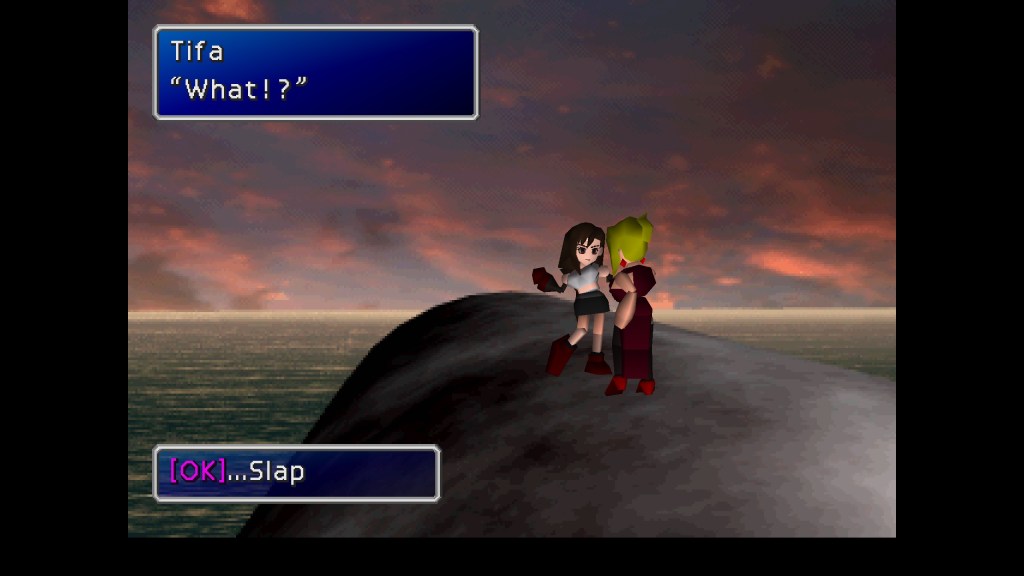
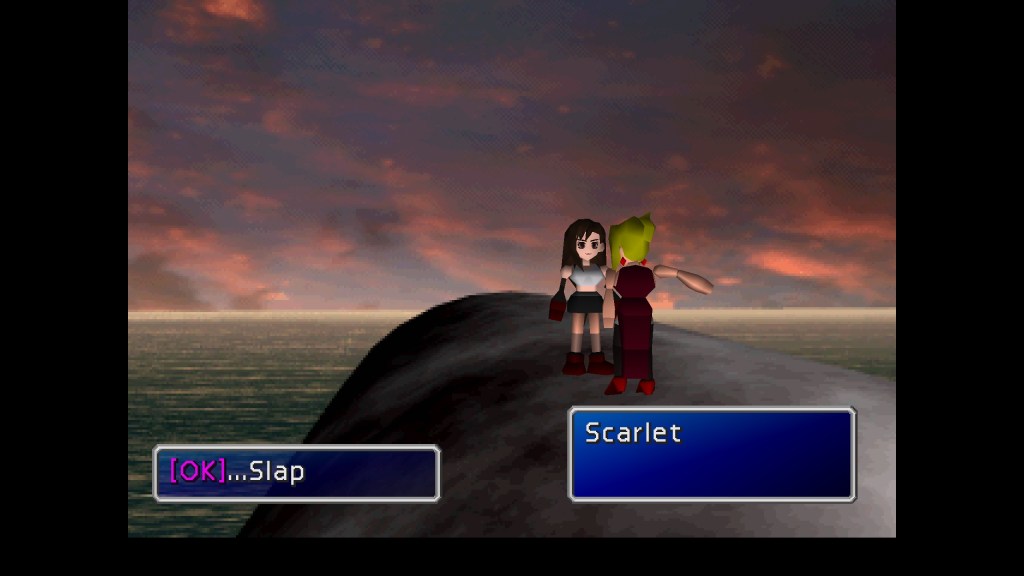
She also has one of the funniest scenes in the game. She engages in a slap fight with martial arts master Tifa on top of the gigantic canon in Junon (sister ray). Tifa is an expert martial artist while Scarlet is just some suit but they engage in a slap fight anyway. I pray this is included in the third game because I laugh every time I even think about it.

The closest you get to fighting Heidegger and Scarlet comes in Disc 2 when the party returns to Midgar. As you’re making your way to stop Hojo from aiding Sephiroth, these guys show up one more time in a giant robot called Proud Clod. The first time I played the game, I had access to a strategy guide and I was so excited for this fight because I misread it as Proud CLOUD. So I thought it would be like…a robotic Cloud the party has to fight.
No. Just a big robot.


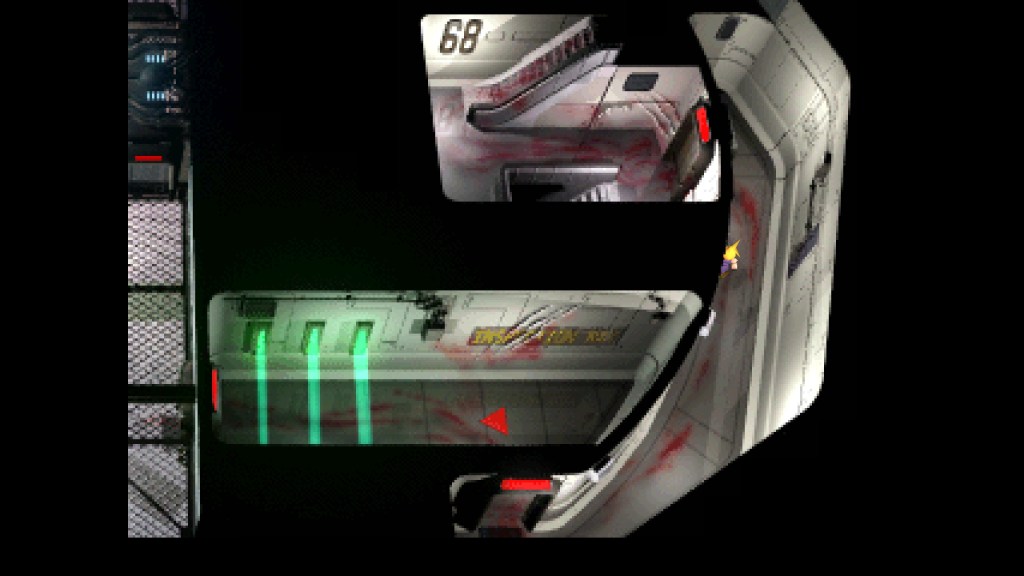
President Shinra isn’t in the game much at all. Much like Aerith, he exists to die. In one of the most jaw dropping scenes of the original game to a young Derek, Sephiroth breaks into Shinra HQ while your party is imprisoned there and mercilessly slaughters everybody. You see a trail of blood that leads up to President Shinra’s office. It’s an early way for the game to communicate how ruthless the main antagonist is.
The first FF VII remake did away with the blood covered floor, which I think really took the weight out of this moment of the game.

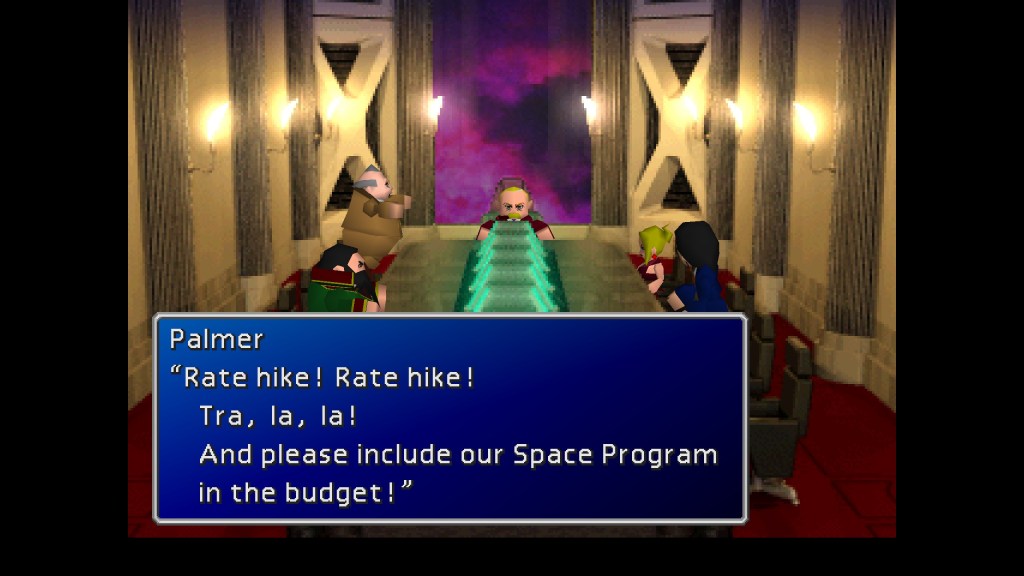
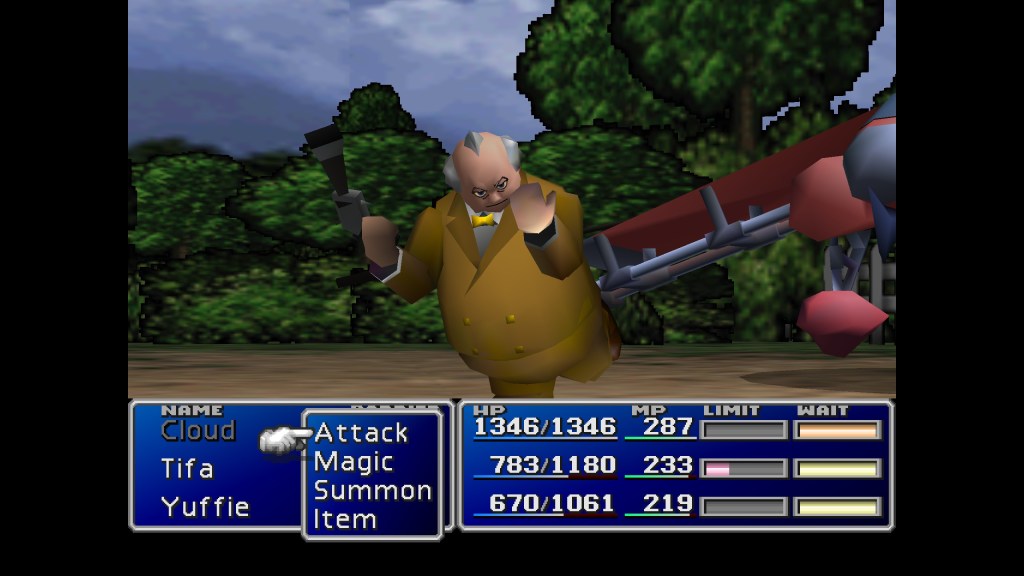
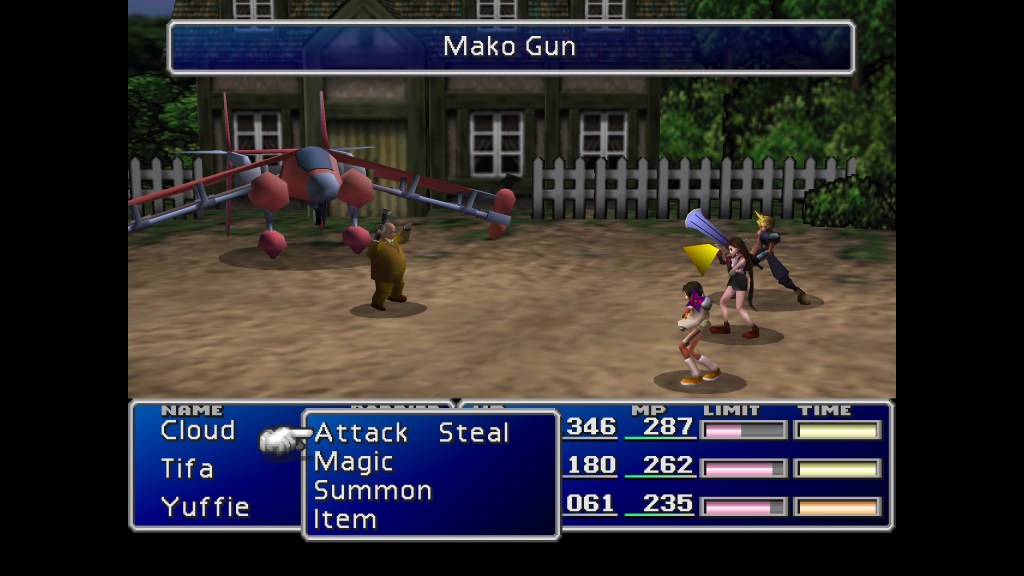
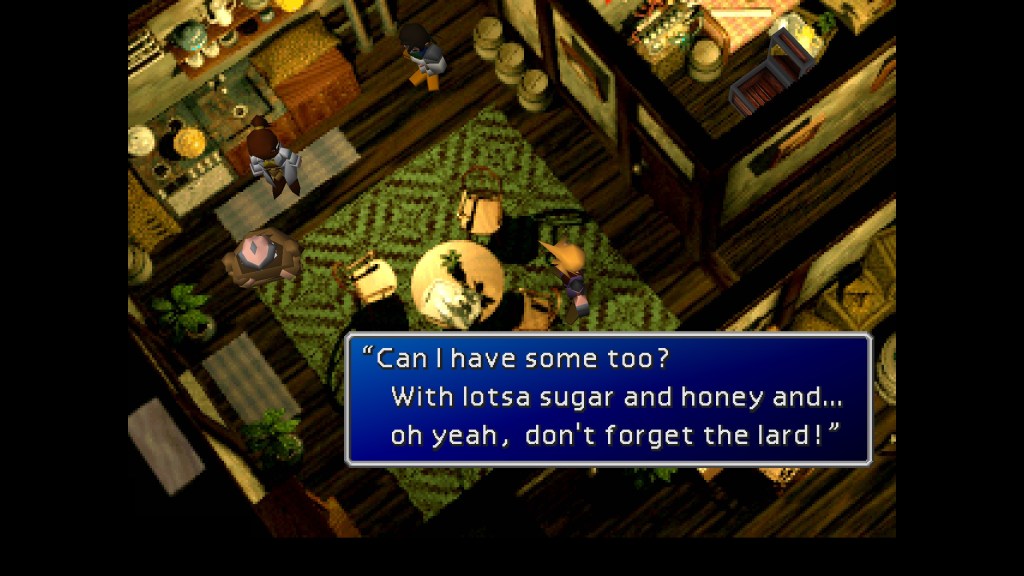
Palmer is in charge of Shinra’s Air and Space division. He is a complete goofball one-note character who basically exists for the party to laugh at. You see, he’s fat. And he’s dumb. A bit of an on-the-nose fatcat capitalist stereotype. I still guffaw at his scene in Rocket Town where he insists he gets lard in his tea. Lard in tea? Who even thought of that? Don’t think too much though, he’s just fat.
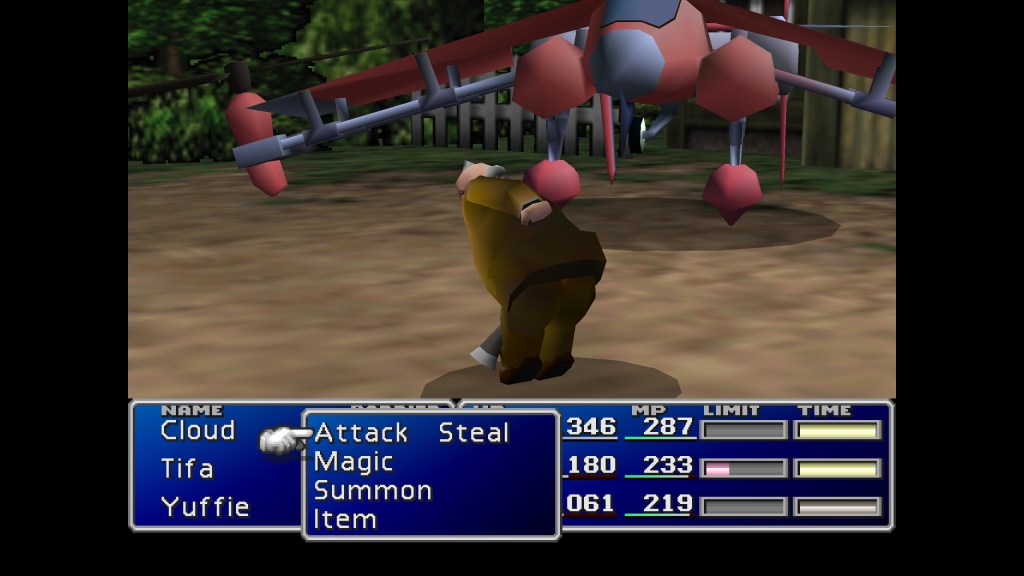
He’s also the only non-Rufus Shinra member you fight in battle. It’s a completely easy boss battle that just features him taunting at the party the entire time. Really, I think it just exists to make you feel good about kicking his ass. It’s very effective at that!

Lastly, there is Reeve. I feel like they go out of the way to show that he is the upstanding dude in Shinra. He has a sense of virtue. This is because he is secretly one of your party members, Cait Sith. We’ll get more into Cait Sith during his proper introduction. But I felt it appropriate to mention Reeve here since he is technically a Shinra suit.
How the remakes treat Shinra: Even more cartoonishly evil. They are so over-the-top that there is a zero percent chance that anybody out there could fall in line with them. I don’t foresee a bunch of stories on fanfiction.net about how Heidegger was the true brains behind Shinra the whole time. You might get some stuff about Scarlet since they lean hard into her being something of a dominatrix. But hey. That sort of thing is in style right now.
That mostly relates to Heidegger and Scarlet though. President Shinra still exists to die and Palmer has very little screen time compared to those two. Rocket Town was not included in Rebirth, so I suspect we will get more of his antics in part 3. I pray that they keep his love of lard in the game.
Rufus Shinra

Rufus Shinra is the son of President Shinra and he emerges on the scene extremely shortly after the death of his father. He immediately takes over his father’s company and acts as a secondary antagonist for the majority of the game. His aim is to follow Sephiroth because he believes the legendary warrior can lead him to the Promised Land, which as stated above is a place Shinra believes is full of infinite Mako energy.
When he shows up, there’s so much going on in the narrative that it’s a little bit shocking. You’re dealing with the assassination of the former head of Shinra, the re-emergence of Sephiroth and trying to get out of Midgar. So a new major force showing up on the scene and announcing his presence feels slightly intimidating. Like oh great, more odds to overcome.
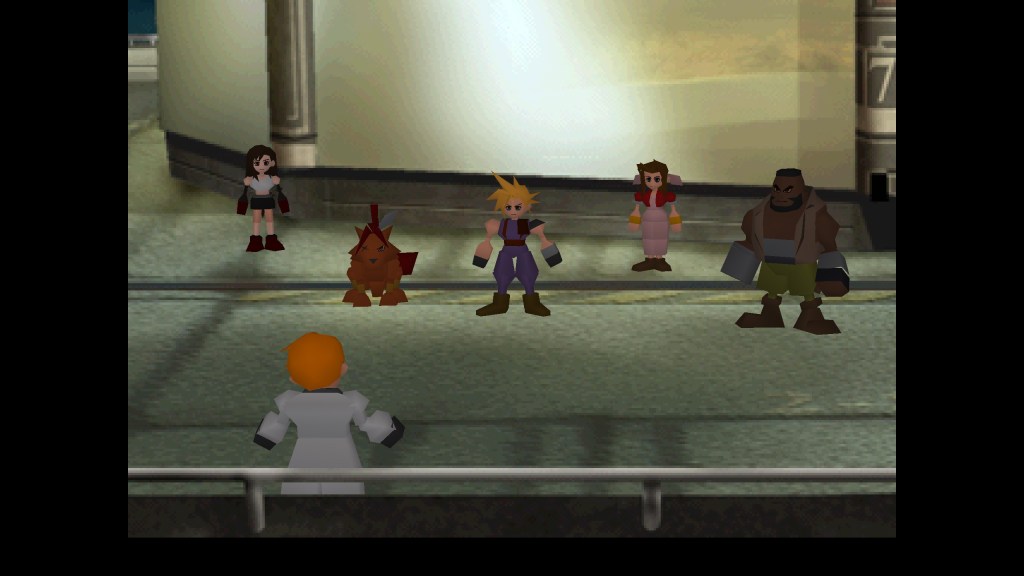
Rufus is an important figure in that he keeps Shinra from going purely insane. He always seems to have a plan and while his subordinates are cartoonishly evil caricatures, Rufus has his head on straight. He has a plan for what the Shinra can do and where the company should go.
This is best demonstrated in Disc 2 when Weapon (Diamond Weapon in this case) emerges from the ocean and marches towards Midgar. Rufus stays in a position that allows him to easily communicate to his subordinates and while telling them to fire the sister ray (a giant canon), Weapon attacks where Rufus is, which presumably kills him.

It’s a really cool moment for what had been a major villain to this point, it paints him in an almost positive and brave light. He went down fighting trying to defend the people as opposed to suck up more energy from the planet.
What follows is anarchy. Heidegger and Scarlet go mad with power and the once organized and efficient Shinra faction appear chaotic and unhinged. The company lost a leader once but a new face immediately showed up to settle things down, but there was no such event the second time and chaos was the result of that. Might have been interesting to see what a leaderless Shinra looked like in Disc 1.
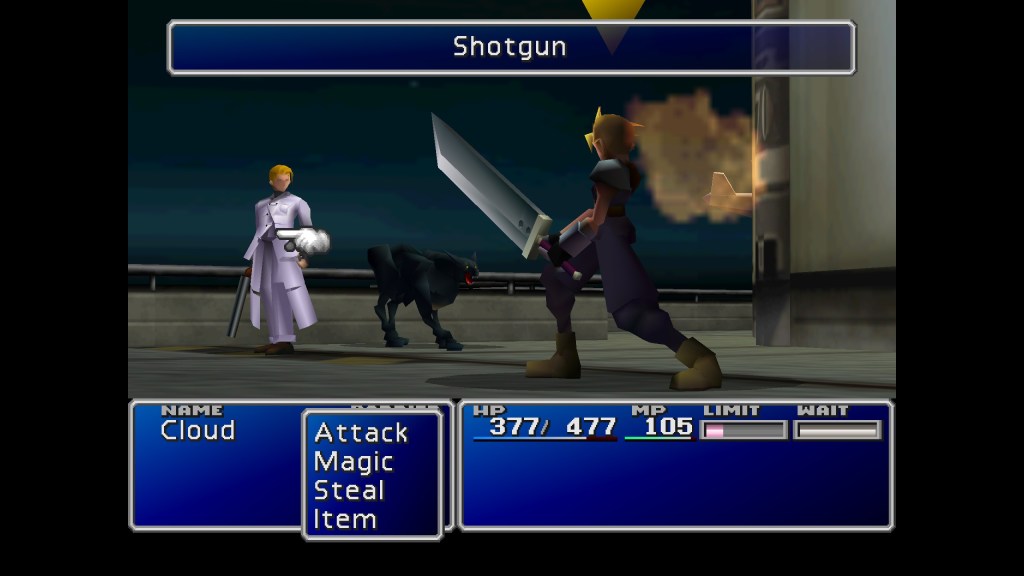
When Rufus shows up, you get one of the game’s more iconic boss battles. A one-on-two battle against the man himself and his pet Dark Nation. Solo bosses always stick out in your mind. Even if the Barret story in North Corel didn’t do anything for the player, they probably remember the showdown with Barret and Dyne. Final Fantasy IX players definitely remember the solo battle between Zidane and Amarant, even if it was fairly inconsequential.
It’s because they’re tense! One critical hit or slip up and you have potential of going down in short order. I’ve never found the fight particularly hard – once you kill Dark Nation, just use common sense on when to heal Cloud and you’ll probably win – but the circumstances around the battle as well as the threat of having to watch a lengthy story sequence again probably scared the hell out of players.
In subsequent materials, it is revealed that Rufus survived this whole ordeal. He gets crippled but he lives. I haven’t seen Advent Children or played Dirge of Cerberus in over 15-years but I feel like it’s a damn shame that they brought him back. His death was the defining moment of his character, it almost acted as a sort of redemption. He’s a bad man but he had principles. I plan on writing about Dirge of Cerberus when I get into the PS2 era so I am interested to see where they go with his guy. Assuming it isn’t just like a five second scene of someone saying “Rufus lived!” I guess.
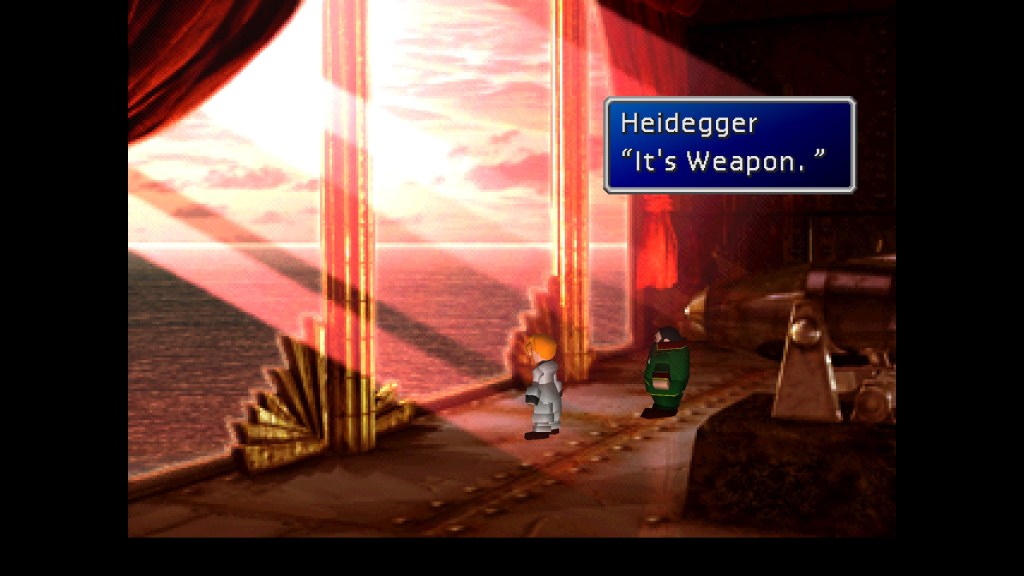
How the remakes treat Rufus: They really work hard on making him feel like a mastermind. A lot of cutscenes of Rebirth center around him talking to a mysterious man from his past who was in a high position of power in Wutai and scheming. For reference, before FF VII, and this is covered a little bit in flavor text in VII proper and in the prequel title Crisis Core, Wutai and Shinra engaged in a large war. Fears of another war with Wutai rage in the remake games and Rufus aims to stoke those flames.
They do a bit in Junon that would have been interesting to see how it plays out. It could have drastically changed the adventure of the party. We have three different scenarios they could have went with and they chose the most boring one. Scenario 1: Cloud and company form an alliance with Rufus to track down Sephiroth. A team up of the evil capitalistic force and Avalanche would have been wild to see. Scenario 2: Rufus gets assassinated. A chaotic Shinra emerges in the middle of Disc 1? How the hell would that have gone?
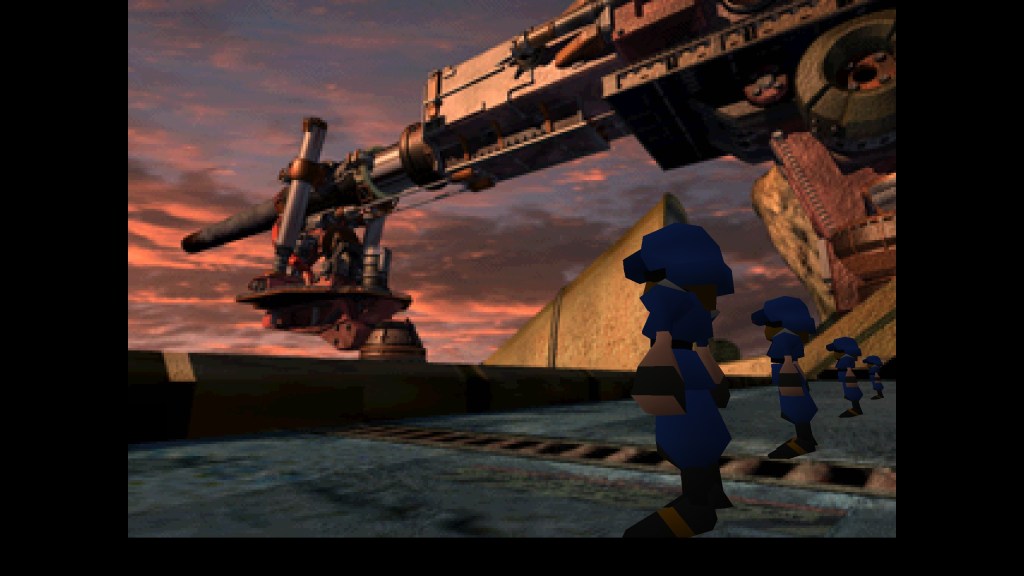
They went with scenario 3: Assassination attempt fails and Rufus blames it on our party and the game plot stays the same while teasing doing something different. I was extremely let down with this angle. What is the point of doing away with ‘fate’ at the end of the first remake title if you’re just going to stick to the same major story beats? As mentioned earlier, they tried to please two different audiences with this approach and wound up in a very unsatisfying middle.
Yuffie Kisaragi
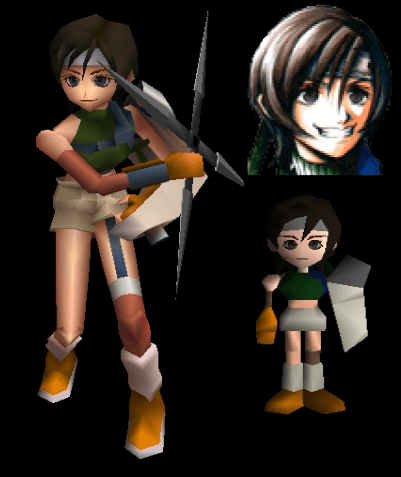
We have arrived at our first optional party member, the spunky ninja Yuffie! Missable party members were brought back from Final Fantasy VI but this time, they gave our extra crew a little bit of story to make it more worth the player’s time to hunt them out. Of course, since Yuffie is optional, she never appears in any cinematic. But hey, getting some additional text from your party is fine.
This is also the last time they do optional party members in the mainline game. I understand why, if you’re going to put work into making someone playable, you probably want to make sure the player can for sure get them to join up. I just think the ‘extra’ crew members added a sense of mystery to the game.
If you’re at school talking with somebody about FF VII and you say one of your main party members is Yuffie and the other person doesn’t know what you’re talking about, it makes them start to ask questions. Are there more hidden characters out there? What in this massive world am I missing? They might go and explore some and poke their noses in unusual places to find secrets. Maybe they engage with stuff they ignored before like chocobo racing or snowboarding. Or, uh, they buy a strategy guide.
The Internet makes this all pointless. Ignore me, I am an old man nostalgic for the days of when games were not cracked open for all their deep dark secrets on day one.

The party recruits Yuffie by encountering her in a random battle in a forest. I was actively looking for her in this playthrough and I think it took like seven or eight battles for her to pop up. So if you don’t know she exists and don’t just wander in the forests for no reason, you may never encounter her.
When she does pop up, Yuffie is just called Mystery Ninja and doesn’t really seem out of place or unusual. This game has a monster house as a random enemy, a ninja girl is just par for the course. As soon as the battle ends, you enter into a dialogue with Yuffie. If you choose the wrong option or enter a menu – there is a save spot in the screen where you speak to her – she will run away and you have to engage her again. I could see someone just figuring this character was another random element to this wild world and just moving on.
She doesn’t factor into the main plot, much like the optional members of FFVI. However she does have her own little side story. Yuffie is from Wutai and if the player winds up in the area, typically around when you get access to a vehicle called the tiny bronco towards the end of Disc 1, she will suddenly act very suspicious and just steal your party’s Materia. As you should know by now, Materia is pretty important to how your party operates in combat!
What follows is a fun little side quest where you learn more about the history of Wutai and Yuffie’s motives. Wutai was a once great nation that had cratered into something of a tourist trap since the days of war. Yuffie is extremely bothered by this and wants to restore the nation to its glory days. Maybe not go right back into a war with Shinra but she definitely wants to restore a sense of national pride. Wutai feels like a sort of commentary on post war Japan.
I think this part of the game probably caused a lot of people to quit playing for a while. If you don’t know it’s coming, it leaps at you out of surprise and derails your forward momentum. The first time you can go to Wutai is at the very end of the first disc. You’re trying to find the temple of the ancients, which is a pretty big moment in the narrative. So you’re stranded in a strange land, your fighting ability is nerfed and you have no idea when you’re going to see the main plot again? It can be frustrating!

I love it though. I think the surprise element really helps Yuffie and the Wutai quest stand out. You feel absolute rage towards her for betraying your party but once you learn her motives, it makes you appreciate her as a character.
You still might feel mad at her for being a thief but you get it. This portion of the game feels like a little slice of life out of the Final Fantasy VII universe and serves as a nice break from worrying about the planet – I think it goes a long way in explaining why Yuffie has been so popular over the years despite having very little impact on the overall narrative. She was in Kingdom Hearts for goodness sakes!
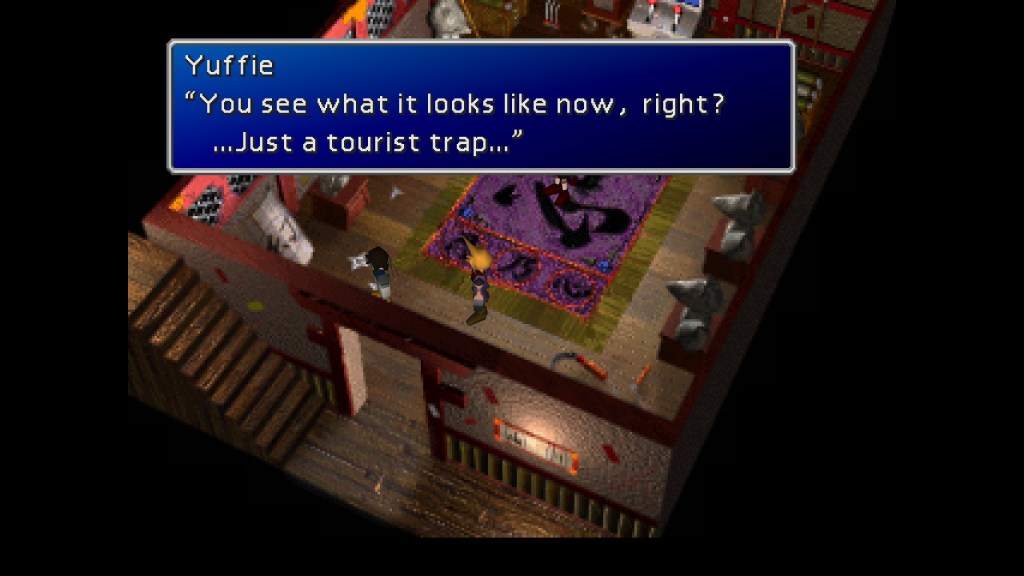


In my playthroughs, I would say about 50% of the time Yuffie winds up in the main party. I just like her spunk. I find that my boneheaded strategy of ‘just use the party members you like, dude’ works better in Final Fantasy VII than it does in most games. A benefit of the cast feeling very similar in combat I suppose.

How the remakes treat Yuffie: She was the star of the remake’s DLC. It was an interesting little narrative that established her motives and introduced some elements from Dirge of Cerberus into ‘mainline’ Final Fantasy VII. Square understood that she’s a fan favorite and treated her as such. Her characterization is pretty consistent with the original too. She is a goofball with pride in her country. Comic relief with a serious side.
She joins the party for real in Rebirth and is not optional. Yuffie is more important than ever! She was tasked with assassinating Rufus, which is what gets her to meet up with Cloud and company. I don’t know if I love the running da chao bean joke – I get it already, the beans are really hard to chew – but I do very much enjoy remake Yuffie.
Cait Sith
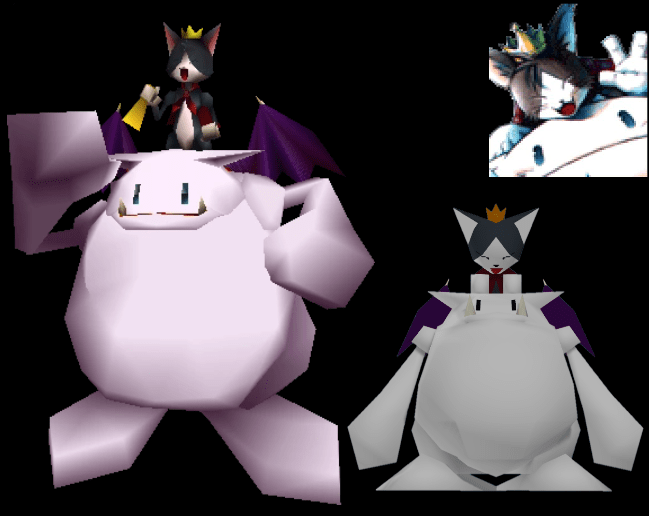
Cait Sith is a robotic toy like creature that joins the party when you reach the Golden Saucer. He acts as a fortune teller and uses a mysterious fortune – foreshadowing the death of Aerith – as an excuse to join up with your crew. He simply wants to see how it goes! Of course, this is all bullshit. Cait Sith is a robot controlled by Reeve of Shinra in order to keep tabs on Avalanche for Rufus. In other words, a spy!
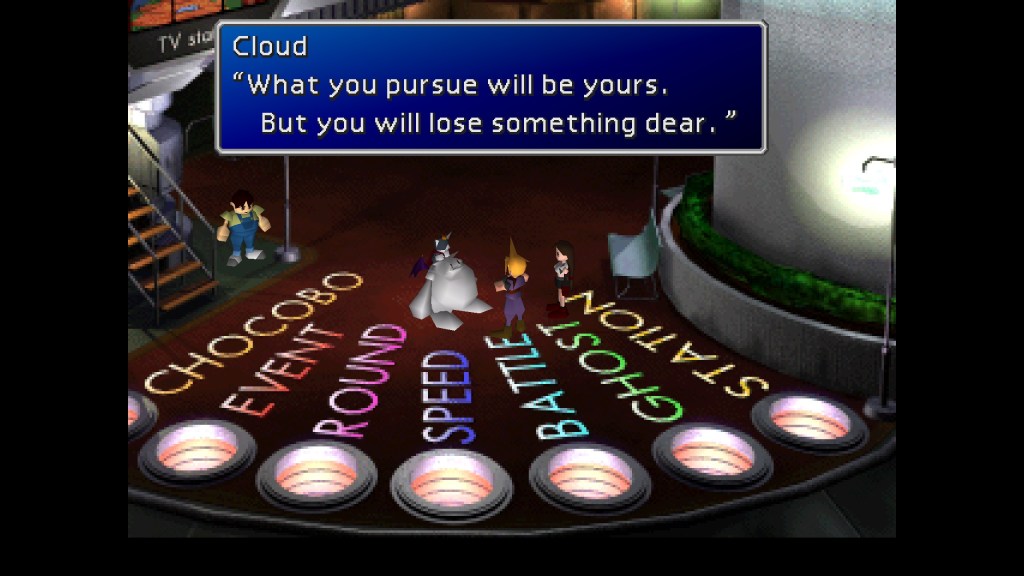
Mentions of a spy start popping up when the party reaches Gongaga – the hometown of Zack Fair – and the Turks are there waiting for you. How did they know you were there? Cloud claims to trust everybody. As someone who knows of Cait Sith’s true nature this part of the game can be infuriating because it’s so obvious what’s going on. Dude! Cloud! The weird cat mog thing that joined up with us like five minutes ago that you barely know is a rat! Duh!

Cait Sith is forced to reveal his hand when you start your trek towards the temple of the ancients. Your crew earns the key to that location in the gold saucer’s battle arena only for Cait Sith to immediately steal it and hand it over to the Turks. Despite this, Cait Sith says he wants to stay but the crew wants nothing to do with this. They can’t trust this guy! So what does Cait or more accurately the noble Reeve do?
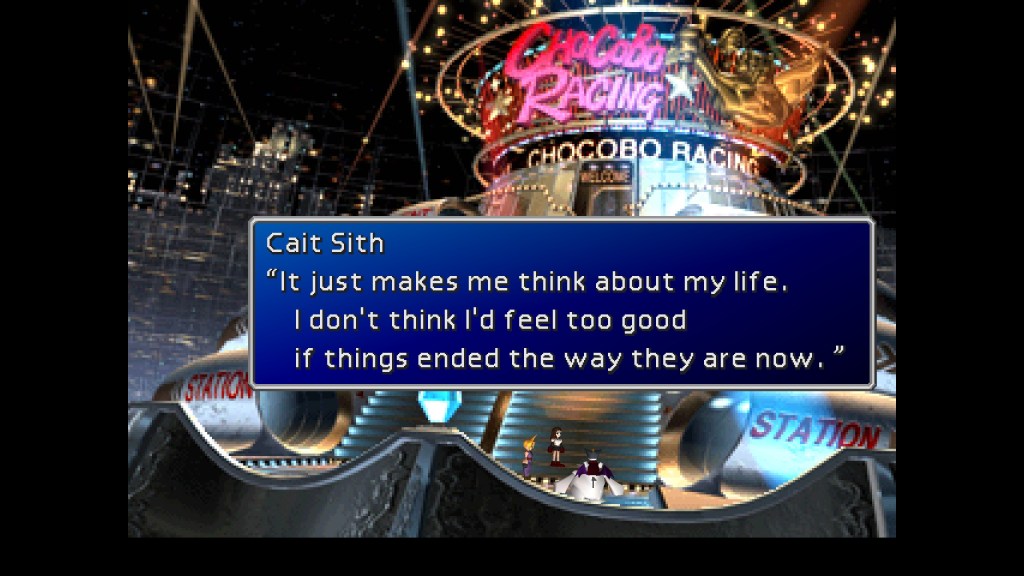
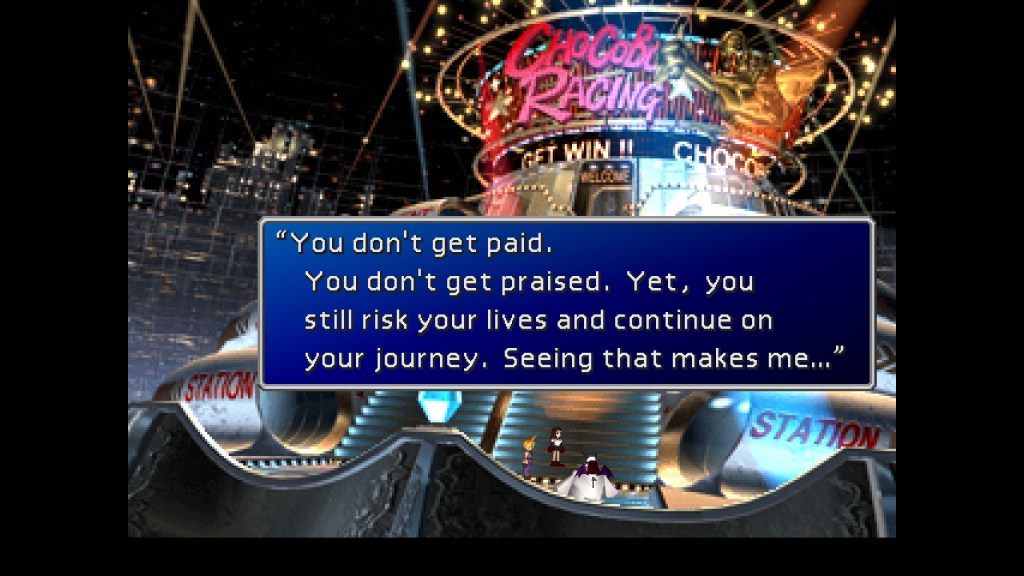
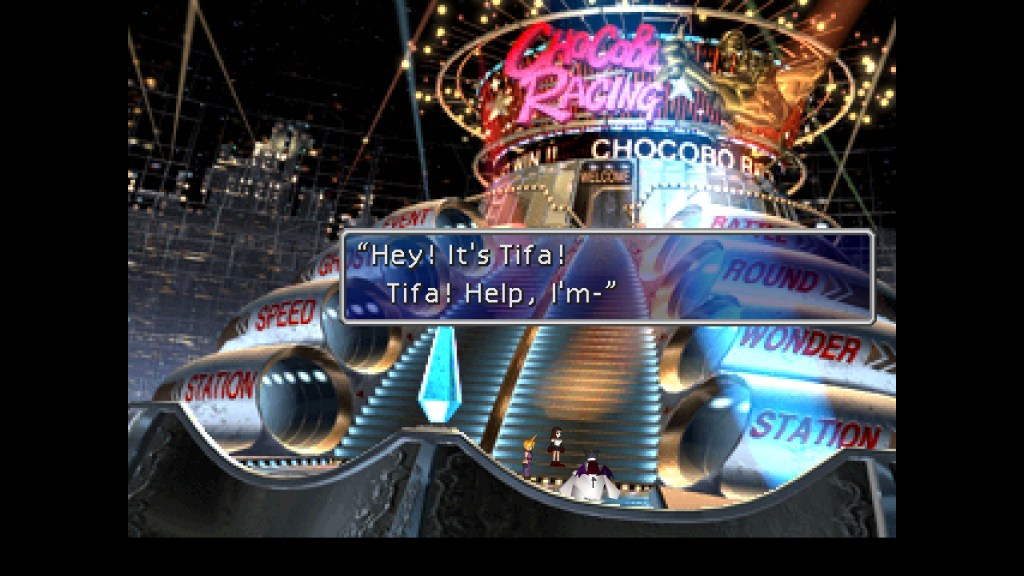

He makes a hostage out of Barret’s foster daughter Marlene in order to ensure he can stay in the party. In all subsequent playthroughs of VII, this ensured Cait would never touch my main party. You kidnapped and threatened a kid, dude! I wonder if anyone actually used him as a party member in the temple of the ancients? Does anyone love his slot ability that much that they’re willing to put up with this asshole?
As a side story, one of my first memories of Final Fantasy VII is when a friend of mine in middle school said he named the character Cait Sith after me. I didn’t know what he looked like or what his personality was, so I was honored to just be thought of. Now whenever I think of that, I’m like…heywaitaminute! That guy thinks I’m a joke! Innovative bullying by children, gotta love it.
Cait redeems himself slightly in the temple of the ancients. The party goes there in order to grab the Black Materia and keep it out of the hands of Sephiroth. More on what that is later. The temple has a gimmick though – the entire thing is actually the item you’re looking for! In order to get it, someone must stay inside of it and solve puzzles as the whole temple shrinks to handheld size. It will crush whoever is inside doing the puzzles…so do you know who is perfect for the job? The robot thing!
What follows is one of my favorite scenes in the game for how zany it is. Cait waxes philosophically about how he’s giving up his body for the party. Reeve is still alive! This toy doesn’t have any personality! Why is Aerith acting so sad about this? I love it but it’s just totally nonsensical.
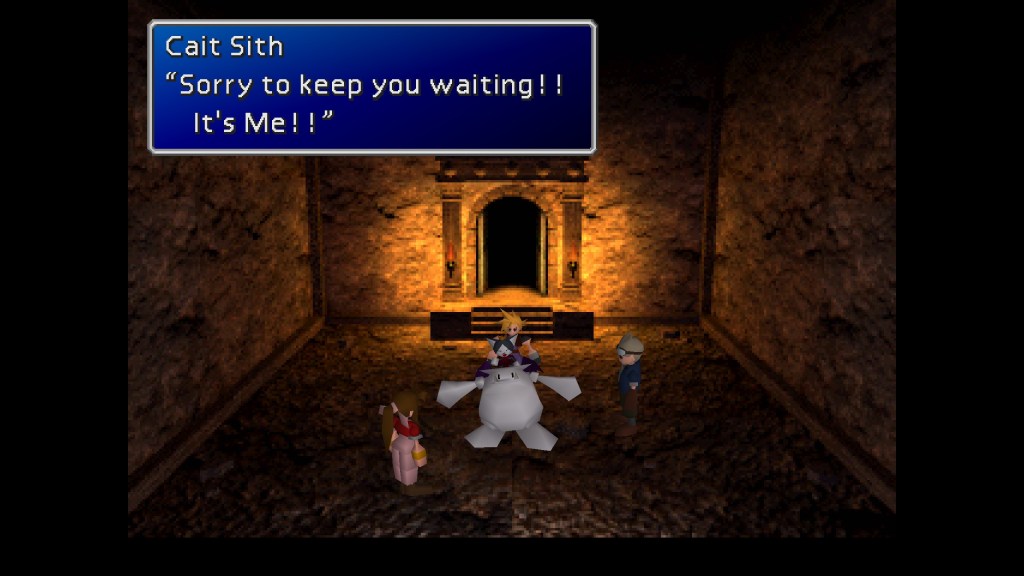
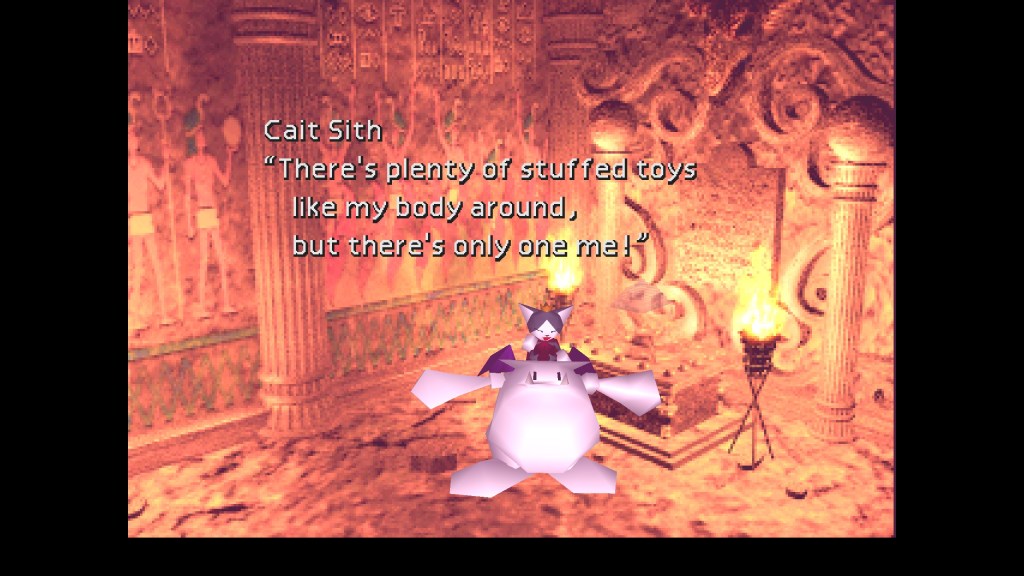
Cait Sith IMMEDIATELY shows back up, which makes the above scene even more hilarious. From this point on, Cait is purely a good guy who, while working for Shinra, sees what they do as ultimately bad. He’s sort of like a double agent at this point as he will inform the crew about what’s going on at Shinra from time-to-time.
That’s basically why he’s in the crew, to give you a look at the other side of the coin. I never quite forgave him for his acts in Disc 1 but they at least try to make the player like him afterwards. I can appreciate an honest effort.
Gameplaywise, Cait is a unique party member in that he only has two limit breaks. He has a gambling gimmick so his first one is rolling a pair of dice that will cause a random amount of damage to the opponent based on what numbers pop up on the dice. The second is slots, which…acts like a slot machine. It brings back the “instant death” mechanic Setzer had for his reels in VI for some reason, which absolutely guarantees this skill sees zero use from me. Or most people…probably.
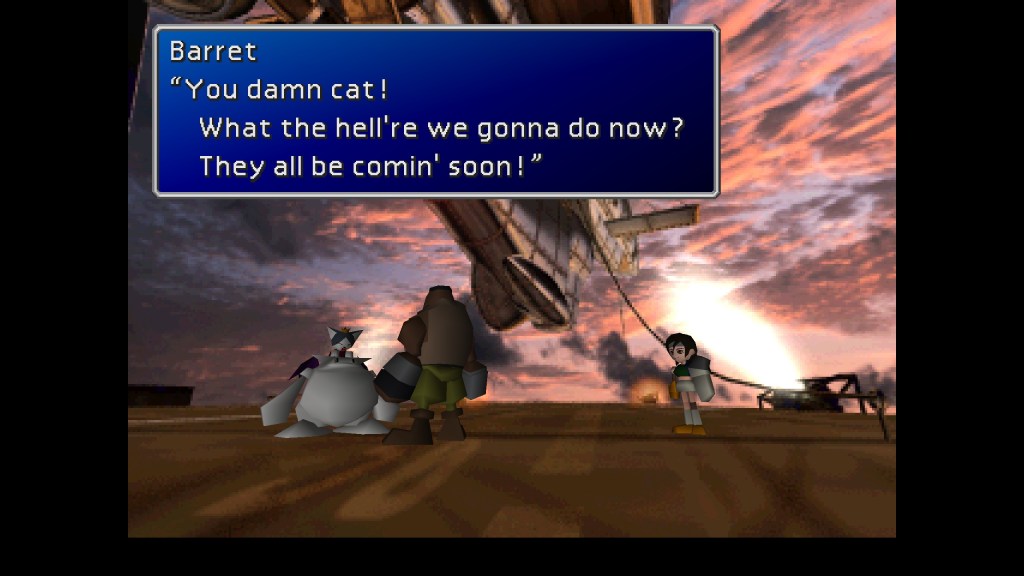
How the remakes treat Cait Sith: How he joins up with the party and him turning traitor with the temple of the ancients key still happens. But there are some key changes. Instead of blackmailing his way back into the crew by threatening Marlene, he simply leaves the party and acts sad. He seems regretful about turning on the fellas the instant he does it and he even tries the steer the party away from the temple of the ancients because he doesn’t want this scenario to play out.
This is so much infinitely better than in the original. It makes it so I can actually root for this guy when he comes back. Instead of being around in the temple of the ancients and then immediately coming back, he returns to the party when they are stuck and can’t figure out how to return with the Black Materia and lends a hand. He expresses sincere guilt about his actions and wants to make amends. I’m not saying Cait has become my favorite party member but I find this iteration of the character far easier to get behind.
I also want to talk about one of the dumbest scenes in video game history. In the first remake game, Cait Sith is seen reacting to the destruction of the sector seven plate. A pivotal moment in the game when Shinra is willing to kill people in Midgar and frame Avalanche for it. Note that I said Cait Sith is reacting and not Reeve. WHY is Reeve controlling Cait Sith and having him act all upset? Why isn’t Reeve acting upset? Why even control Cait Sith at this point in the game, he isn’t trying to spy on anyone? It makes no sense. It’s mindless fanservice. But it’s so absurd that it makes me smile.

Bugenhagen
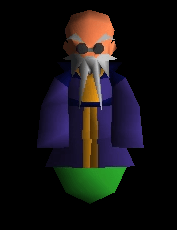
There seems to always be a character in these recaps that I use as a bit of a lore dump. That’s Bugehagen this time. To be fair, that’s sort of the point of his character. We are introduced to him when Red XIII takes the crew to Cosmo Canyon. He is the one who helped guide Red to the truth of his father. After this, he exists to tell you more about Materia, the Lifestream and the planet itself.
In my head, the PS1 model for Bugenhagen was impossible to comprehend. It looked like random geometry to me for years. He felt like some sort of alien being brought here by PS1 technology. I had no idea what in the world they were going to do with him in Rebirth so I was probably the most excited to see what his model looked like.
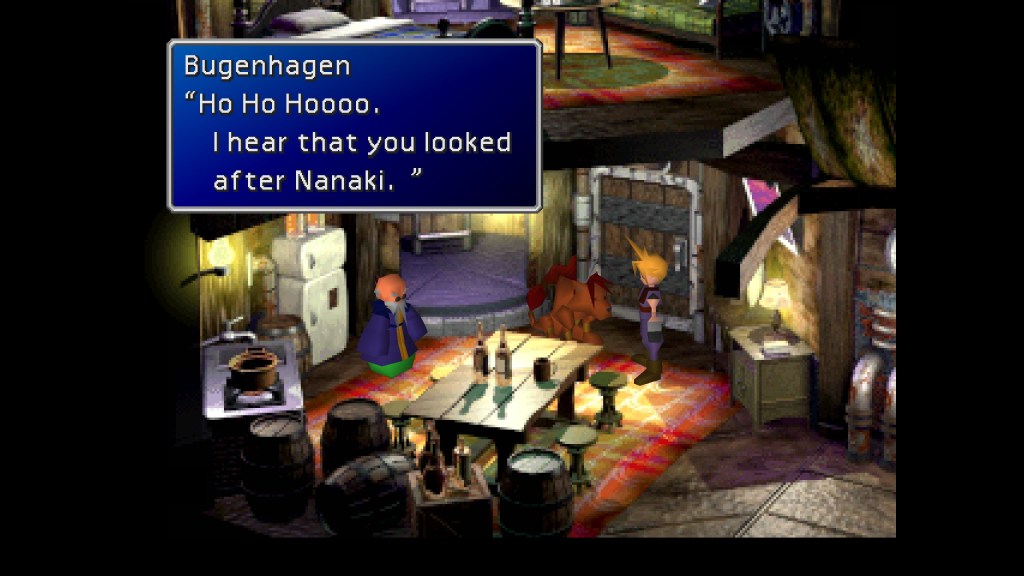
It’s just an old guy who floats around on an orb. And now that I know that, when I see PS1 Bugenhagen that’s all I can notice. It makes me kind of miss the days when graphics were up for interpretation but at the same time how the hell did I not notice that’s what they were going for with him? Made me feel dumb. Still, on this playthrough, I was delighted when I saw this mess of polygons floating around and explaining the way of the world to me.
Bugenhagen informs the crew on what the Lifestream is. It’s a term we’ve heard bandied about up to this point but you don’t actually know what it is until ol Buges enters the picture. In the world of Final Fantasy VII, all life emanates from the Lifestream. When a being dies, their essence returns to the Lifestream to be used again by the planet. In other words, it’s a very literal version of the circle of life. So when Aerith says that somebody has ‘returned to the planet,’ she means it quite literally. Their essence has returned to the Lifestream.
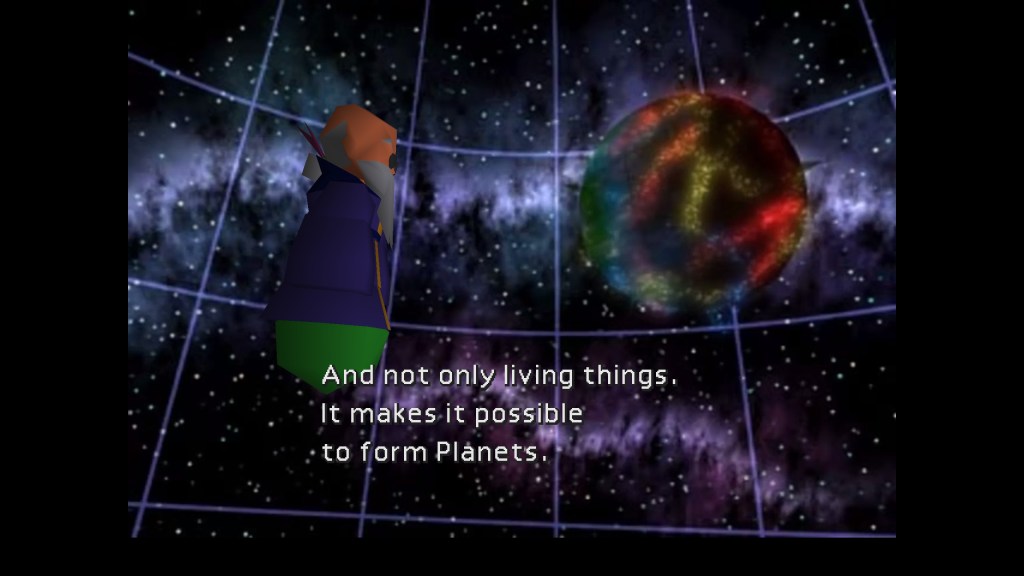
Shinra refers to the Lifestream as Mako. So Materia, power, technology, all of that is powered by the souls of people who once inhabited the planet. The evil company is essentially powering humanity with its ancestors. Tapping into the Lifestream disrupts the circle of life and is slowly killing off the planet as a result.
This is the true purpose of Weapon. If the planet needs healing on a wide scale, Weapon will kill a bunch of living creatures in order to restore the Lifestream. The planet must endure, the spiral of life and death must continue.
If the lifestream is depleted?
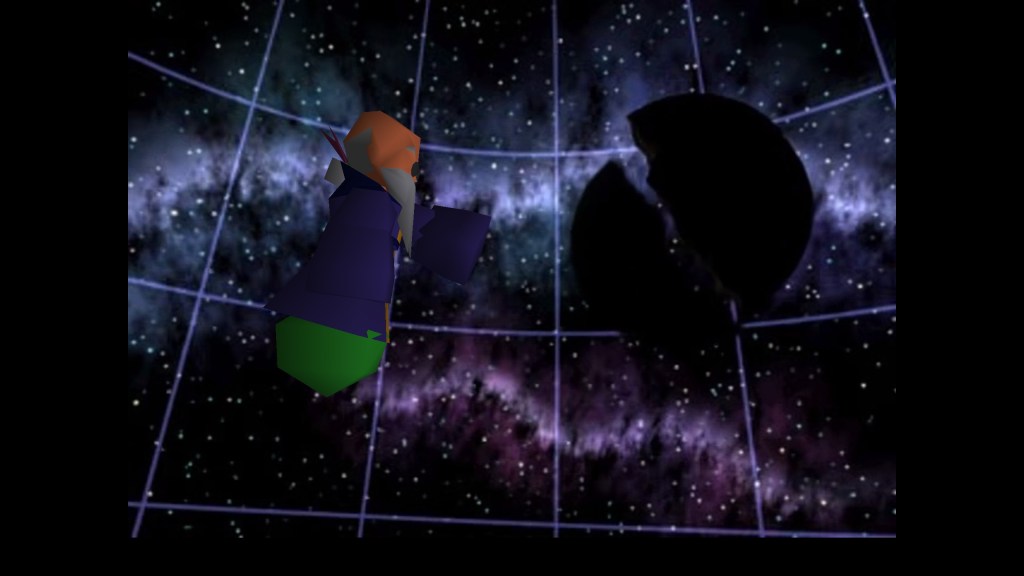
Only beings from this planet can return to the Lifestream. So alien beings like the Gi or Jenova can never ‘return’ there because they didn’t come from there in the first place. This is better conveyed in Rebirth than it is in the original as the Gi are shown as immortal beings praying for the death of all things so they can know rest.
Sephiroth’s ultimate goal is to insert himself into the Lifestream and absorb it to turn himself into a god-like being. The promised land, which you might remember is the source of infinite Mako, is essentially what he seeks. That’s why Shinra wants him. They want a big reserve of souls to power things. They call it Mako because that sells better than ‘former living creatures.’ Sephiroth wants a big reserve of souls to become a god. The planet wants that big reserve of souls to be left the fuck alone so they summon defenses to prevent that from happening.
Which sort of feeds into Sephiroth’s plan because the mass slaughter of people adds more stuff to the Lifestream.
Bugenhagen also describes what holy is and why Aerith knew that she was going to be skewered by Sephiroth, but I will save that explanation for a little later.
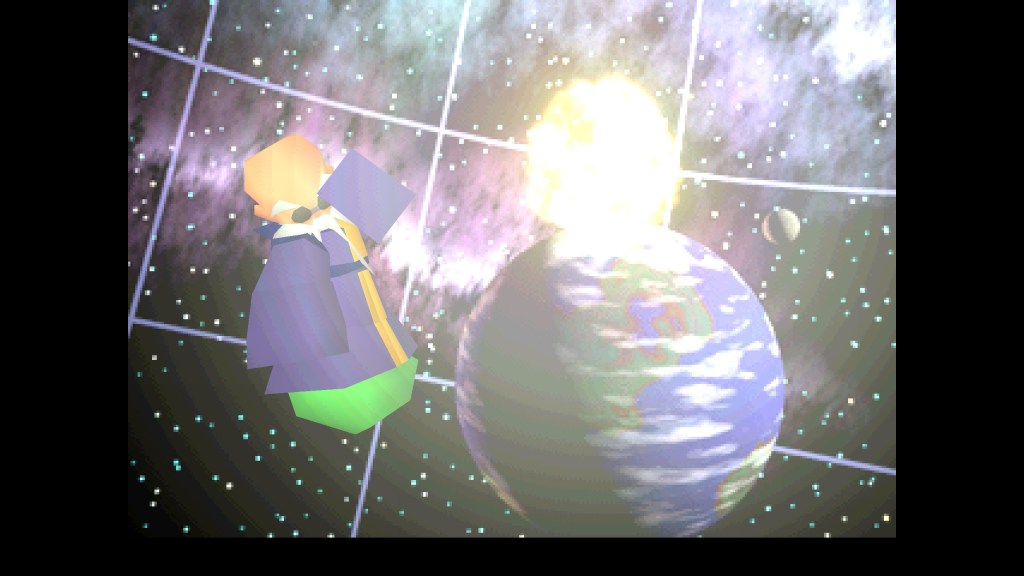
How the remakes treat Bugenhagen: Pretty much the same way as the original. He’s a lore dump facility. They lean into the study of the planet and the Lifestream pretty hard. There’s a bit of the game where Tifa falls into the Lifestream and gains an understanding of the planet and how it’s fixing to die. Bugenhagen and the people of cosmo canyon – less of a hippie institute in the remake and more of a place of study – treat her like an idiot who doesn’t understand the world.
It’s a weird scene because the player knows Tifa is correct. This kind of deflates the reliability of Bugenhagen as someone who knows his shit. If he’s so close minded to the reality of the world, why should we take his knowledge on the lifestream and the planet at face value? He might not know anything. Science? Who needs that shit.
Vincent Valentine
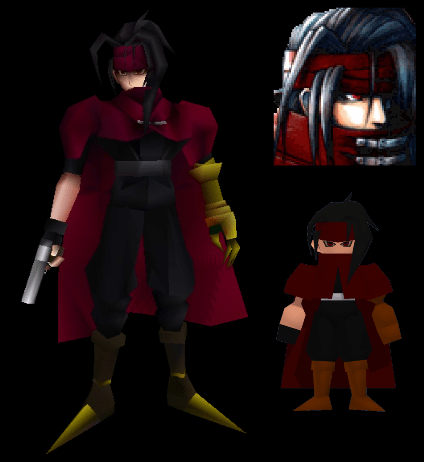
Your second optional party member. When the crew returns to Nibelheim, they have the option to go into the mansion there. In the Nibelheim flashback towards the beginning of the game, the mansion is where Sephiroth learns of his heritage, which leads to him razing the town and killing most of its residents. As a result, the player will likely come here in an effort to learn more about the big bad himself.
In the mansion, if you complete a small puzzle to find the combination for a safe, you can fight a secret boss known as Lost Number. It’s one of the more tricky encounters of the early game, particularly if you try to do this as soon as the party enters Nibelheim. Beating this boss will give the player a key to a room in the mansion’s basement that will lead to Vincent. Who is waiting for the party in a coffin.
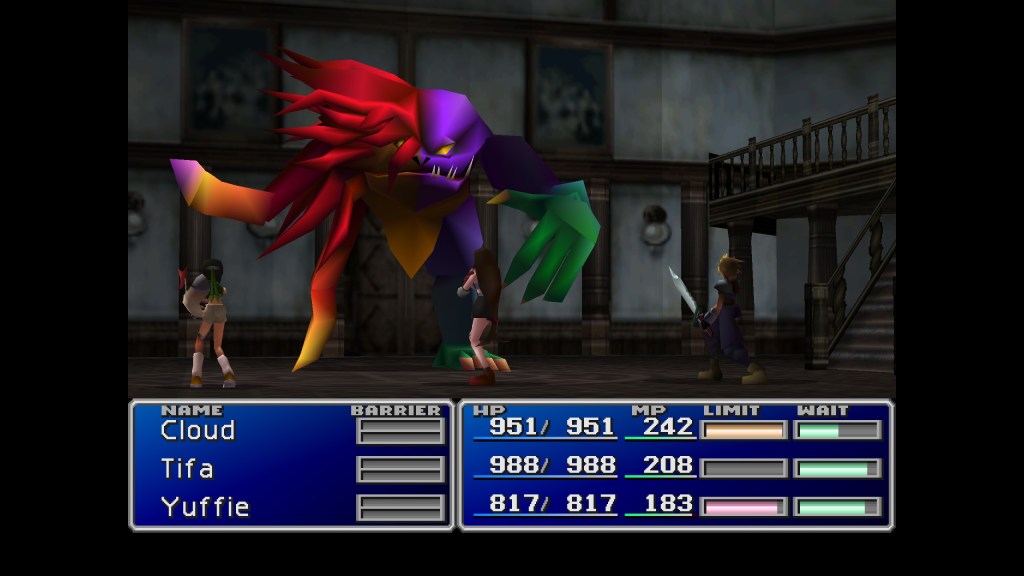
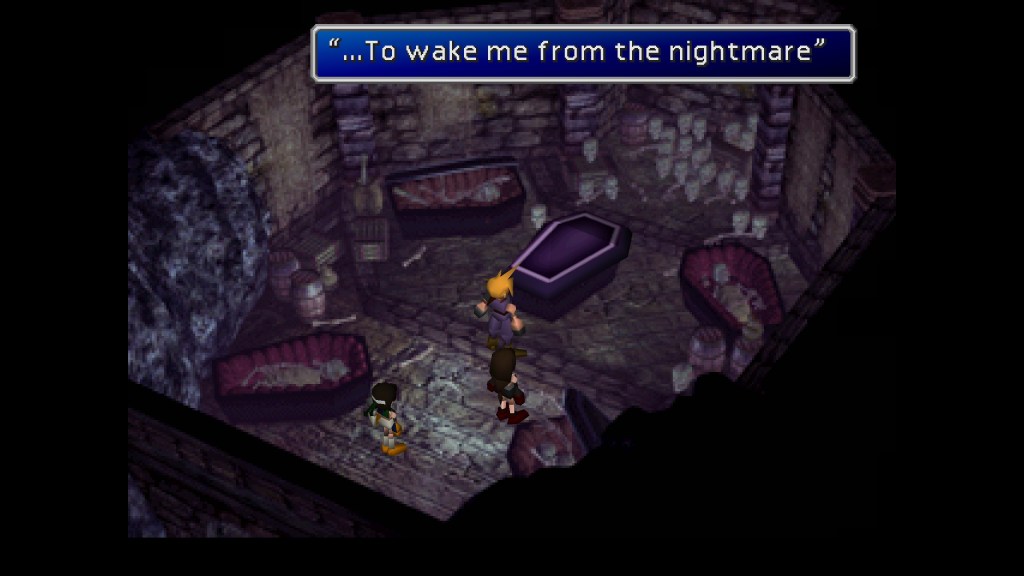
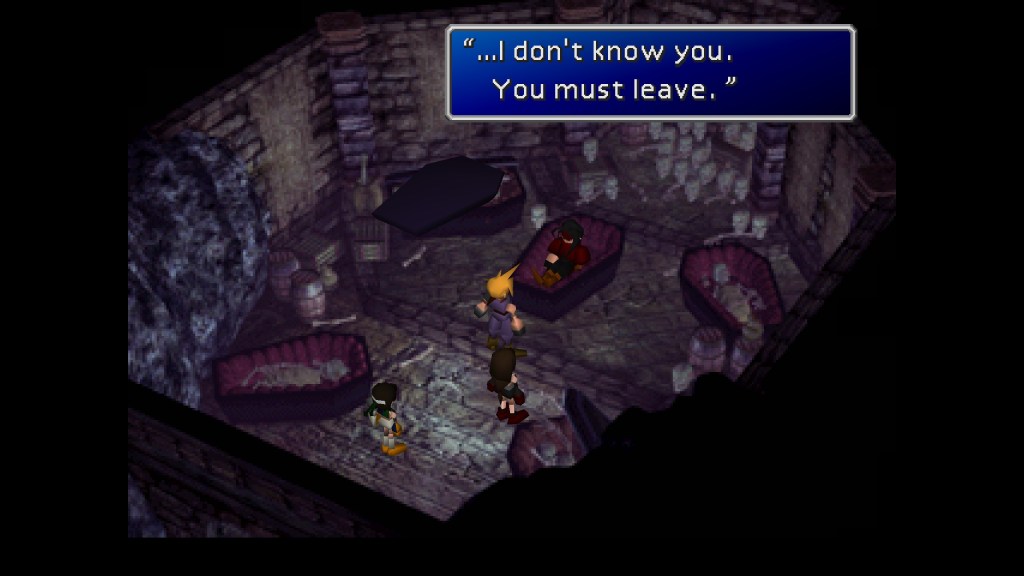
That’s an immediately odd thing about the encounter and it makes Vincent stand out. The player might think he’s some sort of vampire that accidently wound up in this cyberpunk-ish Final Fantasy title about environmentalism. He seems dismissive at first but will happily join your crew when it’s revealed that you’re hunting down Sephiroth. Turns out he has some info on that guy.
Vincent does not get a big side quest like Yuffie does. I think the little mansion trek is meant to serve the same purpose as Wutai does for Yuffie. It’s a unique little player experience that is off the beaten path. That isn’t to say his contributions to the story ends there. This secret character carries with him some Sephiroth lore. You have to go to an out-of-the-way location on the world map in order to learn of it, but it’s kinda wild that this material is mostly contained to side content.
There you learn that Vincent was once the body guard for a woman named Lucrecia. He loved this person but he was not HER love interest. He was fine with this, Vincent just wanted Lucrecia to be happy. She formed a relationship with Hojo, a Shinra scientist. Lucrecia became pregnant with Hojo’s child. The name of that child? Sephiroth. You learn the true identity of Sephiroth’s mother in an optional scene that most players will likely miss. That’s crazy.

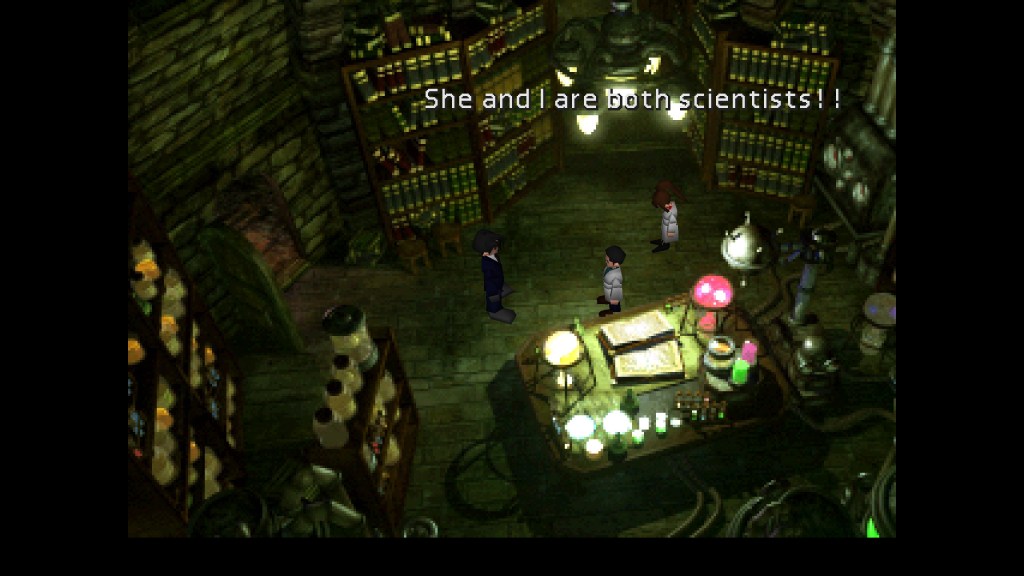

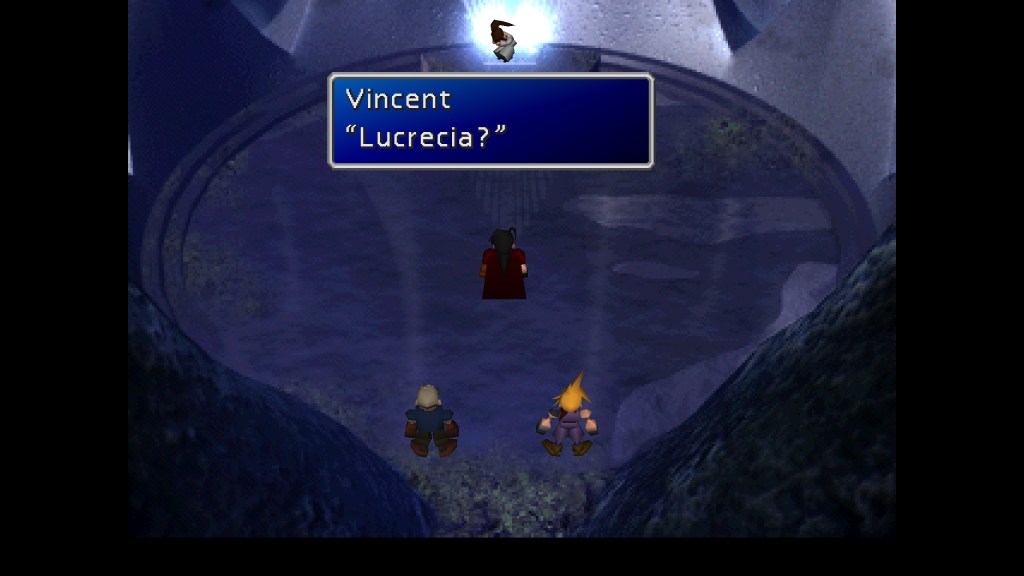
You do learn Hojo is Sephiroth’s father during the main game, but this little bit of lore is lost on the player unless they recruit Vincent and go out of their way. This backstory is explored in depth in the spin-off PS2 title Dirge of Cerberus, so I imagine far more people are aware of this now than they were in 1997, but it’s wild that a crucial bit of information on the main villain is in such an obscure location.
Vincent’s limit break involves him turning into various beasts. This is the result of Hojo performing experiments on him. You cannot control what these monsters do in battle but they stick around for several turns and cause large chunks of damage to foes. Since you can’t control them, I rarely use Vincent. That was my hang-up with Gau as you might recall. I’ve seen strategies people use involving Vincent’s limit breaks that can destroy Emerald and Ruby Weapon extremely quickly, but that’s not for me. Sorry for failing you!

How the remakes treat Vincent: Vincent is in Rebirth but he doesn’t really get much play. He’s a boss fight in Shinra mansion and he tags along with the party, but he doesn’t do much of anything. He just broods and acts mysterious. So I guess it’s kinda faithful! But he’s supposed to be a main character now.
I get that him showing up when he does makes narrative sense – why would the party go BACK to Nibelheim in the third game? – but I might have considered introducing him in a different way and saving him for Part 3. He just does nothing here.
Cid Highwind
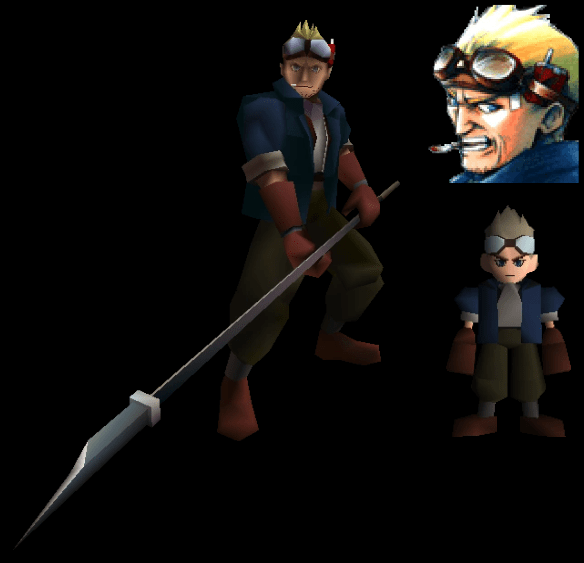
Final Fantasy VII’s take on Cid, the sixth Cid in the franchise. The seventh if you’re a blasphemer who considers new dialogue for Final Fantasy I canon. Just like all previous incarnations of Cid, this guy has an affinity for airships and technology. He falls into a more ‘mechanic’ archetype than past iterations, but the basics of the character are still there. He believes in the power of science, even if he can’t communicate it in the same way as, say, FFVI’s Cid. They start to play loosey goosey with Cid in the next game.


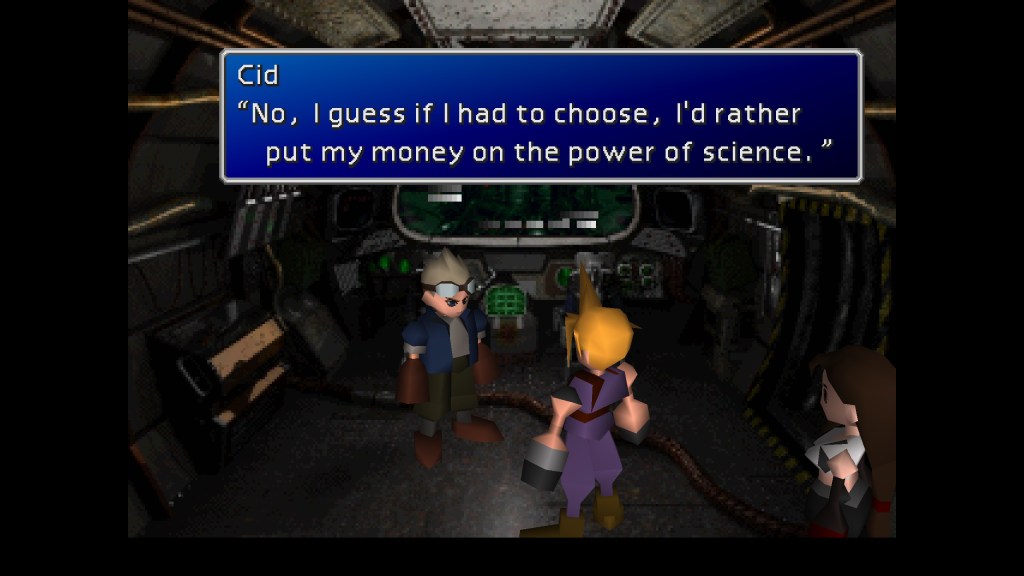
Before getting into his character, I want to talk about something I noticed for the first time on this playthrough. I have finished this single player game with an unchanging narrative an absurd number of times but I never noticed that the character portrait for Cid has a pack of Cigarettes in his goggles.
I also never noticed the pack of cigarettes is also there in his battle model. Cid is a chain smoker, it’s a major part of his character, so I love seeing that represented everywhere. I feel really dumb for not noticing this before, especially since Cid is typically in my party.
You meet Cid towards the end of Disc 1. You know that Sephiroth has escaped north beyond the sea but your party has no means of following him. So when you enter Rocket Town, you get introduced to Cid and his vehicle the Tiny Bronco.

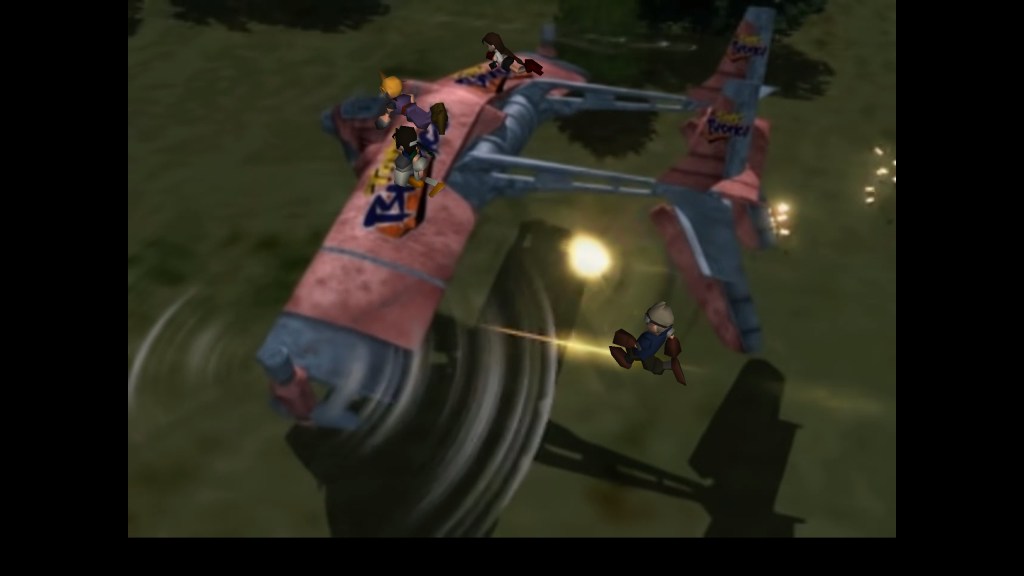
It just so happens that Shinra are also after the Tiny Bronco (I have no idea why, they have their own airship at this point in the game), so you have a minor tussle over it. The crew gets it, it gets shot down by Shinra but it can still float, which allows you to proceed. Just like the Cids of old, he is there to introduce you to a vehicle.
This Cid is unlike any of the others you’ve encountered so far. He’s gruff, he swears a lot, he smokes and he doesn’t seem particularly nice. He lives with a woman named Shera who he constantly berates and talks down to. One of the first lines you see from Cid is him cursing at Shera and telling her to get tea for your party. He’s a total prick.
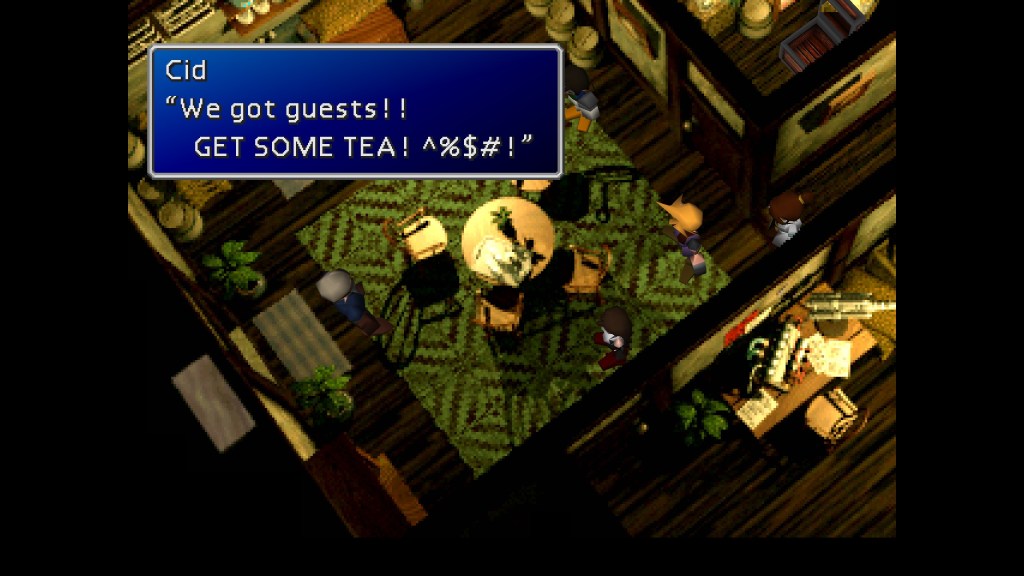
But he’s a prick for a reason. You see, it was always his dream to get into space. He was an employee of Shinra’s space program and was all set to leave the atmosphere and see the wonders of the universe. Shera was a safety inspector for this voyage and she held things up from launching because there was something fishy going on with one of the oxygen tanks. Liftoff was imminent and she was still inspecting.
If things went off as they were supposed to, she would be fried to a crisp. Instead of letting her die, Cid aborts the launch which leads to Shinra nixing the space program and Cid’s dream being abandoned. He will never get to go into space so it crushes him. His dream is dead and he’s bitter. He hates Shinra and he is resentful towards the woman who kept the dream from him when it was actually possible.

Cid just can’t move on, so he treats her like shit. It’s never explicitly stated why Shera and Cid live together, but I always took it as her feeling bad about the space program thing. And he just doesn’t care enough to tell her to go away. There might be some love there but it’s one-sided. It’s a complicated relationship, one the franchise really hasn’t experienced a lot of to this point.
He really hates the Shinra though, so our party gives him an excuse to cause some problems for them.
That’s why I like Cid. Having to continue living while your dreams fade around you is an extremely relatable experience. When this happens to people, they usually don’t just take it in stride and act like things are all hunky dorey. They lash out, they get angry and they take it out on others. It makes Cid feel like a three dimensional character. He is gruff on the surface, he hates life, but on the inside you can see he has thoughts and feelings about things.
As the game progresses, you see his attitude change. He’s still gruff, but he adopts a desire to protect the planet. In Disc 2, Shinra launches a mission in a desperate attempt to destroy Meteor. This involves reviving the rocket program in an attempt to ram something called a Huge Materia into it and explode. Cid finds himself on the rocket and finally gets to live his dream. He’s IN space. He did it.
Once up there, the very same oxygen tank that Shera held up causes problems for the shuttle, which causes Cid to realize that his grudge against her for all these years has been misplaced. She was right all along and she was merely doing her job. Yes, it took accomplishing his dream to realize this, but he does. And it helps shift his attitude and form a new perspective on life. Once seeing the planet from afar, he becomes resolute in the team’s goal to stop Sephiroth and save the planet.


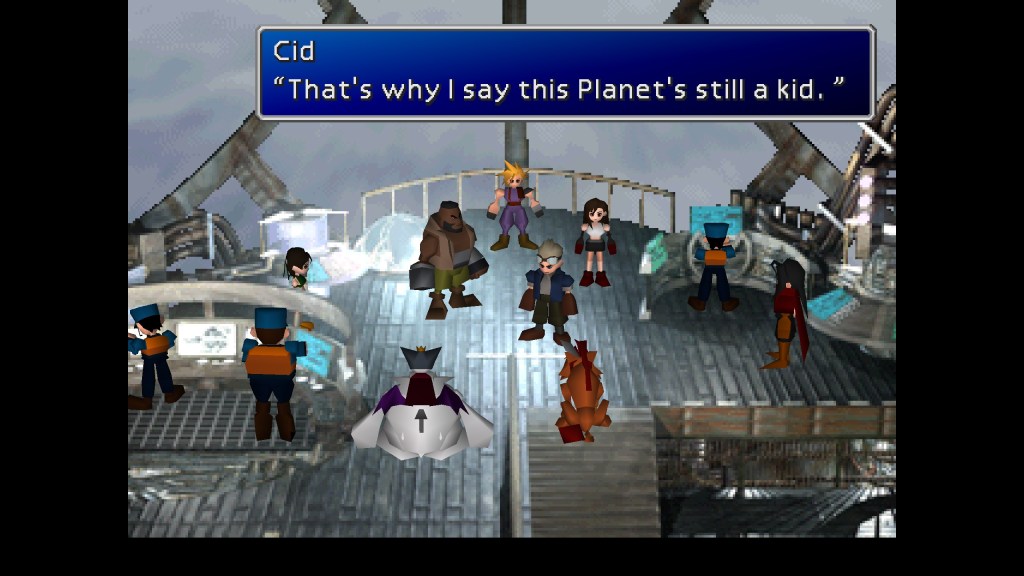
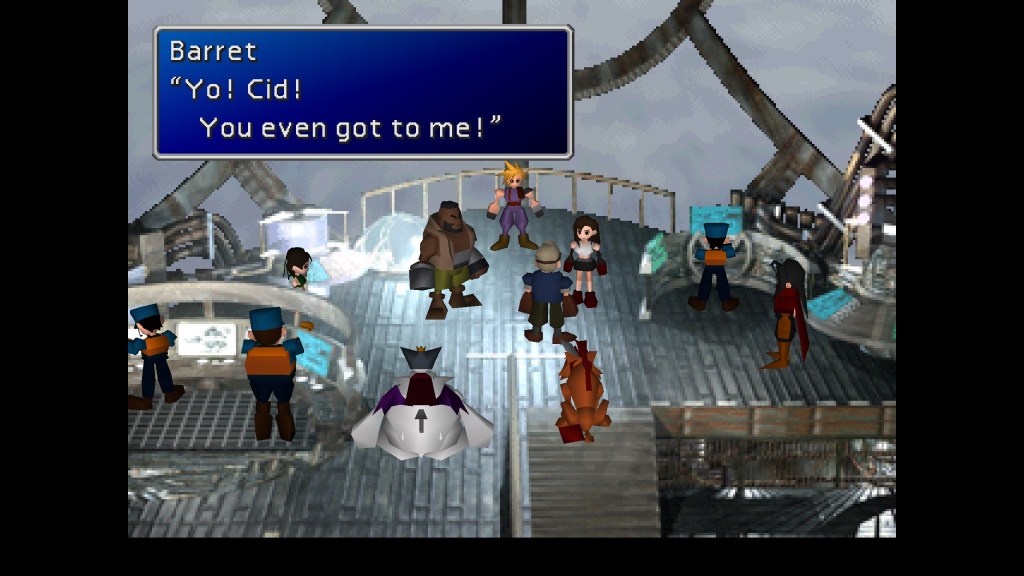
I love Cid because he feels realistic. He knows on the inside that he’s been rash about things and you can tell he’s got a bit of a soft and sweet side in there, but outwardly he is rough. We all know people like that. Cid is a deeply flawed individual who is ultimately a good person. Most people are not “all positive traits, no negative” like Aerith is. In a game about life and humanity, I find Cid to be the most human character of all. He’s not perfect, but he’s my favorite.
I also feel the need to point out that the party assigns Cid the role of leader during Cloud’s mental breakdown. Getting to explore the world with a different lead character is kind of interesting as you can see that person’s thoughts on the wacky stuff going on. Cloud sort of brashly approaches situations with a sense of confidence whereas Cid will sigh and grumble and do what needs to get done while saying something like ‘this shit is gonna blow up in our face.’
In combat, his limit breaks take advantage of his love of technology and also his smoking. His level 4 limit break, Highwind, specifically calls in your airship to assist him in combat. His second level one limit break is my favorite one in the game. In it, he uses his cigarette to light a stick of dynamite. It just takes advantage of his status as a chain smoker. It’s a little touch but I love it all the same.
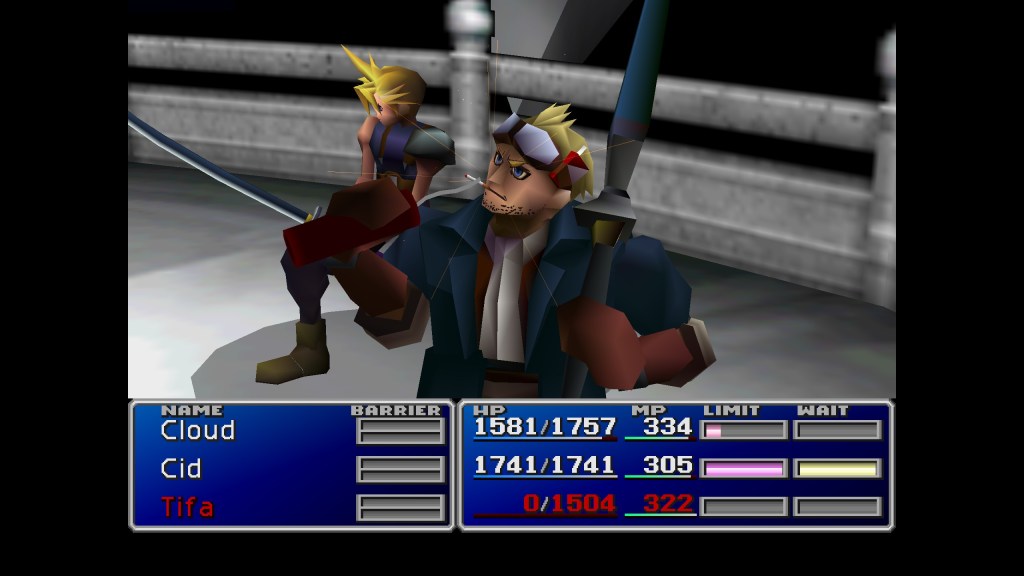
How the remakes treat Cid: Remake Cid is another character that absolutely did not need to be included in Rebirth. He is introduced to the party in order to bring about a fast travel system, but all of his personality traits are sawed off. He doesn’t seem particularly bitter at the world, he doesn’t swear all the time and he doesn’t smoke. HE DOESN’T SMOKE. Are you kidding me? His victory pose is taking a long drag of a cigarette. His character model and portrait have cigarettes in them. Really?
Instead, Cid is a boring character who has a sense of duty to the party because he knows Aerith’s mom Ifalna. The Rocket Town portion of the game has yet to be represented so maybe some aspects of his character will return, but as far as I am concerned Remake Cid is an entirely different character. He’s just an uber driver now with a southern accent. They can salvage him still, maybe, but if you took him out of Rebirth and replaced his character with…I dunno, Chadley?…you would lose nothing. That’s a shame.
Hojo
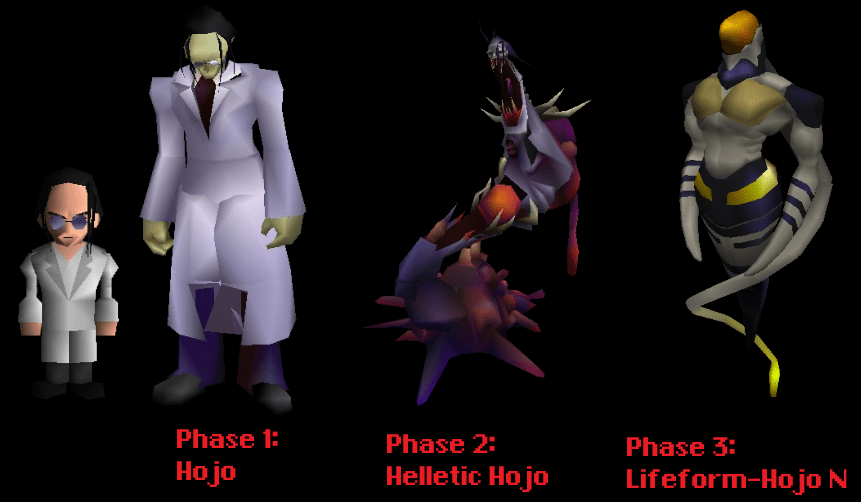
One of the primary antagonists of Final Fantasy VII. He is a man obsessed with furthering scientific progress to a comical degree. I feel it’s a controversial take to say that I never considered this iteration of Hojo to be an evil person. Amoral, absolutely, but not knowingly evil. He just has an insanely one-track mind and ignores everything that doesn’t help him further his goals.
You first run into him while rescuing Aerith from Shinra HQ. He’s there to perform experiments on the captured ancient in hopes of finding the promised land. The finding of this fabled location had been his goal for a long time. Before the events of Final Fantasy VII, a man named Professor Gast discovered an alien creature called Jenova who he mistakenly identified as an ancient (Cetra). Gast started the Jenova project in the hopes it could lead to the reproduction of ancients.

Hojo and the previously mentioned Lucrecia were part of the team performing research on Jenova. The pair formed a relationship, which resulted in a pregnancy. Hojo, obsessed with scientific progress, injected the unborn child with Jenova’s cells as part of the research on the alien and the ancients. This child would go on to become Sephiroth.
Sephiroth would go on to become a legendary warrior, so Jenova cells were injected into more test subjects. The telltale sign of someone being injected is that their bodies start to degrade and they become walking husks. In the game, these men wear black robes and prattle on about something called a reunion.

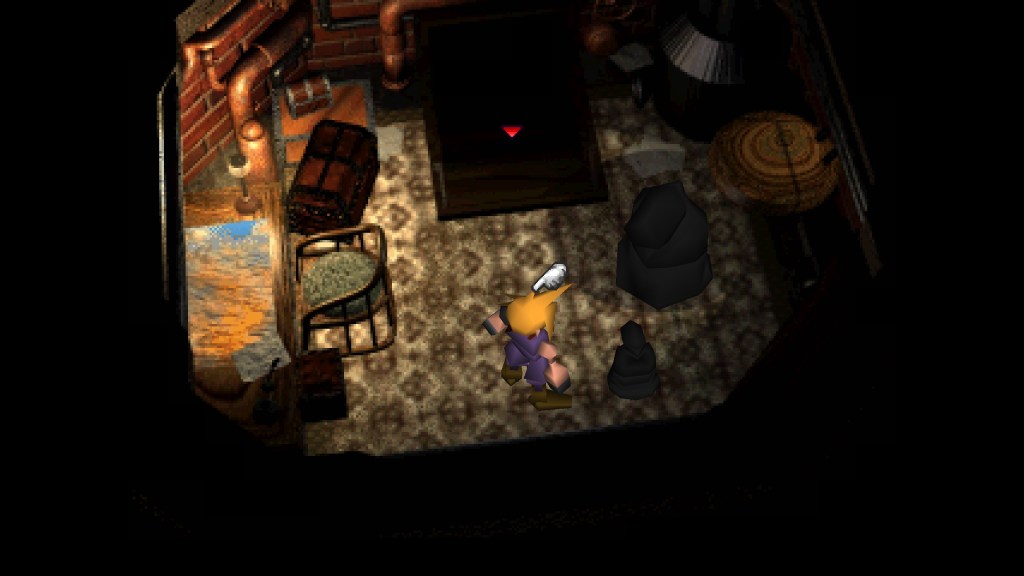
As a man of science, Hojo is fascinated by this. So he forms a hypothesis called the reunion theory, which states that all pieces of Jenova will gather together in order to reform the whole. This proves to be correct as folks injected with Jenova DNA all seem to be drawn to each other.
It is stated that all members of SOLDIER are injected with these cells and that their shortened lifespan and mental degradation has nothing to do with the Mako. This includes our lead character Cloud Strife, who gets injected with Jenova cells prior to the events of Final Fantasy VII.


As I said, I don’t know if I consider Hojo to be an evil person. He’s an inconsiderate jackass that is unrelatable and single-minded, and his focus leads way to some evil activity, but I don’t believe he thinks about anything beyond progress.
At the end of the game, he goes a little bit mad with power in an attempt to help further Sephiroth’s goals, simply because he wants to see if there is a power beyond what science can explain. He wants to see his own view of the world collapse, which is an interesting approach.
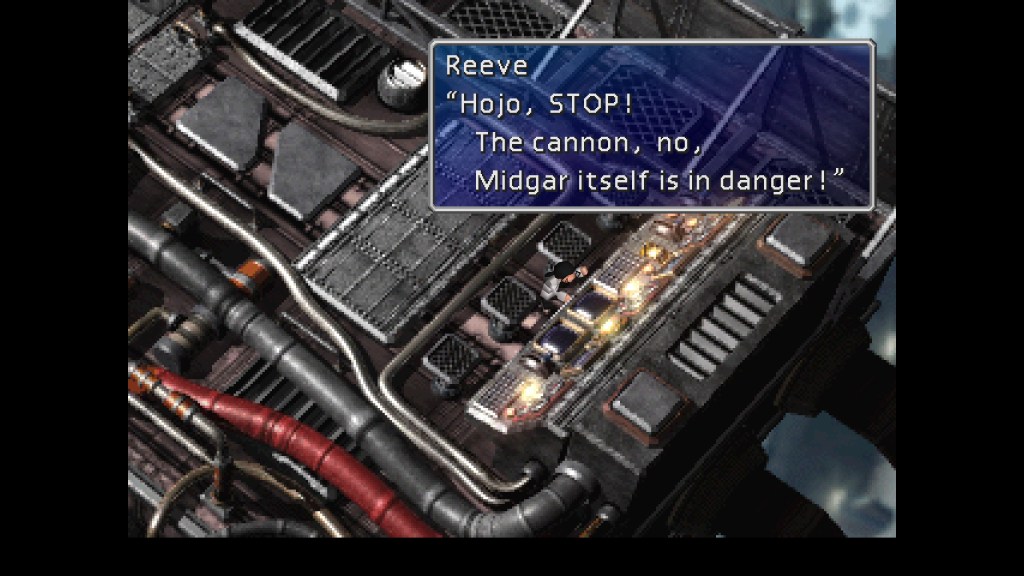


This leads to a boss fight and it’s one of the more intense battles of the game. Hojo injects himself with Jenova cells, which causes him to transform several times in a three-phase battle. You would think a fight with a man of science wouldn’t be so hard, but he hits your group with a bevy of nasty status effect.
If you aren’t ready for it, this can be one of the most trying parts of the game. Luckily, the game gives you two ribbons (an accessory that negates all status effects) relatively early on, so a player who has thoroughly explored the game world probably won’t have much of a problem with this fight.
For everyone else though? You might be in for a doozy.


One final thing I want to mention is a scene you get with Hojo when you visit Coasta Del Sol. You see the scientist on a beach lounging around with babes and he doesn’t seem to have a care in the world. He doesn’t care about you, he’s on vacation.
I like that even the single-minded Hojo takes a break from the grind to relax. I always look forward to the scene with the lounging Hojo, it just always takes me aback to see him just chilling there in his lab coat.

How do the remakes treat Hojo: In Disc 1 of FF VII, Hojo leaves Shinra because they don’t seem interested in his scientific progress anymore. In Rebirth, Hojo stays on with Shinra and instead antagonizes the party throughout the game. I think they make him a wildly more wicked character, one who is unmistakably evil. I don’t get the impression that Rebirth Hojo is as interested in scientific progress as the original one is, he’s just kind of a jackass. He undergoes the same “extreme comic villain” routine the other Shinra members get.
To be fair, in materials released after FF VII, Hojo is portrayed as an extremely sinister individual. They go into this hard with Dirge of Cerberus and Crisis Core. I am willing to admit that my readings on the man in my playthroughs of FF VII could be misplaced considering every other iteration of the character goes against what I think.
I look forward to giving him what he deserves in Part 3.
Jenova
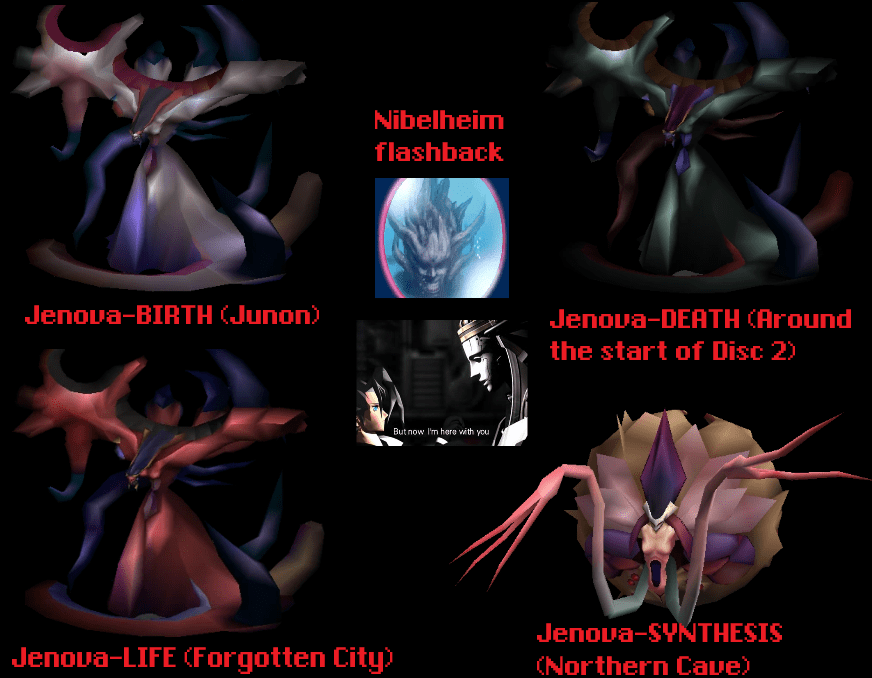
The alien creature behind countless experiments and the main conflict of the game. Most of the acts Sephiroth commits in the first portion of the title are actually carried out by Jenova. This creature has confused both characters in this title and real world people as to what exactly it does. Myself included. Regardless, Jenova is one of the primary antagonists of Final Fantasy VII.
Sephiroth’s mother Lucrecia was injected with Jenova cells and died during childbirth. Hojo did not tell Sephiroth the name of his mother because, well, he considered it irrelevant. Very in character. Instead he says that Jenova is the mother, so Sephiroth lives a wide portion of his life believing that.
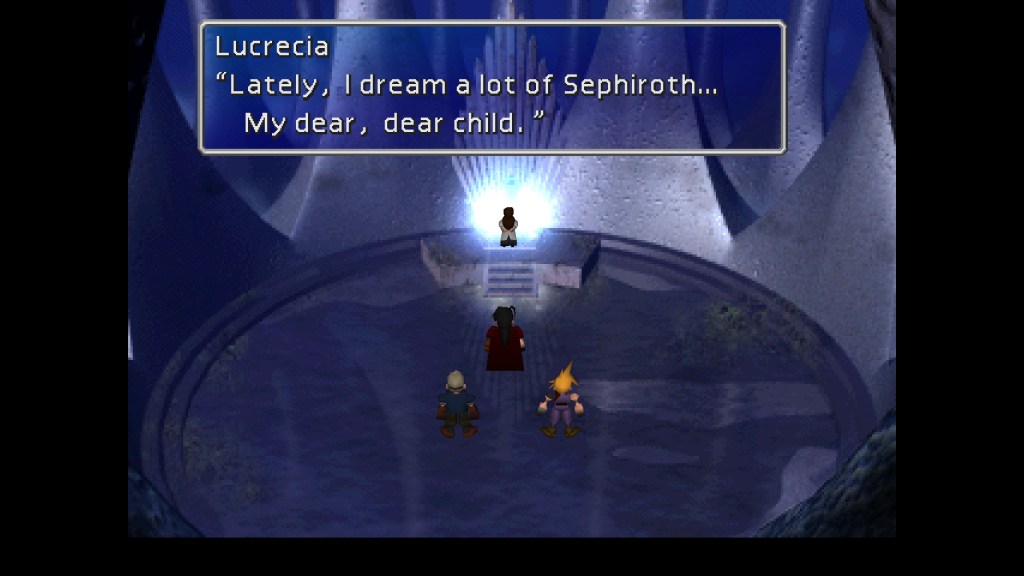
During the mission to Nibelheim before the start of the game, Sephiroth enters the Mako reactor there only to discover research materials on Jenova. He then goes to the library in the mansion located in town to learn more. And does he ever.
Because it was falsely assumed that Jenova was an ancient, all materials in the library talk about it as such. Sephiroth is then filled with the belief that he too is an ancient. Shinra and the human race are in the way of what rightfully belongs to his mother. So he goes mental and burns the town of Nibelheim to the ground. It’s one of the most iconic scenes of the game.
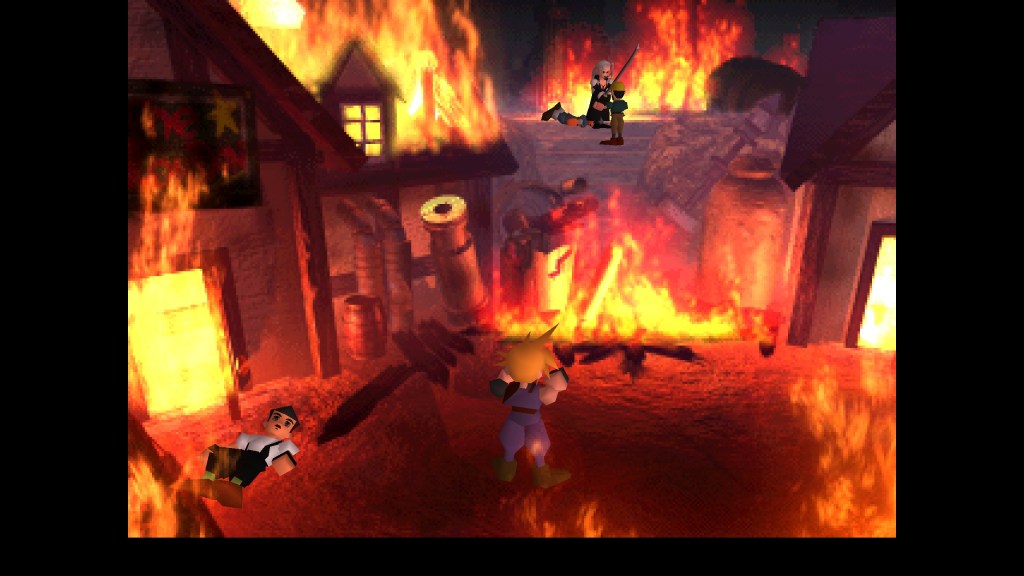
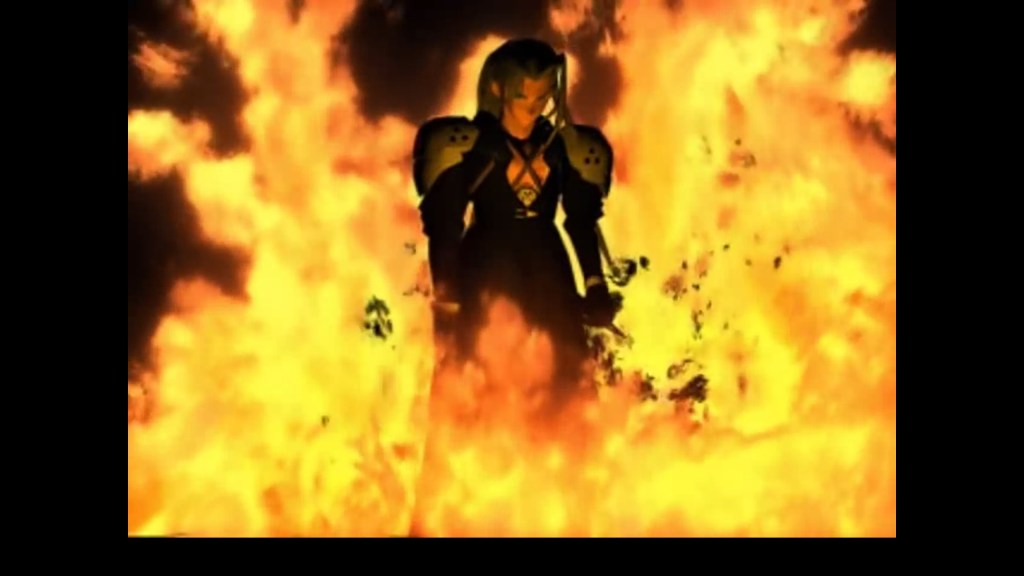
This is all false though. Jenova is not an ancient and is not of this world. She’s an alien. Remember in the bit above about how people not from this planet can’t return to it? Cloud legitimately kills Sephiroth in the flashback. That’s not something he made up. But since Sephiroth has Jenova genes in him that were implanted while he was in the womb, he can’t return to the planet. Instead he floats in the Lifestream, learning the truth of the world and the ancients.
In his stasis, he is able to control remnants of Jenova and have it do his bidding. Every single time you see Sephiroth in the game before the start of Disc 2, it’s actually Jenova. Jenova has the ability to transform and take the shape of others, which they point out a lot in the remakes because I think the nature of this creature is really confusing, so when doing Sephiroth’s bidding, it takes on the form of ol Sepphy.

This takes turn in gameplay when you fight Jenova. Most Jenova fights, save the last one, start out with it looking like you’re going to be fighting Sephiroth. But instead you fight the alien. Sephiroth actually is sleeping, so while the big bad wanted Aerith to die, it wasn’t actually him that landed the killing blow. It was a remnant of Jenova.
The boss fights are something else. I feel that they are probably the hardest parts of the game. The very first one you fight as your party is on a boat leaving Junon hits harder than anything you have fought before and if you’re not constantly healing and trying to buff yourself, you might lose.
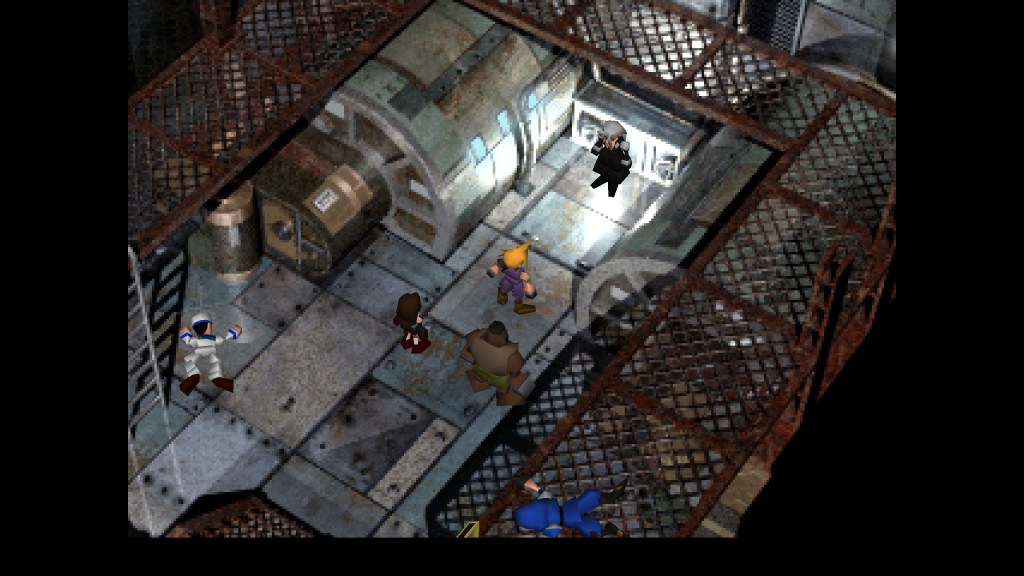
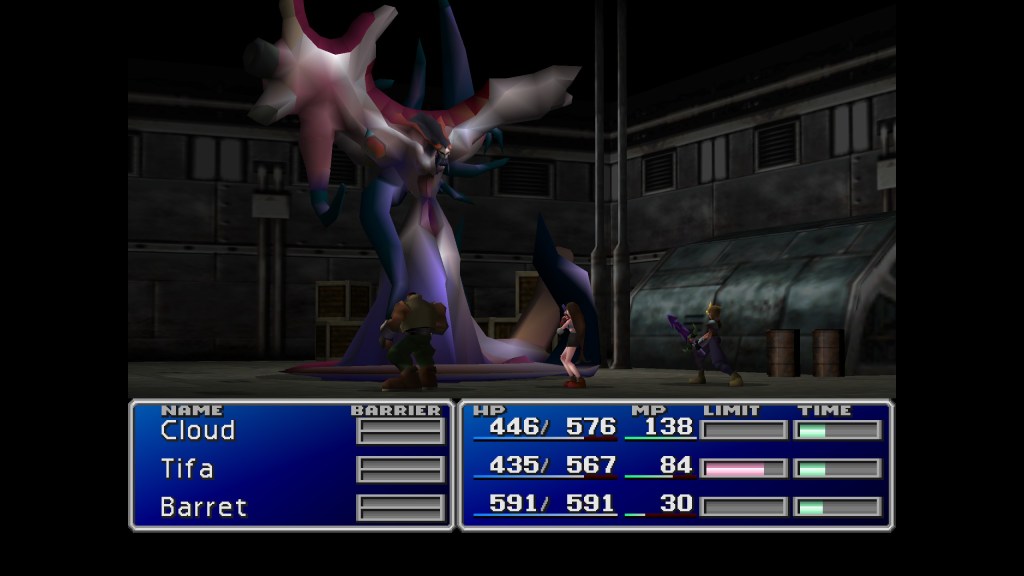
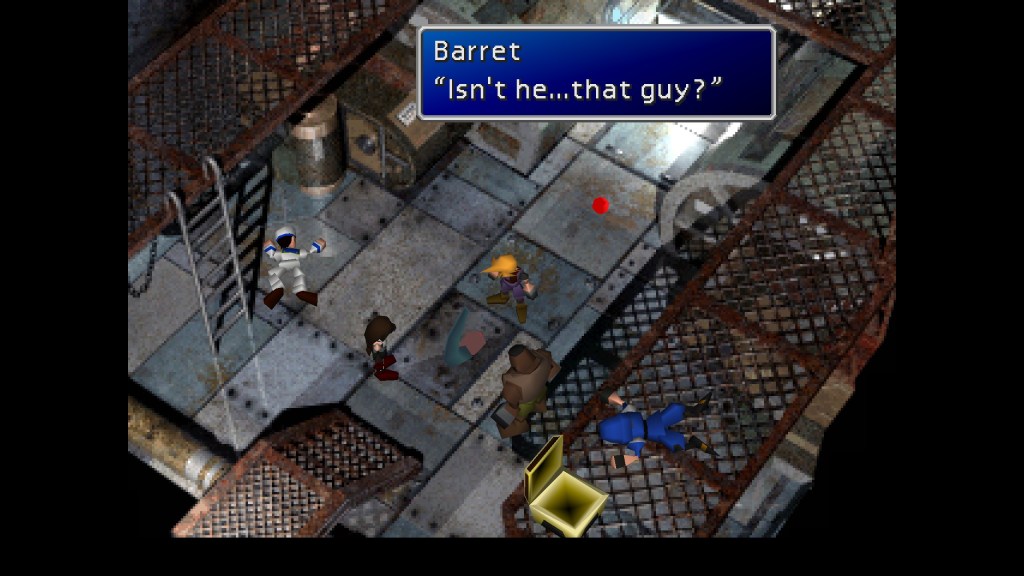
The second one takes place right after Aerith dies. It’s the hardest normal boss in the game in my opinion and if the player doesn’t constantly negate damage with barrier and heal, it’s not going to be an easy go.
I think it’s kind of cruel that the hardest fight in the game is immediately after the title’s biggest moment. You don’t have an opportunity to save beforehand and this was before games would let you skip cutscenes. If you died to Jenova, you had to fight the battle again. For less skilled players, this meant having to relive the death of Aerith over and over again. And it’s not a short scene!
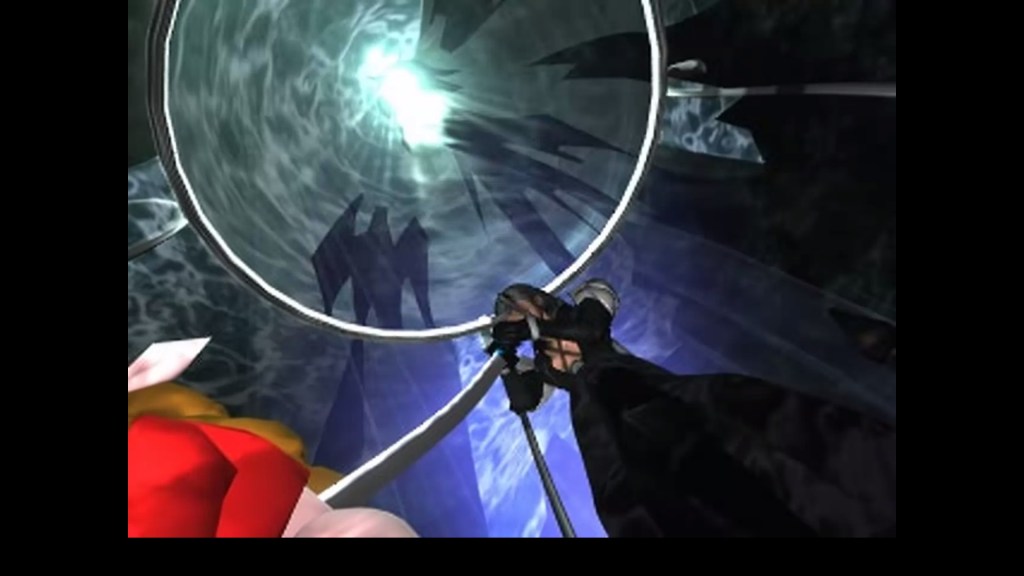
Before the ability to skip cutscenes, this happens a fair deal in the 3D Final Fantasy titles. FFX has a particularly nasty one on Mt. Gagazet before its hardest fight in the game. Its sequel, X-2, lets you skip cutscenes but mysteriously one of the hardest bosses in the game is still placed behind a really long cutscene featuring that game’s protagonist Yuna talking for what feels like an eternity. Well, uh, we’ll talk more about X and X-2 later.
That portion of FF VII has another really difficult boss called Demon’s Gate. If you don’t have barrier, this is an absolutely brutal fight that will ruin your day. I think I struggled against it for hours long ago because I spent a great portion of Rebirth dreading this encounter. And it…was really easy. Well damn. Anyway!
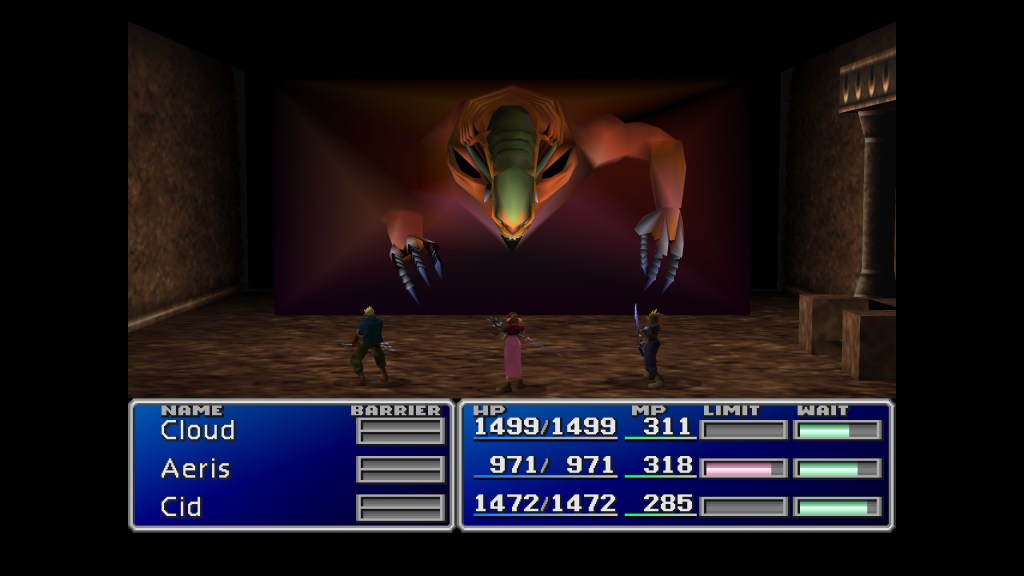
The next two fights are less eventful. The third happens towards the beginning of Disc 2 and acts as a sort of finale for a really long linear sequence. Basically from Aerith’s death to this fight is a straight line reminiscent of the Midgar portion from the start of the game. I don’t know if I have ever lost this one. But hey, shortly after the fight, Sephiroth wakes up and shit hits the fan. So it’s notable!
The final encounter takes place right at the end of your journey as part of a boss gauntlet of sorts. Jenova leads to Bizarro Sephiroth which leads to Safer Sephiroth. Time for a bit of blunt honesty. I can’t remember the last time I fought this battle without using Knights of the Round, the ultimate summon skill in the game. Knights of the Round ends this fight in a single blow. So I can’t remember ever struggling against it. This contest is most notable for having Jenova take on a more humanoid appearance than before.
But yeah, this playthrough saw it die in a single hit. I even forgot to screencap the encounter. Yeesh, how foolish.

How Jenova is treated in Rebirth: Mostly the same. I think they lean into making it more otherworldly and terrifying, but that makes sense with how the character is supposed to be portrayed. We’ll see how Part 3 handles Sephiroth’s awakening. Sephiroth’s stated goals in Rebirth are different than what they are in FF VII so part of me wonders if they will still go with the “Sephiroth spends the first half of the story floating in a crystal up north” thing.
Sephiroth

Finally getting to discuss the man himself. I probably mentioned something about this guy in most of these character entries. He has to be the most fleshed out villain the franchise has had to this point.
Skipping over his first ‘appearance’ in the game during the massacre at Shinra HQ, the player gets their first good look at Sephiroth during the Nibelheim flashback sequence. In it, you get access to Sephiroth as a party member. Cloud too, but ya know, that applies to most of the game. Sephiroth is significantly stronger than anybody in your party is at that point and especially this flashback version of Cloud. This does a good job of portraying his strength through gameplay and not just cutscenes.

I love that they did this for multiple reasons. Not only is it using gameplay to convey something important for the narrative, but it also increases the sense of wonder one might feel when playing. “So the developers made Sephiroth playable at one point, maybe I can recruit him?” Now obviously it’s ludicrous to assume you can talk to the main villain of the game and turn him to your side, but he’s playable! Games had a sense of mystery back then, maybe there’s a secret tale we have to uncover?
You could just hack him into the party with a gameshark though. And Aerith too. Sure things might get glitchy, but ya can! God I miss the Gameshark.
Skipping ahead a little bit to when Sephiroth is in stasis in the northern crater. As he is absorbing the knowledge of the world through the Lifestream, he learns of the Black Materia. The Black Materia allows its user to cast meteor, the ultimate magic in this universe. He manipulates events in order to have Cloud, who has JENOVA cells in his body, to bring him the Materia. Once he has it, he wakes up, which brings about Weapon and a feeling of dread over the world.

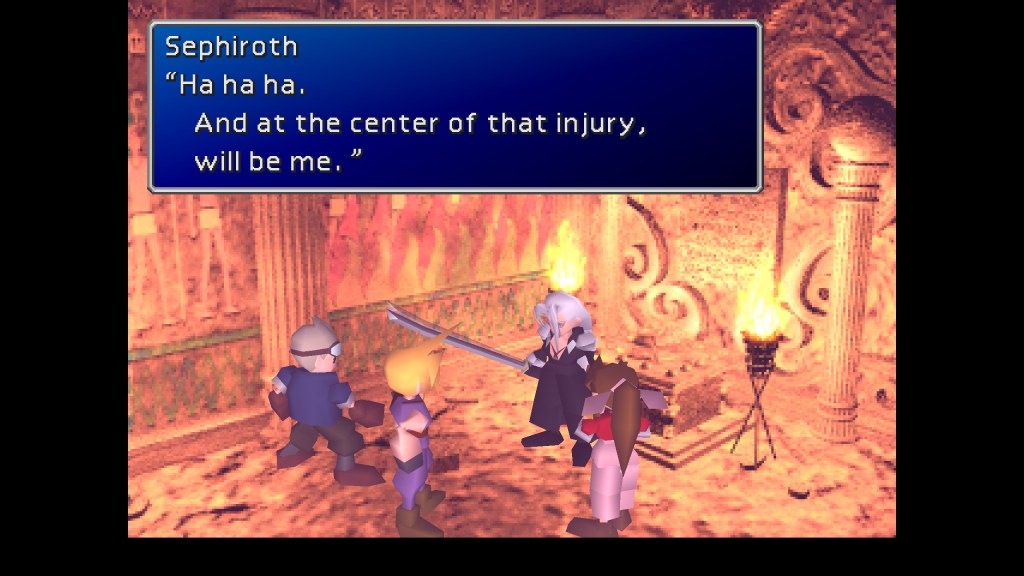

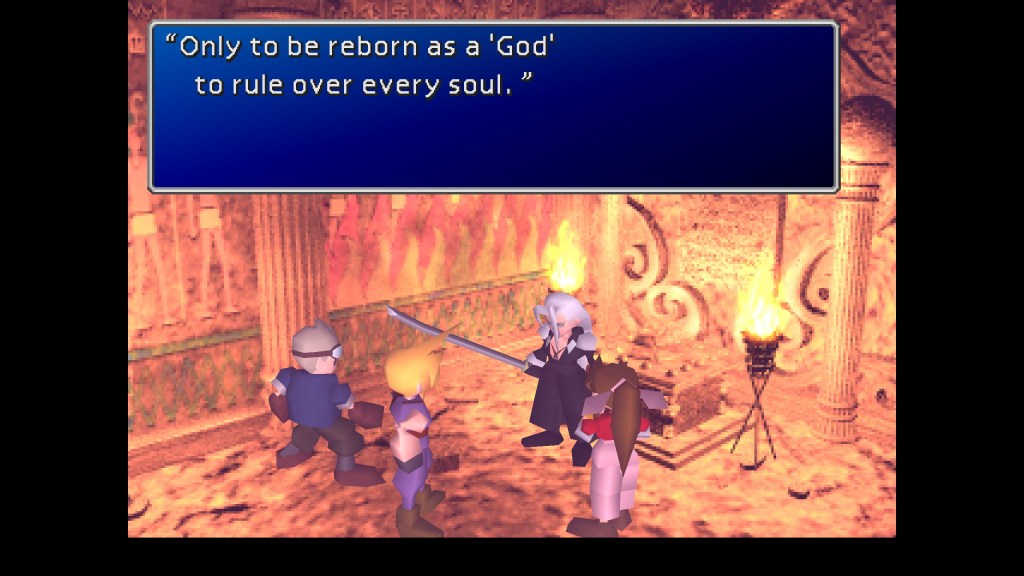
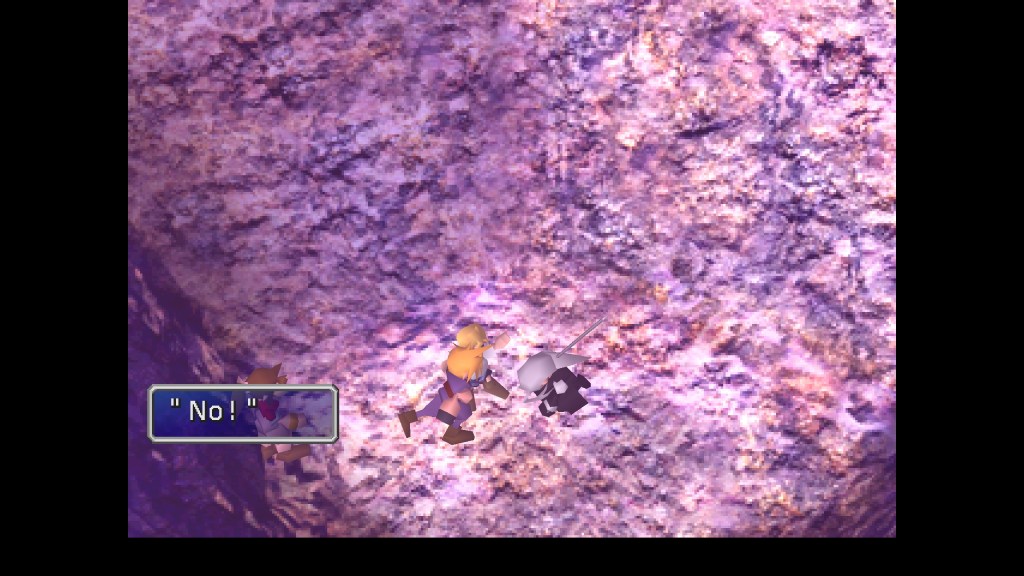
It’s now time to talk about the counter to meteor, holy. Holy is contained in the White Materia and is said to eradicate every single thing deemed ‘harmful’ to the world. It’s an all powerful spell. It will absolutely destroy meteor, but it might destroy other things as well. Such as humanity. The White Materia is carried by Aerith and the scene where ‘Sephiroth’ swoops down to kill her is given a little bit more context. She was there to cast holy. It needed to percolate in the Lifestream before it could come out.
Since Aerith is an actual descendant of the ancients, she has the ability to communicate with the planet and hear the voices of the Lifestream. Since the ‘dead’ Sephiroth is also in there at that point and hatching schemes, she learns of his plans for meteor and sort of foresees what she must do to save her new found friends and the planet itself. When she is praying, she is fully aware that she will die. It’s repainted from being a tragedy to an act of heroism.
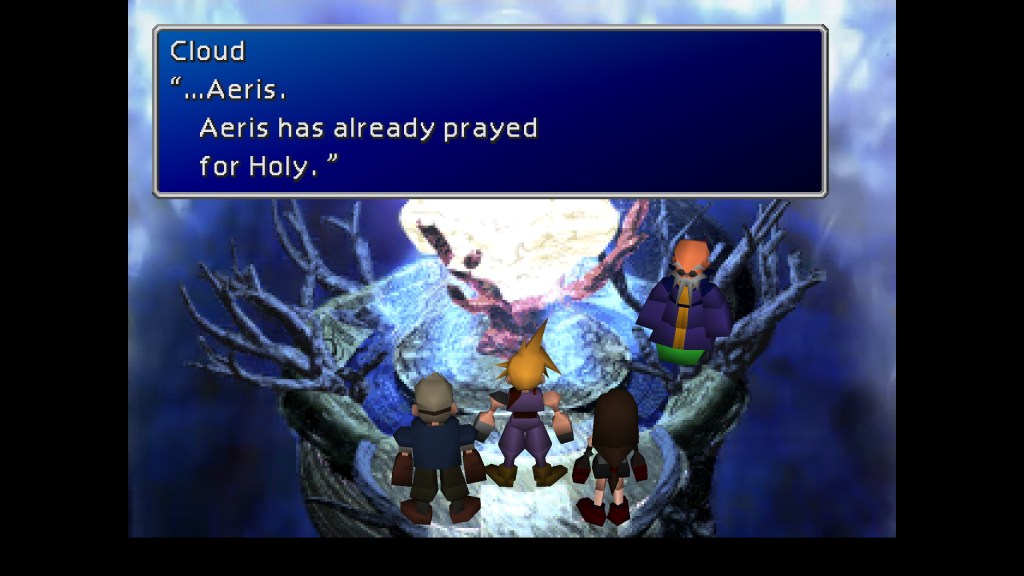
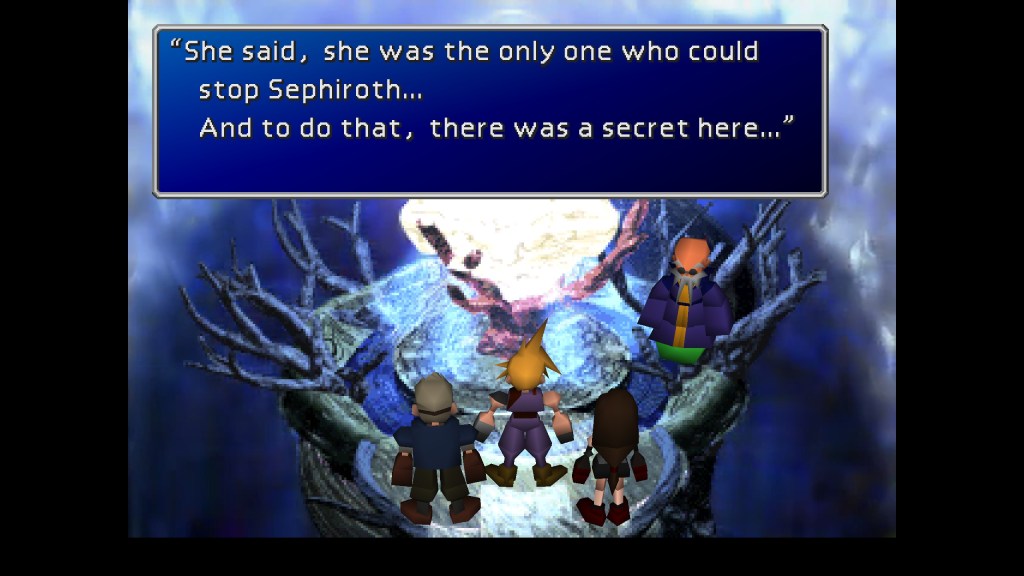
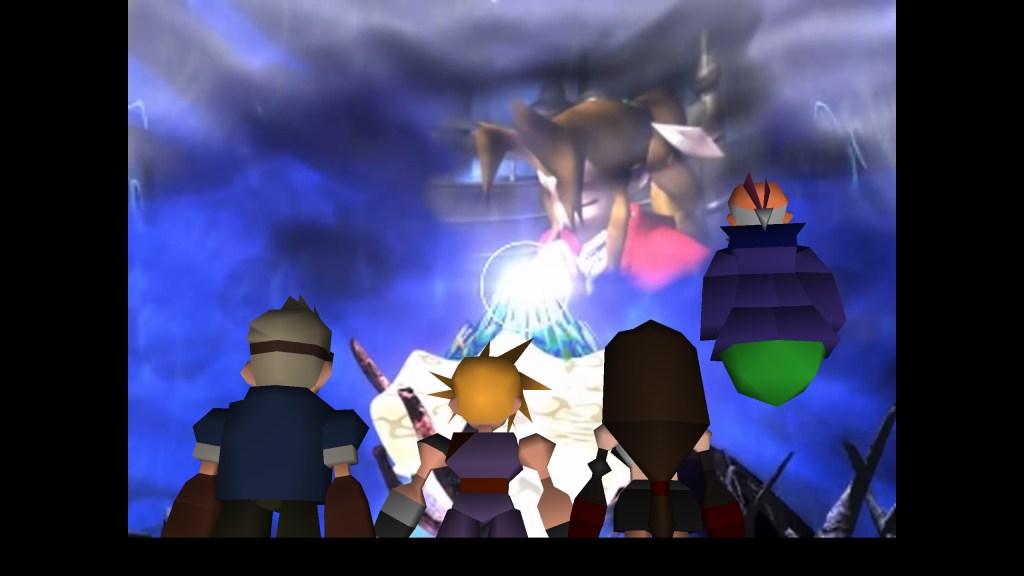
So when Sephiroth revives midway through Disc 2, his existence is holding holy back. That’s the main reason the cast need to do something about Sephiroth. At this point, he is so strong that his presence is putting a halt to holy fully emerging. If Sephiroth wasn’t able to hinder holy, there’d be no reason to do away with him. Holy would simply eliminate all evil in the world.
Sephiroth’s motive has since shifted from what it was before Cloud ‘killed’ him. Then he was under the delusion that his mother Jenova was an ancient. Now he knows she’s some sort of weird powerful otherworldly being, so this knowledge makes him feel he is beyond humanity. He is not one of them, this world is not his…but it should be. So this sets up our showdown. Either Cloud and co. win and holy can do whatever it does or Sephiroth wins and he’s all that’s left.
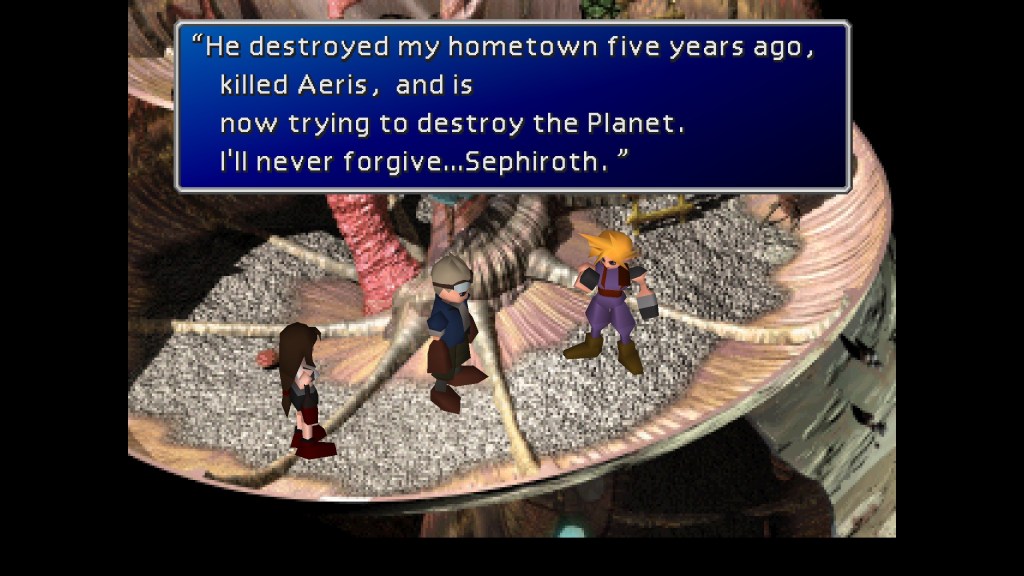
The final boss battle is technically in three phases but really it’s just two. The first one is a form called Bizarro Sephiroth. A menacing form that hits hard. There’s a bit of a gimmick to this battle that calls back to the multiple party members used to defeat Kefka in Final Fantasy VI. Depending on how your final fight with Jenova goes and other elements (such as your party’s average level or whether you got the two secret party members), you can have up to three three-man parties to use.
I don’t think I’ve ever had to engage with the party switching mechanic, but necessitating switching between the two (or three) adds layers of strategy not seen elsewhere in the game. It also makes your whole team feel important. Of course, since I usually nuke Jenova with knights of the round, that issue has never come up.
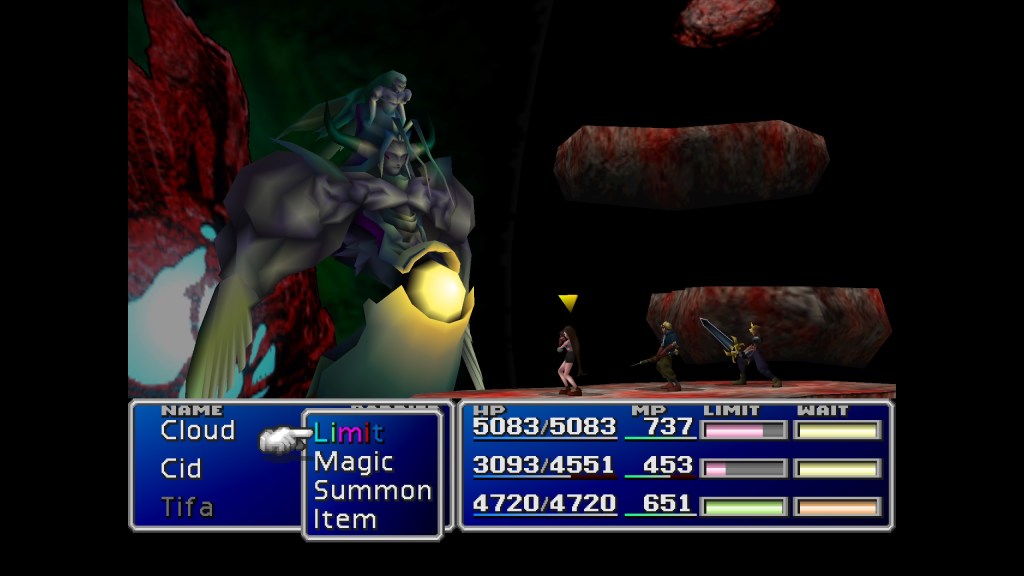
The second phase shows Sephiroth looking like an angel. He casts wall (a spell that lessens magic and physical damage) immediately upon the battle starting which nerfs knights of the round. So if you come out of the gates using the ability and you’re not heinously over-leveled, you probably can’t one-shot the boss. Even miming the move and using it again won’t get it done. It’s a thoughtful counter.
This fight is an endurance battle. If the player is not prepared to deal with status effects or isn’t equipped to heal the entire party at once, it’s probably not going to be a fun time. But if you come in prepared for that, he’s not so bad. It’s a bit of an endurance battle but compared to Kefka from VI and the Cloud of Darkness from III, this is child’s play.
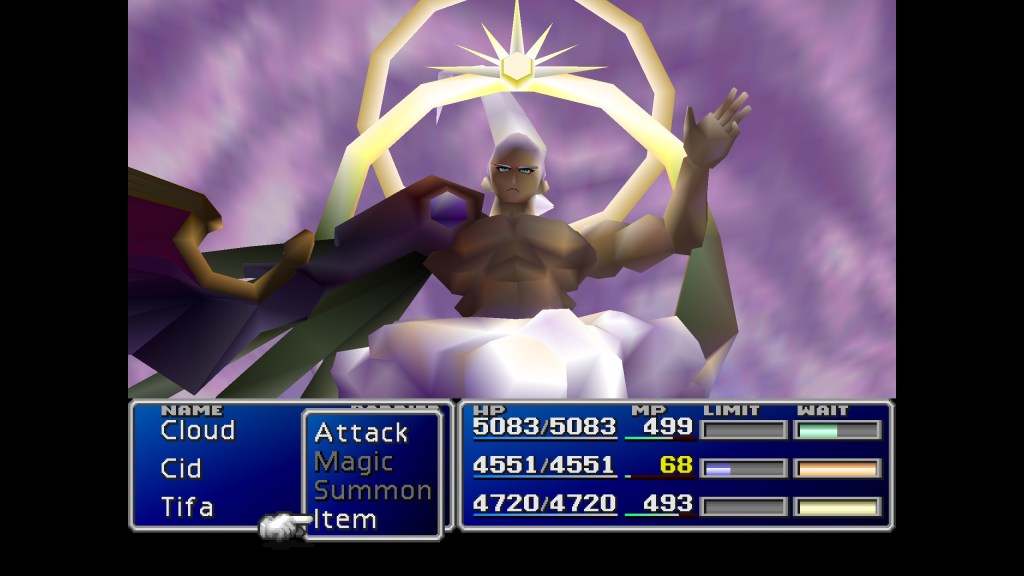
It is imperative to mention the most ridiculous attack in gaming history. Supernova hits the entire party and inflicts a bevy of status effects. You get this a lot, if you’re a veteran of Final Fantasy you know just how damn annoying Malboro fights can be, but what makes this attack unique is how damn long it takes and how over the top the animation is.
Sephiroth summons a meteor (but not THE meteor) and you are treated to scene of it destroying several planets in the solar system. It then slams into the sun, which causes the sun to expand. The sun engulfs Mercury and Venus before it comes to Earth and slowly, slowly creeps behind Sephiroth before it creeps just far enough to hit your party for big damage.
The most extra attack in history. And you get to witness it multiple times during your fight. Pluto is cursed to die many times in order to save our planet. Such is the life of a dwarf planet.



Finally, when it looks like the day is won and everybody is leaving to go see what holy is actually gonna do, Cloud has what appears to be a battle in his mind with Sephiroth. This is a straight forward 1-v-1 encounter and Cloud immediately gets access to his Limit Break, which is the (probably) newly earned Omnislash skill. It’s a series of strikes against your hated rival, it’s very satisfying to use.
This playthrough taught me something about this encounter I never knew. My limit break meter filled but before I could confirm my action, Sephiroth smacked me with what I think was a critical. Cloud got down to around 200 HP. Not a big deal, I can just heal up and then use my limit.
But no. The fight immediately ended, I never got to use Omnislash, and the game acted like I won. I did not know it was impossible to lose this encounter, but I’m guessing if you get down to critical levels the game will just kick you out of the conflict and give you the win. Hey, ya learn something new every day.
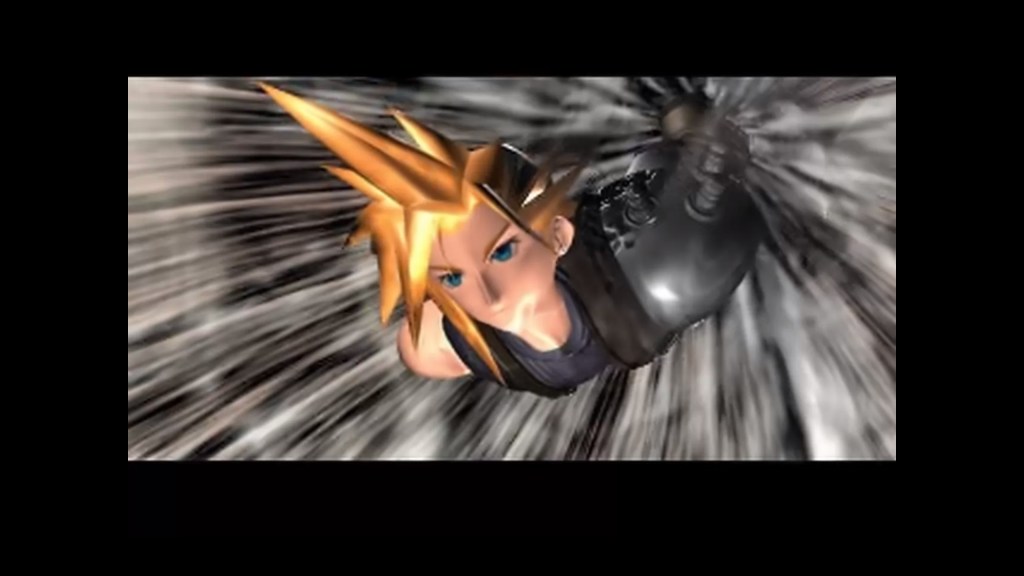

Kinda sad I couldn’t screencap the omnislash against the gray haired wonder, but what can ya do? Go back and do it again? Pffft, I think not!
So let’s talk briefly about the ending. The group escapes the final dungeon and boards the Highwind. It appears that holy has come out too late as it is really struggling to do much against Meteor as it heads straight for Midgar. Suddenly Lifestream flashes up from the ground and you get a brief glimpse of Aerith and then the credits start. That’s it.

There is a postcredit scene. It features Red XIII and what appears to be his children running through nature. They come up on a hill and see the ruined city of Midgar. There are no humans. It’s just nature, the cat-dog things and the ruins of Midgar. This had led to a lot of speculation at the time. Was this saying holy deemed humanity evil and wiped out everything along with Meteor in order to keep nature and the world going?
We got our answer. Nope. Humans lived. Midgar was the only thing destroyed because holy was staggered. Dirge of Cerberus and Advent Children confirm this reality. I’m split on how to feel about this. Though it is a little hacky to say “HUMANS ARE THE BAD GUYS,” I do think it fits in with the themes of environmentalism we see in the game. It suggests that even though Shinra is in tatters, humans will always take advantage of their surroundings and kill the planet to further themselves.
I also like ambiguous endings. I don’t always love being told exactly what happens, I like to come up with a conclusion on my own.
However, I do like that this world and these characters got to be revisited. I love this cast, so getting to spend a bit more time with them isn’t the end of the world. I need to revisit Advent Children and Crisis Core, so I can’t tell you if the writing is handled poorly right now, but I can at least say I am interested to see where things go.
I imagine part three of the remake trilogy will alter the ending a bit to make it less ambiguous. I don’t even know if Red and his children staring out into the void is considered canon anymore. How did Red procreate anyway? Did Hojo……no, no, best not speculate.
How the remakes handle Sephiroth: He’s all over the place and as big of a threat as ever. It’s hard to say how he will truly be handled until the ‘waking up’ event occurs in the third game. That said, Weapon already plays into Rebirth, so there’s a chance that the figure running around and fucking things up for everyone actually is Sephiroth. It’s too early to tell.
I can say that I think the Nibelheim flashback scene that lets you control the bad guy himself is really well done. I don’t think he’s quite as overpowered there as he is in the original release, but he’s still noticeably stronger than Cloud and he’s fun to play as. I think they absolutely nail the destruction of Nibelheim. Can’t say the same for what they do with the city once your party returns to it, though.
It started here
3D graphics and non-console exclusivity

Mentioned in detail above, but felt the need to touch on it here too. The presentation of the Final Fantasy franchise radically changes here. While it looks simplistic with a modern eye, it really felt like technical wizardry at the time. So it’s impressive to say that Final Fantasy VIII took what Final Fantasy VII does here and absolutely runs with it. FF VII looks like a last gen game when compared to VIII. But this is the title where Final Fantasy became the “pretty graffix’ franchise.
Honestly, I think VIII coming out and immediately making VII look dated is a big part of why people have clamored for a FF VII remake over the years. I remember reading a rumor in Electronic Gaming Monthly that stated VII, VIII and IX were being remade for the PS2 and I was so excited to see that play out. I think part of that rumor was just preying on people who desperately wanted VII to look like the newer titles. VII with the graphics of X? Best game of all time, no doubt.
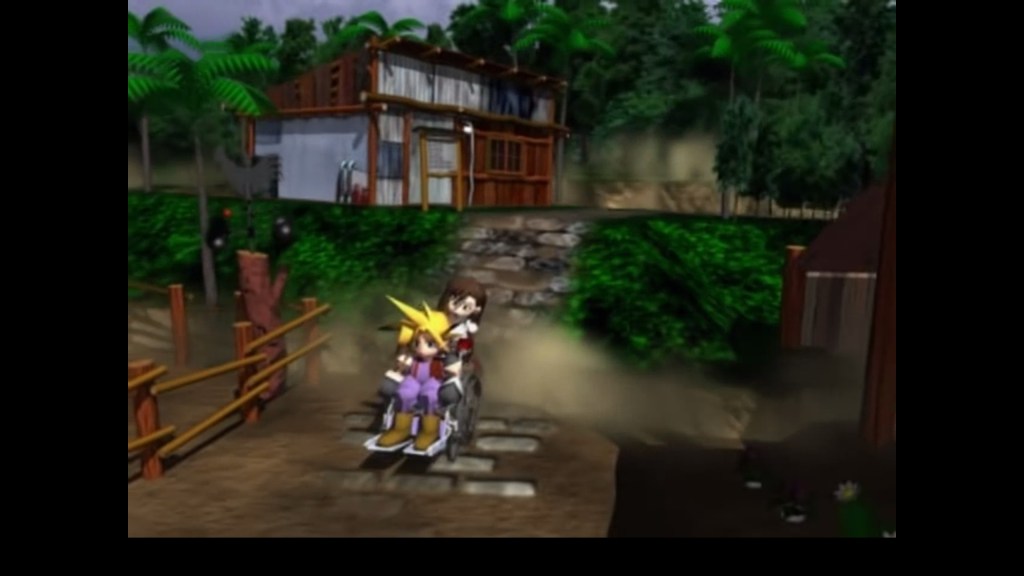
As for the non console exclusivity thing, FF VII was released in 1998 on PC. VIII would also see a PC release and it featured the only way to play a Pocket Station exclusive mini game in America. Final Fantasy XIII would release on two consoles simultaneously, which ended console exclusivity for good…or so we thought until FFXVI released as a PS5 exclusive. Hey man, sometimes the Sony bucks pay real nice.
Regional differences
While differences between versions were present with the NES and SNES titles, typically censorship, the U.S. version of Final Fantasy VII contained a few notable content differences. Most of the stuff changed feels akin to a modern day patch, such as changing of the balance to minigames, but they also add entirely new content.
This version of the game adds the previously mentioned Zack hidden cutscene as well as the scene where Tifa encounters Cloud in Midgar during his mnetal break. It also adds exclusive bosses. Most notably the super bosses Ruby and Emerald Weapons. Diamond Weapon is also made into an actual boss encounter, which was not the case with the original version of the game. The team added this content to VII to compensate for the extra time required to localize it.
A release of this version came out in Japan as Final Fantasy VII: International. Several games in the franchise would see a second version release after this, typically with the International branding. This theme even made it over to Kingdom Hearts with the “Final Mix” titles. Think of this as the equivalent to the modern day “game of the year” editions.
Expansive mini-game and side content
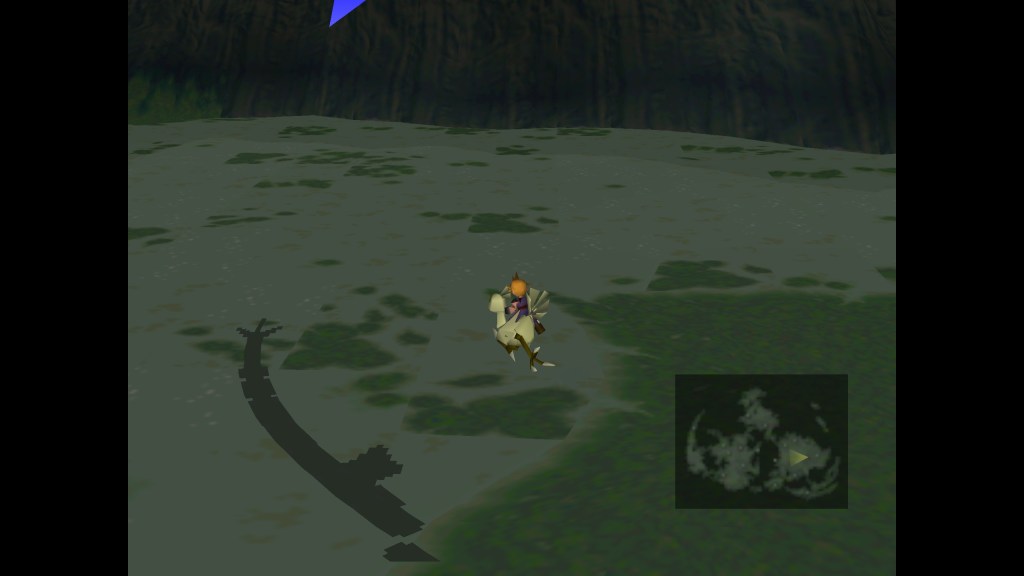
Final Fantasy VII isn’t the first entry in the franchise to have minigames. The original title had a hidden game where you had to complete a slide puzzle to put numbers in order. How riveting. But VII is the first game in the franchise to have what I will refer to as an expansive minigame that you’re meant to interact with throughout your adventure. They give you fantastic in-game rewards that can help you defeat even the hardest bosses your adventure has to offer. Think blitzball in FF X, chocobo hot and cold in FF IX or the card game in FF VIII.
Final Fantasy VII brings us Chocobo breeding. You are introduced to the practice of capturing Chocobos near the beginning of the game and during Disc 2 when you have access to the air ship, the mini game opens up quite a bit. You can catch Chocobos and breed them to create baby chocobos. While this may feel pointless to an uninformed player, breeding allows access to mounts that are able to traverse areas that are inaccessible otherwise.
The main hint for this is hidden away deep in the mountains at the Chocobo sage’s house. Nothing in the game points this location out for you, but if you’re exploring and see a weird out-of-place house in the middle of nowhere…well, there’s your ticket. The Sage has a mountain (green) chocobo. I would consider the black chocobo you encounter during Chocobo races as a hint for this too, but every chocobo in that race has fancy colors so it would probably get brushed off by the player.

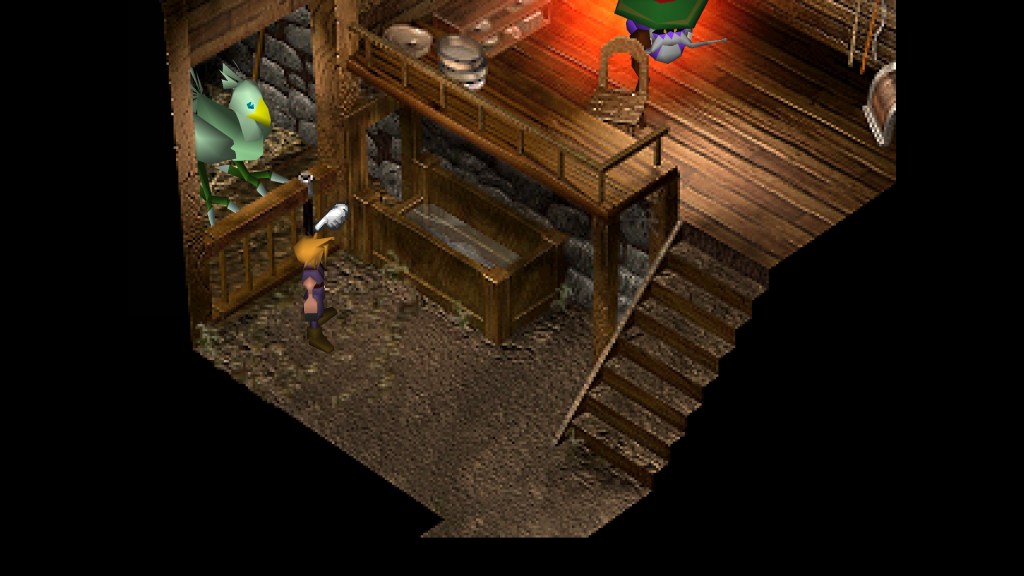
There are four specialty chocobos. River (blue) which can traverse over shallow bodies of water, Mountain (green) which does exactly what it sounds like, Black which combines the two and gold which can travel over everything in the game including gigantic bodies of water. The rewards for doing this are some of the best Materia you can find, which are located in parts of the world where your airship can’t land.
You get access to Mime, which is a bit of a cameo appearance for the ultimate job from Final Fantasy V. Quadra Magic, which allows you to cast any magic paired with it four times in a row. This includes summon magic…mostly. HP<->MP which allows your characters to swap their HP and MP. You want 9,999 MP? That’s your ticket.
Finally, the ultimate Materia you get when you acquire a gold chocobo, is Knights of the Round. As I mentioned above, it can one-shot the final Jenova encounter. Once you gain this Materia, even if you don’t level it up at all, you’ve basically beaten the game. Nothing the main story can throw at you is going to put up much of a fight. Yeah, Sephiroth can tank it since he casts Wall as soon as the fight begins, but you can just use Mime to immediately cast it again. Does that not finish the fight? Well, you can either do it again or heal up and do the rest of the battle. He likely doesn’t have health left.
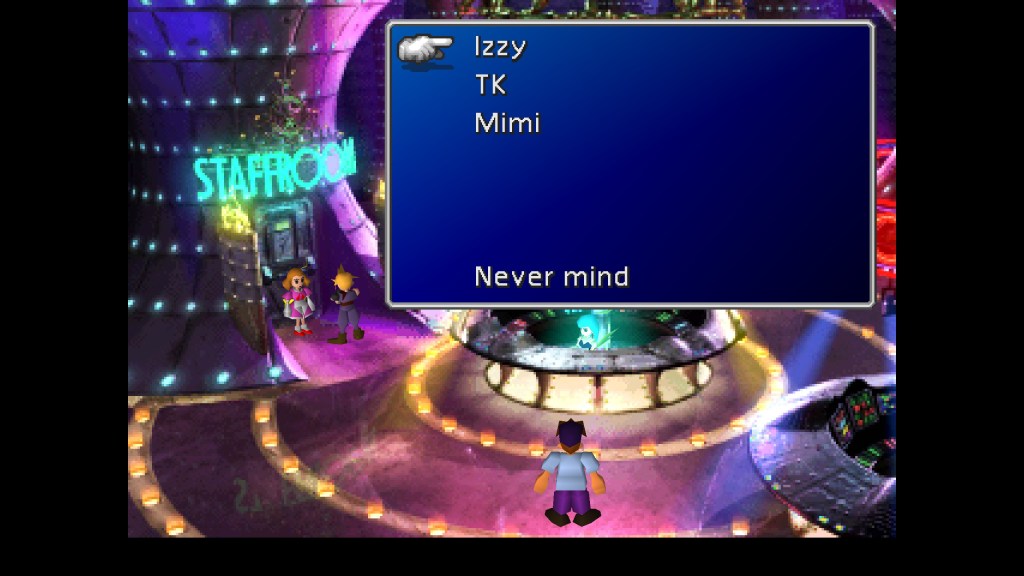
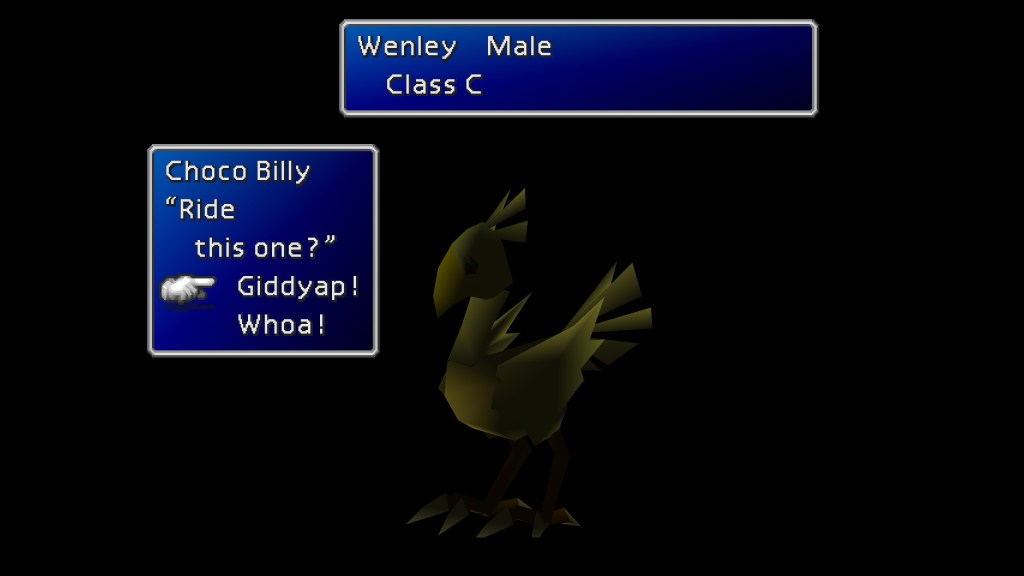


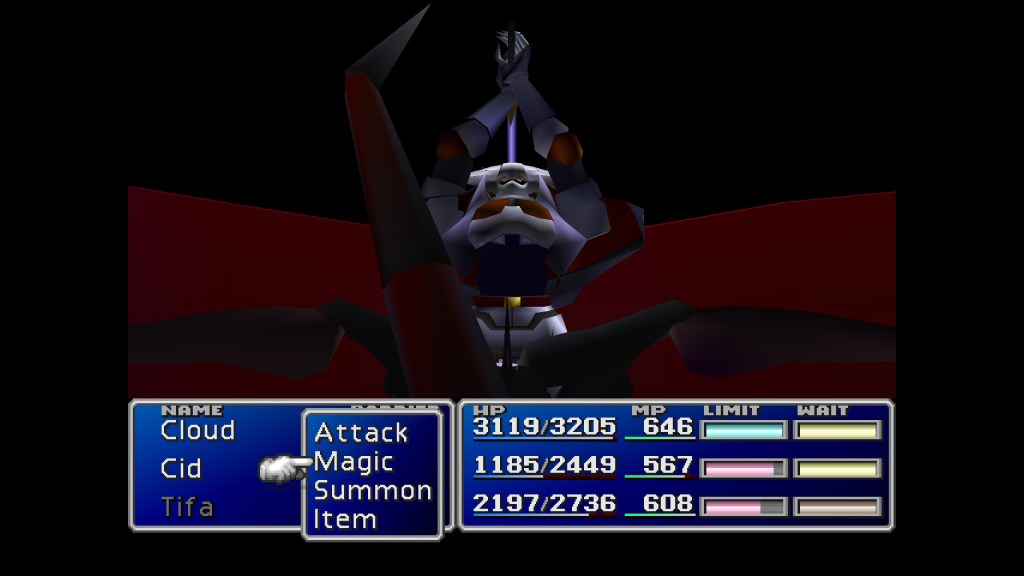
The rewards for chocobo breeding are so insanely good that it sort of tells the player to pay extra close attention to these big vast minigames in future entries. The card game in FF VIII rewards players who take this to heart by letting you break the game as soon as Disc 1 if you’re good enough. Since the games were going to get more expansive from here on out, it was imperative to make the rewards for toiling away in the chocobo mines worth it.
In conclusion
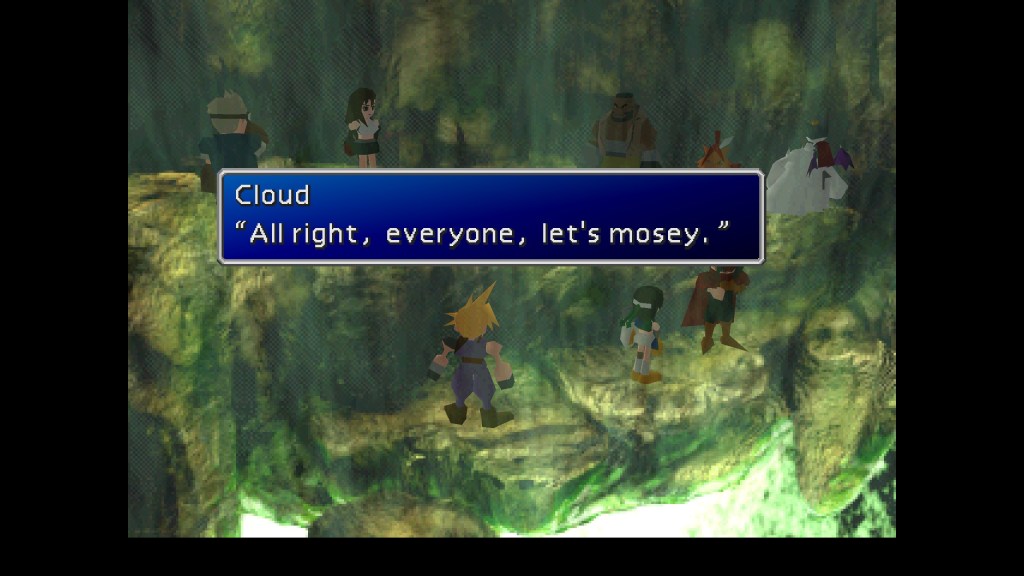
Final Fantasy VII is an incredibly important video game. Age has it looking a little worse for wear and the combat isn’t necessarily as engaging as a couple of the previous entries, but I feel that the total package holds up exceptionally well and should be played by anybody with a passing interest in the franchise. I also think in order to grab the most enjoyment out of the remakes, it’s important to have the original game as context.
It may not be your favorite Final Fantasy title, but hopefully you can appreciate what it meant at the time it released.
My score: 5/5

Wow, a third 5/5 in a row. I feel bad for whatever game breaks this streak.
Up next
Final Fantasy VIII: The Most Realistic Depiction of Teenage Romance in Fiction.
But actually, before I write about that…
Final Fantasy Tactics: Performance Evaluation
Previous: Final Fantasy VI: A Grand Finale
 Vidya Thoughts
Leave a comment