
When hearing people talk about the first few Kingdom Hearts games, there is often a feeling of annoyance that they need to play Chain of Memories in order to fully understand and appreciate Kingdom Hearts 2. I’ve seen a lot of people suggest looking up Youtube videos of Chain of Memories runs as a sort of replacement for experiencing the story.
This is baffling to me. Chain of Memories is not some black sheep game that ruins the reputation of the franchise. You want a game that actively hurts a franchise by existing? Go look up Lunar Dragon Song and then cry yourself to sleep because you just looked up footage of Lunar Dragon Song.
For reference, Chain of Memories is the true ‘second’ Kingdom Hearts title despite lacking the number 2. It bridges the gap between the closing moments of the original game and the opening bits of Kingdom Hearts 2. It’s an important piece to the franchise’s narrative. For a lot of people, the story of 2 is confusing because they skipped over Chain of Memories. This is an important game a lot of people like to downplay the importance of.
I would like to blame the PS2 remake of Chain of Memories, RE:Chain of Memories, for this perception because it took a 2D game and converted it to 3D without thinking too much about it beyond the presentation. It doesn’t help that this is the most easily accessible version of the game, considering it has been ported several times as part of the Kingdom Hearts 1.5 HD collection. If we’re just talking about that game, yeah, it does feel like kind of a slog. But it’s not the end of the story, it should not be the only version of the game people remember or talk about. The original version, released on the Gameboy Advance, should receive some love.
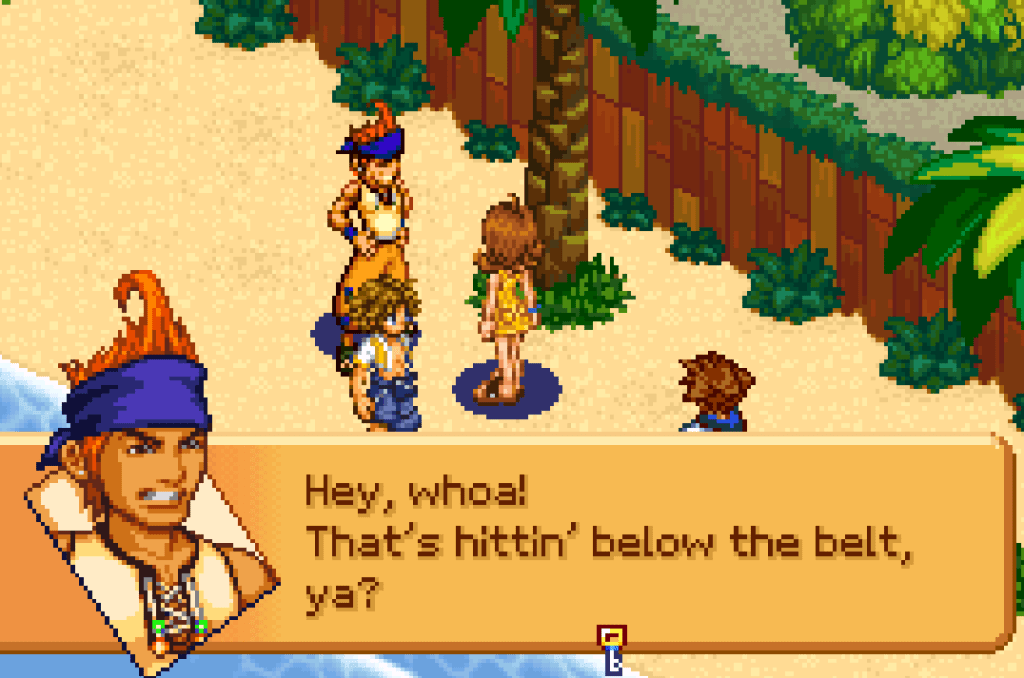
For those unfamiliar, the gameplay of Chain of Memories is a bit of a departure from the original Kingdom Hearts. This is likely due to system limitations. It would be really hard to make a game that plays like Kingdom Hearts on a system with two face buttons and graphical fidelity closer to a SNES than a Playstation 2. Your skill set is completely tied to a deck of cards. You can’t just swing a keyblade, you have to have a keyblade card. Cards come numbered 0-9 with higher number cards cancelling out lower number cards – though the number 0 cancels out everything. So if Sora uses a card with a number of 6 and an enemy uses a card with a number of 7, Sora’s attack will be cancelled out and the enemy’s attack will take priority.
You also have a card point system for deck building. All of your cards are given point values related to how strong they are. So let’s say your card point system cap is 100 – you need to make a deck to fight that works within those constraints. So you have to ask yourself such questions like “Would I rather have a few hard hitting cards? Or do I want more attack options that might be a bit weaker and easier to break?” You also have to think about magic and item cards, so just blindly slapping together a deck full of a bunch of cards with the number “9” on them probably won’t get you very far. You need to think.
As you level up, your card points increase and you can build larger decks. You can also learn special moves that involve combining cards in order to use special attacks, or sleights. So deck building evolves from being “do I want fewer strong cards or more weak cards?” to “how can I make a balanced deck that lets me hit hard and use all these techniques I have?” It leads to a surprising amount of strategy in combat, particularly in boss battles. What if a boss uses a lot of sleights against you? Combining cards will give you a large number, naturally, so the natural counter to that would be to use a lot of cards with a value of 0. Remember, cards with 0 cancel everything out. So on an initial playthrough, a lot of boss fights will involve studying how your opponent uses cards and finding a strategy that works against how they act.
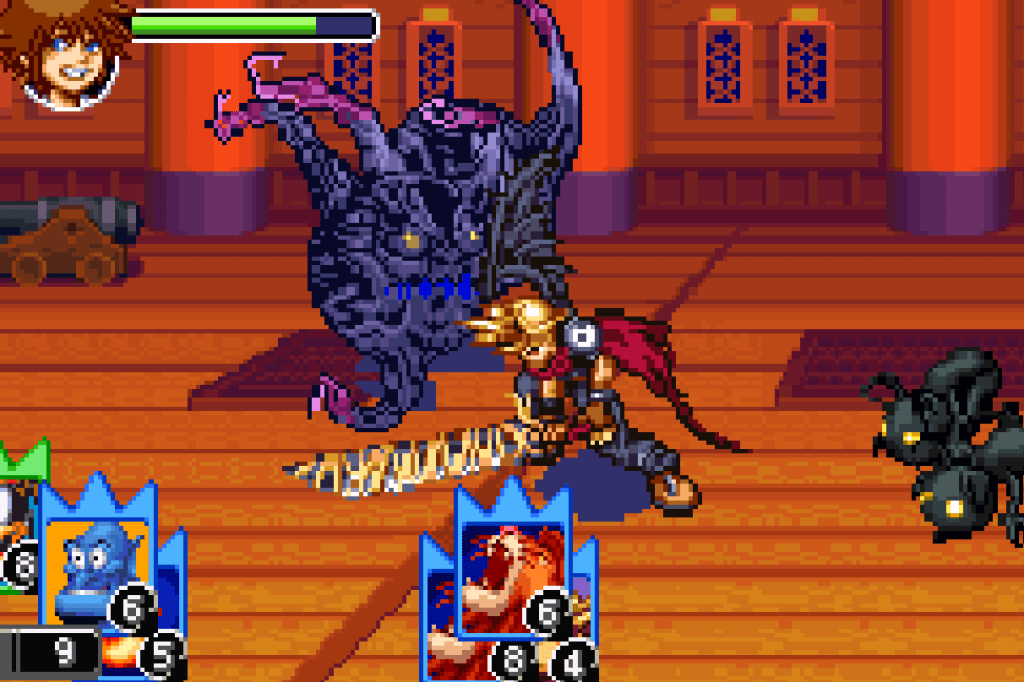
Using sleights yourself makes you lose the first card you sacrifice for that combination, so you have to build your decks with that limitation in mind. You have a spell called super flare that involves using the summon Mushu and two fire cards. When you use it, you will always lose a Mushu card. So do you want to be able to use super flare multiple times and carry multiple Mushus (expensive cards that can take over 30 card points to assign to your deck)? Or would you rather find alternate abilities to use? It’s a deep and confusing sounding system, but once you actually get your hands on it, it makes sense and I would compare it to a more traditional deck building game like the Pokemon Trading Card Game. You just have to think a little.
I mentioned boss battles briefly and what makes them so interesting in this game is that the bosses have the same restrictions you do. When they use sleights, they lose a card. They have to reload their decks when they run out of cards. They can counter you just like you can counter them. It feels like a duel against another person instead of a fight against a computer opponent that has advantages not available to the player.
When you finish the game, you unlock a mode where you play through the game again as Riku. Instead of just being the same deck building experience, it’s something else entirely – you cannot edit your deck at all. It’s an exercise on how well you can adapt to fights with a premade deck. There are some levels where you have like six cards to work with and you have to figure it out for yourself – the mechanic can almost make certain fights feel like puzzles. You can legitimately run out of attack options if you use too many sleights, so you have to really think about what you do. It’s an interesting twist from the standard formula and I actually find it preferable to the main mode of play because it’s a test of your ability to adapt.
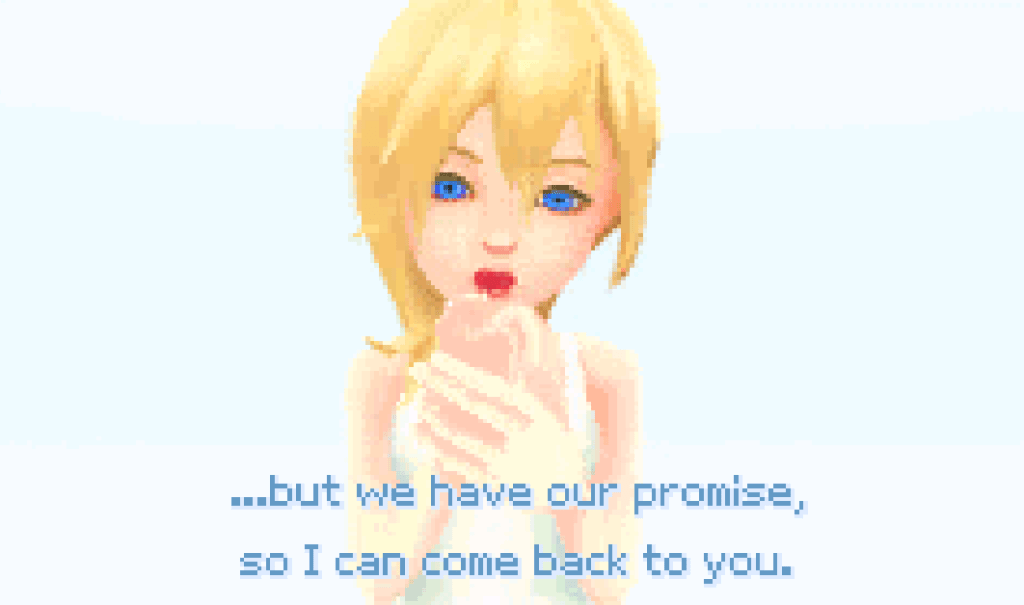
Now it’s time to activate my inner crotchety old man. Part of the appeal of SquareSoft/Square Enix games on the PS2 was how cutting edge they looked for their platform. When you got to a cutscene in Final Fantasy X it legitimately felt like you were living in the far flung future. In modern times, cutscenes kinda just look like normal gameplay scenes most of the time, so they don’t feel as special. If you can believe it, they were able to replicate this feeling on the GameBoy Advance.
Square included a couple of prerendered cutscenes into the mix that play at certain times. Yes, what shows up is nowhere near as visually impressive as what you would get on a PS2, but on a smaller screen it looked close enough and it felt like sorcery seeing your little GBA screen pull off what appeared to be PS2-caliber graphics. Yeah, it’s a trick because the Gameboy Advance isn’t actually rendering this stuff and it’s just a little compressed video, but this trickery went a long way and totally blew my mind. Also, the full version of Simple and Clean plays over the end credits. No midi junk, it feels like the same thing. It’s hard to express this to people who weren’t there to experience it, but the experience on a handheld felt magical.
This is just lost in the transition to 3D. Everything looks the same kind of good. It’s not some magical little game from the future, it’s just a budget PS2 game designed to explain to people just who the hell Namine is.
Now something that isn’t console dependent is the game’s story. You would think that the weird handheld game released on a different console than the main series would have a throw away filler story that wasn’t important to the overall plot of the franchise but you would be dead wrong. Chain of Memories started the tradition of “if we release a game, it matters.” It persists to this day because there are scenes in Kingdom Hearts 3 that don’t make much sense unless you’ve spent time with the mobile games. It can be kind of annoying if you don’t like the type of game you’re supposed to play, but I think it tells the player that ‘nothing we put out is half baked, it all means something.’ Nothing feels like filler, even though it very easily could.
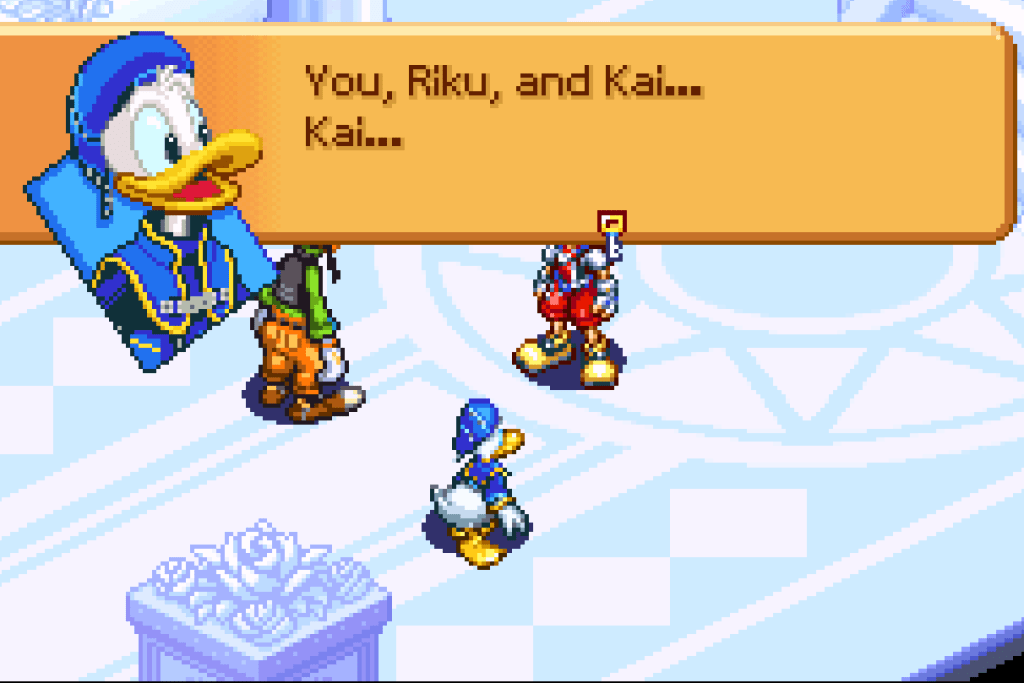
I think the story told is really interesting and the way it details Sora slowly losing his memories is fairly well done. At some point Sora just stops talking about Kairi and all mentions of her are replaced by Namine to the point that he becomes obsessed. It starts out really slowly but eventually Sora’s dialogue becomes extremely focused on this character the player had never heard of before. It’s just a really interesting bit of characterization. Also, it explains why the hell he is in some alien pod at the start of Kingdom Hearts 2.
It also does a very good job of characterizing the members of Organization XIII that appear here. In Kingdom Hearts 2, I don’t feel like the highlighted organization members get that much time to unveil their personalities. There’s a little of it, but what can you tell me about Demyx’s actual personality beyond DANCE WATER DANCE? In Chain of Memories, I feel like Larxene, Vexen, Marluxia and Axel all get developed quite well. They feel like real characters, to the point that before the organization members were expanded on in later games, I preferred the CoM characters because they all seemed really interesting. I was sad Larxene wasn’t in II because she was a lot more interesting than Xigbar (please note these are the early days of the franchise) or Demyx or Luxord.
Truth be told though, the Sora portion of this story is easy enough to understand via context clues, but the Riku part of the story is very crucial to his character. It’s an interesting look into how he views darkness as a necessity and not as an evil – it makes his struggles with darkness in 2 a little more interesting. I think CoM fleshes out Riku considerably and turns him into the most interesting character in the franchise. He isn’t pure of heart like Sora, he isn’t some warrior of darkness either. He’s somewhere in between and this game does a good job of portraying him as such. Skipping this game means missing out on the best character work for the best character in the franchise.
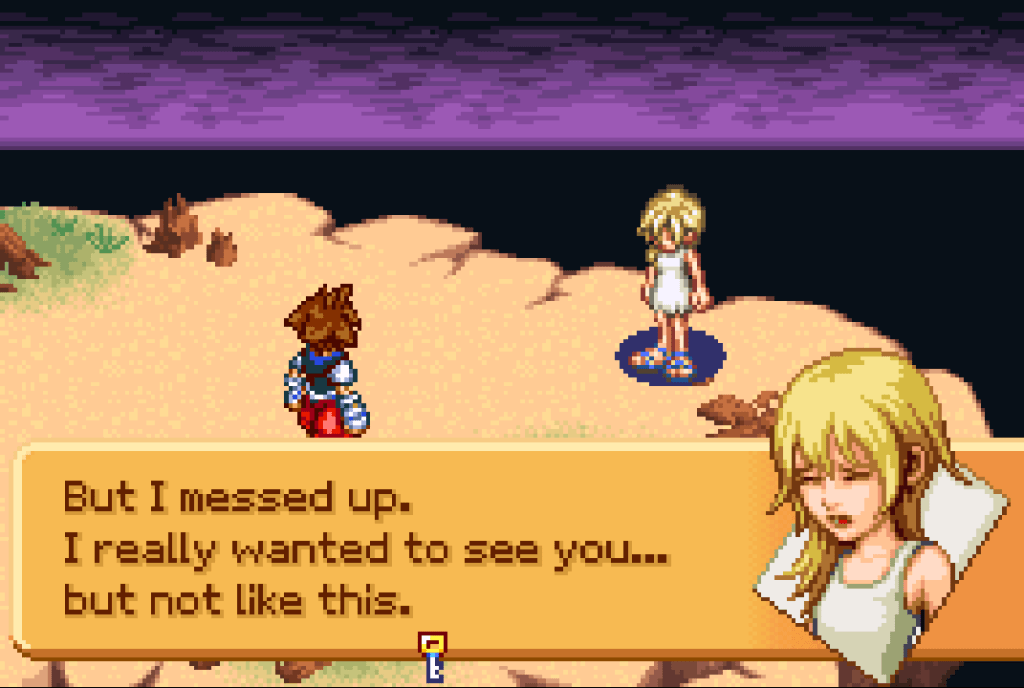
Now, I’m not going to tell you everything about this game is perfect. The ‘Disney’ stories in each level are totally nothing. They are generally complete retreads of what happens in Kingdom Hearts 1 and given that you visit some of these levels again in Kingdom Hearts 2, it can get real aggravating seeing the story beats for something like Atlantica play out again. I also feel that some of the levels later on really drag out. It’s especially painful in the PS2 version because of how much longer it takes to navigate rooms, but even in the GBA version later levels are really long and can feel a bit like padding. Mid game level length feels appropriate but by the end I kept tapping my foot waiting to move things along.
I also very much despise the Hundred Acre Wood level here. It’s a boring chore of guiding Pooh through a straight line. I already don’t like the Hundred Acre Woods levels in the main game and I find GBA CoM’s take on it even worse. Seriously if I could hire someone to do Hundred Acre Woods segment for me in Kingdom Hearts games, I would. I think 3 had the right of it by making the world like 10 minutes long.
But don’t let these flaws stop you. I think the lack of love for Chain of Memories comes from the version most people are exposed to – the PS2 version. Give the GBA game a chance, put yourself in the mind frame of someone playing a handheld console from that era and see how you feel. At the very least, you might be able to appreciate what it was going for a little more. Hell, you might even be like me and consider it a diamond in the rough.
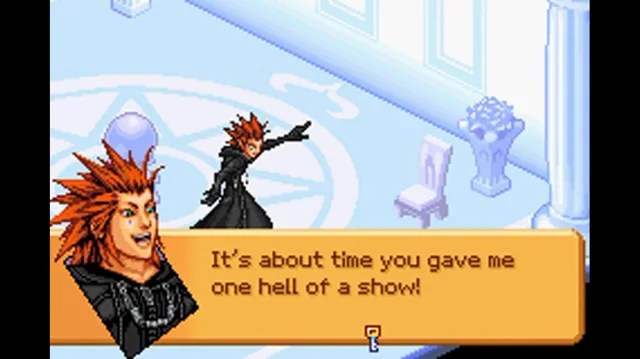
Oh also Axel says hell in this one, which makes it the most adult and therefore best Kingdom Hearts game. Duh. And did you know that Axel’s catchphrase of ‘got it memorized’ wasn’t fully figured out yet and he says ‘commit it to memory’ here instead? Well I just think that’s neat.
 Vidya Thoughts
Leave a comment